Published on : 18 Mar 2026
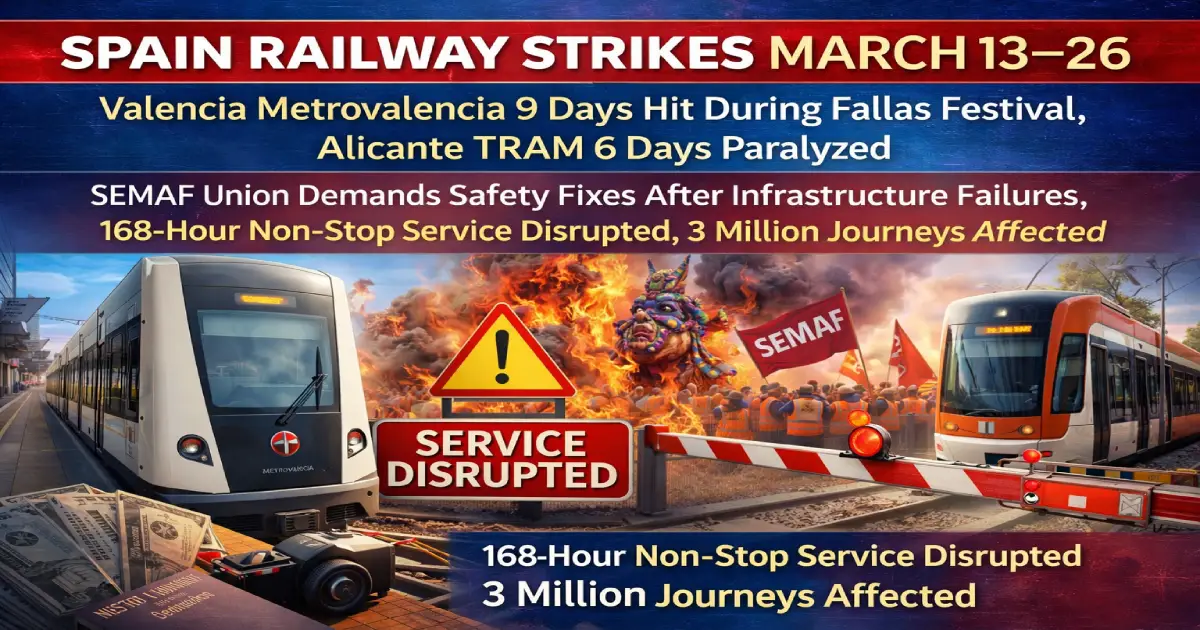
Breaking: Spain’s Valencia and Alicante regional rail systems face 14-day disruption (March 13-26, 2026) as SEMAF union (Spanish Union of Railway Drivers and Assistants) launches partial strikes at Ferrocarrils de la Generalitat Valenciana (FGV)—Metrovalencia struck 9 days (March 13-19, 24, 26) during Fallas festival peak, TRAM d’Alacant struck 6 days (March 13, 16, 18, 20, 24, 26)—with drivers walking out in three daily time slots (7-10 AM, 1-4 PM, 7-9 PM) demanding urgent safety fixes after exhausting negotiations over deteriorating infrastructure (temporary speed restrictions, faulty interlockings, obsolete equipment), inadequate lighting, rundown rolling stock, and “stone-age operational methods” that normalize risks following October 2024 DANA flood damage, threatening Valencia’s planned 168-hour non-stop Fallas service (March 13-20) expected to carry 3 million passengers. Here’s what every Spain traveler needs to know now.
Published: March 13, 2026 (Friday) — STRIKE BEGINS TODAY Strike Duration: March 13-26, 2026 (14-day period) Union: SEMAF (Sindicato Español de Maquinistas y Ayudantes Ferroviarios) Employer: Ferrocarrils de la Generalitat Valenciana (FGV) Services Affected: Metrovalencia (Valencia) + TRAM d’Alacant (Alicante) Valencia strike days: March 13, 14, 15, 16, 17, 18, 19, 24, 26 (9 days) Alicante strike days: March 13, 16, 18, 20, 24, 26 (6 days) Strike hours (all days): 07:00-10:00, 13:00-16:00, 19:00-21:00 (9 hours/day!) Root Cause: Safety crisis (deteriorating infrastructure, inadequate training, post-DANA flood failures)
Friday, March 13, 2026 marks Day 1 of a 14-day partial strike as SEMAF union drivers at Ferrocarrils de la Generalitat Valenciana (FGV) launch coordinated walkouts across Metrovalencia (Valencia’s metro/tram system, 9 strike days) and TRAM d’Alacant (Alicante’s tram network, 6 strike days), implementing three daily time slots (7-10 AM, 1-4 PM, 7-9 PM = 9 hours/day shutdowns) during Valencia’s Fallas festival (March 13-19 = busiest week of year, 3 million expected journeys!) after union claims FGV management operates with “stone-age methods,” normalizes safety failures (temporary speed restrictions, faulty interlockings, obsolete equipment, inadequate lighting), and failed to properly train staff on new systems installed after October 2024 DANA flood devastation, creating “highly dangerous” conditions for drivers and passengers.
Spain Railway Strikes (March 13-26):
✈️ Duration: 14-day period (March 13-26) ✈️ Union: SEMAF (Spanish Union of Railway Drivers and Assistants) ✈️ Employer: FGV (Ferrocarrils de la Generalitat Valenciana) ✈️ Services: Metrovalencia (Valencia) + TRAM d’Alacant (Alicante)
Valencia Metrovalencia Strike:
✈️ Strike days: March 13, 14, 15, 16, 17, 18, 19, 24, 26 (9 days TOTAL) ✈️ March 13 hours: 11:00-15:00, 21:00-23:59 (different schedule Day 1!) ✈️ March 14-19, 24, 26 hours: 07:00-10:00, 13:00-16:00, 19:00-21:00 (3 time slots) ✈️ Total shutdown hours/day: ~9 hours (covers peak commute + midday!) ✈️ Fallas festival impact: March 13-19 = HIGHEST passenger volume week of year!
Alicante TRAM d’Alacant Strike:
✈️ Strike days: March 13, 16, 18, 20, 24, 26 (6 days TOTAL) ✈️ Strike hours (all days): 07:00-10:00, 13:00-16:00, 19:00-21:00 (3 time slots) ✈️ Total shutdown hours/day: 9 hours
Fallas Festival Context (Valencia):
✈️ Dates: March 13-19, 2026 (week-long celebration) ✈️ Expected passengers: 3 million journeys on Metrovalencia (Fallas week) ✈️ FGV planned service: 168-hour non-stop operation (March 13-20 = 7 days continuous!) ✈️ Scheduled trains: 13,000+ train/tram services during Fallas ✈️ Fleet: “Virtually entire fleet” deployed for Fallas (normally ~80% utilization) ✈️ Result: Strike disrupts Spain’s biggest annual festival transport plan!
Safety Crisis (Root Cause):
✈️ Infrastructure failures: Temporary speed restrictions, faulty interlockings, obsolete equipment ✈️ Post-DANA flood damage: October 29, 2024 flood destroyed sections (Picanya area) ✈️ Inadequate training: External contractors installed new traffic control, FGV staff NOT trained! ✈️ Lighting deficiencies: Inadequate track and platform lighting ✈️ Rolling stock: Rundown trains, shortage of spare parts ✈️ Operational risks: Union claims drivers forced to operate in “dodgy conditions”
Interpretation: SEMAF using Fallas festival timing (Valencia’s biggest event = maximum disruption + visibility) to pressure FGV into urgent safety fixes, with union claiming management “belittles drivers” as final safety backstop while running “stone-age” operations that normalized infrastructure failures after October 2024 DANA flood (€400M+ damage) left systems inadequately repaired and staff untrained on new equipment.
Valencia’s Metrovalencia system—combining metro and tram lines serving 2 million+ residents—faces 9 days of partial strikes (March 13-19, 24, 26) during Fallas festival, Spain’s most important regional celebration.
Metrovalencia Strike Schedule:
Friday March 13 (TODAY!):
✈️ 11:00-15:00 (4-hour midday shutdown) ✈️ 21:00-23:59 (3-hour evening/night shutdown) ✈️ Total: 7 hours disrupted (different from other strike days!)
Saturday March 14 – Wednesday March 19 (6 days):
✈️ 07:00-10:00 (3-hour morning rush shutdown) ✈️ 13:00-16:00 (3-hour midday shutdown) ✈️ 19:00-21:00 (2-hour evening rush shutdown) ✈️ Total: 8 hours/day disrupted
Tuesday March 24 + Thursday March 26 (2 days):
✈️ 07:00-10:00 (3-hour morning rush shutdown) ✈️ 13:00-16:00 (3-hour midday shutdown) ✈️ 19:00-21:00 (2-hour evening rush shutdown) ✈️ Total: 8 hours/day disrupted
Why Metrovalencia Strike Devastates Fallas:
Fallas Festival Background:
FGV’s Planned 168-Hour Non-Stop Service:
FGV announced unprecedented 7-day continuous operation (March 13-20) for Fallas 2026:
✈️ Start: Friday March 13, 5:00 AM ✈️ End: Friday March 20, 5:00 AM ✈️ Duration: 168 hours straight (NO overnight closures!) ✈️ Scheduled services: 13,000+ train/tram trips ✈️ Capacity: 5.8 million passenger seats ✈️ Distance: 200,000 km traveled (equivalent to circling Earth 5 times!) ✈️ Expected journeys: 3 million passengers during Fallas week ✈️ Fleet: Virtually entire Metrovalencia fleet deployed
Strike Impact on 168-Hour Service:
Example—Fallas Tourist:
Emma booked Valencia Fallas trip:
Reality:
Alicante’s TRAM d’Alacant—serving Alicante city + coastal towns (Benidorm connector)—faces 6 days of partial strikes (March 13, 16, 18, 20, 24, 26).
TRAM d’Alacant Strike Schedule:
All 6 Strike Days:
✈️ 07:00-10:00 (3-hour morning rush shutdown) ✈️ 13:00-16:00 (3-hour midday shutdown) ✈️ 19:00-21:00 (2-hour evening rush shutdown) ✈️ Total: 8 hours/day disrupted
Why TRAM Strike Hurts Alicante:
TRAM d’Alacant Network:
Example—Benidorm Tourist:
Carlos staying in Benidorm, plans Alicante city day trip:
Reality:
SEMAF union cites nine critical safety issues driving the strike:
The Problem:
The Problem:
The Problem:
The Problem:
The Problem:
The Problem:
The Problem:
The Critical Issue:
October 29, 2024 DANA Flood:
SEMAF’s Concern:
“The installation of the traffic control unit was carried out by an external contractor, and FGV staff did not receive adequate training on how to operate the new equipment.”
Safety Risk:
SEMAF Union Quote:
José Javier Bleda, SEMAF Secretary for Regional Railways:
“FGV runs the show with stone-age methods, belittling drivers as the final safety backstop.”
What This Means:
Beyond safety fixes, SEMAF demands professional recognition:
Collective Bargaining Demands:
Infrastructure Demands:
If You’re Visiting Valencia During Fallas (March 13-19):
If You’re Visiting Alicante/Costa Blanca (March 13-26):
If You’re a Local Commuter (Valencia/Alicante):
Short Answer: Strike scheduled through Thursday March 26, but extension possible.
SEMAF’s Position:
“The planned mobilizations between March 13 and 26 constitute, for now, the first strike schedule called by the union on FGV’s networks.”
“For Now” = Warning:
Recovery Timeline:
Thursday March 26:
Friday March 27:
Wild Cards:
The Valencia/Alicante strikes reflect broader Spanish rail safety concerns in 2026:
Recent Spanish Rail Incidents:
January 2026: Adamuz High-Speed Collision
October 29, 2024: DANA Flood (Valencia)
SEMAF National Strikes (February 2026):
Pattern:
Spain’s Valencia and Alicante railway strike (March 13-26, 2026) paralyzes Metrovalencia 9 days (March 13-19, 24, 26 during Fallas festival peak) and TRAM d’Alacant 6 days (March 13, 16, 18, 20, 24, 26) as SEMAF union drivers walk out 9 hours daily (7-10 AM, 1-4 PM, 7-9 PM) after FGV management “exhausted negotiations” over deteriorating infrastructure (temporary speed restrictions, faulty interlockings, obsolete equipment), inadequate post-DANA flood training (external contractors installed new traffic control systems, FGV staff NOT trained!), rundown rolling stock, lighting deficiencies, and “stone-age operational methods” that normalize safety risks, threatening Valencia’s unprecedented 168-hour non-stop Fallas service (March 13-20) planned to carry 3 million passengers during Spain’s biggest annual festival.
For travelers: Metrovalencia strike March 13-19 = WORST timing (Fallas peak!). Avoid metro 11 AM-3 PM Friday, 7-10 AM/1-4 PM/7-9 PM Saturday-Wednesday. Use EMT buses (city network), walk Valencia city center (compact!), bike-share Valenbisi. TRAM d’Alacant strike 6 days = use ALSA buses Alicante-Benidorm, Renfe Cercanías commuter trains. Check FGV real-time alerts (metrovalencia.es/avisos, tramalicante.es/avisos). Strike may extend beyond March 26 if FGV doesn’t address safety demands. SEMAF’s Fallas festival timing maximizes disruption to force negotiations, union cites January 2026 Adamuz high-speed collision + October 2024 DANA flood inadequate repairs as proof FGV prioritizes cost-cutting over passenger safety, while “for now” language warns March 13-26 = just first strike phase if demands unmet—setting precedent for Spain’s broader rail safety crisis as unions demand infrastructure investment over decades of deferred maintenance.
14-day strike. Metrovalencia 9 days. TRAM 6 days. Fallas festival chaos. 3 million passengers affected. Safety crisis. FGV “stone-age” methods. March 27 recovery IF negotiations succeed.
For More Resources:
Related Articles:
Posted By : Vinay
This article is provided for general informational purposes only and is based on information available at the time of publication. Travel advisories, airline schedules, airport operations, visa requirements, government regulations, and other travel-related information are subject to change without prior notice. While Travel Tourister makes reasonable efforts to verify information using official announcements, government publications, airline and airport communications, and other reliable sources, we cannot guarantee that all information remains complete, accurate, or up to date at all times. Readers should independently verify any information that may affect their travel plans with the relevant airline, airport authority, government agency, embassy, or other official source before making travel, financial, or other decisions. Travel Tourister shall not be liable for any direct or indirect loss, inconvenience, or damages arising from the use of or reliance on the information contained in this article. Nothing in this publication constitutes legal, immigration, financial, or professional travel advice. If you believe any information in this article is inaccurate or outdated, please contact our editorial team. We review all credible correction requests promptly and update our content whenever appropriate.
Lastest News
2nd Floor, 39, Above Kirti Club, DLF Industrial Area, Kirti Nagar, New Delhi, Delhi 110015



Travel Tourister is a leading Travel portal where we introduce travellers to trusted travel agents to make their journey hasselfree, memorable And happy. Travel Tourister is a platform where travellers get Tour packages ,Hotel packages deals through trusted travel companies And hoteliers who are working with us across the world. We always try to find new and more travel agents and hoteliers from every nook and corners across the world so that you could compare the deals with different travel agents and hoteliers and book your tour or hotel with the one you have chosen according to your taste and budget.
Copyright © Travel Tourister, India. All Rights Reserved

 Call
Call Enquiry