Published on : 03 May 2026
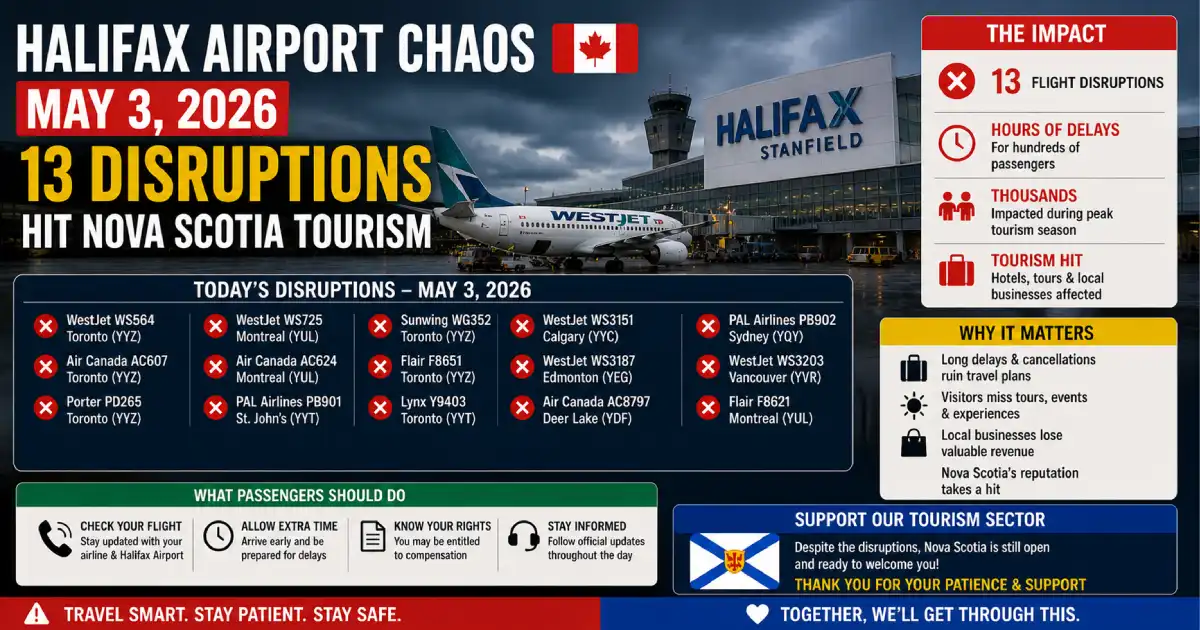
Breaking: Halifax Stanfield International Airport faces spring tourism disruption May 3, 2026 as 13 total flight disruptions (3 cancellations + 10 delays) affect Atlantic Canada travel with PAL Airlines suffering worst impact (2 cancellations + 7 delays = 69% of all disruptions despite operating just 15-20% of airport flights), Air Canada Rouge posting 2 delays, WestJet recording 4 delays while routes to Toronto, Montreal, Ottawa, St. John’s experience cascading problems threatening Nova Scotia’s critical May-September tourism season (estimated $2.5 billion annual tourism economy) when international visitors arrive for Cabot Trail drives, Celtic Colors Festival bookings, Halifax Waterfront exploration, and Maritime summer vacation planning. Here’s what travelers need to know NOW.
Published: May 3, 2026 Total Disruptions: 13 flights (3 cancellations + 10 delays) Worst Carrier: PAL Airlines (2 cancels + 7 delays = 69% of disruptions) Routes Affected: Toronto, Montreal, Ottawa, St. John’s, Gander Tourism Season: Peak May-September ($2.5B annual Nova Scotia tourism) Regional Impact: Atlantic Canada connectivity threatened
Halifax Stanfield International Airport—Atlantic Canada’s primary international gateway serving 4.5 million annual passengers, Nova Scotia’s tourism lifeline, and critical connector for Newfoundland, New Brunswick, Prince Edward Island—experiences May 3, 2026 disruptions totaling 13 flights (3 cancellations + 10 delays) with PAL Airlines (Provincial Airlines Limited, Newfoundland-based regional carrier) posting catastrophic 69% share (2 cancellations + 7 delays out of 13 total disruptions) despite operating just 15-20% of Halifax daily flights.
The May timing amplifies tourism industry concern—Halifax and wider Nova Scotia enter peak May-September tourism season when international visitors (primarily U.S., Ontario, Quebec, European travelers) arrive for:
🌊 Cabot Trail scenic drives (Cape Breton Highlands, ranked world’s top coastal drives) 🎵 Celtic Colors International Festival (October bookings begin May) ⛵ Halifax Waterfront (historic waterfront, museums, seafood restaurants) 🏖️ Beaches (Lawrencetown, Martinique, Queensland) 🍷 Wine tours (Annapolis Valley, Gaspereau Valley wineries) 🦞 Lobster season (May-July peak season, culinary tourism)
Today’s 13 disruptions—small in absolute numbers compared to U.S. mega-hubs (Chicago O’Hare, Atlanta experiencing 1,000+ daily disruptions during April 2026 crisis)—represent DISPROPORTIONATE impact because:
Key Numbers:
✈️ 13 total disruptions (3 cancellations + 10 delays) 🚨 PAL Airlines: 2 cancels + 7 delays = 69% of all disruptions ⚠️ Air Canada Rouge: 2 delays (18% of delays) ⚠️ WestJet: 4 delays (36% of delays) 📍 Routes affected: Toronto, Montreal, Ottawa, St. John’s, Gander 💰 Tourism at risk: $2.5B annual Nova Scotia tourism economy 📅 Season start: May-September peak visitation period
Today’s numbers: 2 cancellations, 7 delays (out of estimated 15-18 daily Halifax operations) Market impact: 69% of airport disruptions despite 15-20% market share Operating as: Independent regional carrier (not branded partner like Air Canada Express) Fleet: Dash 8-100/300 turboprops (37-50 seats)
PAL Airlines (Provincial Airlines Limited)—St. John’s, Newfoundland-headquartered regional carrier operating essential Atlantic Canada routes—posts worst single-day Halifax performance with 2 cancellations + 7 delays representing 69% of entire airport’s problems despite PAL operating just 15-20% of Halifax daily flights.
Why PAL hit hardest:
Essential Air Service concentration: PAL operates federally-subsidized Essential Air Service (EAS) routes connecting remote Atlantic Canada communities (Gander, Goose Bay, Deer Lake, St. Anthony, Blanc-Sablon) where NO alternative carriers exist—meaning PAL cancellations/delays strand communities with zero transportation alternatives unlike major hubs offering multiple carrier options
Turboprop vulnerability: PAL’s Dash 8 fleet (smaller 37-50 seat aircraft) experiences higher weather sensitivity than jet aircraft—spring Atlantic Canada weather (fog, low ceilings, crosswinds) creates operational challenges forcing delays/cancellations for safety
Crew shortage crisis: Regional carrier pilot shortage (PAL starting salary ~$40,000-50,000 CAD vs. Air Canada mainline $100,000-150,000 CAD) creates constant turnover as pilots build minimum hours then leave for better-paying jobs, forcing PAL to operate minimal crew reserves unable to cover sick calls/delays
Newfoundland-Nova Scotia dependency: PAL’s business model centers on connecting Newfoundland cities (St. John’s, Gander) to Halifax (Halifax = primary connection point for Newfoundlanders reaching rest of Canada, international destinations)—when PAL struggles, entire Newfoundland population loses connectivity
Recent operational pattern (2026):
May 3, 2026: 2 cancellations + 7 delays (TODAY) April 19, 2026: 10 delays + 2 cancellations across Canadian network March 9, 2026: 1 cancellation + 10 delays at Halifax alone February 20, 2026: 5 cancellations + 6 delays St. John’s (affecting Halifax connections) February 5, 2026: 11 cancellations (50% of scheduled flights Halifax) during winter storm
Pattern recognition: PAL experiencing chronic operational instability—not isolated May 3 event, systematic fragility
Today’s numbers: 2 delays (no cancellations) Routes affected: Vacation destinations (Florida, Caribbean typical Rouge routes from Halifax) Market share: Air Canada Rouge operates leisure/vacation routes using Rouge branding (vs. mainline Air Canada business/premium routes)
Air Canada Rouge—Air Canada’s leisure subsidiary operating vacation routes—posts 2 delays at Halifax representing 18% of total delay volume despite Rouge operating limited Halifax frequencies (estimated 3-5 daily departures typically Florida/Caribbean destinations).
Why Rouge matters for Halifax tourism:
Halifax residents (480,000 metro population) + wider Nova Scotia (1 million provincial population) rely heavily on direct winter vacation flights (Florida, Caribbean, Mexico) escaping Atlantic Canada’s harsh winters—Rouge disruptions affect leisure travelers who’ve saved months for annual vacation trips, creating disproportionate frustration compared to business travelers with flexible schedules
Seasonal vulnerability: May 3 represents shoulder season (winter vacation routes winding down, summer European routes ramping up)—Rouge aircraft/crews repositioning between seasonal schedules creates operational complexity prone to delays
Today’s numbers: 4 delays (no cancellations) Routes affected: Calgary, Toronto (WestJet’s two primary hubs) Market share: WestJet operates significant Halifax presence as Canada’s #2 carrier (after Air Canada)
WestJet—Calgary-based carrier competing with Air Canada for domestic Canadian market—posts 4 delays representing 36% of Halifax delay volume, affecting critical Halifax-Calgary (Western Canada gateway) and Halifax-Toronto (business/connection hub) routes.
Halifax-Calgary importance: Direct Halifax-Calgary service enables Atlantic Canadians to reach Western Canada (Calgary, Edmonton, Vancouver via Calgary connections), visit family/friends, conduct business, access national parks (Banff, Jasper)—WestJet delays sever this East-West connectivity forcing passengers onto multi-stop routing via Toronto/Montreal (adding 2-4 hours travel time)
Halifax-Toronto volume: Toronto-Halifax represents one of Canada’s busiest domestic routes (business travel, university students, family connections between Ontario-Atlantic Canada)—WestJet’s 4 delays today affect hundreds of passengers during Saturday peak leisure travel period
Affected airlines: WestJet, Air Canada, PAL (via connections) Importance: Toronto-Halifax = busiest Canadian route after Montreal-Toronto
Toronto Pearson serves as Halifax passengers’ primary connection point for:
Today’s disruptions sever this vital artery—delayed Halifax-Toronto flights create missed Toronto connections to international destinations, forcing overnight Toronto hotel stays, rebooking complications
Affected airline: PAL Airlines exclusively Importance: Halifax = PRIMARY connection for Newfoundlanders to rest of Canada
St. John’s, Newfoundland passengers face unique geography—island province with limited direct flight options to major Canadian cities (Toronto, Montreal, Ottawa). Halifax serves as CRITICAL intermediate connection allowing Newfoundlanders to:
PAL’s 2 cancellations + 7 delays today particularly devastate Newfoundland travelers who:
Affected airlines: Air Canada, WestJet, PAL connections Importance: Montreal = Quebec business/culture hub, Ottawa = federal government
Halifax-Montreal: Heavy Acadian/French-Canadian cultural connections, business travel, university exchanges (McGill, Concordia students), leisure travel Halifax-Ottawa: Federal government workers shuttling between regional offices and national capital, military personnel (Halifax = major Canadian Forces base), parliamentary business
Today’s delays disrupt federal government operations (Saturday travel less critical than weekday, but still impacts weekend constituency work, committee travel, military logistics)
Affected airline: PAL Airlines exclusively Importance: These communities have ZERO alternative carriers
Gander, Goose Bay represent remote Newfoundland/Labrador communities where:
PAL’s disruptions today don’t just inconvenience tourists—they potentially delay:
Annual tourism spending: $2.5 billion (2025 estimate) Tourism jobs: 40,000-45,000 (7-8% of Nova Scotia employment) Peak season: May-September (65-70% of annual visitors) International visitors: 40% of tourism spending (primarily U.S., Germany, UK) Top attractions: Halifax Waterfront, Cabot Trail, Peggy’s Cove, Lunenburg
Booking window impact: May = peak booking period for July-August Nova Scotia vacations. International tourists (especially Europeans planning summer North America trips) research/book May for July-August travel. Today’s disruptions create:
❌ Negative online reviews (travelers posting Halifax airport chaos on TripAdvisor, Google, social media) ❌ Media coverage deterring bookings (“Atlantic Canada airport problems” headlines reduce tourist confidence) ❌ Direct rebooking away from Halifax (tourists switch to flying into Montreal/Toronto, renting cars for long Nova Scotia drives vs. flying direct Halifax)
Cruise season coordination: Halifax is major cruise port (100+ cruise ship arrivals annually May-October, 250,000+ cruise passengers). Many cruise passengers book pre/post-cruise hotel stays in Halifax requiring reliable air connections. Today’s disruptions affect:
Festival season preparation: Nova Scotia hosts major festivals requiring advance planning:
Festival organizers booking performers, vendors, sponsors rely on Halifax airport functioning reliably—chronic disruptions create festival planning complications, insurance costs, performer reluctance to commit to remote Atlantic Canada events
Halifax hotel occupancy: 75-80% peak summer (May-September), 50-55% winter Average daily rate: $150-200 CAD summer, $90-120 winter
Tourism operators interviewed expressing concern:
💬 “We’re already facing challenges competing with Ontario, Quebec destinations that are easier to reach. When Halifax airport has problems, it’s another reason for tourists to choose Montreal, Toronto instead of flying all the way to Atlantic Canada.”
💬 “Cruise passengers are our bread and butter May-October. When they miss ships because PAL delays their Halifax connection from St. John’s, that’s lost pre-cruise hotel nights, lost shore excursion bookings, lost restaurant revenue. And they don’t come back—they choose different ports next cruise.”
💬 “International tourists booking summer Cabot Trail drives don’t understand the difference between Air Canada, PAL, WestJet delays. They just see ‘Halifax airport problems’ and book Banff, Vancouver Island instead. We lose that tourism dollar permanently.”
What airlines MUST provide (operational delays/cancellations):
✅ Rebooking obligations: Next available flight (your airline or competitor if your airline cannot accommodate within reasonable timeframe) ✅ Refund rights: Full refund if delay exceeds 3 hours and you choose NOT to travel ✅ Compensation: $400-1,000 CAD depending on delay length (domestic) for delays within airline control ✅ Meal vouchers: Delays 2+ hours ($15 breakfast, $20 lunch/dinner) ✅ Hotel accommodation: Overnight delays when required (if operationally necessary AND airline could have avoided delay)
❌ What airlines NOT required (weather/safety delays):
Compensation for weather-related delays (Atlantic Canada spring weather = common exemption) Hotels/meals when delay caused by safety issues beyond airline control
Three categories under APPR:
1. Within airline control (compensation YES):
2. Within airline control but required for safety (compensation NO, but rebooking/refund YES):
3. Outside airline control (compensation NO, but rebooking/refund YES):
Today’s PAL/Air Canada/WestJet delays: Cause NOT publicly disclosed—airlines must provide reason upon request. If airlines claim “weather” but Halifax weather normal, you can challenge and demand compensation.
Step 1: Contact airline within 1 year of disruption Step 2: Provide booking reference, flight details, disruption length Step 3: Request written explanation of delay cause Step 4: If airline denies compensation and you believe entitled, escalate to Canadian Transportation Agency (CTA): otc-cta.gc.ca Step 5: CTA investigates, rules on compensation—airlines must comply
Timelines: Airlines have 30 days to respond to initial complaint CTA resolution typically 6-12 months (backlog of Canadian passenger complaints) Compensation (if awarded): $400 CAD (3-6 hour delay), $700 CAD (6-9 hours), $1,000 CAD (9+ hours or overnight)
Immediate actions:
📱 Airline app: Fastest rebooking method (avoid 60-90 minute customer service phone queues) 📱 Document everything: Screenshot delay notices, take photos of departure boards showing cancellations, save all airline communications 📱 Request meal vouchers: Don’t wait for airline to offer—proactively request at customer service desk 📱 Hotel if overnight: If delay forces overnight stay, request hotel voucher BEFORE leaving airport (harder to get reimbursement retroactively)
Know your alternatives:
🚗 Driving: Halifax-Toronto 1,800 km (18-20 hours over 2 days), Halifax-Montreal 1,250 km (13-15 hours) 🚂 VIA Rail: Halifax-Montreal overnight train (Ocean service, 3x weekly, 21 hours, $150-300 CAD) ✈️ Alternate airports: Consider rebooking via Moncton (2.5 hours drive from Halifax), Fredericton (4 hours), Saint John NB (4 hours) if Halifax connections exhausted
Next 7-14 days risk assessment:
⚠️ PAL Airlines routes: HIGH RISK given chronic operational issues (consider Air Canada alternatives where available, or allow extra connection buffers) ⚠️ Early morning flights: LOWER RISK (aircraft pre-positioned overnight, crews fresh, weather typically better morning vs. afternoon fog) ⚠️ Final daily flights: HIGHER RISK (accumulated delays cascade, crew duty times exhausted, if flight cancels you’re stuck overnight)
May-September Nova Scotia tourism travelers:
✅ Book refundable fares (+20-30% cost but worth flexibility if disruptions continue) ✅ Travel insurance with trip interruption coverage ($50-150 for typical 1-week Nova Scotia vacation) ✅ Buffer days (arrive Halifax 1 day before cruise departure, leave 1 day after planned departure to absorb delays) ✅ Monitor weather (Atlantic Canada fog/low ceilings predictable—if forecasted, expect delays)
May 3, 2026 Halifax Stanfield International Airport disruptions—13 total (3 cancellations + 10 delays) with PAL Airlines posting 69% of problems—demonstrate Atlantic Canada aviation fragility where regional carrier operational issues disproportionately impact remote communities, tourism industry, and provincial economies lacking alternative transportation infrastructure.
For travelers: PAL Airlines’ chronic struggles (today’s 2 cancellations + 7 delays following months of similar disruptions) require risk mitigation—book alternative carriers where possible, allow generous connection buffers, purchase refundable tickets, expect delays on PAL routes to remote Newfoundland/Labrador communities.
For Nova Scotia tourism: May disruptions during peak booking season create reputational damage as international tourists research summer vacations—negative reviews, media coverage of airport chaos, rebooking complexity all deter visitors from choosing Nova Scotia over easier-to-reach Quebec, Ontario, or Western Canada destinations threatening $2.5 billion annual tourism economy.
For Atlantic Canada connectivity: Halifax serves as CRITICAL hub for Newfoundland, PEI, New Brunswick reaching rest of Canada/world—when Halifax struggles, entire region suffers. St. John’s passengers losing PAL connections face zero alternatives (PAL monopoly many routes), forcing multi-day rebooking delays or expensive last-minute Air Canada premium fares.
For PAL Airlines: Company faces existential question—can regional carrier operating Essential Air Service routes with tight margins, chronic crew shortages, turboprop weather vulnerability maintain reliable service Atlantic Canadians depend on? Today’s 69% disruption share (despite 15-20% market share) suggests systematic operational crisis requiring government intervention, industry consolidation, or service model restructuring.
The Atlantic may be beautiful. But getting here reliably? That’s the challenge facing Canada’s Ocean Playground.
How many flights were actually cancelled versus delayed at Halifax today?
3 flights outright cancelled, 10 experienced significant delays, creating 13 total disruptions. PAL Airlines accounted for 2 of 3 cancellations (67%) and 7 of 10 delays (70%), totaling 9 of 13 disruptions (69%). Air Canada Rouge posted 2 delays (18% of delay volume). WestJet recorded 4 delays (36% of delays, 31% of total disruptions). This represents approximately 11-13% of Halifax’s typical 100-120 daily flight operations.
Will I get compensation for my cancelled/delayed PAL or Air Canada flight?
DEPENDS on delay cause and length. Under Canadian Air Passenger Protection Regulations (APPR), you’re entitled to $400-1,000 CAD compensation if: (1) Delay within airline control (crew scheduling, routine maintenance, overbooking), AND (2) Delay exceeds 3 hours. Weather delays = NO compensation but airlines still must rebook or refund. Airlines must disclose delay reason—if they claim “weather” but Halifax weather was normal, challenge this and file CTA complaint. Today’s disruptions: Cause not publicly disclosed, request written explanation from airline, escalate to Canadian Transportation Agency (otc-cta.gc.ca) if denied compensation you believe entitled to.
Why did PAL Airlines have 9 disruptions when they’re much smaller than Air Canada?
Regional carrier operational fragility: PAL operates turboprop aircraft (Dash 8) more sensitive to weather than jets, employs minimal crew reserves (pilot shortage forces tight scheduling), serves remote routes with zero alternative carriers creating concentration risk. When PAL delays/cancels St. John’s-Halifax flight, passengers have NO other airline options—versus Air Canada routes often having WestJet alternatives. PAL also operates federally-subsidized Essential Air Service routes to communities like Gander, Goose Bay, Deer Lake where economics don’t support multiple carriers, forcing PAL to maintain schedules even when operationally stretched thin. Recent pattern shows chronic PAL instability—not isolated May 3 event but systemic problem affecting Atlantic Canada connectivity.
What if I’m flying to Halifax for a cruise departure and my flight is delayed?
CRITICAL: Cruise lines will NOT wait for late passengers and typically provide NO refunds for missed departures. Strategy: (1) Arrive Halifax minimum 1 day before cruise departs (2-day buffer even better given PAL reliability issues), (2) Purchase “cancel for any reason” travel insurance covering missed cruise departure (10-12% of total trip cost, worth it for $3,000-5,000 cruise), (3) If flight delayed day-of cruise, immediately contact cruise line—some allow joining at next port if you can arrange transportation, (4) Document airline delay for insurance claim (cruise fare, pre-paid excursions, hotels all potentially covered if delay was airline’s fault). Most cruise passengers missing ships due to PAL delays lose entire cruise value—insurance essential.
Can I drive instead of flying if PAL delays look likely?
YES for some routes, impractical for others. Halifax-Toronto: 1,800 km, 18-20 hours driving over 2 days, rental car ~$400-600 one-way + gas $200-300 + hotels $150-300 = $750-1,200 total (vs. $200-400 flight). Halifax-Montreal: 1,250 km, 13-15 hours, similar costs. Halifax-St. John’s: IMPOSSIBLE (Newfoundland is island, requires 6-hour ferry plus 8+ hour drive = 20+ hours total, impractical). For Ontario/Quebec destinations, driving viable if: (1) You have time (2-3 days vs. 3-hour flight), (2) You’re traveling with family (split costs 3-4 ways makes driving economical), (3) You want Nova Scotia road trip experience. Otherwise, flying with generous buffers + refundable tickets better than 18-hour drive.
Should I avoid PAL Airlines entirely for future travel?
DEPENDS on route alternatives. For remote Newfoundland/Labrador routes (Gander, Goose Bay, Deer Lake, Blanc-Sablon), PAL often ONLY option—accept disruption risk or don’t travel to these communities. For major routes (St. John’s-Halifax, St. John’s-Toronto), Air Canada offers alternatives: Book Air Canada if willing to pay premium ($250-400 vs. PAL $150-250 typical), accept fewer daily frequencies (Air Canada 1-2x daily vs. PAL 3-4x daily some routes), or choose PAL for lower fare but allow 24-hour rebooking buffer before connections/critical events. PAL’s chronic operational issues (9 disruptions today following months of similar problems) make it HIGH RISK carrier for time-sensitive travel—business meetings, cruise departures, weddings, medical appointments should NOT rely on PAL without backup plans.
What alternatives exist if Halifax airport keeps having problems?
Limited viable alternatives for Atlantic Canada access: (1) Moncton Airport (YQX) 2.5 hours east of Halifax—smaller but Air Canada, WestJet, PAL service, drive to/from Halifax feasible, (2) VIA Rail Ocean train Halifax-Montreal 3x weekly, 21 hours, $150-300 CAD—scenic but slow, (3) Marine Atlantic ferry North Sydney NS to Newfoundland if accessing NL, (4) Drive from Toronto/Montreal if time permits 18-20 hours. Reality: Halifax IS Atlantic Canada’s primary aviation gateway—4.5 million annual passengers, international connections, most frequent service. Other airports supplement but cannot replace Halifax volume/connectivity. For Nova Scotia tourism specifically: NO practical alternative to flying Halifax unless willing to drive 18+ hours from Toronto/Montreal or accept limited Moncton service.
Why doesn’t Canada have better Atlantic region air service?
Geography + economics: Atlantic Canada (4 provinces, 2.4 million population) spread across large area with limited population density—airlines cannot profitably operate frequent service to small markets. Halifax (480,000 metro) largest city, but still small vs. Toronto (6 million), Montreal (4 million), Vancouver (2.7 million). Regional carriers like PAL operate Essential Air Service subsidized routes to communities (Gander 11,000 population, Goose Bay 7,000) that would have ZERO service without subsidies. Low passenger volumes + high operating costs (fuel, crew, maintenance) + weather challenges (fog, ice, Atlantic storms) make Atlantic Canada aviation inherently difficult. Government could increase subsidies or mandate service levels, but taxpayers ultimately fund this—tradeoff between connectivity and cost.
For More Resources:
Related Articles:
Posted By : Vinay
This article is provided for general informational purposes only and is based on information available at the time of publication. Travel advisories, airline schedules, airport operations, visa requirements, government regulations, and other travel-related information are subject to change without prior notice. While Travel Tourister makes reasonable efforts to verify information using official announcements, government publications, airline and airport communications, and other reliable sources, we cannot guarantee that all information remains complete, accurate, or up to date at all times. Readers should independently verify any information that may affect their travel plans with the relevant airline, airport authority, government agency, embassy, or other official source before making travel, financial, or other decisions. Travel Tourister shall not be liable for any direct or indirect loss, inconvenience, or damages arising from the use of or reliance on the information contained in this article. Nothing in this publication constitutes legal, immigration, financial, or professional travel advice. If you believe any information in this article is inaccurate or outdated, please contact our editorial team. We review all credible correction requests promptly and update our content whenever appropriate.
Lastest News
2nd Floor, 39, Above Kirti Club, DLF Industrial Area, Kirti Nagar, New Delhi, Delhi 110015



Travel Tourister is a leading Travel portal where we introduce travellers to trusted travel agents to make their journey hasselfree, memorable And happy. Travel Tourister is a platform where travellers get Tour packages ,Hotel packages deals through trusted travel companies And hoteliers who are working with us across the world. We always try to find new and more travel agents and hoteliers from every nook and corners across the world so that you could compare the deals with different travel agents and hoteliers and book your tour or hotel with the one you have chosen according to your taste and budget.
Copyright © Travel Tourister, India. All Rights Reserved

 Call
Call Enquiry