Published on : 03 May 2026
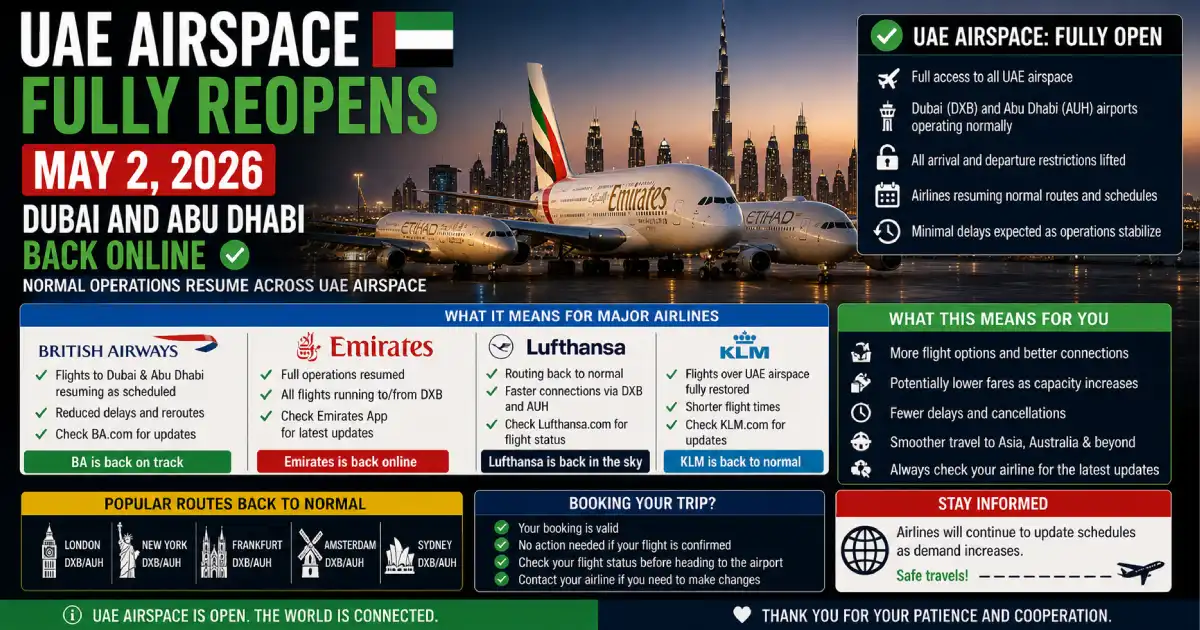
Breaking: The UAE General Civil Aviation Authority confirmed late on May 2, 2026 that all precautionary airspace restrictions imposed since February 28 have been fully lifted. Dubai International Airport (DXB) and Abu Dhabi’s Zayed International Airport (AUH) are back to normal operations. This is the single most important positive travel story of 2026 — but European airlines face critical caveats before they can restore full services. Here is exactly what it means for your booking.
Published: May 3, 2026 GCAA Announcement: Late May 2, 2026 — all restrictions lifted Restriction Period: 64 days — February 28 through May 2, 2026 Reason for Restrictions: US–Israel missile and drone attacks on Iran February 28 — UAE targeted by retaliatory strikes — precautionary airspace closure Full Statement: “A comprehensive evaluation of operational and security conditions, carried out with military and intelligence counterparts — all precautionary restrictions have been lifted” DXB Status: ✅ FULLY OPEN — normal approach/departure corridors restored AUH Status: ✅ FULLY OPEN — Zayed International Airport fully operational Emirates: ✅ ~80% capacity — 125+ destinations — expanding to 150+ by June 16 Etihad: ✅ ~75% capacity — 232 daily flights — 80+ destinations flydubai: ✅ Operating reduced schedule — 100+ routes ⚠️ CRITICAL CAVEAT: DXB 1-flight/day foreign airline cap still active until May 31 ⚠️ CRITICAL CAVEAT: EASA CZIB bulletin still in force — European carriers legally restricted British Airways: July 1, 2026 planned return — 1 daily (down from 3) — unchanged Lufthansa Group: Suspended through May 31 — BA/LH/LX/OS all watching EASA KLM: Suspended through June 22 — updated from June 14 Singapore Airlines: Suspended through May 31 Air France: Resuming May 10 — earliest European carrier Cathay Pacific: Suspended through at least June Air Canada: Suspended through early September Best Option RIGHT NOW: Emirates from LHR/MAN/BHX/GLA/EDI + all major AU/CA gateways Qatar Airways: ✅ Flying Dubai — resumed April 23 Fares: Expected to drop significantly as confidence returns — but European carrier seats not yet available
The United Arab Emirates has lifted all flight restrictions put in place since the start of the United States and Israel’s war on Iran, the country’s civil aviation authority has announced. All air operations have returned to “normal status” in UAE airspace, the General Civil Aviation Authority said in a statement on Saturday.
The General Civil Aviation Authority confirmed the full resumption of normal air navigation operations across UAE airspace, marking the end of temporary precautionary measures introduced amid regional tensions. The announcement follows a comprehensive assessment of operational and security conditions. Authorities said the decision was taken in coordination with relevant entities to ensure aviation safety remains uncompromised. Continuous real-time monitoring systems remain active to track any emerging risks.
The UAE has not faced further missile and drone strikes since a conditional ceasefire came into effect on April 8. “The Authority expressed its appreciation for the cooperation of passengers and airlines throughout the precautionary period and confirmed the readiness of its technical and operational teams to respond to any emerging developments.”
In plain terms: the UAE has declared its airspace fully safe and normal. The restrictions that have grounded hundreds of thousands of flights since February 28 are officially over from the UAE’s perspective. DXB and AUH can once again handle normal approach and departure corridors — the full complement of runways, slots, and routing that made them the world’s busiest international aviation hub before the crisis.
Real-time monitoring systems will remain active, but carriers may once again plan direct routings over Emirati territory and use the country’s full complement of approach and departure corridors. Travel insurance policies that were temporarily voided for “war-risk” routings will revert to standard coverage, and companies can once again rely on Middle East hubs for same-day connections to Africa, South Asia and Europe.
To understand the significance of May 2, you need to understand what the 64-day closure cost the world’s aviation system.
Both Dubai International Airport and Abu Dhabi’s Zayed International Airport were targeted by drone strikes during the conflict. UAE carriers Emirates and flydubai temporarily halted all operations, while Etihad suspended all departures from Abu Dhabi. More than 11,000 flights in and out of the region were cancelled in the opening days of the conflict.
Dubai International Airport is the world’s busiest airport for international passengers. In 2025, DXB handled 92 million passengers — more than London Heathrow and Amsterdam Schiphol combined. When it closed on February 28, every Asia–Europe connection, every Australia–UK service, every Africa–North America transit that routed through the Gulf was simultaneously disrupted. The ripple effects reached every aviation market on earth — including the US jet fuel crisis that ultimately brought down Spirit Airlines.
Emirates airline boss Tim Clark said the company was more than capable of dealing with the fallout. “What we have found is that whenever we’ve been through these traumas before, the strength of demand remains so strong,” Clark said. Emirates airline would become the “most profitable airline” by the end of 2026 despite a quiet March.
“I am proud of the teams at Dubai Airports, Emirates and flydubai,” Sheikh Hamdan said. “Our world-class aviation ecosystem continues to maintain smooth, efficient operations amid evolving conditions while ensuring safety, reflecting the resilience and preparedness of Dubai’s systems.”
This is the single most important nuance in today’s announcement — and the one that most early reporting has missed.
The UAE has lifted its restrictions. But European airlines cannot automatically resume just because the UAE says it is safe. They face two separate barriers that have not yet been removed:
All European carriers are waiting on EASA’s conflict zone advisory, which is next due for review. Lufthansa Group remains suspended through May 31, and KLM through June 22.
The European Union Aviation Safety Agency’s Conflict Zone Information Bulletin — CZIB 2026-03 — is a safety advisory that prevents EU-regulated carriers from flying over or to the affected Middle East region. The GCAA’s announcement that UAE airspace is safe is not the same as EASA lifting its bulletin. EASA makes its own independent safety assessment — based on broader regional risk including Iranian airspace, Iraqi airspace, and the Strait of Hormuz situation — and its bulletin remains in force until EASA specifically updates it.
European carriers (BA, Lufthansa, KLM, Air France, Swiss, Austrian, Finnair, Iberia) cannot resume Dubai services based on the GCAA announcement alone. They need EASA to modify or lift its bulletin first. EASA’s next review date has not yet been published — but given the GCAA’s full reopening announcement, an emergency or accelerated review is now likely within days.
From 20 April through 31 May 2026, Dubai International Airport is limiting all non-UAE airlines to one round trip per day at DXB and one at DWC. UAE-based carriers (Emirates, flydubai) are exempt. Foreign airlines that do resume services will operate at significantly reduced frequencies during this period.
Even if EASA modifies its bulletin tomorrow, the DXB foreign airline capacity cap — 1 round trip per day for each non-UAE carrier — restricts how much capacity European carriers can immediately restore at Dubai. This cap runs through May 31. Until June 1, any European carrier resuming Dubai will be capped at 1 daily frequency — not the 3 daily that BA operated pre-crisis, not Lufthansa’s full Frankfurt–Dubai schedule.
The cap reflects Dubai Airport’s need for an orderly capacity restoration — bringing foreign airline frequencies back in stages rather than all at once — to avoid the ground-handling and slot congestion that would result from 30 carriers all trying to restore full schedules on the same day.
Emirates operated more than 400 flights on April 23 for the first time since February 27, returning to about 80 per cent of its pre-war capacity.
Emirates is operating approximately 145–150 daily departures from Dubai, serving roughly 125–127 of its normal 140+ destinations. The airline plans to expand its network to 150+ destinations by June 16.
Emirates is the best available option for every UK, Australian, Canadian, and US passenger who needs to fly to Dubai or connect through it right now. It operates from London Heathrow (5+ daily), London Gatwick, Manchester, Birmingham, Glasgow, Edinburgh, Dublin — and from Sydney, Melbourne, Brisbane, Perth, Adelaide, Auckland, Toronto, Vancouver, New York JFK, Los Angeles, Houston, Dallas, Chicago, and more.
Some Emirates long-haul routes remain suspended — including Houston, Los Angeles, and Osaka — but the vast majority of Emirates’ global network is now operating. Check emirates.com for current status on your specific route.
Emirates flexible booking: Passengers booked between February 28 and September 15, 2026 can rebook free of charge to the same or an alternative destination for travel through October 31.
Contact Emirates: emirates.com | 0344 800 2777 (UK) | 1-800-777-3999 (US) | 13 26 45 (AU)
Etihad Airways has also resumed operations but remains below normal levels. The Abu Dhabi airline operated 232 flights on April 27, more than 75 per cent of its pre-February 28 average of around 300 daily flights.
Etihad is operating from Abu Dhabi Zayed International (AUH) to approximately 80 destinations across Asia, Europe, Africa, North America, Australia, and the Middle East. For passengers who prefer Abu Dhabi as a Dubai alternative — or who are booked to AUH specifically — Etihad is operating at 75% and growing.
Contact Etihad: etihad.com | 0345 608 1225 (UK) | 1-877-690-0767 (US)
Qatar Airways resumed daily Dubai and Sharjah service on April 23 — the first major non-UAE carrier to return to Dubai during the crisis. Qatar also confirmed on May 2 that it will resume flights to three Iraqi cities from May 10 — Qatar Airways on Saturday confirmed it would resume flights to three Iraqi cities from May 10, after previous suspension.
For UK passengers connecting via Doha to Dubai or wider Gulf destinations: Qatar Airways via Doha is operating normally from London Heathrow. British Airways’ Doha suspension ended April 30 — BA passengers with Doha bookings from May 1 should check their booking status at ba.com.
Contact Qatar Airways: qatarairways.com | 0330 024 0125 (UK) | 1-877-777-2827 (US)
British Airways plans to restart flights to Riyadh in mid-May, followed by Dubai, Doha and Tel Aviv from July 1, but at reduced frequencies.
British Airways: Suspended through May 31; planned return July 1 at one daily flight (down from three pre-crisis). BA has permanently dropped Jeddah from its network effective April 24.
BA’s July 1 return date was set before the GCAA’s full reopening announcement. Now that the UAE has cleared all restrictions, BA has the opportunity to advance its return timeline — but only if EASA modifies its bulletin AND the DXB foreign airline cap allows. The earliest realistic BA Dubai return, given both barriers, is likely June 1–15 if EASA acts quickly. July 1 remains the confirmed planned date if EASA delays.
BA passengers with cancelled Dubai bookings: Full cash refund or free rebooking at ba.com → Manage My Booking. BA’s flexibility policy allows rebooking without fare difference for passengers affected by the suspension.
Contact BA: ba.com | 0344 493 0787 (UK) | 1-800-247-9297 (US)
Lufthansa Group has suspended flights to Dubai and Tel Aviv until May 31, and services to Abu Dhabi, Amman, Beirut, Dammam, Riyadh, Erbil, Muscat and Tehran until October 24. Swiss is following the same Lufthansa Group measures.
Lufthansa has the clearest near-term return potential of any European carrier — its May 31 suspension end date aligns with the DXB foreign airline cap expiry (also May 31). If EASA modifies its bulletin before May 31, Lufthansa could theoretically resume Frankfurt–Dubai on June 1. Watch for Lufthansa announcements this week.
Eurowings: Suspended through October 24 — Eurowings has effectively written off the entire summer 2026 season for Gulf routes. This suspension end date is unlikely to change.
Contact Lufthansa: lufthansa.com | +44 371 945 9747 (UK) | 1-800-645-3880 (US)
KLM has suspended Riyadh and Dammam flights until June 14, while Dubai services remain suspended until June 22.
KLM’s June 22 Dubai suspension date (updated from June 14) reflects a more conservative timeline than Lufthansa. With the GCAA fully reopening and EASA review now imminent, KLM may advance its return if EASA clears the bulletin before mid-June.
Contact KLM: klm.com | 0800 056 1740 (UK) | 1-800-618-0104 (US)
Air France has extended suspensions to Dubai, Riyadh, Tel Aviv and Beirut until May 10.
Air France is the only major European carrier with a Dubai return date in single figures — May 10, now just 7 days away. With the GCAA full reopening confirmed and EASA review now imminent, Air France’s May 10 date is the most credible near-term European carrier return. Watch airfrance.com for a May 10 Dubai resumption announcement this week.
Contact Air France: airfrance.com | +33 9 69 39 02 15 (FR) | 1-800-237-2747 (US)
Singapore Airlines flights to and from Dubai remain cancelled until May 31.
Singapore Airlines via SIN is the most popular routing for Australian passengers connecting to Europe via Dubai. With the full UAE reopening, Singapore Airlines’ May 31 suspension end date may be advanced — watch for Singapore Airlines announcements at singaporeair.com.
Cathay Pacific has extended its Dubai and Riyadh suspensions until May 31, while Singapore Airlines flights to and from Dubai remain cancelled until May 31.
Cathay Pacific’s actual suspension extends through at least June. Passengers on Cathay Pacific CX routes connecting through Hong Kong to Dubai: the SIN alternative via Singapore Airlines may be available sooner.
Air Canada has suspended its Dubai operations through early September, effectively removing a key transatlantic link for travellers between Canada and the UAE.
Air Canada’s September suspension end date reflects the most conservative timeline of any carrier. Canadian passengers needing to reach Dubai: Emirates from Toronto Pearson and Vancouver is operating and remains the best direct option.
The UAE is open. Emirates from London Heathrow, Gatwick, Manchester, Birmingham, Glasgow, and Edinburgh is flying and is your best option right now. BA is not yet back — July 1 is the planned date. The GCAA announcement significantly increases the probability of an accelerated BA return timeline — potentially June 1–15 — but this depends entirely on EASA.
The return to normal operations will be welcomed by the thousands of business travellers whose itineraries had been disrupted by rolling NOTAMs, lengthier block times and sudden slot withdrawals — particularly at DXB and AUH.
For new Dubai bookings from UK airports: Emirates is the safe, confirmed option. BA bookings for July 1+ are now more credible than they were yesterday — but remain conditional on EASA.
FCDO travel advice: Check gov.uk/foreign-travel-advice/united-arab-emirates for the latest UK government advisory. The GCAA reopening is a positive signal but the FCDO updates its own risk assessment independently.
The Sydney–Dubai–London routing — the world’s longest scheduled flight at 22 hours on Qantas non-stop, but historically popular via Emirates connecting — is now back on track. Emirates from Sydney, Melbourne, Brisbane, Perth, and Adelaide is operating and expanding.
The Qantas codeshare on Emirates services via Dubai for connections to London is subject to Qantas’ own scheduling decisions. Check qantas.com for current status on Emirates-codeshare Dubai connections.
Air Canada is suspended through early September. Emirates from Toronto Pearson and Vancouver is the confirmed route to Dubai. For Canadian passengers connecting through Dubai to Europe, Asia, or Africa — Emirates is your only reliable option until Air Canada or another European carrier restores service.
United Airlines’ Dubai suspension runs through September 7, 2026. Emirates from New York JFK, Los Angeles, Chicago, San Francisco, Houston, Dallas, Boston, Washington Dulles, Seattle, Orlando, and Miami remains the best option for US–Dubai travel.
The UAE reopening is the most positive single development for global airfares since the crisis began. The mechanism:
Stage 1 (now–EASA review): Emirates and Gulf carrier fares drop as confidence returns and seat supply increases. Demand for Dubai — suppressed for 64 days — begins returning. Emirates is adding capacity. Qatar Airways is adding routes.
Stage 2 (EASA modification + DXB cap expiry ~June 1): European carriers begin announcing return dates. Forward bookings for June–September on BA, Lufthansa, KLM, and Air France all become bookable at normal market fares. The capacity flood from all carriers simultaneously returning will push fares down significantly.
Stage 3 (Full restoration, late June–July): Multiple European carriers flying Dubai simultaneously. Emirates at 100% capacity. DXB operating at full normal slot allocation. Competition returns and fares normalize.
For UK and Australian passengers: The best fares to Dubai will be in the Stage 2 window — between EASA modification and full carrier restoration — when supply is increasing but demand has not yet fully returned. That window is likely late May through June. Book Dubai flights for late June or July now — before the surge of demand that typically follows route restoration announcements.
Step 1 — If you need to fly to Dubai right now: Book Emirates. Not tomorrow — now. Emirates is at 80% and expanding. Seats on peak dates are already filling as confidence returns. Check emirates.com for your route.
Step 2 — Watch for EASA bulletin update this week. The GCAA’s full reopening is the trigger event EASA needed to begin a formal review. An emergency or accelerated EASA update is now likely within days. Monitor easa.europa.eu for any CZIB modification. The moment EASA eases the bulletin, BA, Lufthansa, and KLM will announce return dates within hours.
Step 3 — Check your airline’s booking portal for new options. Log in to ba.com, lufthansa.com, klm.com, and airfrance.com → Manage My Booking. Watch for waiver or rebooking options that reflect the new post-reopening schedule. Air France’s May 10 resumption may already show bookable seats.
Step 4 — If you accepted a voucher during the suspension: Contact your airline and ask to convert it to a cash booking on a restored route or a later travel date. Vouchers from the suspension period should be redeemable against new bookings now that services are restoring.
Step 5 — For new Dubai bookings June onwards: Emirates is confirmed safe to book now. BA July 1 is conditional on EASA — book with fully flexible fares only until EASA confirms. Lufthansa post-June 1 and KLM post-June 22 are conditional — similarly book flexible only.
Step 6 — Check your travel insurance. Travel insurance policies that were temporarily voided for “war-risk” routings will revert to standard coverage. Contact your insurer and confirm that your UAE travel insurance is restored to standard coverage following the GCAA’s full reopening announcement.
Posted By : Vinay
This article is provided for general informational purposes only and is based on information available at the time of publication. Travel advisories, airline schedules, airport operations, visa requirements, government regulations, and other travel-related information are subject to change without prior notice. While Travel Tourister makes reasonable efforts to verify information using official announcements, government publications, airline and airport communications, and other reliable sources, we cannot guarantee that all information remains complete, accurate, or up to date at all times. Readers should independently verify any information that may affect their travel plans with the relevant airline, airport authority, government agency, embassy, or other official source before making travel, financial, or other decisions. Travel Tourister shall not be liable for any direct or indirect loss, inconvenience, or damages arising from the use of or reliance on the information contained in this article. Nothing in this publication constitutes legal, immigration, financial, or professional travel advice. If you believe any information in this article is inaccurate or outdated, please contact our editorial team. We review all credible correction requests promptly and update our content whenever appropriate.
Lastest News
2nd Floor, 39, Above Kirti Club, DLF Industrial Area, Kirti Nagar, New Delhi, Delhi 110015



Travel Tourister is a leading Travel portal where we introduce travellers to trusted travel agents to make their journey hasselfree, memorable And happy. Travel Tourister is a platform where travellers get Tour packages ,Hotel packages deals through trusted travel companies And hoteliers who are working with us across the world. We always try to find new and more travel agents and hoteliers from every nook and corners across the world so that you could compare the deals with different travel agents and hoteliers and book your tour or hotel with the one you have chosen according to your taste and budget.
Copyright © Travel Tourister, India. All Rights Reserved

 Call
Call Enquiry