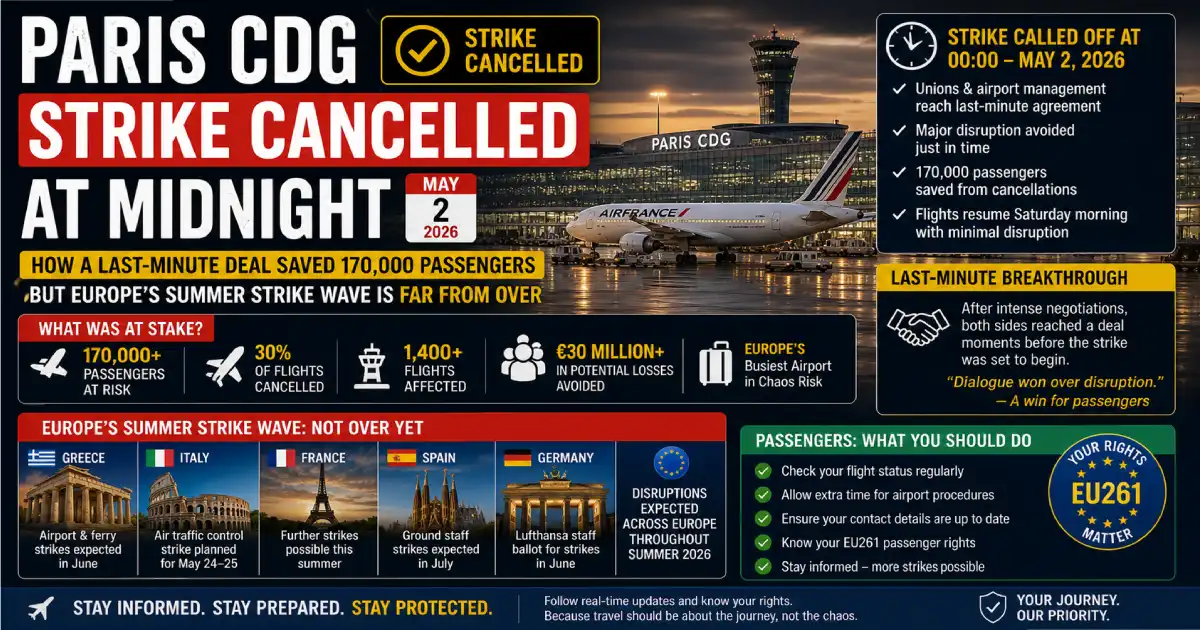
Paris CDG Strike Cancelled at Midnight May 2, 2026 — How a Last-Minute Deal Saved 170,000 Passengers — But Europe’s Summer Strike Wave Is Far From Over
Published on : 03 May 2026
RESOLVED — MAY 2, 2026 FAST FACTS
Event
Planned half-day Vigie-Trafic (ground-movement controller) strike at Paris CDG
✅ Strike withdrawn for May 2 AND May 8 — normal schedule restored
May 8 date
✅ Also withdrawn — VE Day public holiday traffic protected
Summer risk
⚠️ Deal does NOT resolve broader French ATC disputes — more strikes possible June–August
Paris Charles de Gaulle Airport dodged its most disruptive Saturday in years — but only just. In the early hours of Saturday May 2, 2026, France’s CFDT Aviation Civile union withdrew its strike notice covering CDG’s Vigie-Trafic ground-movement controllers for both May 2 and May 8, following three intensive days of mediation with the civil aviation directorate DSNA. The planned half-day walkout — classified as a Level 3 industrial action, the highest pre-cancellation alert category used by corporate travel risk firms — had already forced France’s Directorate-General of Civil Aviation to instruct airlines to cancel 15% of scheduled departures for the morning window. Those cancellation orders were reversed only after the deal was confirmed.
For the 170,000 passengers booked to travel through Europe’s second-busiest aviation hub on May 2, the midnight withdrawal was the difference between a smooth May Day weekend break and hours of chaos. For the airlines, ground handlers, and freight operators that had already begun repositioning aircraft and rebooking passengers, the reversal — welcome as it was — added its own layer of operational complexity. And for anyone flying through Paris, Europe, or French airspace this summer, the near-miss raises an urgent question: how many more of these will there be before September?
🕛 What Happened — The Minute-by-Minute Timeline
This was not a routine labour dispute quietly resolved in a conference room. The CDG Vigie-Trafic strike notice was filed formally, escalated to Level 3, and had already triggered the full regulatory machinery of French aviation crisis management before it was pulled. Understanding the sequence shows just how close the May Day weekend came to genuine disruption.
Thursday April 30 — Strike Notice Filed
CFDT Aviation Civile formally files strike notice for CDG Vigie-Trafic controllers covering Saturday May 2 (07:00–13:00) and Friday May 8. NHE Travel and corporate risk platforms classify it Level 3 industrial action. Airlines with 7+ daily movements at CDG are officially notified to prepare cancellation contingency plans.
Friday May 1 — DGCA Issues 15% Cut Order
France’s Directorate-General of Civil Aviation formally orders airlines operating seven or more departures during the 07:00–13:00 window to cancel 15% of flights. Ground-handling providers warn that even if the strike is short, residual delays will spill into the afternoon as aircraft and crews reposition. Airlines begin issuing passenger rebooking options and waiver policies. Air France, Ryanair, and easyJet are among carriers most affected.
Friday May 1 Evening — Mediation Intensifies
DSNA and CFDT Aviation Civile enter a third consecutive day of intensive mediation. The core dispute: 75% of all CDG ground-movement flights now operate under short-notice overtime (“-1/+1” rosters) — meaning controllers are called in or pulled from shifts with as little as one hour’s notice. The union argues this creates operational fatigue and safety risk. DSNA is under pressure: refusing the deal means 170,000 passengers face a chaotic May Day Saturday.
Early Hours Saturday May 2 — Midnight Deal Confirmed
CFDT Aviation Civile announces it is withdrawing all strike notices for both May 2 and May 8. Under the deal, DSNA commits to publishing a ministerial order by autumn 2026 launching an experimental team-based shift system that caps last-minute schedule changes and recognises the need for compensatory rest or pay. The 15% flight-cut orders are reversed. Airlines restore normal schedules.
Saturday May 2 — Normal Operations
CDG operates on its normal summer schedule. Approximately 170,000 passengers transit the airport without disruption. Corporate travel managers who had rerouted staff via Lyon, Brussels, and London revert to direct itineraries. Airlines quietly cancel their contingency rebooking notices. The crisis that never was goes largely unreported — until now.
⚠️ Why It Almost Happened — The 75% Short-Notice Overtime Crisis
The CDG Vigie-Trafic dispute was not about pay in the conventional sense. It was about a structural staffing failure that has been building quietly for years — and which this deal has only temporarily patched, not resolved.
The “-1/+1” Roster Problem
Vigie-Trafic controllers at CDG are responsible for ground movement operations — directing taxiing aircraft, managing runway crossings, and coordinating pushbacks at one of the world’s most complex airport operations. At an airport handling 1,350 movements on an average May day, this is high-concentration, high-consequence work.
According to the CFDT Aviation Civile, 75% of CDG’s ground-movement aircraft now operate under “-1/+1” short-notice overtime rosters — meaning controllers can be called in to cover shifts at one hour’s notice, or pulled from planned rest days with the same urgency. The union’s argument is direct: fatigued controllers managing 1,350 daily movements on an airport handling more than 170,000 passengers is not just a labour rights issue. It is a safety issue.
⚠️ The Core Dispute — What CFDT Was Demanding
An end to “-1/+1” short-notice overtime rosters covering 75% of CDG ground movements
A structured team-based shift system that provides controllers with advance schedule certainty
Formal recognition of compensatory rest or pay when short-notice overtime is unavoidable
A DSNA ministerial order — not just a verbal commitment — establishing these protections by autumn 2026
The same protections to apply at Paris Orly, Nice, Marseille, Lyon, and Toulouse — where separate disputes remain active
What the Deal Actually Delivers
The midnight agreement is a partial win for the union and a genuine concession from DSNA — but it is not a resolution of the underlying staffing crisis. What was agreed:
Strike notices withdrawn: May 2 and May 8 walkouts cancelled in full
Ministerial order commitment: DSNA will publish a formal ministerial order by autumn 2026 launching an experimental team-based shift system
Cap on last-minute schedule changes: The new system will include provisions limiting short-notice roster changes
Compensatory rest/pay recognised: Formal acknowledgement that controllers working short-notice overtime are entitled to compensation
NOT resolved: The immediate 75% short-notice overtime coverage rate — this continues until the ministerial order is implemented in autumn
NOT resolved: Separate SNCTA and USAC-CGT ATC disputes with the transport ministry over staffing, ageing radar systems, and pay
NOT resolved: Disputes at Nice, Marseille, Lyon, and Toulouse — these were NOT covered by this deal
NOT resolved: The broader French ATC capacity crisis — in late March 2026, the DGCA ordered mandatory capacity cuts of up to 40% at CDG and Orly on previous strike days
✈️ What 15% Fewer CDG Flights Would Have Meant — Airport by Airport Impact
To understand why this deal matters for passengers across Europe — not just those flying to and from Paris — it helps to understand what a 15% CDG departure cut actually does to the wider aviation network on a peak Saturday in May.
CDG handles over 170,000 passengers and approximately 1,350 movements on an average May day. A 15% cut would have removed roughly 200+ departures from the morning schedule. But the cascade effect extends far beyond CDG itself:
Impact Category
What Would Have Happened
Who Is Affected
Direct CDG cancellations
200+ departures removed from 07:00–13:00 morning bank
Air France, Ryanair, easyJet, British Airways, American, Delta, United, Lufthansa, KLM
Afternoon cascade
Aircraft and crews out of position — afternoon delays continue even after 13:00 strike end
All airlines operating CDG afternoon banks
UK passengers
London Heathrow, Gatwick, Manchester, Edinburgh flights to CDG — all disrupted
British Airways, easyJet, Vueling, Air France
Transatlantic connections
CDG is Air France’s primary transatlantic hub — US/Canada morning departures disrupted
Air France, Delta (codeshare), KLM connections
Overflights
France manages a large portion of European ATC airspace — UK and Irish carrier flights crossing French airspace see delays even without landing in France
Ryanair, Aer Lingus, easyJet, TUI
Corporate travel
Monday morning meetings missed — staff stranded in Paris or at origin over the weekend
Business travellers across Europe and US
Cargo
Time-critical freight rerouted via Amsterdam or Frankfurt at short notice
Logistics operators, pharmaceutical shippers
🔵 The Overflights Factor — Why This Affects You Even if You Don’t Fly to Paris
France manages a substantial portion of European ATC airspace — particularly traffic between the UK/Ireland and southern Europe, the Mediterranean, and North Africa
When French ATC strikes, UK and Irish carriers see flights cancelled even when they don’t land in France
Ryanair flights from the UK to Spain, Portugal, Italy, and Greece all cross French airspace — French ATC walkouts directly impact these routes
During the late March 2026 French ATC disputes, the DGCA ordered 30–50% flight cuts at Nice, Marseille, Lyon, and Toulouse — routes popular with British holidaymakers
Any future French ATC strike will affect the entire UK-to-southern-Europe travel corridor, not just CDG passengers
The CDG midnight deal is good news for May 2 and May 8. It is not good news for the summer. Europe’s 2026 strike season is already the most severe in a decade — and the calendar is nowhere near empty.
✅ May 2, 2026 — CDG Vigie-Trafic
Paris Charles de Gaulle — ground-movement controllers
National trade union strike — security & ground handling. 50% of departures cancelled.
CONFIRMED ACTIVE — 60,000 PASSENGERS AT RISK
❌ Ongoing — Spain ATC SAERCO
14 airports — Canary Islands, Seville, Vigo, A Coruña + others. Indefinite. No end date.
ACTIVE SINCE APRIL 17 — NO DEAL
❌ Mon/Wed/Fri — Spain Groundforce
12 airports including Madrid, Barcelona, Malaga. Baggage handlers. Hand-luggage only on strike days.
ACTIVE SINCE MARCH 30 — NO END DATE
⚠️ Ongoing — French ATC (Separate)
SNCTA and USAC-CGT disputes over staffing, ageing radar systems and pay. NOT covered by May 2 deal.
ONGOING — SUMMER STRIKE DATES POSSIBLE
⚠️ May–June 2026 — London RMT Tube
8 more 24-hour strike dates confirmed — Piccadilly (Heathrow), Circle (Gatwick access), Central (Stansted)
8 DATES CONFIRMED — CHECK TFL BEFORE TRAVEL
The Pattern: Strikes Called, Cancelled, Rescheduled — Hours Before Departure
The CDG May 2 near-miss reveals a pattern that is now defining European aviation in 2026: strikes are being filed, escalated, partially resolved, and rescheduled at very short notice — sometimes within hours of the disruption window. This creates a uniquely difficult planning environment for travellers, because:
A flight may be listed as cancelled two days before travel — then restored the night before — then re-cancelled on the morning of departure
Airlines are issuing waivers for strike dates, then withdrawing them when strikes are called off — passengers who have already rebooked may find themselves on the wrong flight
Travel insurance policies that cover “announced strikes” may lapse if a strike is officially withdrawn and then re-filed — leaving passengers unprotected
Corporate travel managers report that the May 2 CDG pattern — where re-routing decisions were made based on a strike that never happened — created its own operational disruption
The EU261 duty-of-care clock does not start until disruption is confirmed — passengers who cancel in advance of a strike that is later called off typically cannot claim compensation
🗼 What This Means If You’re Flying Through Paris This Summer
The good news: CDG is operating normally today, May 3, and the May 8 VE Day weekend is also protected by the same deal. The less good news: the structural problems that caused this strike notice have not been resolved — they have been deferred to autumn. And the broader French ATC dispute involving two other unions (SNCTA and USAC-CGT) over staffing, ageing radar systems, and pay is entirely separate from this deal and remains active.
For UK Passengers Flying to/from Paris
Book refundable or flexible fares wherever possible — the risk of last-minute strike disruption is significantly higher than in previous years
Check your airline’s waiver policy before rebooking — many airlines issue waivers speculatively ahead of filed strike dates, then withdraw them when strikes are called off
Consider Eurostar for London–Paris journeys where timing allows — St Pancras to Gare du Nord in 2h20, not subject to ATC strikes
Allow buffer time for connections — even on clear-skies days, French airspace management can impose ground delays due to staffing constraints
Travel insurance: Ensure your policy includes “travel disruption due to industrial action” AND that it covers strikes announced after you purchased the policy
For US & Australian Passengers Connecting Through CDG
CDG is Air France’s primary transatlantic hub — any future strike disrupts New York, Los Angeles, Boston, Chicago, Toronto, Sydney, and Melbourne routes
Delta’s codeshare partnership with Air France means Delta SkyMiles bookings on Air France metal are equally at risk
US passengers have EU261 rights on EU-carrier flights departing from European airports — even if you booked through Delta or a US OTA
If a CDG-departing flight is cancelled due to a strike: the airline must rebook you OR offer a full refund — duty of care (meals, hotel) also applies during lengthy delays regardless of cause
Consider alternative European hubs: Lisbon and Helsinki report the smoothest EES processing in 2026 and have experienced fewer strike disruptions than Frankfurt, Amsterdam, or CDG
⚖️ Your EU261 Rights at Paris CDG — What You Are and Are Not Owed
🚨 The ATC Strike Loophole — What Airlines Will Tell You
When a flight is cancelled due to an ATC or ground movement strike (like the CDG Vigie-Trafic dispute), airlines classify this as an “extraordinary circumstance”
This means: NO cash compensation of €250–€600 is owed — the airline is not at fault
However, refund or rebook rights are UNCONDITIONAL — the airline must offer you a full refund or alternative routing regardless of the cause
Duty of care is UNCONDITIONAL — if you are stuck at CDG for 2+ hours, you are entitled to meals and refreshments; if overnight, hotel and transfers are mandatory
If an airline tells you they owe you nothing — they are wrong. Refund/rebook and duty of care apply even under extraordinary circumstances
UK passengers: identical rights under UK261 following Brexit — same thresholds, amounts in £
How to Claim at CDG — Step by Step
Keep all boarding passes, confirmation emails, and receipts for food, transport, and accommodation
If stranded: ask the airline desk for meal vouchers immediately — this is your right, not a favour
If overnight: demand hotel accommodation — call your airline’s emergency line if the desk is unmanned
Submit a claim via your airline’s website within 3 months: Air France — airfrance.com/contact
If rejected: escalate to the UK Civil Aviation Authority (UK passengers) or the French DGAC for EU261 enforcement
Third-party services (AirHelp, Flightright, ClaimCompass) handle claims for a 25–35% fee — useful if the airline is unresponsive
🚇 Getting to Paris CDG on Strike Days — Alternative Routes
Even when the CDG flight strike is resolved, access to the airport via Paris’s public transport can itself be disrupted by entirely separate SNCF or RATP strikes. The RER B line — the main train link between central Paris and CDG — is operated jointly: SNCF runs the northern section (CDG to Gare du Nord) and RATP runs the southern section (Gare du Nord to Orly). An SNCF OR RATP strike can disrupt this connection independently.
Transport Option
Status During SNCF Strike
Journey Time
Recommendation
RER B (SNCF section)
🔴 Disrupted — reduced service
30–45 min from Gare du Nord
Allow 90 min — trains cramped on strike days
RER B (RATP section)
🟡 May be disrupted separately
45–60 min from central Paris
Check RATP disruption separately from SNCF
TGV (CDG T2 station)
🟡 May be affected if TGV on strike
Direct from provincial France
Combine Air France Train+Air ticket if possible
Official Paris taxi (fixed fare)
✅ Always operates
45–75 min depending on traffic
✅ Recommended on strike days — fixed fare, no surge
Private transfer (pre-booked)
✅ Operates
45–75 min
✅ Book in advance — unavailable last-minute on strike days
Uber/VTC
🟡 Operates but surge pricing likely
Variable
⚠️ Avoid — surge prices on strike days. Use official taxi instead.
Coach services
✅ Generally operates
60–90 min from Paris centre
✅ Good budget option — allow extra time
💡 Paris Airport Transport Survival Tips for Summer 2026
Pre-book your airport transfer. On strike days, official taxis disappear within minutes of a disruption announcement. Book the night before.
Official taxis charge a fixed fare: Left Bank to CDG = €55 · Right Bank to CDG = €50 · No surge pricing, no matter the disruption
Metro Line 14 to Orly: Line 14 is fully automated and not affected by driver strikes — the most reliable Paris metro line on any strike day
Air France Train+Air ticket: Book a combined ticket from provincial French cities — if your train or flight is disrupted, the entire journey is rebooked under a single reservation
Arrive early — always: On any Paris strike day, allow 3 hours extra for CDG access regardless of which transport you’re using
Check RATP and SNCF separately — they are different operators and can be on strike simultaneously or independently
🌍 The Bigger Picture — Europe’s Most Disrupted Summer in a Decade
The CDG midnight deal is a microcosm of the challenge facing European aviation in summer 2026. Strike notices are being filed, escalated, withdrawn, and refiled across the continent at a pace and frequency that has no precedent since the post-pandemic recovery period of 2022. The difference in 2026 is that the underlying causes are more structural and less likely to resolve quickly.
Three factors are converging to make European aviation uniquely fragile this summer:
1. The Jet Fuel Cost Crisis
Jet fuel prices approximately doubled following the Strait of Hormuz disruption in early 2026. Airlines have responded by cutting capacity, grounding spare aircraft, and removing scheduling buffers that previously allowed them to absorb delays. A system with no slack amplifies every disruption — whether a strike, weather event, or late inbound aircraft.
2. The Staffing Backlog
ATC, ground handling, and security staffing across Europe has not fully recovered from pandemic-era redundancies. Controllers like those at CDG who stayed through the disruption years are now working unsustainable overtime rosters. The CFDT’s complaint about 75% of CDG ground movements running on short-notice shifts is not unique to Paris — it reflects a continent-wide pattern at Frankfurt, Amsterdam, Madrid, and Rome.
3. EES Biometric Queues Adding Pressure
The EU Entry/Exit System went fully live on April 10, 2026, adding biometric registration queues at every Schengen entry point. At CDG, Frankfurt, Amsterdam, Madrid, and Barcelona, passengers are now spending 2–4 hours clearing border control on busy days. This extends the effective airport dwell time — meaning passengers need to arrive earlier, gates are more crowded, and the knock-on effects of any flight delay are amplified.
📌 The Bottom Line
The Paris CDG midnight deal of May 2 was a genuine good news story for 170,000 passengers who woke up on Saturday morning to find their flights were running normally. The CFDT’s decision to pull the strike notice — following three days of intensive mediation with the DSNA — was the right outcome. The deal’s commitment to a team-based shift system and limits on short-notice overtime is a meaningful step toward addressing a structural problem that has been building for years at Europe’s second-busiest hub.
But this was a near-miss, not a resolution. The deal covers May 2 and May 8. It does not cover the broader French ATC disputes involving SNCTA and USAC-CGT. It does not cover Orly, Nice, Marseille, Lyon, or Toulouse — where separate disputes remain active. The implementation of the promised ministerial order is scheduled for autumn — meaning the entire peak summer season from June through August is structurally unprotected. And the pattern of last-minute strike filings, midnight deals, and hours-notice withdrawals is now the defining feature of European aviation planning in 2026.
If you are flying through Paris, France, or French airspace this summer — and the odds are good that you are — build in buffer time, book refundable fares, check your travel insurance covers announced-after-purchase strikes, and never assume that a filed strike notice will actually result in disruption, or that a clear schedule will remain clear until the morning of departure. This summer, nothing in European aviation is certain until the wheels leave the runway.
As a lead contributor for Travel Tourister, Vinay is dedicated to serving our Tier 1 audience (US, UK, Canada, Australia). His mission is to deliver precise, fact-checked news and actionable, data-driven articles that empower readers to make informed decisions, minimize travel risks, and maximize their adventure without compromising safety or budget.
Editorial Disclaimer
This article is provided for general informational purposes only and is based on information available at the time of publication. Travel advisories, airline schedules, airport operations, visa requirements, government regulations, and other travel-related information are subject to change without prior notice.
While Travel Tourister makes reasonable efforts to verify information using official announcements, government publications, airline and airport communications, and other reliable sources, we cannot guarantee that all information remains complete, accurate, or up to date at all times.
Readers should independently verify any information that may affect their travel plans with the relevant airline, airport authority, government agency, embassy, or other official source before making travel, financial, or other decisions.
Travel Tourister shall not be liable for any direct or indirect loss, inconvenience, or damages arising from the use of or reliance on the information contained in this article. Nothing in this publication constitutes legal, immigration, financial, or professional travel advice.
If you believe any information in this article is inaccurate or outdated, please contact our editorial team. We review all credible correction requests promptly and update our content whenever appropriate.
Travel Tourister is a leading Travel portal where we introduce travellers to trusted travel agents to make their journey hasselfree, memorable And happy. Travel Tourister is a platform where travellers get Tour packages ,Hotel packages deals through trusted travel companies And hoteliers who are working with us across the world. We always try to find new and more travel agents and hoteliers from every nook and corners across the world so that you could compare the deals with different travel agents and hoteliers and book your tour or hotel with the one you have chosen according to your taste and budget.




 Call
Call Enquiry