Published on : 18 Feb 2026
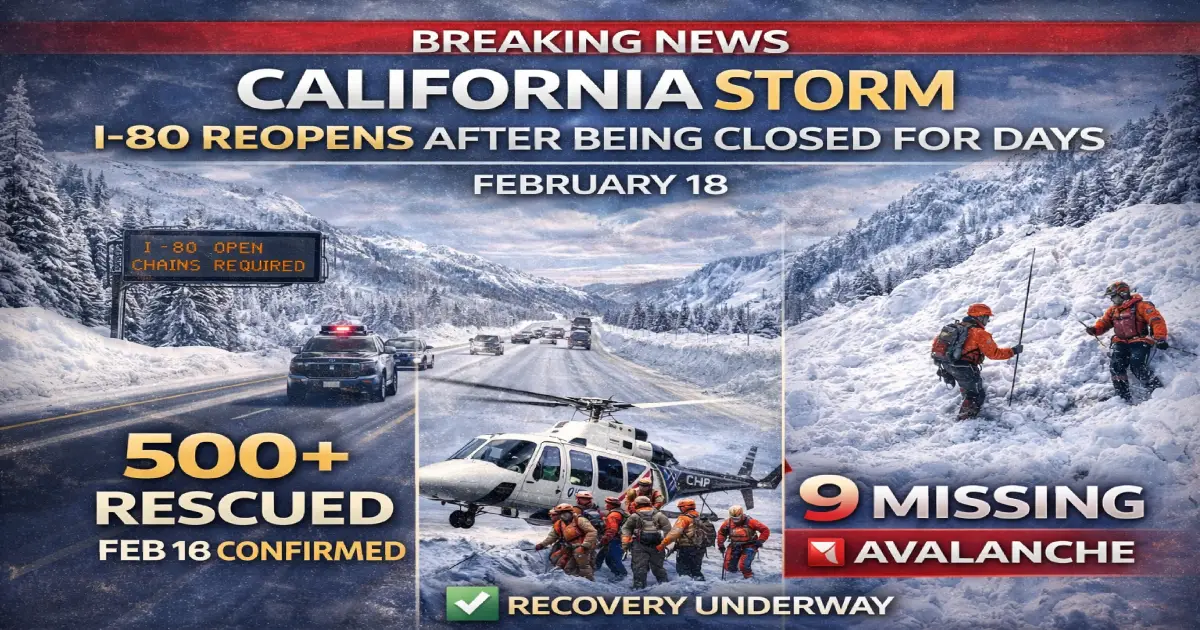
Breaking: California’s historic Presidents Day winter storm enters recovery phase February 18, 2026 as Interstate 80 reopens with chain controls after 60-mile closure—but six backcountry skiers rescued alive from Castle Peak avalanche while nine remain missing in treacherous search, Mammoth Mountain and Palisades Tahoe plan Wednesday reopening after Tuesday total shutdown, and UC Berkeley Snow Lab confirms “worst Sierra conditions in 3 years” with 5-8 feet total snowfall delivered. Here’s everything you need to know now.
Published: February 18, 2026 Event Status: ACTIVE RECOVERY (avalanche search ongoing) I-80 Status: REOPENED with chain controls Avalanche Rescue: 6 alive, 9 missing (Castle Peak) Ski Resorts: Reopen Wednesday Feb 19 (weather permitting) Storm Totals: 5-8 feet through today UC Berkeley: “Worst conditions in 3 years”
The most powerful Sierra Nevada winter storm in three years moves toward resolution February 18 as Interstate 80 reopens with mandatory chain controls from Nevada state line to Drum Forebay—ending a 60-mile closure that stranded thousands during Presidents Day weekend exodus—while dramatic rescue operations continue at Castle Peak where 6 backcountry skiers survived Tuesday’s massive avalanche but 9 remain missing in terrain too dangerous for helicopter evacuation, forcing ground teams on skis and SnoCats to navigate “worst conditions in 3 years” according to UC Berkeley Central Sierra Snow Lab measurements.
Major ski resorts shut down entirely Tuesday (Mammoth Mountain, Palisades Tahoe, Boreal, Sierra-at-Tahoe, Soda Springs) plan Wednesday reopening with limited terrain as operations teams assess avalanche hazards from 5-8 feet of new snow delivered since Sunday—though Mammoth reported wind gusts exceeding 80 mph and near-zero visibility at 2:45 PM Tuesday suggesting conditions may force continued closures if weather doesn’t cooperate overnight.
The Sierra Avalanche Center maintains HIGH avalanche danger through 5 AM Wednesday morning, warning “natural avalanches LIKELY, human-triggered avalanches VERY LIKELY” with travel NOT recommended in backcountry—the same conditions that triggered Tuesday’s catastrophic Castle Peak slide burying 16 skiers (4 guides + 12 clients) on three-day Blackbird Mountain Guides expedition.
Key Numbers:
❄️ 5-8 feet total snow (Sunday-Tuesday) 🚨 Castle Peak avalanche: 6 rescued alive, 9 missing ✅ I-80: REOPENED with chain controls ❌ Resorts closed Tuesday: Mammoth, Palisades, Boreal, Sierra-at-Tahoe, Soda Springs ✅ Reopening Wednesday: Mammoth, Palisades (weather permitting) 🎓 UC Berkeley: “Worst Sierra conditions in 3 years” ⚠️ Avalanche warning: HIGH danger through 5 AM Wed
Nevada County Sheriff’s Office received 911 call reporting avalanche with people buried in Castle Peak area northwest of Lake Tahoe—specifically Frog Lake vicinity near Perry’s Point at approximately 8,200 feet elevation—while blizzard conditions pounded region with 3-4 inches snow per hour creating whiteout conditions that hampered rescue response.
What happened:
16 backcountry skiers (4 guides + 12 clients) from Blackbird Mountain Guides were completing final day of three-day backcountry ski tour staying at Frog Lake Huts (operated by Truckee Donner Land Trust) when massive avalanche struck mid-morning Tuesday as group headed toward Castle Peak trailhead near Boreal ski area alongside I-80—a 3.5-mile route described by land trust as passing through “numerous avalanche hazards.”
Sierra Avalanche Center had issued avalanche warning 5 AM Tuesday (effective through 5 AM Wednesday) rating danger HIGH—second-most-dangerous level below EXTREME—specifically warning: “Travel in, near, or below avalanche terrain is not recommended today. A widespread natural avalanche cycle is expected over the next 24 hours. Large avalanches may run through treed areas.”
Rescue timeline:
11:30 AM Tuesday: 911 call received 11:30 AM-6:00 PM: 46 emergency responders (Nevada County Sheriff Search & Rescue, Placer County Sheriff, Tahoe Nordic Search & Rescue, Washoe County, Truckee Fire, Boreal Mountain Resort ski teams, Tahoe Donner Alder Creek Adventure Center crews) navigate treacherous conditions to reach avalanche site 6:00 PM-10:00 PM: Rescuers locate 6 survivors sheltering in makeshift tarp refuge, evacuate to safety 10:40 PM Tuesday: Nevada County Sheriff confirms 6 rescued, 2 hospitalized, 9 still missing Wednesday morning: Search resumes pending weather conditions (avalanche danger remains HIGH)
Six skiers survived avalanche burial—testament to training, emergency beacons, and luck—with two requiring hospitalization for treatment (conditions not disclosed). Nevada County Sheriff Capt. Russell Greene confirmed survivors maintained communication with authorities through satellite emergency beacons capable of sending text messages:
“They are doing the best they can. They have taken refuge in an area, they have made up a makeshift shelter with a tarp and are doing everything they can to survive and wait for rescue.”
Rescue teams approached cautiously due to continued avalanche danger—triggering secondary slides remained high probability given unstable snowpack from 30+ inches fallen in previous 24 hours combined with high winds loading slopes.
Nine skiers remain unaccounted for as of February 18 morning—buried somewhere in avalanche debris field estimated at massive size based on number of people caught.
Steve Reynaud (Tahoe National Forest avalanche forecaster, Sierra Avalanche Center): “An avalanche burying seven to 10 people would be a very large avalanche, or a group being in a bad location, or potentially both.”
Search complications:
❌ Weather: Continued heavy snow, whiteout conditions, near-zero visibility ❌ Avalanche danger: HIGH rating through Wed 5 AM, additional slides possible ❌ Terrain: Steep, technical backcountry requiring specialized rescue skills ❌ Helicopter impossible: Wind gusts 40-50 mph prevent aerial evacuation ❌ Access: Ground teams on skis/SnoCats only method—slow, dangerous
Nevada County Sheriff’s Office scheduled Wednesday morning news conference to update rescue efforts, though outcome depends heavily on overnight weather improvement.
Castle Peak history:
9,110-foot peak in Donner Summit area is popular backcountry ski destination northwest of Lake Tahoe—part of terrain named for infamous Donner Party (pioneers who resorted to cannibalism after getting trapped winter 1846-1847).
In January 2026, avalanche in Castle Peak area buried and killed snowmobiler. In February 2025, backcountry skier Frederic Dross died in avalanche south of Lake Tahoe. Castle Peak represents sixth avalanche fatality in U.S. this winter (assuming worst-case outcome for missing nine).
Safety equipment standards:
Backcountry skiers should carry:
The Blackbird Mountain Guides group was properly equipped with beacons (how survivors communicated location) and guides were presumably trained in avalanche assessment—yet even professionals caught in “worst conditions in 3 years” during HIGH danger warning.
Trip planning controversy:
Truckee Donner Land Trust notes on Frog Lake Huts website that usual routes have “some degree of avalanche hazard” and path to Castle Peak trailhead passes through “numerous avalanche hazards.”
It’s unclear what land trust’s policy is for guests scheduled to check out when avalanche risk is HIGH (as Tuesday was). Land trust could not be reached for comment.
Avalanche experts universally recommend canceling or postponing backcountry trips when danger rating reaches HIGH or EXTREME—yet economic pressure (paid reservations, non-refundable bookings, client expectations) sometimes pushes guides to proceed despite elevated risk.
Monday Feb 17, early morning: I-80 closed both directions Nevada state line to Drum Forebay due to blizzard, whiteout conditions, near-zero visibility, multiple spinouts, 10+ car pileups
Tuesday Feb 17, 2:30 PM: I-80 REOPENED both directions with mandatory chain controls
Wednesday Feb 18, morning: I-80 REMAINS OPEN with chain controls Nevada state line to Drum Forebay
Commercial trucks: Being turned around at Nevada state line and at Alta due to ongoing hazardous conditions
California Highway Patrol Truckee: “Let’s avoid unnecessary spin-outs and crashes so we can keep the freeway open. Carry chains, reduce your speed, and drive for the conditions. Slow it down and help us keep I-80 moving safely.”
Chain requirements: R-2 (chains or traction devices required on all vehicles except 4WD/AWD with snow tires)
Cautions:
⚠️ Residual snow clearing ongoing ⚠️ Avalanche debris possible on roadway ⚠️ Ice patches under fresh snow ⚠️ Reduced visibility from blowing snow ⚠️ Slow-moving traffic (trucks being turned around creating congestion) ⚠️ Emergency vehicles accessing Castle Peak avalanche site (expect delays near Boreal/Donner Summit area)
Travel recommendation: Monitor Caltrans QuickMap (quickmap.dot.ca.gov) in real-time before departing. Conditions change rapidly—I-80 closed/reopened multiple times during storm.
Storm totals: 31-45 inches new snow Wind gusts: Exceeding 80 mph Visibility: Near-zero at 2:45 PM Tuesday Temperature: Near-zero at summit
Mammoth closed ALL lifts Tuesday—citing deep snow, extreme wind, poor visibility, avalanche hazards requiring operations team assessment before reopening.
Wednesday reopening plan (weather permitting):
Opening from Canyon Lodge and Eagle Lodge bases with rolling lift access:
Reservations: Tuesday and Wednesday bookings required call to 800-MAMMOTH or online cancellation form if not planning to ski
Road conditions: Chains or snow tires REQUIRED, heavy snow creating icy conditions, low visibility from wind-whipped powder
Safety warnings:
Forecast: Continued heavy snow Wednesday, tapering Thursday evening, sunny weekend ahead
Storm totals: 41 inches at 8,000 feet (12+ inches overnight Monday alone) Status Tuesday: ALL lifts on hold, then closed entirely Reason: Poor visibility, avalanche risks, deep snow requiring mountain safety assessment
Palisades implemented temporary base area closures early Tuesday due to avalanche hazards affecting buildings and parking areas—rare safety measure indicating serious instability.
Wednesday reopening: Planned but subject to conditions assessment overnight
CLOSED Tuesday:
OPEN Tuesday (limited):
Mt. Shasta: REOPENED Tuesday (first time this season after snow!)—Northern California resort benefiting from same storm system
The storm hit during peak travel period:
Result: Tens of thousands of skiers/snowboarders at Tahoe region when storm struck, many stranded overnight when I-80 closed Monday, others forced to abandon Tuesday ski plans entirely when resorts shut down.
Economic impact: Lost lift ticket revenue ($150-200/day x thousands of guests), refund requests overwhelming resort customer service, hotel/lodging cancellations, restaurant/retail losses in Tahoe communities dependent on tourism.
Located at Donner Pass (7,200 feet elevation), UC Berkeley’s renowned snow measurement facility confirmed February 18:
“Worst Sierra conditions in 3 years”
This assessment compares current storm to December 2023 “DEEPcember” event (70+ inches in 72 hours, I-80 closed nearly 72 hours), January 2023 atmospheric river series (100+ inches in 10 days, catastrophic flooding), and other major events since 2023.
Mammoth Mountain (Southern Sierra):
Palisades Tahoe (North Lake Tahoe):
Boreal Mountain Resort (Donner Summit):
Soda Springs (near Castle Peak avalanche site):
UC Berkeley Snow Lab (Donner Pass, 7,200 ft):
Higher elevations (8,000-9,000 ft):
Sunday Feb 16 (Storm begins):
Monday Feb 17 (Presidents Day – Peak intensity):
Tuesday Feb 18 (Continued heavy snow, gradual improvement):
Wednesday Feb 19 (Tapering, improvement):
Thursday-Friday (Clearing):
Weekend Feb 22-23 (Sunny, stable):
California’s 2025-26 winter season started slow:
November-December 2025: Below-average precipitation, warm temperatures, ski resorts delayed openings due to insufficient natural snow, Mammoth/Palisades relying heavily on snowmaking, drought concerns resurfacing after wet 2022-23/2023-24 winters
January 2026: Modest snowfall, nothing exceptional
February 2026: MAJOR pattern shift—cold, snowy, active storm track funneling Pacific moisture into Sierra Nevada
The Presidents Day storm represents California’s biggest single event of 2025-26 season, delivering more snow in 48-72 hours than many resorts received entire December-January period.
UC Berkeley Snow Lab’s “worst in 3 years” assessment places storm among Top 10-15 Sierra events of past decade—not historic like February 1986 (12 feet in 6 days) or December 2021 “DEEPcember” (15+ feet multi-week series), but significant by 2020s standards.
Trends:
California experiencing:
Result: Ski resorts face operational challenges—either too little snow (expensive snowmaking, limited terrain, poor conditions) or too much too fast (closures, safety risks, avalanche hazards).
Wednesday-Thursday (Feb 19-20):
⚠️ Resorts reopening with LIMITED terrain (avalanche mitigation ongoing) ⚠️ Expect lift holds, closures without notice as patrol assesses slopes ⚠️ Backcountry remains HIGH avalanche danger (do NOT venture out of bounds) ⚠️ I-80 chain controls continue (carry chains, allow extra travel time) ⚠️ Some roads to resorts may require 4WD/AWD + chains
Friday-Weekend (Feb 21-23):
✅ Conditions improving dramatically ✅ Resorts expanding terrain access ✅ Avalanche danger decreasing to MODERATE/CONSIDERABLE ✅ Sunny forecast = excellent skiing ✅ Fresh powder + stable conditions = prime skiing
Reservations:
Many resorts operating reservation systems (Ikon/Epic Pass limitations, day ticket quotas)—check resort websites before driving up. Mammoth/Palisades may be sold out or require advance booking.
I-80 closure Monday-Tuesday:
No compensation available for highway closures (Acts of God/weather emergencies exempt from liability). However:
Ski resort closures:
If resort closed entirely on day you had tickets/reservations:
✅ Resorts typically offer:
Check resort websites for specific policies—Mammoth, Palisades both posted customer service updates Tuesday night.
Stranded overnight:
If I-80 closure forced unexpected hotel stay:
Backcountry skiing/snowboarding:
❌ DO NOT go out of bounds this week ❌ Avalanche danger remains VERY HIGH despite official warning expiring Wed 5 AM ❌ Snowpack still unstable—human-triggered slides extremely likely ❌ Even experienced guides with proper equipment got caught in Castle Peak avalanche
Wait until avalanche center lowers danger rating to MODERATE (typically 3-5 days after major storm) before considering backcountry access.
Resort skiing:
✅ Stay in bounds on marked trails ✅ Obey rope/fence closures (avalanche mitigation in progress) ✅ Watch for tree wells (deep snow around tree bases—suffocation hazard) ✅ Ski with partner, never alone after major storm ✅ Carry fully charged phone, tell someone your plans
California’s Presidents Day 2026 winter storm delivered “worst Sierra conditions in 3 years” according to UC Berkeley Snow Lab—dropping 5-8 feet of snow, closing I-80 for 60 miles, shutting down major ski resorts entirely, and triggering catastrophic Castle Peak avalanche that rescued 6 backcountry skiers alive but left 9 missing in ongoing search.
Recovery phase began February 18 as I-80 reopened with chain controls (ending 60-mile closure stranding thousands), Mammoth Mountain and Palisades Tahoe planned Wednesday reopening after full Tuesday shutdown, and avalanche warning expired 5 AM Wednesday morning—though HIGH danger persists in unstable terrain requiring continued caution.
For Castle Peak families: Nine remain missing in treacherous search conditions as ground rescue teams on skis and SnoCats navigate avalanche terrain too dangerous for helicopter evacuation. Nevada County Sheriff scheduled Wednesday morning news conference with updates.
For Tahoe/Mammoth travelers: This week offers spectacular fresh powder skiing as resorts reopen terrain gradually Wednesday-Friday, with sunny weekend forecast ahead (Feb 22-23) providing prime conditions. However, I-80 chain controls continue, resort terrain remains limited while patrol assesses avalanche hazards, and backcountry access is OFF LIMITS until snowpack stabilizes (3-5 days minimum).
For California winter sports: The storm proves 2025-26 season—despite slow November-January start—can still deliver major Sierra events when Pacific pattern shifts favorable. Late winter (February-March) increasingly productive period as climate patterns evolve away from early-season November-December snowfall historically dominant.
The worst is over. The best is ahead. But the tragedy at Castle Peak reminds us: winter’s power commands respect, proper planning, and willingness to cancel trips when conditions exceed safe limits—even for experienced guides with paying clients.
Nine families wait for news from Castle Peak. California’s ski community holds its breath.
Is Interstate 80 open now over Donner Summit?
YES. I-80 reopened both directions 2:30 PM Tuesday February 17 with mandatory chain controls from Nevada state line to Drum Forebay. Commercial trucks being turned around at state line and Alta due to hazardous conditions. Chain controls (R-2: chains or traction devices required all vehicles except 4WD/AWD with snow tires) remain in effect through at least Wednesday-Thursday as residual snow clearing continues. Monitor Caltrans QuickMap (quickmap.dot.ca.gov) for real-time status—conditions change rapidly. Allow extra travel time, carry chains, reduce speed, drive for conditions. CHP Truckee warns: “Let’s avoid unnecessary spin-outs and crashes so we can keep the freeway open.”
Are Mammoth Mountain and Palisades Tahoe open today (Wednesday Feb 19)?
PLANNED, weather permitting. Both resorts closed entirely Tuesday due to extreme conditions (heavy snow, high winds, poor visibility, avalanche hazards) and plan limited reopening Wednesday February 19. Mammoth opening from Canyon/Eagle Lodges with select lifts (Roller Coaster Express, Chairs 7/8/20/21, Eagle Express 15, Schoolyard Express 17, Village Gondola). Palisades planning reopening pending overnight conditions assessment. Check resort websites/social media morning of travel—openings subject to change without notice based on weather and avalanche mitigation work. Expect limited terrain, possible lift holds, closures as patrol assesses slopes. Full terrain access likely Friday-weekend as conditions stabilize.
What happened at Castle Peak—are the missing skiers still alive?
6 backcountry skiers RESCUED ALIVE Tuesday evening after massive avalanche 11:30 AM Tuesday buried 16 skiers (4 guides + 12 clients) on Blackbird Mountain Guides three-day tour near Castle Peak. Survivors sheltered in makeshift tarp refuge until 46 emergency responders on skis/SnoCats reached them through blizzard conditions. Two hospitalized, four treated at scene. 9 skiers REMAIN MISSING as of Wednesday morning—buried in avalanche debris field, search ongoing pending weather conditions. Nevada County Sheriff scheduled Wednesday morning news conference with updates. Outcome depends on burial duration, air pocket availability, injuries sustained. Avalanche burial survival decreases dramatically after 15-30 minutes due to asphyxiation—but victims have survived hours-long burials with air pockets. Families waiting for news.
Is it safe to go backcountry skiing this week?
NO. Absolutely not. Sierra Avalanche Center maintains HIGH avalanche danger through 5 AM Wednesday, warning: “Natural avalanches LIKELY, human-triggered avalanches VERY LIKELY, travel NOT recommended in backcountry.” Even after official warning expires, snowpack remains critically unstable for 3-5 days post-storm. Castle Peak avalanche buried 16 skiers including 4 professional guides with proper equipment during HIGH danger period—demonstrating even experts get caught in worst conditions. Wait until avalanche center lowers rating to MODERATE before considering backcountry access. Stick to in-bounds resort skiing this week. Your life depends on respecting avalanche danger ratings.
How much snow fell total in this storm?
5-8 feet storm total at highest elevations (8,000-9,000 ft), 3-5 feet at mid-elevations (7,000-8,000 ft), 2-3 feet at lake level (6,200 ft). Specific measurements: Mammoth Mountain 31-45 inches, Palisades Tahoe 41 inches at 8,000 ft, Boreal/Soda Springs 30 inches past 24 hours, UC Berkeley Snow Lab (Donner Pass 7,200 ft) estimated 4-6 feet. UC Berkeley confirmed “worst Sierra conditions in 3 years”—comparing favorably to December 2023 “DEEPcember” and January 2023 atmospheric river series. Not historic by 1980s-1990s standards (February 1986 saw 12 feet in 6 days), but significant by 2020s norms. Storm delivered more snow in 48-72 hours than many resorts received entire December-January period.
Why did ski resorts close entirely on Tuesday?
Safety. Mammoth Mountain reported wind gusts exceeding 80 mph, near-zero visibility, extreme avalanche hazards requiring operations team assessment before allowing public access. Palisades Tahoe received 12+ inches overnight Monday on top of 29 inches previous days, creating unstable snowpack loading. Resorts closed to: (1) Protect guests from avalanche hazards, tree well suffocation risks, hypothermia exposure, getting lost in whiteout conditions. (2) Allow ski patrol to conduct avalanche mitigation work (explosive control, slope assessment, terrain opening evaluation). (3) Prevent lift mechanical failures in extreme wind, visibility preventing safe evacuation if lifts malfunction. (4) Clear snow from lifts, buildings, parking areas. Full closures rare—indicate serious conditions beyond normal operations capability. Better to close one day, reopen safely Wednesday, than risk guest injuries/deaths.
Will my Presidents Day lift ticket be refunded or extended?
Most likely YES. Ski resorts typically offer three options when closing entirely: (1) Full refund to original payment method, (2) Credit toward future visit equal to ticket value, (3) Automatic ticket validity extension (use ticket any remaining day this season). Specific policies vary by resort—check Mammoth Mountain and Palisades Tahoe websites for customer service updates posted Tuesday night. Many resorts automatically extend validity without requiring guest action. If you had multi-day lift ticket (e.g. 3-day pass, lost day 2 to closure), most resorts add one day to back end (so 3-day becomes 4-day pass). Contact resort guest services with booking confirmation/ticket number for assistance. Season pass holders (Ikon, Epic, Mammoth, Palisades) unaffected—no refunds for weather closures as passes grant access to available days, not guaranteed skiing.
What’s the forecast for this weekend—should I cancel my trip?
NO—don’t cancel! Forecast excellent for Friday-weekend (Feb 21-23): Sunny skies, light winds, stable conditions, fresh powder from storm, resorts expanding terrain access as avalanche mitigation completes. This will be PRIME SKIING weekend—best conditions of 2025-26 season for many resorts. I-80 chain controls likely lifted by Saturday (unless new storm approaches). Avalanche danger decreasing to MODERATE/CONSIDERABLE by weekend (still carry proper equipment if going out of bounds, check daily forecasts). Hotel/lodging availability may be limited as travelers rebook from cancelled Monday-Tuesday plans—book accommodations now if haven’t already. Check resort reservation systems (Mammoth/Palisades may require advance day tickets or have Ikon/Epic Pass blackout dates Presidents Week). Bottom line: This weekend offers spectacular skiing—don’t miss it!
How does this storm compare to other recent California winters?
UC Berkeley Snow Lab calls it “worst in 3 years”—so December 2023 “DEEPcember” (70+ inches 72 hours), January 2023 atmospheric rivers (100+ inches 10 days), and massive February-March 2023 series (700+ inches season total at Palisades) remain larger. But this storm ranks Top 10-15 Sierra events of past decade. Context: California experiencing climate-driven shift from frequent moderate storms to fewer but more intense events. 2025-26 season started slow (November-January below average), then February delivered major punch. Pattern increasingly common—boom-bust rather than steady snowpack buildup. For ski resorts: Either drought (expensive snowmaking, limited terrain) or deluge (closures, safety risks). Middle ground disappearing. This storm proves late winter (Feb-March) remains productive despite early season struggles—don’t write off season based on poor November-December.
For More Resources:
Related Articles:
Posted By : Vinay
This article is provided for general informational purposes only and is based on information available at the time of publication. Travel advisories, airline schedules, airport operations, visa requirements, government regulations, and other travel-related information are subject to change without prior notice. While Travel Tourister makes reasonable efforts to verify information using official announcements, government publications, airline and airport communications, and other reliable sources, we cannot guarantee that all information remains complete, accurate, or up to date at all times. Readers should independently verify any information that may affect their travel plans with the relevant airline, airport authority, government agency, embassy, or other official source before making travel, financial, or other decisions. Travel Tourister shall not be liable for any direct or indirect loss, inconvenience, or damages arising from the use of or reliance on the information contained in this article. Nothing in this publication constitutes legal, immigration, financial, or professional travel advice. If you believe any information in this article is inaccurate or outdated, please contact our editorial team. We review all credible correction requests promptly and update our content whenever appropriate.
Lastest News
2nd Floor, 39, Above Kirti Club, DLF Industrial Area, Kirti Nagar, New Delhi, Delhi 110015



Travel Tourister is a leading Travel portal where we introduce travellers to trusted travel agents to make their journey hasselfree, memorable And happy. Travel Tourister is a platform where travellers get Tour packages ,Hotel packages deals through trusted travel companies And hoteliers who are working with us across the world. We always try to find new and more travel agents and hoteliers from every nook and corners across the world so that you could compare the deals with different travel agents and hoteliers and book your tour or hotel with the one you have chosen according to your taste and budget.
Copyright © Travel Tourister, India. All Rights Reserved

 Call
Call Enquiry