Published on : 23 Mar 2026
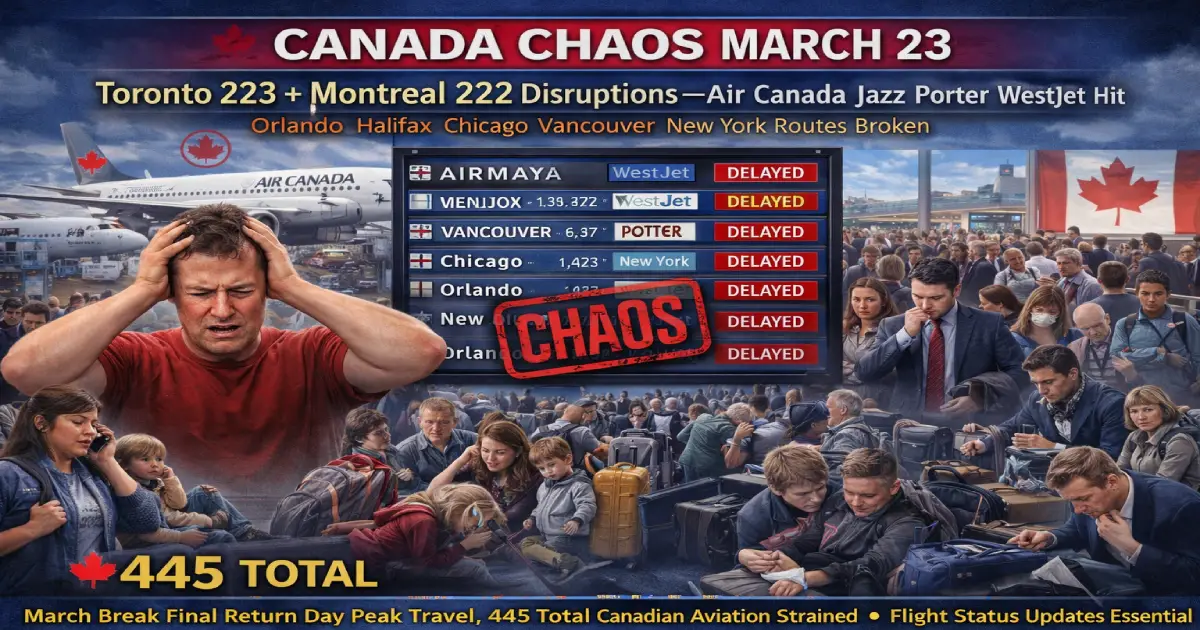
Breaking: Canada’s two largest airports record combined 445 disruptions Sunday March 23, 2026 as Toronto Pearson International Airport suffers 15 cancellations + 208 delays = 223 total + Montreal-Trudeau International Airport records 10 cancellations + 212 delays = 222 total affecting Air Canada (10 cancels + 83 delays Toronto, 2 cancels + 73 delays Montreal), Jazz (4 cancels + 21 delays Toronto, 6 cancels + 57 delays Montreal), Porter Airlines (1 cancel + 26 delays Toronto, 1 cancel + 17 delays Montreal), WestJet (26 delays Toronto, 12 delays Montreal) disrupting routes to Orlando, Halifax, Chicago O’Hare, Vancouver, New York LaGuardia, Fort Lauderdale, Cancun, Punta Cana, Paris creating widespread operational strain during March Break final return day (Canada’s spring break equivalent) when thousands of families travel back from Florida beach vacations, Caribbean resorts, European getaways as Canadian aviation network experiences concentrated pressure with both domestic + US-bound + international routes affected simultaneously forcing passengers repeatedly check airline apps, airport websites for flight status updates before departing homes. Here’s what every Canadian traveler needs to know now.
Published: March 23, 2026 (Sunday) — MARCH BREAK FINAL DAY Total Canadian Disruptions: 445 total (Toronto 223 + Montreal 222) Toronto Pearson (YYZ): 15 cancellations + 208 delays = 223 total (~17% of daily operations) Montreal-Trudeau (YUL): 10 cancellations + 212 delays = 222 total (~19% of daily operations!) Airlines Affected: Air Canada (primary), Jazz (regional), Porter Airlines, WestJet, Air Canada Rouge Routes Disrupted: Orlando, Halifax, Chicago, Vancouver, NYC LaGuardia, Fort Lauderdale, Cancun, Punta Cana, Paris Root Cause: March Break final return day peak travel + operational strain + weather systems Passenger Impact: Thousands adjusting travel plans, missed connections, extended airport waits Critical Timing: Sunday = mass return day from week/2-week vacations
Sunday, March 23, 2026 disrupts Canadian aviation as Toronto Pearson + Montreal-Trudeau airports—nation’s two largest gateways handling ~35% of Canadian air traffic!—record combined 445 disruptions (Toronto 15 cancels + 208 delays = 223 total, Montreal 10 cancels + 212 delays = 222 total) affecting Air Canada (Canada’s flag carrier + dominant domestic operator), Jazz (Air Canada Express regional subsidiary), Porter Airlines (Canadian low-cost carrier), WestJet (Canada’s second-largest airline) across routes to Orlando Florida (March Break beach destination!), Halifax Nova Scotia (Atlantic Canada hub), Chicago O’Hare (US Midwest gateway), Vancouver British Columbia (cross-Canada corridor), New York LaGuardia (Northeast US), Fort Lauderdale Florida, Cancun Mexico, Punta Cana Dominican Republic, Paris France during March Break final return day when Canadian families travel back from week/2-week vacations creating peak Sunday travel volumes that strain aviation system already experiencing concentrated operational pressure (both major hubs disrupted simultaneously = network-wide cascading effects!).
Toronto Pearson (YYZ) Disruptions:
✈️ Total: 15 cancellations + 208 delays = 223 total ✈️ Disruption rate: ~17% of daily operations (Pearson operates ~1,300 flights/day normally) ✈️ Canada’s busiest: ~50 million passengers/year (largest Canadian airport!) ✈️ Primary airlines: Air Canada (dominant carrier), WestJet, Porter Airlines, Air Canada Rouge, international carriers ✈️ Network impact: Toronto = Canadian hub (disruptions ripple nationwide + US/international)
Air Canada Toronto:
✈️ 10 cancellations + 83 delays: Flag carrier hit hardest (93 total disruptions = 42% of Toronto total!) ✈️ Hub operations: Toronto = Air Canada’s primary hub (connects domestic + international) ✈️ Tight connections: Hub-and-spoke delays cascade (passengers miss onwards flights!)
Jazz Toronto:
✈️ 4 cancellations + 21 delays: Regional carrier (operates Air Canada Express brand) ✈️ Smaller aircraft: 50-70 seat turboprops + regional jets (short-haul routes) ✈️ Network feeder: Connects smaller cities to Toronto hub for Air Canada connections
Porter Airlines Toronto:
✈️ 1 cancellation + 26 delays: Canadian low-cost carrier based Toronto City Centre (Billy Bishop) ✈️ Eastern focus: Serves eastern Canada + northeastern US ✈️ Competition: Competes with Air Canada on Toronto-Montreal-Ottawa-Halifax corridor
WestJet Toronto:
✈️ 0 cancellations + 26 delays: Canada’s second-largest airline ✈️ Point-to-point network: Direct routes (vs Air Canada hub-and-spoke) ✈️ Western focus: Calgary hub BUT significant Toronto presence
Air Canada Rouge Toronto:
✈️ 0 cancellations + 22 delays: Air Canada’s leisure subsidiary ✈️ Vacation routes: Caribbean, Mexico, Florida, Europe leisure destinations ✈️ March Break heavy: Peak season for Rouge operations (families to beach destinations!)
Montreal-Trudeau (YUL) Disruptions:
✈️ Total: 10 cancellations + 212 delays = 222 total ✈️ Disruption rate: ~19% of daily operations (Montreal operates ~1,100 flights/day normally) ✈️ Canada’s second-largest: ~20 million passengers/year ✈️ Quebec gateway: Serves French-speaking Quebec province + eastern Canada ✈️ Hub operations: Air Canada + Air Transat hub, international gateway to Europe
Air Canada Montreal:
✈️ 2 cancellations + 73 delays: 75 total disruptions (34% of Montreal total!) ✈️ Hub #2: Montreal = Air Canada’s second hub (after Toronto) ✈️ Europe focus: Strong trans-Atlantic routes (Paris, London, Frankfurt)
Jazz Montreal:
✈️ 6 cancellations + 57 delays: 63 total disruptions (28% of Montreal total!) ✈️ Higher cancellation rate: Jazz Montreal = 6 cancels (vs Jazz Toronto = 4) despite smaller base ✈️ Regional network: Connects Quebec cities + Atlantic Canada to Montreal hub
Porter Airlines Montreal:
✈️ 1 cancellation + 17 delays: Eastern carrier linking Toronto-Montreal-Ottawa triangle ✈️ Business corridor: Toronto-Montreal = high business travel demand
WestJet Montreal:
✈️ 0 cancellations + 12 delays: Limited Montreal presence (WestJet = western-based) ✈️ Domestic competition: Competes with Air Canada on Montreal-Toronto-Vancouver routes
Additional Affected Carriers:
✈️ Air Transat: Multiple delays (Montreal-based vacation carrier) ✈️ Air Canada Rouge: Delays affecting leisure routes ✈️ Air France: Multiple delays (Paris CDG-Montreal route) ✈️ American Airlines: 3 delays (US cross-border routes Toronto/Montreal-US) ✈️ United Airlines: Delays on Chicago O’Hare connections ✈️ Air India: Delays on Toronto-Delhi route
Major Destinations Affected:
Domestic Canada:
✈️ Halifax Nova Scotia: Atlantic Canada hub (multiple delays both Toronto + Montreal) ✈️ Vancouver British Columbia: Cross-Canada corridor (major route, high frequency) ✈️ Toronto ↔ Montreal: Busiest Canadian domestic route (shuttle service!) ✈️ Ottawa Ontario: Capital city (business travel corridor) ✈️ Calgary Alberta: Western hub (WestJet base)
United States:
✈️ Orlando Florida: TOP March Break destination (Disney World, Universal, beaches!) ✈️ Chicago O’Hare: Midwest hub (Air Canada + United connections) ✈️ New York LaGuardia: Northeast gateway (Porter, Air Canada routes) ✈️ Fort Lauderdale Florida: Beach destination + cruise port gateway
International:
✈️ Cancun Mexico: Caribbean beach resort (March Break favorite!) ✈️ Punta Cana Dominican Republic: All-inclusive resort destination ✈️ Paris CDG France: Trans-Atlantic gateway (Air Canada + Air France)
March Break Context:
✈️ Final return day: Sunday March 23 = mass return from week/2-week vacations ✈️ Peak travel volume: Canadian schools’ spring break (similar to US but different timing!) ✈️ Vacation destinations: Florida, Caribbean, Mexico = top March Break choices ✈️ Family travel: Parents + kids returning Sunday for Monday school/work restart
Root Causes (Multiple Factors):
✈️ Peak travel demand: March Break final day = highest Sunday travel volume of year ✈️ Weather systems: Residual winter conditions across Canada + US routes ✈️ Operational strain: Airlines operating near capacity (110-120% pre-COVID volumes!) ✈️ Crew positioning: Weekend operations + staffing challenges ✈️ Aircraft turnaround: Tight scheduling squeezed by delays = cascading effects
Interpretation: Canada’s 445 total disruptions (Toronto 223 + Montreal 222) expose aviation network’s vulnerability during March Break final return day when peak Sunday travel volumes converge with operational strain, affecting Air Canada (12 cancels + 156 delays = 168 total disruptions across both airports!), Jazz (10 cancels + 78 delays = 88 total), Porter (2 cancels + 43 delays = 45 total), WestJet (38 delays) during critical family return period from Florida beaches, Caribbean resorts, Mexican all-inclusives as Canadian aviation system strained by concentrated demand + both major hubs disrupted simultaneously creating network-wide cascading delays.
Toronto Pearson International Airport—Canada’s largest gateway handling ~50 million passengers/year—suffered 15 cancellations + 208 delays March 23.
Why Toronto Pearson Matters:
Scale + Importance:
✈️ 50 million passengers/year: Canada’s busiest airport (handles ~35% of Canadian air traffic!) ✈️ ~1,300 flights/day: Dense scheduling = any disruption cascades quickly ✈️ Primary hub: Air Canada operates major hub-and-spoke network through Toronto ✈️ International gateway: Trans-Atlantic, trans-Pacific, Caribbean, Latin America routes
Air Canada Dominance:
✈️ ~40% market share: Air Canada operates ~520 of Toronto’s 1,300 daily flights ✈️ Terminal 1: Air Canada’s primary terminal (largest tenant!) ✈️ Hub-and-spoke model: Air Canada funnels passengers through Toronto connections ✈️ Tight scheduling: Arrival/departure banks coordinated (delays break entire banks!)
Why 223 Disruptions Matters:
Hub Connection Math:
Example—March Break Family Return:
The Martinez family (2 adults + 3 kids) returning from Orlando Disney World vacation:
Montreal-Trudeau International Airport suffered 10 cancellations + 212 delays March 23, nearly matching Toronto’s disruption level.
Why Montreal-Trudeau Matters:
Quebec + Eastern Canada Hub:
✈️ 20 million passengers/year: Canada’s second-busiest airport ✈️ ~1,100 flights/day: High volume operations ✈️ Quebec gateway: Serves French-speaking Quebec province (8.5 million population!) ✈️ Atlantic Canada: Major connection point for Halifax, St. John’s, Moncton ✈️ Europe focus: Strong trans-Atlantic routes (Paris, London, Brussels = Francophone connections!)
Air Canada + Air Transat Hub:
✈️ Air Canada: Montreal = second hub (after Toronto) ✈️ Air Transat: Montreal-based vacation carrier (specializes Caribbean, Europe leisure) ✈️ Competition: Both carriers vie for Montreal market share
Why 222 Disruptions Significant:
Higher Disruption Rate:
Jazz Cancellation Problem:
Example—Atlantic Canada Passenger:
Sarah booked Air Canada connecting through Montreal:
March 23 Reality:
Air Canada—Canada’s flag carrier + largest airline—suffered 12 cancellations + 156 delays across Toronto + Montreal March 23.
Air Canada at Toronto + Montreal:
Toronto:
✈️ 10 cancellations + 83 delays = 93 total: 42% of Toronto disruptions! ✈️ Hub operations: Connects domestic + international network ✈️ Premium routes: Trans-Atlantic, trans-Pacific, Caribbean, US cities
Montreal:
✈️ 2 cancellations + 73 delays = 75 total: 34% of Montreal disruptions! ✈️ Hub #2: Secondary hub for European connections ✈️ Quebec focus: Serves French-speaking market
Combined:
✈️ 12 cancellations + 156 delays = 168 total Air Canada disruptions! ✈️ 38% of Canada total: Air Canada accounts for over 1/3 of all Canadian disruptions March 23!
Why Air Canada Hit Hardest:
Hub-and-Spoke Vulnerability:
Fleet Utilization:
March Break Pressure:
Jazz (operating as Air Canada Express)—regional subsidiary connecting smaller cities to Air Canada hubs—suffered 10 cancellations + 78 delays March 23.
Jazz Operations:
Aircraft:
✈️ Small planes: 50-75 seat Dash 8 turboprops + CRJ regional jets ✈️ Short-haul routes: Connects small/medium cities to Toronto + Montreal hubs ✈️ Essential service: Many cities have ONLY Jazz flights (no alternatives!)
Network:
✈️ Toronto feeder: Brings passengers from Ottawa, London ON, Thunder Bay, Sudbury, etc. to Toronto hub ✈️ Montreal feeder: Brings passengers from Quebec City, Fredericton, Moncton, etc. to Montreal hub ✈️ Critical connections: Jazz passengers typically connecting to Air Canada long-haul flights
Why Jazz Cancellations Devastating:
No Alternatives:
Missed Connections:
March 23 disruptions devastated three critical route groups:
Why Toronto/Montreal → Orlando Matters:
✈️ #1 March Break destination: Disney World + Universal + beaches = Canadian family favorite! ✈️ High frequency: Air Canada, WestJet, Porter all operate Toronto/Montreal-Orlando routes ✈️ Peak season: March = highest Orlando travel volume for Canadians ✈️ All-age appeal: Theme parks (kids), weather (escaping Canadian winter!), easy travel (direct flights ~3 hours)
March 23 Impact:
Example—Ottawa Family:
The Chen family lives Ottawa, vacationed Orlando:
Why Halifax Matters:
✈️ Atlantic Canada gateway: Serves Nova Scotia, New Brunswick, Prince Edward Island ✈️ Regional hub: Connects smaller Maritime cities to national network ✈️ Toronto/Montreal connections: Halifax passengers typically connect through Toronto OR Montreal to reach Western Canada, US, international ✈️ Frequency: Air Canada + WestJet + Porter all operate Toronto/Montreal-Halifax routes
March 23 Impact:
Why Toronto/Montreal → Chicago Matters:
✈️ Business corridor: Major corporate travel route ✈️ Hub connections: Chicago O’Hare = United hub (connects to rest of US) ✈️ Cross-border: High volume Canada-US travel ✈️ Frequency: Air Canada + United both operate Toronto/Montreal-Chicago routes
March 23 Impact:
March 23 timing = critical factor in disruption severity.
What is March Break?
Canadian School Holiday:
✈️ Timing: Mid-March (typically 3rd week of March) ✈️ Duration: 1 week (some provinces 2 weeks) ✈️ Equivalent: Similar to US spring break BUT different timing (US = late March/early April) ✈️ Travel pattern: Canadian families escape winter (head to Florida, Caribbean, Mexico!)
Top March Break Destinations:
Why Sunday March 23 = Worst Day:
Return Traffic Peak:
Volume Math:
Sold-Out Flights:
Example—Typical March Break Family:
The Rodriguez family (2 adults + 2 kids age 7, 10):
If You’re Flying Through Toronto/Montreal Soon:
If You’re Currently Stranded at Toronto/Montreal:
Short Answer: Gradual improvement Monday March 24 (March Break ends, school resumes).
Recovery Timeline:
Sunday March 23 Evening (6:00-10:00 PM):
Monday March 24:
Tuesday March 25 onward:
Wild Cards:
Canada’s March 23 disruptions continue pattern of March Break aviation chaos:
Recent Canadian Disruptions:
March 21, 2026 (2 days ago):
March 16, 2026 (1 week ago):
March 20, 2026 (3 days ago):
March 23, 2026 (TODAY):
Pattern Analysis:
Canada’s two largest airports record combined 445 disruptions Sunday March 23, 2026 as Toronto Pearson International Airport suffers 15 cancellations + 208 delays = 223 total (~17% of daily operations!) + Montreal-Trudeau International Airport records 10 cancellations + 212 delays = 222 total (~19% of daily operations!) affecting Air Canada (12 cancels + 156 delays = 168 total disruptions = 38% of Canadian total!), Jazz (10 cancels + 78 delays = 88 total), Porter Airlines (2 cancels + 43 delays = 45 total), WestJet (38 delays) across routes to Orlando Florida (TOP March Break destination!), Halifax Nova Scotia (Atlantic Canada hub), Chicago O’Hare (US Midwest gateway), Vancouver BC (cross-Canada corridor), New York LaGuardia, Fort Lauderdale, Cancun Mexico, Punta Cana Dominican Republic, Paris France during March Break final return day when thousands of Canadian families travel back from week/2-week Florida beaches, Caribbean resorts, Mexican all-inclusives creating peak Sunday travel volumes that strain aviation system already experiencing concentrated operational pressure (both major hubs disrupted simultaneously = network-wide cascading effects!).
For travelers: Check flight status obsessively BEFORE leaving home (Air Canada/WestJet/Porter apps, FlightAware, airport websites). Arrive 3-4 hours early (NOT normal 90 min-2 hours!). Build massive connection buffers (3-4 hours domestic, 4-6 hours international minimum). Know Canadian passenger rights (APPR = compensation $400-$1,000 CAD for airline-caused delays + care obligations). Travel insurance covers delays (file claims for extra costs). Consider alternative routing (avoid Toronto/Montreal via Calgary/Vancouver if possible). Use airline apps for self-service rebooking (faster than counters/phone). Airport hotels limited (book immediately if stranded). Recovery expected Monday March 24 (March Break ends, demand drops 30-40%). Canada’s recurring March Break pattern (March 16 = 844 disruptions, March 21 = 849 disruptions NEW RECORD, TODAY = 445 disruptions final return day) exposes aviation network’s annual vulnerability to peak spring break demand when families escape Canadian winter for Florida/Caribbean/Mexico vacations, overwhelming system capacity during compressed 7-10 day period that strains Air Canada hub-and-spoke operations (tight connections break!), Jazz regional network (small cities left stranded!), creating what Canadian travelers describe as “annual March Break airport nightmare” that ends Monday when school + work resume + travel volumes plummet back to normal.
445 disruptions. Toronto 223 (17% operations!). Montreal 222 (19% operations!). Air Canada 168 total (38% of all!). Orlando, Halifax, Chicago routes broken. March Break final return day. Sold-out flights. Tight connections missed. Families stranded. Monday recovery expected.
For More Resources:
Related Articles:
Posted By : Vinay
This article is provided for general informational purposes only and is based on information available at the time of publication. Travel advisories, airline schedules, airport operations, visa requirements, government regulations, and other travel-related information are subject to change without prior notice. While Travel Tourister makes reasonable efforts to verify information using official announcements, government publications, airline and airport communications, and other reliable sources, we cannot guarantee that all information remains complete, accurate, or up to date at all times. Readers should independently verify any information that may affect their travel plans with the relevant airline, airport authority, government agency, embassy, or other official source before making travel, financial, or other decisions. Travel Tourister shall not be liable for any direct or indirect loss, inconvenience, or damages arising from the use of or reliance on the information contained in this article. Nothing in this publication constitutes legal, immigration, financial, or professional travel advice. If you believe any information in this article is inaccurate or outdated, please contact our editorial team. We review all credible correction requests promptly and update our content whenever appropriate.
Lastest News
2nd Floor, 39, Above Kirti Club, DLF Industrial Area, Kirti Nagar, New Delhi, Delhi 110015



Travel Tourister is a leading Travel portal where we introduce travellers to trusted travel agents to make their journey hasselfree, memorable And happy. Travel Tourister is a platform where travellers get Tour packages ,Hotel packages deals through trusted travel companies And hoteliers who are working with us across the world. We always try to find new and more travel agents and hoteliers from every nook and corners across the world so that you could compare the deals with different travel agents and hoteliers and book your tour or hotel with the one you have chosen according to your taste and budget.
Copyright © Travel Tourister, India. All Rights Reserved

 Call
Call Enquiry