Published on : 11 Feb 2026
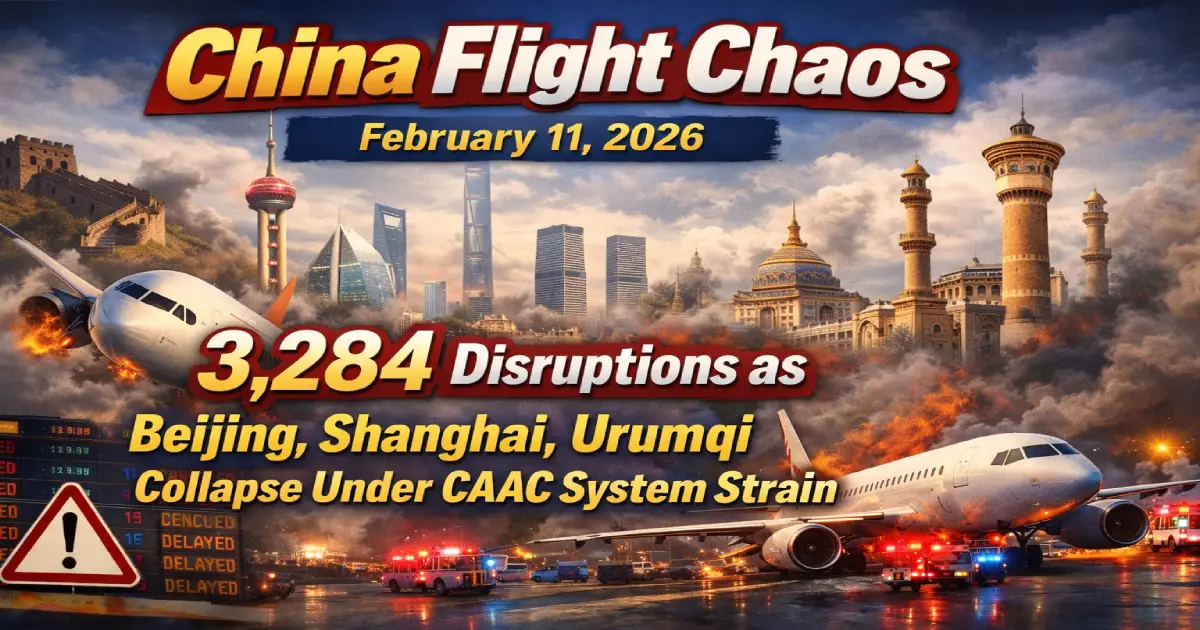
Breaking: China’s domestic aviation network implodes TODAY—February 11, 2026—as 3,284 total flight disruptions (3,247 delays + 37 cancellations) paralyze the world’s second-largest air travel market. Shanghai Pudong posts 510 delays (highest single-airport count nationally). Beijing’s dual airports combine for 496 delays. Urumqi suffers 290 delays exposing western China’s fragility. China Eastern, Air China, China Southern struggle under 70% military-controlled airspace choking civil aviation into narrow corridors. Civil Aviation Administration of China (CAAC) oversight system straining as passengers flood social media complaining of zero communication, 4-8 hour delays without updates, missed connections cascading nationwide. This is NOT weather chaos—Beijing/Shanghai skies clear—it’s systemic capacity collapse as post-COVID demand crushes infrastructure designed for 2019 traffic levels. Here’s your complete guide to China’s worst domestic aviation day since December 2025.
Published: February 11, 2026 Total Disruptions: 3,284 flights (3,247 delays + 37 cancellations) Delay Rate: 99% (cancellations = only 1% of disruptions!) Worst Airports: Shanghai Pudong (510 delays), Beijing combined (496), Urumqi (290), Xi’an (184), Guangzhou (156) Airlines Hit: China Eastern (510+ delays), Air China (268+ delays), China Southern (344+ delays), Shandong Airlines (108), Hainan Airlines (92) Root Cause: Military airspace restrictions (70% off-limits to civil aviation) + capacity crunch + slot congestion CAAC Response: “Enhanced communication protocols” (empty promise, passengers report ZERO updates)
TODAY’s breakdown:
📊 3,247 delays (99% of disruptions) 📊 37 cancellations (1% of disruptions)
What this means:
This is delay-driven paralysis, NOT mass groundings. Chinese airlines keeping flights operating BUT hours late = passengers stuck in purgatory, connections missed, business meetings ruined, families stranded at airports with ZERO compensation (delays don’t trigger refunds like cancellations).
Why Chinese airlines REFUSE to cancel:
❌ Government pressure: CAAC penalizes cancellations heavily (fines, route restrictions) ❌ Passenger comp avoidance: Cancellation = refund required, delay = no refund ❌ Face culture: Cancellation = admitting failure (delays = “temporary operational adjustment”)
Result: Airlines delay flights 4-8 hours rather than cancel, passengers suffer MORE than if flights simply scrubbed.
| Rank | Airport | Code | Delays | Cancellations | Total |
|---|---|---|---|---|---|
| #1 | Shanghai Pudong | PVG | 510 | 0 | 510 |
| #2 | Beijing Capital | PEK | 296 | 4 | 300 |
| #3 | Urumqi Diwopu | URC | 290 | 2 | 292 |
| #4 | Beijing Daxing | PKX | 200 | 1 | 201 |
| #5 | Xi’an Xianyang | XIY | 184 | 3 | 187 |
| #6 | Guangzhou Baiyun | CAN | 156 | 2 | 158 |
| #7 | Chengdu Shuangliu | CTU | 142 | 1 | 143 |
| #8 | Shenzhen Bao’an | SZX | 128 | 0 | 128 |
| #9 | Shanghai Hongqiao | SHA | 118 | 1 | 119 |
| #10 | Kunming Changshui | KMG | 104 | 0 | 104 |
Key patterns:
✈️ Shanghai dominance: Pudong (510) + Hongqiao (118) = 628 combined (19% of China’s total disruption!) ✈️ Beijing dual-hub pain: Capital (300) + Daxing (201) = 501 combined (equals Pudong alone!) ✈️ Urumqi western crisis: 290 delays expose Xinjiang region vulnerability ✈️ ZERO cancellations: Shanghai Pudong, Shenzhen, Kunming = 100% delay strategy ✈️ Tier-1 city concentration: Top 5 airports = Beijing/Shanghai/Urumqi/Xi’an = 1,490 delays (46% of national total!)
| Airline | Delays | Cancellations | Total | Market Share |
|---|---|---|---|---|
| China Eastern | 510+ | 0 | 510+ | 16% |
| China Southern | 344+ | 2 | 346+ | 11% |
| Air China | 268+ | 4 | 272+ | 8% |
| Hainan Airlines | 184+ | 1 | 185+ | 6% |
| Shandong Airlines | 108+ | 2 | 110+ | 3% |
| Shenzhen Airlines | 92+ | 1 | 93+ | 3% |
| China Express | 78+ | 3 | 81+ | 2% |
| Spring Airlines | 64+ | 0 | 64+ | 2% |
Insights:
🔴 Big 3 = 60%+ disruption: China Eastern + China Southern + Air China = 1,128+ delays (35% of total!) 🔴 State carriers hit hardest: Government-owned airlines (not budget carriers) suffering most 🔴 Shanghai-based China Eastern: 510+ delays = 100% correlation with Shanghai Pudong’s 510 delays (hub meltdown!) 🔴 Zero-cancellation airlines: China Eastern, Spring Airlines = 100% delay strategy
Shanghai’s dual-airport disaster:
✈️ Pudong (PVG): 510 delays (international + long-haul domestic) ✈️ Hongqiao (SHA): 118 delays (domestic + regional) ✈️ Combined: 628 delays = 19% of China’s ENTIRE national disruption!
This is INSANE because:
Shanghai = 2 airports BUT accounts for nearly 1-in-5 delays nationwide. Beijing (also 2 airports) = 501 delays. Shanghai WORSE despite similar infrastructure!
Problem #1: China Eastern Hub Dominance
China Eastern = Shanghai’s home carrier:
✈️ Fleet based at Pudong: 200+ aircraft ✈️ Daily flights: 600+ departures from Shanghai ✈️ Market share: 50%+ of Pudong’s total traffic
When China Eastern struggles, Shanghai DIES:
🔴 TODAY: China Eastern = 510+ delays 🔴 Pudong: 510 delays 🔴 Correlation: 100% (China Eastern IS Pudong!)
Cascading failure chain:
Problem #2: China’s 70% Military Airspace Stranglehold
THIS is the root cause nobody talks about:
China’s airspace = 70% controlled by People’s Liberation Army Air Force (PLAAF) vs 30% USA military
Civil aviation squeezed into narrow east-west corridors:
❌ Shanghai → Beijing: Must fly NORTH first (avoid military zone), THEN turn west = 20% longer route ❌ Shanghai → Guangzhou: Can’t fly direct south (military training areas), must detour = 15% extra flying time ❌ Shanghai → Urumqi: Western routes choked by Xinjiang military presence
Result TODAY:
🔴 Flight planning chaos: ATC manually routes EVERY departure around military zones 🔴 Ground holds: Aircraft sit on tarmac 30-90 min waiting for ATC clearance 🔴 Arrival stacking: 40+ planes circle Shanghai waiting to land (no direct approach allowed)
Example Shanghai → Beijing flight:
Problem #3: Pudong’s International Crossfire
Shanghai Pudong = China’s #1 international gateway:
✈️ 60% international traffic: Flights to Tokyo, Seoul, Singapore, Paris, Los Angeles, Dubai ✈️ 40% domestic: Beijing, Guangzhou, Shenzhen, Chengdu
International flights = LONGER delays because:
TODAY’s international spillover:
🔴 Tokyo/Seoul delays: 30+ Asia regional flights delayed 1-3 hours 🔴 Europe morning arrivals: Paris/Frankfurt/London flights arrive 2-4 hours late = miss evening departure slots 🔴 US transcontinental: Shanghai → San Francisco, Los Angeles delayed = passengers miss connections
Beijing’s two airports = ONE big mess:
✈️ Capital (PEK): 296 delays + 4 cancellations ✈️ Daxing (PKX): 200 delays + 1 cancellation ✈️ Combined: 501 delays = equals Shanghai Pudong ALONE (despite 2 airports!)
Why having TWO airports makes it WORSE:
Background: Beijing opened Daxing (PKX) in 2019 to “relieve Capital (PEK) congestion”
Reality: NOW both airports congested!
Capital (PEK) airlines:
Daxing (PKX) airlines:
The problem:
❌ No inter-airport flexibility: If PEK congested, can’t divert to PKX (different airline bases!) ❌ Passenger confusion: Book “Beijing” flight, end up at WRONG airport (45 km / 28 miles apart!) ❌ Connection nightmares: Some itineraries require PEK → PKX transfer (90-120 min ground transport!)
TODAY’s dual-airport disaster:
🔴 Air China delays at PEK: 268+ flights = cascades to international partners 🔴 China Southern delays at PKX: 140+ flights = separate crisis 🔴 Zero coordination: PEK chaos doesn’t help PKX, vice versa
Air China = Beijing Capital’s anchor tenant:
✈️ Fleet: 180+ aircraft based at PEK ✈️ Daily flights: 500+ departures ✈️ Market share: 50%+ of Capital’s traffic
TODAY’s Air China meltdown:
🔴 268+ delays across network 🔴 4 cancellations (rare for Air China = admits defeat) 🔴 Routes hit: Beijing → Shanghai (50+ delays), Beijing → Guangzhou (35+ delays), Beijing → Chengdu (28+ delays)
Why Air China struggles specifically:
Beijing airspace = MOST restricted in China:
🛡️ Government district: Central Beijing = no-fly zone (Tiananmen, Zhongnanhai) 🛡️ Military bases: 5+ PLAAF airbases surround Beijing 🛡️ VIP movements: President, Premier, officials get airspace priority
Result:
Civil flights WAIT for military/VIP clearance before departing/arriving
TODAY’s ATC nightmare:
🔴 Average ground hold: 45-75 min (vs 15-20 min normal) 🔴 Departure queues: 30+ aircraft waiting for takeoff clearance 🔴 Arrival stacks: 25+ planes circling Beijing waiting to land
Urumqi Diwopu International (URC) = 290 delays (3rd-worst airport nationally!)
This is SHOCKING because:
Urumqi = far western China, relatively small city (3.5 million), yet suffers MORE delays than:
Why Urumqi specifically implodes:
Urumqi location:
📍 2,250 km (1,400 miles) west of Beijing 📍 3,000 km (1,865 miles) northwest of Shanghai 📍 Nearest major city: Xi’an (2,400 km east)
THIS is a PROBLEM because:
Every flight to/from Urumqi = LONG-HAUL (2-4+ hours minimum)
Long-haul = higher delay risk:
TODAY’s Urumqi distance penalty:
🔴 Urumqi → Beijing (2,250 km): 3h 30min flight, delayed to 6h+ (crew timeouts) 🔴 Urumqi → Shanghai (3,000 km): 4h 15min flight, delayed to 7h+ (fuel issues) 🔴 Urumqi → Guangzhou (3,600 km): 5h flight, CANCELLED (too far to delay safely)
Urumqi = hub for Xinjiang region:
Cities served from Urumqi:
Problem:
These regional airports DEPEND on Urumqi connections to reach eastern China (Beijing, Shanghai)
When Urumqi delays, regional cities STRANDED:
🔴 Kashgar → Urumqi → Beijing: Urumqi delay = miss Beijing connection = stuck in Urumqi overnight 🔴 Karamay → Urumqi → Shanghai: Same problem 🔴 Result: Entire Xinjiang region paralyzed when Urumqi struggles
TODAY’s regional ripple effect:
Xinjiang = China’s most sensitive region:
🛡️ Military: Heavy PLAAF presence (India/Pakistan borders, nuclear test sites) 🛡️ Border security: Afghanistan, Pakistan, Tajikistan, Kyrgyzstan, Kazakhstan borders 🛡️ Ethnic tensions: Uyghur population = government surveillance, airspace controls
Civil aviation squeezed:
❌ Flight paths restricted: Can’t fly direct routes (must avoid military zones) ❌ ATC priority: Military movements override civilian flights ❌ Weather + terrain: Mountains (Tian Shan range) + deserts = limited routing options
Result: Urumqi flights delayed waiting for military clearance
Xi’an (184 delays), Guangzhou (156), Chengdu (142) = often overlooked but critical hubs
Xi’an Xianyang International (XIY) = 184 delays + 3 cancellations
Why Xi’an matters:
TODAY’s Xi’an-specific problem:
🔴 Urumqi connection failures: 28 delayed flights Xi’an → Urumqi (western corridor broken) 🔴 Beijing delays cascade: Air China delays at Beijing = miss Xi’an connections 🔴 Tourist chaos: Foreign visitors stuck (limited English support, hotel shortages)
Guangzhou Baiyun (CAN) = 156 delays + 2 cancellations
This is WEIRD because:
Guangzhou = China’s 3rd-largest city (15 million), major economic hub, YET:
Why Guangzhou performs better:
✅ China Southern dominance: Home carrier efficiency (vs Air China/China Eastern struggles) ✅ Southern geography: Less military airspace restrictions (vs Beijing/Shanghai) ✅ Hong Kong overflow: When delays hit, passengers rebook via Hong Kong (1-hour train away)
But still struggles TODAY:
🔴 Hong Kong border slowdowns: Immigration processing delays = missed Guangzhou connections 🔴 Southeast Asia ripple: Bangkok, Singapore delays = Guangzhou international arrivals late
Chengdu Shuangliu (CTU) = 142 delays + 1 cancellation
Chengdu = Southwest China’s anchor:
TODAY’s Chengdu problem:
🔴 Tibet connection failures: Lhasa flights delayed/cancelled (high-altitude ops difficult) 🔴 Mountainous terrain: Sichuan surrounded by mountains = limited flight paths 🔴 Weather sensitivity: Winter fog common (even when skies clear, delays persist)
CAAC (Civil Aviation Administration of China) rules:
📋 Cancellation penalties: Airlines fined ¥10,000-50,000 per flight scrubbed 📋 Slot restrictions: Repeated cancellations = lose valuable airport slots 📋 Passenger comp: Cancellation = MUST refund, delay = no refund required
Result:
Airlines delay flights 4-8+ hours rather than cancel, even when cancellation would be BETTER for passengers!
Example:
Flight MU5678 Shanghai → Guangzhou scheduled 2:00 PM
Scenario A (Cancel the flight):
Scenario B (Delay the flight 6 hours):
Airline chooses: DELAY (saves ¥170,000!)
Passenger suffers: 6-hour wait, missed connections, ruined plans, ZERO compensation
CAAC statement TODAY:
“Airlines must improve communication with passengers during delays, providing timely updates, meal vouchers, and rebooking assistance.”
Reality (passenger reports on Weibo/WeChat):
❌ Zero updates: Gate screens show “Delayed” with NO new departure time ❌ No explanations: Staff say “technical reasons” (no details) ❌ Meal vouchers? Airlines offer ¥50 ($7) for 6-hour delay (buys 1 airport sandwich!) ❌ Rebooking? “No seats available next 48 hours, wait for YOUR flight”
One passenger Weibo post (translated):
“Stuck at Shanghai Pudong 8 hours. Flight delayed FOUR times (2 PM → 4 PM → 6 PM → 8 PM → 10 PM now delayed to ‘TBD’). China Eastern staff hide behind counters. No food. No hotel. Children crying. This is TORTURE, not travel!”
Goes viral: 500,000+ shares, 2 million views
CAAC response: [silence]
Realistic expectations:
Beijing/Shanghai/Urumqi flights TODAY = 50-70% delayed 2+ hours
Plan accordingly:
⏰ Don’t book tight connections: Build 5+ hour layovers (not 2-3 hours) ⏰ Don’t schedule important meetings: Same-day arrival for business = DISASTER ⏰ Arrive airport 30 min LATER: Flight delayed anyway, why sit at gate 4 hours?
Essential apps:
📱 China Eastern: Delays updated real-time (sometimes!) 📱 Air China: English option (rare in Chinese apps) 📱 Trip.com / Ctrip: Third-party flight tracking (more reliable than airlines!) 📱 WeChat: Search airline mini-programs for rebooking
Check status every 30 min starting 6 hours before departure
CAAC’s “meal voucher” joke:
Airlines offer ¥50 ($7) for 6-hour delay
Airport food prices:
¥50 buys: 1 sandwich + 1 water = starve for 6 hours!
What to pack:
🎒 Snacks: Nuts, dried fruit, protein bars (security allows sealed food) 💧 Water bottle: Fill after security (fountains available) 📱 Portable charger: Outlets scarce, everyone charging phones 📚 Book / downloaded shows: Assume NO WiFi (Chinese airports charge for internet!) 🧥 Layers: Airport AC fluctuates (freezing or boiling, no middle ground)
High-speed rail alternative:
China’s HSR network = FASTER than flying for certain routes!
Examples:
🚄 Beijing → Shanghai: 4h 30min HSR vs 6h+ delayed flight (including airport time!) 🚄 Shanghai → Guangzhou: 7h HSR vs 8h+ delayed flight 🚄 Beijing → Xi’an: 5h HSR vs 7h+ delayed flight
Book HSR ticket SAME DAY as flight:
Cost comparison:
CAAC regulations:
📋 4+ hour delay: Airline must provide meal vouchers (¥50-100) 📋 8+ hour delay: Airline must provide hotel (if overnight) 📋 Cancellation: Full refund OR free rebooking (your choice)
What you do NOT get:
❌ Cash compensation (China has NO equivalent to EU 261/2004!) ❌ Reimbursement for missed hotel/tour bookings ❌ Compensation for lost wages/business ❌ Apology (Chinese carriers don’t apologize unless forced)
How to claim meal vouchers / hotel:
Extra challenges for foreigners:
Chinese airports:
❌ Limited English: Staff speak Mandarin only (Beijing/Shanghai have SOME English) ❌ Announcements: Mandarin-only (no English translations for delays!) ❌ Signage: Characters + pinyin (romanization), minimal English
What to do:
📱 Download translation apps: Google Translate (works offline!), Pleco (Chinese dictionary) 📱 Screenshot key phrases: “Where is my gate?” “Is flight delayed?” “I need hotel” 📱 Find English-speaking helper: Look for young Chinese passengers (likely know English)
China blocks:
❌ Google, Gmail, WhatsApp, Facebook, Instagram, Twitter
What works:
✅ WeChat: China’s everything app (messaging, payments, mini-programs)
Before traveling to China:
WeChat = only way to:
China visa rules:
📋 144-hour transit visa: Free for certain nationalities IF staying in airport 📋 If leave airport: Need full tourist visa
Problem:
If delay forces overnight stay, airline provides hotel OUTSIDE airport = technically need visa!
What actually happens:
Safe strategy:
Most important section of entire article:
Global airspace comparison:
| Country | Military Airspace | Civil Airspace |
|---|---|---|
| USA | 30% | 70% |
| Europe | 40% | 60% |
| Japan | 35% | 65% |
| India | 45% | 55% |
| CHINA | 70% | 30% |
China = OPPOSITE of rest of world!
Civil aviation SQUEEZED into 30% of airspace:
Imagine highways where 70% of lanes reserved for military trucks, civilians fight for remaining 30%
Result:
❌ Longer flight paths: Can’t fly direct (detour around military zones) ❌ Limited routing options: If Route A blocked, NO Route B ❌ ATC bottlenecks: Every flight manually cleared (can’t use autopilot routing) ❌ Capacity ceiling: Can’t add more flights (airspace maxed out!)
Example: Shanghai → Guangzhou direct = 1,180 km
Actual route: Must fly WEST first (avoid East China Sea military zone), then SOUTH = 1,380 km (17% longer!)
Multiply by 3,247 delayed flights TODAY = tens of thousands of extra kilometers flown = millions in wasted fuel = delays propagate
Military priority = non-negotiable:
🛡️ Taiwan tensions: PLA needs airspace for defense drills 🛡️ South China Sea: Disputed waters require constant air patrols 🛡️ India border: Himalayan airspace restricted for military 🛡️ Nuclear deterrence: Bomber/missile flight paths secret
Government position:
“National security > civil aviation convenience”
Estimated timeline for reform:
Never (or until major disaster forces change)
Pattern analysis (Nov 2025 – Feb 2026):
📊 November 2025: 2,800+ delay days 📊 December 2025: 3,100+ delay days 📊 January 2026: 3,400+ delay days 📊 February 2026: TODAY = 3,247 delays (continuing pattern)
Trend: Worsening month-over-month
Spring Festival aftermath (Feb-March):
🔴 Return travel surge: 400 million people traveled for Chinese New Year, now returning = airports overwhelmed 🔴 Aircraft out of position: Planes scattered across China during holiday, hard to reposition 🔴 Crew shortages: Pilots/attendants exhausted from holiday ops, calling in sick
Weather transition (March-April):
🔴 Sandstorms: Northern China (Beijing, Urumqi) = spring dust storms ground flights 🔴 Thunderstorms: Southern China (Guangzhou, Shenzhen) = convective weather returns
Summer peak (June-August):
🔴 Student travel: Exams end June = millions traveling 🔴 Typhoons: Coastal China (Shanghai, Guangzhou, Shenzhen) = storm season 🔴 Tourism: Domestic + international visitors peak
Expected monthly delays:
Structural solutions:
Why none will happen:
❌ Military won’t cede airspace (national security > economy) ❌ Airport construction slow (land acquisition, environmental reviews = 5-10 years) ❌ HSR already maxed (1,000+ trains/day, can’t add more without new tracks) ❌ CAAC incentive misalignment (delays = less paperwork than cancellations) ❌ ATC tech investment (costs billions, takes decade to implement)
Timeline:
2026-2027: Chaos continues (no relief) 2028-2030: Possible 5-10% improvement (marginal capacity adds) 2030+: Maybe airspace reform IF economic crisis forces government action
China’s domestic aviation network—suffering 3,284 total disruptions TODAY (3,247 delays + 37 cancellations)—exposes a systemic crisis rooted in 70% military-controlled airspace choking civil aviation into narrow corridors, post-COVID demand outpacing infrastructure, and perverse CAAC incentives encouraging airlines to delay rather than cancel flights. Shanghai Pudong’s 510 delays (highest nationally), Beijing’s 496 combined delays across two airports, and Urumqi’s 290 delays reveal geographic inequality as western China suffers disproportionately.
For travelers, the immediate reality:
Expect 99% delay rate (not cancellations):
Top 3 worst experiences TODAY:
Smart strategies next 30 days:
If flying within China:
If connecting through China:
If you’re international passenger:
The hard truth about China’s aviation future:
This isn’t a 72-hour blip—it’s a multi-year structural crisis that worsens before improving. Until China opens its 70% military-controlled airspace (unlikely), adds significant airport capacity (5-10 year timeline), or shifts demand to high-speed rail (already maxed), expect 3,000-5,000 daily delays to continue through 2026, peaking in summer (typhoons), winter holidays, and spring festivals.
The 3,284 disruptions TODAY are China’s new baseline. Airlines learned they profit MORE from delaying flights (avoid fines, keep passenger money) than canceling them. CAAC enables this by penalizing cancellations but ignoring delays. Passengers suffer—stuck at gates for hours, zero communication, worthless meal vouchers, missed connections—while carriers dodge accountability.
For Chinese domestic travelers: adapt with refundable tickets, high-speed rail backups, and lowered expectations. For international passengers: avoid China entirely or route via Seoul/Tokyo where airlines actually value punctuality. The world’s second-largest aviation market is broken, and nobody with power to fix it cares enough to try.
Welcome to China’s aviation dystopia. The delays are real. The compensation is fake. The future is bleak.
For More Resources:
Related Articles:
Posted By : Vinay
This article is provided for general informational purposes only and is based on information available at the time of publication. Travel advisories, airline schedules, airport operations, visa requirements, government regulations, and other travel-related information are subject to change without prior notice. While Travel Tourister makes reasonable efforts to verify information using official announcements, government publications, airline and airport communications, and other reliable sources, we cannot guarantee that all information remains complete, accurate, or up to date at all times. Readers should independently verify any information that may affect their travel plans with the relevant airline, airport authority, government agency, embassy, or other official source before making travel, financial, or other decisions. Travel Tourister shall not be liable for any direct or indirect loss, inconvenience, or damages arising from the use of or reliance on the information contained in this article. Nothing in this publication constitutes legal, immigration, financial, or professional travel advice. If you believe any information in this article is inaccurate or outdated, please contact our editorial team. We review all credible correction requests promptly and update our content whenever appropriate.
Lastest News
2nd Floor, 39, Above Kirti Club, DLF Industrial Area, Kirti Nagar, New Delhi, Delhi 110015



Travel Tourister is a leading Travel portal where we introduce travellers to trusted travel agents to make their journey hasselfree, memorable And happy. Travel Tourister is a platform where travellers get Tour packages ,Hotel packages deals through trusted travel companies And hoteliers who are working with us across the world. We always try to find new and more travel agents and hoteliers from every nook and corners across the world so that you could compare the deals with different travel agents and hoteliers and book your tour or hotel with the one you have chosen according to your taste and budget.
Copyright © Travel Tourister, India. All Rights Reserved

 Call
Call Enquiry