Published on : 17 Sep 2026
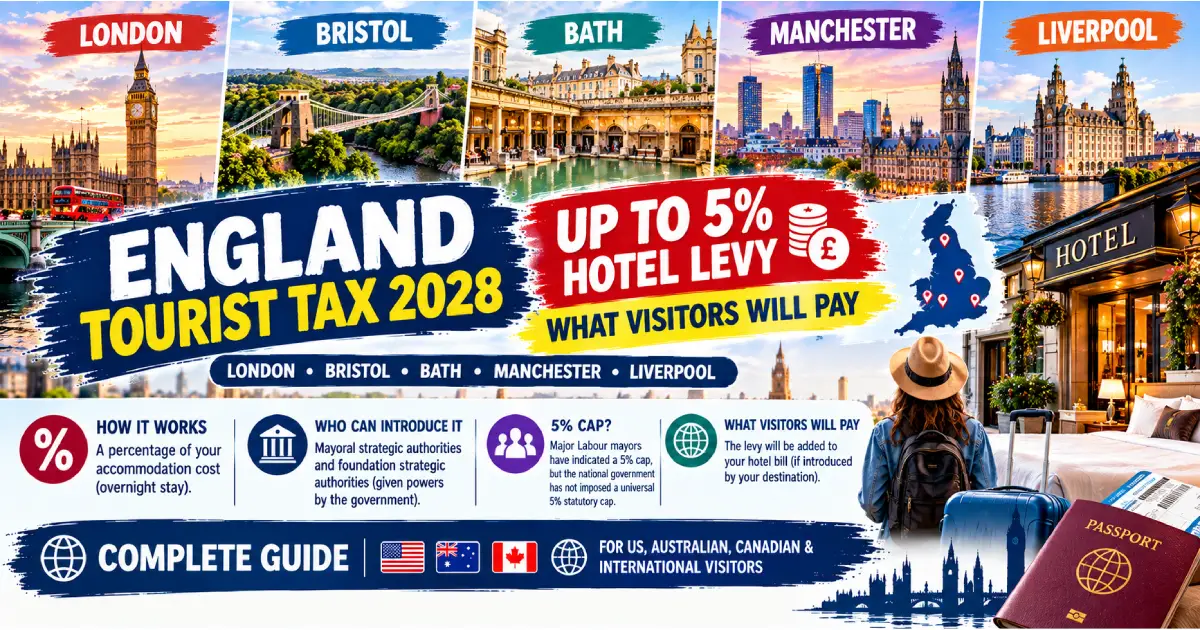
The United Kingdom has taken a decisive step toward joining the rest of Europe in charging tourists for overnight stays. The UK government confirmed on September 10, 2026, that the Overnight Visitor Levy Bill will give English mayors and local authorities the power to charge a percentage of accommodation costs — up to 5% — on hotel stays in their cities. The levy is not mandatory nationally. It is discretionary — each mayor or combined authority decides whether to implement it and at what rate. But with London already exploring a 5% charge, Edinburgh already charging 5%, Cardiff preparing its own version, and Bristol, Bath, Liverpool, and Manchester all actively considering implementation, the practical reality for international visitors is clear: from as early as 2028, a holiday in England’s most popular cities is going to cost more. Every US, Australian, Canadian, and international visitor who books a London hotel in 2027 or 2028 will potentially pay this levy on top of their room rate. A single traveller staying five nights in a £200-per-night London hotel could pay an additional £50. A family of four staying two weeks in peak summer season could pay £280 on top of their accommodation bill. This is not a rumour. It is confirmed UK government policy, announced September 10, 2026, with implementation expected by early 2028. Here is exactly what it means for every international visitor planning a UK trip.
Published: September 17, 2026 Policy Name: Overnight Visitor Levy — England Announced: September 10, 2026 — UK Government confirmed Legislation: Overnight Visitor Levy Bill — gives English mayors power to charge % of accommodation cost Structure: Discretionary — not mandatory nationally — each mayor/combined authority decides Maximum Rate: Up to 5% of accommodation cost per night Applies To: Hotels, serviced apartments, B&Bs, short-term rentals — all paid overnight accommodation Expected Implementation: Early 2028 Cities Confirmed Exploring or Likely to Implement:
The introduction of an Overnight Visitor Levy in England is not a radical innovation — it is England catching up with virtually every other major tourist destination in Europe. Amsterdam charges €3–€5 per person per night. Paris charges up to €14.95 per person per night for luxury hotels. Barcelona charges €3.25–€6.75 per night depending on accommodation type. Rome charges €3–€7 per night. Venice goes further — it now charges a day-visitor entry fee on peak days on top of accommodation levies. Berlin charges 5% of net room rate. Vienna charges 3.2%. Prague charges CZK 21 per night. Lisbon charges €2 per night.
In this context, England — and specifically London, one of the world’s most visited cities — has been a notable outlier. Scotland introduced its visitor levy framework ahead of England: Edinburgh now charges 5% on accommodation, making it one of the highest-rate city visitor levies in the UK. Wales is preparing its own framework. Northern Ireland is considering one. England has been the last major UK nation to act — and the Overnight Visitor Levy Bill now changes that.
The UK government’s September 10 announcement confirms what has been building in policy discussions for several years. English councils and city mayors have been lobbying for the power to charge visitor levies since at least 2020, arguing that high-tourism cities bear disproportionate infrastructure, cleaning, and service costs from visitor activity without having the revenue tools to address them. The devolved nations (Scotland, Wales) already have the power. England’s mayors — particularly in London, Manchester, and Bristol — have been pushing for parity.
The Overnight Visitor Levy Bill resolves this gap by giving England’s mayors and combined authorities the legal power to implement levies. Critically, it does not force any city to charge one — it simply gives them the option. But given that virtually every large English city with significant tourism has been advocating for exactly this power, the practical question is not whether cities will implement it, but when and at what rate.
London is by far the highest-stakes implementation in the Overnight Visitor Levy framework. London receives approximately 40 million visitors annually — the most of any European city — and its accommodation market is the most expensive in the UK. A 5% levy on London hotel stays is the figure most widely discussed by the Mayor of London’s office.
What 5% means for international visitors:
| Nightly Room Rate | 5% Visitor Levy Per Night | 5-Night Stay | 10-Night Stay |
|---|---|---|---|
| £100 (budget hotel/hostel dorm) | £5.00 | £25.00 | £50.00 |
| £150 (mid-range 3-star) | £7.50 | £37.50 | £75.00 |
| £200 (standard 4-star) | £10.00 | £50.00 | £100.00 |
| £300 (superior 4-star) | £15.00 | £75.00 | £150.00 |
| £500 (luxury 5-star) | £25.00 | £125.00 | £250.00 |
American visitor example: A US couple on a 10-night London holiday staying in a standard 4-star hotel at £200/night would pay £200 in visitor levy on top of their £2,000 room bill — the equivalent of approximately $256 USD at current exchange rates.
Australian visitor example: An Australian family of four staying 14 nights in London across two hotel rooms at £150/night each would pay £210 in visitor levy — approximately AUD $410 at current exchange rates.
Canadian visitor example: A Canadian couple staying 7 nights in London at £180/night would pay £63 in visitor levy — approximately CAD $115.
London’s visitor levy revenue would be used at the Mayor’s discretion. Transport for London, cultural infrastructure, public realm maintenance, and tourism-related services are among the likely beneficiaries.
Edinburgh is the template. Scotland’s Visitor Levy Act gave Edinburgh the power to charge a levy, and the city implemented it at 5% of accommodation cost per night — the same rate now contemplated for London. Edinburgh’s levy applies to hotels, serviced apartments, B&Bs, self-catering lets, and other paid overnight accommodation.
Edinburgh’s experience since implementing the levy has been closely watched by English cities. Early data suggests visitor numbers have not materially declined — the levy is too small relative to the total trip cost to deter most visitors — while the revenue generated has been significant for the city’s tourism infrastructure budget.
Bristol has been one of the most enthusiastic advocates for a visitor levy among English cities. The city’s accommodation sector — which includes a growing number of boutique hotels, serviced apartments, and short-term rentals driven by Bristol’s increasing popularity as a UK city break destination — would be subject to the levy. Bristol’s attractions (Clifton Suspension Bridge, street art culture, harbour area) draw significant numbers of UK and international visitors. Exact rate TBC.
Bath is an unusual case because it is a UNESCO World Heritage Site — one of the most intensively visited heritage cities in the UK relative to its population. Bath receives approximately 5 million visitors annually for a city with fewer than 100,000 residents. The visitor levy would directly address the infrastructure costs of managing this visitor pressure. Expected rate: likely 3–5%.
Manchester is the UK’s second-largest city by visitor numbers and the primary gateway city for the north of England. Its accommodation sector has grown rapidly in recent years driven by business travel, cultural tourism (Manchester United, Manchester City, music venues), and the city’s growing status as a European destination. Mayor Andy Burnham’s office has been supportive of visitor levy powers. Rate TBC but likely 2–5%.
Liverpool draws millions of visitors annually for its Beatles heritage, Albert Dock waterfront, Premier League football, and cultural attractions (the Royal Albert Hall, Tate Liverpool). The city has been explicit about wanting visitor levy powers to fund tourism infrastructure. Rate TBC.
| City | Country | Levy | Structure |
|---|---|---|---|
| London | England | Up to 5% | Discretionary — likely from 2028 |
| Edinburgh | Scotland | 5% | Already implemented |
| Cardiff | Wales | TBC | Framework in preparation |
| Amsterdam | Netherlands | €3–€5/person/night | Per person flat + percentage |
| Paris | France | Up to €14.95/person/night | Per person — varies by star rating |
| Barcelona | Spain | €3.25–€6.75/person/night | Flat rate + surcharge |
| Rome | Italy | €3–€7/person/night | Per person — varies |
| Venice | Italy | Up to €5 + day visitor fee | Per person |
| Berlin | Germany | 5% of net room rate | Percentage |
| Vienna | Austria | 3.2% | Percentage |
| Amsterdam | Netherlands | 12.5% of room rate (rising) | Percentage |
| Prague | Czech Republic | CZK 21/person/night | Flat per person |
Key comparison: London’s proposed 5% is moderate by European standards. Amsterdam’s levy has risen to 12.5% — more than double London’s proposed rate. Paris charges by star rating with luxury hotels paying the highest rates.
✅ Every paying overnight guest at any paid accommodation in participating cities ✅ International visitors — US, Australian, Canadian, European, all nationalities ✅ UK domestic visitors staying overnight in a levy-charging city ✅ Business travellers on company accounts ✅ Visitors staying at hotels, serviced apartments, B&Bs, Airbnbs, short-term rentals
❌ Day visitors who do not stay overnight ❌ Children under a certain age (typically under 18 or under 12 — TBC by each city) ❌ Visitors staying with friends or family in private homes ❌ NHS patients and medical accommodation (typically exempt) ❌ Long-term residents above a minimum stay threshold (typically 30+ consecutive nights) ❌ Certain vulnerable groups — precise definitions TBC per city
The Overnight Visitor Levy Bill applies to all paid overnight accommodation — not just hotels. This means Airbnb, Vrbo, and other short-term rental guests will also pay the levy in participating cities. Platforms like Airbnb are expected to add the levy as a line item on the booking invoice, in the same way they collect and remit the levy in European cities where it currently applies.
The Overnight Visitor Levy Bill was confirmed on September 10, 2026. The legislative process in England typically involves:
September 2026 — Confirmation: UK government confirms the Bill and gives mayors the power Late 2026 — Early 2027: Individual cities begin formal consultation processes 2027: Cities publish their levy rates and implementation frameworks Early 2028: Expected first implementations in London and other major cities
The “early 2028” timeline is a projection based on the Edinburgh implementation timeline (which took approximately 18 months from legislation to live implementation). Some cities may move faster, others slower. London — given its scale and the complexity of its accommodation market — may be at the later end of the early-2028 window.
Practical implication for international visitors: If you are booking a London hotel for stays in 2027, you may or may not pay the levy depending on when London activates its specific implementation. If you are booking for 2028, budget for the levy on top of your room rate. The safest assumption for any 2028 London booking is that a 5% levy will apply.
The most likely implementation model — based on Edinburgh and European precedents — is that the levy will be added to your accommodation bill at checkout, or collected by the booking platform (Booking.com, Expedia, Hotels.com, Airbnb) at the time of booking. You will not need to pay it separately at a government office.
Expect to see it as a separate line item on your hotel invoice — either labelled “Visitor Levy,” “City Tax,” or equivalent. Booking.com and Expedia already display city tax line items for European cities and will add London, Manchester, etc. when the levy activates.
Edinburgh’s levy is calculated as a percentage of the room/accommodation cost — not per person. This means a couple sharing a hotel room pays no more than a solo traveller in the same room type. This is different from the Paris and Barcelona models, which charge per person per night.
The levy is charged by the accommodation provider, not the city. If you cancel your booking under your accommodation’s cancellation policy and receive a full refund of your room cost, the levy should also be refunded. If you cancel outside the free cancellation window and pay a no-show charge, the levy component of a no-show charge is TBC by each city’s implementation rules.
This is one of the most frequently asked questions from loyalty programme members. In Edinburgh, the levy applies to all paid accommodation — but whether it applies to fully-redeemed loyalty points stays (where no cash changes hands) is a grey area that Edinburgh’s framework has addressed on a case-by-case basis. Expect London and other English cities to clarify this in their individual implementation frameworks during the 2027 consultation period.
Each participating city determines how it uses its visitor levy revenue. In Edinburgh, the levy funds:
In London, the Mayor’s office has indicated that revenue from a visitor levy could support:
The levy is not yet confirmed to be active in 2027. Book normally — but be aware that your booking may be subject to the levy if London activates its implementation during 2027. Check your booking’s cancellation policy: booking refundable gives you the option to re-evaluate as the implementation date becomes clearer.
Budget for a 5% addition to your accommodation cost. A reasonable planning assumption is that London will be charging the levy by the middle of 2028. If you are booking a £200/night hotel for 10 nights, add £100 to your accommodation budget for the visitor levy.
Edinburgh already charges 5% — this is live now and applies immediately to all bookings. Cardiff’s implementation timeline is TBC. The English cities (London, Manchester, Bristol, Bath, Liverpool) are all targeting early 2028.
The visitor levy is a government-imposed charge on accommodation — it is not generally covered by travel insurance in the way that an airfare or tour package might be. Budget for it as a straightforward additional travel cost.
| Resource | Link |
|---|---|
| UK Government Overnight Visitor Levy | gov.uk — search “Overnight Visitor Levy Bill” |
| Visit Britain — Official Tourism | visitbritain.com |
| London Tourism Information | visitlondon.com |
| Edinburgh Visitor Levy Information | edinburgh.gov.uk |
| Visit England | visitengland.com |
| Visit Manchester | visitmanchester.com |
| Visit Bristol | visitbristol.co.uk |
| Visit Bath | visitbath.co.uk |
| Visit Liverpool | visitliverpool.com |
England is joining the rest of Europe in charging tourists for overnight stays. The UK government confirmed on September 10, 2026, that the Overnight Visitor Levy Bill gives English mayors the power to charge up to 5% on accommodation costs. London — which receives 40 million visitors annually — is the highest-stakes implementation, with a 5% levy the most widely discussed rate. Bristol, Bath, Manchester, and Liverpool are all actively exploring implementation. Edinburgh is already charging 5% and is the working model for how it functions in practice. Implementation is expected in English cities from early 2028.
For US visitors: a 10-night London stay in a standard 4-star hotel at £200/night will cost an additional £100 in visitor levy — approximately $128 USD at current exchange rates.
For Australian visitors: a 14-night London stay across two rooms at £150/night each will cost an additional £210 in levy — approximately AUD $410.
For Canadian visitors: a 7-night London stay at £180/night will cost an additional £63 in levy — approximately CAD $115.
The levy is discretionary, city-specific, and will be collected by accommodation providers or booking platforms — not separately. You do not need to apply for it, register for it, or pay it in advance. It will appear as a line item on your accommodation invoice, exactly as city taxes do across Europe today.
What to do right now:
For More Resources:
Related Articles:
Posted By : Vinay
This article is provided for general informational purposes only and is based on information available at the time of publication. Travel advisories, airline schedules, airport operations, visa requirements, government regulations, and other travel-related information are subject to change without prior notice. While Travel Tourister makes reasonable efforts to verify information using official announcements, government publications, airline and airport communications, and other reliable sources, we cannot guarantee that all information remains complete, accurate, or up to date at all times. Readers should independently verify any information that may affect their travel plans with the relevant airline, airport authority, government agency, embassy, or other official source before making travel, financial, or other decisions. Travel Tourister shall not be liable for any direct or indirect loss, inconvenience, or damages arising from the use of or reliance on the information contained in this article. Nothing in this publication constitutes legal, immigration, financial, or professional travel advice. If you believe any information in this article is inaccurate or outdated, please contact our editorial team. We review all credible correction requests promptly and update our content whenever appropriate.
Lastest News
2nd Floor, 39, Above Kirti Club, DLF Industrial Area, Kirti Nagar, New Delhi, Delhi 110015



Travel Tourister is a leading Travel portal where we introduce travellers to trusted travel agents to make their journey hasselfree, memorable And happy. Travel Tourister is a platform where travellers get Tour packages ,Hotel packages deals through trusted travel companies And hoteliers who are working with us across the world. We always try to find new and more travel agents and hoteliers from every nook and corners across the world so that you could compare the deals with different travel agents and hoteliers and book your tour or hotel with the one you have chosen according to your taste and budget.
Copyright © Travel Tourister, India. All Rights Reserved

 Call
Call Enquiry