Published on : 17 Sep 2026
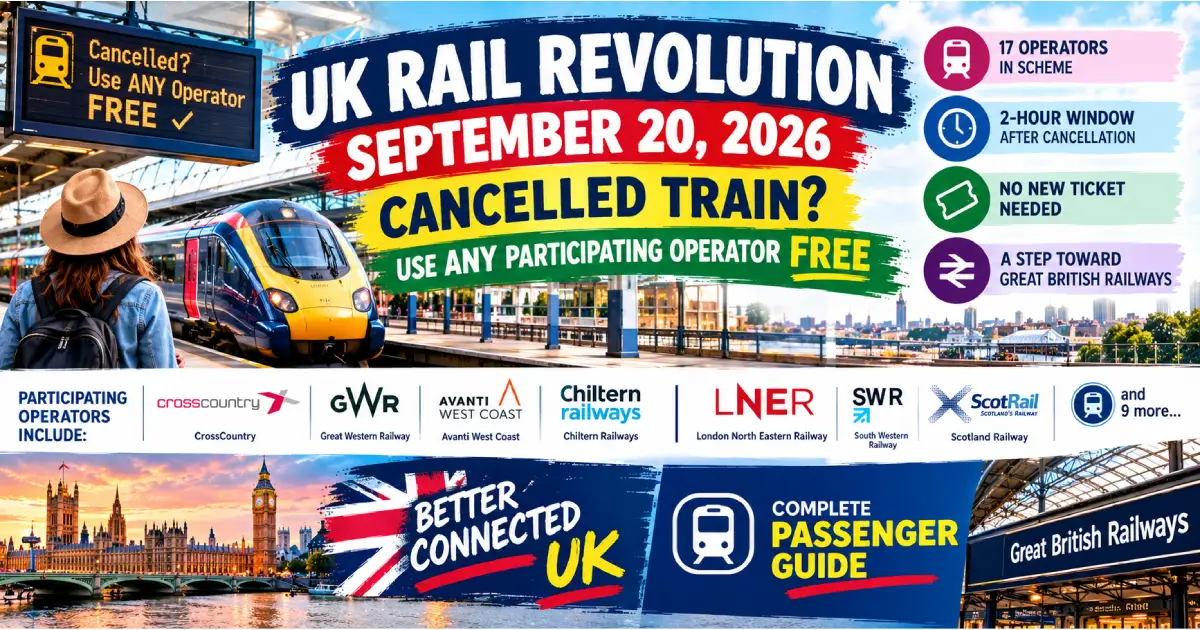
From this Sunday — September 20, 2026 — one of the most maddening aspects of Britain’s fragmented railway system comes to an end. If your train is cancelled, you can board the next service operated by any participating train company and complete your journey at no extra cost. No new ticket. No app. No phone call to customer service. Just show your original ticket to staff on the other operator’s service and travel. The scheme — already covering all publicly owned operators — expands this weekend to include CrossCountry, Great Western Railway, Avanti West Coast, and Chiltern Railways, bringing 17 operators into a unified national cross-operator ticket acceptance scheme. If you travel by rail anywhere in England, this change affects you. Here is everything you need to know before Sunday.
For years, one of the most common — and most legitimate — complaints about travelling by rail in Britain has been the ticket trap: your train is cancelled, another operator’s train is sitting at the platform going to the same destination, but your ticket is worthless on it. You either wait an hour or more for the next service from your own operator, scramble to buy a new ticket on the spot, or abandon your journey entirely. Countless meetings, medical appointments, family reunions, and connections have been missed because of this systemic failure.
That ends on Sunday 20 September 2026. The Department for Transport has confirmed the launch of a formal, automatic right for passengers on cancelled services to use any participating operator’s alternative service — departing within two hours before or after the cancelled train — at no additional cost. The scheme was already in place across all publicly owned train operators but had left out some of the most-used intercity franchises. From this weekend, CrossCountry, Great Western Railway, Avanti West Coast, and Chiltern Railways join the 13 operators already participating, bringing the total to 17 and covering the vast majority of intercity rail journeys in England.
The change is also significant in what it signals. This is not a standalone consumer improvement — it is a structural step toward Great British Railways (GBR), the government’s planned single public body that will bring track and train together under unified management. Rail Minister Lord Hendy said: <cite index=”35-1″>”This is a simple, common-sense change that puts passengers first. No one should be left stranded because of a fragmented railway when their journey is disrupted. From this weekend, if your train is cancelled, you can get on another operator’s service and carry on your journey without paying again. We’re fixing the railway from the ground up, making it simpler, fairer and easier to use, as we move towards Great British Railways and put public service back at the heart of our railways.”</cite>
Published: Wednesday 17 September 2026 Scheme launch: Sunday 20 September 2026 Announced by: UK Department for Transport (DfT) Government investment: £156 million in new ticketing schemes Rule: If your train is cancelled → board any participating operator’s next service → FREE → show original ticket → no new ticket required Time window: Within 2 hours before or after your original cancelled service Route requirement: Direct or reasonable alternative route to your destination Proof required: Original valid ticket — show to customer support staff on the new service Operators joining Sunday (NEW):
To understand why this change matters, you need to understand what was happening before. When a train was cancelled at, say, Birmingham New Street and a CrossCountry service to the same destination was departing in 10 minutes, the average passenger had four options — all of them bad:
Option 1 — Wait. Wait for the next service from your own operator, which could be 30, 60, or 90 minutes away. Miss your connection. Miss your meeting. Miss your appointment.
Option 2 — Ask for informal acceptance. Approach platform staff and ask if the other operator would accept your ticket. Sometimes they agreed. Often they didn’t. Sometimes you had to find a manager. Sometimes you had to phone the ticket hotline. It was random, stressful, and inconsistent.
Option 3 — Buy a new ticket. Pay full price for the next available service on the other operator. Claim a refund later — a process that could take weeks and required a formal application.
Option 4 — Give up. Abandon the journey entirely. Particularly common for passengers who couldn’t afford to buy a second ticket on the spot.
<cite index=”37-1″>Until now, passengers affected by cancellations could be left waiting for operators to formally agree that tickets could be accepted on another company’s services. In some cases, they had to buy a new ticket and later apply for a refund.</cite>
This was not a niche problem. CrossCountry, GWR, and Avanti West Coast are three of the highest-cancellation-rate operators in the UK. According to the Office of Rail and Road, these three operators together account for a disproportionate share of Britain’s most-disrupted long-distance journeys. The passengers most affected were those travelling between major cities — London to Bristol (GWR), London to Birmingham to Manchester (Avanti), and Birmingham to Edinburgh or Cardiff to Newcastle (CrossCountry). These are not occasional leisure journeys. They are the business travel backbone of England’s intercity rail network.
| Operator | In Scheme? | Routes Covered | Notes |
|---|---|---|---|
| c2c | ✅ Already | London Fenchurch Street → Southend Victoria/Shoeburyness | Publicly owned |
| Gatwick Express | ✅ Already | London Victoria ↔ Gatwick Airport | Publicly owned |
| Greater Anglia | ✅ Already | London Liverpool St → Norwich/Stansted/Cambridge | Publicly owned |
| Great Northern | ✅ Already | London Kings Cross → Hertford/Cambridge/Peterborough | Publicly owned |
| LNER | ✅ Already | London → Edinburgh, Leeds, Newcastle, Aberdeen, Inverness | Publicly owned — East Coast Main Line |
| London Northwestern Railway | ✅ Already | London Euston → Birmingham, Milton Keynes, Liverpool | Publicly owned |
| Northern | ✅ Already | Yorkshire, Lancashire, Cumbria, Merseyside, Manchester | Publicly owned |
| Southeastern | ✅ Already | London → Kent, East Sussex | Publicly owned |
| Southern | ✅ Already | London → Surrey, Sussex, Gatwick | Publicly owned |
| Thameslink | ✅ Already | Bedford/Brighton → London (cross-London) | Publicly owned |
| South Western Railway | ✅ Already | London Waterloo → Southampton, Bournemouth, Exeter | Publicly owned |
| TransPennine Express | ✅ Already | Manchester → Leeds, Newcastle, Edinburgh | Publicly owned |
| West Midlands Railway | ✅ Already | Birmingham → Hereford, Stratford, Walsall | Publicly owned |
| Avanti West Coast | ✅ NEW | London Euston → Manchester, Liverpool, Birmingham, Glasgow | Previously excluded |
| Chiltern Railways | ✅ NEW | London Marylebone → Birmingham, Banbury, Aylesbury | Transfers to DfT ownership Sept 20 |
| CrossCountry | ✅ NEW | Birmingham hub → Bristol, Exeter, Leeds, Edinburgh, Glasgow | Previously excluded |
| Great Western Railway | ✅ NEW | London Paddington → Bristol, Cardiff, Plymouth, Penzance | Previously excluded |
| East Midlands Railway | ❌ NOT YET | London St Pancras → Nottingham, Derby, Sheffield | Held back — Hitachi train problems |
<cite index=”37-1″>East Midlands Railway will not initially be included. The operator has been dealing with widespread cancellations and seat shortages linked to problems with the introduction of its Hitachi bi-mode trains. The government has therefore held back its inclusion while those issues continue.</cite>
The logic is straightforward: the cross-operator scheme works when an alternative service on another operator can absorb passengers from a cancelled train. If East Midlands Railway were included in the scheme while simultaneously experiencing widespread cancellations of its own, the result would be a net additional burden on other operators — other operators accepting East Midlands Railway passengers at volume without reciprocal benefit. The DfT has confirmed East Midlands Railway will join once the Hitachi bi-mode train issues are resolved. No date has been given.
If you hold an East Midlands Railway ticket and your train is cancelled, the old rules still apply for now — you must wait for the next EMR service, request informal ticket acceptance from another operator’s staff, or apply for a refund.
Step 1 — Confirm your service is cancelled. Check the departure board, the National Rail app, or Trainline in real time. A service showing “Cancelled” qualifies. A service showing “Delayed” does not automatically trigger the scheme — you would need to wait to see if it becomes a cancellation.
Step 2 — Check the 2-hour window. Look at the departure times of alternative services on other participating operators going to your destination (or a reasonable intermediate point). Any service departing within 2 hours before or 2 hours after your original cancelled service’s scheduled departure qualifies.
Step 3 — Find a reasonable alternative route. The route must be a direct or reasonable alternative — not wildly indirect. A CrossCountry service from Birmingham to Bristol is a reasonable alternative for a cancelled GWR Paddington–Bristol service. A Northern service from Leeds to Edinburgh is not a reasonable alternative for a cancelled LNER London–Edinburgh if it would take four times as long.
Step 4 — Board the other operator’s service. You do not need to buy a new ticket. You do not need to download anything. Simply board the train.
Step 5 — Show your original ticket to staff. Retain your original ticket — paper or digital. When a member of customer support staff on the alternative operator’s service approaches you, show your original ticket as proof of purchase. They will confirm you can travel.
Step 6 — Claim Delay Repay separately. Using the cross-operator scheme does not affect your right to claim Delay Repay compensation from your original operator. If your journey was delayed by 15, 30, 60, or 120+ minutes as a result of the cancellation, you can still claim compensation from the operator whose train was cancelled — even if you eventually completed your journey on a different operator’s service.
| Scenario | Before Sept 20 | After Sept 20 |
|---|---|---|
| Your GWR London Paddington → Bristol is cancelled. A CrossCountry service to Bristol Temple Meads departs in 20 minutes | Had to wait up to 1 hour for next GWR service or buy new ticket | Board CrossCountry service immediately. Show GWR ticket. Travel free. |
| Your Avanti West Coast London Euston → Manchester Piccadilly is cancelled. An LNER service to Manchester departs in 45 minutes | Wait for next Avanti (often 60–90 min on disrupted days) or pay £150+ for LNER walk-up | Board LNER service with your Avanti ticket. Free. |
| Your CrossCountry Birmingham → Leeds is cancelled. A TransPennine Express service departs in 30 minutes | Informal acceptance — depends on station staff. Often refused. | Board TPE with your CrossCountry ticket. Automatic right. |
| Your Chiltern Marylebone → Birmingham is cancelled. An Avanti service from Euston departs in 90 minutes | Different stations (Marylebone vs Euston) — extremely complex pre-scheme | Scheme applies if the alternative is a reasonable route — discuss with staff |
The Birmingham New Street advantage: Birmingham New Street is served by CrossCountry, Avanti West Coast, West Midlands Railway, and London Northwestern Railway simultaneously — four of the scheme’s 17 operators. Passengers at New Street now have by far the most flexible cross-operator options in England.
This change does not exist in isolation. It is the latest visible step in the government’s programme to reform British rail under the Great British Railways framework — a single public body that will, for the first time since privatisation in 1994, bring together responsibility for track, stations, and trains under one roof.
Chiltern Railways’ simultaneous transition to DfT public ownership on September 20 is directly connected. As of Sunday, Chiltern Railways passes from Arriva UK Trains’ management to the DfT Operator — the same publicly owned entity that already runs LNER, Northern, Southeastern, and other operators. This reduces the number of privately held franchises from four to three (CrossCountry, GWR, and Avanti West Coast remaining private while joining the cross-operator scheme voluntarily under government direction).
The £156 million government investment in ticketing reform — of which this scheme is one element — also covers the expansion of pay-as-you-go (contactless and Oyster-style) ticketing to over 100 additional stations across Greater Manchester, the Midlands, and the South-East by 2027.
The direction is clear: by 2027, the fragmented, multi-operator complexity that has defined British rail for 30 years will be significantly reduced — and passengers on cancelled services will have automatic, enforceable rights to alternative travel without paying twice.
Using the cross-operator scheme to complete your journey does not forfeit your right to Delay Repay compensation from your original operator. The two rights are independent:
| Right | Who Provides It | Condition |
|---|---|---|
| Free travel on alternative operator | Participating operators via cross-operator scheme | Train cancelled, alternative departs within 2 hours |
| Delay Repay compensation | Original operator (the one whose train was cancelled) | Journey delayed 15, 30, 60, or 120+ minutes vs schedule |
How to claim Delay Repay: Most UK train operators now process Delay Repay digitally. Submit through the original operator’s website or app — typically within 28 days of travel. You will need your ticket reference and the date and details of the cancelled service. If you used an e-ticket or Trainline booking, the details are automatically associated with your account.
| Delay Length | Compensation |
|---|---|
| 15–29 minutes late at destination | 25% of single fare |
| 30–59 minutes late at destination | 50% of single fare |
| 60–119 minutes late at destination | 100% of single fare |
| 120+ minutes late at destination | 100% of return fare |
Note on cross-operator journeys and delay calculation: Your delay is calculated from your original scheduled arrival time to your actual arrival time — including the time spent waiting for the alternative operator’s service. If your Avanti train was cancelled, you waited 45 minutes for an LNER service, and arrived 50 minutes late overall — you are entitled to 50% of your single fare in Delay Repay, even though you completed the journey on LNER.
Open-access operators remain excluded: Lumo (King’s Cross → Edinburgh), Grand Central (King’s Cross → Bradford/Sunderland, and London → Harrogate), and the Heathrow Express are not participating in the scheme. If your Lumo service is cancelled, you cannot automatically board LNER on the same route under this scheme — though LNER may agree informally. Check at the station.
East Midlands Railway: As above — not yet in the scheme. Leicester to London St Pancras, Nottingham to London, Sheffield to London passengers: old rules apply until EMR joins at a later date.
The scheme covers cancellations, not significant delays: If your train is severely delayed but not formally cancelled, the scheme does not automatically apply. However, if the delay is extreme, speak to station staff — operators may agree ticket acceptance informally on disrupted days.
Reasonable route requirement: The scheme requires a “direct or reasonable alternative route.” If the only other operator’s service involves a lengthy, indirect detour, you may be asked to demonstrate why that route is reasonable. In practice, this is unlikely to be an issue at major multi-operator hubs like Birmingham, Bristol, Leeds, or Manchester.
| Action | Contact / Link |
|---|---|
| Official DfT scheme announcement | gov.uk → “Your cancellation’s covered” |
| National Rail live departure boards | nationalrail.co.uk |
| Trainline app (real-time status) | trainline.com |
| Avanti West Coast rebooking | avantirailway.co.uk |
| CrossCountry rebooking | crosscountrytrains.co.uk |
| Great Western Railway rebooking | gwr.com |
| Chiltern Railways rebooking | chilternrailways.co.uk |
| LNER rebooking | lner.co.uk |
| TransPennine Express rebooking | tpexpress.co.uk |
| Northern rebooking | northernrailway.co.uk |
| Delay Repay claim (GWR) | gwr.com/help-and-contact/claims |
| Delay Repay claim (Avanti) | avantirailway.co.uk/delay-repay |
| Delay Repay claim (CrossCountry) | crosscountrytrains.co.uk/help |
| Delay Repay claim (Chiltern) | chilternrailways.co.uk/delay-repay |
| Office of Rail and Road complaints | orr.gov.uk |
| Transport Focus (independent passenger champion) | transportfocus.org.uk |
From Sunday 20 September 2026, British rail passengers on cancelled services have an automatic, enforceable right to use any participating operator’s alternative service at no extra cost. No new ticket. No phone call. No waiting for informal agreement between operators. Just show your original ticket and travel. CrossCountry, Great Western Railway, Avanti West Coast, and Chiltern Railways join 13 publicly owned operators already in the scheme, bringing the total to 17 operators and covering the vast majority of intercity rail journeys in England. The rule: your alternative service must depart within 2 hours before or after your cancelled train’s scheduled departure, via a direct or reasonable alternative route. East Midlands Railway and open-access operators (Lumo, Grand Central, Heathrow Express) remain outside the scheme for now. The change is backed by £156 million of government investment in rail ticketing reform and is a direct step toward the creation of Great British Railways — the single unified public body that will eventually bring together track and train under one roof. Your Delay Repay rights from your original operator are entirely unaffected and run alongside this new right — you can use the cross-operator scheme to complete your journey AND claim Delay Repay compensation for the disruption.
Your five-point action plan — UK rail from Sunday September 20, 2026:
Related Articles:
Posted By : Vinay
This article is provided for general informational purposes only and is based on information available at the time of publication. Travel advisories, airline schedules, airport operations, visa requirements, government regulations, and other travel-related information are subject to change without prior notice. While Travel Tourister makes reasonable efforts to verify information using official announcements, government publications, airline and airport communications, and other reliable sources, we cannot guarantee that all information remains complete, accurate, or up to date at all times. Readers should independently verify any information that may affect their travel plans with the relevant airline, airport authority, government agency, embassy, or other official source before making travel, financial, or other decisions. Travel Tourister shall not be liable for any direct or indirect loss, inconvenience, or damages arising from the use of or reliance on the information contained in this article. Nothing in this publication constitutes legal, immigration, financial, or professional travel advice. If you believe any information in this article is inaccurate or outdated, please contact our editorial team. We review all credible correction requests promptly and update our content whenever appropriate.
Lastest News
2nd Floor, 39, Above Kirti Club, DLF Industrial Area, Kirti Nagar, New Delhi, Delhi 110015



Travel Tourister is a leading Travel portal where we introduce travellers to trusted travel agents to make their journey hasselfree, memorable And happy. Travel Tourister is a platform where travellers get Tour packages ,Hotel packages deals through trusted travel companies And hoteliers who are working with us across the world. We always try to find new and more travel agents and hoteliers from every nook and corners across the world so that you could compare the deals with different travel agents and hoteliers and book your tour or hotel with the one you have chosen according to your taste and budget.
Copyright © Travel Tourister, India. All Rights Reserved

 Call
Call Enquiry