Published on : 30 Jun 2026
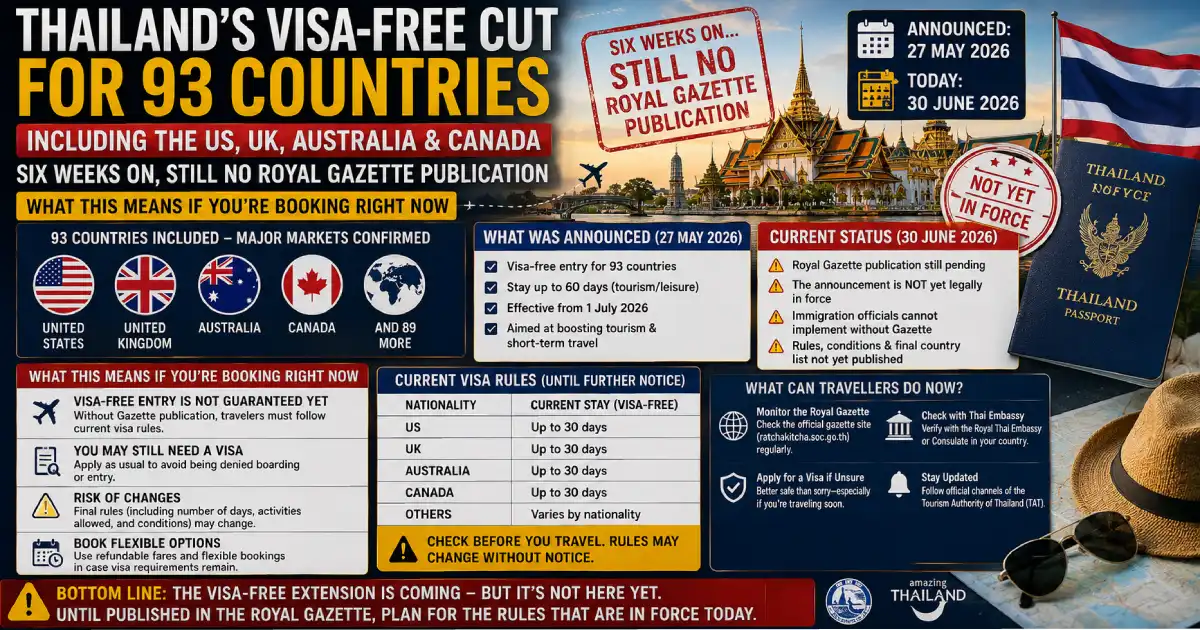
Six weeks ago, Thailand’s Cabinet voted to cut visa-free stays in half for 93 countries. The rule still hasn’t taken effect — and that gap is exactly what travellers need to understand before booking.
On May 19, 2026, Thailand’s Cabinet approved a sweeping rollback of its visa-free entry programme, ending the 60-day visa-free stay that citizens of 93 countries and territories — including Australia, the UK, the US, Canada, and every major EU nation — have enjoyed since July 2024. Most of those nationalities will revert to a 30-day visa-free stay once the change takes legal effect. The decision was framed by Thai officials around concerns that the extended window was being used for illegal work, unlicensed business operations, and in some cases more serious criminal activity, alongside a broader strategic shift toward “quality tourism” rather than simply maximising visitor numbers.
Here is what matters today, June 30, six weeks after that Cabinet decision: the change is still not in force. Under Thai law, a Cabinet approval is a political decision, not a legal one — the new rules become enforceable only after formal notifications are published in the Royal Gazette, Thailand’s official government journal, with the new regime then taking effect 15 days after that publication. As of the most recent confirmed reporting in mid-June, that publication had not happened. The 60-day exemption remains technically in force at the border right now, today, for travellers from all 93 affected countries.
This is not a story that has gone quiet because it stalled — it is a story still actively in motion, with real consequences for anyone weighing a long-stay Thailand trip in the months ahead. Here is the complete, accurate picture.
Published: June 30, 2026 — Tuesday (6 Weeks Since Cabinet Approval — Still No Gazette Publication) Cabinet approval date: May 19, 2026 Current legal status: ⏳ NOT YET IN EFFECT — 60-day exemption remains valid at the border today Trigger for change: Publication in the Royal Gazette, followed by a 15-day countdown Publication status as of latest reporting: No date announced — still pending as of mid-to-late June 2026 Countries affected by the change: 93 — including the United States, United Kingdom, Australia, Canada, and all major EU nations New standard exemption (54 countries): 30 days, down from 60 — covers US, UK, Australia, Canada, EU states, Japan, South Korea, and most traditional tourism markets New reduced exemption (3 countries): 15 days — Maldives, Mauritius, Seychelles Visa on Arrival eligibility: Cut from 31 countries to just 4 — Azerbaijan, Belarus, India, Serbia One-time extension still available: 30 extra days at any Thai immigration office, approximately 1,900 THB (~$55 USD) — bringing the practical maximum to 60 days under the new rules Entries per year cap: New limit of 2 visa-exempt entries per calendar year under the revised framework Retroactivity: ❌ None — travellers already in Thailand, or who enter before the new rule takes effect, keep their originally granted stay length Average actual visitor stay: ~9 days — Thai officials note this is well under even the reduced 30-day limit Context: Thailand’s 2025 tourist arrivals fell 7.2% to ~33 million — first non-pandemic annual decline in a decade; arrivals down a further ~3.3% through mid-2026 Bottom line for short-trip travellers: If your trip is 30 days or under, this change does not affect you, regardless of when it takes effect
This is the detail that has caused the most confusion across English-language coverage of this story since May, and it is worth explaining clearly, because it is the single most important thing for any traveller currently planning a Thailand trip to understand.
A Thai Cabinet resolution is a statement of government intent and policy direction — it instructs the relevant ministries (in this case, the Ministry of Foreign Affairs, working with the Ministry of Interior and the Immigration Bureau) to draft and issue the formal legal instruments that actually change the rules at the border. Those instruments take the form of notifications published in the Royal Gazette. Until that publication happens, the rule has not changed — the Cabinet approval is, legally speaking, a plan, not a law.
This is precisely the situation Thailand has been in since May 19. The Cabinet has approved the change in principle. The Ministry of Foreign Affairs has briefed reporters on the detailed framework. The Tourism Authority of Thailand has issued advisories confirming the situation. But the actual Ministry of Interior notifications that would start the 15-day countdown to enforcement have not yet been published, as of the most recent confirmed reporting in mid-to-late June.
What this means in practice today, June 30: If you arrived in Thailand this morning as a citizen of the US, UK, Australia, Canada, or any of the other 93 affected countries, you would still receive the 60-day visa-free stamp in your passport — not 30 days. The old rule remains the operative rule at Suvarnabhumi, Don Mueang, Phuket, and every other Thai port of entry, right now, today.
Why the delay matters strategically: Publication timelines in Thailand can move with very little advance public notice. There is no scheduled date, no confirmed week, and no guarantee of further warning before the Royal Gazette notification appears. A traveller who books a 45-day or 50-day trip today, assuming the 60-day rule will still apply when they fly in several weeks, is taking on real risk — not because the rule has changed, but because it could change between booking and departure with very little notice.
When the rule does take effect, here is precisely what changes, organised by the new framework Thailand’s Ministry of Foreign Affairs has outlined.
This is the category that covers the vast majority of Thailand’s traditional Western and allied tourism markets, and includes — among others — Australia, Austria, Bahrain, Belgium, Bhutan, Brunei, Canada, Czechia, Denmark, Estonia, Fiji, Finland, France, Georgia, Germany, Greece, Hungary, Iceland, Indonesia, Ireland, Israel, Italy, Japan, Jordan, Kuwait, Kyrgyzstan, Latvia, Liechtenstein, Lithuania, Luxembourg, Malaysia, Netherlands, New Zealand, Norway, Oman, the United Kingdom, and the United States.
For nationals of these 54 countries, the practical change is straightforward: visa-free tourist entry drops from 60 days to 30 days per entry. A one-time 30-day extension remains available at any Thai immigration office for roughly 1,900 THB (approximately $55 USD), which means the realistic achievable maximum stay — with a bit of extra paperwork and an in-person visit to an immigration office — remains 60 days total, just no longer automatic on arrival.
A new, more restrictive 15-day visa-free category applies specifically to Maldives, Mauritius, and Seychelles — a narrower group than the main 30-day tier.
This is one of the more significant but less-discussed elements of the reform. Thailand’s Visa on Arrival programme, which previously covered 31 eligible countries, will be cut to just four: Azerbaijan, Belarus, India, and Serbia. Travellers from the 27 countries losing VOA eligibility who fall outside the main 54-country exemption list will need to apply for an appropriate visa in advance of travel — VOA at the airport will no longer be an option for them.
India is the most significant single case here. India was Thailand’s third-largest source market in 2025, with 2.48 million arrivals, and Indian nationals had previously enjoyed a 60-day visa-free arrangement under a separate bilateral agreement. Under the new framework, India reverts to a 30-day visa-free exemption alongside the main 54-country tier — though Thai officials have indicated they are considering a separate arrangement for India given its market importance, with nothing confirmed as of the most recent reporting.
Countries with separate bilateral visa exemption agreements are not swept up in this general reform. China retains its 30-day exemption under a separate Thailand-China reciprocal agreement signed in March 2024. South Korea keeps a 90-day allowance under its own bilateral arrangement. Argentina, Brazil, Chile, and Peru retain 90-day exemptions under their respective bilateral treaties. A 14-day bilateral exemption continues to apply to Cambodia and Myanmar for arrivals through international airports, and a 30-day bilateral exemption applies to nine additional countries and territories including Hong Kong, Kazakhstan, Laos, Macao, Mongolia, Russia, and Vietnam.
A further restriction worth noting: the revised framework introduces a cap limiting travellers to two visa-exempt entries into Thailand per calendar year. This is specifically aimed at curbing the “border run” practice — repeatedly exiting and re-entering Thailand to reset a visa-free clock — that has been one of the central targets of this entire reform.
Thai officials have been consistent in their public framing since the May 19 announcement, citing three overlapping justifications.
National security and visa misuse: Officials say the 60-day window had been exploited by foreign nationals working illegally, operating unlicensed businesses in tourist areas, and in more serious cases, becoming involved in drug trafficking, human trafficking, and online scam operations. The Thai Foreign Ministry has explicitly cited national security concerns as part of the rationale.
The average-stay argument: Thailand’s own data shows the average foreign visitor stays approximately nine days — well under the 30-day mark, let alone the original 60. Officials have used this figure repeatedly to argue that the vast majority of legitimate tourists are entirely unaffected by the change, and that the 60-day allowance was disproportionate to actual typical tourist behaviour.
A strategic pivot toward “quality tourism”: Thailand’s Tourism and Sports Minister has framed the change as part of a broader shift away from chasing maximum visitor volume and toward attracting higher-spending, shorter-stay visitors — a strategy that arrives at a genuinely difficult moment for Thai tourism, with arrivals down 7.2% in 2025 to around 33 million (the first non-pandemic annual decline in a decade) and a further 3.3%+ decline through the first part of 2026.
The viral incidents factor: Alongside the structural arguments, Thai authorities have also pointed to a string of widely-shared incidents involving foreign tourists behaving badly — including temple vandalism and public drunken altercations — as part of the broader case for tighter entry controls, though this is a secondary rather than primary driver of the policy itself.
US passport holders are among the 93 nationalities losing the automatic 60-day entry. Once the change takes effect, Americans will receive a 30-day visa-free stay instead, extendable once to 60 days total via the standard immigration office process. For the vast majority of US travellers — whose Thailand trips typically run one to three weeks — this change will be entirely invisible in practice. The travellers genuinely affected are the smaller subset planning extended stays: digital nomads, retirees doing extended winters in Thailand, and anyone who has historically relied on the 60-day window or repeated border runs to maintain a longer-term informal presence in the country.
UK citizens will generally qualify for the same 30-day visa-free stay once the new policy is published and takes effect, down from the current 60 days. As with US travellers, the practical impact is concentrated among UK long-stay visitors — a segment that includes a meaningful number of British retirees and remote workers who have used Thailand as a long-stay or seasonal base.
Australian citizens were included in the 2024 expansion that permitted up to 60 days. The May 2026 Cabinet decision reverts Australia to the prior 30-day visa-free status once the new rules are officially published and enforced. Thailand remains one of Australia’s most popular international destinations, and the change is expected to have minimal effect on the typical Australian two-to-three-week Thailand holiday.
Canadian citizens are treated identically to the broader 54-country tier — reverting from 60 to 30 days, with the same 30-day extension option remaining available.
If your trip is 30 days or less: This entire story is functionally irrelevant to you, regardless of when the Royal Gazette publication happens or what the rules say on your specific travel date. Book and travel as normal.
If your trip is between 30 and 60 days: You are in the genuinely affected category. Your safest approach is to plan around the assumption that you will receive 30 days on arrival, not 60 — and treat any additional time as a bonus only if you happen to enter before the new rules take effect. If you need confirmed longer-stay access, consider applying for a 60-day Tourist Visa (TR) in advance at a Thai consulate, rather than relying on the current uncertain window.
If you are planning a stay beyond 60 days — digital nomads, retirees, remote workers: This is where the real planning urgency sits. Options worth investigating now include the Destination Thailand Visa (DTV) — a five-year, multiple-entry visa designed for remote workers and qualifying “soft power” activities, allowing stays of up to 180 days per entry — or the standard Non-Immigrant visa categories appropriate to your specific purpose (work, investment, retirement). Apply before the Royal Gazette publication if possible, since processing times and demand may both increase once the new rules formally take effect and create a rush of applications from people who previously relied on informal long-stay tourism.
If you are already in Thailand on a 60-day stamp right now: Nothing changes for you. Your stay remains valid through the date stamped in your passport regardless of when the Royal Gazette publication happens — the new rule explicitly does not apply retroactively.
Check before you fly, not before you book: The single most practical piece of advice across every credible source covering this story is consistent: verify the current rule close to your actual departure date, not at the point of booking. Given that the publication could occur at any time with limited advance public notice, a rule check done today, June 30, may not reflect the rule in force when you actually travel in August, September, or later.
Where to check: The Thailand Ministry of Foreign Affairs (mfa.go.th) and the Tourism Authority of Thailand (tatnews.org) are the two most authoritative sources for confirmed Gazette publication updates. The Royal Thai Government Gazette itself (ratchakitcha.soc.go.th) is the definitive legal source once the notifications appear.
There is no scheduled or confirmed date for the Royal Gazette publication as of this writing. Once it occurs, the 15-day countdown to enforcement begins automatically — meaning travellers could see the new 30-day standard apply with as little as two weeks’ real-world notice from the moment publication happens.
We will update this article the moment the Royal Gazette publication is confirmed, along with the specific effective date that follows.
Posted By : Vinay
This article is provided for general informational purposes only and is based on information available at the time of publication. Travel advisories, airline schedules, airport operations, visa requirements, government regulations, and other travel-related information are subject to change without prior notice. While Travel Tourister makes reasonable efforts to verify information using official announcements, government publications, airline and airport communications, and other reliable sources, we cannot guarantee that all information remains complete, accurate, or up to date at all times. Readers should independently verify any information that may affect their travel plans with the relevant airline, airport authority, government agency, embassy, or other official source before making travel, financial, or other decisions. Travel Tourister shall not be liable for any direct or indirect loss, inconvenience, or damages arising from the use of or reliance on the information contained in this article. Nothing in this publication constitutes legal, immigration, financial, or professional travel advice. If you believe any information in this article is inaccurate or outdated, please contact our editorial team. We review all credible correction requests promptly and update our content whenever appropriate.
Lastest News
2nd Floor, 39, Above Kirti Club, DLF Industrial Area, Kirti Nagar, New Delhi, Delhi 110015



Travel Tourister is a leading Travel portal where we introduce travellers to trusted travel agents to make their journey hasselfree, memorable And happy. Travel Tourister is a platform where travellers get Tour packages ,Hotel packages deals through trusted travel companies And hoteliers who are working with us across the world. We always try to find new and more travel agents and hoteliers from every nook and corners across the world so that you could compare the deals with different travel agents and hoteliers and book your tour or hotel with the one you have chosen according to your taste and budget.
Copyright © Travel Tourister, India. All Rights Reserved

 Call
Call Enquiry