Published on : 09 Jun 2026
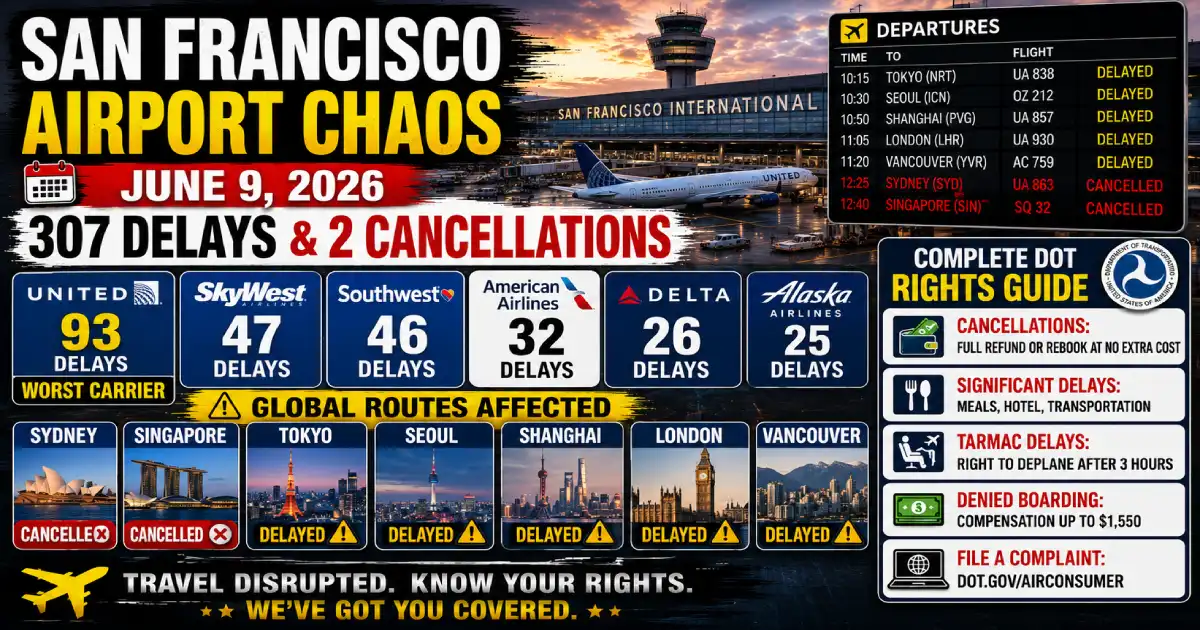
Breaking — June 9, 2026: San Francisco International Airport has recorded 307 flight delays and 2 cancellations today — a total of 309 disruptions making SFO one of the most severely affected major US airports of the week. United Airlines — which controls the dominant share of SFO operations as its primary West Coast hub — has reported the worst single-carrier performance: 93 delays and both cancellations, representing approximately 25% of United’s entire SFO schedule. SkyWest Airlines follows with 47 delays. Southwest Airlines, now operating its expanded West Coast network, recorded 46 delays — with more than half of its scheduled SFO operations impacted. American Airlines: 32 delays. Delta Air Lines: 26 delays. Alaska Airlines: 25 delays. The two cancellations carry specific significance: both are long-haul transpacific routes — Sydney Airport and Singapore Changi Airport — stranding passengers who had planned transpacific journeys on two of the longest commercial routes operating through SFO. Delays are extending across California, New York, Texas, Washington, Illinois, Arizona, and British Columbia domestically, and internationally across Singapore, Japan, South Korea, China, and Europe. International routes connecting San Francisco with Europe, Asia-Pacific, Canada, and Mexico are all recording operational interruptions. Several busy connecting airports — Los Angeles, Seattle, San Diego, Denver, Dallas–Fort Worth, Phoenix, Chicago O’Hare, and New York JFK — are recording multiple delayed services fed from SFO’s cascade. Here is every confirmed number, every carrier, every broken route, and every DOT right you hold today.
Published: June 9, 2026 — Monday Airport: San Francisco International Airport (SFO) — San Mateo County, California Airport IATA Code: SFO Total Delays today: 307 Total Cancellations today: 2 Total Disruptions today: 309 Hardest-hit carrier (delays + cancellations): United Airlines — 93 delays + 2 cancellations = 95 disruptions United Airlines % of SFO schedule delayed: ~25% SkyWest Airlines delays: 47 Southwest Airlines delays: 46 — 50%+ of Southwest SFO schedule American Airlines delays: 32 Delta Air Lines delays: 26 Alaska Airlines delays: 25 Cancellations — destinations: Sydney Airport (SYD) · Singapore Changi Airport (SIN) Cancellation carriers: United Airlines (both cancellations) Domestic routes broken: Los Angeles · New York JFK/EWR · Chicago O’Hare · Dallas–Fort Worth · Seattle · Denver · Phoenix · San Diego · Portland · Las Vegas · Houston · Atlanta · Boston · Washington Dulles International routes broken: Tokyo Narita/Haneda · Seoul Incheon · Shanghai Pudong · Beijing · Singapore Changi · Sydney · London Heathrow · Vancouver · Mexico City · Cancún Countries with international route disruptions: USA · Canada · UK · Japan · South Korea · China · Singapore · Australia · Mexico Secondary cascade airports: LAX · SEA · SAN · DEN · DFW · PHX · ORD · JFK SFO June 2026 pattern: 337 delays + 5 cancellations (June 5) → 307 delays + 2 cancellations (June 9) — elevated baseline Root causes today: Day 70 network positioning debt · Summer peak demand surge · FAA Pacific arrival sequencing restrictions · Parallel runway instrument approach constraints · United hub rotation fatigue DOT cash compensation: Not automatic — but full refund and care rights absolute
San Francisco International Airport is running its fourth consecutive elevated disruption day of June 2026. Four days ago — on June 5 — SFO recorded 337 delays and 5 cancellations, with United Airlines registering 126 delays and 5 cancellations (25% of United’s SFO schedule) and SkyWest logging 57 delays. That day’s disruptions cascaded across the US, Singapore, Philippines, UAE, Ireland, Denmark, UK, Japan, Germany, and China. Today’s 307 delays and 2 cancellations represent a slightly lower total disruption count than June 5 but with the same structural causes — and the same United Airlines dominance in the carrier breakdown.
Flight disruptions mount at San Francisco as United, JetBlue, SkyWest, Alaska, and other airlines face cascading delays disrupting routes across the United States, Canada, Mexico, Italy, Spain, China, Japan, South Korea, Singapore, Australia, and more. The pattern is consistent: SFO enters June 2026 in a state of elevated disruption that mirrors the sustained crisis that has been running through the US aviation network since Day 1 on April 1, 2026.
The reasons SFO is specifically vulnerable to sustained elevated disruption in June are structural, not coincidental:
🔴 United hub concentration: United Airlines controls approximately 45–50% of all SFO departures. When United is disrupted at SFO, SFO is disrupted. Today’s 93 United delays — 25% of its SFO schedule — means one in four United passengers at San Francisco is experiencing a delayed flight. The hub concentration that makes United’s SFO operation commercially powerful makes it operationally fragile — a single bad United day at SFO creates a bad SFO day.
🟠 Pacific arrival sequencing: SFO handles more transpacific traffic than any US airport outside of LAX. The daily wave of arrivals from Tokyo, Seoul, Shanghai, Hong Kong, Sydney, Auckland, and Singapore — typically landing in the early morning window — creates a sequencing challenge that the FAA manages through Optimized Profile Descents (OPD) and arrival spacing programs. On days when late transpacific departures from Asia or Oceania generate early-morning SFO arrival bunching, the arrival delay ripples into the first domestic departure bank, triggering the cascade that produces today’s 307-delay total.
🟡 Parallel runway instrument approach limitations: SFO’s parallel runways (28L/28R) cannot both be used for simultaneous instrument approaches in low-visibility conditions — a restriction that distinguishes SFO from O’Hare, Atlanta, and Dallas, which can operate more runways simultaneously in poor weather. The June marine layer — San Francisco’s characteristic low-cloud phenomenon — periodically reduces visibility below the simultaneous-approach threshold, effectively halving arrival capacity for hours at a time. When the marine layer is active at SFO, delays spike. Today’s disruption pattern is consistent with marine layer constraints.
United Airlines reported the highest number of disruptions with 93 delayed flights and 2 cancellations — representing a staggering proportion of all United flights operating through SFO today. United Airlines experienced the most significant disruption at San Francisco International Airport.
The specific destinations of today’s two United cancellations are the detail that makes this SFO disruption more significant than a routine bad day. Both cancelled flights are long-haul transpacific routes:
Sydney Airport (SYD) — United Airlines SFO–SYD (UA839/840): United’s San Francisco–Sydney service is one of the longest commercially operated flights in the United States route network — approximately 7,420 miles, with a flight time of approximately 15 hours southbound. When United cancels the SFO–SYD service, it does not simply cancel a flight. It strands passengers for a minimum of 24 hours — because United’s SFO–SYD operates once daily, meaning the next available United service is the same flight tomorrow. Passengers with time-critical commitments in Australia (business meetings, medical appointments, family events) face no same-day alternative on United. Their rebooking options are limited to: tomorrow’s United service (if seats available), Qantas SFO–SYD via their codeshare, or a reroute via LAX or Houston.
For SFO–SYD United passengers: ✅ Contact United immediately: united.com → My Trips | 1-800-864-8331 ✅ Request rerouting via LAX–SYD (Qantas direct, 15h15m) or EWR–SYD (United via alternate routing) ✅ Star Alliance alternative: Air New Zealand, Singapore Airlines, or Lufthansa via their connecting hubs ✅ If no acceptable alternative within 24 hours: request full cash refund under DOT regulations
Singapore Changi Airport (SIN) — United Airlines SFO–SIN (UA1/2): United’s San Francisco–Singapore service — known as UA1/UA2, the round-the-world service — is one of United’s most prestigious long-haul routes, connecting SFO to Singapore Changi in approximately 18 hours. Singapore Changi is consistently rated the world’s best airport and serves as the primary transit hub for Southeast Asia — onward connections to Malaysia, Indonesia, Thailand, Vietnam, Myanmar, Cambodia, Laos, Bangladesh, and Sri Lanka all feed through Changi. A cancelled SFO–SIN service strands not just Singapore-bound passengers but every passenger connecting through Changi to Southeast Asian destinations.
For SFO–SIN United passengers: ✅ Contact United: united.com | 1-800-864-8331 ✅ Request rerouting via SFO–Tokyo Narita–Singapore (United operated), or SFO–Hong Kong–Singapore (Cathay Pacific codeshare) ✅ Alternative: Singapore Airlines SFO–SIN (direct, 18 hours) — Star Alliance partner, United can rebook at no charge ✅ Full cash refund available if no acceptable alternative within a timeframe you find reasonable
Beyond the two headline cancellations, United’s 93 delays today represent the full breadth of its SFO hub operation under strain. United Airlines, as SFO’s dominant carrier, serves as the structural backbone of the airport’s entire daily operation. When United delays 93 flights, it affects domestic connections to Chicago, New York, Denver, Houston, and Washington; transpacific connections to Tokyo, Seoul, and Beijing; transatlantic codeshares feeding through its Star Alliance network; and regional United Express connections via SkyWest, Envoy, and Republic.
As SFO serves as one of the carrier’s major hubs, the impact was felt across numerous domestic and international routes connecting the United States, Europe, Asia, Canada, and Mexico.
For all United Airlines SFO passengers today: ✅ united.com → My Trips | 1-800-864-8331 ✅ United app — fastest rebooking tool; push notifications before gate updates ✅ Check united.com → Travel Alerts for any active SFO or West Coast waiver ✅ Star Alliance network: if United cannot rebook you within a reasonable timeframe, request placement on a Star Alliance partner (Lufthansa, Air Canada, Singapore Airlines, ANZ) at no additional charge — this requires United’s explicit agreement but is possible for cancelled long-haul services
SkyWest recorded 47 delayed flights during the day. The airline operates a large number of regional services feeding traffic into and out of San Francisco, resulting in widespread schedule adjustments across several western US destinations.
SkyWest is SFO’s dominant regional operator — flying as United Express and Delta Connection on routes connecting San Francisco to the western US cities that mainline carriers do not serve non-stop. The cities most affected by SkyWest’s 47 delays today include: Fresno, Monterey, Santa Barbara, Redding, Medford, Eugene, Boise, Salt Lake City, Palm Springs, Tucson, El Paso, and other western and Mountain West destinations.
SkyWest’s 47 delays represent approximately the same proportion of disruption as on June 5, when SkyWest logged 57 delays. The sustained elevated SkyWest delay count at SFO through June suggests that the regional feeder network — which operates with the tightest rotation schedules and least recovery capacity of any carrier tier — is the canary in the coal mine for SFO’s overall system health.
For SkyWest / United Express passengers: Contact United Airlines: united.com | 1-800-864-8331 For SkyWest / Delta Connection passengers: Contact Delta Air Lines: delta.com | 1-800-221-1212
Southwest Airlines recorded 46 delayed flights, with more than half of its scheduled operations impacted. A 50%+ delay rate for any carrier is an exceptional disruption figure — it means the majority of Southwest’s SFO schedule is running late today.
Southwest’s SFO operation has expanded significantly in 2026 following the airline’s strategic growth into West Coast markets post-Spirit Airlines collapse. Southwest now operates SFO routes to Las Vegas, Los Angeles, Phoenix, Denver, Portland, Seattle, Chicago Midway, Baltimore, Dallas Love Field, and Houston Hobby. Today’s 46 delays — more than half the schedule — are primarily driven by the same marine layer and Pacific arrival sequencing pressures affecting every carrier at SFO, amplified by Southwest’s tight turnaround model.
Southwest’s zero-interline policy is the most operationally consequential factor for affected passengers: if Southwest cannot rebook you on a Southwest alternative, the only path is a full cash refund. Southwest does not place passengers on United, Delta, or American — regardless of how long the delay is or how urgent the journey.
For Southwest Airlines passengers at SFO: ✅ southwest.com → Manage Reservations | 1-800-435-9792 ✅ No change fees ever — move to any available Southwest service at zero cost ✅ Southwest app — fastest rebooking; the phone hold time at SFO today is extended ✅ Zero-interline policy: Southwest rebooking or full cash refund — no other airline option
American Airlines reported 32 delays at SFO. American’s SFO operation is smaller than United’s but carries significant transpacific commercial weight through its Japan Airlines (JAL) codeshare — American’s SFO–Tokyo Narita flights are operated in conjunction with JAL, making them high-revenue services despite American’s secondary hub status at SFO compared to LAX.
American’s 32 SFO delays today primarily affect: Dallas–Fort Worth connections (American’s primary hub), Chicago O’Hare connections, Miami connections, and transpacific services via the JAL codeshare to Tokyo. Passengers connecting at DFW to international services should be particularly alert — DFW has been running elevated disruptions since the May 25–26 tornado recovery, and an SFO delay feeding into a DFW connection creates a compound problem.
For American Airlines passengers at SFO: ✅ aa.com → My Trips | 1-800-433-7300 ✅ Check aa.com/travelinfo for active SFO or West Coast travel waivers
Delta Air Lines recorded 26 delays at SFO. Delta’s SFO operation primarily serves its Atlanta hub, with secondary connections to Minneapolis, Detroit, and New York JFK. Delta’s transpacific operation at SFO includes Seoul Incheon (through its Korean Air joint venture) and Tokyo services. Today’s 26 delays at SFO are at the lower end of Delta’s crisis pattern at the airport — Delta’s June 5 total at SFO was 17 delays, so today’s 26 represents a moderate escalation in a sustained elevated pattern.
For Delta Air Lines passengers at SFO: ✅ delta.com → My Trips | 1-800-221-1212 ✅ Fly Delta app — push notifications before departure board updates
Alaska Airlines recorded 25 delayed flights throughout the day. Alaska is SFO’s fourth-largest domestic carrier, with significant frequency on West Coast point-to-point routes — Seattle, Portland, San Diego, Los Angeles, Las Vegas, and Hawaiian routes via Honolulu. Alaska’s 25 delays today represent approximately 20–25% of its SFO schedule — consistent with its historical disruption pattern at SFO during marine layer events.
For Alaska Airlines passengers at SFO: ✅ alaskaair.com → Manage Booking | 1-800-252-7522
SFO’s international disruption footprint today extends across four continents. Delays extended across major hubs in California, New York, Texas, Washington, Illinois, Arizona, British Columbia, Singapore, Japan, South Korea, and China. International routes connecting San Francisco with Europe, Asia-Pacific, Canada, and Mexico also experienced operational interruptions.
United, Ana (All Nippon Airways), and Japan Airlines (via American codeshare) all operate SFO–Tokyo services. Today’s United hub disruption directly affects the SFO–NRT/HND corridor. For Japan-bound passengers: Tokyo departures typically carry business travellers, Japanese-American community passengers, and transit passengers connecting onward to Southeast Asia.
Delta’s Korean Air joint venture operates SFO–ICN services. Korean Air also operates independently. Seoul Incheon is one of the world’s premier transit hubs — a delayed SFO–ICN departure strands not just Seoul-bound passengers but every passenger connecting through Incheon to Southeast Asian, South Asian, or Australian destinations via Korean Air.
United operates SFO–Shanghai Pudong as one of its key China routes. Air China and China Eastern also serve SFO–China corridors. Today’s disruptions affect the SFO–China corridor which carries significant commercial traffic between Silicon Valley technology companies and their Chinese partners and operations.
United’s SFO–SIN is one of today’s two confirmed cancellations — see the United Airlines section above for full rebooking guidance.
United’s SFO–SYD is the other cancelled service today — see the United Airlines section above for full rebooking guidance.
British Airways operates SFO–LHR as a daily service connecting Silicon Valley and Northern California to the UK. On June 5, British Airways was among the confirmed disrupted carriers at SFO. Today’s British Airways status at SFO should be verified directly. For UK-bound passengers: if your BA SFO–LHR arrives at Heathrow more than 3 hours late and the cause is within BA’s operational control, UK261 compensation of £520 per passenger may apply.
Air Canada’s SFO–Vancouver (YVR) service is one of the busiest US-Canada air corridors on the West Coast. Delays on this route affect both leisure travellers and business passengers, and — critically — onward connections from Vancouver to Australian, Japanese, and other transpacific destinations via Air Canada’s YVR hub.
Mexico City (MEX) · Cancún (CUN) · Guadalajara (GDL) · Auckland (AKL) · Hong Kong (HKG) · Taipei (TPE) · Manila (MNL) · Osaka Kansai (KIX) · Incheon further connections
Several busy airports including Los Angeles, Seattle, San Diego, Denver, Dallas–Fort Worth, Phoenix, Chicago O’Hare, and New York JFK recorded multiple delayed services connected to SFO. Each delayed SFO departure creates a late arrival at its destination — and each late arrival triggers a late turnaround departure.
Los Angeles (LAX): California’s busiest airport absorbs the highest volume of SFO cascade — the SFO–LAX corridor is one of the world’s busiest short-haul routes. Multiple delayed arrivals from SFO are stacking on the LAX arrivals queue today.
Seattle-Tacoma (SEA): The Pacific Northwest corridor — SFO–SEA operated by Alaska, United, and Southwest — is heavily disrupted. Seattle itself is a major transpacific hub for Delta’s Asian network, meaning SFO cascade into SEA can propagate further into Delta’s Japan and Korea services.
Denver (DEN): United’s SFO–DEN route feeds the Mountain West hub. Denver has been running elevated disruptions since the FAA’s O’Hare cap implementation began compressing the national schedule.
Chicago O’Hare (ORD): United’s SFO–ORD transcontinental route is one of the most disrupted US air corridors of 2026. Delayed SFO departures arrive late at O’Hare, which is still operating under the FAA summer capacity cap (now in Week 4), making the SFO cascade into ORD a compound event.
Dallas–Fort Worth (DFW): American’s SFO–DFW route is delayed today. DFW has been in a sustained elevated disruption pattern since the May 25 tornado day — adding SFO cascade to an already-stressed hub.
New York JFK: United’s SFO–JFK transcontinental route is among the most commercially important US domestic services. Delayed departures from SFO arrive late at JFK, where connecting international passengers face the compound of late domestic arrivals and JFK’s own delay load.
Today’s 309 total disruptions (307 delays + 2 cancellations) place June 9 in the context of an SFO that has been running elevated disruptions throughout June 2026:
| Date | SFO Total | United (worst carrier) | Context |
|---|---|---|---|
| May 18, 2026 | 200 (199 delays + 1 cancel) | 64 delays | Marine layer event |
| May 25–27, 2026 | 207 (avg delays) | ~50 delays | Memorial Day / Post-tornado cascade |
| June 5, 2026 | 342 (337 delays + 5 cancels) | 126 delays + 5 cancels | June peak — worst June day |
| June 7, 2026 | ~168 (159 delays + 9 cancels nationally) | United national recovery | Network-wide |
| June 9, 2026 | 309 (307 delays + 2 cancels) | 93 delays + 2 cancels | Today — SYD & SIN cancelled |
The June 5 event — 337 delays and 5 cancellations, United’s worst SFO day of 2026 — appears to be the recent peak. Today’s 309 disruptions represent a continued elevated level but below the June 5 extreme. The consistent United Airlines dominance in the carrier breakdown (June 5: 126 UA delays; June 9: 93 UA delays) confirms that SFO’s disruption pattern is structurally driven by United’s hub mechanics, not random variation.
Looking ahead — summer 2026 at SFO: The June marine layer will persist through late July. Transpacific demand is running at or near 2019 pre-pandemic levels. United’s SFO hub is operating with Day 70 network positioning debt from the sustained spring crisis. The FAA Ground Delay Program advisories issued for SFO through summer note that disruptions could continue whenever weather conditions deteriorate or runway capacity remains constrained during heavy traffic flows. Travelers have been advised to monitor airline notifications closely and verify departure times before arriving at the airport.
For today’s two United cancellations (Sydney and Singapore): full cash refund within 7 business days under the DOT’s May 2024 refund rule. Absolute — no vouchers unless you explicitly choose one. Say: “I am requesting a cash refund under DOT regulations.”
United must rebook you to Sydney or Singapore — not just to an alternative US hub. If United cannot provide an acceptable rebooking within a timeframe you consider reasonable, you are entitled to the cash refund and may self-rebook on an alternative carrier.
For delays of 3+ hours where the cause is within the airline’s operational control (not pure weather or FAA-mandated ground stop), carriers committed to the DOT Customer Service Dashboard must provide meal vouchers. SFO’s June disruptions include a mix of marine layer weather (extraordinary circumstance) and structural positioning debt (operational cause). If your specific delay is attributed to positioning debt rather than active weather: challenge weather-only attributions and request meal vouchers.
For the SFO–SYD and SFO–SIN cancellations: United must provide hotel accommodation at San Francisco for the overnight wait before tomorrow’s alternative departure, if the cancellation is within United’s operational control. Keep all receipts — hotel, meals, transport.
For British Airways SFO–LHR passengers arriving at Heathrow 3+ hours late due to airline operational control causes: UK261, £520 per passenger.
For any EU carrier operating to EU destinations from SFO (Air France, Lufthansa, KLM codeshares through US connections): EU261, up to €600 per passenger for 3hr+ arrivals within airline control.
All fees paid for checked bags, seat upgrades, or priority boarding on any cancelled SFO flight must be refunded in full.
If any carrier at SFO today fails to honour your rights: DOT Air Consumer Travel Portal: airconsumer.dot.gov Keep booking confirmation, airline app notifications (screenshot), all receipts, and any written gate agent communications.
Posted By : Vinay
This article is provided for general informational purposes only and is based on information available at the time of publication. Travel advisories, airline schedules, airport operations, visa requirements, government regulations, and other travel-related information are subject to change without prior notice. While Travel Tourister makes reasonable efforts to verify information using official announcements, government publications, airline and airport communications, and other reliable sources, we cannot guarantee that all information remains complete, accurate, or up to date at all times. Readers should independently verify any information that may affect their travel plans with the relevant airline, airport authority, government agency, embassy, or other official source before making travel, financial, or other decisions. Travel Tourister shall not be liable for any direct or indirect loss, inconvenience, or damages arising from the use of or reliance on the information contained in this article. Nothing in this publication constitutes legal, immigration, financial, or professional travel advice. If you believe any information in this article is inaccurate or outdated, please contact our editorial team. We review all credible correction requests promptly and update our content whenever appropriate.
Lastest News
2nd Floor, 39, Above Kirti Club, DLF Industrial Area, Kirti Nagar, New Delhi, Delhi 110015



Travel Tourister is a leading Travel portal where we introduce travellers to trusted travel agents to make their journey hasselfree, memorable And happy. Travel Tourister is a platform where travellers get Tour packages ,Hotel packages deals through trusted travel companies And hoteliers who are working with us across the world. We always try to find new and more travel agents and hoteliers from every nook and corners across the world so that you could compare the deals with different travel agents and hoteliers and book your tour or hotel with the one you have chosen according to your taste and budget.
Copyright © Travel Tourister, India. All Rights Reserved

 Call
Call Enquiry