Published on : 31 Mar 2026
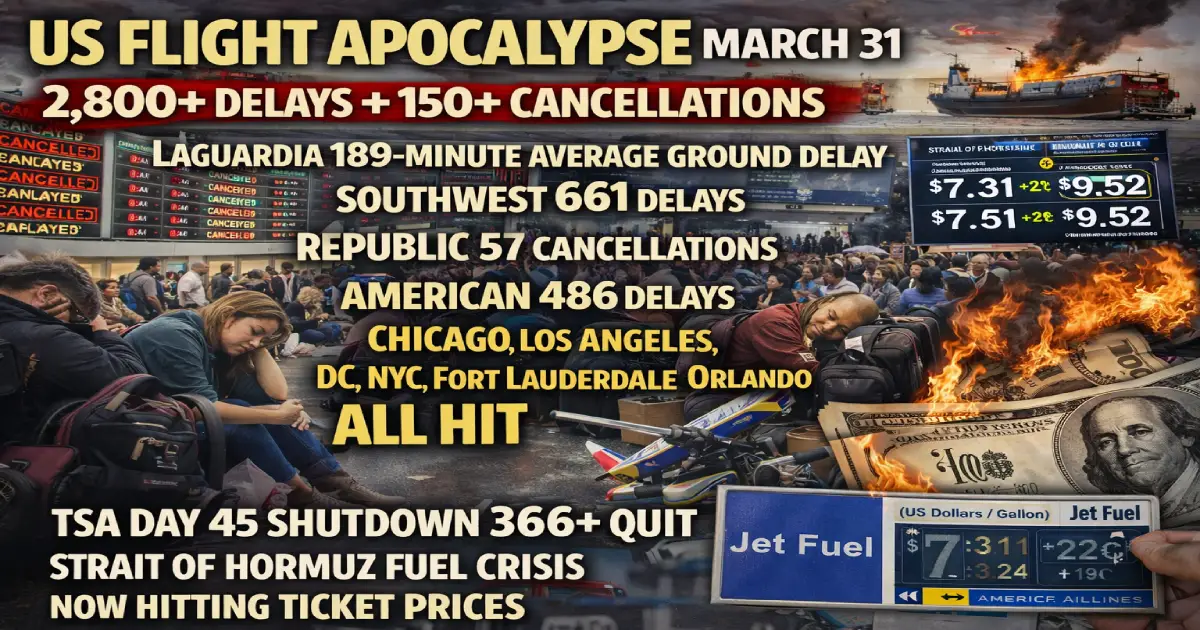
Breaking: The United States aviation system records 2,800+ delays and 150+ cancellations TODAY (Tuesday March 31, 2026) as the nation’s worst sustained travel crisis of the modern era enters its 45th consecutive day, with LaGuardia Airport posting a catastrophic 189-minute average ground delay — more than THREE HOURS average wait for every single arriving aircraft — as Southwest Airlines absorbs the nation’s highest delay count with 661 delays and 18 cancellations, American Airlines records 486 delays and 14 cancellations, Republic Airways leads all carriers in cancellations with 57 flights grounded alongside 210 delays, Delta Air Lines adds 305 delays and 7 cancellations, while Chicago O’Hare (20 cancellations, 219 delays), Fort Lauderdale (departure delays averaging 30 minutes and climbing), Orlando (5 cancellations, 194 delays), Los Angeles (significant delays), Washington DC airports, and New York’s JFK (12 cancellations, 135 delays) are all simultaneously overwhelmed — as TSA Day 45 with 366+ officer resignations means security lines are reaching 3+ hours at major hubs, jet fuel prices have surged to near-record highs driven by the Strait of Hormuz closure (Brent crude elevated, airlines burning through cash reserves), United Airlines cut 3% of summer flights citing economic pressure, Transport Secretary Sean Duffy warns the summer travel season will make this “look like child’s play,” and with Congress not returning from Easter recess until April 10 — there is no government fix possible for at least nine more days. Here is everything every US traveler needs to know right now.
Published: March 31, 2026 (Tuesday) — DAY 45 OF ONGOING US AVIATION CRISIS National Total: 2,800+ delays + 150+ cancellations = 2,950+ total disruptions Worst Airport: LaGuardia (LGA) — 189-minute average ground delay (3+ hours!) Most Delays (Airline): Southwest Airlines — 661 delays + 18 cancellations = 679 total! Most Cancellations: Republic Airways — 57 cancellations + 210 delays = 267 total! Second Most Disrupted: American Airlines — 486 delays + 14 cancellations = 500 total Delta Air Lines: 305 delays + 7 cancellations = 312 total Airports Hit: LaGuardia, Chicago O’Hare, Fort Lauderdale, Orlando, Los Angeles, Washington DC, JFK, Austin, Phoenix TSA Status: Day 45 of shutdown — 366+ resignations — 3+ hour security lines at major hubs Fuel Crisis: Strait of Hormuz closure driving jet fuel near record highs — United already cutting 3% summer flights Duffy Warning: “Summer will look like child’s play” — Congress not back until April 10 No Fix Possible: Government shutdown continues — TSA paycheck crisis unresolvable before April 10 minimum
Tuesday, March 31, 2026 — the final day of March — delivers yet another chapter of the worst sustained US aviation disruption since the COVID-19 pandemic grounded the global fleet. With nearly 2,800 flight delays and more than 150 cancellations affecting major airports in Chicago, Los Angeles, Washington D.C., New York, and Fort Lauderdale, the situation has escalated into a full-blown travel crisis.
The disruption has not only frustrated travelers but also raised concerns over airline operations, with many people scrambling to rebook flights or find accommodation. Airlines such as United Airlines, Southwest, and American Airlines have been reworking their schedules, trying to clear backlogs and manage disrupted itineraries.
But today’s 2,800+ delays are not an anomaly within an otherwise functional system. They are the latest data point in a 45-day pattern that the data now confirms is structural, not episodic.
The 45-Day US Aviation Crisis Arc:
| Week | Worst Single Day | Total Range | Character |
|---|---|---|---|
| Week 1 (Feb 28 – Mar 6) | ~4,000+ disruptions | 2,000-4,000/day | Shock phase — Iran conflict triggers |
| Week 2 (Mar 7–13) | 1,459 (ORD alone) | 1,500-4,000/day | Regional carrier collapse begins |
| Week 3 (Mar 14–20) | 4,188 (Mar 23) | 1,200-4,200/day | LGA crash + spring break convergence |
| Week 4 (Mar 21–27) | 3,273 (Mar 27) | 500-3,273/day | TSA accelerating, storms hit |
| Week 5 (Mar 28–31) | Today’s 2,950+ | 652-2,950/day | No improvement — crisis hardening |
✈️ Today: 2,800+ delays + 150+ cancellations = 2,950+ total disruptions ✈️ LaGuardia: 189-minute average ground delay — worst single-airport metric of the week ✈️ Southwest: 661 delays + 18 cancellations = 679 total — most disrupted US airline today ✈️ Republic Airways: 57 cancellations = highest cancel count of any US carrier today ✈️ American Airlines: 486 delays + 14 cancellations = 500 total — second highest ✈️ Delta Air Lines: 305 delays + 7 cancellations = 312 total ✈️ TSA: Day 45 — 366+ resignations — security lines 3+ hours at major hubs ✈️ Fuel: Near-record jet fuel prices — United cutting summer capacity, others to follow
What Three Converging Crises Look Like on Day 45:
At the heart of the issue lies staffing shortages within the Transportation Security Administration, where a significant portion of agents remain unpaid due to a federal budget impasse. With fewer TSA agents available to manage the growing number of passengers, airport security lines have grown longer, delaying the flow of travelers through checkpoints. Additionally, the nationwide weather disruptions, including winter storms in the Midwest and Northeast, have compounded the situation, forcing flight cancellations and delays that ripple through the system.
But 45 days in, weather is no longer the primary driver — structural breakdown is:
✈️ TSA structural collapse: 366+ resignations = permanent workforce reduction, not temporary shortage ✈️ Regional carrier fragility: Republic’s 57 cancellations today = the same carrier that cancelled 110 nationally on March 27 — no recovery ✈️ Fuel economic pressure: Jet fuel near record highs — United cutting flights, American expected to follow, Southwest absorbing fuel cost in 661 delays rather than cancelling and triggering refunds
New York’s LaGuardia Airport is the single most disrupted airport in the country today, recording 88 cancellations and 416 delays. Ground delays are averaging 142 minutes — more than two hours — attributed to unspecified “other” causes. Airlines most affected include Republic Airways, American Airlines, and Delta Air Lines. Passengers transiting through LGA should assume their schedules are effectively void and rebook proactively rather than waiting at the gate.
Today’s LaGuardia picture — based on the rolling 189-minute average ground delay figure — is even worse than those March 27 data points.
LGA 189 Minutes: What It Actually Means:
A 189-minute average ground delay at LaGuardia means:
What Creates a 189-Minute Average Ground Delay:
LaGuardia (LGA) has experienced ground delays, with average delays of 189 minutes due to a combination of operational issues and external factors.
Who Is Worst Hit at LGA Today:
Republic Airways — operating regional feeder flights for American, United, and Delta — has the highest cancellation count today at 57, alongside 210 delays. Regional cancellations are especially painful as they strand passengers at smaller airports with fewer rebooking alternatives.
✈️ Republic/American Eagle passengers: Call American 1-800-433-7300 ✈️ Republic/United Express passengers: Call United 1-800-864-8331 ✈️ Delta Air Lines LGA: 416 delays today — Delta Sky Club at Terminal C at capacity
Chicago O’Hare International (ORD): A major transit point for both domestic and international flights, ORD saw 12 cancellations and 219 delays.
Today’s O’Hare disruption numbers are the first full day operating under the FAA’s Summer 2026 cap (2,800 daily operations maximum, effective March 29). Despite the cap reducing scheduled operations by approximately 280 flights/day from the pre-cap 3,080 figure, ORD is still recording 231 disruptions — confirming that the cap helps, but does not eliminate disruption when structural carrier fragility (Republic, SkyWest, Endeavor) and TSA staffing pressure remain unresolved.
ORD Under the New Cap — What Changed:
✈️ Before cap (March 27): 552 total disruptions — 539 delays, 13 cancellations ✈️ After cap Day 3 (today): 231 disruptions — 12 cancellations, 219 delays ✈️ Improvement: Yes — 552 → 231 = significant reduction in absolute disruption count ✈️ BUT: 231 disruptions on a Tuesday in clear weather = still structurally elevated above normal ✈️ Verdict: Cap is helping. But TSA + regional carrier fragility = disruptions persist even at 2,800 ops/day
Fort Lauderdale (FLL) and Los Angeles International (LAX) are among the busiest hubs facing moderate to severe delays, with average delays ranging from 30 to 45 minutes.
March 26, 2026 — A sharp decline in on-time departure performance is cascading through several major US airport hubs this week, with Fort Lauderdale International Airport (FLL), Orlando International Airport (MCO), and LaGuardia Airport (LGA) experiencing the most severe disruptions.
Fort Lauderdale’s departure delay picture today is driven by the combination of:
FLL Departure Time Reality Today:
FLL: Departure delays, average of 30 minutes (increasing) due to weather and volume.
✈️ Current average FLL departure delay: 30 minutes and increasing as of this morning ✈️ Direction: Climbing — afternoon bank may reach 45-60 minute averages ✈️ Airlines hardest hit: Spirit, JetBlue, Southwest FLL operations ✈️ Passenger tip: FLL departures today — arrive 3+ hours early (security + delay buffer)
Fort Lauderdale International (FLL) and Orlando International (MCO): Both airports saw a considerable number of cancellations and delays, further exacerbating the situation in Florida.
MCO: Departure delays, average of 30 minutes (increasing) due to weather and volume.
Orlando is processing the final wave of spring break returnees — the families and students who extended their Disney/Universal trips through Easter weekend and are now trying to get home for school and work Tuesday. MCO’s disruption profile today reflects maximum leisure travel return pressure hitting an airport that has recorded elevated delays for the past two weeks.
MCO Quick Stats:
✈️ Cancellations: 5 today ✈️ Delays: 194 — and climbing as afternoon bank approaches ✈️ Primary carriers: Spirit, Southwest, American, JetBlue — all Florida-heavy operators ✈️ Theme park families: This is the highest-stress passenger profile — tired kids, tight budgets, non-flexible itineraries
Fort Lauderdale (FLL) and Los Angeles International (LAX) are among the busiest hubs facing moderate to severe delays.
Los Angeles International Airport — the US’s second-busiest — is today dealing with the convergence of standard high-volume Tuesday operations, the Easter return surge from Hawaii and Mexico routes, and the structural TSA staffing pressure that has made LAX security wait times unpredictable throughout March.
LAX Context:
✈️ Delays: Significant — LAX handling ~900 daily flights, any departure-rate reduction cascades widely ✈️ TSA: LAX T1/T2/TBIT/T4/T5/T6/T7 — multiple checkpoints, variable staffing per terminal ✈️ International: LAX handles significant trans-Pacific traffic — Japan, Korea, Australia routes may face secondary delays from domestic LAX congestion ✈️ Tip: TBIT (International Terminal) typically has better-staffed TSA than domestic terminals today — if connecting internationally, plan extra time
The disruptions are hitting airports in Chicago, Los Angeles, Washington D.C., Austin, New York, and Fort Lauderdale.
Washington DC’s three-airport system — Reagan National (DCA), Dulles International (IAD), and Baltimore-Washington (BWI) — are all experiencing today’s disruption picture, with DCA particularly impacted given its proximity to the government-shutdown story and the concentration of federal employee and contractor travel in the DC market.
✈️ DCA: American + Southwest + regional carriers — delays continuing ✈️ IAD: United’s Dulles hub — elevated delays from United’s national 45-day disruption pattern ✈️ BWI: Southwest’s Baltimore hub — Southwest’s 661 national delays radiating into BWI ✈️ Amtrak alternative: DC’s Union Station → New York Penn Station on Acela = 2h 45m — genuinely competitive with DCA → LGA/JFK today given 189-minute LGA ground delays
PHX: Departure delays, average of 45 minutes (increasing) due to compacted demand.
Austin and Phoenix represent the Sun Belt growth airports that have been consistently elevated throughout the 2026 crisis. Both markets have seen dramatic passenger growth since 2020, and both are served heavily by Southwest (661 delays nationally today) and Republic Airways (57 cancellations nationally).
✈️ Phoenix: 45-minute average departure delay — compacted demand at Sky Harbor ✈️ Austin: Departure delays — growing hub serving Texas tech sector travelers
JFK International registers 12 cancellations and 135 delays, further squeezing the already-congested New York metro airspace.
JFK’s disruptions today are secondary to LaGuardia’s 189-minute crisis, but 147 total disruptions at the world’s most-watched international airport carry global implications: trans-Atlantic passengers, international arriving passengers, and JetBlue’s JFK-hub operation are all affected.
Southwest Airlines is absorbing the heaviest delay load of any US carrier today, with 661 delays and 18 cancellations across Las Vegas, Orlando, and Palm Beach. For a point-to-point carrier with no hub buffer, delays at one airport ripple immediately to the next destination.
Southwest Airlines National Snapshot (March 31):
✈️ National total: 661 delays + 18 cancellations = 679 total — highest of any US carrier today ✈️ Worst stations: Las Vegas (LAS), Orlando (MCO), Palm Beach (PBI) ✈️ Cascade factor: Southwest’s point-to-point network — every morning delay cascades through 4-6 rotations ✈️ Passenger protection: Southwest still offers best-in-class rebooking: no change fees, no fare difference
Why Southwest’s 661 Delays Are Structurally Inevitable:
Southwest runs its fleet at some of the highest utilisation rates in global aviation — aircraft fly 12-14 hours per day across multiple city pairs. When TSA delays slow passenger boarding at origin airports, every departure is pushed back. When LaGuardia averages 189-minute ground delays, Southwest’s inbound aircraft from LGA arrive late everywhere they go next.
The 661 delays are not Southwest operational failures in isolation — they are the mathematical product of a point-to-point carrier absorbing 45 days of TSA staffing shortfall, LaGuardia infrastructure failure, and near-record fuel prices simultaneously.
Southwest Fuel Context:
Southwest historically hedges its fuel exposure more aggressively than legacy carriers. But the Strait of Hormuz closure has driven jet fuel to near-record levels that even Southwest’s hedging programme cannot fully absorb. The airline is choosing to delay rather than cancel (preserving revenue) — but 661 daily delays signals the financial strain is real.
What Southwest Passengers Should Do Today:
✈️ App rebooking: Southwest app → Change Flight — fastest option, no change fees, no fare difference ✈️ LAS/MCO/PBI passengers: These are today’s worst Southwest stations — check status first ✈️ Phone: 1-800-435-9792 ✈️ Connection tip: Do not build tight connections through Southwest today — 661 delays mean cascades are guaranteed
Republic Airways — operating regional feeder flights for American, United, and Delta — has the highest cancellation count today at 57, alongside 210 delays. Regional cancellations are especially painful as they strand passengers at smaller airports with fewer rebooking alternatives.
Republic Airways National Snapshot (March 31):
✈️ 57 cancellations — highest of any US carrier today ✈️ 210 delays — second highest delay volume nationally ✈️ Total: 267 combined disruptions — a system-level regional carrier emergency ✈️ Networks broken: American Eagle (American’s regional) + United Express (United’s regional) — both simultaneously
The 45-Day Republic Collapse in Numbers:
| Date | Republic Cancellations | Republic Delays | Context |
|---|---|---|---|
| March 26 | 8 (ORD) + 8 (STL) | 36+ | Back-to-back ORD crisis days |
| March 27 | 110 (national) | 100 | US National Crisis day |
| March 28 | 8 (ORD) | 36 | Third consecutive ORD 8-cancel day |
| March 31 | 57 (national) | 210 | Today — continuing collapse |
Republic Airways has now recorded elevated cancellation rates on at least 6 of the past 7 days. This is not weather. This is not bad luck. This is structural crew displacement that has not been resolved:
Smaller Cities Are Being Left Behind:
Regional cancellations are especially painful as they strand passengers at smaller airports with fewer rebooking alternatives.
When Republic cancels 57 flights nationally, the pain concentrates at smaller cities that have limited or no alternative service:
Republic Passengers — Your Rights:
✈️ Booked as American Eagle? → Call American (1-800-433-7300) — full refund OR rebooking, your choice ✈️ Booked as United Express? → Call United (1-800-864-8331) — same rights ✈️ Smaller city? Ask specifically about routing via alternative hub cities — not just the direct Republic flight ✈️ 57 cancellations = 57 separate DOT-required refund-or-rebook situations — exercise your rights
American Airlines is dealing with 486 delays and 14 cancellations, with LaGuardia, Orlando, and Southwest Florida the worst-affected stations.
American Airlines National Snapshot (March 31):
✈️ 486 delays — second highest delay volume of any US carrier today ✈️ 14 cancellations — 34.7:1 delay-to-cancel ratio (deliberate delay-over-cancel strategy) ✈️ Total: 500 combined disruptions ✈️ Worst stations: LaGuardia (AA’s largest LGA operation), Orlando, Southwest Florida (RSW/PBI)
The 34.7:1 Ratio Explained — Again:
American Airlines is running 34.7 delays for every cancellation today. This ratio has been consistent throughout the 45-day crisis and reflects a deliberate financial strategy:
The LaGuardia-American Compound:
LaGuardia Airport (LGA) in New York tops the list with 88 cancellations and 416 delays, Ground delays are averaging 142 minutes — more than two hours.
American’s LGA operation — the airline’s largest domestic hub after DFW and MIA — is doubly hit today: American’s own 486 national delays + LGA’s 189-minute average ground delay = American LGA passengers facing the worst conditions of any airline at any airport today.
What American Passengers Can Do:
✈️ Cancelled flight? You choose: full cash refund OR rebooking — do NOT accept travel credit ✈️ Delayed 3+ hours? Ask for meal vouchers — American’s Customer Service Plan provides these during significant operational delays ✈️ LGA American passengers: Use AA app immediately — counter queue 45-60 minutes today ✈️ Contact: 1-800-433-7300 / aa.com
The U.S. Department of Homeland Security (DHS) and TSA continue to monitor these disruptions and have been taking steps to alleviate passenger frustrations, such as deploying additional resources. Airport officials and TSA leaders are calling on lawmakers to pass a funding bill that would relieve the current staffing crisis.
Today is Day 45 of the federal government partial shutdown that began February 14. The TSA staffing picture:
✈️ Resignations: 366+ TSA officers have permanently left since February 14 — these are not “callouts,” these are people who quit ✈️ Callout rate: Still 10-40% at major hubs above normal baseline ✈️ Security lines: 3+ hours standard lanes at major hubs — some checkpoints 2-2.5 hours ✈️ Congress: Not returning from Easter recess until April 10 — no funding bill possible before then ✈️ TSA officer reality: Working Day 45 without a paycheck — the surprise is not that 366+ quit, it’s that the rest haven’t
In several busy markets, local reports indicate that standard guidance about arriving two hours before a domestic flight is proving insufficient during peak times. Travel sites and regional news outlets have documented instances of wait times stretching beyond 90 minutes at some checkpoints, with certain airports in Texas and along the Gulf Coast reporting average waits approaching three hours on the busiest days of the shutdown.
The “Hidden Disruption” Problem:
Industry analysts note that these missed departures are not captured in formal cancellation statistics yet still contribute to the perception of “hidden” disruption, since travelers must scramble for same-day rebooking or overnight accommodations.
Today’s 2,800+ delays and 150+ cancellations are the official, reported numbers. The actual passenger impact is higher — because passengers who miss flights due to TSA lines are not counted in disruption statistics, yet they experience the full disruption consequence (missed flights, rebooking, hotel costs).
The Strait of Hormuz crisis that began February 28 is no longer just a Middle East cruise story — it is now directly reshaping US domestic air travel through jet fuel prices.
Jet fuel prices have nearly doubled since late February, raising costs across the industry and disrupting global flying patterns through reroutings and airspace restrictions. United CEO Scott Kirby announced the airline will cancel about 3% of flying in off-peak periods — including red-eyes and mid-week flights — in Q2 and Q3 2026, citing the fuel shock from the Iran war.
What the Fuel Spike Means for Passengers:
✈️ United cutting 3% of summer flights: Approximately 50,400 fewer United seats in summer 2026 ✈️ Other airlines expected to follow: American and Delta have not yet announced cuts — but Wall Street analysts expect equivalent reductions by Q2 ✈️ Ticket prices: Fares on remaining flights increasing as capacity decreases and fuel costs are passed through ✈️ Route economics: Some marginal routes being suspended permanently — smaller city pair nonstops being axed ✈️ Southwest’s 661 delays: Partly driven by Southwest choosing to delay (keep revenue) rather than cancel (trigger refunds) as fuel cost pressure squeezes margins
The Fuel-Disruption Connection:
Airlines facing near-record fuel costs have less financial buffer to operate recovery flights, position spare aircraft, or arrange last-minute crew alternatives. Every cancelled Republic regional flight that goes unrecovered is partly a fuel economics decision — it costs money to position a recovery aircraft.
Republic’s 57 cancellations today join Endeavor Air’s ongoing disruptions (32 cancellations nationally on March 27), SkyWest’s repeated elevated disruption counts, and CommuteAir’s persistent delay rates to paint a picture of a regional aviation sector that has not recovered from the 45-day cumulative strain.
Airlines are also facing a severe shortage of flight attendants and pilots, which is only exacerbating the situation. Crew exhaustion and the unpredictable nature of the disruptions are further compounding the issue, leading to reduced flight availability on major routes.
The Regional Crew Displacement Math:
Each cancelled regional flight today means:
After 45 days of elevated cancellations, Republic’s crew positioning problem is compounding, not resolving. Each day’s cancellations add to the displacement burden of the previous day’s.
Transport Secretary Duffy’s Warning — Now More Relevant Than Ever:
Transportation Secretary Sean Duffy has publicly warned that if the TSA shutdown continues into the summer travel season, the current disruptions will “look like child’s play.” He also stated that smaller airports “may have to quite literally shut down” if TSA staffing collapses further.
With 366+ permanent resignations already, the first closures of TSA checkpoints at smaller airports may come before April 10 — the earliest Congress can vote on a funding bill.
The Single Most Important Action:
Travel advocates advise passengers to monitor airline apps closely and to adjust itineraries proactively if wait time estimates suggest a risk of missing departure.
Arrive Early — The Updated 2026 Standard:
Passengers who arrive too close to departure risk missing flights not because of airline delays, but because they cannot clear checkpoints in time. The most acute disruptions so far in 2026 have clustered around large connecting hubs and weather-sensitive regions.
✈️ LaGuardia: Arrive 4+ hours before departure — 189-minute ground delay means every buffer you have matters ✈️ Chicago O’Hare: Arrive 3.5 hours before — 219 delays today, TSA staffing pressure ✈️ Fort Lauderdale/Orlando: Arrive 3 hours before — 30+ minute departure delays and climbing ✈️ Los Angeles/Washington DC: Arrive 3 hours before ✈️ Major hubs generally: The 2019 standard of “90 minutes domestic” is now dangerously insufficient
Build Connection Buffers:
Where itineraries once allowed 45 minutes between flights at large hubs, many advisors now encourage buffers of at least 90 minutes, especially when connections involve a terminal change or re-clearance of security. Passengers booking separate tickets on different airlines should allow even more margin, as they may need to exit and reenter secure areas.
✈️ Minimum connection buffer today: 90 minutes at any major hub ✈️ Connection through LGA: 3-hour buffer minimum — 189-minute average ground delay makes anything shorter a gamble ✈️ Connection through ORD: 2-hour buffer minimum ✈️ Separate tickets: 3+ hours — you may need to exit security and re-enter
Know Your Rights:
✈️ Cancelled flight: Full cash refund OR rebooking — your choice, airline cannot force travel credit ✈️ Delay (any length): No mandatory US DOT refund right — ask for meal vouchers as goodwill, document everything for travel insurance ✈️ Missed flight due to TSA line: Airlines NOT legally required to rebook — but most are cooperating given publicised crisis. Ask, document, be polite ✈️ Republic/regional carrier cancellation: Contact marketing carrier (American/United/Delta) — NOT Republic directly
Airline Contact Directory:
✈️ American Airlines: 1-800-433-7300 / aa.com ✈️ Southwest Airlines: 1-800-435-9792 / southwest.com ✈️ United Airlines: 1-800-864-8331 / united.com ✈️ Delta Air Lines: 1-800-221-1212 / delta.com ✈️ Republic (American Eagle): Call American 1-800-433-7300 ✈️ Republic (United Express): Call United 1-800-864-8331 ✈️ US DOT Consumer Line: 1-202-366-2220
With LaGuardia at 189-minute average ground delays and the TSA adding 2-3 hours to every airport visit, Amtrak and surface alternatives are now genuinely competitive for Northeast Corridor trips that would normally fly:
✈️ New York → Boston: Acela 3h 30m vs LGA → BOS total journey today = easily 5-6 hours with TSA + 189-min delay ✈️ New York → Washington DC: Acela 2h 45m vs DCA or LGA → DC = comparable or faster today ✈️ New York → Philadelphia: Northeast Regional 65 minutes — faster than flying in every meaningful way ✈️ Chicago → Detroit: Amtrak Wolverine 4h 40m — competitive with ORD when 219 delays and TSA are factored ✈️ Book: amtrak.com / 1-800-872-7245
Honest Assessment — March 31, 2026:
The US aviation crisis has three components with three different resolution timelines:
TSA Shutdown (longest fix):
Regional Carrier Structural Fragility (medium fix):
Fuel Crisis (dependent on Iran conflict):
The Bottom Line on “When This Ends”:
As the spring and summer travel seasons near, airport officials and TSA leaders are calling on lawmakers to pass a funding bill that would relieve the current staffing crisis. The Federal Aviation Administration has assured the public that strategic planning and new staffing models will be rolled out, aiming to ease congestion and improve the travel experience.
None of these assurances have a concrete date. Transport Secretary Duffy’s warning that summer will make current disruptions “look like child’s play” is the most authoritative forecast available — and it is not optimistic.
The United States aviation system’s 2,800+ delays and 150+ cancellations on Tuesday March 31, 2026 — Day 45 of the ongoing crisis — represent the hardening of a structural breakdown that shows no near-term resolution: Republic, Southwest, Spirit, and United face a staggering 2,791 delays and 159 cancellations, with the combination of extreme weather conditions and high passenger volume causing chaos, leaving many passengers stranded. LaGuardia’s 189-minute average ground delay is the single most alarming airport metric of the week — a three-hour average wait that makes every LGA-connecting itinerary structurally unreliable, as Southwest absorbs 661 delays across Las Vegas, Orlando, and Palm Beach in a point-to-point cascade that has no hub buffer to absorb it, Republic Airways cancels 57 flights (the highest of any US carrier today) for at least the sixth elevated day in seven — confirming that crew displacement has become a structural condition, not a weather recovery — and American Airlines runs its now-familiar 486-delay, 14-cancellation pattern (the 34.7:1 ratio that reveals the deliberate delay-over-cancel financial strategy), while TSA Day 45 with 366+ permanent resignations creates 3+ hour security lines that are causing passengers to miss flights they technically hold tickets for, Congress remains on Easter recess until April 10 with no funding bill possible before then, and the Strait of Hormuz fuel crisis drives jet fuel to near-record levels as United cuts 3% of summer capacity and other airlines are expected to follow — with Transport Secretary Sean Duffy’s warning that summer travel will make today’s chaos “look like child’s play” standing as the most accurate forecast available.
For US travelers today: Arrive at LaGuardia 4+ hours early — 189-minute average ground delay makes this non-negotiable. All other major hubs: 3-3.5 hours minimum (TSA + delay buffer). Republic cancelled? Call marketing carrier (American or United) — not Republic. Southwest delay? App rebooking — no fees, fastest option. American delay? Document everything for travel insurance — no DOT refund right for delays. Connection at LGA? Build 3-hour minimum buffer — anything less is a gamble at 189-minute average delays. Consider Amtrak for Northeast Corridor trips — Acela is now genuinely competitive with flying via LGA today. Congress isn’t back until April 10 — no TSA fix before then. Plan every March-April 2026 trip with a disruption buffer.
Day 45. 2,800+ delays. 150+ cancellations. LGA 189-minute ground delay. Southwest 661 delays. Republic 57 cancellations. TSA 366+ resignations. Fuel near-record. United cutting summer flights. Congress on recess. America’s aviation system — in its worst spring crisis since COVID — with no end in sight.
For More Resources:
Related Articles — Your Complete 2026 US Crisis Series:
Posted By : Vinay
This article is provided for general informational purposes only and is based on information available at the time of publication. Travel advisories, airline schedules, airport operations, visa requirements, government regulations, and other travel-related information are subject to change without prior notice. While Travel Tourister makes reasonable efforts to verify information using official announcements, government publications, airline and airport communications, and other reliable sources, we cannot guarantee that all information remains complete, accurate, or up to date at all times. Readers should independently verify any information that may affect their travel plans with the relevant airline, airport authority, government agency, embassy, or other official source before making travel, financial, or other decisions. Travel Tourister shall not be liable for any direct or indirect loss, inconvenience, or damages arising from the use of or reliance on the information contained in this article. Nothing in this publication constitutes legal, immigration, financial, or professional travel advice. If you believe any information in this article is inaccurate or outdated, please contact our editorial team. We review all credible correction requests promptly and update our content whenever appropriate.
Lastest News
2nd Floor, 39, Above Kirti Club, DLF Industrial Area, Kirti Nagar, New Delhi, Delhi 110015



Travel Tourister is a leading Travel portal where we introduce travellers to trusted travel agents to make their journey hasselfree, memorable And happy. Travel Tourister is a platform where travellers get Tour packages ,Hotel packages deals through trusted travel companies And hoteliers who are working with us across the world. We always try to find new and more travel agents and hoteliers from every nook and corners across the world so that you could compare the deals with different travel agents and hoteliers and book your tour or hotel with the one you have chosen according to your taste and budget.
Copyright © Travel Tourister, India. All Rights Reserved

 Call
Call Enquiry