Published on : 30 Mar 2026
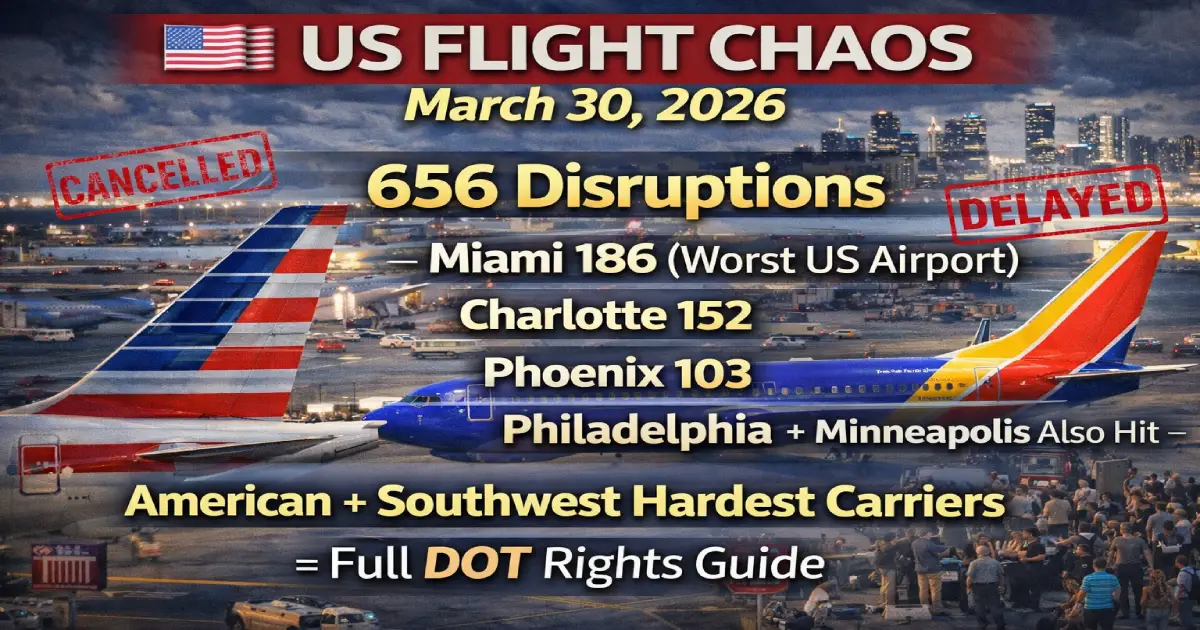
US flight chaos March 30, 2026 has produced 656 total disruptions — 6 cancellations and 650 delays — across Miami, Charlotte, Phoenix, Philadelphia, and Minneapolis, as Spring Break’s final peak weekend collides with sustained operational pressure across the American aviation network. Miami International Airport leads all US airports today with 186 disruptions. Charlotte Douglas follows with 152. Phoenix Sky Harbor records 103. And while the raw numbers are lower than the 4,495-disruption catastrophe of March 28, today’s chaos carries a harder story: with only 6 cancellations across all five affected airports, airlines are choosing to delay rather than cancel — stretching hundreds of thousands of Spring Break passengers across hours of waiting rather than giving them the clean break of a cash refund.
Published: March 30, 2026 Data source: FlightAware — confirmed by Travel and Tour World (10 hrs ago) + The Traveler (9 hrs ago) Total US disruptions today: 656 (6 cancellations + 650 delays) Worst airport — total: Miami International (MIA) — 186 disruptions (184 delays + 2 cancellations) Second worst: Charlotte Douglas (CLT) — 152 disruptions (152 delays + 0 cancellations) Third worst: Phoenix Sky Harbor (PHX) — 103 disruptions (101 delays + 2 cancellations) Also disrupted: Philadelphia International (PHL) | Minneapolis–St. Paul (MSP) Worst carrier — delays: American Airlines — MIA + CLT + PHL concentrated — triple hub pressure Second worst carrier: Southwest Airlines — PHX primary + national point-to-point cascade Context — March 28 comparison: Today’s 656 vs March 28’s 4,495 — smaller absolute total but structurally significant because Spring Break should be winding down Cause 1: Spring Break peak volume — record 2.8 million passengers/day national — final Easter weekend surge Cause 2: American Airlines hub convergence — MIA + CLT + PHL all simultaneously pressured Cause 3: Network cascade — aircraft and crews mispositioned after March 28’s 4,495-disruption day — system has not fully reset Cause 4: DHS shutdown Day 45 — TSA staffing gaps continuing at MIA, CLT, PHL checkpoints Why 6 cancellations matters: Airlines are absorbing disruption as delays rather than cancellations — protecting revenue at passenger expense — 650 delays with 6 cancels = deliberate decision to operate late DOT automatic cash refund: ✅ For cancellations — 7 business days — demand cash not vouchers DOT significant delay threshold: Domestic 3hr+ = right to full cash refund if you choose not to travel Duty of care (controllable): ✅ Meals + hotel — all major carriers committed per DOT dashboard
When an airline cancels your flight, you have clarity: request a cash refund, get rebooked, know where you stand. When an airline delays your flight by 2 hours, then 3 hours, then shows a new departure time of “TBD” — you are in limbo. You cannot leave the gate area. You cannot book an alternative. You cannot know whether to buy dinner or sprint to a connection. You are simply waiting.
Today’s ratio of 650 delays to 6 cancellations is not accidental. It is a deliberate operational choice by airlines under pressure. Cancelling a flight triggers a cascade of obligations: passenger rebooking costs, duty of care commitments (meals, hotels), and — for controllable cancellations — potential compensation claims. Delaying the same flight avoids all of those immediate costs, keeps the revenue, and transfers the burden of waiting entirely to passengers.
The result is what The Traveler describes as “soft chaos” — terminals full of passengers facing repeated gate changes, rolling departure times, and longer waits on tarmacs and jet bridges. No single dramatic cancellation event. Just a grinding, unannounced, uncompensated wait that stretches Spring Break travel from a Sunday flight home into a Sunday night arrival.
Miami International is today’s worst-performing US airport with 184 delays and 2 cancellations. MIA is American Airlines’ primary international hub — and today American is recording its highest delay counts of any carrier nationally, concentrated specifically at Miami, Charlotte, and Philadelphia simultaneously.
For MIA, this is a continuation of a difficult week. The March 25 article on your site confirmed 77 delays and 8 cancellations at MIA five days ago. Today’s 184 delays represent a significant step up in delay volume, reflecting the Easter Sunday return surge hitting an airport that handles over 50 million passengers per year.
Why MIA specifically: Miami is the endpoint of some of the highest-traffic leisure corridors in the US — New York, Boston, Philadelphia, Chicago, and the entire Caribbean connection network. When Spring Break families are all trying to fly home simultaneously from Miami on Easter weekend, there are no spare gate slots, no spare aircraft, and no spare crews to absorb any disruption. A single delayed inbound from JFK becomes a delayed outbound to Chicago becomes a delayed arrival in Minneapolis.
Routes worst hit today: MIA ↔ New York (JFK/LGA/EWR) | MIA ↔ Chicago (ORD/MDW) | MIA ↔ Philadelphia | MIA ↔ Charlotte | MIA ↔ Bogotá | MIA ↔ Lima
American Airlines at MIA today: At Miami and Charlotte, both key hubs for American Airlines, delay tallies reached into the triple digits as aircraft arriving late from earlier legs created a cascading backlog. American’s hub-dependent system meant delays at Phoenix rippled through Charlotte and Dallas-Fort Worth connections too.
If you are at MIA right now: ✈️ Check the AA app — MIA departure boards are lagging behind real-time app data today ✈️ If delayed 3+ hours and you choose not to travel: you are entitled to a full cash refund under the DOT significant delay rule ✈️ If your inbound flight is late and you have a connection: go to the American Airlines rebooking desk before your original connection departs — do not wait at the gate
Charlotte Douglas is recording 152 delays with zero cancellations — the purest example of today’s “soft chaos” pattern. Every single disrupted passenger at CLT today is sitting in a delay, not a cancellation. American’s connecting complex at Charlotte is the second-largest in the US after Dallas-Fort Worth — and today it is absorbing inbound delays from MIA, PHL, and the Northeast simultaneously.
152 delays at zero cancellations means American has made a clear operational call: hold the aircraft, hold the passengers, protect the revenue. The passengers bearing the cost are the ones mid-journey who cannot get off the delay carousel without forfeiting their ticket.
The connection trap at CLT: Charlotte Douglas is a pure hub — almost no one’s final destination. Almost everyone connecting through CLT today is on a two-leg journey. A 90-minute inbound delay at MIA → CLT becomes a missed connection to the onward CLT → final destination flight. With zero cancellations across the CLT complex today, those missed connections are being absorbed as delays on the next available departure — which is also delayed.
If you are connecting through CLT today: ✈️ American Airlines passengers on a single booking: your carrier is responsible for getting you to your final destination — rebooking on the next available flight is mandatory at no cost ✈️ If your connection has already departed: go directly to the American Airlines rebooking desk — do not use the app for missed connections, use the desk ✈️ If the next available CLT flight to your destination is 5+ hours away: ask specifically for routing through a different hub (PHL, DFW, ORD) — you are entitled to ask
Phoenix Sky Harbor records 101 delays and 2 cancellations today — Southwest Airlines is the primary carrier affected. Phoenix is Southwest’s largest Southwest focus city outside of Dallas — its point-to-point network from PHX connects to Los Angeles, Denver, Las Vegas, Chicago, Dallas, Houston, and the entire East Coast.
When Southwest accumulates delays at Phoenix, the cascade travels through every city in its network simultaneously. A delayed PHX → LAX morning departure means a delayed LAX → SFO afternoon departure means a delayed SFO → Portland evening departure. Today’s 101 Phoenix delays are not 101 isolated events — they are 101 dominos.
Southwest’s specific PHX exposure: Southwest Airlines, a major presence in Phoenix, also experienced elevated delays, particularly on dense domestic routes linking the Southwest and East Coast. Scheduling experts note that point-to-point networks become stressed when multiple focus cities see even moderate constraints, forcing rolling schedule adjustments as the day progresses.
If you are on a Southwest flight through PHX today: ✈️ Southwest’s no-change-fee policy is your most powerful tool — use it now via the app if your schedule is severely impacted ✈️ Southwest does not interline with other airlines — if your Southwest flight is cancelled, you rebook on Southwest only ✈️ Southwest Rapid Rewards elite members: call the priority line — hold times on the standard line are extreme today
Philadelphia International is experiencing average arrival delays approaching half an hour on some boards. PHL is American’s third major hub today — alongside MIA and CLT, it forms the triple-hub pressure that is making American today’s most disrupted legacy carrier.
Philadelphia’s disruption today is primarily inbound-driven: aircraft arriving late from MIA and CLT are the fuel for PHL’s outbound delays. Unlike MIA and CLT where American is the dominant carrier, PHL also sees significant impact on American’s regional operations through PSA Airlines and Piedmont Airlines — regional feeders whose tight scheduling margins amplify hub delays.
Minneapolis is recording disruptions consistent with the broader national pattern today — Delta’s presence at MSP and Southwest’s transcon routes to Minneapolis are both showing delay pressure. No specific breakdown confirmed from today’s sources — confirmed disrupted but at lower volume than MIA, CLT, and PHX.
American Airlines is today’s most affected legacy carrier by delay volume. American, which operates large connecting complexes at Miami, Charlotte, and Philadelphia, appeared among the most heavily affected carriers as late-arriving aircraft and crew rotations fueled downstream holdups. Publicly available performance snapshots show American leading or near the top of national delay counts by mid-afternoon, with dozens of its departures from those hubs leaving behind schedule.
The triple-hub convergence — MIA + CLT + PHL all simultaneously pressured — is the specific structural problem American faces today. United has one primary hub under pressure (ORD). Delta has Atlanta. American has three hubs all recording triple-digit delays on the same day.
American passengers — what to do right now: ✈️ Check your specific flight at aa.com/en-us/flight-status ✈️ If delayed 3+ hours and you are departing from a US airport: you are entitled to a full cash refund if you choose not to travel — DOT confirmed ✈️ Use the AA app for rebooking — faster than every other channel today — agent hold times are extreme
Southwest Airlines is recording elevated delays nationally, with Phoenix as the primary pressure point. Southwest’s point-to-point model means Phoenix delays travel through its entire system within hours. Today’s elevated Southwest delay count at PHX is consistent with the carrier’s March pattern — it has appeared in every major disruption article since March 6.
Southwest passengers — what to do right now: ✈️ Use the Southwest app — the only fast channel today ✈️ No change fees — rebook to any available flight at no cost if your schedule is severely impacted ✈️ Southwest’s hotel and meal commitments apply for controllable cancellations — check the DOT dashboard to confirm your specific situation
Other large US carriers, including low-cost competitors and regional affiliates, reported scattered disruptions as shared airspace, runway congestion, and gate availability narrowed the margin for on-time performance. Delta, United, Spirit, and Frontier are all showing moderate delay counts nationally — none at the level of American’s triple-hub exposure today.
Spring Break peak travel is surging, with record numbers of passengers taking to the skies. At 2.8 million passengers per day nationally, today represents one of the highest single-day passenger totals in US aviation history. Airlines and airports designed for 2.3–2.4 million daily passengers are absorbing 2.8 million — a 17–21% capacity overage that has no slack in it anywhere.
The passengers most at risk today are not those whose flights are cancelled — they have clear rights and a clear path. The passengers most at risk are those sitting in 2-hour, 2.5-hour, 2-hour-59-minute delays that never quite reach the 3-hour threshold that triggers DOT refund rights. Airlines know that threshold. Experienced travellers should too.
The 3-hour rule: Under the DOT’s 2024 automatic refund rule, a domestic flight delayed by 3 or more hours at your final destination — for reasons within the airline’s control — entitles you to a full cash refund if you choose not to travel. A 2-hour-59-minute delay does not. That one-minute gap is worth hundreds of dollars in some situations.
Any cancellation entitles you to a choice between a full cash refund or rebooking on the next available flight at no extra cost. The words to use:
“I am requesting a full cash refund under the DOT automatic refund rule.”
Timeline: 7 business days to your original payment method. Airlines cannot legally offer vouchers as the only option. If refused at the desk: file at transportation.gov/airconsumer immediately.
A domestic delay of 3+ hours that you choose not to accept entitles you to a full cash refund under DOT’s 2024 rule — for controllable causes. The words to use:
“My flight has been delayed by [X hours]. I am requesting a full cash refund under the DOT significant delay refund rule.”
The cause question: Ask the airline for the specific cause code of your delay. Weather and ATC are extraordinary — no refund right for significant delay, though you can still request a refund for a cancelled flight. “Operational reasons” without a specific extraordinary cause is NOT a valid exemption — challenge it.
For controllable cancellations and significant delays — all major US carriers have committed to:
✈️ Meals: After 2+ hour controllable delay — ask immediately at the gate desk ✈️ Hotel: For overnight controllable delays — ask at the airline desk, not the airport desk ✈️ Ground transport: To and from hotel — request with the hotel confirmation
If refused: Buy what you need, keep every receipt, claim reimbursement in writing within 21 days.
US flight chaos March 30, 2026 — 656 disruptions across five airports on Easter Monday. Miami is the worst-performing airport in the country today. American Airlines is running its worst triple-hub delay day of March. Southwest is cascading through Phoenix into its national network. And the system’s choice to absorb 650 delays rather than 650 cancellations means most affected passengers have less clarity and fewer rights than they would if their flight were simply cut.
The Spring Break surge does not end today. Millions of passengers still need to return home through this week. Today’s disruption is not the final chapter — it is the penultimate one, before the post-Easter normalisation that airlines are banking on by Wednesday.
Check your flight status now. Know the 3-hour threshold. And if your flight is cancelled — request cash, every time, at every desk.
For More Resources:
Related Articles:
Posted By : Vinay
This article is provided for general informational purposes only and is based on information available at the time of publication. Travel advisories, airline schedules, airport operations, visa requirements, government regulations, and other travel-related information are subject to change without prior notice. While Travel Tourister makes reasonable efforts to verify information using official announcements, government publications, airline and airport communications, and other reliable sources, we cannot guarantee that all information remains complete, accurate, or up to date at all times. Readers should independently verify any information that may affect their travel plans with the relevant airline, airport authority, government agency, embassy, or other official source before making travel, financial, or other decisions. Travel Tourister shall not be liable for any direct or indirect loss, inconvenience, or damages arising from the use of or reliance on the information contained in this article. Nothing in this publication constitutes legal, immigration, financial, or professional travel advice. If you believe any information in this article is inaccurate or outdated, please contact our editorial team. We review all credible correction requests promptly and update our content whenever appropriate.
Lastest News
2nd Floor, 39, Above Kirti Club, DLF Industrial Area, Kirti Nagar, New Delhi, Delhi 110015



Travel Tourister is a leading Travel portal where we introduce travellers to trusted travel agents to make their journey hasselfree, memorable And happy. Travel Tourister is a platform where travellers get Tour packages ,Hotel packages deals through trusted travel companies And hoteliers who are working with us across the world. We always try to find new and more travel agents and hoteliers from every nook and corners across the world so that you could compare the deals with different travel agents and hoteliers and book your tour or hotel with the one you have chosen according to your taste and budget.
Copyright © Travel Tourister, India. All Rights Reserved

 Call
Call Enquiry