Published on : 21 Sep 2026
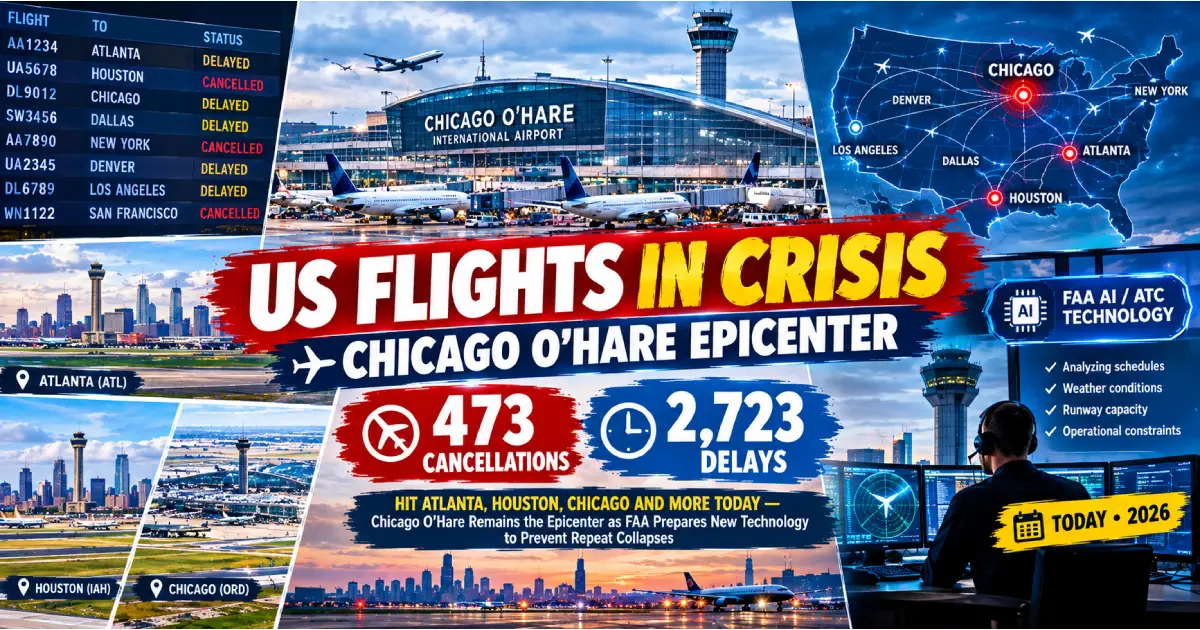
For the second time in three days, Chicago has dragged the entire national aviation network into crisis with it — and this time, the airport alone accounts for nearly three-quarters of all cancellations nationwide.
Widespread operational strain across the United States aviation network has triggered 2,723 flight delays and 473 cancellations today, September 19, 2026, according to FlightAware data logged at 1:22 PM ET. The disruption is centered heavily in the Midwest, with Chicago O’Hare International Airport once again emerging as the primary epicenter — recording 1,042 delays and 342 cancellations on its own, meaning O’Hare alone accounts for roughly 72% of every cancellation logged nationwide today. This is a repeat of the pattern this site documented just two days ago, when O’Hare recorded 1,055 delays and 175 cancellations in what was then described as its worst day since summer — today’s cancellation count at the same airport is nearly double that figure.
Today’s systemic interruptions are touching a broad spectrum of carriers. United is reporting 511 delays and 42 cancellations, a 17% delay rate, while American Airlines has logged 466 delays and 41 cancellations, a 14% delay rate. Southwest is also heavily affected, with 341 delays recorded so far. Regional operators — SkyWest, Republic Airways, Envoy Air, and GoJet — are seeing especially high percentages of cancelled departures relative to their smaller overall schedules. Beyond Chicago, disruption is also being felt at Atlanta, Houston, Boston, Orlando, Reagan National, LaGuardia, and Detroit Metro, extending the reach of today’s crisis across seven additional major airports simultaneously.
Published: September 19, 2026 — Saturday National total: 473 cancellations + 2,723 delays Data source: FlightAware, logged September 19, 2026, 1:22 PM ET Epicenter: Chicago O’Hare — 1,042 delays + 342 cancellations (72% of the national cancellation total) Atlanta Hartsfield-Jackson: 116 delays + 12 cancellations (5% origin delay rate) Boston Logan: 105 delays + 7 cancellations LaGuardia: 62 delays + 8 cancellations Also affected: Houston Bush · Orlando International · Reagan National · Detroit Metro Wayne Co United Airlines: 511 delays + 42 cancellations (17% delay rate) American Airlines: 466 delays + 41 cancellations (14% delay rate) Southwest Airlines: 341+ delays recorded Regional carriers with high cancellation percentages: SkyWest · Republic Airways · Envoy Air · GoJet Context: O’Hare’s second major disruption event in three days — today’s cancellation count (342) is nearly double Sept 17’s (175) FAA response: Preparing to deploy new technology aimed at mitigating repeat operational collapses of this kind DOT cash refund rule: ✅ Full refund to original payment method for any airline-cancelled flight — no vouchers required
Two major disruption events at the same airport within a three-day window, with the second event roughly doubling the first one’s cancellation count, is a meaningfully different pattern than a single isolated bad-weather day. O’Hare’s dual role — as one of the country’s busiest connecting hubs and a primary base for both United and American Airlines — means that whatever is driving repeated strain there doesn’t just affect Illinois travelers. It ripples through both major carriers’ entire national networks simultaneously, which is exactly the mechanism behind today’s broad reach into Atlanta, Houston, Boston, Orlando, and three additional major airports.
The scale gap between O’Hare and every other affected airport is worth sitting with for a moment. Atlanta, the world’s busiest airport by passenger volume, recorded only 116 delays and 12 cancellations today — a fraction of O’Hare’s 1,042 delays and 342 cancellations. Boston Logan, still operating under its own well-documented runway construction constraints, posted just 105 delays and 7 cancellations by comparison. This gap illustrates that today’s crisis isn’t simply “bad weather affecting the whole country evenly” — it’s a concentrated failure at one specific hub that has metastasized outward through connecting itineraries, rather than a genuinely nationwide weather system hitting every airport with equal force.
United’s 17% delay rate and American’s 14% delay rate both significantly exceed what either carrier would consider a normal operating day, and the explanation traces directly back to Chicago. Both airlines operate O’Hare as one of their most important domestic and international connecting hubs, meaning a disruption there doesn’t stay contained to O’Hare-originating or O’Hare-bound flights — it cascades into missed connections, out-of-position aircraft, and displaced crews across each airline’s entire national network for the rest of the day. Southwest’s 341-plus delays reflect a similar dynamic, even though Southwest’s point-to-point network structure typically insulates it somewhat better from single-hub cascading failures than the hub-and-spoke carriers.
The involvement of four separate regional carriers — SkyWest, Republic, Envoy, and GoJet — operating on behalf of the larger network airlines adds another layer to today’s picture. These carriers typically fly the smaller regional jets that connect mid-sized cities into major hubs like O’Hare, and their high cancellation percentages today suggest the disruption is squeezing the connecting-flight layer of the network especially hard, even as mainline carriers report proportionally more delays than outright cancellations.
Today’s national total of 2,723 delays and 473 cancellations sits within a range this site has tracked repeatedly over the past two weeks, but the concentration at a single airport is unusually severe. For comparison, a September 17 event produced a similar national delay count (4,218) with cancellations far more evenly spread across the network, while a September 11 event saw Atlanta itself as the leading airport with 335 delays but only 5 cancellations — a very different disruption profile than today’s O’Hare-dominated picture, where cancellations rather than delays are the dominant story at the epicenter airport.
Today’s crisis is coinciding with what’s described as a critical period of infrastructure tension, with the FAA reportedly preparing to deploy new technology aimed at preventing this kind of repeated operational collapse. While the specific system hasn’t been detailed in today’s coverage, this fits a broader pattern this site has tracked throughout 2026: air traffic control staffing constraints and aging technology infrastructure have been repeatedly cited as contributing factors across numerous disruption events this year, from Newark’s ongoing flight caps to the NATS software defect identified this week in the UK. Whatever specific system the FAA is preparing, its stated goal — reducing the frequency and severity of exactly this kind of cascading multi-hub disruption — directly addresses the pattern visible in O’Hare’s repeat performance this week.
Regardless of cause, any of today’s 473 cancellations entitle affected passengers to a full refund to their original payment method if they decline rebooking. This applies whether you were on one of O’Hare’s 342 cancelled flights or affected at any other airport today.
If today’s disruption is primarily weather and congestion-driven, as with O’Hare’s event two days ago, the standard DOT-tracked compensation commitment (up to $775 for controllable delays of 3+ hours) is unlikely to apply in most cases. Ask your airline for the specific stated cause in writing — this matters particularly for United and American passengers today, given both carriers’ substantial exposure.
Given how many carriers are affected simultaneously today, ask about rebooking on partner or competing airlines if your own carrier’s next available flight involves an unreasonable wait — this is especially relevant if you’re booked on one of the regional carriers reporting high cancellation percentages today.
Given O’Hare’s outsized share of today’s disruption, consider whether an alternate routing through a less-affected connecting hub might get you to your destination faster than waiting for your original O’Hare-routed itinerary to clear the backlog.
Get the specific stated cause in writing → file directly with the airline first → escalate to airconsumer.dot.gov if unresolved.
✅ Check your specific flight status before heading to the airport, particularly if connecting through O’Hare, Atlanta, Houston, Boston, Orlando, Reagan National, LaGuardia, or Detroit Metro ✅ If you’re booked on a regional carrier (SkyWest, Republic, Envoy, or GoJet), treat your flight as elevated risk given today’s disproportionate impact on these operators ✅ If your itinerary touches O’Hare in any way, treat it as significantly higher risk than any other airport in today’s data — it’s carrying nearly three-quarters of the day’s entire national cancellation count ✅ Build extra connection buffer time for any itinerary touching Chicago, given the airport’s repeated disruption pattern this week ✅ If your flight was cancelled, contact your airline directly for rebooking rather than waiting for automatic reaccommodation, given the volume of affected passengers today
| Airline | Action | US Phone |
|---|---|---|
| United Airlines | united.com → Travel Alerts | 1-800-864-8331 |
| American Airlines | aa.com → Travel Alerts | 1-800-433-7300 |
| Southwest Airlines | southwest.com → Travel Advisories | 1-800-435-9792 |
DOT complaint portal: airconsumer.dot.gov FAA live status: fly.faa.gov Chicago O’Hare live status: flychicago.com → Flight Status
Related Articles:
Posted By : Vinay
This article is provided for general informational purposes only and is based on information available at the time of publication. Travel advisories, airline schedules, airport operations, visa requirements, government regulations, and other travel-related information are subject to change without prior notice. While Travel Tourister makes reasonable efforts to verify information using official announcements, government publications, airline and airport communications, and other reliable sources, we cannot guarantee that all information remains complete, accurate, or up to date at all times. Readers should independently verify any information that may affect their travel plans with the relevant airline, airport authority, government agency, embassy, or other official source before making travel, financial, or other decisions. Travel Tourister shall not be liable for any direct or indirect loss, inconvenience, or damages arising from the use of or reliance on the information contained in this article. Nothing in this publication constitutes legal, immigration, financial, or professional travel advice. If you believe any information in this article is inaccurate or outdated, please contact our editorial team. We review all credible correction requests promptly and update our content whenever appropriate.
Lastest News
2nd Floor, 39, Above Kirti Club, DLF Industrial Area, Kirti Nagar, New Delhi, Delhi 110015



Travel Tourister is a leading Travel portal where we introduce travellers to trusted travel agents to make their journey hasselfree, memorable And happy. Travel Tourister is a platform where travellers get Tour packages ,Hotel packages deals through trusted travel companies And hoteliers who are working with us across the world. We always try to find new and more travel agents and hoteliers from every nook and corners across the world so that you could compare the deals with different travel agents and hoteliers and book your tour or hotel with the one you have chosen according to your taste and budget.
Copyright © Travel Tourister, India. All Rights Reserved

 Call
Call Enquiry