Published on : 21 Apr 2026
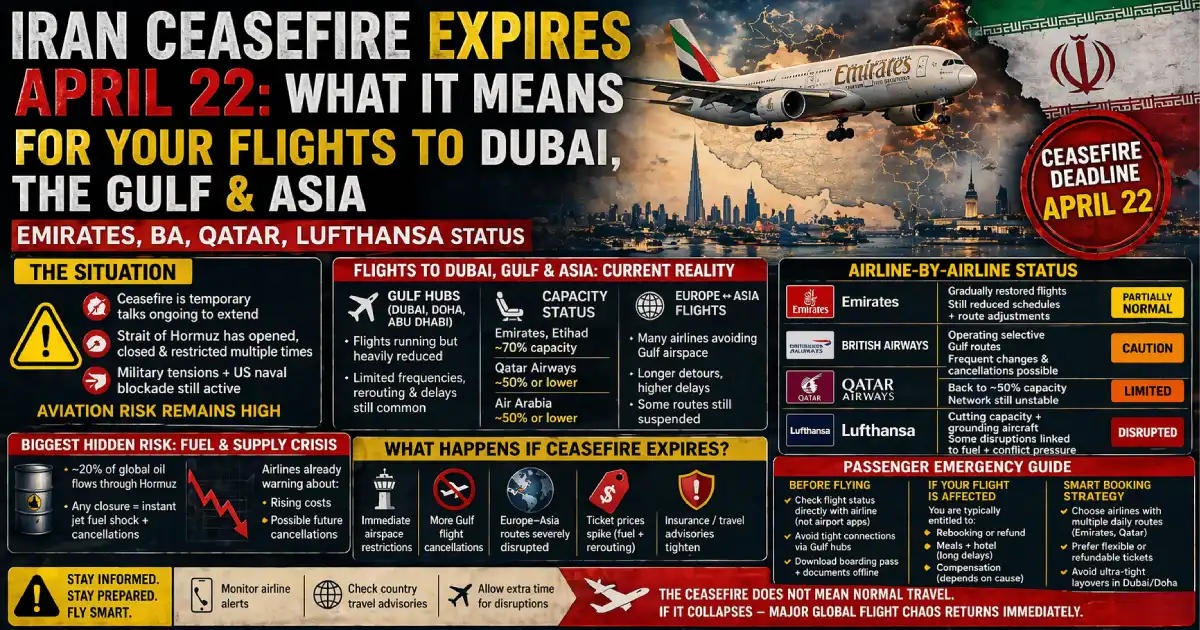
Breaking — April 21, 2026: The two-week US–Iran ceasefire that has kept Gulf airspace partially open since April 8 is now in its final hours — and peace talks have effectively collapsed. Iran has told Pakistan it has “no plan for a second round of negotiations with the US for now.” Oil prices have surged back above $89 a barrel on WTI and $95 on Brent. Only 16 ships crossed the Strait of Hormuz on Monday — a fraction of normal traffic. US Vice President JD Vance is en route to Islamabad for a second negotiating session that Iran may not attend. And Trump has shifted the ceasefire expiry deadline to Wednesday evening US Eastern Time — warning it is “highly unlikely” he will extend it further if no deal is reached.
Every passenger with a flight to or through Dubai, Abu Dhabi, Doha, Riyadh, or any Gulf destination this week needs to understand exactly what happens if the ceasefire expires — and what your rights are. This is that guide.
Published: April 21, 2026 — Monday Ceasefire Start Date: April 8, 2026 (US–Iran, mediated by Pakistan) Original Expiry: April 22, 2026 (Tuesday) Trump’s Revised Deadline: Wednesday evening US Eastern Time (approximately Wednesday night London / Thursday morning Dubai) Iran’s Position (as of Monday April 21): No plan for second round of talks “for now” US Position: JD Vance travelling to Islamabad — hopes Iran attends Hormuz Traffic Monday April 21: Only 16 ships traversed the strait — near-standstill Oil prices Monday: Brent $95.50/barrel (+5.6%) · WTI $89/barrel (+6%) — surging on war risk EASA Conflict Zone Bulletin (CZIB 2026-03-R6): Valid through April 24, 2026 — covers all altitudes over 11 countries The Two Critical Dates This Week: April 22 (ceasefire expiry) · April 24 (EASA bulletin review) Scenario A — Deal reached: Ceasefire extended, EASA may ease bulletin, European carriers closer to May return Scenario B — Ceasefire collapses: Airspace disruptions, new cancellations, Emirates route suspensions, potential return to February 28 conditions
The two-week ceasefire agreed on April 8, 2026 between the United States, Iran, Israel, and Lebanon — mediated by Pakistan — was always fragile. JD Vance described it from the start as a “fragile truce.” It was negotiated not as a permanent peace but as a window for diplomacy: a pause in hostilities to allow US and Iranian negotiators to work toward a more durable framework.
Since February 28, when US and Israeli strikes on Iran triggered the closure of the Strait of Hormuz and the near-total collapse of Gulf aviation, the ceasefire has been the single most important geopolitical variable affecting civil aviation. Before the ceasefire, Iran had effectively shut the Strait — through which roughly 20% of the world’s oil normally flows — causing fuel shortages, flight cancellations, and the stranding of six cruise ships for 47 days.
The April 8 ceasefire:
But the ceasefire has also been violated repeatedly. The US imposed a naval blockade of Iranian ports on April 13 — two days after the first Islamabad talks. Iran called this a ceasefire breach and demanded it be lifted as a condition for further talks. On Saturday April 18, ships were fired on in the Strait of Hormuz as cruise ships were transiting. The US seized an Iranian container ship. As of Monday April 21, only 16 commercial vessels crossed Hormuz in the entire day — compared to the hundreds that normally use it.
As CNBC’s Rory Johnston described it: “We had the most violent day in the strait on Saturday that we’ve had since the beginning of this crisis, and things don’t seem to be getting any better.”
JD Vance, Steve Witkoff, and Jared Kushner flew to Islamabad. Iran’s Foreign Minister Abbas Araghchi and Parliament Speaker Mohammad Ghalibaf attended. The talks ran for 21 hours. No agreement was reached. The US proposed a 20-year pause on Iranian uranium enrichment. Iran rejected this, insisting on five years. Trump subsequently announced the US Navy would blockade the Strait of Hormuz — which Iran immediately characterised as a ceasefire violation.
The first round of Islamabad talks was formally declared to have ended without agreement, raising urgent questions about ceasefire renewal. Iran’s Foreign Ministry accused Washington of “excessive demands, unrealistic expectations, constant shifts in stance” and described US statements about talks as “a media game.” Parliament Speaker Ghalibaf said Trump was seeking to turn the negotiating table “into a table of surrender.”
Iran’s foreign ministry spokesperson Esmaeil Baghaei confirmed Monday that Iran has “no plan for a second round of negotiations with the US for now.” The ministry cited the US naval blockade and the seizure of an Iranian container ship as breaches of the truce. Iranian FM Araghchi told his Pakistani counterpart Ishaq Dar that Iran is “taking all aspects into consideration” but the presence of “provocative actions” was a major obstacle.
Despite Iran’s public stance, Pakistani officials have expressed “cautious optimism” and described the process as “moving in a positive direction.” CNN sources say a second round of talks in Islamabad is currently planned for Wednesday — the same day the ceasefire expires — but “the situation remains fluid.”
Trump, asked about Iran’s refusal to attend: “They’re going to negotiate, and if they don’t, they’re going to see problems like they’ve never seen before.”
The bottom line: As of Monday April 21, the outcome is genuinely uncertain. Ali Vaez of the International Crisis Group described the most likely near-term scenario not as “immediate war” but as “a volatile period of pressure, signaling, and last-minute attempts to prevent a wider conflagration.”
This is the moment that determines everything else. Three outcomes are possible:
🟢 Outcome A — Ceasefire extended: Iran agrees to talks, both sides announce an extension. Oil prices fall. Gulf airspace remains stable. EASA has a basis to ease its April 24 bulletin. European carriers’ May/June return plans remain on track. Emirates and Etihad continue expanding schedules. This is the best-case scenario for passengers.
🟡 Outcome B — Ceasefire lapses quietly: No deal, no formal extension, but no immediate resumption of hostilities. Both sides return to their capitals for further deliberation. This is the “volatile limbo” scenario. Airspace remains technically open but airlines add contingency buffers. EASA may extend its bulletin again on April 24 without changes. European carriers do not restart in May. Uncertainty continues.
🔴 Outcome C — Ceasefire collapses with hostilities resuming: Iran announces the truce is over and resumes Hormuz restrictions. US responds militarily. Gulf airspace goes back toward the February 28 scenario — widespread closures, mass cancellations, new passenger evacuations. Emirates suspends additional routes. All European carrier return plans dissolve. Oil price spike of 15–20% or more. This is the worst-case scenario.
EASA’s Conflict Zone Information Bulletin CZIB 2026-03-R6 expires on April 24. This review determines whether European-regulated airlines — British Airways, Lufthansa, Air France, KLM, Swiss, Austrian, Brussels Airlines, Iberia, Finnair, and all others — can legally restart Gulf operations.
If EASA lifts or eases the bulletin: European carriers can begin planning their actual restarts. BA’s July 1 Dubai date, Lufthansa’s May 31 suspension end — these remain in place as minimum dates regardless, but EASA lifting the bulletin would allow carriers to pull those dates forward if they choose.
If EASA extends the bulletin again (the more likely outcome given ceasefire uncertainty): All European carrier suspension dates remain in force. The next review would likely be two weeks later — early May.
The CZIB covers all altitudes over 11 countries: Bahrain, Iran, Iraq, Israel, Jordan, Kuwait, Lebanon, Oman, Qatar, Saudi Arabia, and the United Arab Emirates.
Current status: Operating approximately 145–150 daily departures from Dubai, serving roughly 125–127 of its normal 140+ destinations at approximately 70% of pre-crisis capacity. Exempt from EASA bulletin as a UAE-based carrier. Exempt from the DXB foreign airline 1-flight cap.
Flexible booking policy: Emirates has extended its rebooking policy to cover travel through May 31, 2026. Passengers booked to travel between February 28 and May 31 can rebook free of charge to the same destination or another destination in the same region for travel on or before June 15.
If the ceasefire collapses: Emirates would need to reassess routes that overfly Iranian or Iraqi airspace. Some long-haul routes (particularly to Europe and North America) could face longer routing via southern corridors, adding flight time and fuel costs.
🇬🇧 UK passengers: Emirates operates direct DXB→LHR multiple times daily. This is currently the primary route for London–Dubai travel. Check emirates.com for live schedule. 🇦🇺 Australian passengers: Emirates’ DXB→SYD, DXB→MEL, DXB→BNE, DXB→PER all continue operating. Emirates is the primary Europe–Australia routing through Dubai. If your connecting flight from a European city to Dubai is on a non-Emirates airline, check that carrier’s status separately. 🇨🇦 Canadian passengers: Emirates operates DXB→YYZ. This route overflies Iranian-adjacent airspace — confirm routing status before travel. 🇺🇸 US passengers: Emirates operates DXB→JFK, DXB→LAX, DXB→ORD, DXB→IAD and others. These continue operating.
Contact Emirates: emirates.com | UAE: +971-600-555-555 | UK: 0344 800 2777 | US: 1-800-777-3999 | Australia: 1300 303 777
Dubai (DXB): Suspended — resuming July 1, 2026 at 1 daily flight (down from 3 pre-crisis) Abu Dhabi (AUH): Suspended — no confirmed restart date Doha (DOH): Suspended — resuming July 1, 2026 Riyadh (RUH): Resuming mid-May at 1 daily flight Jeddah (JED): Permanently dropped from BA network from April 24, 2026 Bahrain (BAH): Suspended until October 25, 2026 Amman (AMM): Not resuming until October 25, 2026
BA flexible booking: Full refund or free date change for all affected bookings through October 31, 2026.
⚠️ Critical note for passengers: BA’s July 1 Dubai return is at reduced frequency (1 daily vs 3 pre-crisis). If you are booked on BA to Dubai in May or June 2026, your flight does not exist. Contact BA immediately to rebook on Emirates or request a cash refund.
🇦🇺 Australian passengers: Many Australians use the BA–Dubai–Australia connection via Qantas code-share. With BA Dubai suspended until July, this pathway is closed through at least June 30. Alternatives: Singapore Airlines or Qantas direct via Singapore; Malaysia Airlines via Kuala Lumpur; Cathay Pacific via Hong Kong; or Emirates direct on DXB–Australia routes.
Contact BA: ba.com | UK: 0344 493 0787 | US: 1-800-247-9297 | Australia: 1300 767 177
Dubai (DXB): Suspended through May 31, 2026 Abu Dhabi (AUH): Suspended through October 24, 2026 — the longest Gulf suspension of any major airline Riyadh, Jeddah, and other Gulf routes: Extended suspensions through at least May 2026
This applies across the full Lufthansa Group: Lufthansa mainline, Swiss, Austrian Airlines, Brussels Airlines, Lufthansa CityLine, Eurowings. Air Dolomiti flights are also affected on relevant routes.
Rebooking: Affected passengers can rebook fee-free or request a full cash refund. Contact your booking agent or lufthansa.com.
Note on Lufthansa strike + Gulf crisis: Lufthansa’s 9-day strike wave (April 8–17) combined with Gulf route suspensions has left the airline’s long-haul network severely depleted. Passengers transiting Frankfurt to Gulf or Asia destinations face both the strike cascade impact and the route suspension issue.
Contact Lufthansa: lufthansa.com | UK: 0371 945 9747 | US: 1-800-645-3880 | Germany: 069 86 799 799
Dubai (DXB): Suspended through May 3, 2026 (arriving flights) / May 4 (departing) Riyadh: Suspended through May 3
Flexible policy: Free postponement in same travel class, or one-year voucher valid on Air France, KLM, or Delta flights.
Dubai (DXB): Suspended through June 14, 2026 KLM’s 160 May cancellations were announced due to the fuel cost crisis linked to Hormuz — the highest cancellation announcement of any European carrier.
🇦🇺 Impact note for Australians: KLM’s Amsterdam–Dubai–Australia connections (via code-shares and partnerships) are suspended until mid-June. Route via Singapore or direct Qantas is the current recommended alternative.
Current status: Operating the most comprehensive schedule of any Gulf carrier outside the UAE. Qatar Airways has restored over 108+ daily departures from Doha to approximately 120 destinations. Doha–London Heathrow, Doha–Paris, Doha–Amsterdam, Doha–Frankfurt, Doha–Sydney, Doha–Melbourne all continuing.
Flexible policy: Passengers with bookings through June 15 are eligible for two complimentary date changes or a full refund.
Why Doha may be safer than Dubai this week: Qatar’s airspace was partially reopened under the ceasefire, but Qatar Airways routes to and from Doha use corridors that are slightly less exposed to Iranian airspace restrictions than some UAE-originating routes.
Contact Qatar Airways: qatarairways.com | UK: 0330 024 0110 | US: 1-877-777-2827 | Australia: 1300 340 600
For passengers travelling Europe–Australia, Europe–India, or Europe–Southeast Asia via the Gulf:
Most stable current routing (in order of recommendation):
Turkish Airlines routes that transit Iranian airspace have been rerouted. Istanbul (IST) remains fully operational as a hub. Some Middle East routes suspended. Turkey is not covered by EASA’s CZIB — Turkish Airlines operates under its own risk assessment and national aviation authority guidance. Istanbul–Dubai continues with extended routing.
Fully insulated from the Gulf crisis. Singapore–London (SQ via SIN) operates normally. Singapore–Sydney, Singapore–Melbourne, Singapore–Auckland all fully operational. Singapore Airlines cancelled selected services to Dubai through April 30 but its Europe–Asia routing via SIN does not traverse Gulf airspace.
If you are flying Emirates: Your flight is most likely to operate regardless of the ceasefire expiry. Emirates will continue operating as long as UAE airspace remains open. However, monitor for route changes — if ceasefire collapses and Iranian airspace becomes fully militarised, some Emirates route paths may need adjusting, potentially adding 1–2 hours.
If you are flying British Airways: Your May or June flight to Dubai does not exist. BA is suspended until July 1. Call BA on 0344 493 0787, request a full cash refund or rebooking onto Emirates. Under UK261, a cancelled flight entitles you to a full cash refund unconditionally.
If you are flying via Dubai as a connection hub: If your connecting carrier is European (Air France, KLM, Lufthansa) for the Dubai leg, and they are suspended, you will need to rebook via Emirates or Qatar Airways. Your European carrier owes you a full cash refund if your original flight is cancelled.
Critical: Do not fly to Dubai airport hoping to connect onto a suspended carrier. If your inbound European flight is cancelled and you need an alternative to Dubai, use Qatar Airways via Doha — it operates the most robust European schedule from a Gulf hub right now.
Australia’s most affected route is the Europe–Dubai–Australia corridor. With British Airways Dubai suspended, Lufthansa Dubai suspended until May 31, KLM until June 14, and Air France until May 3, the only reliable way to fly Europe–Dubai–Australia is via Emirates.
If you are booked on a European carrier for a Europe–Dubai–Australia connection:
Check your booking immediately. If your European carrier leg to Dubai is suspended, the entire itinerary may be broken. Your options: ✅ Rebook the entire itinerary on Emirates (London Heathrow–Dubai–Sydney/Melbourne/Brisbane/Perth) ✅ Reroute via Singapore (BA/Qantas London–Singapore, Qantas Singapore–Australia) ✅ Contact your original airline for a full cash refund under EU261/UK261 (if a European carrier) or consumer protection rights under Australian Consumer Law
Direct Australia–UK travel: Qantas operates Perth–London direct (Project Sunrise route) — no Gulf exposure whatsoever. Sydney–London via Singapore is also unaffected by the Gulf crisis.
Contact Qantas: qantas.com | Australia: 13 13 13 | UK: 0345 030 0303
Canada–Dubai via Emirates continues (YYZ–DXB). However, Air Canada’s Dubai suspension means no Air Canada option for this route. Emirates direct is the only Canadian passenger route to Dubai currently operating.
For Canada–India and Canada–Pakistan traffic that normally routes via Gulf hubs: Qatar Airways via Doha is the most stable alternative to Emirates via Dubai.
Most US carriers (United, American, Delta) do not fly to the Gulf — their Middle East exposure is primarily through partner/code-share arrangements. United’s transatlantic network via Newark faces some routing elongation on flights to South Asia and Southeast Asia that would normally use Gulf airspace. However, US passengers are less directly exposed than UK and Australian travellers.
Passengers with Emirates bookings (DXB–JFK/LAX/ORD/IAD) should monitor emirates.com but these routes are expected to continue operating.
If your flight is cancelled because of ceasefire collapse, airspace closure, or airline suspension:
✅ Full cash refund — unconditional, within 7 days to your original payment method ✅ Free rebooking on next available service to your destination ✅ Duty of care — meals and refreshments at 2+ hour delays; hotel if overnight required
⚠️ Compensation (£220–£520) will NOT apply if your flight is cancelled due to airspace closure or conflict escalation — these are extraordinary circumstances beyond the airline’s control. However, refund and rebooking rights are unconditional regardless.
The words to use: “My flight has been cancelled. I am requesting a full cash refund under UK261 (Aviation (Retained EU) Regulation 261/2004) to my original payment method within 7 days.”
CAA complaints: caa.co.uk/passengers | AviationADR (free): aviationadr.org.uk
Identical framework to UK261 for flights departing EU airports or arriving at EU airports on EU carriers. Full refund and rebooking unconditional. Cash compensation (€250–€600) unlikely for airspace-closure cancellations. File through your carrier’s online claims portal or escalate to your national aviation authority.
If your flight is cancelled and your airline does not offer a refund: lodge a complaint with the Australian Competition and Consumer Commission (accc.gov.au). Airlines must provide a remedy (refund or re-routing) under Australian Consumer Law. ATOL protection applies to package holidays booked through UK-registered travel agents — if your entire package is cancelled, the tour operator owes you a full refund.
Under DOT automatic refund rules (April 2024 rule): if your flight is cancelled for any reason, you are entitled to an automatic cash refund to your original payment method. No vouchers, no credits — cash. File complaints at airconsumer.dot.gov.
1. Check your carrier’s Dubai/Gulf status right now Go to your airline’s website, not a third-party booking site. Search for any active travel waivers on your booking. Every major airline has a travel alerts or travel information page showing current suspension dates. Do not assume your flight is operating because it still shows in the booking system — suspensions can be added with 24 hours’ notice.
2. If you have a European carrier booking to Dubai in May or June — act today BA May and June Dubai flights do not exist. Lufthansa Dubai through May 31 doesn’t exist. KLM through June 14 doesn’t exist. If you have these bookings, request a full cash refund now and rebook on Emirates or Qatar Airways. Do not wait for the airline to cancel — you have already been informed the flights will not operate.
3. If you are connecting through Dubai to Australia, India, or Southeast Asia — confirm your entire chain Every leg of a multi-carrier Dubai connection needs individual checking. If one leg is suspended, the whole itinerary is broken. Your best alternative right now is Qatar Airways via Doha for the Gulf leg or Singapore Airlines via Singapore for the entire route.
4. Do not buy non-refundable Dubai/Gulf bookings until after April 24 The EASA bulletin review on April 24 — two days after the ceasefire expiry — is the next major signal. Until you see how both the ceasefire situation and the EASA review resolve, only buy fully flexible fares that allow free cancellation. A non-refundable Dubai booking purchased today could be worthless by Thursday.
5. Monitor two specific sources on Wednesday evening
The Bottom Line: Wednesday evening is the most important moment for Gulf aviation since February 28. The ceasefire that has kept Dubai flying, allowed cruise ships to escape, and given European carriers a planning window for May/June restarts expires in less than 48 hours. Iran is refusing to come to the table. JD Vance is flying to Islamabad for talks Tehran has publicly said it won’t attend. Oil has already surged back above $89. Only 16 ships used Hormuz on Monday. The cruise ships got out through a window that has already partially closed.
If you are flying to the Gulf this week, you are watching this in real time. If you are flying to the Gulf in May or June on a European carrier, your booking is already suspended. If you are connecting through Dubai to Australia, the only reliable carrier today is Emirates. And if the ceasefire collapses, every one of those situations gets significantly worse.
Book flexible. Check daily. Act before Wednesday. And know your refund rights — because you may need them.
For More Resources:
Related Articles:
Posted By : Vinay
This article is provided for general informational purposes only and is based on information available at the time of publication. Travel advisories, airline schedules, airport operations, visa requirements, government regulations, and other travel-related information are subject to change without prior notice. While Travel Tourister makes reasonable efforts to verify information using official announcements, government publications, airline and airport communications, and other reliable sources, we cannot guarantee that all information remains complete, accurate, or up to date at all times. Readers should independently verify any information that may affect their travel plans with the relevant airline, airport authority, government agency, embassy, or other official source before making travel, financial, or other decisions. Travel Tourister shall not be liable for any direct or indirect loss, inconvenience, or damages arising from the use of or reliance on the information contained in this article. Nothing in this publication constitutes legal, immigration, financial, or professional travel advice. If you believe any information in this article is inaccurate or outdated, please contact our editorial team. We review all credible correction requests promptly and update our content whenever appropriate.
Lastest News
2nd Floor, 39, Above Kirti Club, DLF Industrial Area, Kirti Nagar, New Delhi, Delhi 110015



Travel Tourister is a leading Travel portal where we introduce travellers to trusted travel agents to make their journey hasselfree, memorable And happy. Travel Tourister is a platform where travellers get Tour packages ,Hotel packages deals through trusted travel companies And hoteliers who are working with us across the world. We always try to find new and more travel agents and hoteliers from every nook and corners across the world so that you could compare the deals with different travel agents and hoteliers and book your tour or hotel with the one you have chosen according to your taste and budget.
Copyright © Travel Tourister, India. All Rights Reserved

 Call
Call Enquiry