Published on : 20 Apr 2026
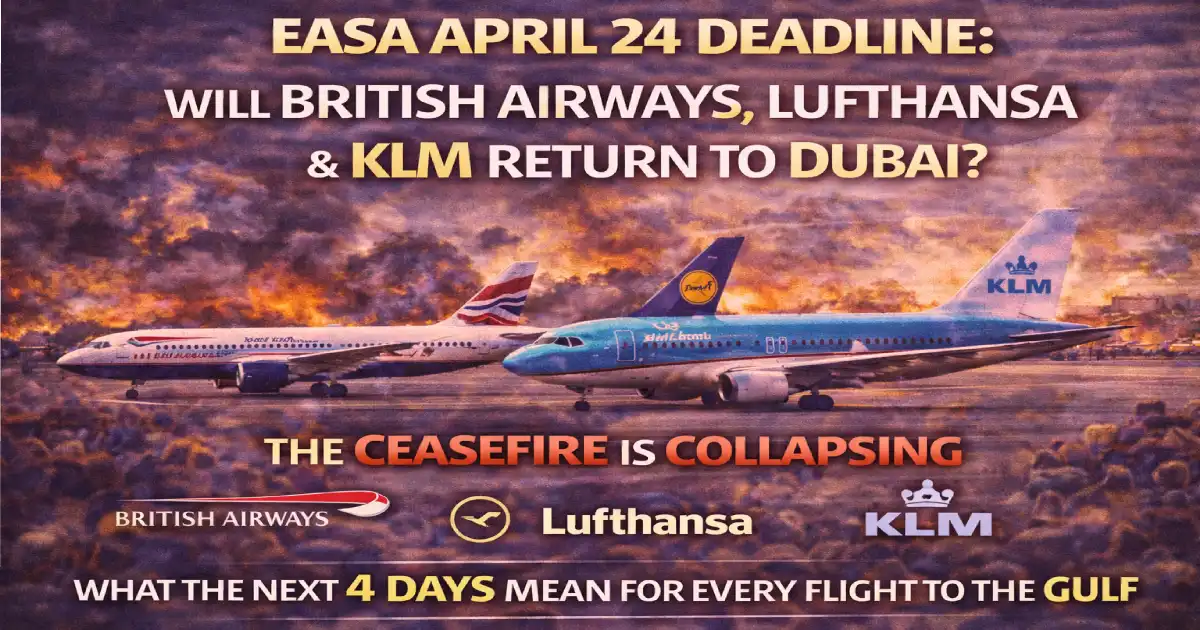
Critical Warning: The most important four days in international aviation since the Iran war began are now underway. On Thursday April 24, the European Union Aviation Safety Agency reviews its Conflict Zone Information Bulletin — the safety order that has grounded British Airways, Lufthansa, KLM, Air France, and every other European carrier from Dubai, Abu Dhabi, Riyadh, and every Gulf destination since late February. But the geopolitical picture that will determine that decision has just deteriorated sharply. Iran has pulled out of a second round of nuclear ceasefire talks with the United States in Pakistan, throwing the fragile truce into uncertainty just days before it expires on April 22 — describing the American approach to negotiations as “childish” and inconsistent, and accusing Washington of breaching the ceasefire through its naval blockade of Iranian ports. Without an extension or a permanent peace agreement, the ceasefire deal that began April 8 is slated to expire on Wednesday April 22. The ceasefire expires two days before EASA’s April 24 review. If the ceasefire collapses before Thursday, the EASA bulletin is almost certain to be extended — pushing BA’s July 1 return date, KLM’s June 14 suspension, and Lufthansa’s May 31 cut-off all further back. If a last-minute deal saves the ceasefire, April 24 becomes the most consequential airline restart decision of 2026. This article explains exactly what is at stake, which airlines are affected, and what every passenger must know before making any booking decision involving the Gulf.
Published: April 20, 2026 EASA Review Date: Thursday April 24, 2026 Bulletin: CZIB 2026-03-R6 — Conflict Zone Information Bulletin, Middle East and Persian Gulf Current Validity: Extended to April 24, 2026 — no content changes since original February 28 issue Ceasefire Expiry: Wednesday April 22, 2026 — 2 days before the EASA review Ceasefire Status: 🔴 CRITICAL — Iran withdrew from Islamabad Round 2, April 20; US naval blockade of Iranian ports active; Strait of Hormuz not fully open Airlines Directly Blocked: British Airways · Lufthansa Group (Lufthansa, SWISS, Austrian, ITA, Brussels) · KLM · Air France · Air Canada · Singapore Airlines · United Airlines · Philippine Airlines · Turkish Airlines Airlines Operating: Emirates (125+ destinations, 70% capacity) · flydubai (100+ routes, 40% capacity) — both exempt as UAE-based carriers Dubai Foreign Airline Cap: Active from April 20 — 1 flight/day per foreign carrier at DXB and DWC through May 31 BA’s Return Plan: July 1, 2026 — 1 daily flight London–Dubai (down from 3) — subject to EASA clearance KLM Suspension: Until at least June 14, 2026 Lufthansa Group Suspension: Until at least May 31, 2026 Air France Suspension: Until at least May 3, 2026
The EASA April 24 review is not a scheduled reopening. It is a scheduled reassessment. EASA will examine the security picture, consult with EU Member States and the European Commission, and decide one of three things: lift the bulletin (allowing European carriers to plan Gulf route returns), modify it (potentially creating limited exceptions or graduated risk levels), or extend it again (keeping everything as is, pushing airline suspension dates further out).
Despite ceasefire efforts, military activity continues across the region, including ongoing Israeli strikes in Lebanon. This shows the conflict is not contained to Iran alone, and the wider regional risk picture remains elevated. Even where airspace has reopened, most international operators are still avoiding the region or using only tightly controlled routings.
The critical new variable as of today, April 20: Iran has pulled out of a second round of ceasefire talks with the United States in Pakistan, throwing the fragile truce into uncertainty just days before it expires on April 22. With the ceasefire set to expire on April 22 and talks now in disarray, both sides have refused to move on the core issues: Iran’s nuclear enrichment programme, its regional proxies including Hezbollah, and control over the Strait of Hormuz. Despite back-channel negotiations, deep mistrust between Washington and Tehran remains the biggest obstacle to any peace agreement.
EASA issued its original Conflict Zone Information Bulletin on 28 February 2026, shortly after the United States and Israel conducted coordinated military strikes on targets inside Iran. The agency cited risks of misidentification, interception errors, and advanced air defence systems at all altitudes. EASA notes that the presence of all-altitude air-defence systems, cruise and ballistic missiles, and military aircraft capable of interception significantly increases the risk of spill-over effects, misidentification, miscalculation, or interception failures across the region.
The sequence of events now playing out in real time — with Iran skipping Round 2, the ceasefire expiring April 22, and EASA reviewing on April 24 — means that the April 24 decision is more likely to produce an extension than a lifting. The most probable outcomes, in order of likelihood as of today:
The most common misunderstanding passengers have about this crisis is that the airlines are choosing to stay grounded. They are not. They are legally and contractually prevented from flying.
The CZIB was originally issued on 28 February 2026 shortly after the US and Israel conducted coordinated military strikes on targets inside Iran. EASA confirmed an extension of the bulletin until 24 April 2026, following a joint review by EU Member States, the European Commission and EASA. The decision means European-regulated airlines — including British Airways, Lufthansa, Air France, KLM and others — remain grounded across Gulf routes for at least another two weeks.
EASA’s Conflict Zone Information Bulletin (CZIB 2026-03-R6) remains in effect through 24 April 2026, advising European operators to avoid all altitudes across 11 countries: Bahrain, Iran, Iraq, Israel, Jordan, Kuwait, Lebanon, Oman, Qatar, Saudi Arabia, and the United Arab Emirates. Until this advisory is lifted or modified, KLM cannot resume Gulf routes regardless of the ceasefire.
The practical mechanism: European carriers’ war-risk insurance is directly tied to EASA’s safety assessment. European carriers’ war-risk insurance follows EASA’s assessment directly, which is why airlines like British Airways, Lufthansa, Air France, and KLM remain grounded in the region. Even if an airline wanted to resume Dubai flights tomorrow, its insurance provider would refuse to cover the flight without EASA clearance. There is no workaround.
Emirates: Emirates is scheduling around 145–150 departures daily from DXB, operating to roughly 125–127 of its normal 140+ destinations at about 70% capacity. As a UAE-based carrier, Emirates is exempt from both the EASA bulletin and the foreign airline cap. It is the primary way to fly to and from Dubai right now for passengers from all countries. Emirates has extended its flexible rebooking policy to cover travel through May 31, 2026 — passengers can rebook free of charge to the same destination or another for travel on or before June 15.
flydubai: flydubai is running approximately 70–73 flights per day, serving over 100 routes at around 40% of pre-crisis levels. Also exempt from the cap as a UAE-based carrier. Some destinations including Kuwait City remain suspended due to airport damage.
Qatar Airways (via Doha): Operating the most robust Gulf schedule of any non-UAE carrier. Qatar Airways via Doha has emerged as the primary alternative transit hub for UK, Australian, and US passengers who relied on Dubai connections. Doha is not subject to the Dubai foreign airline cap. If you need to reach the UAE or Southeast Asia, Qatar Airways via Hamad International Airport is currently the best-connected option through the Gulf. Passengers with bookings through June 15 are eligible for two complimentary date changes or a full refund.
Etihad (via Abu Dhabi): Operating around 80+ destinations from Abu Dhabi. Etihad is covering some capacity gaps left by Dubai-suspended carriers.
| Carrier | Dubai Suspension | Other Routes | Return Plan |
|---|---|---|---|
| British Airways | Until May 31 | Amman + Bahrain May 31 · Abu Dhabi Oct 25 · Jeddah permanent cut | July 1, 2026 — 1 daily LHR–DXB (down from 3) |
| Lufthansa | Until May 31 | Tel Aviv May 31 · Wider region until Oct | No specific date post-May 31 |
| SWISS | Until May 31 | — | Subject to Lufthansa Group decision |
| Austrian Airlines | Until May 31 | — | Subject to Lufthansa Group decision |
| ITA Airways | Until May 31 | — | Subject to Lufthansa Group decision |
| Brussels Airlines | Until May 31 | — | Subject to Lufthansa Group decision |
| Eurowings | Until October 24 | — | No summer return |
| KLM | Until June 14 | Riyadh May 17 · Dammam May 17 | First European carrier to set June return date |
| Air France | Until May 3 | Riyadh suspended | Earliest possible return of any European carrier |
| Air Canada | Until September 7 | — | Extended well beyond European carriers |
| Singapore Airlines | Until May 31 | — | No earlier date announced |
| Philippine Airlines | Until April 30 | — | Potential May restart |
| United Airlines | Until September 7 | — | No summer Gulf operations |
| Turkish Airlines | No date | — | Still no confirmed restart |
British Airways announced it will resume London Heathrow to Dubai from July 1, 2026, reduced from the pre-crisis three daily flights to one daily flight. Jeddah is permanently dropped from the BA network from April 24. BA is redeploying the freed-up aircraft to India and Africa, doubling flights to Bangalore and Nairobi, and increasing capacity to Delhi and Hyderabad. Riyadh restarts mid-May at one daily flight — down from two. Bahrain and Amman don’t resume until October 25.
What July 1 means practically:
One daily London Heathrow to Dubai means one flight a day in each direction — approximately 350 seats (assuming a 777 or A350). In normal times, BA operated three 777s per day on that route, carrying over 1,000 passengers daily. When BA returns to one flight, those 1,000 daily seats become 350. Supply collapses by 66%. Fares will be high. Booking flexibility will be limited. If you need to fly BA to Dubai from July, book as early as possible once the route reopens.
The July 1 date is conditional on EASA clearance. If EASA extends its bulletin beyond April 24 in a way that does not permit UAE operations, July 1 will slip. BA has acknowledged this dependency — the date is a target, not a guarantee.
For Australian passengers: Many Australians use the BA–Dubai–Australia connection via Qantas code-share or partner bookings. With BA’s Dubai route suspended until July at minimum, this pathway is closed through at least June 30. Alternative routings via Singapore (Singapore Airlines or Qantas direct), via Kuala Lumpur (Malaysia Airlines), or via Hong Kong (Cathay Pacific) are the current options. Perth–London direct via Qantas (Project Sunrise) remains unaffected by the Gulf crisis.
The two dates that matter most this week are not both April 24. The most critical is April 22 — when the US–Iran ceasefire expires. The ceasefire expires on April 22, and peace talks have collapsed. If the ceasefire collapses, expect airspace disruptions and flight cancellations similar to those seen in March 2026.
The Islamabad talks that were supposed to produce a ceasefire extension have fractured. Iran has pulled out of a second round of ceasefire talks, describing Washington’s approach as childish and inconsistent, and accusing the US of breaching the ceasefire through its ongoing naval blockade of Iranian ports.
US Central Command says the blockade has forced 21 ships to turn around and return to Iran. Iran’s parliamentary speaker said the Strait of Hormuz will remain closed if the US does not lift the blockade.
The talks ended with no agreement reached and no memorandum of understanding being issued. The main unresolved issues included Iran’s nuclear programme and the status of the Strait of Hormuz. While the US side insisted on a phased sanctions relief linked to compliance, Iran demanded comprehensive lifting of sanctions and release of assets including $6 billion.
The scenario map for aviation passengers over the next four days:
| Scenario | Probability | Aviation Impact |
|---|---|---|
| Ceasefire extended via last-minute deal | Possible | EASA may modify bulletin on April 24 — some conditional airline returns possible |
| Ceasefire expires April 22, limited resumption of hostilities | Most likely given current trajectory | EASA almost certainly extends bulletin — all airline suspensions slip |
| Ceasefire collapses completely, full hostilities resume | Lower probability | Full airspace closures, new cancellation wave, Emirates may suspend additional routes |
| Ceasefire holds/extended AND EASA lifts bulletin April 24 | Least likely | Airlines begin restart planning — BA could advance July 1 |
Even in the best-case scenario — EASA modifies its bulletin on April 24 and European carriers begin planning Gulf restarts — passengers should understand that the Dubai 1-flight-per-day foreign airline cap complicates any restart.
The cap runs through May 31. From 20 April to 31 May 2026, Dubai International Airport is limiting all non-UAE airlines to one round trip per day. UAE-based carriers are exempt. This means foreign airlines that do resume services will operate at significantly reduced frequencies during this period.
So even if EASA clears KLM or Air France to resume Dubai flights in May: they can only operate one rotation per day, not their pre-crisis frequencies of multiple daily flights. Capacity will be severely constrained. Fares will be elevated. This is not a return to normal — it is a constrained partial return.
The grounding of Gulf hub connections has forced fundamental changes to long-haul routing that are adding hours and cost to every Asia–Europe flight.
Carriers have relied on northern routings through the Caucasus and Afghanistan, or southern paths through Egypt, Saudi Arabia, and Oman. These patterns reflect the kind of operational adjustments airlines make when regulators and national authorities judge airspace conditions too unstable for normal planning. EASA’s extension until April 24 leaves little doubt that, in its view, the conflict risk over the Middle East has not passed.
For business travellers and corporate mobility managers, the impact is immediate: capacity on key trunk routes has shrunk by an estimated 18%, according to global distribution system (GDS) data.
Practical impact for passengers:
London–Singapore: Normally 12–13 hours via Gulf. Now 15–16 hours via northern routing or southern Africa diversion. Fuel burn up 20–25%. Fares significantly elevated.
Sydney–London: Normally routed through Dubai or Singapore. Dubai routing unavailable for most carriers. Singapore via Asia-Pacific carriers (Qantas, Singapore Airlines) remains the primary option — unaffected as these carriers route around the Gulf entirely.
London–Mumbai/Delhi: Gulf overflight route closed. Some carriers rerouting via Black Sea and Central Asian corridors. Flight times up 3–4 hours. Fuel costs pushed higher.
Check your booking today. Log into your airline’s app or website and confirm the status of your specific flight. All major grounded carriers — BA, Lufthansa Group, KLM, Air France, Singapore Airlines, Qatar Airways — have confirmed free rebooking or full refund policies for affected passengers.
EU261 and UK261 compensation rules still apply for departures from the European Union and the United Kingdom, even when cancellations stem from airspace restrictions — unless the carrier can prove extraordinary circumstances. ATC closures and military airspace conflicts are generally classified as extraordinary circumstances — meaning airlines are not required to pay fixed €250–€600 cash compensation for cancellations caused by the EASA bulletin. However, you are always entitled to a full refund or free rebooking.
Carrier-specific refund and rebooking policies:
British Airways: Full refund or free date change for all bookings through October 31, 2026. Jeddah bookings: refund available as BA is permanently exiting that route from April 24. Call 0344 493 0787 (UK) or 1-800-247-9297 (US). Log into ba.com → Manage My Booking.
Lufthansa Group (Lufthansa, SWISS, Austrian, ITA, Brussels): Dubai and Tel Aviv suspended through May 31; Eurowings through October 24. Rebooking on available Group flights or full refund. Contact lufthansa.com or call your local Lufthansa office.
KLM: Not flying to or from Dubai through June 14. Passengers can rebook their tickets free of charge or request a refund via My Trip on klm.com. If your flight to the region is cancelled: choose a free rebook, a one-year voucher valid on KLM, Air France, Delta, and Virgin Atlantic flights, or a full refund.
Air France: Dubai suspended through May 3. Free rebook to May 17 or a one-year voucher valid on Air France, KLM, or Delta. Check airfrance.com directly.
Qatar Airways: Limited schedule in place from Doha. Passengers with bookings through June 15 are eligible for two complimentary date changes or a full refund.
Emirates: Emirates has extended its flexible rebooking and refund policy to cover travel through May 31, 2026. Passengers booked to travel between February 28 and May 31 can rebook free of charge to the same destination or another destination in the same region for travel on or before June 15.
Do not book Dubai flights on European carriers for May or June yet. All current suspension dates could extend beyond their stated end dates if: (a) EASA extends its bulletin on April 24, (b) the ceasefire expires April 22 without renewal, or (c) new incidents occur near UAE airspace. Book only on Emirates or flydubai for near-term Dubai travel with certainty. For European carrier Dubai bookings in July or beyond, use flexible fares only — fare difference waivers are not guaranteed if you book at a fixed fare and the airline extends its suspension past your travel date.
On or around April 24, EASA will publish its updated assessment. The document to watch is the CZIB 2026-03 bulletin on EASA’s website at easa.europa.eu/domains/air-operations/czibs. If the bulletin is lifted or modified, airlines will begin the internal process of restoring insurance, obtaining route permits, and scheduling returns — a process that takes days to weeks, not hours.
If the ceasefire holds and EASA modifies its advisory on April 24, a June return by some European carriers becomes credible. If EASA extends the bulletin, the dates will slip further out.
Given today’s ceasefire deterioration, the most prudent planning assumption as of April 20 is that EASA will extend the bulletin on April 24. Plan your travel accordingly. Do not assume European carrier Dubai services will return before July at the earliest.
| Action | Where To Go |
|---|---|
| EASA conflict zone bulletin live | easa.europa.eu/domains/air-operations/czibs |
| British Airways Dubai booking / refund | ba.com → Manage My Booking |
| Lufthansa rebooking / refund | lufthansa.com |
| KLM rebooking / refund | klm.com → My Trip |
| Air France rebooking / refund | airfrance.com |
| Emirates flight status + rebooking | emirat.es/flightstatus |
| flydubai flight status | flydubai.com |
| Qatar Airways rebooking | qatarairways.com → Manage Booking |
| US–Iran ceasefire live updates | cbsnews.com live news |
| Dubai Airport live departures | dubaiairports.ae |
| UK FCO travel advice — UAE | gov.uk/foreign-travel-advice/united-arab-emirates |
| Australian Smartraveller — UAE | smartraveller.gov.au |
| US State Department — UAE | travel.state.gov |
April 24 is the date every airline, insurer, and frequent flyer to the Gulf is watching — but the outcome of Thursday’s EASA review is now heavily shaped by what happens in the next 48 hours. The US–Iran ceasefire expires April 22, two days before the EASA review. Iran has withdrawn from a second round of peace talks in Islamabad, calling US demands childish and pointing to the ongoing US naval blockade of Iranian ports as a ceasefire violation. Without a ceasefire extension, EASA is almost certain to extend its conflict zone bulletin, pushing all European carrier return dates further out.
British Airways has named July 1 as its Dubai restart date — but only at one daily flight, down from three, and only if EASA clears the route. Jeddah has been permanently removed from BA’s network. KLM is suspended until June 14. Lufthansa Group through May 31. Air France through May 3. Emirates and flydubai are operating and are the only reliable way to reach Dubai right now. The foreign airline cap of one flight per day at DXB runs through May 31, meaning even post-EASA carriers will return to severely constrained capacity.
Your planning checklist for the next four days:
Related Articles:
Sources: EASA Conflict Zone Information Bulletin CZIB 2026-03-R6 (extended to April 24, 2026),CBS News Live (ceasefire status, US naval blockade, April 20, 2026), Al Jazeera (Islamabad talks status, April 15–16, 2026), CNN Live (Iran–US ceasefire latest, April 20, 2026), Gulf News (EASA extension confirmed, April 2026).
Posted By : Vinay
This article is provided for general informational purposes only and is based on information available at the time of publication. Travel advisories, airline schedules, airport operations, visa requirements, government regulations, and other travel-related information are subject to change without prior notice. While Travel Tourister makes reasonable efforts to verify information using official announcements, government publications, airline and airport communications, and other reliable sources, we cannot guarantee that all information remains complete, accurate, or up to date at all times. Readers should independently verify any information that may affect their travel plans with the relevant airline, airport authority, government agency, embassy, or other official source before making travel, financial, or other decisions. Travel Tourister shall not be liable for any direct or indirect loss, inconvenience, or damages arising from the use of or reliance on the information contained in this article. Nothing in this publication constitutes legal, immigration, financial, or professional travel advice. If you believe any information in this article is inaccurate or outdated, please contact our editorial team. We review all credible correction requests promptly and update our content whenever appropriate.
Lastest News
2nd Floor, 39, Above Kirti Club, DLF Industrial Area, Kirti Nagar, New Delhi, Delhi 110015



Travel Tourister is a leading Travel portal where we introduce travellers to trusted travel agents to make their journey hasselfree, memorable And happy. Travel Tourister is a platform where travellers get Tour packages ,Hotel packages deals through trusted travel companies And hoteliers who are working with us across the world. We always try to find new and more travel agents and hoteliers from every nook and corners across the world so that you could compare the deals with different travel agents and hoteliers and book your tour or hotel with the one you have chosen according to your taste and budget.
Copyright © Travel Tourister, India. All Rights Reserved

 Call
Call Enquiry