Published on : 05 Jul 2026
The fireworks are over. The hangover has not ended. And the heat dome that made July 4 dangerous is still sitting over the country.
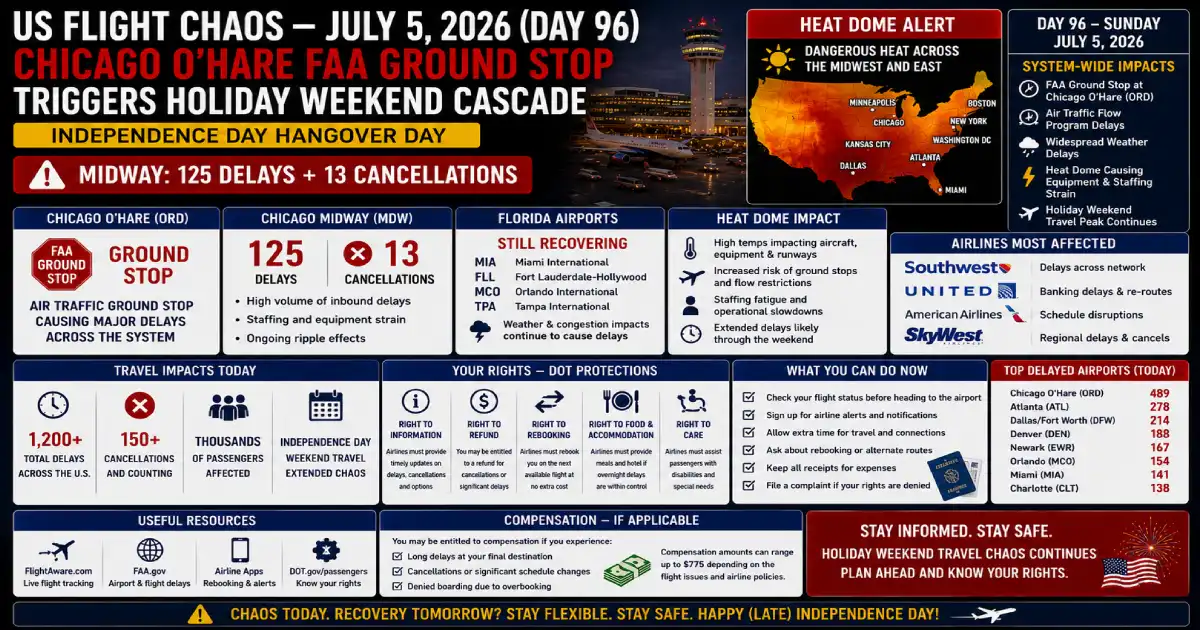
On Sunday, July 5, 2026 — Day 96 of the continuous US aviation crisis that began on April 1 — the United States aviation network is absorbing the full positioning debt of what AAA had forecast as one of the busiest Independence Day travel periods in history, with 72.2 million Americans moving at least 50 miles from home between June 27 and today. Yesterday, July 4, Chicago O’Hare International Airport — the day’s US epicentre — recorded 91 cancellations and 104 delays, with the FAA implementing a ground stop for inbound O’Hare flights after heavy rain and lightning moved across northern Illinois. That ground stop’s downstream cascade is today’s problem.
Today, July 5, the cascade from yesterday’s O’Hare shutdown is rippling across the national network. <cite index=”53-1″>Chicago Midway International Airport recorded 125 flight delays and 13 cancellations. The largest share of the disruption was linked to Southwest Airlines, which accounted for all recorded cancellations while also operating the overwhelming majority of delayed flights.</cite> O’Hare’s own recovery is underway but incomplete — the same FAA ground stop mechanism that paralyzed July 4’s departures has generated the aircraft-out-of-position and crew-in-rest-windows debt that is making July 5’s operations structurally challenged before a single thunderstorm has developed today.
The travel disruption continues into Independence Day onward; the U.S. National Weather Service forecasts additional storms and has issued warnings for several regions. Much of the central and eastern US will remain under a sprawling heat dome, with temperatures running up to 10 degrees above historical averages, even by July standards. Although the heat dome will shift toward the south-central US during the holiday weekend, it will continue to fuel hot and humid conditions across much of the Midwest and East. Thunderstorms in parts of the Midwest and Northeast may be the most problematic.
This is what a 96-day aviation crisis looks like when it meets the single busiest travel weekend of the year.
Published: July 5, 2026 — Sunday (Day 96 of the US Aviation Crisis · Independence Day Weekend · Post-July 4 Hangover Day) Day count: Day 96 — continuous elevated disruption since April 1, 2026 July 4 (yesterday, Day 95): O’Hare 91 cancellations + 104 delays — FAA ground stop from heavy rain + lightning Chicago Midway (MDW) today: 125 delays + 13 cancellations — Southwest Airlines dominant carrier affected Chicago O’Hare (ORD) today: Recovery underway — residual cascade from yesterday’s ground stop active Weather cause: Heat dome covering central and eastern US — AccuWeather forecasts continued thunderstorm risk through the holiday weekend across Midwest and Northeast Florida airports: Miami and Orlando — both recently hit — still recovering from earlier-week disruptions Heat dome advisory: Temperatures 10°F+ above historical averages — hottest July 4 weekend in recent years for much of the US Airlines most affected: Southwest Airlines (dominant at Midway) · United Airlines (dominant at O’Hare) · American Airlines · SkyWest · Frontier National cascade reach today: Boston · Orlando · Dallas Love Field · Phoenix · Atlanta · Baltimore · Denver · Minneapolis · Detroit · Philadelphia · Las Vegas · Tampa · Kansas City · Fort Lauderdale · Los Angeles · Seattle · Portland DOT automatic refund: ✅ Unconditional for all cancellations regardless of cause DOT cash compensation: ✅ Up to $775 for controllable delays 3+ hours Weather caveat: Heat dome + storms classified as extraordinary circumstances — cash compensation limited for direct weather delays Positioning debt: ⚠️ Post-weather positioning failures are potentially controllable — worth claiming
Yesterday, July 4, 2026 — the 250th anniversary of American independence and one of the most commercially significant travel days of the year — was supposed to be the climax of the holiday. Instead, it became the worst single disruption day of the week.
Chicago O’Hare International Airport reported 91 flight cancellations and 104 flight delays across departures and arrivals. The disruption affected flights operating within, into and out of Chicago, creating widespread challenges for thousands of passengers travelling during one of the busiest holiday periods of the American summer.
Peak holiday demand meant airlines had less operational flexibility to absorb disruptions. Aircraft were heavily utilised, and spare capacity was often limited. The combination of these operational pressures explains why the disruption extended across multiple airlines rather than remaining isolated to a single carrier or route.
The FAA’s ground stop — triggered by heavy rain and lightning over northern Illinois — meant that aircraft scheduled to fly into O’Hare were held at their departure airports across the US. A Southwest flight from Dallas Love Field that should have departed at 9am, arrived at O’Hare by 11am, and turned around for a 1pm Chicago–Denver departure, instead sat at Love Field until the ground stop lifted. It arrived at O’Hare hours late. The 1pm Denver departure became a 5pm departure. The crew that was supposed to fly it at 1pm hit their duty limit window by 6pm. The 5pm became a cancellation. That pattern — repeated across hundreds of aircraft at O’Hare yesterday — is the positioning debt that Day 96 is carrying.
A wave of summer thunderstorms moving across the Midwest significantly affected air traffic throughout the Chicago region. The Federal Aviation Administration implemented a ground stop for inbound flights heading to Chicago O’Hare International Airport after heavy rain and lightning moved across northern Illinois. Although the FAA action specifically targeted Chicago O’Hare, the operational effects extended well beyond that airport. Chicago Midway International Airport also experienced a noticeable ripple effect as aircraft rotations, crew schedules, and gate availability became increasingly interconnected across the region.
Today, the Midway cascade is the most visible single data point. Southwest Airlines experienced by far the highest number of disruptions at Chicago Midway. The carrier accounted for all recorded cancellations while also operating the overwhelming majority of delayed flights. Since Midway serves as one of Southwest’s largest operating bases, even relatively minor operational challenges can affect numerous departures and arrivals throughout the day.</cite>
The national reach of today’s disruption is extensive. Among the airports seeing the greatest operational impact alongside Chicago Midway were Boston Logan International Airport, Orlando International Airport, Dallas Love Field, John Glenn Columbus International Airport, Baltimore/Washington International Airport, and Phoenix Sky Harbor International Airport, reflecting the widespread nature of the disruption.
Beyond Chicago, the heat dome’s influence is being felt across Florida, the Southeast, and the Atlantic Seaboard. That prediction could spell chaos for Florida’s major airports, including Orlando International Airport and Miami International Airport, which have only just recovered from serious storm-related disruption earlier in the week.
O’Hare’s recovery from yesterday’s FAA ground stop is the central story of today’s national disruption picture. When an airport of O’Hare’s scale — the world’s fourth-busiest airport by operations, processing over 900 aircraft movements daily — experiences 91 cancellations and 104 delays in a single day, the recovery is not a 24-hour reset. It is a 48–72 hour process of repositioning aircraft, clearing crew rest windows, and rebuilding the rotation schedule from the positions aircraft actually ended up in overnight versus where they were planned to be.
ORD is United Airlines’ biggest and busiest hub in terms of flights and seats, with Denver International Airport as its second biggest for passenger volume. United’s recovery operations at O’Hare today are the most resource-intensive of any carrier at the airport — and United’s recovery pace directly determines whether O’Hare stabilises by this evening or carries the debt into July 6.
What O’Hare passengers should expect today: Morning wave departures (before 10am) had the highest probability of operating normally — the repositioning effort focuses on early departures first. Midday and afternoon departures carry elevated residual delay risk from yesterday’s cascade. Evening departures should be monitored actively — if weather develops again over northern Illinois today as AccuWeather warns, the same ground stop mechanism could trigger a second disruption day.
United at ORD today: Check united.com → My Trips for any active travel waiver. United typically extends its weather waivers through the following day when a major hub ground stop has occurred. The active United waiver for Midwest airports — first issued for July 3 disruptions and extended through the holiday weekend — may still cover today’s O’Hare connections.
American at ORD today: American Airlines operates a significant O’Hare presence alongside United. American’s July 4 performance at ORD was among the worst of any carrier. Today’s recovery is partially constrained by American’s simultaneous operational challenges at DFW, Miami, and Charlotte. Check aa.com → Travel Notices.
Chicago Midway International Airport recorded 125 flight delays and 13 cancellations across arriving and departing services. Southwest Airlines accounted for all recorded cancellations while also operating the overwhelming majority of delayed flights.
Midway is Southwest Airlines’ largest Chicago operation and one of its five biggest hubs nationally. Southwest’s point-to-point network model — which has made the carrier the most delay-prone in the US across all 96 days of this crisis — means that yesterday’s O’Hare ground stop’s downstream effects have hit Midway directly: aircraft that were supposed to cycle through Dallas, Los Angeles, and Phoenix en route to Midway did not complete their rotations yesterday. Today’s Midway Southwest operations are drawing on a fleet that went to bed out of position.
The effects reached cities including Boston, Orlando, Dallas, Phoenix, Atlanta, Baltimore, Denver, Minneapolis, Detroit, Philadelphia, Baltimore, Las Vegas, Tampa, Kansas City, Columbus, Fort Lauderdale, Los Angeles, Seattle and Portland.
For Southwest passengers at Midway today: the carrier has no hub model — there are no connection passengers to prioritise above point-to-point travellers. Every Midway passenger is either starting or ending their journey here. If your Southwest flight is cancelled, the next same-route service may be today’s only remaining departure — or tomorrow’s if today’s is already full. Book immediately via southwest.com → Manage Reservations.
Florida’s major airports, including Orlando International Airport and Miami International Airport, have only just recovered from serious storm-related disruption earlier in the week. At MCO, around 800 passengers were delayed on June 27 for over five hours at baggage claim.
Florida’s summer thunderstorm pattern — afternoon convective storms that develop daily from Memorial Day through September — combines with today’s heat dome to create a consistent afternoon disruption window at both MIA and MCO. The heat dome’s southward shift today positions its most disruptive thunderstorm-generating conditions over exactly the Florida corridor.
MCO and MIA are the two primary airports for the US Caribbean and Latin American leisure market. Airlines serving San Juan, Nassau, Cancún, Punta Cana, Montego Bay, and Medellín from Florida hubs are carrying double exposure today: yesterday’s holiday positioning debt and today’s heat dome afternoon storm risk.
The stormiest zone will extend from parts of Colorado and New Mexico, eastward to Florida, and then northward along the Atlantic Seaboard. Denver sits at the western edge of today’s heat dome zone, where temperature differentials between the mountain air and the overheated plains can produce rapid afternoon thunderstorm development. Denver has been one of the most consistently disrupted airports of the 96-day crisis — it recorded triple-digit delays earlier this week — and today’s weather pattern maintains its exposure.
Frontier Airlines, which is based at Denver, and United Airlines, which operates its second-largest hub there, are both carrying July 4 weekend positioning debt into Denver’s July 5 operations.
The Northeast’s portion of the heat dome is producing dangerous heat indices across Massachusetts, New York, New Jersey, and Connecticut this weekend. Boston Logan is recording delays today as a downstream recipient of the Midwest cascade and as an independently stressed airport under Northeast summer weather conditions. <cite index=”49-1″>The New York–Toronto corridor absorbed the heaviest impact of any international route</cite> earlier this week, and today’s continued Boston disruption extends that Northeastern pressure.
| Day | Date | US disruption | Key airport | Key event |
|---|---|---|---|---|
| Day 91 | June 30 | 300+ DCA delays | Reagan National | Saturation delay event |
| Day 92 | July 1 | 462 delays + 85 cancels nationally | Toronto (Canada) | Canada Day collapse |
| Day 93 | July 2 | 2,199 delays + 73 cancels | DFW, O’Hare, JFK | Pre-July 4 surge |
| Day 94 | July 3 | O’Hare 326 delays · LGA 117 delays | O’Hare, LaGuardia | FAA GDP + Salute to America airspace |
| Day 95 | July 4 | O’Hare 91 cancels + 104 delays | O’Hare | FAA ground stop — worst July 4 day |
| Day 96 | July 5 | Midway 125 delays + 13 cancels · O’Hare recovery | Midway | July 4 positioning hangover + heat dome |
The week of July 1–5 has been the most consistently disrupted five-day stretch of the entire 96-day crisis — not because any single day matched June 15’s 8,628-disruption peak, but because the accumulation of moderate-to-high disruption across every consecutive day of the highest-volume travel week of the year has generated a multi-layer positioning debt that the system has no slack to clear.
Every aircraft that failed to complete a planned rotation this week is out of position for next week’s schedule. Every crew that hit a duty limit during this week’s cascades is in a rest window that the July 6 and 7 departure banks will need to work around. The holiday week carries its positioning debt forward, not backward.
The weather system driving today’s disruption is structurally different from the convective thunderstorms that typically disrupt aviation in the summer. A heat dome — a high-pressure system that traps warm air and prevents it from rising — superheats the surface layer to temperatures 10°F or more above seasonal averages. That extreme surface heat then becomes fuel for intense, rapid-developing afternoon thunderstorms when any disturbance breaks through the dome’s cap.
For aviation, this creates an unusual pattern. Mornings under a heat dome are often clear and calm — aircraft can depart and arrive normally, and the early departure wave typically operates well. Then, from mid-afternoon (typically 2pm–7pm), the stored heat triggers explosive thunderstorm development. These afternoon storms can generate lightning, extreme wind shear, and sudden microburst conditions that force ground stops with very little warning — less warning than a typical organised frontal system.
AccuWeather warns that “while there are likely to be long stretches of dry weather in this zone, the frequent downpours and thunderstorms could be highly disruptive.”
For passengers planning afternoon or evening departures from any Midwest, Southeast, or Atlantic Seaboard airport today — the heat dome’s afternoon storm window (roughly 2pm–8pm local time) is the highest-risk departure period. Morning departures before noon carry the lowest weather risk today. If your flight is scheduled for the afternoon window and you have any flexibility, complete online check-in early and monitor your flight status from mid-morning.
Southwest has been the most-delayed carrier throughout this crisis, and the July 4 week has been no exception. <cite index=”53-1″>Southwest Airlines experienced by far the highest number of disruptions at Chicago Midway, accounting for all recorded cancellations.</cite> Southwest’s national July 4 performance is being tracked as one of its worst holiday-week records in years — the combination of its Midway hub disruption, the Dallas Love Field to O’Hare cascade, and the Florida afternoon storm exposure have combined to produce a holiday week that Southwest’s operational team will be reviewing carefully.
Southwest action: southwest.com → Manage Reservations | 1-800-435-9792
United’s July 4 O’Hare performance — the carrier’s biggest and busiest hub experiencing hundreds of cancellations — will define United’s recovery pace through July 5 and 6. United has the largest aircraft and crew resources at O’Hare to execute a recovery, but also the largest exposure. Denver, United’s second hub, is simultaneously under heat dome weather pressure.
United waiver check: united.com → My Trips → Travel Advisories | 1-800-864-8331
American’s exposure today spans O’Hare, Dallas-Fort Worth, Miami, and Charlotte — four of its five primary hubs all under some degree of weather or positioning pressure simultaneously. American’s Miami operation faces the Florida afternoon storm window. Its O’Hare operation faces recovery from July 4. Its Charlotte operation has been under consistent pressure throughout the crisis.
American action: aa.com → Travel Notices | 1-800-433-7300
SkyWest’s 96-day crisis role has been consistent: when major hubs fail, SkyWest’s thin-frequency regional routes cancel first. <cite index=”53-1″>Endeavor Air, Frontier Airlines, Porter Airlines, and Volaris also reported delayed operations</cite> at Chicago Midway today — the regional cascade from the Southwest main-carrier disruption running through the feeder network exactly as it has on every major disruption day since April.
Full cash refund: For every cancellation today, you are entitled to a full cash refund to your original payment method within 7 business days. No travel credits or vouchers without your explicit consent. This is automatic under the DOT’s 2024 Final Rule and requires no specific request — but if an airline offers a voucher first, you are legally entitled to decline.
Free rebooking to final destination: Airlines must rebook you on the next available flight to your actual final destination at no additional charge. This includes rebooking on a competing carrier if the disrupting airline cannot accommodate you within a reasonable timeframe.
From a 2-hour delay at the airport, all major carriers have committed to providing meal vouchers under the DOT Customer Service Dashboard. For overnight delays within airline control, hotel accommodation and transfers are required. On holiday weekends, airline customer service desks are their most overwhelmed — request duty of care proactively and in writing, don’t wait for the airline to offer it.
Today’s weather trigger: The heat dome and associated thunderstorms are weather — classified as extraordinary circumstances. Cash compensation for delays directly caused by the weather is unlikely to succeed.
The positioning debt distinction: An afternoon July 5 delay at an airport where the weather is currently clear but the inbound aircraft is late from a weather-disrupted hub is not a weather delay — it is a positioning failure. Ask the gate agent specifically: “What is the cause of this delay?” If the answer is “late inbound aircraft” or “crew availability” rather than active weather at your departure airport right now, you have a stronger controllable claim.
File regardless: Even for weather-adjacent claims, file with your airline and allow them to formally respond before assuming you have no recourse. Airlines must respond in writing within 14 days.
DOT cash compensation scale (controllable delays only):
| Delay | Maximum compensation |
|---|---|
| 3+ hours domestic, controllable | $775 per passenger |
File with your airline:
Escalate to DOT: transportation.gov → Aviation Consumer Protection → File a Complaint
Day 97 (July 6 — Monday): Monday is typically the system’s best recovery day — lowest leisure volume, highest carrier recovery capacity. But Day 97 arrives with the full weight of the holiday week’s accumulated positioning debt. Expect elevated disruption in the morning before the system begins normalising toward afternoon.
The Italian July 5 cascade: Today’s Italy strikes — which have produced 438 disruptions across Fiumicino and Malpensa — will generate transatlantic cascade beginning this afternoon and tonight. US carriers operating Rome and Milan services — Delta (FCO–JFK, FCO–ATL), United (MXP–EWR, FCO–EWR), American (via ITA codeshare) — will see their Italian-originating aircraft arrive late or not at all today. Tomorrow’s outbound US–Italy transatlantic services begin out of position.
July 4 week final assessment: By every metric — daily disruption volume, hub cancellation counts, carrier performance — the July 1–5 period has been the most sustained high-disruption week of the entire 96-day crisis. It did not produce a single day matching June 15’s 8,628-disruption peak, but it produced five consecutive days of 1,500–4,500+ disruptions at the highest-demand week of the year. The system’s inability to normalise during its own peak was the most significant structural statement of the crisis to date.
Posted By : Vinay
This article is provided for general informational purposes only and is based on information available at the time of publication. Travel advisories, airline schedules, airport operations, visa requirements, government regulations, and other travel-related information are subject to change without prior notice. While Travel Tourister makes reasonable efforts to verify information using official announcements, government publications, airline and airport communications, and other reliable sources, we cannot guarantee that all information remains complete, accurate, or up to date at all times. Readers should independently verify any information that may affect their travel plans with the relevant airline, airport authority, government agency, embassy, or other official source before making travel, financial, or other decisions. Travel Tourister shall not be liable for any direct or indirect loss, inconvenience, or damages arising from the use of or reliance on the information contained in this article. Nothing in this publication constitutes legal, immigration, financial, or professional travel advice. If you believe any information in this article is inaccurate or outdated, please contact our editorial team. We review all credible correction requests promptly and update our content whenever appropriate.
Lastest News
2nd Floor, 39, Above Kirti Club, DLF Industrial Area, Kirti Nagar, New Delhi, Delhi 110015



Travel Tourister is a leading Travel portal where we introduce travellers to trusted travel agents to make their journey hasselfree, memorable And happy. Travel Tourister is a platform where travellers get Tour packages ,Hotel packages deals through trusted travel companies And hoteliers who are working with us across the world. We always try to find new and more travel agents and hoteliers from every nook and corners across the world so that you could compare the deals with different travel agents and hoteliers and book your tour or hotel with the one you have chosen according to your taste and budget.
Copyright © Travel Tourister, India. All Rights Reserved

 Call
Call Enquiry