Published on : 29 Jun 2026
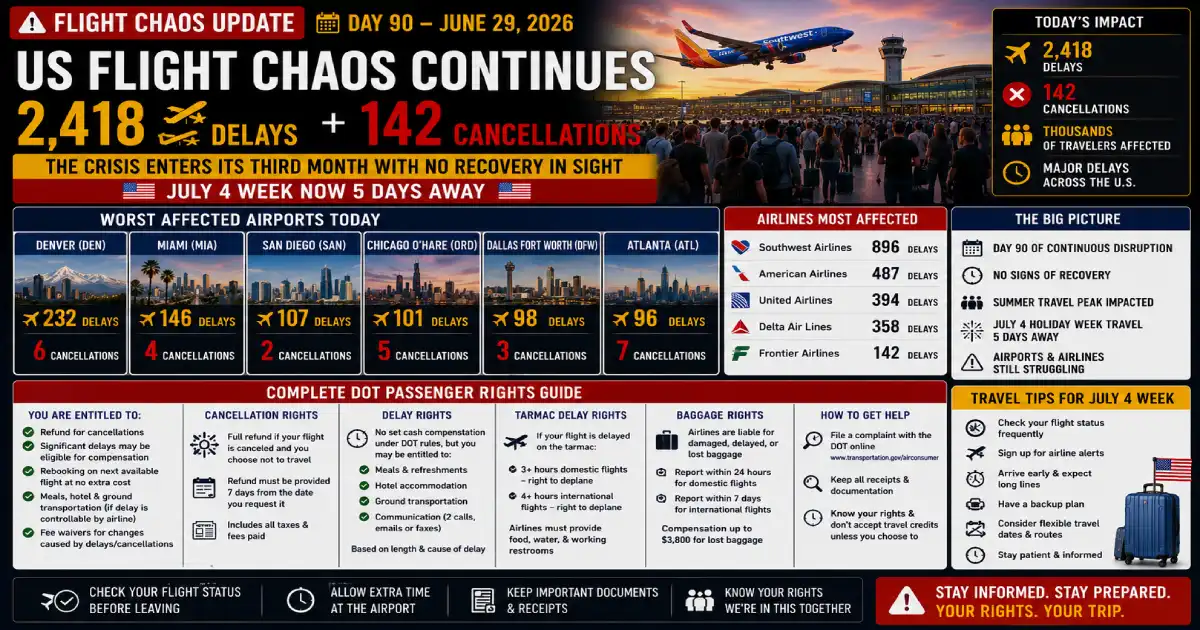
Today is Day 90. The US aviation crisis has now lasted three full calendar months without a single day of clean operations.
On Monday, June 29, 2026, the United States aviation network records its 90th consecutive day of elevated disruption — an unbroken streak that began on April 1, 2026, and has not paused for weather, weekday schedules, or the Monday low-volume relief that usually offers the system its best recovery window of the week. Denver International Airport is today’s most visible disruption point, recording 232 delays and 6 cancellations as United Airlines and Southwest Airlines carry the heaviest load — with Air Canada, Lufthansa, and Frontier adding international and regional cascade across corridors linking the US, Canada, Germany, Mexico, and Puerto Rico. Miami International Airport records 146 delays and 2 cancellations, with American Airlines generating the largest share of Miami’s delay volume and Southwest Airlines accounting for both cancellations. San Diego International Airport records 107 delays and 3 cancellations, Southwest again the most disrupted carrier.
Those three airports alone account for over 485 delays on what is typically the quietest day of the week. The system’s inability to use Monday to recover — a pattern that has defined every week of this 90-day crisis — is the single most damning statistical statement about the structural state of US aviation as it enters July.
Yesterday, June 28 (Day 89), was a Sunday that produced 78 cancellations and 2,249 delays nationally. Southwest accounted for 388 delays and 16 cancellations. American 324 delays and 2 cancellations. United 183 delays and 7 cancellations. Delta 181 delays and 6 cancellations. JetBlue 141 delays. Boston Logan had a FAA ground delay programme with average delays of 48 minutes from low ceiling weather. Newark was under a GDP with 15-minute average delays. Reagan National was recording 88-minute delays. That was the system’s Sunday posture. Monday’s Denver, Miami, and San Diego numbers are the mathematical continuation of Sunday’s debt.
In 5 days, July 4 begins. The Independence Day week is the highest-volume domestic leisure travel period of the year. The US aviation system is entering it on Day 90 of a crisis that has never stopped.
Published: June 29, 2026 — Monday (Day 90 of the US Aviation Crisis · 5 Days to Independence Day Peak) Day 90 milestone: 3 full calendar months of continuous elevated disruption since April 1, 2026 Denver International (DEN): 232 delays + 6 cancellations — worst airport by disruption today Miami International (MIA): 146 delays + 2 cancellations San Diego International (SAN): 107 delays + 3 cancellations Denver primary carriers hit: United Airlines · Southwest Airlines · Air Canada · Lufthansa · Frontier Airlines Miami primary carriers hit: American Airlines (highest delay count) · Southwest Airlines (both cancellations) · Delta · United · Frontier · Copa · LATAM · British Airways San Diego primary carriers hit: Southwest Airlines (highest delays) · Alaska Airlines (delays + cancellations) · American · Horizon Air · SkyWest · United · Delta · Lufthansa · Copa · Jazz (Air Canada Express) Yesterday (Day 89, June 28): 78 cancellations + 2,249 delays nationally — Southwest 388 delays + 16 cancels · American 324 delays + 2 cancels · United 183 delays + 7 cancels · Delta 181 delays + 6 cancels · JetBlue 141 delays Yesterday airports: BOS ground delay programme (48-min avg) · EWR GDP (15-min avg) · DCA 88-minute delays · JFK 7 cancels + 35 delays · BOS 4 cancels + 36 delays International cascade today at DEN: Canada · Germany · Mexico · Puerto Rico International cascade at MIA: UK · France · Brazil · Caribbean · Latin America International cascade at SAN: Canada · Germany · Panama July 4 week: 5 days away — highest-volume domestic travel of the year Italy July 5 strike: 6 days away — four-layer action affecting US passengers on Italian/northern Italy routes DOT automatic refund: ✅ Unconditional for all cancellations regardless of cause DOT cash compensation: ✅ Up to $775 for controllable delays 3+ hours Southwest rebooking: 1-800-435-9792 · southwest.com → Manage Reservations American rebooking: 1-800-433-7300 · aa.com → Travel Notices United rebooking: 1-800-864-8331 · united.com → My Trips Delta rebooking: 1-800-221-1212 · delta.com → Travel Advisories
The number 90 matters. Day 90 of an aviation crisis is not simply “another bad day.” It is a structural inflection point — the moment at which what began as an event has become a condition.
The US aviation crisis began on April 1, 2026. In the first week, it looked like a typical post-Easter disruption spike — the kind of elevated disruption the system produces every spring when leisure travel demand jumps and weather in the South and Midwest generates flow-control delays. By Day 14, it was clear something different was happening. By Day 30, it had outlasted every comparable crisis stretch in recent aviation history. By Day 67 — June 6, with 4,421 delays and 84 cancellations — it had become a full summer crisis. By Day 76, June 15, with 8,628 disruptions in a single day, it had produced the worst 24-hour aviation event in years. And today, Day 90, it is still happening on a Monday — the lowest-volume day of the week — showing 485+ delays across just three airports before the rest of the national data is even compiled.
What does 90 days of continuous elevated disruption actually mean for the system?
Aircraft positioning debt: Every aircraft that fails to complete its planned rotation on Day X arrives at Day X+1 out of position. Ninety days of that compounds into a structural misalignment between where airlines’ fleet management systems say aircraft should be and where those aircraft actually are. Airlines manage this through overnight repositioning flights, ferry flights, and schedule trimming — but they cannot fully eliminate the debt while simultaneously carrying peak-summer passenger loads. The system is running with a permanent positioning overhang that it cannot clear.
Crew fatigue and duty limit exposure: Ninety days of elevated disruption means 90 days of flight crews hitting duty limits unexpectedly, rest periods being consumed by airports rather than hotels, and scheduling systems constantly recalculating which crews are legally available for which flights. The FAA’s flight and duty time regulations exist for safety — but they interact with a disruption crisis to create a secondary cascade. A crew that hits its duty limit at O’Hare at 8pm because their inbound was delayed two hours cannot fly the 10pm departure. That 10pm departure becomes another cancellation or delay. Another passenger is stranded.
Rebooking inventory exhaustion: Peak summer means full aircraft. When a passenger’s flight is cancelled today and the airline offers rebooking, the next available flight may be tomorrow — because today’s alternatives are already full with yesterday’s displaced passengers plus today’s normal load. After 90 days of disruption carrying daily cancellations into already-full summer schedules, the rebooking backlog has depth. A passenger stranded at Denver today faces a queue of displaced passengers from Days 88, 89, and 90 competing for the same limited seats on tomorrow’s services.
The Monday paradox: Mondays are usually when the system recovers. Leisure travel volume is at its weekly low. Business travel is ramping up but hasn’t peaked. Airlines can use Monday’s lighter schedule to reposition aircraft and catch up on crew rest. Day 90 — a Monday — is producing 232 delays at Denver, 146 at Miami, 107 at San Diego. The Monday recovery effect, which should be the system’s strongest weekly reset, is being absorbed entirely by the 89-day positioning debt it is trying to clear. The system cannot use its own recovery mechanism because the debt exceeds the mechanism’s capacity.
Denver International Airport is today’s most disrupted US hub — a striking result on a Monday, when Denver typically benefits from the same low-volume recovery dynamic as the broader system. The disruption is being driven by a combination of factors across major airline systems — United and Southwest Airlines are carrying the heaviest operational load, while Air Canada, Lufthansa, and Frontier are contributing to broader international and regional timing disruptions.
Denver’s unique position in the US network makes it structurally vulnerable on positioning-debt days. It is the primary hub for Frontier Airlines and one of Southwest’s largest western operations. United operates a significant Denver hub as well. When the national network carries positioning debt from a heavy weekend — as it does today following Sunday’s 78-cancellation/2,249-delay Day 89 — Denver absorbs the cascade from aircraft that were supposed to arrive from the Northeast, from the South, and from the West Coast but didn’t complete their rotations cleanly.
International cascade from DEN today: Air Canada’s Denver connections feed into Toronto Pearson’s network — affecting Canadian passengers connecting Denver to transatlantic services. Lufthansa operates the Denver–Frankfurt route, bringing European business travellers into the disruption zone. Frontier’s Latin American connections through Denver are showing delays across Mexico and Puerto Rico.
The Denver–Italy July 5 angle: United Airlines operates Denver–Frankfurt (FRA) connections that feed into northern Italian airspace on July 5. Passengers booked on any DEN–FRA–Italy connection on July 5 face the compound of Denver’s ongoing Day 90 disruption and the four-layer Italian strike six days from now.
For passengers at DEN right now:
Miami is Day 90’s second most disrupted airport. Miami International Airport recorded 146 flight delays and 2 cancellations, with American Airlines experiencing the largest number of delays and Southwest Airlines accounting for both cancellations. Disruptions also extended to Philadelphia, Baltimore, Charlotte, LaGuardia, Los Angeles, and Boston from Miami’s cascade.
Miami is American Airlines’ primary Latin America and Caribbean gateway and one of its three largest domestic hubs alongside Dallas-Fort Worth and Charlotte. American’s dominance at Miami — the carrier operates approximately 40% of all MIA flights — means that when American carries positioning debt from the weekend, Miami absorbs the highest concentration of that debt.
International routes disrupted from MIA today: Miami’s position as the US gateway for the Caribbean, Latin America, and Brazil means that today’s delays cascade across Copa Airlines’ Panama routing, LATAM Brasil’s South American connections, and British Airways’ London Gatwick–Miami service. British Airways passengers arriving into Miami from London today and connecting to a delayed American domestic service face the same broken-connection problem that has been present at this airport throughout the crisis.
The World Cup angle at Miami: FIFA World Cup matches continue at Miami-area venues through mid-July. International fan travel through MIA — from Europe, Latin America, and beyond — is concentrated in exactly the American Airlines and international carrier flights that are showing the highest delay volumes today. A Brazilian fan flying MIA→São Paulo on LATAM after a Round of 16 match and finding a 3-hour delay is in the same rights framework as any other passenger — but the emotional and logistical stakes are higher.
Caribbean routes from MIA: American’s flights from Miami to Nassau, San Juan, Aruba, and Cancún are all in the disruption zone today. These are leisure routes booked months in advance, often as part of packages that include hotel and cruise connections. A Miami–Nassau delay today that causes a passenger to miss a cruise ship departure is a consequential loss that travel insurance needs to cover — check your policy.
San Diego International Airport (SAN) recorded 107 flight delays and 3 cancellations on June 29, with Southwest Airlines accounting for the largest number of delayed flights, making it the most affected carrier during the day’s operations. Alaska Airlines experienced both delays and flight cancellations. American Airlines, Horizon Air, SkyWest, United Airlines, and Delta Air Lines also reported operational disruptions. International carriers including Lufthansa, Copa Airlines, and Jazz (Air Canada Express) were affected.
San Diego is a military city and major leisure destination, with the airport serving a large civilian base and significant tourist volume. Southwest is the dominant carrier at SAN and its delay footprint today reflects the carrier’s national positioning-debt picture from the weekend.
Routes disrupted from SAN today: Seattle, Vancouver, Dallas-Fort Worth, San Jose, Sacramento, Phoenix, San Francisco, and Denver — spanning the major West Coast and Southwest hub connections that define SAN’s network.
Jazz/Air Canada at SAN: Jazz Air Canada Express operates the San Diego–Vancouver connection. With Air Canada simultaneously under pressure from its own Day 90 Canadian disruptions, the Jazz SAN–YVR service today faces cascade from both ends — the US network debt on the SAN side and Canadian network pressure on the Vancouver side.
Southwest has been the most-delayed carrier nationally for most of the 90-day crisis. Its point-to-point network model — which creates cascade when any aircraft fails to complete its rotation — means that weekend disruption on Saturday and Sunday (Day 88: 1,062 delays; Day 89: 388 delays + 16 cancellations) feeds directly into Monday’s positioning failure at every airport Southwest serves.
Today’s Southwest visibility is highest at Denver (heaviest delay carrier at DEN), San Diego (highest delay carrier at SAN), and Miami (both cancellations). The pattern is consistent: Southwest is not the cause of the crisis, but its network structure makes it the most visible carrier when the crisis hits.
American’s 324 delays and 2 cancellations on Day 89 roll into Day 90 with Miami showing the highest American delay count of any single airport today. American’s three-hub model (DFW, CLT, MIA) concentrates its positioning debt at these airports — and Miami on a Monday, carrying Sunday’s Latin American and Caribbean positioning debt, is showing the pressure clearly.
United is the carrier most directly visible at today’s worst airport: Denver. United and Southwest together carry the heaviest load at DEN on Day 90. United’s Denver hub feeds a large share of the Rocky Mountain region’s connectivity — connections to Salt Lake City, Portland, Sacramento, and onward international — and its positioning debt today cascades across all of those routes.
Delta’s Day 89 total of 181 delays and 6 cancellations carries forward into Day 90’s Atlanta and secondary hub picture. Delta’s Atlanta operation — the world’s busiest airport — is Day 90’s most watched secondary disruption point. Atlanta was not identified as the worst airport today, suggesting Delta is managing the Monday low-volume window better than its peers — but with 181 delays yesterday, the positioning picture remains stressed.
Frontier’s primary base is Denver. Day 90’s Denver disruption directly hits Frontier’s entire network, including its Latin American connections to Mexico and Puerto Rico. Frontier’s lean crew and aircraft model makes it among the most positioning-sensitive carriers — when Denver’s arrival rate slows, Frontier’s tight turnarounds break first.
| Milestone | Date | Day | National total | Significance |
|---|---|---|---|---|
| Crisis begins | April 1 | Day 1 | Elevated | Post-Easter weekend start |
| First major spike | April 14 | Day 14 | ~900 (ORD 118 cancels) | Flooding + storms |
| 30-day mark | April 30 | Day 30 | ~1,173 | System not recovering |
| Spirit Airlines collapse | May 2 | Day 32 | — | Spirit liquidates; 4,000 displaced workers |
| FAA summer cap begins | May 17 | Day 47 | — | O’Hare capped at 2,708 daily ops |
| Worst single day | June 15 | Day 76 | 8,628 | All-time crisis record |
| Day 88 | June 27 | Day 88 | 4,625 | DFW 381 delays; Southwest 1,062 |
| Day 89 | June 28 | Day 89 | 2,327 | SW 388 delays + 16 cancels; GDP at BOS/EWR |
| Day 90 | June 29 | Day 90 | DEN 238 + MIA 148 + SAN 110 confirmed | 3-month milestone; July 4 in 5 days |
The crisis has now spanned three distinct aviation seasons: the post-Easter spike (April), the Memorial Day peak (late May), and the full summer surge (June–present). Each period was expected to normalise. None did. The structural reasons are well-documented: the FAA staffing shortfall that restricts sector capacity, the summer cap at O’Hare that removes scheduling flexibility, the Southwest network architecture that amplifies cascade, and the 90-day positioning debt that has never fully cleared.
Today’s Day 90 is not just a milestone — it is a warning. In five days, the United States begins its Independence Day holiday week. July 4 week represents the highest-volume domestic leisure travel period of the entire calendar year. Airlines operate at maximum schedule density. Every aircraft is scheduled. Every crew is utilised. Airports are at or above their practical capacity.
A system entering July 4 week on Day 90 of a 90-day crisis has no slack. Zero spare aircraft. Zero rested crew reserve. Zero positioning buffer. When a thunderstorm hits Dallas on July 3, it hits a network that has been carrying positioning debt since April 1 and has never managed to clear it.
The July 4 week forecast: The period from July 3 through July 7 is the highest single-risk window of the entire summer for US aviation. Airlines will cancel flights proactively in the days before July 4 to pre-position aircraft and crews ahead of the surge — but pre-positioning delays are still delays, and passengers will see elevated disruption through the entire week.
What to do if you are flying July 4 week:
After 90 days, the rights framework is the same as Day 1. The DOT’s 2024 Final Rule has not changed. What has changed is that passengers are increasingly savvy about filing claims — and airlines’ claim processing systems are under their highest-ever load.
For every cancelled flight today — at Denver, Miami, San Diego, or anywhere else in the US — you are entitled to an automatic cash refund to your original payment method within 7 business days. No voucher substitution without your explicit consent. No “travel credits” unless you choose them. Cash.
Under the DOT Airline Customer Service Dashboard commitments:
| Delay | Compensation |
|---|---|
| 3+ hours domestic (controllable) | Up to $775 per passenger |
What is controllable on Day 90: Positioning-debt delays — where your flight is delayed because an aircraft or crew failed to arrive from a previous sector, not because of active weather at your airport right now — are controllable. Ask the gate agent for the specific stated reason in writing. “Late inbound aircraft” = potentially controllable = worth filing a claim.
What is extraordinary on Day 90: Active weather at the departure airport is still extraordinary. But Day 90 delays at 3pm at Denver where active weather ended at 10am — the afternoon delay is positioning debt, not weather.
From 2+ hours of delay, airlines must provide meals and refreshments. For controllable overnight delays, hotel accommodation and transfers. The major carriers — Southwest, American, United, Delta, Alaska, JetBlue, Frontier — have all committed to these provisions on the DOT Customer Service Dashboard.
Say at the desk: “My flight has been delayed over two hours. I am requesting meal vouchers under [Airline]’s DOT Customer Service Dashboard commitment.”
US aviation’s Day 90 does not exist in isolation. Today’s disruptions feed into an already-stressed global network. Key concurrent disruption events:
| Event | Date | Impact on US passengers |
|---|---|---|
| Italy July 5 strike | 6 days — July 5 | US passengers on Rome, Milan, Venice routes — Delta FCO, United MXP, ITA codeshares — all exposed |
| Italy July 21 strike | 22 days — July 21 | Milan Malpensa ground handling — follow-on Italy strike already confirmed |
| France ATC risk | Ongoing — summer | Ryanair/easyJet pulling Paris capacity; CDG connections for US passengers |
| July 4 week US | 5 days | Worst domestic travel week of the year on top of 90-day crisis |
| FIFA World Cup | Ends July 19 | Fan return travel adding demand pressure through July 19 |
For US passengers with connecting European itineraries in July — particularly Italy connections on July 5 — the compound of US Day 90 disruption and Italian four-layer strike creates the highest travel risk window of the summer. Monitor both your US departure and your Italian arrival airport simultaneously.
Posted By : Vinay
This article is provided for general informational purposes only and is based on information available at the time of publication. Travel advisories, airline schedules, airport operations, visa requirements, government regulations, and other travel-related information are subject to change without prior notice. While Travel Tourister makes reasonable efforts to verify information using official announcements, government publications, airline and airport communications, and other reliable sources, we cannot guarantee that all information remains complete, accurate, or up to date at all times. Readers should independently verify any information that may affect their travel plans with the relevant airline, airport authority, government agency, embassy, or other official source before making travel, financial, or other decisions. Travel Tourister shall not be liable for any direct or indirect loss, inconvenience, or damages arising from the use of or reliance on the information contained in this article. Nothing in this publication constitutes legal, immigration, financial, or professional travel advice. If you believe any information in this article is inaccurate or outdated, please contact our editorial team. We review all credible correction requests promptly and update our content whenever appropriate.
Lastest News
2nd Floor, 39, Above Kirti Club, DLF Industrial Area, Kirti Nagar, New Delhi, Delhi 110015



Travel Tourister is a leading Travel portal where we introduce travellers to trusted travel agents to make their journey hasselfree, memorable And happy. Travel Tourister is a platform where travellers get Tour packages ,Hotel packages deals through trusted travel companies And hoteliers who are working with us across the world. We always try to find new and more travel agents and hoteliers from every nook and corners across the world so that you could compare the deals with different travel agents and hoteliers and book your tour or hotel with the one you have chosen according to your taste and budget.
Copyright © Travel Tourister, India. All Rights Reserved

 Call
Call Enquiry