Published on : 01 Sep 2026
By Travel Tourister | Updated Sep 2026
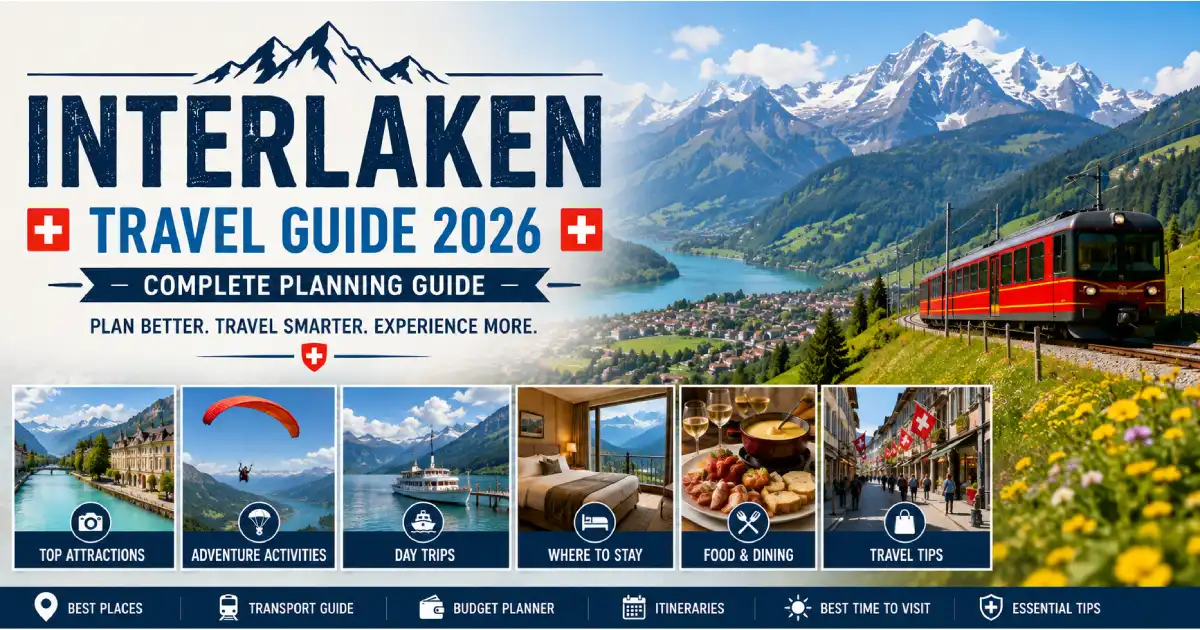
Interlaken functions as Switzerland’s most consequential single travel planning decision — the choice to base here versus in Zurich, Lucerne, or Bern determines not just where you sleep but which version of Switzerland you inhabit. Interlaken’s specific geography (the narrow Bödeli plain between Lake Thun and Lake Brienz, at the foot of the Bernese Oberland) and its railway connectivity (the BOB narrow-gauge network radiating into the surrounding mountain landscape) make it the only Swiss base from which the Jungfraujoch, Grindelwald, Lauterbrunnen, Mürren, Wengen, Schynige Platte, and the two Bernese lakes are all accessible as day excursions on a single Swiss Travel Pass without accommodation changes or multi-hour transport. A Lucerne-based visitor can reach Interlaken in 2 hours and theoretically do a Jungfraujoch day trip, but the 4-hour round transport reduces the summit time significantly and eliminates the multiple-destination flexibility that a Bernese Oberland base provides. For visitors whose Switzerland priorities are dominated by mountain excursions, adventure sports, and the Bernese Oberland landscape, Interlaken is the correct base — and this guide explains how to use it effectively.
The planning complexity of an Interlaken visit is different from other Swiss cities — less about navigating a complex urban infrastructure and more about managing the specific logistics of the surrounding mountain excursion network (which trains run when, which mountain railways are covered by which passes, how to sequence multiple excursions across available days, and critically how to assess and respond to the mountain weather that determines whether the Jungfraujoch shows the Aletsch Glacier or a CHF 150 cloud). This Interlaken Travel Guide 2026 addresses all of this — getting there, getting around, understanding the Swiss Travel Pass’s specific Interlaken coverage, the budgeting reality, where to stay, and the planning mistakes that turn a potentially extraordinary Bernese Oberland visit into an expensive frustrating experience.
For specific Interlaken recommendations, see our Best Places to Visit in Interlaken 2026, Things to Do in Interlaken 2026, Best Restaurants in Interlaken 2026, and Best Time to Visit Interlaken guides.
| Category | Details |
|---|---|
| Location | Bernese Oberland, Canton Bern, Switzerland |
| Altitude | 568 meters (village level) |
| Population | Approximately 5,500 permanent residents |
| Language | German (Berndeutsch dialect); English very widely spoken |
| Currency | Swiss Franc (CHF) — NOT Euro |
| Main Stations | Interlaken West (western station); Interlaken Ost (eastern station — main hub for mountain railways) |
| Nearest Airport | Bern-Belp Airport (45 min); Zurich Airport (2 hrs); Geneva Airport (2.5 hrs) |
| Time Zone | CET (UTC+1); CEST (UTC+2 summer) |
| Electricity | 230V / Type J plugs (Swiss-specific — adaptor required) |
| Emergency | 112 (universal); Mountain rescue: 1414 (REGA) |
| Average Daily Budget (Mid-Range) | CHF 200–350/person (hotel, meals, mountain excursions) |
| Swiss Travel Pass Value | Very high — covers trains to all mountain railway bases, lake steamers, Harder Kulm funicular |
| Best Visiting Months | June, September, May, October |
Interlaken has two main railway stations — Interlaken West (the western station, serving trains from Bern and western Switzerland) and Interlaken Ost (the eastern station, serving trains from Lucerne and eastern Switzerland, and crucially the departure point for all Bernese Oberland mountain railways: BOB to Grindelwald and Lauterbrunnen, Schynige Platte Bahn to Wilderswil, and the BLS lake steamers on Lake Brienz). First-time visitors should understand this two-station geography before arriving — arriving at Interlaken West and needing to access the BOB mountain trains requires a short connecting train journey (5 minutes, every few minutes, between the two stations).
From Zurich (the most common international arrival):
From Bern:
From Lucerne:
From Geneva:
From Basel:
From Zurich Airport (ZRH):
Zurich Airport (ZRH): The most practical international airport for Interlaken — excellent European connections, direct rail link to Zurich HB (10 minutes, S-Bahn), then approximately 2 hours by train to Interlaken. The Swiss Travel Pass covers the Zurich HB → Interlaken segment; the airport train to Zurich HB is separately ticketed (CHF 6.90) unless the Swiss Travel Pass Airport extension is purchased.
Bern-Belp Airport (BRN): The nearest airport to Interlaken (approximately 45 minutes by bus + train) — a small regional airport with limited international connections, but worth checking for visitors from specific European hubs (London City, Munich, Vienna, and others serve Bern directly in limited frequency).
Geneva Airport (GVA): Viable for visitors arriving from North America or African routes that don’t serve Zurich — approximately 2.5 hours from Interlaken by train (Geneva Cornavin → Bern → Interlaken Ost).
Driving to Interlaken from Germany, France, or within Switzerland is straightforward via the A6 motorway from Bern (exit at Spiez or Interlaken, clearly signposted). Practical considerations:
Car parking in Interlaken: Several public car parks available in both the West and Ost areas (CHF 12–18/day). The town is compact enough that the car becomes unnecessary once arrived — all mountain railways and lake steamers depart from the stations. Parking for a multi-day stay at one of the central car parks and navigating by train and foot for the visit provides the most practical approach.
Car-free mountain villages: Grindelwald (accessible by car, the exception among Bernese Oberland mountain villages), Wengen (car-free — all visitors arrive by BOB rack railway from Lauterbrunnen), and Mürren (car-free — accessible by cable car from Lauterbrunnen) are the primary mountain village destinations from Interlaken. Visitors with cars cannot drive to Wengen or Mürren regardless of vehicle type.
The Swiss Travel Pass is the single most important planning tool for an Interlaken visit — its coverage across the specific transport network surrounding Interlaken provides more per-franc value here than at any other Swiss destination because of the concentration of covered transport modes (lake steamers, regional trains, funicular) combined with the significant discounts on mountain railways that would otherwise be the visit’s single largest expense.
Fully included (free with valid Swiss Travel Pass):
50% discount (half-price with Swiss Travel Pass):
NOT included (full price regardless of Swiss Travel Pass):
For a typical 3-day Interlaken visit including the Jungfraujoch and two other mountain excursions:
| Activity | Full price (no pass) | With Swiss Travel Pass |
|---|---|---|
| Train from Zurich → Interlaken | CHF 60 | Free |
| BOB to Grindelwald (return) | CHF 18 | Free |
| Wengernalpbahn Kleine Scheidegg (return) | CHF 22 | Free |
| Jungfrau Railway Kleine Scheidegg → Jungfraujoch (return) | CHF 95 | CHF 47.50 (50% off) |
| Schynige Platte return | CHF 60 | Free |
| BLS Lake Thun steamer full circuit | CHF 30 | Free |
| Harder Kulm funicular | CHF 34 | Free |
| Total comparison | CHF 319 | CHF 47.50 (pass costs ~CHF 244/3-day) |
The 3-day Swiss Travel Pass (approximately CHF 244 for adult second class as of 2026 — check sbb.ch for current pricing) produces net savings of approximately CHF 30 on transport alone for this specific itinerary, while providing coverage for additional journeys (the included trains to and from Interlaken and all day’s local transport on covered routes). For 4+ day Interlaken visits with multiple mountain excursions, the Swiss Travel Pass value is clearly positive.
Interlaken West and Interlaken Ost are connected by a frequent shuttle train (every 5–10 minutes, 4-minute journey, covered by Swiss Travel Pass — no separate ticket required) and by the Höheweg boulevard (a 25-minute walk along the main promenade, pleasant in both directions but impractical with significant luggage). The key practical knowledge: all mountain railway departures (BOB to Grindelwald and Lauterbrunnen, Schynige Platte from Wilderswil, BLS Lake Brienz steamers) use Interlaken Ost; trains from Bern and western Switzerland arrive primarily at Interlaken West (though many continue to Ost). Guests arriving from Zurich on the main intercity service typically arrive at Ost; guests arriving from Bern may arrive at West first.
Interlaken’s compact town center (the Höheweg boulevard connecting the two stations, the Unterseen historic village immediately west of Interlaken West, and the main commercial streets branching north of the Höheweg) is entirely walkable — no internal bus or tram system required for the central visitor infrastructure. The maximum walking distance from any central hotel to either station is 15–20 minutes.
The BOB (Berner Oberland-Bahn) narrow-gauge railway is the primary tool for accessing the Bernese Oberland’s mountain destinations from Interlaken Ost. Key BOB practical information:
Near Interlaken West: Access to the Höheweg grand hotels (Victoria-Jungfrau, Beau Rivage/Lindner Grand Hotel), the BLS Lake Thun steamer pier, and the Unterseen village walking distance. Train connections to Bern and western Switzerland. Best for visitors who prioritize the Höheweg experience and Lake Thun excursions.
Near Interlaken Ost: Best for active mountain excursion visitors — immediate access to the BOB mountain railway, the Harder Kulm funicular, the BLS Lake Brienz steamers, and the shortest walking distance to the adventure sports operator area. Most budget hotels and hostel accommodation clusters in this area.
Budget (CHF 30–120/night): Backpackers Interlaken (the town’s largest hostel, near Interlaken Ost, with dormitory and private room options — the specific social atmosphere of Switzerland’s largest adventure sports hub’s primary backpacker accommodation is itself a part of the Interlaken experience for budget travelers), several budget guesthouses near Interlaken Ost and along the Höheweg’s side streets.
Mid-Range (CHF 120–250/night double): A strong mid-range hotel market exists in Interlaken — hotels like Hotel Metropole (the high-rise on the Höheweg, distinctive in the Interlaken skyline and providing guaranteed Jungfrau views from upper floors), Hotel Du Nord, Hotel Aarburg, and various other centrally located three-star properties. The mid-range market in Interlaken is genuinely competitive — more so than in Lucerne or Geneva — because the large adventure tourism visitor base creates consistent demand for comfortable but not luxury accommodation.
Luxury (CHF 250–600+/night double): The Victoria-Jungfrau Grand Hotel and Spa (the defining Interlaken luxury experience, CHF 350–800+/night for rooms with Jungfrau views, with the specific grand hotel history that 160 years of Swiss Alpine hospitality has created) and the Lindner Grand Hotel Beau Rivage (CHF 250–500/night, historic Höheweg property with lakefront positioning) constitute the luxury tier. Various other four-star properties (Hotel Beatus Merligen on Lake Thun, Villa Sunnehüsi, and boutique properties) provide alternative luxury options.
Mountain Village Alternative: Staying in Grindelwald (from CHF 100/night budget guesthouses to CHF 400+/night luxury properties), Wengen (car-free, quiet, directly on the ski slopes and Männlichen ridge walk trails — CHF 120–350/night for various property types), or Mürren (the most dramatically positioned car-free village, CHF 150–400/night) provides a qualitatively different experience from Interlaken — in the mountains rather than at their base, without car traffic, with the Eiger north face or Jungfrau massif visible directly from the village.
| Period | Book Ahead |
|---|---|
| July–August peak | 3–5 months (Victoria-Jungfrau: 6+ months) |
| Christmas–New Year | 4–6 months |
| September | 4–8 weeks |
| Ski season weekends (Jan–Feb) | 4–8 weeks (Grindelwald/Wengen village hotels: 2–3 months) |
| May–June | 4–6 weeks |
| October | 2–4 weeks |
| November, March | 1–2 weeks or often last-minute |
Interlaken itself (the town’s hotels, restaurants, and shopping) prices at a level comparable to other Swiss mid-sized towns — expensive by global standards but not at the premium of Zurich or Geneva. The budget complexity comes from the mountain excursion layer — the Jungfraujoch return ticket (CHF 145–195 without pass, CHF 73–98 with 50% Swiss Travel Pass discount) and the adventure sports (tandem paragliding CHF 170–220, skydiving CHF 290–380) represent the visit’s highest single costs and most require specific budget planning.
Budget (CHF 80–150/day/person):
Mid-Range (CHF 200–350/day/person):
Luxury (CHF 400+/day/person):
The Jungfraujoch is Interlaken’s single most expensive day activity — the mountain railway ticket (CHF 145–195 from Interlaken Ost without pass, CHF 73–98 with Swiss Travel Pass 50% discount) represents a significant single-day cost that requires specific budget planning. The Good Morning Ticket (a discounted early-departure version — check jungfrau.ch for current 2026 pricing) provides further reduction beyond the Swiss Travel Pass discount when purchased for the first morning departures.
A complete Jungfraujoch budget calculation:
Mountain weather in the Bernese Oberland is the single most important variable in Interlaken’s visitor experience — a CHF 98 Jungfraujoch ticket purchased for a cloudy summit day produces a completely different experience from the same ticket on a clear day. The practical skill of assessing and responding to mountain weather conditions is what distinguishes experienced Swiss mountain visitors from frustrated first-timers.
Jungfrau summit webcam (jungfrau.ch/en-gb/planning/webcams): The single most reliable tool for Jungfraujoch weather assessment — checking this webcam at 7–8 AM on the planned excursion day provides a direct view of actual summit conditions rather than lowland weather forecasts that don’t translate reliably to 3,454-meter conditions.
MeteoSwiss mountain forecasts (meteoswiss.admin.ch): Switzerland’s national weather service provides Bernese Oberland high-altitude forecasts at specific mountain locations — the 24-hour and 3-day forecasts for “Jungfrau” specifically are the most reliable available for planning purposes.
The Interlaken valley rule: Clear blue sky in Interlaken does NOT guarantee a clear Jungfraujoch summit — the specific orographic effect of the Bernese Oberland (moist air from the northwest rising and condensing on the high peaks) frequently produces summit cloud in conditions where the valley below is in full sunshine. The reverse is also possible — a grey Interlaken morning can clear to a spectacular summit by mid-morning. Always check the summit-specific webcam rather than inferring from valley conditions.
The most experienced approach to Interlaken weather planning is building a flexible multi-day itinerary where the weather-dependent excursions (Jungfraujoch primarily) are scheduled on a “best available clear day” basis rather than on a fixed day, with the fully enclosed/covered excursions (the Trümmelbach Falls underground, St. Beatus Caves, Ballenberg Museum under roof) as alternatives for overcast days. A 3-day Interlaken itinerary with this approach might look like:
This flexible approach produces significantly higher satisfaction rates than fixed-day Jungfraujoch planning that produces cloudy-summit disappointment.
Interlaken has one of the most concentrated adventure sports industries of any Alpine destination — over 30 operators offering paragliding, skydiving, canyoning, canyon swinging, white-water rafting, bungee jumping, kayaking, and various other activities in and around the Bernese Oberland. The market’s concentration creates both benefits (competitive pricing, experienced instructors, mature safety culture) and complexity (choosing between similar-seeming operators).
Book the day before (minimum): Most Interlaken adventure sports operators require at minimum 24 hours’ advance booking — same-day walk-up booking is sometimes available but limits activity choice, especially in peak season (July–August).
Weather cancellation policy: All reputable Interlaken adventure sports operators maintain flexible weather cancellation policies — if weather prevents the activity (cloud cover for paragliding, unsafe water levels for rafting, lightning for skydiving), operators reschedule without penalty. Confirming the specific cancellation policy before booking prevents misunderstandings.
Price comparison: The adventure sports price range in Interlaken is relatively standardized — if an operator quotes significantly below the market rate (tandem paraglide for CHF 80 when the standard is CHF 170–220, for example), the price difference typically reflects instructor certification level, equipment quality, or safety management shortcuts rather than equivalent quality at better value. Booking with established operators who display Swiss or European certification credentials provides the most reliable safety assurance.
The operator street on the Höheweg: Several Interlaken adventure operators maintain booking desks and walk-in offices along the Höheweg and near Interlaken Ost — for visitors who arrive without pre-booking, walking this strip and comparing offers provides the same access that online booking provides, with the added benefit of face-to-face communication about current conditions and schedule availability.
Day 1 (clear day): Jungfraujoch 7:00 AM — Depart Interlaken Ost by BOB (check current timetable for first departure) → Grindelwald or Lauterbrunnen (Eiger Express from Grindelwald is faster) → Kleine Scheidegg → Jungfrau Railway → Jungfraujoch summit (arrive approximately 9:30–10 AM with Good Morning Ticket timing). 10 AM–1 PM — Summit: Sphinx terrace (Aletsch Glacier), Ice Palace, Sphinx Observatory platform. 1 PM — Begin descent (Wengernalpbahn from Kleine Scheidegg → Wengen → Lauterbrunnen → BOB back to Interlaken OR descend via Grindelwald and Eiger Express). Evening — Dinner at Hüsi Bierhaus or Restaurant Schuh.
Day 2: Lauterbrunnen Valley + Harder Kulm Morning — BOB to Lauterbrunnen (22 min) → Trümmelbach Falls (bus or walk, 1 hour) → valley floor walk toward Stechelberg (Staubbachfall visible throughout) → cable car to Mürren (optional, additional ticket) → return to Interlaken by early afternoon. Afternoon — Harder Kulm funicular (free with Swiss Travel Pass, 10 min from Interlaken Ost) → two-lake panorama, Two Lakes Bridge → return to village. Evening — Höheweg evening walk (Jungfrau alpenglow if clear).
Add to 2-day itinerary: Day 3: BOB to Grindelwald (35 min) → First gondola (50% discount with pass) → First Cliff Walk → Bachalpsee hiking (45 min trail) → return to Grindelwald → lunch in Grindelwald village → BOB return to Interlaken → BLS Lake Brienz steamer (Interlaken Ost pier) → Giessbach Falls visit (steamer stop + funicular) → return to Interlaken by early evening.
Add to 3-day itinerary: Day 4: Morning paragliding (book previous day, approximately 10 AM launch from Beatenberg with Höheweg landing, 2 hours total) → Schynige Platte rack railway (BOB to Wilderswil 5 min + Schynige Platte Bahn 50 min to summit) for afternoon → Alpine Botanical Garden → sunset panorama → return to Interlaken by early evening.
The single most common (and most expensive) Interlaken mistake — purchasing the Jungfraujoch ticket for a specific fixed date without building in flexibility for weather conditions, and arriving at the summit in cloud rather than clear glacier panorama. The flexible itinerary approach (checking the summit webcam morning-of and scheduling the Jungfraujoch for the clearest available day within a multi-day stay) produces dramatically better outcomes than fixed-day planning.
The valley in July may be 26°C. The Jungfraujoch summit is -10°C to -15°C on the same July day — a temperature differential of 35–40°C. Visitors who arrive at the BOB station in t-shirts and shorts for a “summer day trip” consistently experience genuine distress at the summit. The Jungfraujoch provides fleece and wind jacket loaners at the summit station (for a fee), but arriving with appropriate warm layers eliminates this avoidable discomfort.
All BOB mountain trains (to Grindelwald, Lauterbrunnen, and via Wilderswil to Schynige Platte) depart from Interlaken Ost — not Interlaken West. Visitors staying near Interlaken West who walk to the West station for a mountain railway train and discover the error lose 20–30 minutes (the connecting train to Ost, then orientation at the correct station). Confirming departure stations before leaving the hotel prevents this time loss.
Lake Brienz and Lake Thun are genuinely swimmable in summer (July–August lake temperatures reaching 22–24°C), and the lakeside swimming areas (Iseltwald on Lake Brienz, various Lake Thun locations) are some of Switzerland’s finest free outdoor swimming destinations. Visitors who don’t pack swimwear miss the most specifically Interlaken outdoor pleasure of the summer season. The turquoise color of Lake Brienz swimming, specifically, is not adequately conveyed by photographs — the color surrounding a swimmer in the water is a distinctly different experience from the lake surface view from the shore.
The Trümmelbach Falls (inside the mountain, CHF 13, a 10-minute bus or 25-minute walk from Lauterbrunnen village) are consistently rated the single most surprising specific experience in the Bernese Oberland by visitors who include them — and consistently reported as the single biggest regret by visitors who skip them for time reasons. The combination of underground access, overwhelming scale (up to 20,000 liters per second in spring), and the specific visual impact of lit underground waterfall chambers genuinely cannot be described adequately in text. Include them.
The Swiss Travel Pass provides substantial coverage and discounts across the Interlaken excursion network, but several attractive additional activities (Schilthorn cable car from Mürren, First gondola from Grindelwald, Eiger Express) provide 50% discount rather than free inclusion. Visitors who don’t know the specific coverage level purchase full-price tickets for 50%-covered activities — a straightforward and avoidable financial loss. Checking the full Swiss Travel Pass coverage list at sbb.ch/en/travelcards-and-tickets/ticket-overview/swiss-travel-pass.html before arriving confirms exactly what’s covered versus discounted versus full-price for each planned activity.
Interlaken has two main stations — West and Ost — and the distinction matters significantly for different activities. BLS Lake Thun steamers depart from near West; BLS Lake Brienz steamers and all BOB mountain trains depart from near Ost. SBB trains from Bern typically stop at West first (sometimes continuing to Ost); trains from Zurich and Lucerne typically arrive at Ost. Understanding this geography before arriving prevents the scramble of arriving at the wrong station for a time-sensitive mountain departure.
About Travel Tourister Travel Tourister’s destination specialists have navigated Interlaken’s full planning complexity — from Swiss Travel Pass coverage calculation and Jungfraujoch weather-check morning routines through BOB mountain railway timing and Interlaken Ost departure orientation to Victoria-Jungfrau terrace booking strategy and Trümmelbach Falls timing advice — to deliver the most practical and honest planning guide for 2026 Interlaken visitors of every experience level and budget.
Posted By : Vinay
Latest Article
2nd Floor, 39, Above Kirti Club, DLF Industrial Area, Kirti Nagar, New Delhi, Delhi 110015



Travel Tourister is a leading Travel portal where we introduce travellers to trusted travel agents to make their journey hasselfree, memorable And happy. Travel Tourister is a platform where travellers get Tour packages ,Hotel packages deals through trusted travel companies And hoteliers who are working with us across the world. We always try to find new and more travel agents and hoteliers from every nook and corners across the world so that you could compare the deals with different travel agents and hoteliers and book your tour or hotel with the one you have chosen according to your taste and budget.
Copyright © Travel Tourister, India. All Rights Reserved

 Call
Call Enquiry