Published on : 01 Sep 2026
By Travel Tourister | Updated Sep 2026
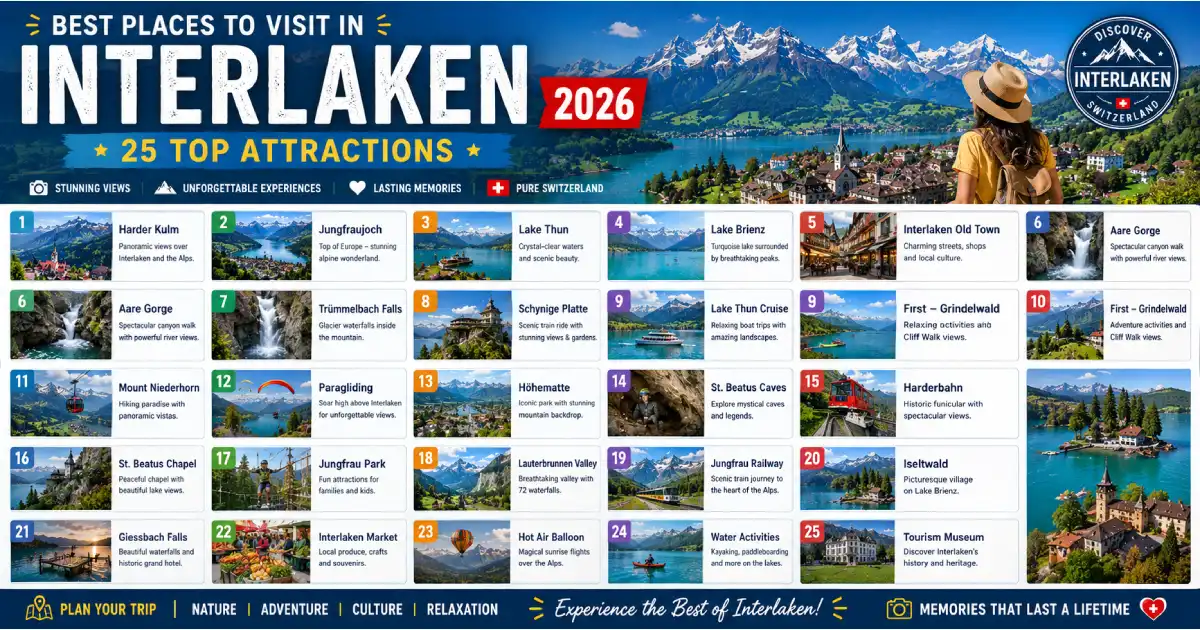
Interlaken occupies one of the most dramatically positioned urban sites in Europe — a narrow glacial plain sitting precisely between two Alpine lakes (Lake Thun to the west and Lake Brienz to the east), hemmed in on all sides by the pre-Alpine peaks of the Bernese Oberland, with the snow-capped Eiger-Mönch-Jungfrau triumvirate filling the southern horizon in a visual composition of such raw Alpine force that it stopped artists and writers throughout the Grand Tour era and continues to stop visitors in the same way today. The best places to visit in Interlaken span the Höheweg promenade (the main lakeside boulevard whose southern view delivers the Jungfrau massif at full scale across the open Bödeli plain — arguably the finest mountain view from any inhabited urban space in the Alps), the Harder Kulm viewpoint (a funicular ascent to 1,322 meters providing the only elevated perspective showing both lakes simultaneously), the Unterseen historic village (Interlaken’s largely unchanged 14th-century founding settlement immediately west of the main town, with its church tower and guild house facades), and the surrounding excursion network that makes Interlaken the most logistically central base in the Bernese Oberland.
What makes Interlaken genuinely distinctive from other Alpine resort towns is this gateway character — the combination of the town’s own compact charms (the Höheweg, the Unterseen village, the casino gardens, and the lake steamers) with its position as the entry point to three UNESCO World Heritage landscapes (the Jungfrau-Aletsch UNESCO region reached by mountain railway, the Bernese Oberland’s Lauterbrunnen Valley, and the broader Swiss Alps Jungfrau-Aletsch natural heritage area) creates a destination whose value extends far beyond what the town itself provides. This guide covers the 25 best places to visit in Interlaken and its directly accessible surroundings with practical details — access, costs, timing, and the insider knowledge that makes each experience complete.
For complete guides, see our Things to Do in Interlaken 2026, Best Restaurants in Interlaken 2026, Best Places to Visit in Switzerland 2026, and Switzerland Travel Guide 2026 guides.
| Place | Type | Entry Cost | Best For | Time Needed |
|---|---|---|---|---|
| Höheweg Promenade | Boulevard | Free | Jungfrau view, grand hotel facades | 30–45 min |
| Harder Kulm | Viewpoint | CHF 34 return | Both lakes simultaneously, panorama | 1.5–2 hrs |
| Unterseen Historic Village | Historic Quarter | Free | Medieval character, church tower | 1–1.5 hrs |
| Jungfraujoch | Mountain Summit | CHF 145–195 (50% Swiss Travel Pass) | Top of Europe, Aletsch Glacier | Full day |
| Grindelwald | Alpine Village | Swiss Travel Pass (Eiger Express extra) | Eiger north face, First Cliff Walk | Full day |
| Lauterbrunnen Valley | Valley | Swiss Travel Pass | 72 waterfalls, Trümmelbach Falls | Full day |
| Schynige Platte | Mountain | CHF 50–65 return | Alpine botanical garden, panorama | Half day |
| Mürren (Car-Free Village) | Alpine Village | Swiss Travel Pass (cable car extra) | Car-free cliff village, Eiger views | Half day |
| Lake Thun Steamers (BLS) | Lake Boat | Swiss Travel Pass | Most beautiful lake in Bernese Oberland | 2–3 hrs |
| Lake Brienz Steamers (BLS) | Lake Boat | Swiss Travel Pass | Turquoise lake, Giessbach Falls | 2–3 hrs |
| Niederhorn | Mountain | CHF 38–48 return | Quiet alternative summit, views | Half day |
| St. Beatus Caves (Beatenbucht) | Caves | CHF 19 | Stalactites, cave walks, lake access | 1.5 hrs |
| Giessbach Falls and Hotel | Waterfall | Swiss Travel Pass + free falls | Historic funicular, lakeside hotel | 2 hrs |
| Interlaken Kursaal (Casino Gardens) | Gardens / Casino | Free (gardens) | Belle Époque architecture, gardens | 30 min |
| Rugen Forest | Park / Nature | Free | Local forest walk, castle ruins | 1–2 hrs |
| Aare River Walk | Riverside | Free | River between the lakes | 45 min |
| Beatenberg Viewpoint | Viewpoint | CHF 20–25 (cable car) | Lake Thun panorama from above | 1 hr |
| Interlaken West Station Area | Sightseeing | Free | Grand hotels, Victoria-Jungfrau | 20 min |
| Touristik-Museum der Jungfrauregion | Museum | CHF 5 | Alpine tourism history from 1800s | 45 min |
| Paragliding Landing Zone (Bönigen) | Activity Area | Free to watch | Paragliders landing by the lake | 20 min |
| Iseltwald Village | Village | Swiss Travel Pass + free | Turquoise lake, Korean drama location | Half day |
| Wengen | Car-Free Village | Swiss Travel Pass | Car-free village, Lauterbrunnen views | Half day |
| First (Grindelwald) | Mountain | CHF 36–42 (gondola) | Cliff Walk, mountain biking, views | Half day |
| Ballenberg Open-Air Museum | Museum | CHF 32 (bus from Interlaken) | Swiss rural heritage, 100+ historic buildings | Half day |
| Sigriswil Panorama Bridge | Bridge | Free | Europe’s longest pedestrian suspension bridge | 1 hr |
Entry: Free | Location: Central boulevard between Interlaken West and Interlaken Ost stations | Best Time: Morning (clearest mountain definition) and evening (alpenglow) | Length: 1.8 km
The Höheweg — a 1.8-kilometer boulevard lined on the north by the historic grand hotels (the Victoria-Jungfrau Grand Hotel and Spa most distinguished, continuously operating since 1865) and on the south by the Höhematte (a 14-hectare open meadow protected from development since the 19th century specifically to preserve the Jungfrau view) — delivers the most direct and most scale-appropriate encounter with the Bernese Oberland’s highest peaks available from any inhabited lowland position in Switzerland. The Eiger (3,967m), Mönch (4,107m), and Jungfrau (4,158m) fill the southern horizon across the open plain with no intervening development — the mountain wall in full scale, approximately 12–15 kilometers distant, at a distance-to-height ratio that produces the optimal human comprehension of Alpine magnitude.
The specific emotional impact — which the photographs consistently undersell — comes from the combination of the flat Bödeli plain between observer and mountain (allowing the full mountain height to be perceived without foreshortening from lower terrain) and the three peaks’ specific arrangement (the Eiger’s forbidding north face left, the Mönch center, and the Jungfrau’s more rounded summit right), creating a mountain composition that has anchored Interlaken’s identity as a Grand Tour destination since the early 19th century.
Insider tips: The Höheweg’s most photographic condition is immediately after a summer rainstorm — the rain clears atmospheric haze, producing the sharpest Eiger-Mönch-Jungfrau definition available. The mountain view is most consistently clear before 10 AM and diminishes as valley haze builds through the afternoon. Evening alpenglow (the reddening of the snow-covered peaks approximately 30 minutes before sunset on clear days) is visible from the Höhematte as one of the Bernese Oberland’s finest free visual events.
Entry: CHF 34 return (funicular) | Transport: Harderbahn funicular from near Interlaken Ost (10-min walk) | Altitude: 1,322 meters | Best Time: Clear mornings | Duration: 1.5–2 hours
Harder Kulm (1,322 meters), reached by the Harderbahn funicular in approximately 10 minutes, provides Interlaken’s most complete topographical overview — the only panoramic view simultaneously showing both Lake Thun (to the west) and Lake Brienz (to the northeast), connected by the Interlaken plain between them, with the Jungfrau massif rising directly south and the broader Bernese Oberland extending in all directions. This is the visual explanation of Interlaken’s geographical identity (Inter lacus — Between the Lakes) made visible from above.
The Two Lakes Bridge (a viewing platform extending over the valley on a cantilever structure, with glass-floor panels above the 1,300-meter drop to Interlaken below) and the Harder Kulm restaurant terrace provide the summit experience. The glass floor panels (transparent sections creating vertigo-inducing downward visibility to the valley) are most effective on clear mornings when the town below and both lake surfaces are simultaneously visible.
Insider tips: The Two Lakes Bridge is most effective in clear morning conditions when both lakes are simultaneously visible in their distinctive colors — Lake Thun’s deeper blue-grey to the west and Lake Brienz’s turquoise-green to the northeast. Arriving on the first funicular (check current Harderbahn timetable, departures from approximately 8:10 AM in summer) delivers the summit before the main tour group arrivals and in the clearest morning visibility conditions.
Entry: Free | Location: 10-minute walk west of Interlaken West station | Best Time: Morning | Duration: 1–1.5 hours
Unterseen (the original medieval settlement of the Bödeli plain, predating the name “Interlaken” and representing the valley’s pre-tourism community character) provides Interlaken’s most historically authentic experience — a cluster of 14th–17th century buildings centered on the Kirchplatz and extending into the Marktplatz, whose architectural character differs meaningfully from the Grand Tour-era tourism infrastructure of the Höheweg. The Stadtkirche’s distinctive late Gothic tower (visible from throughout the western Interlaken area) and the guild house facades of the Marktplatz constitute the Old Town’s primary architectural content.
The contrast between Unterseen’s pre-tourism character and Interlaken’s grand hotel boulevard provides the most complete understanding of the Bödeli’s historical layering — the original agricultural and artisanal community on one side, the 19th-century tourist city superimposed on top of it on the other, both coexisting within 15 minutes’ walk of each other.
Insider tips: The Unterseen Marktplatz on a Wednesday or Saturday morning (when the local market activates) provides the most socially complete version of the village — the market draws Bernese Oberland residents from the surrounding communities, creating a genuine community gathering that the tourist-facing Höheweg doesn’t replicate.
Entry: CHF 145–195 (full ticket from Interlaken Ost); 50% Swiss Travel Pass discount on Jungfrau Railway | Transport: BOB → Grindelwald or Lauterbrunnen → Kleine Scheidegg → Jungfraujoch | Altitude: 3,454 meters | Season: Year-round | Duration: Full day
The Jungfraujoch (Europe’s highest railway station at 3,454 meters, accessible from Interlaken Ost in approximately 2 hours via the mountain railway sequence) is Switzerland’s single most visited tourist attraction and the Bernese Oberland’s definitive experience. The Aletsch Glacier (the longest glacier in the Alps at 23 kilometers, visible from the outdoor Sphinx terrace), the Ice Palace (carved within the glacier, with ice sculptures maintained at constant below-freezing temperature), and the Sphinx Observatory (with the outdoor viewing platform at 3,571 meters — the highest-altitude public viewing position in Europe accessible without mountaineering) constitute the summit experience.
The railway journey itself is as extraordinary as the summit — the Jungfrau Railway ascending inside the Eiger and Mönch through a tunnel bored directly through the mountain, with brief stops at windows cut into the Eiger’s north face providing views downward to Grindelwald 2,000 meters below. This tunnel railway, completed 1912 after 16 years of construction, remains one of the most remarkable engineering achievements in the history of mountain railways.
Insider tips: The Jungfraujoch Good Morning Ticket (discounted early-ascent ticket for first departures from Kleine Scheidegg — check jungfrau.ch for current 2026 pricing) saves approximately CHF 20–30 on the already-discounted pass-holder ticket while delivering summit arrival before the main visitor flow. Checking the Jungfraujoch summit webcam (jungfrau.ch/en-gb/planning/webcams) the evening before provides realistic visibility assessment — a cloudy summit produces an expensive cloud experience rather than the glacier panorama that justifies the trip.
Entry: Swiss Travel Pass covers trains; Trümmelbach Falls CHF 13 | Transport: BOB train Interlaken Ost → Lauterbrunnen (22 min) | Duration: Full day | Season: Year-round
The Lauterbrunnen Valley — a glacier-carved U-valley with 300-meter vertical cliff walls on both sides, 72 named waterfalls, the car-free cliff villages of Mürren (western wall) and Wengen (eastern slope), and the Trümmelbach Falls (ten glacial meltwater waterfalls inside the mountain, accessible by tunnel lift and spiral stairs, CHF 13) — is the single most dramatic landscape accessible from Interlaken. The valley’s specific character (walls so vertical and close that the sky appears as a strip above, the waterfalls descending in long white threads from the cliff-tops to the valley floor) creates a geological grandeur available at no comparable location in Switzerland.
Insider tips: The Trümmelbach Falls (accessible on foot or by bus from Lauterbrunnen village, 10 minutes south) are the most underappreciated attraction in the entire Bernese Oberland — genuinely extraordinary in a way that the “waterfall inside a mountain” description doesn’t prepare visitors for. Missing them on a Lauterbrunnen day is the single most consistent regret reported by visitors who skipped them for time reasons.
Entry: Swiss Travel Pass covers BOB train; First gondola CHF 36–42, Eiger Express extra | Transport: BOB train Interlaken Ost → Grindelwald (35 min) | Duration: Full day | Season: Year-round
Grindelwald (35 minutes from Interlaken Ost by BOB narrow-gauge, fully covered by Swiss Travel Pass) provides the Bernese Oberland’s most dramatic single-village experience — the Eiger north face (the Nordwand, 1,800 meters of vertical rock, one of the most legendary climbing routes in history) rising directly above the village to 3,967 meters, visible from the main street and railway station. The First gondola (to 2,168 meters, with the First Cliff Walk — a metal walkway bolted to the cliff face including glass-floored sections) and the Eiger Express gondola (connecting to the Jungfraujoch railway sequence) provide the primary mountain access.
Insider tips: The First Cliff Walk (most productively visited on the first morning gondola departure) provides the most exposure-oriented viewpoint experience in the Bernese Oberland — standing on a metal platform bolted to the cliff face, with the Eiger north face directly across and the valley 2,000 meters below, creates a specifically vertiginous Alpine experience unavailable at enclosed summit viewpoints.
Entry: CHF 50–65 return (rack railway from Wilderswil, adjacent to Interlaken Ost) | Altitude: 1,967 meters | Season: June–October | Duration: Half day
The Schynige Platte (1,967 meters, reached by the historic Schynige Platte Bahn rack railway from Wilderswil in approximately 50 minutes) is Interlaken’s most rewarding undervisited mountain excursion — providing a combination of the finest topographical panorama (both Lake Thun and Lake Brienz visible below, the Jungfrau massif directly across), the Alpine Botanical Garden (600+ mountain plant species maintained by the University of Bern since 1929), and the historic rack railway itself (operating since 1893, original rolling stock maintained and operational) in a summit environment where visitor numbers are a fraction of the Jungfraujoch and Grindelwald First.
Insider tips: The Schynige Platte-to-First hiking trail (6 hours, high-altitude ridge walk connecting to the First gondola station above Grindelwald — one of the finest ridgewalks in the Bernese Oberland) allows combining the Schynige Platte ascent with a Grindelwald descent in a complete mountain traverse. Fit hikers with a full day should specifically consider this combined route over the standard summit-and-return format.
Entry: Swiss Travel Pass; cable car from Lauterbrunnen CHF 15–20 additional | Transport: BOB → Lauterbrunnen → cable car to Grütschalp → rack railway to Mürren | Altitude: 1,650 meters | Season: Year-round
Mürren (1,650 meters, car-free, accessible only by cable car and rack railway) provides the most atmospheric Alpine village experience in the Bernese Oberland — 450 permanent residents, no through-road traffic, and the Eiger-Mönch-Jungfrau appearing directly across the Lauterbrunnen Valley at eye level from the village streets. The Schilthornbahn (continuing above Mürren to the Schilthorn at 2,970 meters — the revolving Piz Gloria restaurant, the 007 WALK OF FAME, and one of the Bernese Oberland’s finest panoramas) provides the higher-altitude extension.
Insider tips: The Schilthorn’s Piz Gloria (the rotating restaurant used as Blofeld’s lair in “On Her Majesty’s Secret Service,” 1969) completes a full rotation every 55 minutes — arriving for the restaurant’s opening meal service (breakfast from approximately 8 AM, check current hours) provides the rotating panorama in the day’s clearest morning conditions alongside the James Bond interactive experience.
Entry: Included Swiss Travel Pass | Transport: BLS lake steamers from Interlaken West pier | Season: Full fleet May–October; year-round reduced | Duration: 45 min (to Spiez) to 1.5 hrs (to Thun)
Lake Thun (18 km long, azure-blue with the Bernese Alps rising on its southern shore) provides Interlaken’s most visually spectacular lake excursion — the BLS steamers navigating between Interlaken West and Thun town, passing Schloss Spiez (the medieval castle on its vineyard peninsula, one of Switzerland’s most photographed castle positions, CHF 10 entry with steamer stop), the lakeside villages of Spiez, Hilterfingen, and Oberhofen, and the broader lake panorama with the Bernese Alps as the continuous southern backdrop.
Insider tips: The Schloss Spiez stop (BLS steamer disembarking at Spiez village, short walk to the castle and vineyard peninsula) integrated into a lake steamer day creates a specifically Swiss castle-and-lake experience of the highest scenic caliber — the castle’s vineyard position above the lake (and the Schloss Spiez castle wine, produced from the estate’s own vineyard and available at the castle shop) adds a specifically regional dimension to the standard castle visit.
Entry: Included Swiss Travel Pass; Giessbach funicular CHF 5 | Transport: BLS lake steamers from Interlaken Ost pier | Duration: 2–3 hours | Season: Full fleet May–October
Lake Brienz (the eastern of Interlaken’s two lakes, smaller than Thun but vivid emerald-turquoise from glacial meltwater minerals — particularly striking in morning sunlight) provides a distinctly different lake experience, with the Giessbach Falls (a multi-stage waterfall cascading down the steep southern lake shore, with the Grand Hotel Giessbach at its midpoint — accessible from the lake steamer stop by the 1879 Giessbach funicular, CHF 5) as the primary destination. The combination of the turquoise lake, the historic steamer, the vintage funicular, and the dramatic waterfall setting creates one of the Bernese Oberland’s most complete single-excursion experiences.
Insider tips: The Grand Hotel Giessbach terrace lunch (served on the hotel terrace with the Giessbach Falls cascading immediately adjacent and the lake visible below) provides one of the Bernese Oberland’s most atmospheric midday dining experiences — accessible by BLS steamer from Interlaken without a car, entirely covered by Swiss Travel Pass for the water transport segment.
Entry: Free; Swiss Travel Pass covers BLS steamer | Transport: BLS steamer from Interlaken Ost, or PostBus (30 min) | Season: Year-round | Best Time: Early morning before visitors
Iseltwald (a small village on Lake Brienz’s southern shore) achieved international recognition from its appearance in the Korean series “Crash Landing on You” (2020) and subsequent social media amplification — the specific private jetty extending into the turquoise lake creating an image of Lake Brienz at its most vividly colored. The village itself (beyond the jetty) is a genuinely pleasant lakeside settlement with the lake shore walk westward toward the Giessbach Falls direction providing continued turquoise-lake views.
Insider tips: The Iseltwald jetty photograph (in peak summer, queues form for the specific unobstructed image) is best accessed before 8 AM when early morning light and pre-tourist conditions combine. The village’s genuine character (a working lakeside community beyond the photographed pier) rewards exploration of the lanes behind the main waterfront — specifically the small chapel and the traditional Oberland houses in the upper village area.
Entry: CHF 19 | Transport: BLS steamer from Interlaken West to Beatenbucht (20 min) or PostBus | Duration: 1.5 hours | Season: March–October
The St. Beatus Caves (Beatushöhlen), carved by an underground river in the limestone cliff face above Lake Thun’s northern shore near Beatenberg, provide the most accessible underground geology experience in the Bernese Oberland — a guided tour through illuminated cave passages (approximately 1 km of walkable cave, with stalactites, stalagmites, and the active underground stream still audible throughout) combined with the legendary association with St. Beatus (the Irish monk who according to tradition drove a dragon from the cave in the 6th century — the dragon in various artistic forms appearing throughout the cave’s presentation and adjacent museum).
Insider tips: The cave combination with the BLS steamer to Beatenbucht (the lake steamer stopping at the cave’s lake-level pier) and the Niederhorn gondola (ascending from Beatenbucht to the 1,927-meter Niederhorn summit) creates one of the Bernese Oberland’s most varied single-day circuits — boat, caves, summit gondola, and descent hiking in a single loop from Interlaken.
Entry: CHF 32 | Transport: PostBus from Interlaken (30 min) | Duration: Half day | Season: April–October
The Ballenberg Swiss Open-Air Museum (66 hectares, 100+ historic rural buildings from across Switzerland’s distinct regional building traditions) provides the most comprehensive single-day encounter with Switzerland’s pre-industrial rural heritage available anywhere in the country. Buildings from the Valais, Ticino, Bernese Oberland, Central Switzerland, and Graubünden are displayed in geographically-grouped clusters, each staffed with artisans demonstrating traditional crafts in the specific building types where those crafts were historically practiced.
Insider tips: The Bernese Oberland section (most geographically relevant to an Interlaken-based visit) and the Valais section (providing contrast with the neighboring linguistic region’s entirely different building traditions) together constitute the most rewarding Ballenberg focus for visitors with limited time — these two sections alone require 2–3 hours of genuine engagement.
Entry: Free | Transport: Bus from Interlaken to Sigriswil (30–40 min) | Duration: 1 hour | Season: Year-round
The Sigriswil Panorama Bridge (340 meters long, 182 meters above the valley floor below Lake Thun’s southern shore — one of the world’s longest pedestrian suspension bridges) provides the Lake Thun area’s most specifically thrilling free experience. The 340-meter crossing at 182 meters of height, with Lake Thun’s turquoise surface visible directly below through the open mesh walkway, delivers the full vertigo-inducing height experience that makes this bridge worth the specific 30-minute bus journey from Interlaken.
Insider tips: The Sigriswil bridge is most atmospheric in clear conditions when the specific three-dimensional spatial experience — the bridge’s height, Lake Thun below, and the Bernese Alps on the southern horizon simultaneously — is fully visible. The bridge’s free entry makes it one of Switzerland’s best free views, comparable in drama to the paid summit viewpoints at a fraction of the cost.
Entry: CHF 38–48 return | Transport: BLS steamer to Beatenbucht + gondola to Niederhorn | Altitude: 1,927 meters | Season: May–October | Duration: Half day
The Niederhorn (1,927 meters) provides the finest quiet alternative mountain summit from Interlaken — panoramic views showing both Lake Thun and Lake Brienz simultaneously (comparable to Harder Kulm but from 600 meters higher and with a wider horizon) with a fraction of the visitor volume that more marketed excursion peaks attract. The descent hiking trail (from the summit through Beatenberg to the lake steamer pier at Beatenbucht, approximately 2–3 hours) completes the circuit as an alternative to the gondola return.
Insider tips: The Niederhorn’s summit restaurant (one of the least visited quality mountain restaurants in the Interlaken area) provides views comparable to the Harder Kulm restaurant at meaningfully lower visitor density — the combination of quality summit panorama and peaceful dining environment makes the Niederhorn specifically worthwhile for visitors who’ve already done the Harder Kulm and want a different mountain restaurant experience.
About Travel Tourister Travel Tourister’s destination specialists have explored Interlaken across all seasons — from Höheweg alpenglow evenings and Harder Kulm two-lakes mornings through Jungfraujoch glacier panoramas and Lauterbrunnen Trümmelbach Falls visits to Schynige Platte botanical garden walks and Lake Thun Schloss Spiez steamer excursions — to deliver the most practical and honest guide to the best places to visit in Interlaken for every type of 2026 visitor.
Posted By : Vinay
Latest Article
2nd Floor, 39, Above Kirti Club, DLF Industrial Area, Kirti Nagar, New Delhi, Delhi 110015



Travel Tourister is a leading Travel portal where we introduce travellers to trusted travel agents to make their journey hasselfree, memorable And happy. Travel Tourister is a platform where travellers get Tour packages ,Hotel packages deals through trusted travel companies And hoteliers who are working with us across the world. We always try to find new and more travel agents and hoteliers from every nook and corners across the world so that you could compare the deals with different travel agents and hoteliers and book your tour or hotel with the one you have chosen according to your taste and budget.
Copyright © Travel Tourister, India. All Rights Reserved

 Call
Call Enquiry