Published on : 01 Sep 2026
By Travel Tourister | Updated Sep 2026
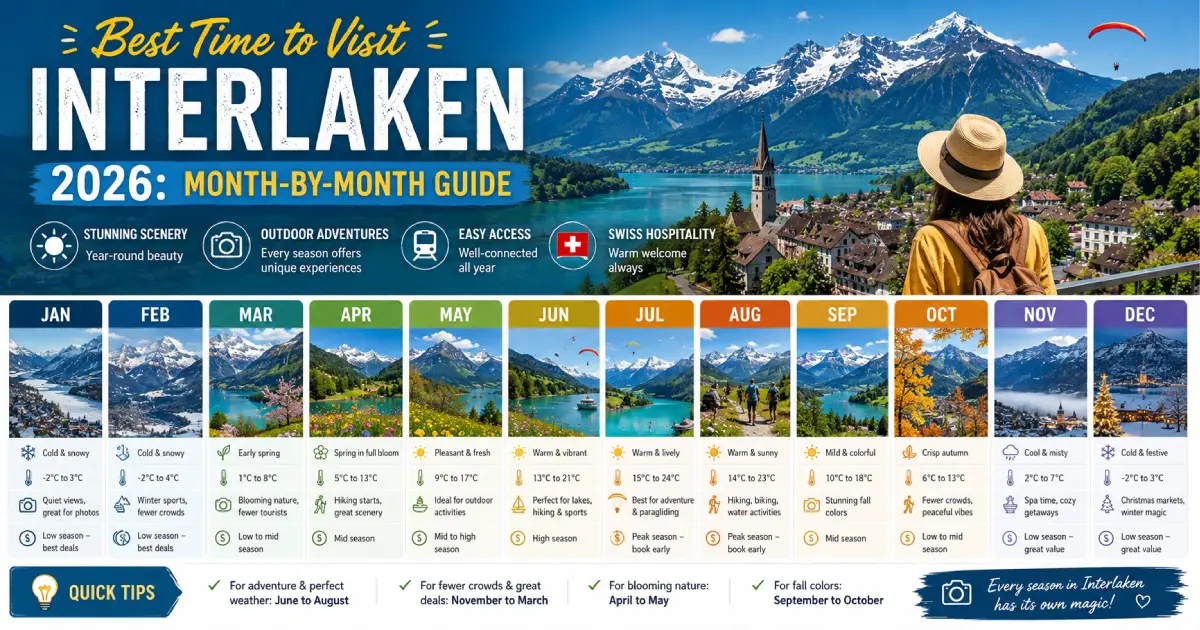
Interlaken is a genuinely year-round destination — but its specific activity profile means that the question of when to visit carries more consequence than for most European city destinations. The Jungfraujoch is accessible every month of the year but is most clearly visible in autumn and late spring. The Lauterbrunnen Valley’s 72 waterfalls are most dramatically full in May and June. The adventure sports season (paragliding, skydiving, canyoning, white-water rafting) runs May through October. The Jungfrau Ski Region (Grindelwald-First, Männlichen-Kleine Scheidegg, Mürren-Schilthorn) operates December through April. The Schynige Platte rack railway and alpine botanical garden are accessible June through October only. And Interlaken’s two lakes are warmest and most swimmable in July and August, while the most dramatically turquoise-colored (the glacial mineral content most vivid in certain light conditions) in May and September.
The best time to visit Interlaken in 2026 depends almost entirely on which of these activity windows best matches your priorities — and on understanding the crowd and pricing implications of each window. July and August deliver everything simultaneously (all mountain railways, all adventure sports, both lakes swimmable, all valley excursions fully accessible, maximum daily light hours) but at the year’s highest prices and visitor volumes. September and October provide most of the same access at meaningfully reduced crowds and prices with specific autumn advantages (clarity, colour, harvest). May and June provide the full mountain season opening, maximum waterfall flow, and pre-peak pricing. December through March deliver the Jungfrau Ski Region at full operation for skiers and snowboarders who specifically want the Bernese Oberland’s winter version. This guide provides the complete month-by-month assessment to support 2026 planning.
For specific Interlaken recommendations, see our Best Places to Visit in Interlaken 2026, Things to Do in Interlaken 2026, and Best Restaurants in Interlaken 2026 guides.
| Month | Avg High/Low (°C) | Avg High/Low (°F) | Crowd Level | Hotel Prices | Best For |
|---|---|---|---|---|---|
| January | 2°C / -3°C | 36°F / 27°F | Low | $ | Skiing, quiet, budget |
| February | 5°C / -2°C | 41°F / 28°F | Low–Medium | –– $ | Skiing, Harder Kulm snow views |
| March | 9°C / 1°C | 48°F / 34°F | Low–Medium | $$ | Spring skiing, waterfalls beginning |
| April | 14°C / 5°C | 57°F / 41°F | Medium | $$ | Spring, waterfalls, valley walking |
| May | 18°C / 9°C | 64°F / 48°F | Medium | $$$ | Full waterfall peak, all activities opening |
| June | 22°C / 13°C | 72°F / 55°F | Medium–High | $$$ | All activities open, waterfalls still strong |
| July | 25°C / 15°C | 77°F / 59°F | Very High | $$$$ | Peak season, lake swimming, maximum access |
| August | 24°C / 15°C | 75°F / 59°F | Very High | $$$$ | Full summer, lake at warmest |
| September | 20°C / 11°C | 68°F / 52°F | High–Medium | $$$ | Best all-round month, excellent clarity |
| October | 13°C / 5°C | 55°F / 41°F | Medium | $$ | Autumn colour, shoulder pricing, clarity |
| November | 6°C / 0°C | 43°F / 32°F | Low | $ | Quietest, budget, city focus |
| December | 2°C / -3°C | 36°F / 27°F | Medium | -$ | Christmas markets, ski season opening |
Avg Temp: 9°C / 48°F | Adventure sports: Not yet open | Mountain railways: Jungfraujoch year-round; Schynige Platte closed; ski season ongoing | Crowds: Low–Medium | Hotel Prices: $$
March in Interlaken occupies the transitional space between ski season and spring — the Jungfrau Ski Region continuing at full operation (typically through April, with spring skiing conditions developing from mid-March: longer days, warmer afternoon temperatures, corn-snow texture on sun-facing slopes), while the valley below begins its tentative spring transformation (the first wildflowers appearing on the lower Höheweg meadow by late March, the Lauterbrunnen Valley’s smallest waterfalls resuming flow as snowmelt begins, and the specific early-spring light on the Jungfrau massif creating photography conditions different from any other season).
The adventure sports season hasn’t yet opened (most operators begin May), the Schynige Platte rack railway is closed for the season, and the lake temperatures remain too cold for swimming — March’s specific value is the combination of the ski season’s continuation with the first signs of spring awakening in the valley, at hotel prices that are meaningfully below the summer ceiling.
What to do: Spring skiing in the Jungfrau Ski Region (Grindelwald First, Kleine Scheidegg, and Mürren-Schilthorn all operating — March’s spring-snow conditions typically provide the ski season’s most enjoyable skiing for intermediate and advanced skiers who appreciate corn snow over heavy powder), the Jungfraujoch excursion (year-round, but March’s specific clear-air conditions between winter cold and summer haze often produce excellent visibility), and the first valley walks as snow clears from lower elevations (the Lauterbrunnen Valley floor and the Grindelwald village area walkable in dry March conditions).
Insider tip: The March Jungfraujoch excursion (year-round accessible, but March’s typically cold clear days produce the specific atmospheric clarity that allows the Aletsch Glacier’s full 23-kilometer length to be seen from the Sphinx terrace without summer’s haze compression) is specifically worth prioritizing for the clearest glacier view — the winter air’s transparency producing definition that July’s warmer, hazier conditions reduce.
Avg Temp: 14°C / 57°F | Adventure sports: Some operators beginning late April | Mountain railways: Jungfraujoch year-round; Schynige Platte closed until June | Crowds: Medium | Hotel Prices: $$
April brings Interlaken’s most dramatic waterfall display — the Lauterbrunnen Valley’s spring snowmelt period (April–June, peaking in May) creating the most powerful waterfall flow of the year, with the Staubbachfall (297 meters of free-falling water) visible in full force from the valley floor and the Trümmelbach Falls (carrying up to 20,000 liters per second during peak spring flow) operating at their most thunderously impressive. For visitors specifically interested in the waterfall dimension of Lauterbrunnen’s 72-waterfall character, April and May provide the most dramatically powerful versions that summer’s reduced snowmelt and autumn’s lower flow don’t match.
The adventure sports season begins for some operators in late April (typically paragliding first, as the early operators start when weather consistently allows, with skydiving, canyoning, and rafting following into May) — April’s specific window provides the first paragliding opportunities of the year in the least-crowded conditions of the entire paragliding season.
Hotel prices in April maintain spring shoulder territory — noticeably below the July–August summer peak while the valley and lower-elevation trail network is fully accessible. The Easter holiday period (date varies, typically April) brings a modest European domestic visitor increase for the specific holiday weekend.
What to do: Lauterbrunnen Valley walk in spring waterfall flow conditions (the most specifically rewarding single Interlaken-area activity in April — the valley floor walk from Lauterbrunnen village toward Stechelberg with the full-force waterfalls descending from all sides in the spring snowmelt), the Jungfraujoch excursion on clear days, and the Harder Kulm (year-round) for the two-lakes view in spring light.
Insider tip: The Trümmelbach Falls in late April to early May — the spring snowmelt peak producing the most powerful throughput of the year (up to 20,000 liters per second, the tunnels genuinely thundering) — represent the single most viscerally powerful natural experience in the Bernese Oberland. Timing a Lauterbrunnen visit specifically for this peak-flow period (checking the Lauterbrunnen Tourism website for current conditions) produces an experience qualitatively different from the same visit in August’s lower-flow summer conditions.
Avg Temp: 18°C / 64°F | Adventure sports: Full season open | Mountain railways: Jungfraujoch year-round; Schynige Platte opens late May/June; all ski areas closed | Crowds: Medium | Hotel Prices: $$$
May is Interlaken’s finest month for visitors whose priorities combine mountain access, adventure sports, and reasonable crowd levels in genuinely warm (15–22°C) conditions. The full adventure sports season opens in May (paragliding, skydiving, canyoning, white-water rafting, and canyon swinging all operational), the waterfalls are at or near their annual peak flow (the snowmelt maximum typically occurring in late May to early June), the Jungfraujoch is accessible year-round, and the complete valley hiking network clears of snow at lower elevations through the month.
The Schynige Platte rack railway typically opens in late May or early June (check schynigeplatte.ch for the specific 2026 opening date — the rack railway’s opening is weather and snowpack-dependent, varying by year) — the first weeks of the Schynige Platte season provide the most dramatically colorful wildflower display, as the late-lying snow clears to reveal the full spring botanical display in concentrated form.
Hotel prices in May (the beginning of the summer premium transition, above April’s shoulder rates but not yet at July–August’s ceiling) provide the last genuinely good-value window before summer’s peak pricing. Booking May accommodation with 6–8 weeks’ advance notice typically provides preferred central hotels.
What to do: The full Interlaken adventure sports program (specifically the May debut of the skydiving season, when the first-of-season atmosphere creates a specific energy in the operators and the landscape is at its greenest and clearest), the waterfall peak in Lauterbrunnen (the most powerful spring flow conditions), and the Männlichen ridge walk as the high-altitude trail network opens for the season.
Insider tip: May’s paragliding specifically (the season’s opening weeks, when the thermal activity is still developing from spring’s lighter heating patterns, producing more consistent and predictable flight conditions than July–August’s stronger afternoon thermals) represents the most reliably comfortable paragliding weather of the year — the specific combination of morning calm, developing afternoon thermals, and the landscape’s vivid spring green creates both the best flight conditions and the most photogenic landscape backdrop for the experience.
Avg Temp: 22°C / 72°F | Adventure sports: Full season | Mountain railways: All operating including Schynige Platte | Crowds: Medium–High | Hotel Prices: $$$
June activates the complete Interlaken activity program — the Schynige Platte opening (typically mid-to-late June, check schynigeplatte.ch for the specific 2026 date), the lake temperatures reaching 18–20°C (making Lake Brienz and Lake Thun swimming genuinely comfortable for the first time in the season), all adventure sports operating at full schedule, and the valley hiking network at its most accessible. The Bernese Oberland’s wildflower display peaks in June–July at mid-altitude (1,500–2,000 meters), creating the most botanically colorful version of the mountain landscape available in any month.
The European school holiday season hasn’t fully activated (most Continental European summer holidays begin in July), keeping June crowds at medium rather than the very-high levels of July–August — June provides the full summer activity access at meaningfully lower crowd concentration than the following two months.
What to do: The complete Interlaken summer program — Jungfraujoch in June’s still-excellent clarity (before summer haze builds through July and August), the Schynige Platte’s opening-week wildflower display, lake swimming as it becomes comfortable in late June, and the full adventure sports schedule at pre-peak crowd conditions. The First Cliff Walk in Grindelwald (opening with the mountain railway season) and the Männlichen ridge walk in June’s fresh green landscape represent the finest mountain hiking conditions of the season.
Insider tip: June’s Jungfraujoch excursion specifically (the mountain’s visibility is typically better in June than in July–August when summer valley haze affects the approach views and occasionally the summit’s clarity) rewards visitors who prioritize maximum visibility on the glacier. Booking the Good Morning Ticket (first-train departure from Kleine Scheidegg, currently discounted — check jungfrau.ch for 2026 pricing) in June’s clearer conditions provides the highest-probability good-visibility summit experience of the summer season.
Avg Temp: 25°C / 77°F | Adventure sports: Full season at peak demand | Mountain railways: All operating at peak frequency | Crowds: Very High | Hotel Prices: $$$$
July is Interlaken at its summer peak — lake water temperatures at 22–24°C (genuinely warm for extended swimming), all mountain railways and adventure sports at full operation, the Höheweg’s grand hotels at capacity, and the visitor volume at its annual maximum. The Iseltwald jetty’s daily photography queue, the Harder Kulm funicular’s potential 20–30 minute waits during peak midday hours, and the BOB trains to Grindelwald filling with Asian tour groups at the main tourist departure times all represent July’s specific crowding challenges — manageable with early morning timing and appropriate planning.
The specific July Interlaken pleasure — swimming in Lake Brienz’s turquoise water at Iseltwald or Bönigen, the Höheweg alpenglow at 9 PM when the July sun lingers on the Jungfrau’s summit long after the valley is in shadow, and the full summer energy of Switzerland’s most international adventure tourism destination — is genuinely extraordinary and specifically summer-only.
What to do: The complete summer Interlaken program, with specific timing awareness: first-train Jungfraujoch departures (6–7:30 AM from Interlaken Ost) for minimum queuing and maximum clarity, early morning Iseltwald lake photography before visitor arrival, the Männlichen ridge walk on clear mornings before afternoon cloud build-up, and lake swimming (Lake Brienz at Iseltwald and Bönigen, Lake Thun at various lakeside swimming areas) in the afternoon warmth.
Insider tip: The Good Morning Ticket for the Jungfraujoch (the discounted first-departure ticket — check jungfrau.ch for 2026 pricing and current availability) is at its most operationally significant in July and August, when the mountain railway’s midday trains carry their maximum load and the summit is most crowded from 11 AM onward. Arriving at the Jungfraujoch at 9–9:30 AM (when the first Good Morning Ticket groups are already descending) and staying until noon provides the summit experience in conditions of moderate rather than maximum crowding while still using the discounted ticket.
Avg Temp: 24°C / 75°F | Adventure sports: Full season | Mountain railways: All operating | Crowds: Very High | Hotel Prices: $$$$
August maintains July’s full summer conditions while adding Switzerland’s National Day (August 1, with fireworks over Lake Thun and Lake Brienz visible from the Höheweg meadow and various lakefront positions — one of Switzerland’s most scenic National Day celebrations, the fireworks reflecting in the lakes with the Bernese Alps silhouetted behind) and the Unspunnen Festival (held in Interlaken, periodically — check current 2026 scheduling as the festival occurs every 12 years in its full traditional format, with intermediate smaller events; the main festival features Schwingen traditional Swiss wrestling, Hornussen, and various traditional Swiss folk activities in a specifically Bernese Oberland cultural context).
National Day August 1: The lakefront fireworks display (positions along the Höheweg meadow, the lake steamer piers, and the waterfront providing the best views) constitute one of the Bernese Oberland’s finest public celebrations — arriving at the Höheweg by 9:30 PM provides position before the 10 PM display begins, with both lakes potentially visible in the background depending on the specific firework positions.
Insider tip: Late August (the final two weeks) provides Interlaken’s best “full summer access at slightly reduced peak conditions” window — the European school holidays beginning to conclude for some markets while the Swiss domestic summer calendar remains active. Specifically targeting late August (August 18–31) provides equivalent mountain and adventure access with hotel prices beginning to soften from the July–early August absolute peak, and crowd levels perceptibly reduced on the most-visited mountain excursions.
Avg Temp: 20°C / 68°F | Adventure sports: Full season through month | Mountain railways: All operating | Crowds: Medium–High (early), Medium (late) | Hotel Prices: $$$
September is the month that repeat Interlaken visitors most consistently identify as their preferred — the summer warmth persisting through the month (17–22°C, with lake water still warm enough for swimming through mid-September), all mountain railways and adventure sports operating at full schedule, and the tourist crowd pressure dropping meaningfully as European school holidays conclude and the main summer travel wave subsides. The mountain panoramas specifically — the Jungfrau massif’s visibility from Interlaken’s Höheweg, from the Harder Kulm, and from the Jungfraujoch’s Sphinx terrace — benefit from September’s autumn air clarity (typically sharper than August’s heat-haze-affected views, with the Aletsch Glacier’s full length visible on clear September days in conditions that August often doesn’t match).
The Lauterbrunnen Valley in September: the waterfalls reduced from their spring peak but still flowing substantially, the valley floor’s autumn colors beginning in the beech and larch forests above the cliffs, and the specific September light quality (lower sun angle than summer, warmer directional color) creating photography conditions that summer’s overhead light doesn’t replicate. The Bachalpsee above Grindelwald (the reflection lake above the First gondola) in September morning calm — the Eiger-Mönch-Jungfrau reflected in the still lake surface before 10 AM — represents the most photogenically rewarding single Bernese Oberland location in its most favorable seasonal conditions simultaneously.
What to do: The complete September Interlaken program: Jungfraujoch in September’s clearest-visibility conditions (first train, Good Morning Ticket), the Männlichen ridge walk in September’s reduced-crowd conditions (the trail that in July requires early departure to avoid group congestion is in September walkable at mid-morning without significant overcrowding), and lake swimming through mid-September (Lake Thun and Lake Brienz both maintaining swimmable temperatures through approximately September 15–20 in most years).
Insider tip: September’s single most specific advantage over July–August is the Jungfraujoch visibility — the mountain air’s September clarity consistently provides better glacier views than summer’s haze, making the (still peak-season-priced but less peak-season-crowded) September Jungfraujoch excursion specifically more likely to deliver the full panorama than the equivalent July visit. For visitors whose primary Interlaken objective is the Jungfraujoch and who have schedule flexibility, September represents the optimal combination of visibility and manageable crowding.
Avg Temp: 13°C / 55°F | Adventure sports: Most closing mid-to-late October | Mountain railways: Schynige Platte closes mid-October; Jungfraujoch year-round; ski areas not yet open | Crowds: Medium | Hotel Prices: $$
October brings Interlaken’s autumn transition — the beech forests on the valley walls above the Lauterbrunnen and Grindelwald areas turning through yellows and oranges, the larch trees (the only deciduous conifer, whose golden October needles create the specific autumn Alpine colour that distinguishes the Bernese Oberland’s October landscape from any other season), and the mountain panorama’s autumn clarity (the Jungfrau massif in October’s low-angle light, the first fresh snowfall on the high peaks appearing through the month as autumn advances, and the specific colour contrast of fresh summit snow against the golden larch forests below) creating photographic conditions that summer doesn’t provide.
The adventure sports season concludes for most operators in mid-to-late October (paragliding, skydiving, and canyoning all have specific closing dates — checking current operator schedules before planning October adventure activities confirms availability). The Schynige Platte closes for the season in mid-October (check schynigeplatte.ch for the specific 2026 date). The Jungfraujoch remains accessible year-round, and the Harder Kulm funicular operates year-round.
Hotel prices in October drop noticeably from September’s levels — the post-summer adjustment producing 20–35% reductions in comparable properties without any reduction in the city’s core attractiveness. October is one of Interlaken’s best value months for visitors whose priorities include mountain access (the Jungfraujoch’s year-round operation and the autumn clarity for visibility), autumn photography, and the Lauterbrunnen Valley’s colour-changed character.
What to do: The larch colour photography (the Lauterbrunnen Valley’s cliff walls behind the golden larch forests, Grindelwald’s meadows surrounded by golden larch above and fresh snow on the Eiger behind — October’s specific photographic combination unavailable in any other month), the Jungfraujoch in October’s clear-air conditions (typically the year’s finest visibility outside of clear winter days), and the Harder Kulm for the two-lake view in autumn light.
Insider tip: The larch colour peak in the Bernese Oberland (typically October 5–20, varying by year based on temperature — earlier in cold autumns, later in warm ones) creates the Interlaken area’s finest landscape photography window. The specific larch colour combined with the Eiger’s north face (gaining its first significant winter snow cover during October) creates a colour-and-white-summit composition available for only 2–3 weeks annually and specifically worth timing a visit around for photography-motivated visitors.
Avg Temp: 6°C / 43°F | Adventure sports: Closed | Mountain railways: Jungfraujoch year-round; Schynige Platte closed; ski areas preparing | Crowds: Very Low | Hotel Prices: $ (lowest of year)
November is Interlaken’s quietest and most affordable month — the adventure sports season closed, the Schynige Platte closed, the lake temperatures too cold for swimming, and the ski season not yet open. Hotel prices reach their annual minimum in November, with properties at 40–60% below July–August equivalents. The Jungfraujoch remains accessible year-round, the Harder Kulm funicular operates (providing the two-lakes winter view — particularly atmospheric in early-winter fog inversions when the lakes appear to float in cloud below the clear summit), and the Lauterbrunnen Valley’s waterfalls continue flowing (reduced from spring’s peak but still operational).
The specific November Interlaken pleasure: the town in its most authentic resident-character, with the grand hotels in their quiet inter-season mode, the Höheweg free of summer’s tour groups, and the Jungfrau massif visible in November’s typically clear cold air in its first winter-snow configuration (the peaks freshly whitened from October’s initial snows, the glaciers in their pre-spring-melt fullest coverage). November Interlaken provides the Jungfrau massif in its most visually complete snow-covered form without the ski-season visitor infrastructure that December brings.
Insider tip: The Jungfraujoch in November (the least-crowded month for the year-round excursion, with good-morning ticket departures practically empty compared to July’s full trains) provides the most peaceful summit experience of the year — the Sphinx terrace potentially shared with only a handful of other visitors in conditions of extraordinary November clarity. The cold (summit temperatures typically -10°C to -20°C in November) requires appropriate warm clothing, but the experience of the Aletsch Glacier in near-solitude justifies the preparation.
Avg Temp: 2°C / 36°F | Adventure sports: Closed | Mountain railways: Jungfraujoch year-round; ski areas opening | Crowds: Medium–High (Christmas) | Hotel Prices: $$–$$$ (Christmas and New Year = higher)
December activates Interlaken’s Christmas market season (the Weihnachtsmarkt in the town center and the Unterseen area, running from late November through Christmas Eve — the Unterseen version particularly atmospheric in the medieval village setting) and the Jungfrau Ski Region’s opening (the first ski lifts typically opening in late November or early December on the highest terrain, with full operation building through December as snowpack develops). The Victoria-Jungfrau and other grand hotels’ specific Christmas programming (festive menus, decorations, and the specific grand hotel Christmas atmosphere that the Bernese Oberland’s luxury accommodation tradition has refined across generations) adds a specifically refined festive character to December accommodation.
Insider tip: The December Christmas market combination with the Jungfraujoch (the year-round excursion in its winter clarity, with December’s cold air producing some of the year’s finest summit visibility) creates an Interlaken December day of maximum contrast: the Christmas market’s warm lights and Glühwein in the afternoon, the glacier’s silent white expanse and -15°C clarity in the morning. The specific December version of this combination is unavailable in any other month.
Avg Temp: 2–5°C / 36–41°F | Adventure sports: Closed | Mountain railways: Jungfraujoch year-round; full ski season | Crowds: Low (town) to High (ski resorts) | Hotel Prices: $ (Interlaken town) to $$$$ (Grindelwald, Mürren, Wengen ski village accommodation)
January and February deliver the Jungfrau Ski Region at its peak — the full ski area operating (Grindelwald-First, Kleine Scheidegg-Männlichen, and Mürren-Schilthorn all at winter capacity), the snowpack established from December’s accumulation and building through February, and the longest skiing days of the season (January’s solstice-recovery sun extending the afternoon skiing window progressively through February’s longer days).
The specific character of using Interlaken as a ski region base (rather than staying in the ski villages of Grindelwald, Wengen, or Mürren): the town accommodation prices remain at near-November’s low rates (the ski village accommodation is what prices at peak-season levels — Interlaken’s own hotels don’t capture the same premium), the BOB and other Swiss Travel Pass-covered trains provide reliable access to the ski areas without car logistics, and the town’s full infrastructure (restaurants, shops, the Höheweg promenade) remains accessible between ski days.
Insider tip: The Jungfraujoch in January–February (the year’s coldest summit temperatures, -20°C to -30°C common, with the summit often in exceptionally clear winter high-pressure conditions) provides the most extreme version of the Top of Europe experience — the Aletsch Glacier’s winter silence, the mountain panorama’s winter clarity (the Bernese Alps and in exceptional conditions the Black Forest, Mont Blanc, and the Vosges all simultaneously visible), and the specific cold’s physical effect (breath visible, the temperature immediately felt on any exposed skin) create a summit encounter qualitatively different from any summer visit. Appropriate warm clothing (down jacket, wind protection, warm gloves, and thermal base layers) is non-negotiable rather than merely recommended.
Best months: June, July, September. June for the opening season’s fresh conditions and pre-peak crowds; July for maximum operator choice and schedule availability; September for reduced crowding and continued full-season operation. May for the season’s opening (some operators start May 1).
Best months: June, July, September. All mountain railways (including Schynige Platte) at full operation. September specifically for the Männlichen ridge walk in reduced crowd conditions. June for the wildflower peak at mid-altitude.
Best months: September–October, January–February. Autumn and winter provide the clearest visibility for the glacier panorama. Summer visits are accessible but subject to haze. Year-round accessibility makes any month viable with Good Morning Ticket on a clear-forecast day.
Best months: April–June. Spring snowmelt peak produces the most powerful Staubbachfall and Trümmelbach Falls. The difference between May’s peak and August’s reduced flow is visually and aurally significant.
Best months: January–March. Full Jungfrau Ski Region operation, peak snowpack, longest days in January–March. March provides spring skiing conditions (corn snow, longer afternoons) with often the best value within the ski season.
Best months: November, January (pre-ski), February (mid-week non-holiday). Hotel prices at their annual minimum while the Jungfraujoch (year-round) and Harder Kulm provide the core experiences. The Lauterbrunnen Valley and valley hiking network are accessible in lower-altitude sections year-round.
| Target | Best Month | Specific Timing |
|---|---|---|
| Jungfrau alpenglow | Year-round | 30 min before sunrise, Höheweg meadow |
| Lauterbrunnen waterfall peak | May | Morning before wind |
| Bachalpsee Eiger reflection | September | First gondola, before 9 AM |
| Larch forest autumn gold | October | Golden hour, valley walls above cliffs |
| Höhematte snow Jungfrau | December–February | Morning after fresh snowfall |
| Two-lake fog inversion | November–January | Dawn from Harder Kulm direction |
| Lake Brienz turquoise peak | May–June | Morning light, 8–10 AM |
Warm layers for morning mountain visits (summit temperatures 10–15°C below valley — a light summer jacket is wholly inadequate for the Jungfraujoch regardless of May valley temperatures). Waterproof jacket for the Lauterbrunnen Valley’s spray (the waterfall mist in spring peak flow genuinely wets bystanders). Hiking footwear for valley trails. Swimwear in late May for the first lake swimming.
Light clothing for valley conditions. Swimwear essential. Heavy warm layer and windproof jacket for Jungfraujoch (-10°C to -15°C at summit even in July — the most common visitor mistake is arriving in t-shirt and shorts for a summer day-trip without accounting for 25°C of temperature differential between valley and summit). Sunscreen for mountain excursions (UV intensity at 3,454 meters is severe). Adventure sports operators provide all necessary equipment for their specific activities.
Medium-weight layers for valley conditions (September: jacket needed by evening; October: genuine coat required). Proper hiking footwear for the larch forest walks and mountain trails that October’s conditions require. Camera battery spares (cold temperatures reduce battery life significantly at altitude).
Full winter clothing — down jacket, thermal base layers, waterproof outer shell, warm hat and gloves essential for any mountain visit. The Jungfraujoch in January–February requires the equivalent of extreme cold weather preparation: -20°C is routinely encountered and wind-chill amplifies the effective temperature. Multiple warm layers allow adaptation between the valley (0 to 5°C) and the summit (-15°C to -25°C) without requiring complete clothing changes mid-excursion.
About Travel Tourister Travel Tourister’s destination specialists have visited Interlaken across all twelve months — from January’s Jungfraujoch winter clarity and February’s spring ski season through May’s Lauterbrunnen waterfall peak and July’s Lake Brienz turquoise swimming to September’s Bachalpsee dawn reflections and October’s larch forest gold — to deliver the most practical and honest month-by-month guide for planning your 2026 Interlaken trip.
Posted By : Vinay
Latest Article
2nd Floor, 39, Above Kirti Club, DLF Industrial Area, Kirti Nagar, New Delhi, Delhi 110015



Travel Tourister is a leading Travel portal where we introduce travellers to trusted travel agents to make their journey hasselfree, memorable And happy. Travel Tourister is a platform where travellers get Tour packages ,Hotel packages deals through trusted travel companies And hoteliers who are working with us across the world. We always try to find new and more travel agents and hoteliers from every nook and corners across the world so that you could compare the deals with different travel agents and hoteliers and book your tour or hotel with the one you have chosen according to your taste and budget.
Copyright © Travel Tourister, India. All Rights Reserved

 Call
Call Enquiry