Published on : 03 Sep 2026
By Travel Tourister | Updated Sep 2026
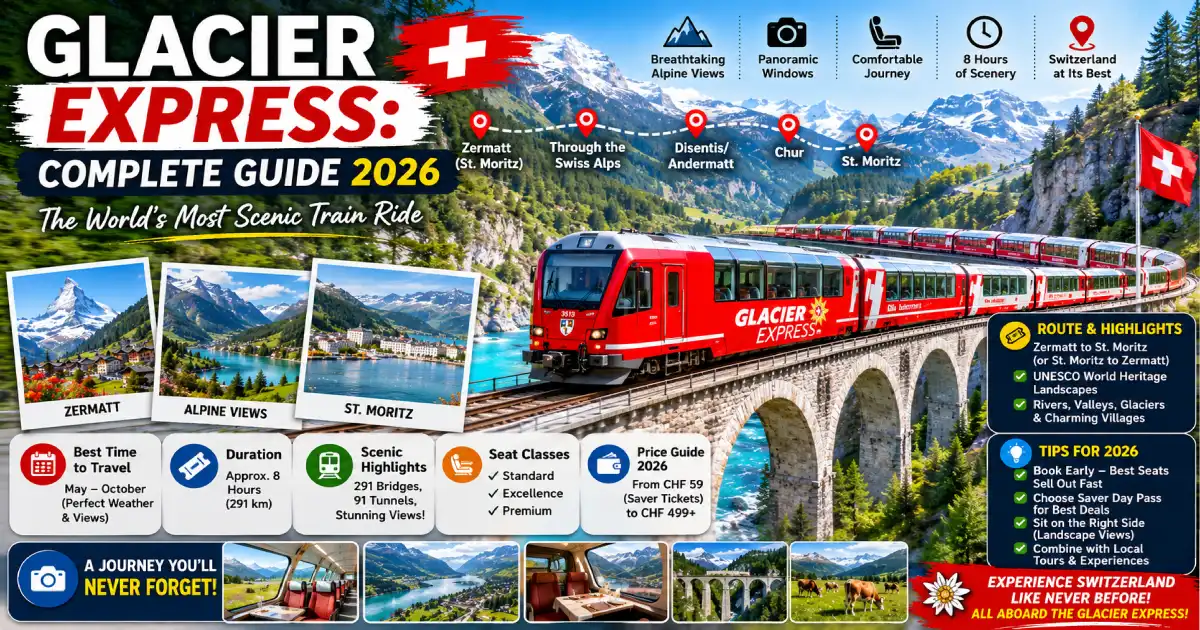
The Glacier Express — running between Zermatt in the Valais and St. Moritz or Davos in Graubünden, covering 291 kilometers through the Swiss Alps in 7 hours 45 minutes (Zermatt–St. Moritz) or 8 hours (Zermatt–Davos), crossing 291 bridges and passing through 91 tunnels while ascending to the Oberalp Pass (2,033 meters — the highest point of the route, which crosses the pass by rack railway rather than tunnel) — is the world’s most celebrated panoramic railway journey, marketed somewhat tongue-in-cheek as “the world’s slowest express train” in acknowledgment of the specific intentional leisureliness of a journey whose purpose is landscape observation rather than transport efficiency. The Glacier Express is not Switzerland’s fastest train, its most comfortable, or its cheapest — it is, however, the train journey that most completely delivers the Swiss Alps’ specific mountain grandeur across the widest range of Alpine landscape types (the Valais valley scenery, the Oberalp Pass high-Alpine terrain, the Rhine Gorge’s dramatic limestone cliffs, and Graubünden’s specific mountain-and-pasture character) in a single uninterrupted journey that connects two of Switzerland’s most celebrated mountain destinations.
Planning a Glacier Express trip in 2026 requires understanding several elements that the train’s marketing materials don’t always clarify: the Swiss Travel Pass covers the entire route but a mandatory seat reservation (CHF 13–49 depending on car class) is required on top of pass coverage; the panoramic cars (the “Excellence Class” and “1st Class Panoramic”) provide larger windows and included dining but at significant additional cost over standard class; the journey’s best views come from specific sides of the train for specific sections of the route (the right side from Zermatt for the first Alpine views, the left side for the Rhine Gorge section); and the weather — particularly cloud and rain in the high Alpine sections — can significantly affect the landscape experience in a way that the train’s fixed-schedule format doesn’t allow postponing. This complete 2026 Glacier Express guide covers everything: the full route and its highlights, ticket types and pricing, seat selection strategy, what to eat and drink on board, the best direction to travel, and the practical planning details that make the difference between a rewarding and an underwhelming journey.
For related Switzerland guides, see our Zermatt Travel Guide 2026, Best Places to Visit in Zermatt 2026, Switzerland Travel Guide 2026, and Best Places to Visit in Switzerland 2026 guides.
| Category | Details |
|---|---|
| Route | Zermatt ↔ St. Moritz (main route) or Zermatt ↔ Davos (via Disentis) |
| Total Distance | 291 km (Zermatt–St. Moritz) |
| Journey Time | 7 hours 45 min (Zermatt–St. Moritz); approximately 8 hours (Zermatt–Davos) |
| Bridges Crossed | 291 |
| Tunnels Passed | 91 |
| Highest Point | Oberalp Pass, 2,033 meters |
| Operating Companies | Matterhorn Gotthard Bahn (Zermatt–Disentis) + Rhaetian Railway (Disentis–St. Moritz/Davos) |
| Frequency | 1–2 trains daily each direction (varies by season and route) |
| Seat Reservation | Mandatory — CHF 13 (2nd class standard), CHF 33 (1st class standard), CHF 49 (Excellence Class) |
| Swiss Travel Pass | Covers the ticket; seat reservation purchased additionally |
| Best Direction | Zermatt → St. Moritz (for the Zermatt morning departure with best light) |
| Best Seats (2nd class) | Right side departing Zermatt (facing direction of travel) |
| Best Season | June–October (summer panoramas); December–March (winter Alpine landscape) |
| Dining | Restaurant car included; Excellence Class dining included in the supplement |
Journey time: Approximately 1 hour 10 minutes | Altitude: 1,608m (Zermatt) → 651m (Visp)
The Glacier Express departs Zermatt station (the western terminus, from the same platform that serves the standard MGB trains between Zermatt and Visp/Brig) and immediately enters the Mattertal — the Matter Valley running north from Zermatt toward the Rhône Valley, through which the Vispa River flows. The first minutes of departure are specifically worth close window attention — the Matterhorn’s northeast face (the most famous mountain profile in the world) remains visible from the right side of the departing train for approximately 5–10 minutes as the train moves north through the valley, with the mountain’s pyramidal form progressively diminishing in the frame before the valley curves and the Matterhorn disappears from view.
The descent from Zermatt (1,608 meters) to Visp (651 meters) covers 957 meters of altitude in 37 kilometers — the narrow valley providing dramatic close-range views of the valley walls and the torrent below as the MGB narrow-gauge railway negotiates the tight curves and limited gradient margins that mountain railway construction in such steep terrain requires.
Key stops: St. Niklaus, Randa (where a 1991 rockfall of approximately 30 million cubic meters of rock partially buried the village and created a natural dam whose effects remain visible from the train), Stalden (the valley junction where the Saastal branches east toward Saas-Fee), Visp (the major junction where the train connects with the SBB mainline — the Glacier Express continues east toward Brig and the Furka Base Tunnel approach without requiring passengers to change).
What to watch: The Matterhorn visible for the first 5–10 minutes departing Zermatt (right side of the train, facing direction of travel, upper portion of the window) — the mountain gradually disappearing as the valley curves north; the narrow Mattertal gorge sections where the valley walls press close on both sides; the Randa rockfall zone (visible from the right side as the train passes through, the scar on the eastern valley wall still clearly visible more than 30 years after the event).
Journey time: Approximately 2 hours 40 minutes | Altitude: 651m (Visp) → 1,444m (Andermatt) via 2,033m (Oberalp Pass)
From Visp, the Glacier Express traverses the Rhône Valley westward briefly to Brig (the major Valais junction and the Simplon Tunnel’s southern entrance) before turning north into the Goms Valley — the upper Rhône Valley above Brig, a traditional Valais landscape of wooden chalets, hay meadows, and the river Rhône in its uppermost accessible form, ascending progressively toward the headwaters region. The Goms Valley section (Brig to Oberwald, approximately 45 minutes) provides some of the journey’s most characteristically Swiss agricultural scenery — the specific landscape of Upper Valais farming communities, the valley’s traditional larch-timber construction visible in the villages along the route, and the progressively narrowing valley form as the train ascends toward the watershed.
The Furka Base Tunnel: From Oberwald (in the Goms), the Glacier Express enters the Furka Base Tunnel (15.4 kilometers, opened 1982, crossing beneath the Furka Pass that the historic steam railway’s original surface route crossed at 2,160 meters — the surface route now operates as the famous Dampfbahn Furka-Bergstrecke summer tourist railway with steam engines). The tunnel takes approximately 18 minutes — the journey’s longest underground section, during which the window view disappears entirely.
Realp and Andermatt: Emerging from the Furka Base Tunnel at Realp (in the canton of Uri, 1,538 meters), the train descends briefly into the Ursern Valley to Andermatt (1,444 meters) — one of Switzerland’s most historically significant Alpine junctions (where the Gotthard, Furka, and Oberalp passes converge — a strategic point in Swiss military and commercial history across centuries).
The Oberalp Pass: From Andermatt, the Glacier Express begins the most technically dramatic section of its journey — the rack railway ascent of the Oberalp Pass (2,033 meters, the highest point of the entire route). The Matterhorn Gotthard Bahn uses its Abt rack system for this ascent, the train slowing noticeably as the gradient increases and the rack teeth engage the central rail. The Oberalppass station (2,033 meters, with Lake Oberalp visible to the right of the train as the summit is crossed) provides a brief glimpse of the high-Alpine world before the descent begins into the Graubünden.
What to watch: The Goms Valley’s traditional Valais village architecture (the characteristic dark larch-timber construction darkened by centuries of Alpine weathering); the Furka Base Tunnel’s 18-minute darkness (use this time for refreshments rather than window-watching); Andermatt’s specific junction character (the military fortress visible on the hillside above the village); the Oberalp Pass rack ascent (the train’s noticeable gear-change as the rack engages, the gradient’s physical effect in the carriage’s tilt, and the Lake Oberalp’s sudden appearance at the pass summit on the right side of the train).
Journey time: Approximately 50 minutes | Altitude: 1,130m (Disentis) → 698m (Ilanz)
From Disentis (the junction where the Matterhorn Gotthard Bahn hands off to the Rhaetian Railway — RhB — for the remaining eastern journey), the Glacier Express descends through the Surselva region of Graubünden toward the Rhine Gorge (Ruinaulta in Romansh, the fourth official Swiss language — Graubünden is the only canton where Romansh is an official language alongside German and Italian, and the Glacier Express crosses through Romansh-speaking territory for this section).
The Ruinaulta Rhine Gorge — a 13-kilometer limestone gorge carved by the Rhine River through Graubünden’s specific geological formation (the result of a massive prehistoric landslide approximately 10,000 years ago that blocked the Rhine before the river subsequently carved this dramatic passage through the accumulated debris) — provides the Glacier Express’s most specifically dramatic landscape passage: vertical limestone cliffs rising up to 350 meters on both sides of the valley, the Rhine’s turquoise-green water visible below, and the train following the gorge’s base through a landscape that the specific geological events of the last ice age produced and that continues to evolve as the river erodes its walls. This section is often described as Switzerland’s “Grand Canyon” — an exaggeration, but one whose specific character (the cliff colors, the river, and the Romansh-speaking villages perched above the gorge walls) creates the most dramatically intimate canyon passage on any Swiss railway.
What to watch: The Rhine Gorge’s limestone cliff faces (the specific orange-grey color of the Verrucano limestone, visible in close detail as the train passes directly beneath the cliff walls); the Rhine’s turquoise coloration (the specific mineral content of the meltwater origin creating the characteristic color visible from the train); Romansh village names on station signs (Trun, Rabius, Sumvitg — the specific phonetic character of Romansh distinguishable from German by ear as well as by eye).
Journey time: Approximately 45 minutes | Altitude: 698m (Ilanz) → 726m (Chur) → 694m (Thusis)
From Ilanz, the Glacier Express continues eastward through the Upper Rhine Valley toward Chur (the capital of Graubünden, Switzerland’s oldest city with continuous urban settlement since approximately 3000 BC — the train passes through but doesn’t stop for extended time on most Glacier Express schedules). The wider Rhine Valley between Ilanz and Chur provides a more open landscape than the gorge sections — vineyards appearing on the south-facing slopes above the valley floor (Graubünden has its own wine production, the Bündner Herrschaft region north of Chur producing Pinot Noir in the specific microclimate created by the Föhn wind’s warming effect), and the valley’s agricultural character becoming more visible in the lowland sections.
What to watch: The vine-terraced slopes between Ilanz and Chur (the Graubünden vineyards visible on the south-facing right-hand slopes as the train approaches Chur from the west — the specific Alpine viticulture of this altitude and latitude producing wines of specific character); Chur’s historic center visible from the train (the Cathedral tower and the Old Town visible from the right side as the train passes through the Chur station area).
Journey time: Approximately 30 minutes | Altitude: 694m (Thusis) → 1,007m (Tiefencastel)
From Thusis, the Glacier Express leaves the Rhine Valley for the last time and enters the Domleschg (the wide valley between Thusis and the Albula approach), ascending through the Via Mala Gorge area (the Via Mala — Latin for “Bad Road” — a historically significant gorge through which the Hinterrhein flows, one of the most important Alpine pass routes in medieval commercial geography) before reaching Tiefencastel at the foot of the Albula Pass approach.
What to watch: The Domleschg valley’s medieval castle landscape (a remarkable concentration of ruined and restored medieval castles on the valley walls — Graubünden has the highest castle density of any Swiss canton, and the Domleschg section is particularly rich — Ortenstein, Rietberg, and various other ruins visible from the train); the Via Mala Gorge approach (the dramatic narrowing of the valley visible from the train as the Hinterrhein forces its way through the limestone formation).
Journey time: Approximately 40 minutes | Altitude: 1,007m (Tiefencastel) → 1,789m (Preda)
The Albula Railway section (from Tiefencastel to Preda, then through the Albula Tunnel to Spinas) is one of the two sections of the Rhaetian Railway designated as a UNESCO World Heritage Site (the other being the Bernina Line) — the engineering achievement of the Albula Railway’s mountain-ascending design (the line uses a series of spiral tunnels and dramatic viaducts to gain the altitude required to reach the Albula Pass without exceeding the adhesion railway’s grade limitations) representing one of the most significant mountain railway engineering achievements in history. The line’s circular viaducts (particularly the Landwasser Viaduct — see below) and the spiral tunnel system are the specific engineering elements that the UNESCO designation recognizes.
The Landwasser Viaduct — The Glacier Express’s Most Famous Single Image: The Landwasser Viaduct (65 meters high, 136 meters long, six curved spans of limestone masonry construction completed 1902, entering a tunnel portal directly at the viaduct’s end — the tunnel bored directly into the cliff face at the viaduct’s final arch) is the single most reproduced image of Swiss railway engineering and one of the most photographed railway structures in the world. The specific photographic composition (the six curved arches spanning the gorge, the train visible crossing from one side, the tunnel portal at the far end, and the valley below) is Switzerland’s definitive railway image.
The Glacier Express crosses the Landwasser Viaduct from right (entering the viaduct from the east) to left (passing through the tunnel portal at the western end) — passengers on the left side of the train (facing direction of travel, i.e., toward St. Moritz/Davos) look down into the gorge as the viaduct is crossed and see the structure most dramatically from within the train; passengers on the right side see the cliff face and the tunnel portal ahead as the train crosses. External photographs of the viaduct (the iconic composition) require positioning at specific viewpoints adjacent to the line rather than from within the train itself.
What to watch: The Albula spiral tunnels (the train appearing to circle back on itself in altitude as the spiral tunnels gain height — the specific disorientation of appearing to return to a previously-seen view at a different altitude); the Landwasser Viaduct crossing (both the view downward from the left-side windows into the gorge and the tunnel portal approach from the right-side windows); the progressive Alpine landscape of the Albula approach (the vegetation line receding as altitude increases, the snow-coverage on higher terrain in most months).
Journey time: Approximately 35 minutes | Altitude: 1,789m (Preda) → 1,856m (St. Moritz)
The Albula Tunnel (5.9 km, passing beneath the Albula Pass at 2,315 meters) deposits the Glacier Express in the Upper Engadin — the high-altitude valley of the Inn River in southern Graubünden, the specific landscape of Switzerland’s most glamorous winter resort region. The Engadin’s specific landscape character (a broad, relatively flat high-altitude valley at 1,700–1,800 meters, with clear lakes — the Inn River’s origin water visible in the chain of Engadin lakes), the characteristic Engadin farmhouse architecture (the distinctive sgraffito-decorated facades — traditional Engadin decoration created by scratching patterns through colored plaster to reveal the contrasting color beneath), and the Bernina massif visible to the south create a specifically different landscape from the dramatic gorge and pass terrain of the preceding sections.
The train descends through Pontresina (the quieter alternative to St. Moritz) and arrives at St. Moritz — the most glamorous Swiss winter resort, at 1,856 meters altitude, where the Palace Hotel and the high-end resort infrastructure that has served European royalty and international wealth since the late 19th century create a specifically opulent arrival environment.
What to watch: The Upper Engadin lakes (Lake Silvaplana, Lake Champfèr, Lake St. Moritz — visible from the left side of the train as the descent proceeds); the Bernina massif (visible to the south on the right side of the descending train, the Bernina group’s glaciated peaks including the Piz Bernina at 4,049 meters — the easternmost four-thousand-meter peak in the Alps); Engadin farmhouse sgraffito decoration on the buildings of the villages passed (Zuoz, Bever, Samedan — the characteristic regional architectural decoration visible even from a passing train with attentive observation).
The Glacier Express is covered by the Swiss Travel Pass for the rail fare itself — holders of a valid Swiss Travel Pass (or Half Fare Card + full-price ticket, or various other Swiss pass products) do not pay additional rail fare. However, a mandatory seat reservation is required for all Glacier Express passengers regardless of pass coverage:
| Class | Reservation Fee | Includes |
|---|---|---|
| 2nd Class Standard | CHF 13 | Seat reservation only |
| 1st Class Standard | CHF 33 | Seat reservation only |
| Excellence Class | CHF 49 (+ Excellence Class supplement of CHF 350–490) | Seat + gourmet dining + service |
Important: The seat reservation (CHF 13 or CHF 33) is separate from and additional to any pass coverage — Swiss Travel Pass holders who forget to purchase the reservation before boarding may be required to pay a higher on-board fee or may not have guaranteed seating in peak season.
Full point-to-point Glacier Express tickets (for passengers traveling without a Swiss Travel Pass):
| Routing | 2nd Class | 1st Class |
|---|---|---|
| Zermatt → St. Moritz | CHF 182 | CHF 312 |
| Zermatt → Davos | CHF 176 | CHF 302 |
| St. Moritz → Zermatt | CHF 182 | CHF 312 |
Half Fare Card value: The Swiss Half Fare Card (annual CHF 120 subscription) provides 50% discount on all Swiss rail fares including Glacier Express point-to-point tickets — for visitors on longer Switzerland itineraries, the Half Fare Card combined with a full-price Glacier Express ticket (at 50% discount = CHF 91 for 2nd class Zermatt–St. Moritz) often provides better value than the full Swiss Travel Pass for shorter visits.
The Excellence Class (the highest tier of Glacier Express service, introduced 2022) transforms the journey into a full-day dining experience — dedicated panoramic cars with individually rotating seats (allowing every passenger to face the direction of best view regardless of seating position), a 4-course lunch served at the seat by dedicated car attendants (using ingredients from the regions the train passes through — the lunch menu changes seasonally with specific sourcing from Valais, Graubünden, and Uri producers), an aperitif service at departure, and the continuous attention of a dedicated car host throughout the journey. The Excellence Class supplement (approximately CHF 350–490 per person on top of the rail fare or pass coverage plus the CHF 49 reservation) positions this as a genuinely special-occasion option rather than a standard travel upgrade.
Is Excellence Class worth it? For the specific visitor who values the guided culinary experience, the individual rotating seats, and the all-inclusive service character — yes, it represents good value for a special-occasion journey. For the visitor whose priority is the landscape itself and who views food as a practical necessity rather than a central experience, the standard panoramic 1st class provides essentially the same window with the freedom to choose from the restaurant car menu at their own pace.
Zermatt → St. Moritz direction (the most popular direction): The morning departure from Zermatt (typically 8:52 AM or 9:52 AM — check current 2026 timetable at glacierexpress.ch) provides the best overall light conditions for the journey’s most celebrated sections — the Matterhorn view departing Zermatt in the morning light, the Goms Valley and Oberalp Pass in mid-morning clarity (before afternoon haze develops), and the Rhine Gorge and Albula sections in mid-afternoon light.
St. Moritz → Zermatt direction: Equally valid for the landscape experience, with different light angles on the same scenery. The Zermatt arrival in the late afternoon (approximately 5 PM) provides an atmospheric entry into the car-free village with the Matterhorn potentially visible in evening light.
This is the single most practically useful piece of Glacier Express planning information and the question most consistently asked by first-time passengers:
Zermatt → St. Moritz direction:
| Section | Best Side | What You See |
|---|---|---|
| Zermatt departure (first 5–10 min) | Right (facing direction of travel) | Matterhorn profile as it recedes |
| Mattertal gorge | Either | Close valley walls both sides |
| Goms Valley (Brig to Oberwald) | Either | Traditional Valais villages |
| Oberalp Pass | Right | Lake Oberalp at the summit |
| Surselva / Rhine Gorge | Left | Rhine Gorge’s dramatic cliff walls |
| Ilanz to Chur | Right | Graubünden vineyard slopes |
| Domleschg Valley | Either | Medieval castles on both slopes |
| Landwasser Viaduct crossing | Left | View down into the gorge |
| Engadin approach | Left | Upper Engadin lakes |
| Bernina massif view | Right | Piz Bernina and glaciers |
The practical takeaway: For the Zermatt → St. Moritz direction, the Matterhorn view (first minutes), the Rhine Gorge, and the Landwasser Viaduct crossing favor the left side of the train (facing direction of travel, window seat — seats marked “A” and “C” in most Glacier Express car configurations). The right side provides the Oberalp Pass lake, vineyard slopes, and Bernina views. Booking a window seat on the left side (A or C designation — confirm with current reservation system) provides the most consistently rewarding single-side selection for the main celebrated sections, with the Oberalp Pass and Bernina views visible from the aisle side or by crossing the car briefly.
Online at glacierexpress.ch: The official Glacier Express website provides direct seat reservation with car plan selection — the most reliable method for selecting specific window seats and car sections.
Via SBB (Swiss Federal Railways) website or app (sbb.ch/en): SBB handles Glacier Express reservations alongside Swiss Travel Pass sales — the most practical booking method for visitors who are simultaneously booking pass coverage and the reservation.
At any Swiss station ticket counter: Reservations can be made in-person at any SBB ticket counter throughout Switzerland — practical for visitors who don’t book in advance online.
Book how far ahead: Summer peak season (July–August) and winter peak (Christmas–New Year, February ski holidays) require booking 4–8 weeks ahead for preferred window seats. Spring and autumn travel is bookable 2–4 weeks ahead with comfortable selection remaining. Same-day booking is sometimes possible in shoulder season but risks poor seat selection.
The Glacier Express includes a restaurant car (in 1st and 2nd class trains — most scheduled services) providing a full menu throughout the journey. The restaurant car is not mandatory (passengers can bring their own food) but is specifically designed for the Glacier Express experience and provides:
Breakfast service (early morning departures only — the Zermatt departure is typically in the 9 AM hour when breakfast service has normally concluded): Continental breakfast options.
Lunch service (the primary service for most passengers, covering the mid-journey 12–2 PM window): A 3-course fixed menu (CHF 45–65 per person, included drinks extra) using regionally-sourced ingredients that change seasonally — the specific sourcing from Valais and Graubünden producers is the menu’s distinguishing characteristic from generic railway catering. A shorter à la carte selection (soups, light dishes, Swiss specialties) provides flexibility for passengers who prefer a smaller meal or different timing.
Afternoon tea/snack service (later in the journey): Pastries, coffee, and light snacks available throughout.
Drinks throughout: Swiss wines (including Valais and Graubünden regional selections), Swiss beers, soft drinks, and the specific specialty — a Glacier Express cocktail served in a glass specifically angled to compensate for the train’s tilt on mountain gradients (a design detail whose precision is a matter of ongoing debate between those who believe the angled glass is genuinely functional and those who believe it’s a marketing device — the train’s actual gradient on the Oberalp rack section is significant enough that a standard vertical glass would theoretically be slightly filled asymmetrically).
Booking the restaurant car: For the fixed lunch menu, reservation is recommended and can be made simultaneously with the seat reservation at glacierexpress.ch or through SBB. Walk-in availability in the restaurant car is usually possible for à la carte items but the fixed menu may sell out on busy services.
The summer season provides the Glacier Express experience in its most visually complete form — all landscape sections in their most saturated green and most clearly defined mountain-snow contrast (the lower valleys green, the high terrain above 2,000 meters still snow-patched, and the specific clarity of summer Alpine air producing the definition that winter fog and spring mud don’t match). June and September specifically are recommended over July and August for reduced crowding and marginally better value on seat reservations without meaningful loss of visual quality.
Wildflower peak: The Goms Valley’s Alpine meadow wildflowers (June–July) and the high-altitude wildflower display visible from the Oberalp Pass section (July–August) provide specifically botanical visual content unavailable in other seasons — the specific carpet of Alpine wildflowers across the Goms Valley meadows, visible from the train window at close range, constitutes one of the journey’s most specifically beautiful sections during its peak bloom period.
The winter Glacier Express (operating year-round, with the full timetable reduced slightly in winter compared to summer peak frequency) provides the journey in its dramatically white-covered version — the Mattertal’s snow, the Goms Valley’s deep winter snowpack, the Oberalp Pass in full winter Alpine conditions, and the specific clarity of winter Alpine air (often superior to summer’s occasional haze) create a visually distinct and equally rewarding journey. The specific practical consideration: the shorter winter days mean the December journey arrives in St. Moritz or Zermatt after dark, reducing the final sections’ visual experience.
Christmas and New Year: The Glacier Express at Christmas (the period between December 23 and January 3) combines the snow-covered landscape with the festive character of the mountain villages visible along the route — the Goms Valley’s traditional Valais chalets decorated for Christmas visible from the train create a specifically atmospheric winter journey. Hotel booking on both ends requires months of advance planning during this period.
October specifically provides the Glacier Express in the most photographically distinctive seasonal conditions — the larch forests (European larch, Larix decidua, the only deciduous conifer native to the Alps) covering the middle-altitude slopes of the Valais and Graubünden sections in their golden October needle-color, the specific warm tone of the golden larches against the grey-white limestone cliff backgrounds and the blue autumn sky creating color compositions unavailable in any other season. The Goms Valley section and the Albula approach are both particularly rich in larch forest — October train travelers see both in simultaneous golden display.
The seat reservation (CHF 13–49) is the single most practically significant Glacier Express booking action — without it, you cannot board specific train services in peak season regardless of pass coverage. Booking the reservation simultaneously with Swiss Travel Pass purchase (both available at sbb.ch) eliminates the possibility of a fully-booked reservation system at departure.
Cloud at the Oberalp Pass (2,033 meters) — the journey’s highest point — eliminates the high-Alpine landscape that the section is specifically valued for. The MeteoSwiss forecast for “Andermatt/Oberalp” specifically provides the most relevant single indicator of pass-section visibility. A completely cloudy forecast for the Oberalp section doesn’t necessarily justify changing the journey (the Rhine Gorge and Albula sections, both lower, may be clear) but provides realistic expectation-setting.
Both 1st and 2nd class Glacier Express panoramic cars feature the same large panoramic windows — the primary differences are seat width and comfort level rather than window size. The panoramic car design (larger-than-standard windows, slightly angled to allow upward viewing of valley walls and peaks) is standard across classes, making the landscape experience essentially equivalent between 1st and 2nd class. The additional CHF 20 seat reservation (CHF 33 vs CHF 13) does not provide proportionally better window access in practice.
7 hours 45 minutes in a train requires more planning than a standard 2-hour scenic ride. Practical stamina management: the restaurant car (for a proper seated meal rather than snacking throughout), moving between sections of the train to change the view angle (the car-to-car connection is straightforward and walking through the train on tight mountain curves is specifically advised against during the rack sections), and timing sleep or rest for the Furka Base Tunnel (18 minutes of complete darkness, ideal for a brief rest) and the less visually remarkable Rhine Valley sections.
The seat selection guidance above is genuinely important — booking a right-side aisle seat in 2nd class when the best views for the specific route and direction are on the left-window side consistently disappoints passengers who learn this after the journey. Confirm the correct window side for the planned direction before booking the specific seat number.
At Reichenau-Tamins (where the route from Disentis meets the route from Chur), some Glacier Express services split — with one portion continuing to St. Moritz and another to Davos. Confirming which portion your reservation is in before departure prevents arriving in the wrong destination (an error that has occurred and that the journey’s significant length makes particularly consequasive).
Mountain railway operations on the Glacier Express’s 291-kilometer route (crossing multiple pass approaches, rack railway sections, single-track portions, and weather-affected high terrain) produce more schedule variation than Swiss mainline intercity services. Connections booked immediately after the Glacier Express’s arrival in St. Moritz or Zermatt are at risk if the train runs late — building a 1-hour buffer into any onward connection is recommended.
The classic experience — the full 7 hours 45 minutes (Zermatt–St. Moritz) covering all sections. The most visited, the most complete, and the most operationally complex in terms of planning.
The Glacier Express can be boarded and alighted at any station along the route — passengers are not required to travel the full Zermatt–St. Moritz journey. Notable partial routes:
Andermatt → St. Moritz (or Chur): A shorter version of the Glacier Express journey covering the Oberalp Pass, Rhine Gorge, and Albula Railway sections — achievable from Lucerne (train to Andermatt, then Glacier Express portion) as a day trip covering the most celebrated engineering sections without the full 8-hour commitment.
Disentis → Chur (Rhine Gorge section only): The Rhine Gorge (Ruinaulta) section covers approximately 45 minutes of the most dramatically scenic section on a standard RhB service rather than specifically the Glacier Express — cheaper and achievable as part of a broader Graubünden rail exploration without the mandatory Glacier Express reservation.
Zermatt → Andermatt: The western half of the journey, covering the Mattertal descent and Goms Valley ascent to the Oberalp Pass — useful for visitors based in Zermatt who want to experience the Glacier Express departure ritual and the Goms/Oberalp section without committing to the full journey.
From Zermatt: Board the morning Glacier Express to Visp (1 hour, included in Swiss Travel Pass), returning by standard intercity train — this provides the Mattertal descent journey experience and Visp connection without full Glacier Express reservation requirements.
From Chur: The Disentis–Chur segment covering the Rhine Gorge can be traveled on standard RhB regional trains (free with Swiss Travel Pass, no reservation required) — effectively experiencing the journey’s most dramatic section without the Glacier Express supplement.
About Travel Tourister Travel Tourister’s destination specialists have traveled the complete Glacier Express route in both directions, across multiple seasons — from summer wildflower Goms Valley crossings and Rhine Gorge autumn larch journeys through winter snow-covered Oberalp Pass ascents and Excellence Class lunch services at the Landwasser Viaduct — to deliver the most practical and honest guide for 2026 Glacier Express travelers.
Posted By : Vinay
Latest Article
2nd Floor, 39, Above Kirti Club, DLF Industrial Area, Kirti Nagar, New Delhi, Delhi 110015



Travel Tourister is a leading Travel portal where we introduce travellers to trusted travel agents to make their journey hasselfree, memorable And happy. Travel Tourister is a platform where travellers get Tour packages ,Hotel packages deals through trusted travel companies And hoteliers who are working with us across the world. We always try to find new and more travel agents and hoteliers from every nook and corners across the world so that you could compare the deals with different travel agents and hoteliers and book your tour or hotel with the one you have chosen according to your taste and budget.
Copyright © Travel Tourister, India. All Rights Reserved

 Call
Call Enquiry