Published on : 03 Sep 2026
By Travel Tourister | Updated Sep 2026
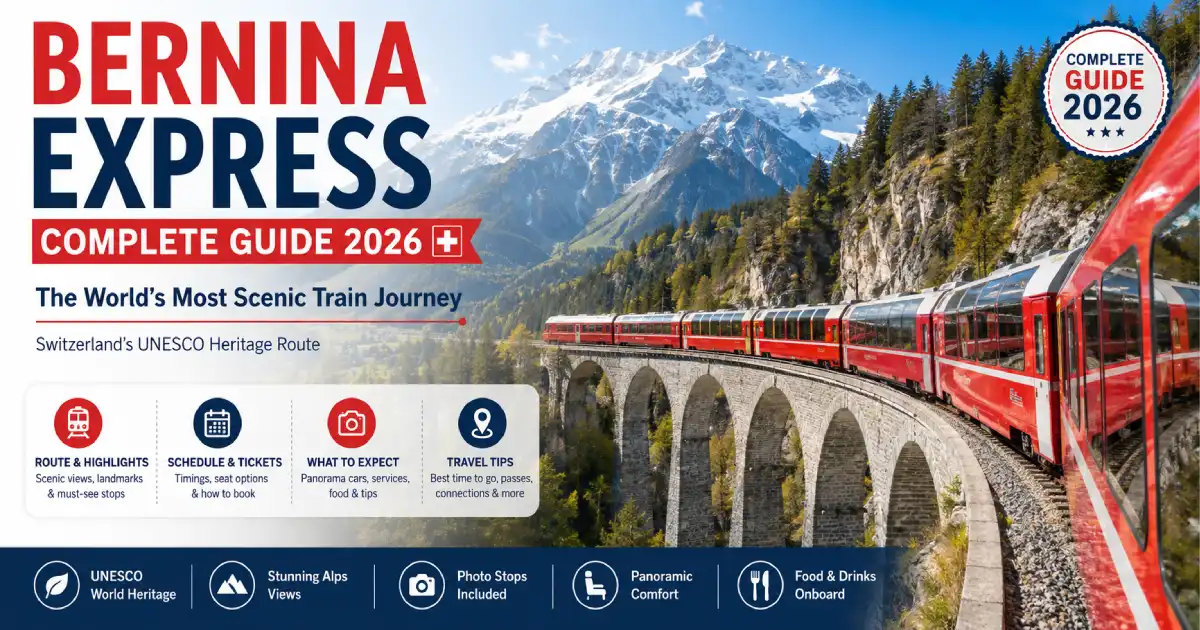
The Bernina Express — operating on the Rhaetian Railway’s Albula and Bernina lines between Chur or St. Moritz in Switzerland and Tirano in Italy, crossing the Bernina Pass at 2,253 meters (the highest point of any transalpine railway in the world that does not use a tunnel at its summit), traversing 55 tunnels and 196 bridges across 122 kilometers (St. Moritz–Tirano section) in approximately 2 hours 25 minutes — is the most technically remarkable scenic railway in Europe and one of the most geographically extraordinary railway journeys in the world. The Rhaetian Railway’s Albula and Bernina lines are designated a UNESCO World Heritage Site (since 2008, the second UNESCO-listed railway in Switzerland after the Jungfrau Railway’s adjacent infrastructure) specifically for the combination of the routes’ technical audacity (the Albula line’s spiral tunnels, the Bernina line’s adhesion-only operation at gradients exceeding 7% — the steepest adhesion railway in the Alps without rack assistance) and their landscape integration (the lines designed to enhance rather than impose upon the Alpine landscape through which they pass).
Unlike the Glacier Express (which takes 7 hours 45 minutes to cross the Alps), the Bernina Express’s Switzerland-to-Italy section (St. Moritz or Pontresina to Tirano) takes only 2 hours 25 minutes — a dramatically condensed mountain-crossing that transitions from Swiss glaciers and snow-covered high-Alpine terrain at 2,253 meters to the Italian Valtellina’s palm trees and Lake Como-adjacent Mediterranean character in a timeframe that seems literally impossible for the geological and cultural distance covered. The complete Chur–Tirano journey (starting at Chur in the Swiss Rhine Valley, crossing the Albula Pass via the UNESCO spiral tunnels, through the Upper Engadin, over the Bernina Pass, and descending to Tirano in Italy) covers the full range of Alpine landscape transition from the Rhine Valley to Mediterranean in a single uninterrupted experience.
This complete 2026 Bernina Express guide covers everything required for planning: the full route and its most celebrated sections, ticket pricing and Swiss Travel Pass coverage, the critical seat selection decision (which side of the train, which car type, and why this matters enormously for the key photographic sections), the difference between the Bernina Express and the standard Rhaetian Railway regional services on the same route, and the practical planning details — including what to do in Tirano and how to extend the Italian arrival into a Como or Milan connection.
For related guides, see our Glacier Express: Complete Guide 2026, Switzerland Travel Guide 2026, and Best Places to Visit in Switzerland 2026 guides.
| Category | Details |
|---|---|
| Main Route | Chur → St. Moritz → Tirano (Italy) OR St. Moritz → Tirano only |
| Full Route Distance | 144 km (Chur → Tirano) / 122 km (St. Moritz → Tirano) |
| Journey Time | Chur → Tirano: approximately 4 hours; St. Moritz → Tirano: 2 hours 25 min |
| UNESCO Status | Both Albula and Bernina lines are UNESCO World Heritage Sites |
| Highest Point | Ospizio Bernina (Bernina Pass), 2,253 meters |
| Operating Company | Rhaetian Railway (RhB) |
| Frequency | 2–4 trains daily depending on season and route |
| Seat Reservation | CHF 14 (Switzerland); €12 (Italy); recommended but technically not always mandatory |
| Swiss Travel Pass | Covers Swiss portion (Chur/St. Moritz → Italian border); Italian portion requires additional ticket |
| Best Direction | St. Moritz → Tirano (for maximum altitude-to-sea contrast in one direction) |
| Best Seats | Right side (St. Moritz → Tirano direction) for Morteratsch Glacier and Bernina Pass views |
| Best Season | June–October (summer UNESCO landscapes); December–March (winter snow, no bus connection) |
| Panoramic Cars | Open-plan panoramic cars with large windows on all Bernina Express services |
Journey time: Approximately 1 hour 35 minutes | Altitude: 585m (Chur) → 1,856m (St. Moritz)
Travelers beginning the Bernina Express at Chur (the capital of Graubünden, Switzerland’s oldest city, at 585 meters) rather than at St. Moritz add the complete Albula Railway section — the first of the two UNESCO World Heritage components — to their journey. This section covers the famous Albula spiral tunnels (where the railway gains altitude through a series of loops within the mountain, the train appearing to pass the same external landscape feature twice at different heights), the Rhine Gorge (Ruinaulta), and the Landwasser Viaduct before reaching the Upper Engadin.
The Landwasser Viaduct: The Albula Line’s most celebrated single structure (65 meters high, six curved masonry arches, entering a tunnel portal directly at the viaduct’s end — Switzerland’s most reproduced railway image) is crossed on this section. See the Glacier Express guide’s detailed Landwasser Viaduct description — the same structure, the same sight-line considerations. Travelers on the Bernina Express Chur–Tirano route experience this section before reaching the Bernina Pass; travelers starting at St. Moritz skip the Albula section entirely.
Preda and the Albula Tunnel: The Albula Tunnel (5.9 km beneath the Albula Pass) deposits the train in the Upper Engadin at Spinas — the landscape transition from the Albula side’s more forested, lower-altitude character to the Upper Engadin’s high-altitude, open valley character is immediately perceptible on emergence from the tunnel.
Journey time: Approximately 55 minutes | Altitude: 1,856m (St. Moritz) → 2,253m (Ospizio Bernina)
From St. Moritz (the Bernina Express’s most common starting point for the Italian crossing), the train departs the Upper Engadin’s glamour-resort environment and immediately enters the Bernina Valley — a progressively wilder, more specifically alpine landscape as the train ascends toward the Bernina Pass. The journey from St. Moritz to the Bernina summit is the Rhaetian Railway’s most spectacular adhesion-railway achievement: the line climbs 397 meters over 37 kilometers without rack assistance, using the 70‰ (7%) maximum gradient that makes this the steepest adhesion alpine railway in the Alps.
Pontresina: The first significant stop after St. Moritz (approximately 6 minutes from St. Moritz) — the quieter alternative to St. Moritz, with the Engadin’s sgraffito-decorated Engadin houses visible from the train. The Morteratsch Glacier approach begins becoming visible from the train window south of Pontresina.
Morteratsch Glacier: As the train ascends the Bernina Valley south of Pontresina, the Morteratsch Glacier appears on the right side — the Bernina Express’s most visually dramatic single landscape element before the Bernina Pass itself. The Morteratsch (one of Switzerland’s largest glaciers and the longest in the Eastern Alps) descends from the Bernina massif in a dramatically visible tongue of blue-white ice, flanked by the Piz Bernina (4,049 meters — the easternmost four-thousander in the Alps) and the Bellavista ridge. The glacier has retreated approximately 3 kilometers since the railway was built (1910), with the retreat progression documented annually by the Morteratsch station’s signposts showing the glacier’s historical extent.
What to watch (Morteratsch): The Morteratsch station (a request stop — passengers who specifically want to alight and walk to the glacier face must signal the conductor) and the viewpoint from the train as it passes (right side of the train, St. Moritz → Tirano direction) — the glacier visible in its entirety from the train window for approximately 3–4 minutes as the track curves around the valley below. The Piz Palü (3,900 meters), Piz Bernina (4,049 meters), and the Bellavista ridge create the mountain wall behind the glacier.
Bernina Lagalb and Diavolezza: Above Morteratsch, the train passes the Diavolezza cable car station (the aerial cable car ascending to the Diavolezza viewpoint at 2,978 meters, providing one of the Alps’ finest high-altitude panoramas including a face-on view of the Morteratsch Glacier from above — a specific worthy add-on for visitors with a full day at this section) and the Bernina Lagalb ski area stations, continuing to climb toward the pass.
Lago Bianco (White Lake) and the Bernina Pass: At the Bernina Pass summit (2,253 meters, Ospizio Bernina station), the Lago Bianco (White Lake — two reservoirs created by damming the natural Bernina Pass wetland, the lakes’ milky-white color from glacial mineral content) appears on both sides of the train as the pass is crossed — the most visually distinctive and most widely reproduced single image of the Bernina Express. The specific photograph (the red train crossing the pass with the Lago Bianco’s white-blue water visible on both sides, the snow-covered Bernina peaks above, and the dramatic scale of the high-alpine pass landscape creating a near-surreal composition) is the Bernina Express’s defining image and the UNESCO designation’s primary photographic symbol.
The Bernina Pass crossing is the journey’s climatological and geological watershed — the southern (Italian) side of the pass is the beginning of the Mediterranean drainage basin (waters eventually reaching the River Adda and Lake Como) while the northern side drains to the Inn River and ultimately the Black Sea. The railway crosses this continental watershed at the highest non-tunnel transalpine railway crossing in the world.
Insider tips for the Bernina Pass section: The Lago Bianco’s most photogenic condition is morning (the low-angle morning sun illuminating the white water surface and the surrounding peaks from the east in the direction that maximizes contrast) — the St. Moritz → Tirano direction in morning departures provides this morning-light advantage. The right side of the train (St. Moritz → Tirano direction) provides the most direct view of the Lago Bianco as the pass is crossed.
Journey time: Approximately 12 minutes | Altitude: 2,253m (Ospizio Bernina) → 2,091m (Alp Grüm)
The descent from the Bernina Pass to the Alp Grüm station provides the most visually dramatic single view sequence of the entire Bernina Express journey — the Palü Glacier (descending from the Piz Palü’s 3,900-meter summit directly toward the train, visible at close range from the left side of the train as the descent begins) and the first distant visibility of the Italian valleys far below (the Po Valley visible on clear days as a hazy plain in the extreme distance, the vertical scale of the descent’s final destination already implied by the 2,000+ meters of altitude separating the pass from the valley floor).
Alp Grüm station: One of the most dramatically positioned railway stations in the world — perched on the cliff face above the Poschiavo Valley with the Palü Glacier immediately behind the station building and the valley visible 1,500 meters below. The station’s terrace (a restaurant and viewing terrace accessible to all passengers regardless of whether they alight) provides the Bernina Express’s finest single static viewpoint — the combination of the glacier above, the valley below, and the train tracks visible curving downward on the Ruinaulta-style serpentine descent creates a vertigo-inducing landscape composition.
What to watch: The Palü Glacier on the left side of the train (departing Ospizio Bernina toward Alp Grüm — in the St. Moritz → Tirano direction); the first appearance of the Italian valley floor far below (the vertical scale immediately apparent as the descent begins from the pass); the Alp Grüm station’s terrace position (if alighting briefly at Alp Grüm — some itineraries specifically include an Alp Grüm stop to walk the station terrace, photograph the glacier, and rejoin the next train southward).
Journey time: Approximately 30 minutes | Altitude: 2,091m (Alp Grüm) → 1,014m (Poschiavo)
The descent from Alp Grüm to the Val Poschiavo floor (a vertical descent of 1,077 meters in approximately 15 kilometers) constitutes one of the most technically extraordinary sections of any European adhesion railway — the Rhaetian Railway achieves this 7% maximum gradient through a series of serpentine loops, spiral curves, and the Brusio Circular Viaduct (see Section 5) — the train winding back and forth across the valley face in curves that allow continuous views of the landscape from alternating sides of the carriage as the orientation changes with each hairpin.
The Val Poschiavo: As the train descends toward the valley floor, the landscape transitions perceptibly from high-Alpine to sub-Mediterranean — the vegetation zones shifting from Alpine meadow (above 2,000 meters) through coniferous forest (1,500–2,000 meters) to the mixed deciduous and subtropical vegetation of the Poschiavo Valley floor (1,000 meters). This transition — visible from the train window as the vegetation changes character with each 200 meters of altitude lost — is one of the most visible climate-change demonstrations available from any public transport journey in Europe.
Poschiavo: The major valley town between the Bernina Pass and Tirano — an Italian-speaking Swiss community (the Val Poschiavo is the southernmost Swiss municipality, linguistically Italian-Swiss) with a specific architectural character that mixes the Swiss public infrastructure tradition (the SBB-related railway stations, the Swiss cantonal government buildings) with the Italian-influenced domestic architecture that the valley’s southern cultural orientation produces. The Piazza Centrale (visible briefly from the train) and the town’s overall character provide a foretaste of the Italian arrival that Tirano completes.
Journey time: Approximately 35 minutes | Altitude: 1,014m (Poschiavo) → 429m (Tirano)
The Brusio Circular Viaduct — The Journey’s Most Celebrated Engineering Moment: Approximately 10 minutes south of Poschiavo, the Rhaetian Railway’s most globally recognized single structure appears — the Brusio Circular Viaduct (completed 1908, one span of continuous curved viaduct forming a complete circle in plan, the train crossing the viaduct and then passing beneath its own path as it completes the curve and continues the descent). The circular viaduct (technically a helical loop — the loop gains altitude as it completes the circle, like a spiral staircase in bridge form) was required by the railway’s maximum gradient limitation (7%) in a section of valley where the natural descent is steeper than the railway can accommodate directly — the loop adds track length to reduce the effective gradient.
The Brusio Circular Viaduct is the most photographed single structure on the Bernina Express and one of the most photographed railway structures in Europe — the composition (the red RhB train visible on two levels of the circular viaduct simultaneously, the stone arches of the structure, and the terraced Italian vineyards behind) is the Bernina Express’s second-most-famous single image after the Lago Bianco pass crossing.
From the train: The circular viaduct is best photographed externally (from specific viewpoints adjacent to the track — the most accessible at a small parking area and path near the Brusio station) rather than from within the train, since within the train the circularity of the structure is difficult to perceive — the train simply appears to be curving on what seems like a standard viaduct. The external photograph (showing the complete circular structure with the train visible) requires positioning at the trackside viewpoint. However, from within the train on the right side (St. Moritz → Tirano direction), the valley panorama visible through the complete circle of the viaduct provides a specific framing of the Italian valley landscape that is the internal-train equivalent of the famous external composition.
The Italian Crossing and Tirano: South of Brusio, the Rhaetian Railway crosses the Swiss-Italian border into Italy (no passport control — the Schengen Area eliminates formal border checks on this crossing, though customs technically applies for goods) and descends through the final section of Italian territory to Tirano (429 meters above sea level) — the southern terminus of both the Bernina Express and the Rhaetian Railway’s Swiss section.
Tirano itself (an Italian town of approximately 9,000 residents in the Valtellina — the valley of the Adda River in Lombardy) provides the first complete Mediterranean encounter: palm trees, Italian piazzas, the Renaissance-Baroque Basilica of the Madonna di Tirano (one of the most significant pilgrimage sites in Lombardy, built 1505 adjacent to the spot where the Virgin Mary is said to have appeared — the basilica’s decorated facade visible from the Rhaetian Railway station area), and the specific sensory environment (Italian language, Italian café culture, Mediterranean temperature) of a southern Alpine Italian town in marked contrast to St. Moritz’s Swiss High Alps character.
The continuation from Tirano: Tirano is served by Italian Trenord trains to Sondrio, Lecco, and Milan (approximately 2.5 hours to Milan Centrale by Trenord regional train) and by bus connections toward Lake Como (Colico, approximately 1 hour by bus). The most celebrated continuation is the extension to Lake Como (Tirano → Colico by bus → boat on Lake Como), completing a St. Moritz–Lake Como traverse using exclusively public transport across one of Europe’s most extraordinary geographic transitions.
This is the most consistently misunderstood aspect of Bernina Express planning — the Bernina Express panoramic cars and the standard Rhaetian Railway regional trains (Regio) run on the identical tracks, stop at the same stations, and cross the identical Bernina Pass. The differences:
| Aspect | Bernina Express | RhB Regional (Regio) |
|---|---|---|
| Cars | Dedicated panoramic cars with larger windows | Standard RhB rolling stock |
| Reservation | CHF 14 recommended/required (peak) | No reservation required |
| Frequency | 2–4/day in summer | Hourly |
| Stops | Limited stops (main stations) | All stations |
| Price | Swiss Travel Pass covers + CHF 14 reservation | Swiss Travel Pass covers; no extra cost |
| Window quality | Panoramic (larger, angled upward) | Standard (smaller) |
| Food/drink | No dining car on most Bernina Express services | No dining car |
The practical implication: For budget-conscious travelers with Swiss Travel Passes, taking the standard RhB regional service (Regio) on the same route saves the CHF 14 reservation fee without meaningfully compromising the landscape experience — the panoramic window difference is genuine but not dramatic, and the standard service’s higher frequency (hourly vs. 2–4/day) provides more scheduling flexibility, including the ability to alight at Morteratsch for a glacier walk or at Alp Grüm for the terrace view and reboard the next train.
Who should book the Bernina Express specifically: Visitors who want the largest possible windows, the specific branding experience (the recognizable red panoramic cars, the onboard announcements in multiple languages explaining the landmarks), and the limited-stop format (arriving in Tirano faster than the regional service).
The Swiss Travel Pass covers the entire Swiss portion of the Bernina Express (Chur or St. Moritz to the Swiss-Italian border at Campocologno) at no additional fare. The Italian portion (Campocologno to Tirano — approximately 5 minutes of additional travel) requires either:
Seat reservation: CHF 14 per person (Switzerland section); €12 per person (Italy section if booking from Tirano northward). The reservation is technically optional on less-busy services but is practically essential for the panoramic window seats during peak season (June–September).
Point-to-point Bernina Express tickets:
| Route | 2nd Class | 1st Class |
|---|---|---|
| St. Moritz → Tirano | CHF 43 | CHF 68 |
| Chur → Tirano | CHF 57 | CHF 91 |
| Pontresina → Tirano | CHF 38 | CHF 61 |
| Tirano → St. Moritz | CHF 43 | CHF 68 |
Panoramic supplement: A small additional panoramic car supplement (approximately CHF 5–10 — confirm current pricing) may apply on specific Bernina Express services for panoramic car access — confirm at time of booking.
The Bernina Express Bus (operating between Tirano and Lugano via the Maloja Pass road, crossing three mountain passes in a 4-hour bus journey that connects the Bernina Express to the Italian Lakes region) provides an alternative to the Trenord train continuation from Tirano — a specifically scenic bus route that completes a Chur/St. Moritz → Tirano → Lugano traverse using the Bernina Express train for the mountain crossing and the bus for the Italian lakes continuation. Swiss Travel Pass holders receive a discount on this bus (check current terms at rhb.ch) — it is not fully included.
For St. Moritz → Tirano direction (the most commonly traveled):
| Section | Best Side | What You See |
|---|---|---|
| St. Moritz → Pontresina | Either | Engadin valley, sgraffito-decorated buildings |
| Pontresina → Morteratsch | Right | Morteratsch Glacier and Bernina massif |
| Morteratsch → Bernina Pass | Right | Glacier views, Diavolezza approach |
| Bernina Pass (Lago Bianco) | Right | Lago Bianco’s white-blue water |
| Alp Grüm approach | Left | Palü Glacier upper section |
| Alp Grüm → Poschiavo | Both alternating | Serpentine views alternating sides |
| Poschiavo → Brusio | Right | Valley panorama framed by circular viaduct interior |
| Brusio Circular Viaduct | Right | Italian vineyard valley framing |
| Brusio → Tirano | Either | Italian valley, final descent |
The practical takeaway: For the St. Moritz → Tirano direction, the right side window seat (facing direction of travel — seat number “A” in most RhB panoramic car configurations, at the window) provides the primary views of the journey’s two most celebrated visual elements: the Morteratsch Glacier and the Lago Bianco. The Palü Glacier (Alp Grüm section) is best from the left side — briefly switching seats at the Ospizio Bernina station (the pass summit, where the train briefly pauses) provides both the right-side Lago Bianco view during the crossing and the ability to move left for the Palü Glacier descent.
Access: Alight at Morteratsch station (request stop — signal the conductor before Pontresina), walk 45–90 minutes to the glacier face, return to Morteratsch and board the next train southward.
The Morteratsch Glacier walk (a well-marked 1.5-kilometer path from the station to the current glacier face, with historical markers showing the glacier’s position in 1900, 1920, 1940, 1960, 1980, and subsequent decades — the most visual climate-change documentation available at any Swiss glacier viewpoint) provides the closest physical encounter with the Bernina massif’s glaciation available without technical mountaineering equipment. The glacier face (the blueish-white ice wall at the walk’s end, the scale immediately comprehensible at close range in a way that train-window views don’t provide) and the surrounding lateral moraines (the rock debris deposited by the retreating glacier, now colonized by pioneer vegetation in a specific succession process) create a glaciology lesson of impressive immediacy.
Planning: The Morteratsch stop requires knowing the train frequency on the day of travel — summer services run more frequently, allowing a 1.5–2 hour stop with comfortable rebooking on the next southward service. Confirm the next train time at Morteratsch station’s posted timetable before the walk begins.
Access: Alight at Alp Grüm (regular stop on Bernina Express and regional services), explore the station terrace, photograph the Palü Glacier and valley, reboard the next southward train.
Alp Grüm station (2,091 meters, the highest station on the Italian side of the Bernina Pass) deserves the specific additional time that an Alp Grüm stop provides — the restaurant terrace (a warming lunch in a mountain restaurant immediately adjacent to the glacier, overlooking the 1,500-meter descent to the valley below) and the station’s specific atmospheric combination of glacier-above and valley-below creates a single stopping point that provides both the alpine-high-altitude world and the Italian valley’s distant promise simultaneously. The restaurant serves simple Italian-Swiss cooking appropriate to the altitude and the context — the minestrone specifically.
Planning: A 45-minute stop at Alp Grüm (terrace visit and lunch or snacks, photography of both the glacier and the valley below) with a southward regional train departure provides the most complete Alp Grüm experience. Check the station’s posted timetable for the next available southward departure.
Access: Regular Bernina Express and regional service stop. Day visitors can explore the Piazza Centrale, the Spanish houses (the distinctive ochre-yellow houses built by 19th-century Poschiavo merchants who emigrated to Spain, returned wealthy, and built ostentatiously Italian-influenced houses in their Swiss home community), and the local café culture before continuing to Tirano.
The Poschiavo stop (the largest intermediate town between the Bernina Pass and Tirano) provides the most complete cultural transition visible on the route — Italian-speaking Swiss citizens whose community occupies the cantonal position of being simultaneously Swiss (Graubünden canton) and culturally Italian (language, architecture, food). The Piazza Centrale’s café (Caffè Italia — the name reflecting the community’s specific dual identity) and the surrounding architecture provide a 30-minute cultural stop of genuine quality.
Tirano (the Italian terminus) typically receives Bernina Express passengers who then immediately board the continuation transport (Trenord train to Milan, or the Bernina Express Bus to Lugano). However, Tirano merits a specific 1–2 hour stop before continuation:
Basilica della Madonna di Tirano: The most significant attraction in Tirano — a Renaissance-Baroque pilgrimage church (built 1505 on the reported site of a Marian apparition) whose exterior facade (visible from the railway station area immediately outside) and interior (elaborate carved wooden choir stalls, Renaissance frescoes, and the specific votive offering collection of a significant pilgrimage destination) provide a genuine religious-art experience appropriate to the shift from Swiss Alpine to Italian Lombard cultural context that the Bernina crossing accomplishes.
Tirano historic center: The old town (Borgo antico) and the Via Stelvio (the main commercial street) provide 30–45 minutes of Italian market-town atmosphere — the outdoor cafés, the Italian cheese shops, and the Valtellina wine (the Nebbiolo-based wines of this specific valley, the same grape as Barolo and Barbaresco but in a higher-altitude Alpine interpretation) providing the first specifically Italian experiences of the descent from Switzerland.
Local food to try: Bresaola della Valtellina (the air-dried beef produced in this specific Lombard valley, DOP-protected, with a flavor and texture specific to the Valtellina’s altitude and curing tradition — the finest bresaola in Italy is arguably produced in this specific valley); Pizzoccheri (the Valtellina’s most celebrated pasta — buckwheat tagliatelle with cabbage, potatoes, and the local Casera cheese, a preparation so specifically tied to this valley that it has DOP geographical protection); and Sforzato di Valtellina (the passito-style Nebbiolo wine, made from partially dried grapes, producing a wine of concentration and complexity specific to this valley).
The Bernina Express’s most celebrated continuation — the Italy component of the St. Moritz → Lake Como traverse — extends from Tirano to the Lake Como shore:
Tirano → Colico by bus (approximately 1 hour): The PostBus service (and summer tourist buses) connects Tirano with Colico at the northern tip of Lake Como — a connection that completes the Swiss-to-Como traverse without requiring a train-to-Milan detour.
Tirano → Sondrio → Lecco → Como by Trenord train (approximately 2 hours): The longer but scenically varied southern continuation, passing through the Valtellina’s wine-producing towns to Lecco and the southeastern arm of Lake Como before reaching Como city itself.
The Bernina Express Bus (Tirano → Lugano, 4 hours): The dedicated scenic bus route connecting Tirano to Lugano via the Maloja, Julier (or Splügen), and various other mountain passes — an extension that turns the Bernina Express rail journey into a complete mountain-crossing experience using both train and bus through genuinely extraordinary scenery.
The summer Bernina Express provides the journey in its most visually complete form — the Morteratsch Glacier’s ice visible against the green lower valley (the color contrast most vivid in July and August), the Lago Bianco’s white-blue water in full summer reflection, the Brusio Circular Viaduct surrounded by the Italian vineyard terraces in their fullest summer green, and the full vegetation transition from alpine to Mediterranean across the 122 kilometers clearly perceptible.
July and August specifically provide the most saturated colors but the highest passenger volumes — booking panoramic window seats 4–6 weeks ahead is minimum preparation for preferred seats in peak summer.
September and early October provide the Bernina Express in its most photographically distinctive autumn conditions: the larch forests on the descent from the Bernina Pass turning golden in October, the Italian vineyard terraces in their harvest-season color (the Nebbiolo vines of the Valtellina turning red-gold in autumn), and the specific clarity of autumn Alpine air improving the mountain definition visible from the pass.
The winter Bernina Express (operating year-round, the Rhaetian Railway maintaining the mountain crossing in all weather conditions through snowplowing and heating systems) provides the journey in its dramatically white version — the Morteratsch Glacier’s ice in the specific blue-white of winter glacial conditions, the Lago Bianco frozen and snow-covered at the pass summit, and the descent from the pass through the specifically silent white-covered landscape of the Poschiavo Valley in winter. The Bernina Express Bus does not operate in winter — the Tirano continuation must use Trenord trains in the December–March period.
The Bernina Express’s panoramic window seats fill quickly in peak summer — window seats on the correct side of the train for the key landscape sections (right side, St. Moritz → Tirano direction) book out weeks ahead during July and August. Booking the seat reservation (CHF 14) simultaneously with Swiss Travel Pass purchase provides the best selection.
Two different routes, two different mountain crossings, two different terminus cities. The Glacier Express (Zermatt ↔ St. Moritz/Davos) takes 7+ hours and crosses the Oberalp Pass. The Bernina Express (Chur/St. Moritz ↔ Tirano, Italy) takes 2.5–4 hours and crosses the Bernina Pass into Italy. Both are operated on the Rhaetian Railway infrastructure (the eastern section of the Glacier Express and the entire Bernina Express), but the journeys, routes, and destinations are completely different.
Passing through Alp Grüm station without alighting (most Bernina Express passengers remain on the train) means missing the single most dramatic static viewpoint of the entire journey — the station terrace’s glacier-above/valley-below composition is one of the finest views in the Swiss Alps. Building a specific Alp Grüm stop into the itinerary (alighting, spending 30–45 minutes, and rejoining the next southward train) produces a meaningfully more complete Bernina experience.
Passengers who board the first available Trenord train from Tirano without pausing in the town miss the Basilica della Madonna di Tirano, the Valtellina’s bresaola and pizzoccheri food culture, and the specific Italian-town atmosphere that completes the cultural contrast with St. Moritz’s Swiss Alpine setting. A 1.5–2 hour Tirano stop before the Italian continuation creates the most complete Alps-to-Italy transition experience.
Cloud at Ospizio Bernina (2,253 meters) eliminates both the Lago Bianco view and the mountain panorama that constitute the journey’s most celebrated sections. MeteoSwiss’s forecast for “Bernina Pass” specifically provides the most relevant mountain-level weather assessment. A clear morning forecast for the pass section dramatically improves the experience.
The Bernina Express Bus (Tirano → Lugano via mountain passes) does NOT operate in winter (approximately November–April) — visitors planning a winter Tirano → Lugano connection via the scenic bus must use the Trenord train to Milan and then the Milan-to-Lugano connection instead, a completely different itinerary.
About Travel Tourister Travel Tourister’s destination specialists have traveled the complete Bernina Express route in both directions, across multiple seasons — from summer Morteratsch Glacier walks and Lago Bianco sunrise crossings through autumn larch-golden Poschiavo Valley descents and winter frozen-pass snow landscapes to Alp Grüm terrace lunches and Tirano bresaola and pizzoccheri arrivals — to deliver the most practical and honest guide for 2026 Bernina Express travelers.
Posted By : Vinay
Latest Article
2nd Floor, 39, Above Kirti Club, DLF Industrial Area, Kirti Nagar, New Delhi, Delhi 110015



Travel Tourister is a leading Travel portal where we introduce travellers to trusted travel agents to make their journey hasselfree, memorable And happy. Travel Tourister is a platform where travellers get Tour packages ,Hotel packages deals through trusted travel companies And hoteliers who are working with us across the world. We always try to find new and more travel agents and hoteliers from every nook and corners across the world so that you could compare the deals with different travel agents and hoteliers and book your tour or hotel with the one you have chosen according to your taste and budget.
Copyright © Travel Tourister, India. All Rights Reserved

 Call
Call Enquiry