Published on : 24 Sep 2026
By Travel Tourister | Updated Sep 2026
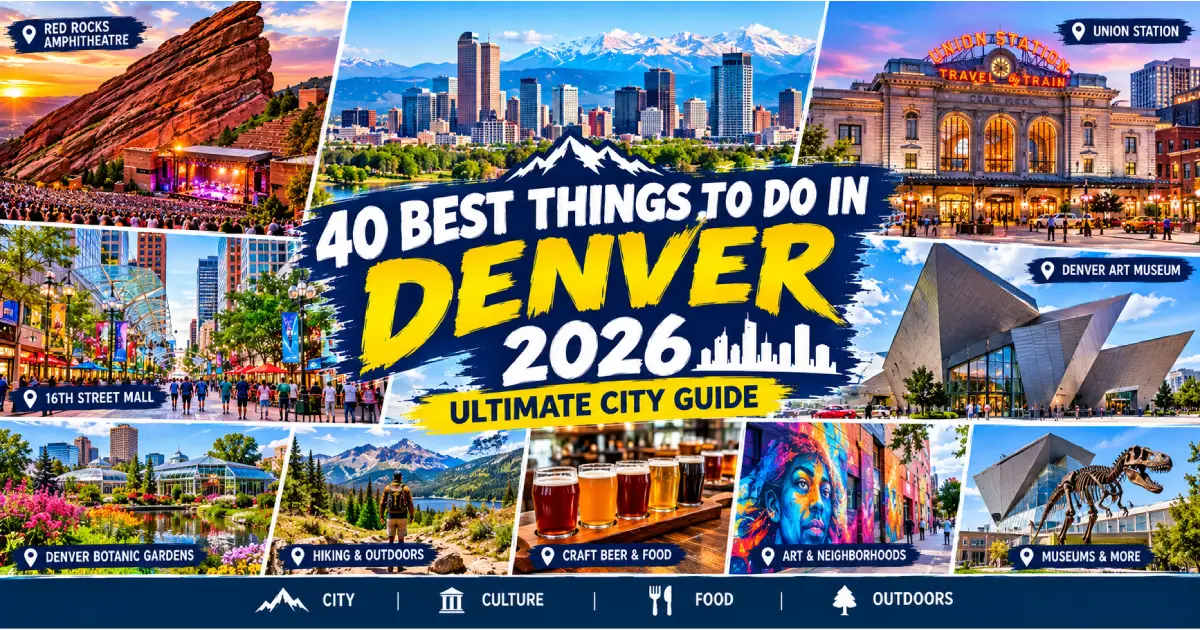
Denver is the American city most specifically defined by its geographic position — the 5,280-foot altitude that gives the Mile High City its nickname, the Rocky Mountains rising dramatically from the city’s western edge to 14,000-foot peaks visible on clear days from downtown, and the specific combination of the urban sophistication that Colorado’s tech-and-energy economy has produced alongside the outdoor lifestyle culture that 300 days of annual sunshine and immediate mountain access enables. The best things to do in Denver in 2026 span the internationally famous (Red Rocks Amphitheatre — the natural rock formation concert venue that consistently ranks as the world’s most beautiful outdoor music venue, the 9,000-foot altitude seating providing views of the Denver skyline visible to the east between the formations), the specifically local (the RiNo Art District’s converted warehouse galleries and the best craft beer concentration of any major American city), and the genuinely extraordinary (Rocky Mountain National Park 90 minutes northwest, the Colorado ski resorts 1.5–2 hours west, and the Garden of the Gods just beyond Colorado Springs 1 hour south).
Denver in 2026 is a city in the middle of its most significant cultural evolution — the specific tension between the original Denver of the Rockies (the country western bars on Colfax Avenue, the rodeo at the National Western Stock Show, and the specific Western frontier character that the city has maintained since its 1858 gold rush founding) and the new Denver of the tech boom (the Union Station neighborhood’s Beaux-Arts restoration, the RiNo District’s creative class, and the brewery taprooms that have made Denver the craft beer capital of the United States) creates a city of genuinely interesting contradictions that the visitor who looks beyond the Red Rocks headline finds most specifically rewarding. This guide covers the 40 best things to do in Denver for every type of 2026 visitor.
For related guides, see our Denver Travel Guide 2026, Day Trips from Denver 2026, Best Restaurants in Denver 2026, and Best Time to Visit Denver 2026.
| # | Activity | Category | Cost | Duration | Book Ahead? |
|---|---|---|---|---|---|
| 1 | Red Rocks Amphitheatre (concert) | Music/Nature | $35–$150 (event) | Evening | Yes (months) |
| 2 | Red Rocks (daytime visit + hike) | Nature | Free | 2–3 hrs | No |
| 3 | Rocky Mountain National Park | Nature | $35/vehicle | Full day | Yes (timed entry) |
| 4 | Denver Art Museum | Museum | $20 | 2–3 hrs | No |
| 5 | Union Station Neighborhood | Culture/Food | Free to explore | 2 hrs | No |
| 6 | RiNo Art District Walk | Culture/Art | Free | 1.5 hrs | No |
| 7 | Denver Botanic Gardens | Garden | $17 | 1.5–2 hrs | No |
| 8 | Colorado State Capitol Building | History | Free | 45 min | No |
| 9 | Larimer Square | Shopping/Food | Free to walk | 1.5 hrs | No |
| 10 | Denver Zoo | Zoo | $24 | 2–3 hrs | No |
| 11 | Denver Museum of Nature & Science | Museum | $22 | 2–3 hrs | No |
| 12 | City Park Walk | Park | Free | 1 hr | No |
| 13 | Confluence Park and Cherry Creek | Park | Free | 1 hr | No |
| 14 | Craft Brewery Tour (Great Divide, Wynkoop) | Beer | $15–$25/brewery | 1–2 hrs | No |
| 15 | Denver Beer Trail (self-guided) | Beer | Free to walk; tasting costs | Half day | No |
| 16 | 16th Street Mall Walk | Shopping | Free | 1–1.5 hrs | No |
| 17 | Molly Brown House Museum | History | $14 | 1 hr | No |
| 18 | Clyfford Still Museum | Museum | $14 | 1–1.5 hrs | No |
| 19 | Coors Field Baseball (Rockies game) | Sports | $20–$80 | 3 hrs | Yes |
| 20 | Empower Field (Broncos game) | Sports | $75–$300 | 3.5 hrs | Yes (advance) |
| 21 | Buffalo Bill Museum (Lookout Mountain) | History | $8 | 1.5 hrs | No |
| 22 | Forney Museum of Transport | Museum | $13 | 1.5 hrs | No |
| 23 | Denver Performing Arts Complex | Culture | $30–$150 | Evening | Yes |
| 24 | Five Points Jazz District | Culture/Music | Free to explore | Evening | No |
| 25 | Capitol Hill and Colfax Avenue | Culture | Free | 1–2 hrs | No |
| 26 | Washington Park (Wash Park) | Park | Free | 1–2 hrs | No |
| 27 | Rocky Mountain Arsenal Wildlife Refuge | Nature | Free | 2 hrs | No |
| 28 | Denver Skate Park | Sports | Free | 1 hr | No |
| 29 | Meow Wolf Denver (Convergence Station) | Art/Experience | $45–$55 | 2–3 hrs | Yes |
| 30 | History Colorado Center | Museum | $16 | 1.5–2 hrs | No |
| 31 | Stanley Marketplace (Aurora) | Food/Market | Free to explore | 1.5–2 hrs | No |
| 32 | Dumb Friends League Petco Park | Free | Free | 1 hr | No |
| 33 | Denver Central Market | Food | Free to browse | 1 hr | No |
| 34 | Morrison Day Trip (Red Rocks area) | Nature/Town | Free | Half day | No |
| 35 | Mt. Evans Scenic Byway (summer) | Scenic Drive | $35 vehicle | Half day | No |
| 36 | Pikes Peak (day trip) | Nature | $20/person | Full day | No |
| 37 | Garden of the Gods (Colorado Springs) | Nature | Free | Half day | No |
| 38 | Breckenridge (skiing/summer) | Ski/Mountain | $180–$220 lift ticket | Full day | Yes |
| 39 | Rocky Mountain National Park Elk Rut (Sept–Oct) | Nature | $35/vehicle | Full day | Yes |
| 40 | Denver Comedy Works | Entertainment | $20–$35 | 1.5 hrs | Yes |
Cost: $35–$150+ (event-dependent) | Location: 18300 W. Alameda Pkwy, Morrison (15 miles west of Denver) | Season: May–October (concerts); year-round (park) | Book: redrocksonline.com — months ahead for major acts | Access: Car, RTD bus (special event service), or Uber ($35–$45 from downtown)
Red Rocks Amphitheatre (the naturally occurring geological formation 15 miles west of Denver — the two massive sandstone monoliths [Ship Rock and Creation Rock] flanking a natural bowl that the City of Denver converted into a 9,525-seat outdoor concert venue in 1941, the most beautiful amphitheatre setting available at any American outdoor music venue) is the single experience most specifically associated with Denver in the global music community: every significant touring artist considers a Red Rocks performance the most specifically memorable single venue on any American tour, the combination of the 6,450-foot altitude seating, the natural acoustics (the sandstone formations creating an acoustic environment of extraordinary natural quality), the western Denver city views from the upper seats, and the specific Red Rocks sunset-to-darkness atmospheric progression during evening performances together creating the most cinematically beautiful single American concert experience.
The Red Rocks experience specifics:
The approach from the parking lot (the specific Red Rocks Park drive — the geological formations visible throughout the approach, the Ship Rock silhouette appearing progressively larger as the parking area is reached) → the venue walk-up (the stone steps from the parking area to the general admission and reserved section entries, the specific physical exertion of the 6,450-foot altitude making the normally unremarkable stairs slightly more demanding than sea-level equivalent) → the venue reveal (the moment of entering the venue bowl and seeing the complete formation for the first time — the two sandstone monoliths framing the performance stage with the Denver skyline visible in the distance to the east, the specific combination that makes Red Rocks the most specifically awe-inspiring single American entertainment venue regardless of what’s performing).
Practical Red Rocks concert planning:
Altitude consideration: The 6,450-foot Red Rocks altitude (compared to Denver’s 5,280-foot downtown elevation) is meaningfully more demanding than sea-level performance venues — the specific altitude effect (reduced oxygen creating more rapid breathing, more rapid alcohol absorption, and a faster dehydration rate than sea-level conditions) requires specific preparation: arriving well-hydrated (the Red Rocks altitude dehydrates significantly faster than sea-level venues), eating a full meal before the show (the altitude amplifies alcohol’s effect — the two drinks that would be comfortable at sea level produce a meaningfully more intoxicating effect at 6,450 feet), and dressing in layers (the Red Rocks temperature drops rapidly after sunset, the mountain air creating 20–30°F temperature drops between the warm afternoon and the late-evening show conclusion).
The best Red Rocks acts: The Red Rocks concert calendar (typically running May through October, the annual programming announced in January–February) consistently features the most specifically Red-Rocks-appropriate acts — the jam band tradition (Phish, String Cheese Incident, and the various Colorado-affiliated improvisational bands whose specific improvisation character most specifically rewards the Red Rocks atmospheric setting), the Colorado-native acts (the specific homecoming energy of Colorado musicians performing at the state’s most beloved venue), and the crossover artists (the touring acts that specifically add Red Rocks to their routing because the venue reputation makes it worth the geographic detour).
Cost: Free | Hours: 5 AM–11 PM | Best time: Morning (5–9 AM for sunrise) or late afternoon | Parking: Free daytime | Activity: Hiking, photography, yoga
Red Rocks in the daytime (the park open continuously when no concert is scheduled, the sandstone formations accessible for hiking and photography without any admission charge) provides one of the most dramatically beautiful free outdoor experiences in any American metropolitan area — the specific Red Rocks Amphitheatre Trading Post Trail (the 1.4-mile loop connecting the amphitheatre with the surrounding park) and the Red Rocks formations visible throughout the surrounding park’s trail network creating a geological landscape of specific drama.
The sunrise yoga tradition: The Red Rocks Yoga (the official park-sanctioned morning yoga classes held in the amphitheatre on Sunday mornings during the summer season — check redrocksonline.com for 2026 schedule and the modest admission fee) provides the most specifically peaceful and most specifically extraordinary single yoga experience available at any American venue: the rising sun illuminating the sandstone formations, the Denver skyline visible to the east in the morning clarity, and the specific mountain air quietude creating the most dramatically located yoga session available outside of a Himalayan retreat.
The film series: Film on the Rocks (the summertime outdoor film series at Red Rocks — classic and cult films shown on a large screen erected at the performance stage, the audience watching from the amphitheatre’s natural bowl seating) is the most specifically beloved single Denver summer event — the combination of the Red Rocks setting and the specific community film-watching culture creating an outdoor cinema experience of specific character.
Cost: $35/vehicle (7-day pass) | Distance: 72 miles northwest of Denver | Drive time: 1.5 hours to the Estes Park entrance | Season: Year-round (full access June–October; Trail Ridge Road open approximately June–October) | Timed entry permits: Required May–October (recreation.gov — book weeks ahead) | Best for: Wildlife (elk, moose, bighorn sheep), Trail Ridge Road, hiking, alpine lakes
Rocky Mountain National Park (the 415-square-mile national park stretching across the Continental Divide 72 miles northwest of Denver — the 77 mountains exceeding 12,000 feet, the 450 miles of hiking trails, and the Trail Ridge Road [the highest continuous paved road in the United States, reaching 12,183 feet at its maximum elevation] together creating the most accessible mountain wilderness experience available within day-trip distance of any major American city) is the single most specifically Colorado-distinct natural experience accessible from Denver.
Trail Ridge Road: The 48-mile scenic highway crossing the Continental Divide — the road traversing the alpine tundra environment (the specific landscape above treeline where the growing season is so short that the plant communities are specific low-growing tundra species, the same plants found at sea level in the Arctic) while providing the most dramatic continuous mountain road views available at any American drive-accessible location. The specific Trail Ridge Road experience: the treeline crossing (the transition from the subalpine forest of spruce and fir to the open tundra landscape, the specific moment when the trees end and the 360-degree mountain panorama begins), the Alpine Visitor Center (the highest-altitude visitor center in the National Park Service, 11,796 feet, the panoramic views from the center’s terrace extending to the mountain horizon in every direction), and the specific weather (the Trail Ridge Road weather can change from warm sunshine to lightning-accompanied thunderstorms within 30 minutes — the afternoon convective storms arriving with specific reliability in summer, the morning visits providing the most consistently stable single Trail Ridge Road weather window).
The September–October elk rut: The single most specifically extraordinary single Rocky Mountain National Park experience — the bull elk bugling during the September–October breeding season (the specific vocalization [the bull elk’s bugle — a clarion call that escalates to a high-pitched shriek and then descends to a series of grunts — audible across vast distances in the mountain air] and the specific rutting behavior [the bull elk herding their harems, the occasional bull-vs-bull confrontation, and the specific urgency of the autumn breeding season creating the most specifically dramatic wildlife encounters available at any US national park accessible as a day trip from a major city]). The Horseshoe Park and Moraine Park meadows in Estes Park provide the most reliably productive single elk rut viewing locations.
Cost: $6–$10 per tasting; tours $15–$25 | Concentration: RiNo, LoHi, and downtown neighborhoods | Season: Year-round | Best approach: Self-guided Denver Beer Trail (dennerbeertrail.com)
Denver has more craft breweries per capita than any major American city — the specific Colorado brewing tradition (the state’s water chemistry, the local barley and hops agriculture, and the specific Colorado outdoor-lifestyle culture creating both the ingredients and the consumer base for the most developed single-state craft beer industry in the United States) concentrated most specifically in Denver’s RiNo, Highland (LoHi), and downtown neighborhoods.
The essential Denver breweries:
Great Divide Brewing Company (2201 Arapahoe St, RiNo): The most nationally recognized single Denver craft brewery — the Yeti Imperial Stout (the most celebrated Great Divide annual release, the massive black stout of extraordinary intensity) and the Titan IPA (the most continuously-produced Great Divide flagship) representing the specific Great Divide approach (big, bold, award-winning beers with minimal stylistic compromise). The RiNo taproom (the converted brick building in the heart of the RiNo Arts District) provides the most specifically RiNo-character single Denver brewery experience.
Wynkoop Brewing Company (1634 18th St, LoDo): The oldest craft brewery in Colorado (founded 1988 by John Hickenlooper, who subsequently served as Denver Mayor and Colorado Governor) — the most historically significant single Denver brewery, the LoDo (Lower Downtown) location in the 1890s mercantile building providing the most specifically historic single Denver brewery environment. The billiards hall on the second floor (the most specifically Wynkoop-character element — the pool tables operating in the upstairs space where Denver’s creative class gathered in the 1990s craft beer awakening) and the Rail Yard Ale (the most specifically Denver-heritage single Wynkoop beer) together create the most historically resonant single Denver brewery experience.
TRVE Brewing Company (227 Broadway, Baker): The most specifically Denver subculture-representative single brewery — the heavy metal-themed taproom (the specific dark aesthetic, the metal music programming, and the irreverently-named beers creating the most distinctly non-corporate single Denver brewery experience). TRVE’s specific beer quality (the sour beers and the barrel-aged program being the most critically-recognized TRVE output) makes it the most craft-enthusiast-specific single Denver brewery recommendation.
Breckenridge Brewery (2220 Blake St, RiNo): The most commercially scaled RiNo brewery (the 12,000-square-foot taproom with the most extensive single Denver brewery food menu) — the Avalanche Amber Ale (the most specifically Colorado-nostalgic single Breckenridge beer, the amber ale that most specifically represents the pre-craft-boom Colorado beer tradition) alongside the more adventurous current brewing program creating the most accessible single Denver brewery for visitors not specifically seeking the small-batch extremes.
Black Shirt Brewing Co (3719 Walnut St, RiNo): The most specifically RiNo-character Denver brewery — the red beer focus (the specific Black Shirt philosophy of brewing exclusively red beers in various styles, the commitment creating the most distinctively conceptually-focused single Denver taproom) and the live music programming creating the most specifically neighborhood-integrated single Denver brewery experience.
Cost: $20 (adults); $10 (ages 6–18) | Location: 100 W. 14th Ave Pkwy, Golden Triangle | Hours: Tuesday–Sunday 10 AM–5 PM (Friday until 9 PM) | Duration: 2–3 hours | Highlight: The most comprehensive American Indian art collection at any US art museum
The Denver Art Museum (the Daniel Libeskind-designed titanium-clad addition [the 2006 Frederic C. Hamilton Building — the most specifically architecturally dramatic single Denver building, the faceted titanium exterior whose specific angular geometry creates the most dynamically shadowed single building facade in the Denver skyline] alongside the original Gio Ponti-designed building [the 1971 seven-story structure whose specific castellated window pattern references the mountain profile visible from the museum’s Golden Triangle location] together creating the most specifically architecturally significant single Denver cultural institution complex) houses the most comprehensive American Indian art collection of any US art museum: the 18,000-object American Indian collection (the most extensively documented Native American material culture collection in the American West, the specific depth of the Great Plains and Southwest traditions providing the most contextually complete single American Indian art encounter available at any US museum).
The specific DAM experience:
The American Indian galleries (the most visited and most specifically Denver-identity-aligned single DAM collection area — the Plains Indian beadwork, the Pueblo pottery, and the Northwest Coast totem and ceremonial objects creating the most comprehensively documented single Native American material culture encounter), the Western American art collection (the Frederic Remington bronzes, the Charles Russell paintings, and the specific Rocky Mountain landscape tradition providing the most specifically Colorado-contextual single painting collection), and the Architecture, Design, and Graphics collection (the DAM’s most surprising single collection for first-time visitors — the Bauhaus furniture, the graphic design history, and the specific mid-century design objects creating the most unexpected single DAM collection).
Cost: $45–$55 (adults); $30–$40 (children) | Location: 1338 1st St, Denver (near Union Station) | Hours: Wednesday–Sunday (check meowwolf.com for current 2026 hours) | Duration: 2–3 hours | Book: Yes — meowwolf.com | Character: Immersive art experience; not a children’s attraction despite the playful name
Meow Wolf Denver (Convergence Station — the 90,000-square-foot immersive art experience from the Santa Fe-founded Meow Wolf collective, the Denver installation representing the most architecturally ambitious single Meow Wolf property [the Colorado-based Convergence Station narrative [four alien worlds connected by an interdimensional transit hub, the specific science fiction narrative woven throughout the installation’s interactive elements] creating the most specifically narrative-complete single Meow Wolf experience) provides the most genuinely immersive single Denver indoor art experience: the four alien worlds (NUMINA, C Street, Ossuary, and Dragnomeld, each with its own specific visual character, its own specific interactive elements, and its own specific narrative thread that contributes to the overall Convergence Station story), the discovery-based exploration (the specific Meow Wolf philosophy — no guided path, no correct route, the discovery of hidden rooms, climbable structures, and interactive elements determined by the visitor’s own curiosity), and the sheer visual ambition (the specific craftsmanship of the Meow Wolf installation — the individually created objects, the hand-painted murals, and the custom-built interactive environments representing the most labor-intensive single Denver cultural institution creation).
Who specifically benefits from Meow Wolf: Adults and teenagers with specific interest in immersive art, science fiction, and non-linear narrative experiences — the Convergence Station narrative rewards visitors who specifically engage with the story elements. Young children (under 8) may be overwhelmed or frightened by specific elements; adults specifically seeking conventional gallery art will find it too chaotic. The most rewarding single Meow Wolf visit: 2–3 hours, no specific destination, maximum exploratory openness.
Cost: Free to explore | Location: River North (RiNo) neighborhood, north of downtown | Best time: Saturday afternoons for the most gallery activity | Duration: 1.5–2 hours | Character: Denver’s most dynamic creative neighborhood
The RiNo Art District (the River North neighborhood north of downtown Denver — the former industrial warehouse district whose specific conversion trajectory [the loading docks becoming taproom patios, the warehouse walls becoming mural canvases, and the rail yards becoming creative office and retail spaces] has created the most specifically creative-class-defined single Denver neighborhood) provides the most concentrated single urban mural collection in Colorado: the 50+ large-scale murals covering the warehouse walls of the Larimer Street and Brighton Boulevard corridors (the specific RiNo mural program — including commissioned works by nationally recognized street artists and local Denver talent alongside the spontaneous additions that the neighborhood’s creative culture permits — creating the most extensively muraled single Denver streetscape).
The RiNo experience: The Larimer Street walk (the most mural-dense single RiNo corridor — the 25th–35th Street blocks of Larimer providing the most complete single Denver outdoor mural gallery experience), the brewery taproom cluster (Great Divide, Ratio Beerworks, Black Shirt, and the various other RiNo brewery taprooms concentrated within walking distance of each other creating the most brewery-dense single Denver neighborhood), and the restaurant concentration (Safta, The Bindery, Cart-Driver, and the various RiNo-neighborhood restaurants representing Denver’s most current food culture) together create the most comprehensively contemporary single Denver neighborhood day.
Cost: Free to explore | Location: 1701 Wynkoop St, LoDo (Lower Downtown) | Duration: 1.5–2 hours | Character: The most successfully restored historic transportation hub in the US
Union Station (the 1914 Beaux-Arts transportation hub — the specific “Travel by Train” neon sign that illuminates the station’s Great Hall at night creating the most specifically atmospheric single Denver outdoor sign, the full renovation completed in 2014 transforming the historic station into a hotel [The Crawford Hotel occupies the upper floors], a food hall [the Terminal Bar, the Mercantile Dining & Provision, the Snooze A.M. Eatery, and the various other Union Station tenants creating the most commercially complete single historic train station restoration in the US], and the active transit hub [the RTD commuter rail and light rail convergence at Denver Union Station making it the central node of Denver’s transit network]) is the most specifically successful historic restoration in Denver and the most specifically photographable single Denver interior space: the Great Hall’s 65-foot ceilings, the restored Beaux-Arts detailing, and the specific Terminal Bar installation (the working bar in the center of the Great Hall, the most visible single Union Station social space) creating the most architecturally rewarding single Denver indoor public space.
The LoDo (Lower Downtown) context: The Union Station renovation anchored the most successful single Denver urban neighborhood transformation — the LoDo warehouse district (the 1880s–1890s commercial buildings between Union Station and Coors Field whose specific brick warehouse architecture has been converted to lofts, restaurants, bars, and galleries creating the most specifically historic-fabric-preserving single Denver neighborhood) provides the most walkable single Denver neighborhood day: the Union Station walk → the Larimer Street restaurant strip → the Coors Field exterior → the Cherry Creek Trail access.
Cost: Free (exterior); Free (tours, check for 2026 availability) | Location: 200 E. Colfax Ave | Hours: Monday–Friday 7:30 AM–5 PM | Duration: 45 minutes | Highlight: The 13th step — exactly one mile above sea level
The Colorado State Capitol (the 1901 Neoclassical building whose specific gold dome [the dome covered in 200 ounces of 24-karat gold leaf, the specific Colorado gold-rush heritage symbolized in the building’s most visible element], the Colorado rose onyx interior [the most rare and complete collection of rose onyx in the world, the specific Colorado stone whose commercial source was exhausted during the Capitol’s construction making the building’s rose onyx interior irreplaceable], and the specific “one mile above sea level” marker on the 13th step [the surveyed exact location of the 5,280-foot altitude on the Capitol’s western steps] creating the most specifically Colorado-identity single building in Denver) provides the most specifically civic-heritage single Denver visit.
The 13th step tradition: The specific Denver visitor ritual — standing on the 13th step of the Capitol’s western entrance staircase at exactly 5,280 feet above sea level (the bronze marker embedded in the step marking the surveyed elevation) and photographing the elevation marker provides the most specifically “Denver” single photographic moment available at any city landmark.
Cost: Free to walk | Location: Larimer Street between 14th and 15th Streets | Character: Denver’s oldest commercial block, most specifically preserved Victorian streetscape | Best time: Evening for the string-light atmosphere
Larimer Square (the 1400 block of Larimer Street — the oldest commercial block in Denver, saved from 1960s urban renewal demolition by developer Dana Crawford and subsequently preserved as the city’s most specifically Victorian commercial streetscape) provides the most specifically historic single Denver street experience: the 1870s–1880s brick commercial buildings (their facades preserved in the specific red-brick-and-ornamental-detail vocabulary of the Denver Victorian commercial tradition), the specific string-light canopy (the overhead lights strung between the buildings creating the most specifically atmospheric single Denver evening street environment), and the restaurant and retail concentration (the specific Larimer Square tenants — Rioja, Tamayo, and the various other restaurants whose quality reflects the commercial premium of the city’s most specifically historic address) creating the most complete single Denver urban-historic evening walk.
Cost: $180–$220/day (lift ticket, 2026 approximate); Epic Pass provides significant savings | Distance: 85 miles west of Denver | Drive time: 1.5 hours (I-70 West) | Season: November–April (skiing); June–September (summer hiking/biking) | Best for: Skiing (world-class), summer mountain biking, historic Victorian mining town
Breckenridge (the 150-year-old Colorado mining town at 9,600 feet elevation — the Victorian-era gold and silver mining history visible in the Main Street historic district, the 400+ historic buildings providing the most specifically intact single Colorado mining town streetscape) and the Breckenridge Ski Resort (the 2,908 skiable acres, 5 peaks, and 187 runs making it the most visited single ski resort in the United States in recent seasons) together create the most completely realized single Colorado ski destination: the Victorian Main Street (the après-ski and après-hike dining [Hearthstone Restaurant in the 1886 Victorian house, the most historically atmospheric single Breckenridge restaurant], the specific gold rush-era building facades converted to contemporary restaurants, gear shops, and galleries) alongside the world-class mountain skiing (the specific Breckenridge terrain — the Imperial Bowl above 13,000 feet providing the most technically demanding accessible single-mountain skiing at any US resort, the Peak 8 terrain providing the most specifically beginner-and-intermediate-accessible single Breckenridge area).
The I-70 corridor reality: The Denver-to-Breckenridge drive (85 miles west on I-70 through the Eisenhower Tunnel at 11,158 feet) is one of the most specifically well-maintained mountain drives in the US — but the Friday-afternoon Denver ski traffic and the Sunday-return traffic create specific delays (the I-70 westbound Friday evening congestion [the specific 5–7 PM I-70 westbound peak when Denver’s ski population leaves simultaneously] can extend the normal 1.5-hour drive to 2.5–3.5 hours). The Saturday morning departure (6–7 AM) and the Sunday departure (after 3 PM) provide the most traffic-optimized I-70 ski trip timing.
Cost: $35/vehicle | Distance: 70 miles west of Denver | Drive time: 1 hour 30 minutes | Season: Late May–early October (snow-dependent) | Altitude: 14,130 feet at summit | Best for: The most accessible 14er summit by car, mountain goats, bighorn sheep
The Mt. Evans Scenic Byway (the highest paved road in North America — the 28-mile state highway ascending from Echo Lake at 10,600 feet to the Mt. Evans summit at 14,130 feet, the most accessible 14,000-foot summit by car of any US mountain) provides the most dramatically altitude-escalating single Colorado drive: the treeline crossing (approximately 11,500 feet, the subalpine forest ending and the alpine tundra beginning), the Summit Lake (the alpine cirque lake at 12,830 feet, the most dramatically positioned single mountain lake visible from a Colorado highway), and the summit area (the mountain goats and bighorn sheep that regularly appear at the summit parking area at 14,130 feet — the most specifically accessible mountain wildlife encounter in Colorado, the goats approaching remarkably close to vehicles and visitors without the wariness that lower-altitude wildlife maintains).
The altitude caution: The Mt. Evans summit at 14,130 feet creates the most specifically altitude-demanding single Colorado drive: visitors who arrived in Denver within the past 24 hours (not yet altitude-adjusted to Denver’s 5,280-foot base elevation) should specifically limit summit time (15–20 minutes maximum), avoid strenuous activity at the summit, and descend immediately at the first sign of altitude sickness symptoms (headache, nausea, dizziness, unusual fatigue).
Cost: Free | Location: South Denver, East Virginia Ave | Best time: Morning or evening | Character: Denver’s most beloved neighborhood park
Washington Park (the 165-acre park in the South Denver residential neighborhood — the two lakes [Smith Lake and Grasmere Lake], the formal rose garden, the refectory building, and the perimeter running path [the 2.5-mile loop the most consistently used single running path in Denver by resident population] creating the most specifically beloved single Denver public park) provides the most specifically local Denver outdoor experience: the morning runners (the specific Wash Park runner culture — the city’s most serious amateur runners making the 2.5-mile perimeter loop their primary training route), the weekend cyclist density (the most bicycle-dense single Denver park, the perimeter path shared between cyclists and runners in the specific Washington Park cycling culture), and the Sunday afternoon park culture (the most specifically local-feeling single Denver outdoor gathering, the park filling with South Denver residents rather than tourist visitors for the most authentically neighborhood-integrated single Denver park experience).
Cost: Free (park); $22 (Denver Zoo, within park); $22 (Denver Museum of Nature & Science, adjacent) | Location: East 17th Ave and Colorado Blvd | Best time: Morning for wildlife; any time for the mountain view | Size: 330 acres
City Park (the 330-acre public park housing the Denver Zoo, adjacent to the Denver Museum of Nature & Science, and providing the most dramatically framed single Rocky Mountain panorama visible from any Denver city park — the mountain view from the City Park pavilion looking west across the park’s lake toward the Front Range providing the most specifically Denver-identity single landscape view: the urban park in the foreground, the Denver skyline in the mid-ground, and the snow-capped Rockies on the horizon creating the most comprehensively Colorado single visual composition available from a city park) is the most completely programmed single Denver public park.
About Travel Tourister Travel Tourister’s destination specialists have explored Denver across all seasons — from Red Rocks Amphitheatre morning yoga sessions at sunrise and summer concert evenings watching the Denver skyline appear between the sandstone formations, through Rocky Mountain National Park September elk rut bugling at Horseshoe Park meadow dawn and Trail Ridge Road tundra walks above 12,000 feet, to RiNo Art District Saturday morning mural walks and Great Divide Yeti Imperial Stout taproom tastings, Union Station Great Hall Terminal Bar afternoon sessions, Denver Art Museum American Indian collection immersions, Meow Wolf Convergence Station two-hour exploratory wanderings, Washington Park 5 AM morning run laps, and I-70 Friday-afternoon ski traffic Breckenridge approaches that confirmed the Saturday 6 AM departure strategy — to deliver the most practically honest and most completely experienced Denver activities guide for every type of 2026 visitor.
Posted By : Vinay
Latest Article
2nd Floor, 39, Above Kirti Club, DLF Industrial Area, Kirti Nagar, New Delhi, Delhi 110015



Travel Tourister is a leading Travel portal where we introduce travellers to trusted travel agents to make their journey hasselfree, memorable And happy. Travel Tourister is a platform where travellers get Tour packages ,Hotel packages deals through trusted travel companies And hoteliers who are working with us across the world. We always try to find new and more travel agents and hoteliers from every nook and corners across the world so that you could compare the deals with different travel agents and hoteliers and book your tour or hotel with the one you have chosen according to your taste and budget.
Copyright © Travel Tourister, India. All Rights Reserved

 Call
Call Enquiry