Published on : 25 Sep 2026
Southwest Airlines has now exceeded 1,100 delays in a single day for the second time in September. Boston Logan’s runway construction is approaching its sixth consecutive week of serious disruption. And seven of the United States’ busiest airports are simultaneously disrupted on a Thursday that should be an ordinary travel day. Autumn 2026 is proving nearly as turbulent as the summer.
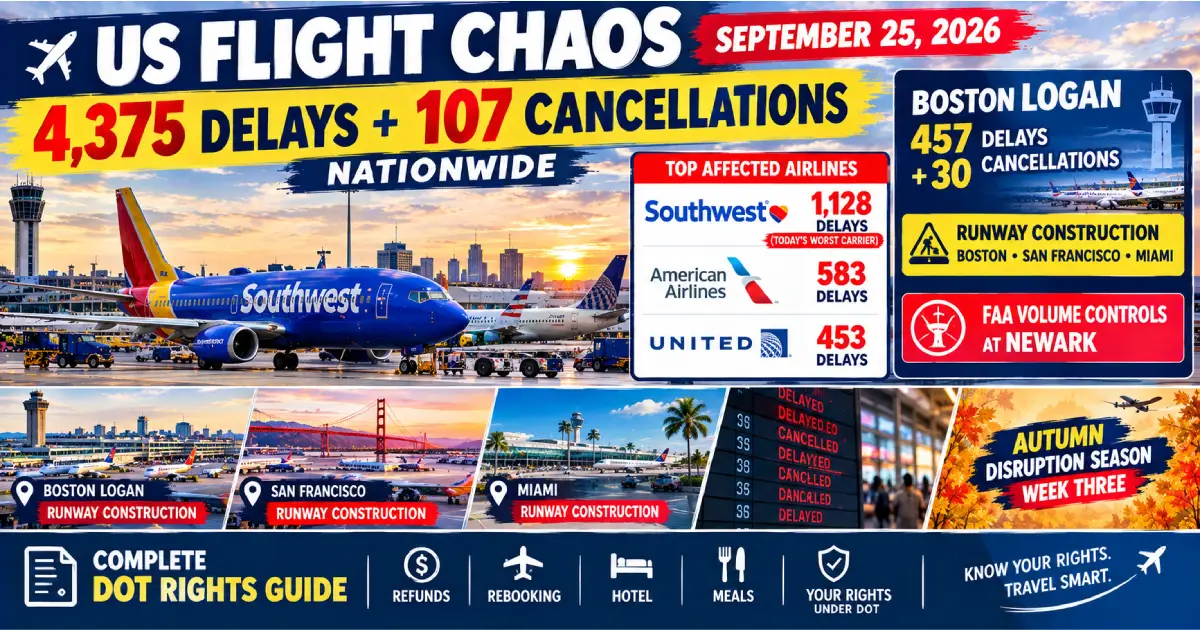
Travelers across the USA are facing flight delays and cancellations at major airports in Boston, Denver, San Francisco, Miami, Los Angeles, Newark, Atlanta, and other cities. According to the latest data, 4,375 delays and 107 cancellations have been reported for September 25, 2026.
Among the airlines facing the heaviest delays are Southwest Airlines, American Airlines, United Airlines, SkyWest Airlines, and Delta Air Lines. Alaska Airlines is recording one of the highest cancellation rates among US carriers today.
Across the specific carrier breakdown: Southwest Airlines is facing 1,128 delays and 1 cancellation. American Airlines is facing 583 delays and 5 cancellations. United Airlines is recording 453 delays and 11 cancellations. Alaska Airlines is facing 115 delays and 28 cancellations.
The FAA cites runway construction at Boston Logan, San Francisco International, and Miami International as causes of departure delays today. Airport volume is contributing to delays at Newark Liberty and Teterboro.
Published: September 25, 2026 — Total delays nationwide: 4,375 Total cancellations nationwide: 107 Total disruptions: 4,482 Worst carrier by delays: Southwest Airlines — 1,128 delays + 1 cancellation Second worst: American Airlines — 583 delays + 5 cancellations Third worst: United Airlines — 453 delays + 11 cancellations Highest cancellation rate: Alaska Airlines — 115 delays + 28 cancellations Worst airport: Boston Logan — 457 delays + 30 cancellations Primary FAA causes: Runway construction (Boston Logan, SFO, Miami) + airport volume (Newark, Teterboro) Autumn context: Week 3 of the US autumn disruption season — fourth major chaos day since September 14 DOT refund right: ✅ Active — all controllable cancellations Boston Logan context: Massport confirmed elevated delays through mid-November 2026 due to ongoing runway construction
Four weeks ago, the US aviation crisis of summer 2026 appeared to be winding down. The catastrophic peaks of June — 855 cancellations on June 15, 7,773 delays on the same day — had receded. The Day 80, Day 81, Day 88 counter that this publication tracked throughout the summer had given way to what seemed like a more manageable period.
The month of September has disabused that notion.
Since September 14, this publication has documented the following major US aviation disruption days:
| Date | Total delays | Total cancels | Worst event |
|---|---|---|---|
| September 14 | 1,122 | 43 | Boston Logan runway + gusty winds |
| September 16 | 3,979 | 175 | Boston Logan 412 + 83 cancels — worst US airport |
| September 18 | 4,218 | 275 | Chicago O’Hare 1,055 delays + 175 cancels |
| September 19 | 2,723 | 473 | O’Hare 342 cancels alone |
| September 21 | 3,592 | 182 | Chicago flooding + SFO low ceilings |
| September 21–22 | 6,000+ | 1,000+ | FAA fibre cable cut — Newark 500+ cancels |
| September 25 (today) | 4,375 | 107 | Boston Logan 457 delays + 30 cancels |
Seven significant disruption events in eleven days. The pattern reveals something important: autumn 2026 is not the recovery from summer 2026. It is a continuation of it — with different specific triggers but the same underlying structural causes: aged aviation infrastructure, insufficient spare capacity, runway construction programmes at multiple major airports simultaneously, and a carrier network that has had no genuine rest since the crisis began in April.
Southwest Airlines is facing 1,128 delays and 1 cancellation today — the worst single-carrier delay figure of September 25.
Southwest’s 1,128 delays today is not a surprise. It is a pattern. Throughout September 2026, Southwest has consistently been the highest-delay carrier on any given day of elevated national disruption:
The airline’s point-to-point network model — its defining operational characteristic and commercial advantage — is also its primary vulnerability during sustained disruption. When runway construction delays a Southwest departure at Boston Logan by 45 minutes this morning, that aircraft is scheduled to complete 4–6 additional flights today at other cities. The 45-minute delay becomes a 90-minute delay by the second stop, a 2-hour delay by the third, and so on through the day.
Southwest’s extraordinarily low cancellation count today — just 1 cancellation against 1,128 delays — reflects its well-documented operational preference for absorbing delays rather than outright cancelling. The consequence for passengers: most Southwest travellers today are not cancelled. They are delayed — some of them significantly — for the entire day.
The Southwest same-day standby option: Because Southwest’s standard policy includes no-fee same-day standby on any available earlier flight, passengers on significantly delayed Southwest services should check the Southwest app immediately for earlier departures to their destination. On a day with 1,128 delays, earlier flights may themselves be delayed — but boarding a flight already in the air 30 minutes late is still better than waiting for a flight that will depart 3+ hours late.
Southwest passengers:
Boston Logan is recording 457 delays and 30 cancellations — the highest disruption total of any single US airport today. The FAA is reporting an average departure delay of 15 minutes, with delays increasing because of runway construction. 22% of originating flights are delayed.
Boston Logan’s runway construction is not new news. This publication covered the story in detail in its Boston Logan dedicated disruption article earlier this month — Massport has confirmed elevated delays particularly in the afternoons and evenings until mid-November 2026, due to an ongoing runway construction project.
What is significant about today’s Boston figures — 457 delays and 30 cancellations — is their scale relative to the construction-driven baseline. On September 6 (Phase 1 construction beginning), Boston recorded 256 delays and 59 cancellations. On September 11, Boston recorded a similar pattern. Today’s 457 delays represent a 79% increase over the Phase 1 opening day figure, suggesting that the construction disruption is not diminishing as the project progresses but instead compounding as aircraft rotations and crew positions become increasingly disturbed by the persistent delay pattern at one of the Northeast’s most important aviation hubs.
The mid-November timeline: Massport has confirmed the elevated delays continue through mid-November 2026 — approximately seven more weeks. Passengers with Boston Logan departures or arrivals before mid-November should consistently plan for the possibility of 15–95 minute delays on any given day, with peaks in afternoon and evening schedules.
The knock-on from Boston: Boston is a JetBlue hub, a significant Delta presence, and an important United, American, and Southwest operation. Boston disruptions propagate directly into:
For passengers connecting through or to Boston today, the 22% outbound delay rate means roughly one in five flights is affected — a significant exposure on what should be an ordinary Thursday.
Boston Logan passengers today:
American Airlines is enduring 583 delays and 5 cancellations today. American’s disruption profile is spread across its hub network — Dallas-Fort Worth, Charlotte, Philadelphia, Miami, and Chicago O’Hare — reflecting the systemic nature of today’s disruption rather than a single-hub problem.
American’s 5 cancellations today are notably low relative to its delay volume, consistent with a pattern of absorbing disruption through extended delays rather than proactive cancellation.
American Airlines passengers:
United Airlines is recording 453 delays and 11 cancellations. United’s exposure today spans its primary hubs — Chicago O’Hare, Newark, San Francisco, Houston, and Washington Dulles. FAA runway construction at San Francisco and volume congestion at Newark are directly hitting two of United’s most important bases simultaneously.
United’s Boston presence is also elevated today. United is recording elevated delays because of runway construction delays in Boston, a FAA-reported cause for today’s pattern, per the underlying data.
United Airlines passengers:
Alaska Airlines is facing 115 delays and 28 cancellations — giving it the highest cancellation rate of any major US carrier today at approximately 19.6% of its disrupted flights resulting in full cancellation rather than delay.
Alaska’s elevated cancellation rate is a carrier-specific characteristic of its operational model under disruption: Alaska tends toward proactive cancellation of services it cannot confidently complete rather than issuing speculative delay notices. For passengers, this means clearer early warning of cancellations — but it also means more passengers needing rebooking rather than simply waiting.
Alaska operates primarily in the Pacific Northwest (Seattle, Portland), California, and Alaska state routes. Its 28 cancellations today reflect pressure concentrated in these markets.
Alaska Airlines passengers:
SkyWest Airlines is among the carriers contributing to today’s national disruption figure. SkyWest — which operates as Delta Connection, United Express, and American Eagle at different airports — is one of the least-visible but most commercially significant airlines in the US system.
SkyWest’s disruption today is felt through the brands it operates rather than through SkyWest branding. Passengers who see a Delta, United, or American flight delayed or cancelled at a regional US airport are frequently flying on a SkyWest aircraft operated under that brand. Rebooking for SkyWest-operated services always goes through the marketing carrier — Delta, United, or American — not SkyWest directly.
Denver International Airport is among today’s disrupted airports. Denver’s disruption today is primarily weather-driven — the same pattern of afternoon thunderstorms that generated 650+ delays at Denver on September 21 (covered in this publication’s September 21 chaos article) appears to be recurring today as a late-season convective pattern.
Denver is a major Southwest and United hub. Southwest’s highest delay volume is partly attributable to its Denver operations today.
The FAA is reporting a ground delay at San Francisco associated with low ceilings, with an average delay of 52 minutes.
SFO’s low-ceiling problem is the Bay Area’s characteristic autumn pattern — marine layer and coastal fog that reduces instrument approach minimums and forces controllers to increase spacing between arriving aircraft. The 52-minute average ground delay at SFO means that every aircraft arriving at San Francisco today is doing so approximately an hour later than scheduled — and every aircraft that needs to depart SFO after that arrival is starting its next sector an hour late.
Airport volume is contributing to delays at Newark and Teterboro.
Newark is still recovering from the extraordinary disruption of September 21–22 — the FAA fibre cable cut that stranded 500+ flights and displaced United Airlines’ entire Newark operation. The volume-related delays at Newark today reflect the continuing knock-on from that event as the airline schedules have not yet fully normalised.
The FAA is reporting runway construction at Miami as a contributing cause today. Miami joins Boston and San Francisco as airports where runway construction programmes are simultaneously compressing available capacity — a nationwide infrastructure maintenance backlog that has been deferred for years and is now being addressed across multiple airports at once.
Both Atlanta Hartsfield-Jackson and Los Angeles International are recording elevated delays as the national network strain propagates through Delta’s home hub and the busiest arrival airport in the western US.
Today’s disruption is the fourth major US chaos event of September’s final two weeks, following the September 21 Chicago flooding disaster, the September 21–22 FAA fibre cut catastrophe, and September 19’s O’Hare 342-cancellation day.
The structural causes driving autumn 2026’s persistent disruption are distinct from summer 2026’s:
Summer 2026: Extreme demand, insufficient staffing, weather cascades, carry-forward from each prior crisis day.
Autumn 2026: Runway construction at multiple airports simultaneously (Boston Logan, SFO, Miami confirmed today — plus Newark construction that severed the FAA fibre cable on September 21), reduced network spare capacity as airlines trim schedules, and the same aging infrastructure vulnerabilities exposed by September’s NATS (UK) and FAA (US) failures.
Massport’s confirmation that Boston Logan’s construction disruption continues through mid-November is the clearest signal: the autumn 2026 disruption pattern has a known, scheduled endpoint — but it is seven weeks away. Every traveller planning US air travel through November should incorporate Boston Logan’s elevated delay risk into their planning, particularly for afternoon and evening departures.
Today’s primary FAA-cited cause — runway construction — creates a nuanced rights question. Unlike weather (which is clearly extraordinary) or software failures (which are clearly extraordinary), runway construction is a scheduled, known, airline-manageable operational factor.
Massport scheduled this construction. Airlines were given advance notice. Airlines chose to continue operating at Boston Logan despite knowing disruptions would occur through mid-November. This schedule visibility means the “extraordinary circumstances” defence is less clearly applicable to construction-driven delays than to weather or ATC failures.
Passengers whose specific delays today are directly caused by FAA construction ground delays at Boston, SFO, or Miami may have stronger grounds to claim that the disruption is controllable — and therefore that cash compensation (if 3+ hour delay) may be applicable.
Ask your airline in writing: “Is my specific delay today classified as extraordinary circumstances or as an operational delay?”
Right 1 — Full cash refund for any cancelled flight: All 107 of today’s cancellations. To original payment method. Non-refundable tickets fully refundable when airline cancels.
Right 2 — Penalty-free rebooking: Next available service. No fare difference. Southwest: already fee-free as standard policy.
Right 3 — Duty of care for controllable delays: Meals (3+ hour domestic delay, controllable cause) and hotel (overnight, controllable cause). Construction-driven delays may be controllable — ask your airline.
Right 4 — Refund for 3+ hour controllable delays if you choose not to travel: Under the DOT’s 2024 final rule, significant delays caused by controllable factors entitle you to a full refund if you choose not to travel.
File DOT complaint: airconsumer.dot.gov
| Airline | Today | Phone | Online |
|---|---|---|---|
| Southwest Airlines | 1,128 delays · 1 cancel | 1-800-435-9792 | southwest.com → Manage |
| American Airlines | 583 delays · 5 cancels | 1-800-433-7300 | aa.com → My Trips |
| United Airlines | 453 delays · 11 cancels | 1-800-864-8331 | united.com → My Trips |
| Alaska Airlines | 115 delays · 28 cancels | 1-800-252-7522 | alaskaair.com → My Trips |
| Delta Air Lines | Elevated delays | 1-800-221-1212 | delta.com → My Trips |
| SkyWest | Via Delta/United/AA | — | Via marketing carrier |
| US DOT complaints | — | 1-202-366-2220 | airconsumer.dot.gov |
| FAA live status | — | — | fly.faa.gov |
| Boston Logan | — | (617) 561-1800 | massport.com/logan |
| Denver International | — | (303) 342-2000 | flydenver.com |
| San Francisco | — | (650) 821-8211 | flysfo.com |
| Newark Liberty | — | (973) 961-6000 | newarkairport.com |
| Miami International | — | (305) 876-7000 | miami-airport.com |
| Metric | Figure |
|---|---|
| Total delays | 4,375 |
| Total cancellations | 107 |
| Worst carrier (delays) | Southwest Airlines — 1,128 delays + 1 cancellation |
| Second worst | American Airlines — 583 delays + 5 cancellations |
| Third worst | United Airlines — 453 delays + 11 cancellations |
| Highest cancellation rate | Alaska Airlines — 28 cancellations (19.6% of disrupted flights) |
| Worst airport | Boston Logan — 457 delays + 30 cancellations |
| FAA construction airports | Boston Logan · San Francisco · Miami |
| FAA volume airports | Newark · Teterboro |
| Boston construction timeline | Elevated delays through mid-November 2026 |
| September context | 4th major disruption day since Sept 14 — autumn season confirmed |
| DOT refund right | ✅ Active — all controllable cancellations |
| Construction delays rights | Potentially controllable — stronger compensation grounds |
Related Articles:
Posted By : Vinay
This article is provided for general informational purposes only and is based on information available at the time of publication. Travel advisories, airline schedules, airport operations, visa requirements, government regulations, and other travel-related information are subject to change without prior notice. While Travel Tourister makes reasonable efforts to verify information using official announcements, government publications, airline and airport communications, and other reliable sources, we cannot guarantee that all information remains complete, accurate, or up to date at all times. Readers should independently verify any information that may affect their travel plans with the relevant airline, airport authority, government agency, embassy, or other official source before making travel, financial, or other decisions. Travel Tourister shall not be liable for any direct or indirect loss, inconvenience, or damages arising from the use of or reliance on the information contained in this article. Nothing in this publication constitutes legal, immigration, financial, or professional travel advice. If you believe any information in this article is inaccurate or outdated, please contact our editorial team. We review all credible correction requests promptly and update our content whenever appropriate.
Lastest News
2nd Floor, 39, Above Kirti Club, DLF Industrial Area, Kirti Nagar, New Delhi, Delhi 110015



Travel Tourister is a leading Travel portal where we introduce travellers to trusted travel agents to make their journey hasselfree, memorable And happy. Travel Tourister is a platform where travellers get Tour packages ,Hotel packages deals through trusted travel companies And hoteliers who are working with us across the world. We always try to find new and more travel agents and hoteliers from every nook and corners across the world so that you could compare the deals with different travel agents and hoteliers and book your tour or hotel with the one you have chosen according to your taste and budget.
Copyright © Travel Tourister, India. All Rights Reserved

 Call
Call Enquiry