Published on : 21 Sep 2026
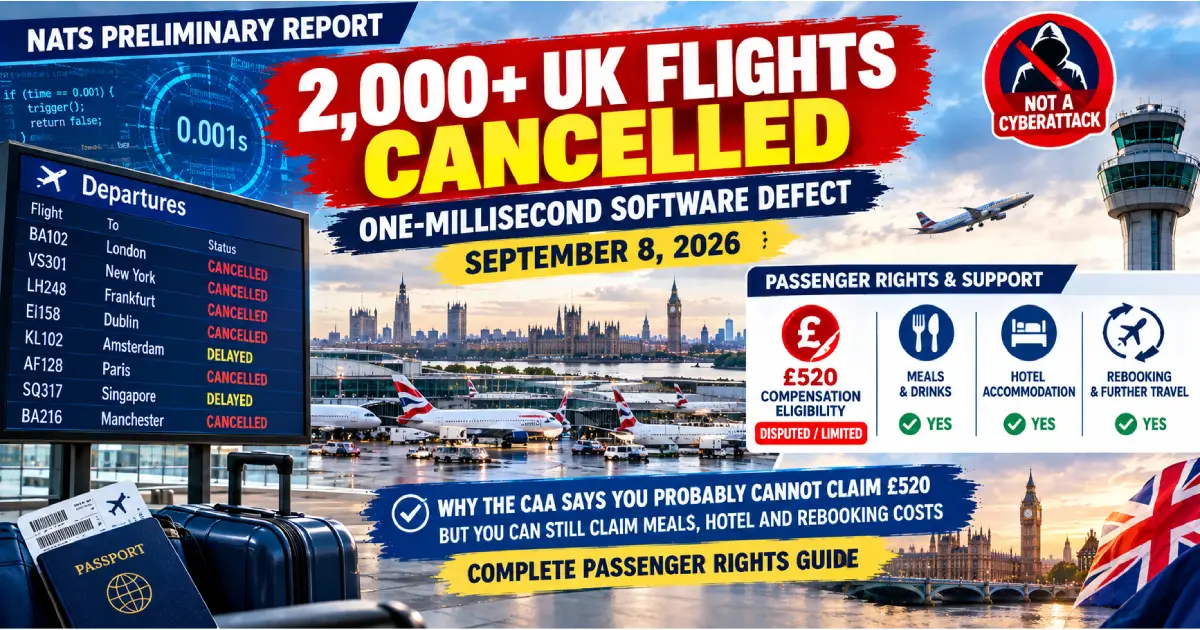
Your flight was cancelled. The airline pointed to extraordinary circumstances. Now you’re learning that the disruption that cost you days, hotel bills, and ruined plans was triggered by a fault that lasted roughly a millisecond. This is what happened, what it means for your legal rights, and exactly what you can — and cannot — claim.
On 8 September 2026, a defect in the National Airspace System (NAS) software — the flight data system that manages British airspace — forced NATS to restrict air traffic for about six hours, leaving more than 2,000 flights delayed, cancelled or diverted. According to the preliminary report that NATS made public on Friday 18 September, the cause is a programming error that triggers only within a window of roughly one millisecond.
The scale of the disruption was enormous. Cirium data confirms 2,145 flights were disrupted over two days. British Airways cancelled 550 flights, affecting 85,000 passengers. More than 1,750 flights were canceled on September 8 alone. A further 291 were scrapped on September 9, as airlines scrambled to reposition aircraft and crews that had been left out of place overnight.
The UK Civil Aviation Authority has now confirmed its position on compensation: the CAA considers that disruption caused by the NATS outage is likely to be considered the result of extraordinary circumstances under passenger rights rules. This means that although passengers should be looked after by airlines, they are unlikely to be entitled to compensation for delays or cancellations that were directly caused by the incident.
This is the definitive guide to what happened, why it happened, and precisely what your rights are — including what the CAA ruling means for your specific situation.
Published: September 21, 2026 Incident date: Tuesday, September 8, 2026 NATS preliminary report published: Friday, September 18, 2026 Cause: One-millisecond software defect in the NAS — squawk code allocation module NOT: Operator error · Cyberattack · Human mistake · Related to August 2023 failure Total disrupted flights: 2,145 (Cirium data) over September 8–9 September 8 alone: 1,750+ cancellations British Airways: 550 flights cancelled · 85,000 passengers affected easyJet: 31 disruptions from 614 scheduled departures (highest volume individual impacts) Ryanair: ~150,000 passengers affected (prior reporting) Duration of airspace restrictions: Approximately 6 hours Airports affected: Heathrow · Gatwick · Stansted · Manchester · Edinburgh · 10+ more CAA ruling: Extraordinary circumstances — fixed compensation unlikely Cash compensation (£220–£520): Unlikely to apply Duty of care (meals, hotel, rebooking): ✅ STILL legally required NATS CEO status: Martin Rolfe under pressure — Ryanair and Wizz Air demand resignation CAA independent review: Ordered by UK government — ongoing Permanent software fix: Under safety testing — not yet deployed
The preliminary report’s technical explanation is essential to understanding why a fault measured in millionths of a second grounded 2,145 flights across two days. A previously unknown software defect with an exposure window of about one millisecond corrupted flight data at the UK’s main air traffic control provider on September 8, triggering restrictions that left more than 2,000 flights delayed, canceled or diverted.
The defect sat in the National Airspace System (NAS) — specifically in the module that allocates squawk codes. These are the discrete identification numbers broadcast by each aircraft’s onboard transponder that allow controllers on radar to match a blip on their screen to a specific flight’s data. Without a correctly allocated squawk code, a controller cannot identify which aircraft they are looking at — a fundamental safety problem.
The sequence of failure, step by step:
Step 1: An air traffic controller made a manual request to allocate a squawk code to an aircraft. Normally this happens automatically, but manual requests are a standard and routine function of the system.
Step 2: While the NAS was processing this manual squawk request, a higher-priority message arrived. The system paused the squawk allocation to handle the higher-priority task — this is also a normal function.
Step 3: When the system attempted to resume the paused squawk allocation, the software defect triggered. Instead of resuming correctly, the output became corrupted. This corrupted output then affected subsequent flight data updates across the system.
Step 4: The NAS at London Area Control Centre, detecting the data corruption, disconnected itself from the corrupted data feed. This is the safety protection working as designed — but it left controllers without reliable automation support for managing the traffic picture.
Step 5: With controllers unable to rely on parts of the live flight data picture, NATS imposed nationwide traffic flow restrictions to keep operations within safety limits while the system was restarted and flight data reloaded.
Step 6: The airspace restrictions lasted approximately six hours. But the operational consequences — aircraft in the wrong positions, crews who had exceeded their legal duty hours, maintenance schedules disrupted, tens of thousands of passengers stranded or delayed — continued for two full days.
NATS chief executive Martin Rolfe said: “This was a software issue in a specific part of our flight data system, that we have traced to a small subsection of coding. The issue has been identified and mitigation is in place while a permanent fix is safety tested and deployed.”
This is the question that has dominated UK aviation discussion since the preliminary report was published. The answer lies in aviation’s fundamental dependency on real-time data accuracy.
The NAS is not simply one system among many — it is the central nervous system of UK air traffic management. It maintains all active flight plans, processes every controller input and amendment, links each plan to its radar track, and allocates the squawk codes that give every aircraft its identity on radar screens across the country.
When the NAS produces corrupted data output — even for a fraction of a millisecond — controllers cannot trust the information they are seeing. And when controllers cannot trust their information, they cannot safely manage traffic at normal density. The only safe response is to reduce the number of aircraft in the system — which means stopping flights from departing.
A millisecond is 1/1000th of a second. A human blink takes approximately 100–400 milliseconds. The defect that grounded 2,145 UK flights occurred in a window shorter than it takes a raindrop to fall 1 centimetre. Yet because that defect touched the data systems that underpin the work of every air traffic controller in UK airspace simultaneously, its consequences were felt across the entire national aviation network within minutes.
This is not a new vulnerability. NATS has experienced three significant software-related failures since the system opened in 2002. The August 2023 failure — caused by a different component, the FPRSA-R flight plan reception system — disrupted some 700,000 passengers and cost airlines an estimated £75–100 million. NATS says the September 2026 incident is unrelated to the August 2023 failure of FPRSA-R. It is a separate defect in a separate module — but the third significant failure in three years from the same provider.
British Airways was forced to cancel nearly 550 flights, an action that impacted more than 85,000 passengers.
BA confirmed its response in a statement during the disruption: “Like other airlines operating in the UK, we are continuing to experience the knock-on effects of yesterday’s NATS Air Traffic Control issue, which includes unavoidable delays and cancellations. Customers travelling today on short-haul services can move their flight to a later date free of charge if they wish, subject to availability.”
BA’s 550 cancellations were spread across September 8 and the knock-on day of September 9, as aircraft and crew positioning problems compounded through the day and overnight.
EasyJet faced the highest volume of individual flight impacts, reporting 31 disruptions out of 614 scheduled departures.
Ryanair, which had approximately 150,000 passengers affected by the September 8 disruption, responded most aggressively of any airline. Ryanair COO Neal McMahon called for NATS CEO Martin Rolfe to be removed and questioned the credibility of NATS assessing its own latest system failure.
Ryanair’s statement was pointed: “It is clear that no lessons have been learnt since the Aug ’23 NATS system outage and passengers continue to suffer as a result of Martin Rolfe’s incompetence.”
Wizz Air joined Ryanair in demanding leadership changes at NATS, citing the September 8 failure as evidence of systemic management failure rather than an isolated technical incident.
Virgin Atlantic emerged from the disruptions relatively unscathed, seeing the cancellation of only two flights, VS231 and VS232, between Heathrow and Austin-Bergstrom International Airport.
The disruption was confirmed at Heathrow, Gatwick, Edinburgh, Manchester, and at least 10 additional UK airports. The technical issue led to delays and the cancellation of hundreds of UK arriving and departing flights on 8 September. The knock-on effect of so many delays and cancellations, and the operational challenges these have caused, means that flights continued to be disrupted into September 9 as the recovery worked through the system.
The CAA considers that delays and cancellations on 8 September that were caused by the NATS technical issue are likely to be “extraordinary circumstances”. The CAA considers that delays and cancellations directly caused by the knock-on effects of the issue are also likely to be “extraordinary circumstances”. As a result, passengers are unlikely to be entitled to compensation for cancellations and delays.
The CAA’s ruling reflects the legal definition of extraordinary circumstances under UK261 — the retained UK version of the EU’s air passenger rights regulation. Extraordinary circumstances exist when the cause of a cancellation or delay is beyond the airline’s control and could not have been avoided even if all reasonable measures had been taken.
An air traffic control system failure — caused by a software defect in the national airspace management infrastructure — is precisely what UK261’s extraordinary circumstances provision was designed for. The airlines cannot control NATS. They cannot fix a software defect in the NAS. They cannot override airspace restrictions imposed for safety reasons.
The practical consequence for affected passengers is clear: cash compensation of £220, £350, or £520 (depending on flight distance) is almost certainly not payable for cancellations and delays caused by the September 8 NATS failure.
The extraordinary circumstances ruling eliminates cash compensation. It does not eliminate duty of care. Airlines must offer passengers whose flights have been cancelled a choice between a refund, re-routing at the earliest opportunity or re-routing at a later date. Where passengers are delayed, airlines must provide appropriate meals and refreshments and, where necessary, hotel accommodation.
These duty of care obligations are separate from and independent of the compensation regime. They apply regardless of whether the cause is extraordinary circumstances. They are not optional. They are not subject to airline discretion. They are legally required.
Your duty of care rights in full:
Right 1 — Choice between refund or rebooking: If your flight was cancelled, your airline must offer you a choice between a full refund to your original payment method OR rebooking on the next available service to your destination. You choose — not the airline. If you accepted a rebooking and then waited days to get home, that delay itself may give rise to additional claims (see below).
Right 2 — Meal vouchers during your wait: For delays of 2+ hours (short-haul) or 3+ hours (long-haul), your airline must provide meal vouchers or meals proportional to the wait. If they did not provide this, you can claim reimbursement for reasonable meal costs you incurred yourself.
Right 3 — Hotel accommodation for overnight delays: If the cancellation or delay required you to stay overnight away from home, your airline must provide hotel accommodation and transport to and from the hotel. If they did not arrange this, you can claim reimbursement for reasonable hotel costs.
Right 4 — Communications: Two telephone calls, emails, or faxes while you waited.
Step 1 — Gather your documentation: You need: your booking confirmation, the cancellation notification (screenshot the app or email), all receipts for meals, hotel, transport, and any other expenses directly caused by the disruption.
Step 2 — File your duty of care claim with your airline: Contact your airline’s customer relations department — not the general customer service line. Specifically request reimbursement of duty of care expenses under UK261. Name the specific costs: meals, hotel, transport.
| Airline | Duty of care claim |
|---|---|
| British Airways | ba.com → Customer Support → Compensation and expenses |
| easyJet | easyjet.com → Help → Make a complaint |
| Ryanair | ryanair.com → Help → Contact Us → Customer Relations |
| Wizz Air | wizzair.com → Help Centre → Contact Us |
| Virgin Atlantic | virginatlantic.com → Help → Feedback and complaints |
Step 3 — If your airline rejects your duty of care claim: Escalate to the CAA’s Passenger Advice and Complaints Team (PACT): caa.co.uk/passengers. Alternatively, use the ADR scheme your airline participates in — CEDR (cedr.com) or Aviation ADR (aviation-adr.co.uk).
Step 4 — For passengers rebooked onto much later flights: If your airline’s rebooking placed you on a service more than 5 hours later than your original scheduled departure, you have the additional right to cancel the journey entirely and receive a full refund — plus a return flight to your departure point if you had already begun your outward journey.
The CAA considers that delays and cancellations directly caused by the knock-on effects of the issue are also likely to be “extraordinary circumstances”.
This is the ruling’s most controversial element. Ryanair and other airlines have argued that once the NATS system was restored on September 8, subsequent disruptions on September 9 were caused by airline operational factors — wrong-position aircraft, crew in rest, maintenance backlogs — rather than the NATS failure itself. Under this argument, September 9 disruptions might be classified as airline-operational rather than extraordinary circumstances.
The CAA’s position is that the knock-on effects remain extraordinary circumstances. However, this is precisely the kind of case-by-case assessment that individual passengers and airlines may dispute. If your specific September 9 cancellation or delay was caused by a factor your airline could have mitigated — spare aircraft, alternative crew, proactive recovery measures — you may have grounds to challenge the extraordinary circumstances classification for your specific flight.
The practical advice: if you were disrupted on September 9 rather than September 8, file your compensation claim anyway. Airlines may contest it citing CAA guidance, but the CAA itself acknowledges this is a likely rather than certain classification, and an independent review is ongoing.
The 8 September technical issue affected NATS’ flight processing system and contributed to roughly 2,000 disrupted flights across two days as airlines dealt with knock-on operational problems. Ryanair COO Neal McMahon has called for NATS CEO Martin Rolfe to be removed and questioned the credibility of NATS assessing its own latest system failure. The UK government has given NATS one week to report on the failure, while the Civil Aviation Authority will conduct a separate independent review of the incident and system resilience.
The political heat on NATS reflects the fact that this is the provider’s third significant failure in three years — and the second to result in 2,000+ disrupted flights. The 2023 failure cost airlines £75–100 million. The 2026 failure’s full cost has not yet been confirmed, but with 2,145 disrupted flights and 85,000+ BA passengers alone affected, the industry-wide cost will be significant.
The government’s independent review — ordered separately from NATS’s own preliminary report — will examine not only what happened but whether NATS’s resilience planning and investment priorities are adequate. Its findings are expected to have consequences for how NATS is regulated and funded going forward.
The permanent software fix has been developed and is currently undergoing safety testing before deployment. NATS said a mitigation measure is already in place while that process completes.
Many affected passengers have asked whether September 2026 is the same failure as August 2023. The report says the incident is unrelated to the August 2023 failure of FPRSA-R, the flight plan reception system at the centre of that outage.
The 2023 failure affected a different component — the Flight Plan Reception Subsystem A-Route (FPRSA-R) — and was caused by a flight plan with an unusual or invalid data element that the system could not process. The 2026 failure affected the squawk code allocation module of the NAS and was caused by a rare timing-sensitive software defect triggered when a routine process was interrupted by a higher-priority message.
They are different faults in different modules with different root causes. But they share a common context: a national aviation infrastructure system that has now experienced significant software failures in 2023 and 2026, plus a radar-related fault at Heathrow in July 2025. The pattern — rather than any single incident — is what Ryanair, Wizz Air, and now the UK government have identified as the core problem.
Use this guide to determine your specific situation:
Was your flight cancelled on September 8 due to NATS? → Cash compensation (£220–£520): Unlikely — extraordinary circumstances → Refund or rebooking: Yes — mandatory → Meals and hotel: Yes — mandatory if applicable → File a duty of care claim: Yes, file now
Was your flight delayed 3+ hours on September 8 due to NATS? → Cash compensation: Unlikely — extraordinary circumstances → Meals during wait: Yes — mandatory → Hotel if overnight: Yes — mandatory if applicable
Was your flight cancelled on September 9 (knock-on effects)? → Cash compensation: Disputed — CAA says likely extraordinary circumstances, but challenge if you believe your airline could have mitigated → Duty of care: Yes — mandatory → File your compensation claim anyway: Yes
Did your airline fail to provide meals or hotel despite the delay? → Claim reimbursement for reasonable costs: Yes — this is a legal right that still applies under extraordinary circumstances
Did you incur additional costs (car hire, new hotel booking, missed event) beyond travel? → These are harder to recover and not covered by UK261 — consider your travel insurance’s trip interruption benefit
| Airline | Affected passengers | Claim portal | ADR scheme |
|---|---|---|---|
| British Airways | 85,000+ | ba.com → Customer Support | CEDR (cedr.com) |
| easyJet | Highest disruption count | easyjet.com → Help | Aviation ADR |
| Ryanair | ~150,000 | ryanair.com → Customer Relations | CEDR (cedr.com) |
| Wizz Air | Significant | wizzair.com → Help Centre | Aviation ADR |
| Virgin Atlantic | Minimal (2 flights) | virginatlantic.com → Complaints | CEDR (cedr.com) |
| CAA PACT | All passengers | caa.co.uk/passengers | — |
| CEDR | All | cedr.com | — |
| Aviation ADR | All | aviation-adr.co.uk | — |
| Metric | Figure |
|---|---|
| Cause | One-millisecond software defect — squawk code allocation module, NAS |
| NOT | Operator error · Cyberattack · Related to August 2023 failure |
| Total disrupted flights | 2,145 (Cirium) over September 8–9 |
| September 8 alone | 1,750+ cancellations |
| British Airways | 550 cancellations · 85,000 passengers |
| easyJet | 31 disruptions from 614 departures (highest individual volume) |
| Ryanair | ~150,000 passengers affected |
| Airspace restriction duration | Approximately 6 hours |
| Preliminary report published | September 18, 2026 |
| CAA ruling | Extraordinary circumstances — fixed compensation unlikely |
| Cash compensation (£220–£520) | Unlikely to apply |
| Duty of care (meals, hotel) | ✅ Still legally required regardless of CAA ruling |
| Permanent fix status | Under safety testing — not yet deployed |
| Independent review | Ordered by UK government — CAA conducting |
| NATS CEO | Under pressure — Ryanair + Wizz Air demand resignation |
| Third party for claims | CEDR · Aviation ADR · CAA PACT |
Related Articles:
Posted By : Vinay
This article is provided for general informational purposes only and is based on information available at the time of publication. Travel advisories, airline schedules, airport operations, visa requirements, government regulations, and other travel-related information are subject to change without prior notice. While Travel Tourister makes reasonable efforts to verify information using official announcements, government publications, airline and airport communications, and other reliable sources, we cannot guarantee that all information remains complete, accurate, or up to date at all times. Readers should independently verify any information that may affect their travel plans with the relevant airline, airport authority, government agency, embassy, or other official source before making travel, financial, or other decisions. Travel Tourister shall not be liable for any direct or indirect loss, inconvenience, or damages arising from the use of or reliance on the information contained in this article. Nothing in this publication constitutes legal, immigration, financial, or professional travel advice. If you believe any information in this article is inaccurate or outdated, please contact our editorial team. We review all credible correction requests promptly and update our content whenever appropriate.
Lastest News
2nd Floor, 39, Above Kirti Club, DLF Industrial Area, Kirti Nagar, New Delhi, Delhi 110015



Travel Tourister is a leading Travel portal where we introduce travellers to trusted travel agents to make their journey hasselfree, memorable And happy. Travel Tourister is a platform where travellers get Tour packages ,Hotel packages deals through trusted travel companies And hoteliers who are working with us across the world. We always try to find new and more travel agents and hoteliers from every nook and corners across the world so that you could compare the deals with different travel agents and hoteliers and book your tour or hotel with the one you have chosen according to your taste and budget.
Copyright © Travel Tourister, India. All Rights Reserved

 Call
Call Enquiry