Published on : 08 Sep 2026
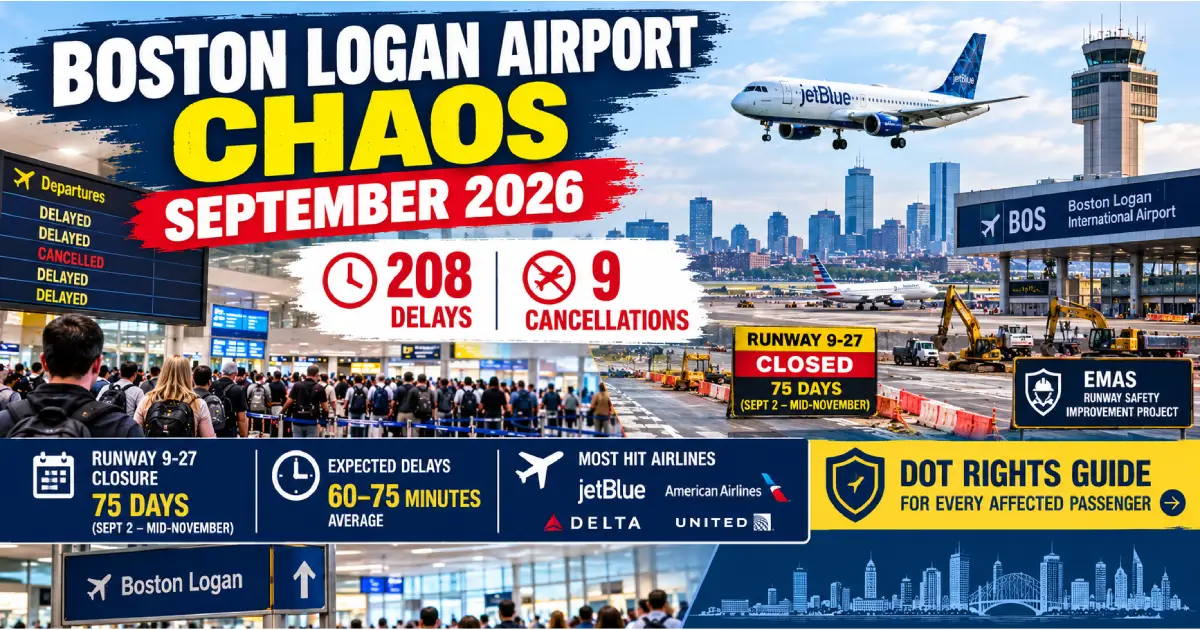
Boston Logan International Airport has become the most consistently disrupted major hub in the United States during the first week of September 2026 — and the disruption has a specific, confirmed cause that is not going away before mid-November. Construction on runway 9-27 is continuing to affect flights. The work is the first of two planned 75-day closures that will allow Massport to install a new safety system intended to stop planes that overshoot the runway. Runways will undergo rework for 75 days, beginning September 2, to improve runways with EMAS — Engineered Materials Arresting System. Flights will have average delays of 60 to 75 minutes, or more depending on weather. The EMAS system is a bed of crushable soft concrete installed beyond the runway end — if an aircraft overshoots the runway, the material collapses under the weight of the aircraft and brings it to a controlled stop before it reaches airport boundaries, vehicles, or infrastructure. The system is installed at more than 120 US airports. After Sunday’s fatal Amazon cargo plane crash at Miami International — which notably lacks EMAS on its runway — Logan’s EMAS installation could not be more timely or significant. But while EMAS is being installed, the primary runway at one of America’s busiest Northeast airports is out of service — and every passenger flying through Boston is feeling the consequences.
Boston Logan is experiencing the largest number of delays in the USA, with 256 delays and 59 cancellations on September 6. On September 4, active runway construction combined with regional air traffic control constraints led to 434 delays and 6 cancellations, with the FAA reporting average gate holding delays of 43 minutes. On September 7, Boston Logan International Airport recorded 208 delays and 9 cancellations, with FAA ground delays averaging 44 minutes driven by active runway construction. Departing flights logged 17% delays, while inbound flights experienced 10% delays. Massport has stated: “We do expect delays, particularly in the afternoons and evenings until mid-November, due to an ongoing runway construction project. As always, we would advise passengers to check with their airline for the best info on their flight.” That is an official airport authority statement confirming elevated delays at Boston Logan through mid-November 2026. If you are flying through Boston between now and November, this article is for you.
Published: September 8, 2026 — Tuesday Airport: Boston Logan International Airport (BOS) — Boston, Massachusetts Construction Project: EMAS (Engineered Materials Arresting System) installation on runway 9-27 Construction Started: September 2, 2026 Expected Duration: 75 days — through mid-November 2026 Expected Delays: Average delays of 60–75 minutes — or more depending on weather Official Massport Statement: “We do expect delays, particularly in the afternoons and evenings until mid-November” Runway Closed: Runway 9-27 — one of Logan’s primary runways — closed for duration of construction September 4 (Thursday): 434 delays + 6 cancellations — FAA gate holding delays averaging 43 minutes September 6 (Saturday): 256 delays + 59 cancellations — worst airport in US that day | Departing: 4% cancellations + 11% delays | Arriving: 4% cancellations + 30% delays September 7 (Monday): 208 delays + 9 cancellations — FAA ground delays averaging 44 minutes — 17% departing delays | 10% inbound delays Worst Carriers: JetBlue (Boston base carrier), American Airlines 241 delays Sept 6, United 167 delays, Delta elevated Context: Second 75-day closure planned for sometime after July 1, 2027 — so this is Phase 1 of a two-phase project JetBlue Boston-London Status: JetBlue Boston–London Heathrow launch delayed to September 20 — Airbus delivery delays for long-range A321 aircraft Peak Risk Window: Afternoons and evenings — worst delay accumulation at BOS DOT Rights: Weather/construction = extraordinary circumstances → no cash compensation | Cancelled = full cash refund mandatory
The construction is to improve runways with EMAS — Engineered Materials Arresting System. This is a soft concrete material installed beyond the end of a runway. If an airplane gets into that area, it becomes like mud and stops the airplane from continuing moving forward, preventing the airplane from leaving the airport premises.
The installation of EMAS at Boston Logan is a federal safety mandate, not an optional upgrade. After multiple high-profile runway overrun incidents at US airports — and particularly in the wake of Sunday’s fatal Amazon cargo crash at Miami International, which notably does not have EMAS on runway 30 — the FAA’s push to install EMAS at every major US commercial airport has intensified. Logan’s runway 9-27 is undergoing its EMAS installation now precisely because Massport and the FAA determined it could not wait longer.
The work is the first of two planned 75-day closures that will allow Massport to install a new safety system intended to stop planes that overshoot the runway. The second closure is planned for sometime after July 1, 2026. This means Boston Logan passengers face not one but two runway construction periods in 2026. Phase 1 is happening right now — September 2 through mid-November. Phase 2 will follow after July 2027.
Boston Logan International Airport has three runways in normal operations — 4R/22L, 9/27, and 15R/33L — plus a shorter crosswind runway. Runway 9-27 is one of Logan’s primary instrument approach runways. When it is closed, the airport operates with reduced runway capacity. This reduction has two compounding effects:
Effect 1 — Reduced hourly movements: With one primary runway closed, Logan can handle fewer aircraft arrivals and departures per hour. Under FAA traffic management, this translates directly into ground hold programs — aircraft at origin airports are held on the ground rather than flying to Boston only to sit in a holding stack burning fuel.
Effect 2 — Afternoon and evening peak compression: Terminal B moves the largest number of travelers per day, and this will definitely impact other terminals and traffic around the airport. The afternoon and evening banks — the busiest period of the aviation day — are where the reduced capacity creates the longest queues. By 2:00 PM each day, the accumulated delays from the morning’s construction-constrained operations have multiplied into cascading late afternoon departures.
One user who identified themselves as a former Logan employee posted: “Runways will undergo rework for 75 days, beginning September 2. This is to improve runways with EMAS. Flights will have average delays of 60–75 minutes. Or more depending on weather. Plan accordingly.”
| Date | Delays | Cancellations | FAA Program | Construction Status |
|---|---|---|---|---|
| September 4 (Thursday) | 434 | 6 | Avg gate hold 43 min | Runway 9-27 Day 2 closed |
| September 5 (Friday) | Elevated | Multiple | Active | Runway 9-27 Day 3 closed |
| September 6 (Saturday) | 256 | 59 | Avg delays — arriving 30% | Runway 9-27 Day 4 closed |
| September 7 (Monday) | 208 | 9 | Avg FAA hold 44 min | Runway 9-27 Day 5 closed |
| September 8 (TODAY) | Elevated | Ongoing | Active — afternoon peak | Runway 9-27 Day 6 closed |
| Through mid-November | Elevated daily | Ongoing | Daily FAA programs likely | 75-day closure continues |
For flights departing Boston, cancellations account for 4% and delays 11%, while for arriving flights, cancellations account for 4% and delays 30% on the worst days. That 30% arrival delay rate on September 6 — nearly one in three arriving flights — is the clearest single-day indication of how severely the construction is compressing incoming traffic.
JetBlue is Boston’s primary carrier, operating the largest daily schedule from Logan of any single airline. JetBlue’s point-to-point model — without the hub-and-spoke buffering that United or American use — makes it structurally the most vulnerable carrier to sustained runway construction delays at its core airport.
JetBlue is facing 133 delays and 25 cancellations on September 6 — a single-carrier total that represents more than half of that day’s entire Boston disruption count.
The JetBlue exposure at Logan is amplified by two separate operational factors today:
Factor 1 — Runway construction: JetBlue operates dense short-haul domestic schedules from Boston — New York, Washington, Fort Lauderdale, Orlando, Miami, Las Vegas, Los Angeles — all of which depend on tight turnaround times at Logan. When construction reduces turnaround efficiency, every rotation runs slightly late, and late rotations compound across the day into significant evening delays.
Factor 2 — Delayed transatlantic launch: JetBlue has delayed the launch of its transatlantic service between Logan Airport and London. Flights from Boston to London Gatwick were supposed to start July 19, revised to August 4. The first flight to London Heathrow from Logan was expected August 22 but will now be September 20. JetBlue is blaming “unexpected production delays” from Airbus — two aircraft scheduled for delivery this summer are on order specifically to operate transatlantic routes from Boston. The Boston–London Heathrow launch delay means JetBlue is entering its first transatlantic expansion from BOS during the most congested construction period the airport has faced in years.
JetBlue Logan passengers: ✅ jetblue.com → Manage Flights | 1-800-538-2583
American Airlines travelers may need to allow extra time, with 241 delays affecting its schedule on September 6 nationally — with a significant concentration at Boston where American operates a major East Coast hub.
American’s Boston-Logan connections — particularly its connections to Philadelphia, Charlotte, Washington, Chicago, and Dallas — are among the routes most exposed to the afternoon delay cascade. Passengers connecting at Logan from short-haul American Eagle feeders onto American mainline departures face the highest missed connection risk during the construction period.
American Airlines passengers at Logan: ✅ aa.com/flightstatus | 1-800-433-7300 | American app
United is facing 167 delays and nine cancellations nationally on September 6, with Boston Logan being a primary affected hub. United’s Boston operations connect to its Newark and Houston hubs — both of which have their own separate delay pressures this week — creating a compounding effect for passengers trying to connect beyond Boston into the United network.
United Airlines passengers at Logan: ✅ united.com/flight-status | 1-800-864-8331 | United app
Delta operates a significant domestic presence at Boston, primarily competing with JetBlue on Florida, Southeast, and Midwest routes. Delta’s Boston disruption during the construction period is significant but somewhat buffered by its ability to reroute passengers through its Atlanta hub.
Delta passengers at Logan: ✅ delta.com | 1-800-221-1212 | Fly Delta app
When Boston Logan runs a 40–44 minute average ground delay for an entire day, the cascade radiates outward through the national aviation network:
| Origin City | Route to Logan | Carrier | Status Today |
|---|---|---|---|
| New York JFK/LGA | BOS short-hop | JetBlue, Delta, American | Hold times at origin |
| Washington Reagan (DCA) | BOS | American, Delta | Held before departure |
| Miami International | BOS | JetBlue, American, Delta | Additional MIA cargo crash pressure |
| Fort Lauderdale | BOS | JetBlue | Held — JetBlue worst affected |
| Orlando | BOS | JetBlue, Southwest | Held |
| Chicago O’Hare | BOS | United, American | Connecting bank disruption |
| San Francisco | BOS | United, JetBlue | Transcon delay cascade |
| Los Angeles | BOS | JetBlue, American, United | Transcon delay cascade |
| London Heathrow | BOS (from Sept 20) | JetBlue | New transatlantic — launching INTO peak construction |
Sunday’s fatal Amazon cargo crash at Miami International — where a Boeing 767-300 overshot runway 30 at approximately 130 mph and crashed into vehicles, killing five people — has given Boston’s EMAS installation new urgency and new context. MIA is not equipped with arresting systems that the FAA says have been installed at more than 120 airports nationwide to safely stop planes that do go past the end of a runway. Miami’s lack of EMAS on runway 30 is now at the centre of the NTSB investigation into what caused the crash to be so catastrophic. Logan’s runway 9-27 will have EMAS when this construction is finished. Delays caused by EMAS construction are understandably frustrating, but this safety measure provides an added layer of security. For airports near water or other potentially hazardous terrain, these runways have been shown to prevent serious incidents.
Boston Logan’s primary runway ends approach water on both ends — the Charles River Basin to the west and Boston Harbor to the east. EMAS installation at Logan is not a nice-to-have. It is a critical safety necessity for one of America’s most geographically constrained major airports.
Runway construction is treated similarly to weather under US DOT compensation rules — it is a circumstance outside the airline’s direct control, and airlines are not required to pay additional cash compensation per passenger for construction-caused delays or cancellations beyond their existing DOT obligations.
However — these rights remain fully active regardless of cause:
| Situation | Your Right |
|---|---|
| Flight cancelled — any cause including construction delays | Full cash refund to original payment — mandatory, no voucher substitution |
| Domestic flight delayed 3+ hours — you choose not to travel | Full cash refund right |
| International flight delayed 6+ hours — you choose not to travel | Full cash refund right |
Exact phrase: “Under the DOT’s April 2024 Automatic Refund Rule, I am requesting a full cash refund to my original payment method for this cancelled flight. I do not accept a travel credit or eCredit.”
| Right | JetBlue | American | Delta | United | Southwest |
|---|---|---|---|---|---|
| Meal vouchers (significant delay) | ✅ | ✅ | ✅ | ✅ | ✅ |
| Hotel (construction/extraordinary) | ✅ JetBlue provides | ⚠️ Discretionary | ⚠️ Discretionary | ⚠️ Discretionary | ✅ Southwest provides |
| Free rebooking | ✅ | ✅ | ✅ | ✅ | ✅ |
If your Boston Logan delay is caused by an airline-controllable factor — such as crew scheduling failure, aircraft maintenance outside normal operations, or an overbooking situation — DOT compensation rules do apply:
Step 1 — Know the worst times at Logan and avoid them Massport expects delays, particularly in the afternoons and evenings until mid-November. If you have the flexibility to choose your departure time, book morning flights from Logan — the earliest possible departure on any given day. The prediction from a former Logan employee: “Plan accordingly. Terminal B moves the largest number of travelers per day. And this will definitely impact other terminals and traffic around the airport.” The earlier you fly, the less accumulated delay cascade you will face. ing for Logan The FAA National Airspace System status page (fly.faa.gov) shows the current ground hold program at BOS in real time, including the current average delay. If the BOS ground hold is running at 44+ minutes, your arriving flight is already later than its published arrival time. Check before leaving home, not at the airport.
Step 3 — Check your inbound aircraft on FlightAware Search your specific flight number at flightaware.com. Find where the aircraft scheduled for your rotation currently is. If it departed its previous city late due to Logan construction delays on its previous leg, your departure today will also be late.
Step 4 — Use airline apps for rebooking — never queue during Logan disruption Boston Logan is a mid-size airport — its customer service counters are not scaled for the volume of disrupted passengers that construction delays are generating. JetBlue, American, Delta, and United apps all process rebooking faster than any counter queue during this construction period.
Step 5 — Build minimum 3-hour connections through Logan during construction Standard minimum connection times at Logan (60–75 minutes) are not viable during the current construction period. With a 44-minute average ground delay meaning individual delays range from 15 minutes to 2+ hours, a 75-minute connection has a material probability of failure. Build in 3 hours for any Logan connection through mid-November.
Step 6 — If connecting internationally: contact your airline before travel JetBlue’s new Boston–London Heathrow service launches September 20 — directly into the peak construction disruption window. Any passenger booked on JetBlue’s inaugural Boston–LHR transatlantic service should contact JetBlue to understand how construction delays might affect their specific itinerary.
Step 7 — Terminal B passengers: allow extra time for ground transport Travellers may experience delays with roads, shuttles, and pickups. Massport recommends checking flight and traffic statuses to account for potential delays. Terminal B is the highest-volume terminal at Logan — additional road congestion and shuttle delays from the construction are adding time to the check-in process on top of the runway-related flight delays.
Step 8 — Meal vouchers: ask immediately at the 2-hour mark Walk to any JetBlue, American, Delta, or United desk and say: “My flight has been delayed more than two hours due to the Logan runway construction. I am requesting meal vouchers.” Keep all food receipts regardless.
| Resource | Contact / Link |
|---|---|
| Boston Logan Live Status | massport.com/logan-airport |
| FAA Ground Hold Status (BOS) | fly.faa.gov |
| FlightAware Boston | flightaware.com |
| JetBlue (largest BOS carrier) | jetblue.com |
| American Airlines | aa.com/flightstatus |
| Delta Air Lines | delta.com |
| United Airlines | united.com |
| Southwest Airlines | southwest.com |
| Massport Official | massport.com |
| DOT Consumer Protection | airconsumer.dot.gov |
Boston Logan International Airport is the most consistently disrupted major US airport of September 2026 — and it will remain elevated through mid-November. The cause is clear and confirmed: construction on runway 9-27 for the installation of EMAS (Engineered Materials Arresting System) — a safety system that stops aircraft that overshoot the runway — which began September 2 and continues for 75 days. Massport has formally stated: “We do expect delays, particularly in the afternoons and evenings until mid-November.” September 4 produced 434 delays and 6 cancellations at Logan. September 6 produced 256 delays and 59 cancellations — the worst airport in the United States that day — with 30% of arriving flights delayed. September 7 produced 208 delays and 9 cancellations with a 44-minute FAA average ground hold. This is not improving until November. This is Phase 1 of two planned 75-day closures — Phase 2 is planned for after July 2027.
The eight things every Boston Logan passenger must know:
For More Resources:
Related Articles:
Posted By : Vinay
This article is provided for general informational purposes only and is based on information available at the time of publication. Travel advisories, airline schedules, airport operations, visa requirements, government regulations, and other travel-related information are subject to change without prior notice. While Travel Tourister makes reasonable efforts to verify information using official announcements, government publications, airline and airport communications, and other reliable sources, we cannot guarantee that all information remains complete, accurate, or up to date at all times. Readers should independently verify any information that may affect their travel plans with the relevant airline, airport authority, government agency, embassy, or other official source before making travel, financial, or other decisions. Travel Tourister shall not be liable for any direct or indirect loss, inconvenience, or damages arising from the use of or reliance on the information contained in this article. Nothing in this publication constitutes legal, immigration, financial, or professional travel advice. If you believe any information in this article is inaccurate or outdated, please contact our editorial team. We review all credible correction requests promptly and update our content whenever appropriate.
Lastest News
2nd Floor, 39, Above Kirti Club, DLF Industrial Area, Kirti Nagar, New Delhi, Delhi 110015



Travel Tourister is a leading Travel portal where we introduce travellers to trusted travel agents to make their journey hasselfree, memorable And happy. Travel Tourister is a platform where travellers get Tour packages ,Hotel packages deals through trusted travel companies And hoteliers who are working with us across the world. We always try to find new and more travel agents and hoteliers from every nook and corners across the world so that you could compare the deals with different travel agents and hoteliers and book your tour or hotel with the one you have chosen according to your taste and budget.
Copyright © Travel Tourister, India. All Rights Reserved

 Call
Call Enquiry