Published on : 03 Oct 2026
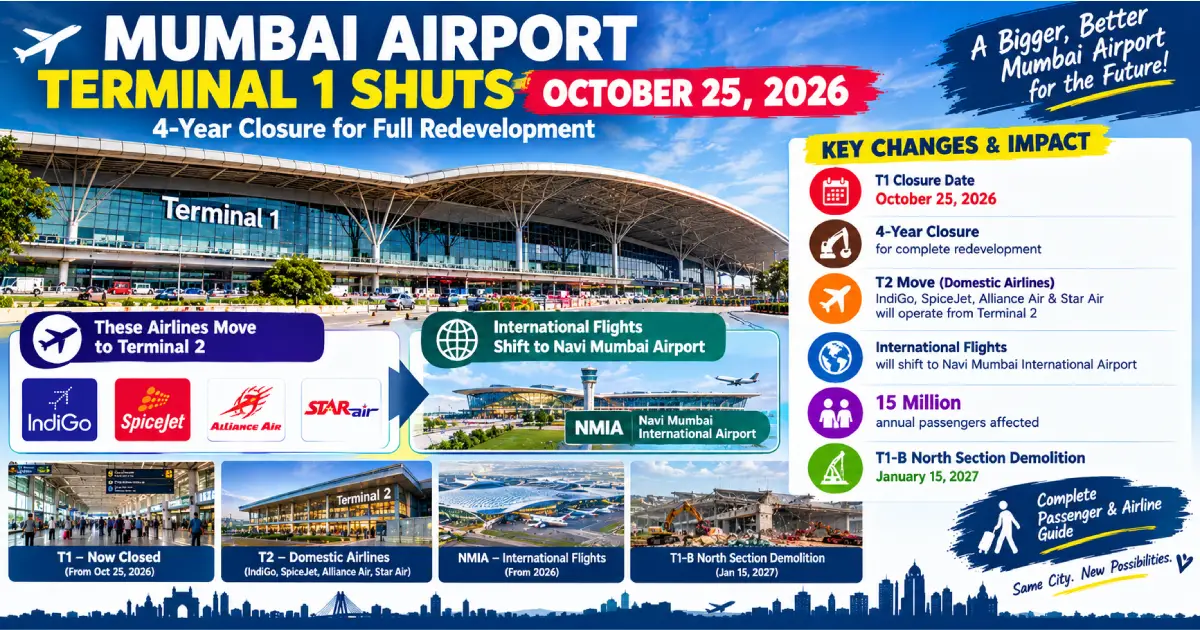
Mumbai’s Terminal 1 — one of India’s oldest active airport terminals, nearly 80 years old, known locally as Santacruz airport — will cease all flight operations on October 25, 2026. What follows will be the most significant restructuring of Mumbai aviation in decades: a four-year redevelopment programme that will eventually replace the ageing terminal with a world-class facility, while simultaneously activating the newly opened Navi Mumbai International Airport as the region’s second major aviation hub.
Mumbai International Airport Limited has announced that Terminal 1 at Chhatrapati Shivaji Maharaj International Airport will halt flight operations from October 25, 2026, remaining closed until approximately 2029–30. The redevelopment is being undertaken following a directive from the Airports Authority of India and the Airport Economic Regulatory Authority of India.
The shutdown affects the millions of passengers who fly through Mumbai annually. During the 2025–26 financial year, Terminal 1 handled nearly 15 million passengers, while Terminal 2 processed 40 million. The closure concentrates 55 million annual passengers across Mumbai’s remaining infrastructure — Terminal 2 at CSMIA, and the newly opened Navi Mumbai International Airport — in what will be the most complex capacity management challenge the city’s aviation sector has faced.
Airlines currently operating from T1 will have the option of shifting their operations to Terminal 2 at Mumbai airport, moving flights to Navi Mumbai International Airport, or temporarily suspending services.
Published: October 3, 2026 Shutdown date: October 25, 2026 — T1 flight operations end Demolition date: January 15, 2027 — T1-B North Section demolition begins Closure duration: Until 2029–30 financial year Directive issued by: Airports Authority of India (AAI) + AERA Operator: Mumbai International Airport Limited (MIAL) T1 annual passengers (FY 2025–26): ~15 million T2 annual passengers (FY 2025–26): ~40 million Daily flights at risk: One-third of Mumbai’s ~950 daily operations T1 airlines affected: IndiGo (domestic) · SpiceJet · Alliance Air · Star Air Already moved: Akasa Air — shifted to T2 from August 1, 2026 October 1 change (already live): One-third of T2 international flights → Navi Mumbai International October 25 change: One-third of T1 domestic flights → Terminal 2 Navi Mumbai Airport: Domestic ops from December 25, 2025 · International from July 15, 2026 Airline slots: MIAL confirmed airlines will NOT lose their slots during redevelopment T1 airport codes: CSMIA Terminal 1 / BOM T1 (locally: Santacruz terminal) T2 airport codes: CSMIA Terminal 2 / BOM T2 (locally: Sahar International) Navi Mumbai codes: NMIA / NMI (new — confirm with your airline) Confirmed by: Business Today · The Week · NewsBytes · Indian Eagle · Mumbai Live · Azat.tv · Deep Arrival · Aviation A2Z · Free Press Journal · CNBC-TV18
Mumbai Airport Terminal 1 is nearly 80 years old and is now set for major redevelopment. The terminal — officially known as Terminal 1 of Chhatrapati Shivaji Maharaj International Airport but still referred to by many Mumbaikars by its original name, Santacruz airport — has been the gateway to India’s financial capital for generations of travellers. It was the city’s original domestic terminal, built in the post-independence era, and has been significantly extended and modified over the decades to handle growing traffic volumes.
Parts of Terminal 1 have already been demolished, and the upcoming work represents the next major phase of the airport’s redevelopment programme.
The timing of the shutdown is directly enabled by a development that would not have been possible even two years ago: Navi Mumbai began domestic operations on December 25, 2025, and international operations on July 15, 2026. With Navi Mumbai International Airport now operational as an alternative within the Mumbai Metropolitan Region, the capacity equation that previously made a T1 shutdown impossible has changed. Airlines have somewhere to go. Passengers have a second Mumbai gateway.
The phased approach confirms a two-stage October restructuring:
Stage 1 (Already live — October 1, 2026): At least one-third of international air traffic movements currently operating from Mumbai Terminal 2 moved to Navi Mumbai International Airport.
Stage 2 (October 25, 2026): At least one-third of the air traffic movements currently handled by T1 are expected to move to Terminal 2.
Stage 3 (January 15, 2027): T1-B North Section demolition begins. The physical structure starts coming down.
This is the most important section for passengers. Your terminal assignment on and after October 25 depends entirely on which airline you are flying. Here is the confirmed picture for every T1-affected carrier:
IndiGo is the largest carrier at Mumbai’s Terminal 1 by volume — operating more domestic departures from T1 than any other carrier. Following the complete execution of these shifts by October, Mumbai Airport’s T1 will effectively operate as a dedicated domestic base, facilitating the operations of just four carriers, including IndiGo, SpiceJet, Star Air, and Alliance Air — before the October 25 shutdown moves all of them.
MIAL has therefore been working with airlines to redistribute flights between Terminal 2, Navi Mumbai International Airport, and other airports where required.
IndiGo passengers after October 25: Check your booking at goindigo.in → Manage Booking → confirm terminal is listed as T2. For international IndiGo services, the flight may depart from T2 or Navi Mumbai — confirm directly.
SpiceJet operates both domestic and international services from Mumbai. Domestic operations are expected to move to Terminal 2. International SpiceJet flights may be directed to Navi Mumbai International Airport depending on slot availability.
SpiceJet passengers after October 25: spicejet.com → Manage Booking → check terminal assignment. Allow extra travel time if assigned to Navi Mumbai.
Both regional carriers that operated domestic services from T1 will relocate to Terminal 2. Their route networks are primarily domestic, connecting Mumbai to tier-2 and tier-3 Indian cities.
Akasa Air is set to entirely exit Terminal-1 (T1). Akasa Air has already moved domestic operations from Terminal 1 to Terminal 2 from August 1, 2026. If you have been flying Akasa Air from Mumbai since August, you have already been using T2. No change for Akasa passengers post-October 25.
Air India Express will split its operations across both the terminals from October 1. All of its domestic flights will relocate to T1, while its international flights will continue to depart from and arrive at T2. After October 25 — when T1 closes — Air India Express domestic flights will move to T2 alongside all other carriers.
Air India’s mainline and international operations have historically operated from Terminal 2 only. This does not change post-October 25.
International flights serving Mumbai have historically operated from Terminal 2 (Sahar International). From October 1, at least one-third of international air traffic movements currently operating from Mumbai Airport to Navi Mumbai International Airport — meaning some international carriers are already operating from Navi Mumbai, and this will increase. Check directly with your international carrier for your specific terminal assignment.
Critical warning for international travellers: If you are flying internationally from Mumbai after October 1, you must confirm whether your flight departs from CSMIA Terminal 2 (airport code BOM) or Navi Mumbai International Airport (airport code NMI). These are different airports, located in different parts of the Mumbai Metropolitan Region. Arriving at the wrong airport will cause you to miss your flight.
Terminal 2 at CSMIA, known locally as Sahar International Airport, is Mumbai’s existing international terminal. It currently handles approximately 40 million passengers annually across both international and domestic flights. T2 is a modern, extensively refurbished facility with:
T2 is located at the same site as T1 — the two terminals share the Sahar Road address, separated by approximately 3–4 kilometres by road. Transfer between T1 and T2 has historically been available by shuttle bus — but after October 25, T1 is no longer operational and this transfer is moot.
Navi Mumbai International Airport is India’s newest major airport, having opened for domestic operations on December 25, 2025, and for international operations on July 15, 2026. It is located in Navi Mumbai — on the eastern shore of Thane Creek, across from the existing Mumbai Airport.
Critical distance warning: Navi Mumbai International Airport is not adjacent to CSMIA. It is located approximately 35–50 kilometres from central Mumbai by road, with journey times varying significantly based on traffic. Travellers accustomed to the 20–30 minute taxi ride from the Bandra-Kurla Complex or South Mumbai to CSMIA will face a substantially longer journey to Navi Mumbai Airport.
How to reach Navi Mumbai International Airport:
The closure is significant because Mumbai airport currently handles around 950 flights every day through its two terminals. Terminal 1’s closure removes approximately one-third of CSMIA’s daily flight capacity from the airport complex — capacity that must be redistributed across Terminal 2 and Navi Mumbai.
Terminal 2 already processes 40 million passengers annually. Adding T1’s 15 million annual passenger volume would push T2 toward its designed capacity ceiling — which is why MIAL’s simultaneous strategy of redirecting international flights from T2 to Navi Mumbai (from October 1) is an essential counterbalance.
Airlines have not uniformly committed to shifting their existing international operations from Mumbai Terminal 2 to Navi Mumbai. This uncommitted position from some carriers creates a planning risk: if international airlines resist the T2-to-Navi Mumbai shift, Terminal 2 risks congestion well above its efficient operating capacity during the T1 redevelopment period.
MIAL’s position: the redevelopment schedule must proceed while airlines determine how they will accommodate affected passengers and flights.
What this means for passengers in practice:
One critical reassurance from MIAL: MIAL says airlines won’t lose their slots after the makeover. The airport operator has confirmed that the slot allocations held by airlines currently operating from Terminal 1 are preserved through the redevelopment period. Airlines that temporarily suspend services or shift to alternative airports retain their right to resume at Mumbai after the new terminal opens in approximately 2029–30.
This is commercially significant: Mumbai is one of the world’s most slot-constrained airports, and losing a Mumbai slot is functionally irreversible under normal circumstances. The AAI/MIAL slot-protection commitment makes the closure more palatable for carriers who would otherwise face permanent loss of access.
AERA has also introduced incentives aimed at encouraging new international routes from Navi Mumbai Airport — a deliberate effort to build Navi Mumbai’s route network quickly by making it financially attractive for airlines to establish new services there rather than waiting for T1’s redevelopment to complete.
When Terminal 1’s redevelopment is complete in approximately 2029–30, Mumbai will have a fundamentally different airport configuration. The redeveloped T1 will be designed to modern international standards — meeting the growing demand of India’s fastest-expanding aviation market.
India’s aviation market is projected to become the world’s third-largest by 2030. Mumbai, as the country’s financial capital and primary international gateway, needs airport infrastructure to match. The existing T1, originally designed for a passenger volume a fraction of what it handles today, cannot be incrementally upgraded to meet 2030-era demand — hence the full redevelopment.
The combination of a modern T1, an expanded T2, and the new Navi Mumbai International Airport will give Mumbai a three-airport ecosystem capable of handling 150 million+ annual passengers — transforming the city into one of Asia’s dominant aviation hubs.
Step 1 — Check your terminal assignment NOW: If you have flights booked to, from, or through Mumbai for any date after October 25, 2026, contact your airline or check your booking online immediately. Confirm whether your flight operates from:
Step 2 — Confirm your ground transport: If your booking moves from T1 (which you may have been reaching by a habitual route) to either T2 or Navi Mumbai, recalculate your journey to the airport. In particular:
Step 3 — Check again closer to your departure: Passengers flying from Mumbai should stay updated and confirm their departure details directly with the airline. Terminal assignments may continue to evolve through October as airlines finalise their relocation plans. Set a reminder to recheck your booking 1 week before departure.
Step 4 — International connecting passengers: If you are arriving on a domestic T1-era flight and connecting to an international service, your connection now involves two potentially different terminals or airports. The T1-to-T2 domestic move and the T2-to-Navi Mumbai international move can stack on the same day for some travelers. Confirm both sectors independently.
Step 5 — Travel insurance check: If your travel insurance covers missed connections, confirm it covers connections between Mumbai’s different airport terminals/airports. Standard policies cover missed connections at the same airport — a same-city but different-airport connection (CSMIA to Navi Mumbai) may require a specific multi-airport connection clause.
| Date | Event |
|---|---|
| August 1, 2026 | Akasa Air exits T1 → moves to T2 (already done) |
| October 1, 2026 | One-third of T2 international flights → Navi Mumbai (already live) |
| October 25, 2026 | T1 flight operations end — one-third of T1 flights → T2 |
| January 2027 | MIAL begins T1 redevelopment construction |
| January 15, 2027 | T1-B North Section demolition begins |
| ~2029–30 | New T1 opens — modern world-class terminal |
| Post-2029 | Mumbai three-airport ecosystem fully operational |
| Airline | Terminal after Oct 25 | Contact |
|---|---|---|
| IndiGo | T2 (domestic) / confirm international | goindigo.in · 1800 180 3838 |
| SpiceJet | T2 / Navi Mumbai — confirm per booking | spicejet.com · 1800 180 3333 |
| Akasa Air | T2 (already moved August 2026) | akasaair.com · 1800 120 2005 |
| Air India | T2 (no change) | airindia.com · 1860 233 1407 |
| Air India Express | T2 post-Oct 25 | airindiaexpress.com |
| Alliance Air | T2 post-Oct 25 | allianceair.in |
| Star Air | T2 post-Oct 25 | starair.in |
| British Airways | T2 or Navi Mumbai — confirm | ba.com · 0800 727 800 (UK) |
| Emirates | T2 or Navi Mumbai — confirm | emirates.com · 600 555 555 |
| Singapore Airlines | T2 or Navi Mumbai — confirm | singaporeair.com |
| Qantas (via SIA/EK) | Via codeshare carrier — confirm | qantas.com |
| CSMIA T2 info | — | mumbaiairport.com |
| Navi Mumbai Airport | — | navimumbaiairport.com |
| Metric | Detail |
|---|---|
| Closure date | October 25, 2026 |
| Closure duration | Until 2029–30 (approximately 4 years) |
| Reason | AAI/AERA directive — full redevelopment of ~80-year-old terminal |
| T1 annual passengers | ~15 million (FY 2025–26) |
| T2 annual passengers | ~40 million (FY 2025–26) |
| Daily flights affected | One-third of Mumbai’s ~950 daily flights |
| Airlines affected | IndiGo · SpiceJet · Alliance Air · Star Air (domestic T1 carriers) |
| Already moved | Akasa Air (to T2 from August 1, 2026) |
| October 1 (already live) | One-third of T2 international flights → Navi Mumbai |
| Airline slots | Protected — carriers will not lose Mumbai slots |
| Demolition start | January 15, 2027 (T1-B North Section) |
| Replacement options | Terminal 2 (BOM T2) or Navi Mumbai International Airport (NMI) |
| Navi Mumbai distance | 35–50km from central Mumbai — allow 45–90 min travel time |
| Key risk | Arriving at wrong terminal/airport — confirm before travel |
Related Articles:
Posted By : Vinay
This article is provided for general informational purposes only and is based on information available at the time of publication. Travel advisories, airline schedules, airport operations, visa requirements, government regulations, and other travel-related information are subject to change without prior notice. While Travel Tourister makes reasonable efforts to verify information using official announcements, government publications, airline and airport communications, and other reliable sources, we cannot guarantee that all information remains complete, accurate, or up to date at all times. Readers should independently verify any information that may affect their travel plans with the relevant airline, airport authority, government agency, embassy, or other official source before making travel, financial, or other decisions. Travel Tourister shall not be liable for any direct or indirect loss, inconvenience, or damages arising from the use of or reliance on the information contained in this article. Nothing in this publication constitutes legal, immigration, financial, or professional travel advice. If you believe any information in this article is inaccurate or outdated, please contact our editorial team. We review all credible correction requests promptly and update our content whenever appropriate.
Lastest News
2nd Floor, 39, Above Kirti Club, DLF Industrial Area, Kirti Nagar, New Delhi, Delhi 110015



Travel Tourister is a leading Travel portal where we introduce travellers to trusted travel agents to make their journey hasselfree, memorable And happy. Travel Tourister is a platform where travellers get Tour packages ,Hotel packages deals through trusted travel companies And hoteliers who are working with us across the world. We always try to find new and more travel agents and hoteliers from every nook and corners across the world so that you could compare the deals with different travel agents and hoteliers and book your tour or hotel with the one you have chosen according to your taste and budget.
Copyright © Travel Tourister, India. All Rights Reserved

 Call
Call Enquiry