Published on : 06 Oct 2026
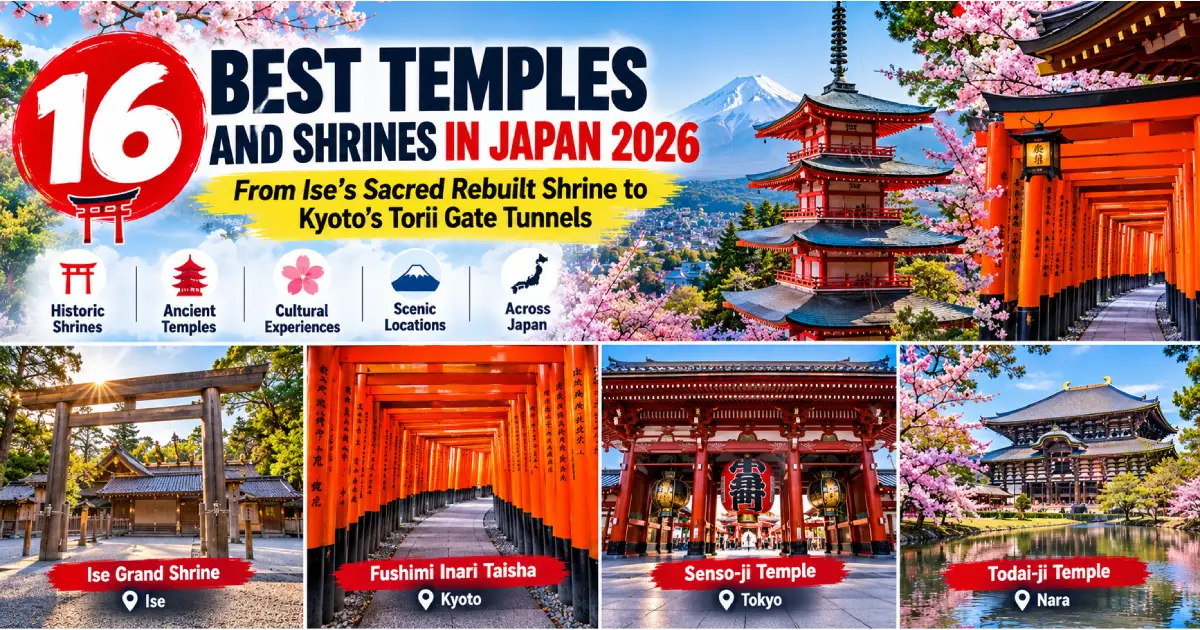
Japan holds over 80,000 Buddhist temples and roughly the same number of Shinto shrines nationwide, and while Kyoto understandably dominates most “best temples in Japan” lists, the genuinely most significant sites in the country are spread far beyond the Kansai region — a shrine in rural Mie Prefecture considered so sacred that Japanese tradition holds every citizen should visit at least once in their life, a set of wooden halls in Nara Prefecture recognized as the oldest surviving wooden structures on Earth, and a gold-leafed hall in a small town in Iwate Prefecture that most foreign visitors never discover exists. This guide covers Japan’s essential temples and shrines nationally, with brief cross-references to our deeper city guides for the Kyoto, Nara, and Tokyo sites already covered in full detail elsewhere, and genuinely new coverage of the significant sites beyond those cities that deserve a place on any serious “best of Japan” list.
| # | Site | Location | Significance | UNESCO Status |
|---|---|---|---|---|
| 1 | Ise Grand Shrine | Mie Prefecture | Shinto’s most sacred shrine, rebuilt every 20 years | Not listed (by design) |
| 2 | Izumo Taisha | Shimane Prefecture | One of Japan’s oldest and most important shrines | Not listed |
| 3 | Dazaifu Tenmangu | Fukuoka | Japan’s most significant scholarship shrine | Not listed |
| 4 | Horyu-ji | Nara Prefecture | World’s oldest surviving wooden structures | Yes |
| 5 | Zenko-ji | Nagano | Major nonsectarian pilgrimage temple | Not listed |
| 6 | Chuson-ji (Konjikido) | Hiraizumi, Iwate | 12th-century gold-leafed hall | Yes |
| 7 | Fushimi Inari Taisha | Kyoto | Thousands of torii gates | Not listed, but iconic |
| 8 | Kinkaku-ji | Kyoto | The Golden Pavilion | Yes |
| 9 | Kiyomizu-dera | Kyoto | Nail-free wooden stage | Yes |
| 10 | Sanjusangendo | Kyoto | 1,001 Kannon statues | No |
| 11 | Todai-ji | Nara | Largest wooden building, Great Buddha | Yes |
| 12 | Kasuga Taisha | Nara | Thousands of stone and bronze lanterns | Yes |
| 13 | Itsukushima Shrine | Miyajima | The floating torii gate | Yes |
| 14 | Toshogu Shrine | Nikko | Japan’s most elaborately decorated shrine | Yes |
| 15 | Senso-ji | Tokyo | Tokyo’s oldest temple | No |
| 16 | Meiji Shrine | Tokyo | Tokyo’s most significant Shinto shrine | No |
Location: Ise, Mie Prefecture | Significance: Shinto’s most sacred site | Best Time: Any season
Dedicated to Amaterasu, the sun goddess considered the ancestral deity of the Japanese imperial family, Ise Grand Shrine is widely regarded as the single most sacred site in Shinto belief — and its most remarkable feature isn’t architectural grandeur but a specific ritual practice: the shrine’s main buildings are completely rebuilt every 20 years in an ancient wood-joinery technique (the most recent rebuilding in 2013, the next due 2033), a tradition called Shikinen Sengu intended to renew the shrine’s purity and pass construction knowledge to each new generation of craftsmen. Traditional belief holds that every Japanese person should visit Ise at least once in their lifetime, and the inner shrine’s deep cedar forest approach is deliberately understated rather than ornate — sacred through simplicity rather than decoration.
Location: Izumo, Shimane Prefecture | Significance: One of Japan’s oldest and most important shrines | Best Time: October (when, according to Shinto belief, all of Japan’s deities gather here)
Among the oldest and most architecturally significant Shinto shrines in Japan, Izumo Taisha is specifically associated with Okuninushi, the deity of marriage and good relationships — and according to Shinto tradition, every October (when the rest of Japan calls the month Kannazuki, “the month without gods”) all of Japan’s deities travel to Izumo for an annual assembly, making this one month specifically significant for visiting. The shrine’s massive shimenawa (sacred straw rope, among the largest in Japan) hanging over the main hall’s entrance is one of its most photographed features.
Location: Dazaifu, Fukuoka Prefecture | Significance: Japan’s most important shrine dedicated to scholarship | Best Time: February–March, for plum blossoms
Built over the grave of Sugawara no Michizane, a 9th-century scholar later deified as the god of learning, Dazaifu Tenmangu is the head shrine of roughly 12,000 Tenmangu shrines across Japan and draws students nationwide before exam season to pray for academic success — the grounds hold several thousand plum trees (ume, the tree specifically associated with Michizane in the shrine’s founding legend), making late winter a particularly significant time to visit.
Location: Ikaruga, Nara Prefecture | Significance: The oldest surviving wooden buildings on Earth | UNESCO: Yes
Founded in 607 AD, Horyu-ji’s five-story pagoda and main hall (kondo) are recognized as the oldest surviving wooden structures in the world — predating European cathedrals by centuries and offering a specific, tangible connection to early Japanese Buddhism that even Kyoto’s oldest surviving buildings can’t match, since most of Kyoto’s current temple structures are reconstructions following historical fires rather than true originals.
Location: Nagano | Significance: A major nonsectarian pilgrimage site | Best Time: Any season
Unlike most major Japanese temples, which belong to a specific Buddhist sect, Zenko-ji has remained nonsectarian since its founding over 1,400 years ago, making it historically welcoming to pilgrims of any Buddhist affiliation — its main hall houses what’s believed to be Japan’s first Buddhist statue, kept permanently hidden from public view, and the temple’s pitch-black underground passage (said to lead pilgrims to enlightenment by touching a specific “key to paradise” in complete darkness) is one of Japan’s more genuinely unusual temple experiences.
Location: Hiraizumi, Iwate Prefecture | Significance: A 12th-century hall covered entirely in gold leaf | UNESCO: Yes (part of the Hiraizumi World Heritage Site)
Konjikido (“Golden Hall”), the surviving centerpiece of the Chuson-ji temple complex, is covered inside and out in gold leaf, lacquer, and intricate mother-of-pearl inlay — built in 1124 by the Fujiwara clan in a deliberate attempt to recreate a Buddhist paradise on Earth, and now protected within its own surrounding structure to preserve it against the elements. Genuinely remote relative to Japan’s major tourist circuits, Hiraizumi receives only a small fraction of Kyoto’s foreign-visitor traffic despite the Golden Hall’s significance rivaling anything in the Kansai region.
Location: Kyoto | Significance: Thousands of vermilion torii gates climbing Mount Inari
Japan’s single most photographed shrine. Full coverage, including the best early-morning timing strategy, in our Things to Do in Kyoto guide.
Location: Kyoto | Significance: Japan’s most photographed building, covered in gold leaf | UNESCO: Yes
Full coverage in our Things to Do in Kyoto guide.
Location: Kyoto | Significance: A massive wooden stage built without a single nail | UNESCO: Yes
Full coverage in our Things to Do in Kyoto guide.
Location: Kyoto | Significance: 1,001 individually carved wooden Kannon statues
One of Kyoto’s most underrated major sites relative to its crowd levels. Full coverage in our Things to Do in Kyoto guide.
Location: Nara | Significance: The largest wooden building on Earth, housing a 15-meter bronze Buddha | UNESCO: Yes
Full coverage, including the best timing to combine with Nara Park’s deer, in our Nara Day Trip Guide.
Location: Nara | Significance: A shrine approach lined with thousands of stone and bronze lanterns | UNESCO: Yes
Full coverage in our Nara Day Trip Guide.
Location: Miyajima, near Hiroshima | Significance: The floating torii gate — one of Japan’s most photographed images | UNESCO: Yes
Full coverage, including the tide-chart timing that determines whether the gate appears to float or can be walked to directly, in our Things to Do in Hiroshima guide.
Location: Nikko | Significance: Japan’s most elaborately decorated shrine complex, the mausoleum of shogun Tokugawa Ieyasu | UNESCO: Yes
Covered in our Day Trips from Tokyo guide as one of the best full-day additions to a Tokyo-based itinerary.
Location: Asakusa, Tokyo | Significance: Tokyo’s oldest Buddhist temple, founded 645 AD
Full coverage in our 24 Best Things to Do in Tokyo guide.
Location: Tokyo | Significance: Tokyo’s most significant Shinto shrine, set within a 170-acre forest
Full coverage in our 24 Best Things to Do in Tokyo guide.
About Travel Tourister Travel Tourister’s destination specialists have traveled well beyond Kyoto’s well-known temple circuit — to Ise’s deliberately understated rebuilt shrine, Horyu-ji’s 1,400-year-old wooden halls, and Hiraizumi’s gold-leafed Konjikido — to put together a genuinely national guide to the best temples and shrines in Japan for 2026 visitors.
Posted By : Vinay
Latest Article
2nd Floor, 39, Above Kirti Club, DLF Industrial Area, Kirti Nagar, New Delhi, Delhi 110015



Travel Tourister is a leading Travel portal where we introduce travellers to trusted travel agents to make their journey hasselfree, memorable And happy. Travel Tourister is a platform where travellers get Tour packages ,Hotel packages deals through trusted travel companies And hoteliers who are working with us across the world. We always try to find new and more travel agents and hoteliers from every nook and corners across the world so that you could compare the deals with different travel agents and hoteliers and book your tour or hotel with the one you have chosen according to your taste and budget.
Copyright © Travel Tourister, India. All Rights Reserved

 Call
Call Enquiry