Published on : 06 Oct 2026
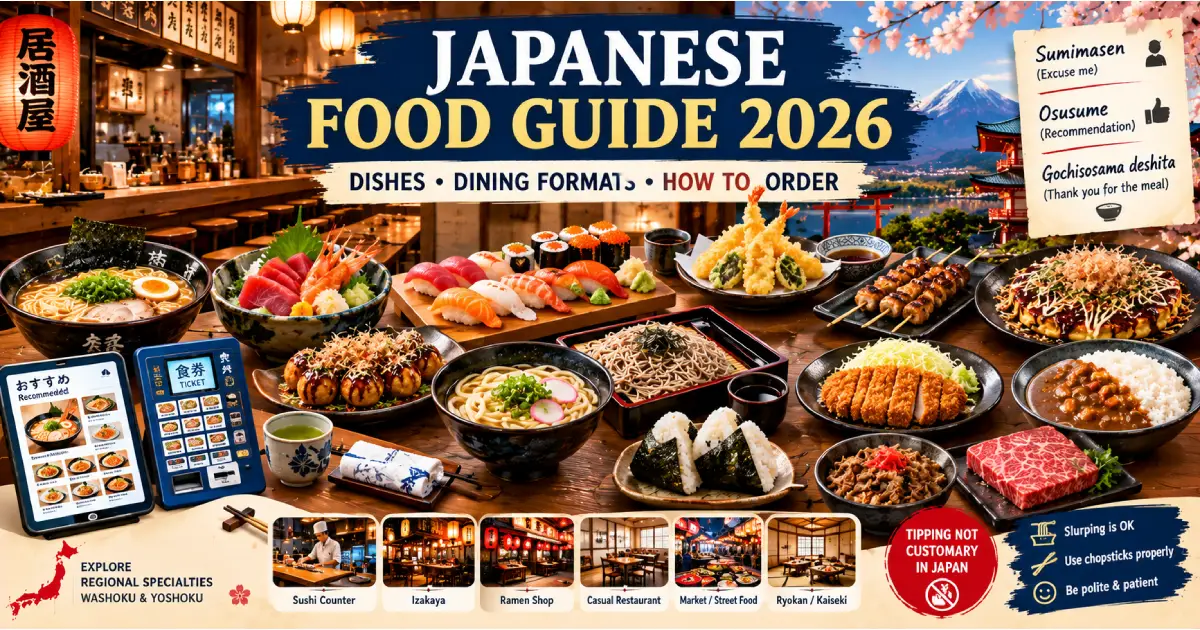
Our 25 Best Restaurants in Japan guide and our city-specific restaurant guides tell you where to eat; this guide explains what you’re actually eating and why Japanese dining works the way it does — the specific dish categories, the dining formats that structure how meals are ordered and served, the regional specialties that make Osaka’s food culture genuinely distinct from Kyoto’s or Hiroshima’s, and the practical mechanics of ordering a meal with zero Japanese language ability. Japanese food culture rewards specialization in a way most tier-1 visitors’ home food cultures don’t — a restaurant serving exactly one dish, refined over decades, is the norm rather than the exception — and understanding that structure in advance makes every meal on a Japan trip easier to navigate and more rewarding to actually understand.
| Category | What It Is | Where to Find the Best |
|---|---|---|
| Sushi (寿司) | Vinegared rice with raw or cured fish, shellfish, or vegetables | Tokyo (Edomae style), nationwide |
| Ramen (ラーメン) | Wheat noodles in broth, regional styles vary widely | Nationwide, each region distinct |
| Tempura (天ぷら) | Battered, deep-fried seafood and vegetables | Tokyo, nationwide |
| Tonkatsu (とんかつ) | Breaded, deep-fried pork cutlet | Tokyo, nationwide |
| Udon / Soba (うどん・そば) | Thick wheat or buckwheat noodles | Kyoto (soba), nationwide |
| Yakitori (焼き鳥) | Skewered, grilled chicken | Tokyo, nationwide |
| Okonomiyaki (お好み焼き) | Savory griddled pancake, regional styles differ | Osaka (mixed), Hiroshima (layered) |
| Kaiseki (懐石) | Traditional multi-course seasonal tasting menu | Kyoto |
| Yakiniku (焼肉) | Tableside grilled beef and other meats | Nationwide |
| Donburi (丼) | Rice bowl topped with meat, seafood, or egg | Nationwide |
| Takoyaki (たこ焼き) | Octopus-filled grilled batter balls | Osaka |
A fixed combination meal — typically a main dish, rice, miso soup, and small pickled sides — teishoku is the standard lunch format throughout Japan, offering a complete, balanced meal at a fixed, usually reasonable price without needing to navigate an extensive menu. This is the most accessible, lowest-anxiety dining format for a first-time visitor.
A format, most associated with sushi counters but used across many formal dining styles, where the chef selects and serves each course without the diner ordering individually — the specific sequence, pacing, and content are entirely the chef’s choice, built around that day’s best available ingredients. Omakase requires trust in the chef and, at the highest-end counters, carries a correspondingly high price.
Japan’s most historically rigorous tasting menu format, built around seasonal ingredients served across ten or more small, deliberately sequenced courses — see our Best Restaurants in Kyoto guide for specific kaiseki recommendations, since Kyoto remains the format’s most significant home.
Casual, drinks-focused restaurants serving a wide range of small shareable dishes — the closest Japanese equivalent to a Western gastropub, and the default format for an evening of drinking and eating among groups of friends or coworkers.
A specific, traditional policy at some of Kyoto’s most exclusive restaurants and ochaya (teahouses), requiring a personal introduction from an existing customer before a first-time guest can be seated — a genuine barrier for most tier-1 visitors without local connections, and the reason some of Kyoto’s most historic establishments remain effectively inaccessible without a concierge or local introduction regardless of budget.
Many casual noodle shops, particularly ramen and gyudon (beef bowl) chains, use a ticket vending machine at the entrance — select and pay for your dish before sitting down, then hand the printed ticket to staff — a format that removes the language barrier entirely once understood, and genuinely common enough that first-time visitors should expect to encounter it within their first day or two in Japan.
Edomae sushi (the Tokyo style) uses aged, cured, or marinated fish rather than exclusively raw preparations — a specific technique tradition distinct from the simpler raw-fish-on-rice format most Western sushi bars default to. See our 25 Best Restaurants in Japan guide for the full range from ¥5,000 market-counter sushi to ¥40,000+ omakase.
Ramen’s broth base (tonkotsu pork bone, shoyu soy sauce, miso, or shio salt) and noodle style vary significantly by region — Hiroshima’s own soy-tonkotsu blend, covered in our Best Restaurants in Hiroshima guide, is distinct from both Tokyo’s clearer shoyu style and Kyushu’s heavier pure-tonkotsu tradition, and seeking out a region’s specific local style rather than defaulting to a familiar chain is one of the most rewarding small food decisions on a multi-city Japan trip.
Properly made tempura uses an ice-cold, minimally mixed batter and precise oil temperature control to achieve a specifically light, non-greasy crispness — a world apart from Western deep-frying, and the reason a Michelin-starred tempura counter genuinely justifies its price difference from a casual tempura restaurant.
Udon (thick wheat noodles) and soba (thinner buckwheat noodles) are both centuries-old Japanese noodle traditions, often served either hot in broth or cold with a dipping sauce — Osaka specifically claims the invention of kitsune udon (topped with sweet fried tofu), covered in our Best Restaurants in Osaka guide.
Osaka’s okonomiyaki mixes all ingredients (cabbage, batter, pork, seafood) together before griddling; Hiroshima’s version layers the same ingredients around a bed of fried noodles rather than mixing them — a specific regional rivalry genuinely worth experiencing both sides of if your itinerary includes both cities.
Proper yakitori restaurants serve a wide range of specific chicken cuts as individual skewers — thigh, skin, liver, heart, and cartilage among them — treating each cut as a distinct dish rather than interchangeable chicken pieces, a specificity most Western grilled-chicken traditions don’t apply.
Donburi covers any dish served as a topping over a bowl of rice — gyudon (simmered beef), katsudon (breaded pork cutlet with egg), oyakodon (chicken and egg, the name literally meaning “parent and child”), and unadon (grilled eel) are among the most common, and collectively represent some of Japan’s most accessible, fastest, and most affordable full meals.
| Region | Signature Dishes | Full Guide |
|---|---|---|
| Tokyo | Edomae sushi, soba, monjayaki, tempura | Best Restaurants in Tokyo |
| Kyoto | Kaiseki, yudofu (tofu), shojin ryori | Best Restaurants in Kyoto |
| Osaka | Takoyaki, okonomiyaki (mixed), kushikatsu | Best Restaurants in Osaka |
| Hiroshima | Okonomiyaki (layered), oysters, anago (eel) | Best Restaurants in Hiroshima |
Vegetarian and vegan dining in Japan requires more active navigation than in most tier-1 visitors’ home countries, primarily because dashi (the foundational broth used throughout Japanese cooking, including in many miso soups and sauces that otherwise appear vegetable-based) is traditionally made with bonito fish flakes — meaning a dish that looks vegetarian frequently isn’t, unless specifically prepared otherwise. Shojin ryori, the formal Buddhist vegetarian cuisine developed within temple cooking traditions, is the most reliable genuinely vegetarian dining format, served at several Kyoto temples as covered in our Best Restaurants in Kyoto guide. For visitors with specific allergies or strict dietary requirements, a printed card in Japanese explaining the restriction (several free templates exist online specifically for this purpose) is far more reliable than attempting to explain in English, given how commonly dashi and other animal-derived bases are used without obvious indication on a menu.
About Travel Tourister Travel Tourister’s destination specialists have eaten across every region covered in this guide — comparing Osaka’s mixed okonomiyaki against Hiroshima’s layered version, navigating ticket vending machines at countless ramen counters, and working through shojin ryori’s dashi-free Buddhist cooking tradition — to put together a complete, practical guide to understanding Japanese food for 2026 visitors.
Posted By : Vinay
Latest Article
2nd Floor, 39, Above Kirti Club, DLF Industrial Area, Kirti Nagar, New Delhi, Delhi 110015



Travel Tourister is a leading Travel portal where we introduce travellers to trusted travel agents to make their journey hasselfree, memorable And happy. Travel Tourister is a platform where travellers get Tour packages ,Hotel packages deals through trusted travel companies And hoteliers who are working with us across the world. We always try to find new and more travel agents and hoteliers from every nook and corners across the world so that you could compare the deals with different travel agents and hoteliers and book your tour or hotel with the one you have chosen according to your taste and budget.
Copyright © Travel Tourister, India. All Rights Reserved

 Call
Call Enquiry