Published on : 12 Oct 2026
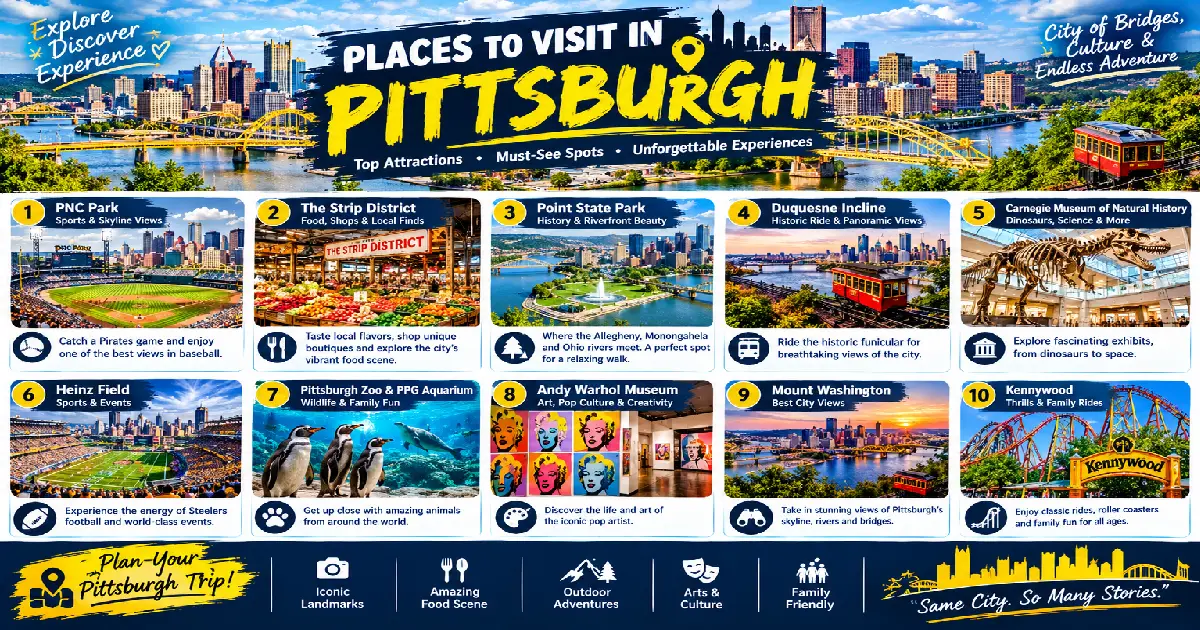
Pittsburgh is a city that earns its reputation slowly and then all at once. First-time visitors often arrive expecting a post-industrial city still working through its identity crisis, and leave astonished — by the drama of the skyline appearing from the Fort Pitt Tunnel, by the density of world-class museums and cultural institutions clustered in Oakland, by the neighborhood vitality of Lawrenceville and the South Side, by the sheer improbability of a city this interesting existing at this scale in western Pennsylvania. Pittsburgh is consistently ranked among America’s most livable cities, and the reasons become immediately apparent to anyone who spends a few days actually exploring it.
The city’s geography is its greatest asset and its greatest storytelling challenge. Built at the confluence of three rivers — the Allegheny, Monongahela, and Ohio — and spreading across a collection of hills and ridgelines that make conventional city grids impossible, Pittsburgh has 90 distinct neighborhoods connected by 446 bridges (more per capita than any city on earth) and two functioning funicular railways. The topography creates dramatic views at every turn: the skyline from the Mount Washington overlook, the Cathedral of Learning rising above Oakland, the three bridges visible simultaneously from PNC Park’s right-field seats. Understanding Pittsburgh means understanding its hills, its rivers, and the neighborhoods that grew up between them.
This guide covers the 20 most important places to visit in Pittsburgh — the landmarks, museums, neighborhoods, and natural spaces that together constitute the Pittsburgh experience. From the historic Point where three rivers converge to the mountain house Frank Lloyd Wright built over a waterfall 90 minutes outside the city, these are the places that will make Pittsburgh unforgettable.
| Place | Neighborhood | Entry |
|---|---|---|
| Point State Park | Downtown | Free |
| Andy Warhol Museum | North Shore | $25 |
| Duquesne & Monongahela Inclines | Mount Washington | $2.75/ride |
| Carnegie Museums Complex | Oakland | $26 |
| Phipps Conservatory | Oakland | $20 |
| PNC Park | North Shore | Varies |
| Cathedral of Learning | Oakland | Free / $4 |
| Strip District | Strip District | Free |
| Fallingwater | Mill Run, PA | $34–$42 |
| Mattress Factory | North Side | $20 |
The geographic and historical heart of Pittsburgh
Point State Park occupies the precise tip of Pittsburgh’s Golden Triangle — the triangular peninsula where the Allegheny River flowing from the northeast and the Monongahela from the southeast converge to form the Ohio River, which then flows west toward the Mississippi. It is the most historically significant location in Pennsylvania west of Philadelphia: the site of Fort Duquesne (French, 1754) and Fort Pitt (British, 1758), the strategic pivot of the French and Indian War, and the reason Pittsburgh exists where it does rather than anywhere else.
Today the 36-acre park is beautifully maintained green space with river access on three sides, a 150-foot circular fountain that is one of the largest in the US (running April through October), and the Fort Pitt Museum embedded in a reconstructed corner bastion of the original fort. The views from the very tip of the point — upstream toward the Allegheny bridges, downstream toward the Ohio, and back toward the downtown towers — are extraordinary. The park is free and open at all hours; it’s the ideal starting point for any Pittsburgh exploration and the most satisfying place to end a visit.
The Fort Pitt Museum ($8) tells the story of the colonial collision between French, British, and Native American nations that made Pittsburgh into a flashpoint of 18th-century geopolitics. The artifacts, maps, and multimedia presentations are excellent and well worth the hour required to see them properly.
The finest urban panorama in Pennsylvania
Mount Washington is the ridge that rises immediately south of downtown Pittsburgh across the Monongahela River, and the views from its overlook at Grandview Avenue are the defining visual experience of visiting the city. The entire Golden Triangle spreads below you — the downtown towers, the three rivers and their bridges, PNC Park, Acrisure Stadium, the North Shore — in a panorama so complete and so dramatic that first-time visitors routinely stand in silence for several minutes absorbing it.
The Duquesne Incline (1877) and Monongahela Incline (1870) are two of the oldest continuously operating funicular railways in the United States — cable-car hillside climbers that have been carrying Pittsburghers up and down Mount Washington since the era of the steel mills. Both depart from the South Side riverfront and arrive at Grandview Avenue; the Duquesne has a small museum of Pittsburgh history at its upper station. The view from Grandview Avenue is accessible by road as well, but arriving by incline is the Pittsburgh way.
Grandview Avenue along the top of the ridge is lined with restaurants exploiting the view — some excellent (Altius, Monterey Bay Fish Grotto) and some merely capitalizing on the location. The walk between the two inclines along Grandview (about 800 feet) is one of Pittsburgh’s essential short walks.
The world’s largest single-artist museum — Pittsburgh’s most celebrated institution
The Andy Warhol Museum on the North Shore is the most important cultural institution in Pittsburgh — a seven-story, 88,000-square-foot celebration of the life and work of the city’s most famous native son. Andrew Warhola was born in Pittsburgh in 1928, the son of Carpatho-Rusyn immigrant parents who had come to work in the steel mills; he grew up in the Oakland neighborhood, attended Carnegie Tech (now Carnegie Mellon), and left for New York in 1949 to become the most influential American artist of the 20th century.
The museum’s permanent collection of over 9,000 works tells the full Warhol story across seven floors of beautifully arranged galleries. The early commercial illustration work that launched his career, the Campbell’s Soup Cans, the Marilyn and Elvis silkscreens, the Death and Disaster series, the films (Sleep, Empire, Chelsea Girls), the Silver Factory photographs, the Interview magazine empire, and the extraordinary late religious paintings are all represented with depth and intelligence. The time capsules — cardboard boxes Warhol packed with daily ephemera that he sealed and numbered without labeling — are among the most endlessly fascinating objects in the collection.
What distinguishes the Warhol from other major artist museums is its commitment to contextualizing the work within Pittsburgh’s history, Warhol’s immigrant family background, and the specific conditions of post-war American culture. The result is a museum that illuminates both an artist and an era.
Andrew Carnegie’s great gift to Pittsburgh — world-class collections in Oakland
The Carnegie Museums complex in Oakland houses two of the finest museums in Pennsylvania, connected by a grand Beaux-Arts hall that itself feels like a monument. Andrew Carnegie founded both in 1895 with characteristically democratic ambitions: he wanted the working people of Pittsburgh to have access to the finest art and science in the world without traveling to New York or Washington. He succeeded magnificently.
Carnegie Museum of Natural History is most famous for its Dinosaur Hall — among the finest in North America. The hall’s centerpiece is a mounted Diplodocus skeleton excavated in Carnegie’s name from the western US in 1898, presented to the museum in 1907. The Apatosaurus, Tyrannosaurus rex, and Allosaurus specimens around it form one of the most impressive assemblages of mounted dinosaur skeletons anywhere. The Hillman Hall of Minerals and Gems (extraordinary quartz crystals, native gold specimens, and meteorites), the Egyptian mummies (three unwrapped, with facial reconstructions), the Hall of Arctic Life, and the Walton Hall of Ancient Egypt are all excellent.
Carnegie Museum of Art holds a distinguished collection of over 30,000 objects spanning ancient Egypt to the contemporary. The Impressionist galleries (Monet, Pissarro, Toulouse-Lautrec), the decorative arts collection (exceptional American furniture and glass), and the Hall of Architecture — a plaster-cast gallery of architectural fragments from major historical buildings, unique in North America — are the highlights. The contemporary galleries in the Scaife wing are among the finest modern art spaces in western Pennsylvania.
Victorian glass architecture and tropical gardens in Schenley Park
Phipps Conservatory and Botanical Gardens is one of the most beautiful public buildings in Pittsburgh and one of the finest Victorian glasshouses in America. Henry Phipps, Andrew Carnegie’s business partner, built the original 1893 structure as a gift to the city; subsequent expansions have created 23 distinct garden rooms under glass covering more than 14,000 square feet of tropical, temperate, and arid plant displays.
The permanent collection spans a tropical forest room (giant fig trees, bromeliads, orchids cascading from ceiling mounts), a Victorian Room with period-appropriate furnishings and plantings, a Japanese courtyard, an arid house with rare cacti and succulents, and a Butterfly Forest that operates seasonally. The seasonal flower shows — Spring Flower Show (March–April), Summer Orchid Show (July–August), Fall Harvest (October), Holiday Magic (November–January) — are among Pittsburgh’s most attended annual events, each transforming the conservatory with extraordinary floral installations.
Phipps has been comprehensively renovated to LEED Platinum certification, making it one of the most energy-efficient public gardens in the US. The outdoor Shadehouse Garden and the Welcome Center’s green roof are accessible free of charge. The conservatory at night — during the Holiday Magic show in particular, when the glasshouse glows from within against falling snow — is one of the most magical settings in Pennsylvania.
The most beautiful baseball stadium in America
PNC Park opened in 2001 on the North Shore of the Allegheny River and immediately established itself as the most architecturally successful baseball stadium of the modern era. The design places the field low to the river so that the Roberto Clemente Bridge and the Pittsburgh skyline — towers, bridges, the Point — fill the view beyond the outfield in a panorama that no other stadium in America can match. Watching baseball here on a summer evening, with the city glowing behind center field and the river visible through the right-field corner, is a genuinely transcendent experience.
The stadium itself is beautifully proportioned — intimate by modern standards (capacity 38,362), with sightlines that keep every seat reasonably close to the action and a seamless circulation system that gets 35,000 people in and out without the crushing bottle-necks that afflict larger facilities. Tickets are affordable (bleacher seats from $12), the food has improved considerably in recent years, and the Friday night fireworks games are among the most festive family events in Pittsburgh’s calendar. Even if baseball is not your passion, PNC Park on a summer evening is an essential Pittsburgh experience.
The Roberto Clemente Bridge — one of the Three Sisters suspension bridges, named for the Pirates’ legendary right fielder who died in a humanitarian mission plane crash on December 31, 1972 — closes to vehicle traffic on home game days, becoming a pedestrian promenade. Walking the bridge to the stadium from downtown is a Pittsburgh ritual.
Frank Lloyd Wright’s greatest masterpiece — 90 minutes from Pittsburgh
Fallingwater in Mill Run, Pennsylvania is one of the most important buildings in the history of architecture and the single most compelling day trip from Pittsburgh. Frank Lloyd Wright designed the house for Edgar Kaufmann Sr. (owner of Pittsburgh’s Kaufmann’s department store) in 1935, at the age of 68, in a burst of creative energy that produced what Time magazine called “the best all-time work of American architecture.” The house is built directly over a waterfall on Bear Run Creek in the Laurel Highlands, with reinforced concrete cantilevered terraces extending over the falls and the living room floor incorporating the natural rock ledge of the stream bed.
Seeing Fallingwater for the first time — walking from the parking area through the forest and glimpsing the house through the trees before the full view opens up — is a genuine architectural epiphany. The guided interior tour (required for interior access) reveals how Wright integrated the house with its landscape: the water sound audible from every room, the natural stone floors continuous with the bedrock below, the windows framing specific views of the forest and the falls. The grounds include walking trails along Bear Run and views of the house from upstream (the classic postcard angle) and downstream.
Timed-entry tickets sell out weeks ahead during peak season (May–June, September–October). The combination visit with Kentuck Knob (another Wright house, 8 miles south, $26) makes an ideal full-day architectural pilgrimage. Book before you arrive.
Pittsburgh’s historic market neighborhood — food, culture, and street life
The Strip District is the narrow stretch of land between downtown Pittsburgh and the Allegheny River that has served as the city’s wholesale market district since the 1800s — a dense concentration of produce markets, specialty food importers, fishmongers, butchers, spice merchants, and restaurant supply stores that has evolved into Pittsburgh’s most vibrant food destination without losing the commercial character that gives it authenticity.
The best time to visit is Saturday morning, when the sidewalk fills with vendors selling pierogies (Pittsburgh’s beloved stuffed dumplings), the permanent market stalls are doing peak business, and the whole mile-long stretch becomes a cultural experience as much as a food shopping trip. Wholey’s Fish Market (fish so fresh it’s still moving in some tanks), Pennsylvania Macaroni Company (the finest Italian grocery outside New York’s Arthur Avenue), Lotus Food Company (exceptional Asian produce and pantry goods), and Prestogeorge Coffee (Pittsburgh’s oldest coffee roaster) are the anchor stops. La Prima Espresso — an Italian-style espresso bar that has been making the city’s best coffee since 1988 — is the morning essential.
The Strip has also developed an excellent evening dining and bar scene: Gaucho Parrilla Argentina, Eleven Contemporary Kitchen, and the Senator John Heinz History Center (technically adjacent) have transformed it from a morning-only destination to an all-day neighborhood. The Klavon’s Ice Cream parlor, open since 1923, is the ideal conclusion to any Strip District visit.
Pittsburgh’s great urban park — 456 acres of trails and landscape in Oakland
Schenley Park is Pittsburgh’s Central Park — 456 acres of wooded hills, meadows, trails, and recreational facilities given to the city by Mary Schenley in 1889. Adjacent to the University of Pittsburgh and Carnegie Mellon University in Oakland, the park contains Phipps Conservatory, the Schenley Park Café and Visitor Center, tennis courts, a historic golf course, cross-country ski trails in winter, and an extensive network of hiking and running trails through second-growth deciduous forest.
The park is extraordinary at different times of year: dogwood and redbud in spring, full green canopy in summer, spectacular fall foliage from mid-October through early November, and cross-country skiing on groomed trails after significant snowfall. Panther Hollow Lake, at the park’s center, has a small beach and paddleboat rentals in summer. Flagstaff Hill — a meadow in the park’s upper section — hosts the Pittsburgh Outdoor Film Festival each summer, where thousands of Pittsburghers gather with blankets and picnic food to watch classic films projected on a hillside screen. It is one of the city’s most beloved traditions.
The 42-story Gothic tower at the heart of Pittsburgh’s university district
The Cathedral of Learning at the University of Pittsburgh is one of the most architecturally ambitious academic buildings ever constructed in America — a 535-foot Gothic skyscraper built between 1926 and 1937 that serves as the symbolic and functional center of Pitt’s Oakland campus. The building was funded in part through a campaign that invited Pittsburgh schoolchildren to contribute 10 cents each to “buy” a brick in the Cathedral — a campaign that raised $600,000 from 97,000 children and created a direct civic connection between the city’s young people and the institution.
The interior is as dramatic as the exterior. The Commons Room — a four-story vaulted Gothic hall that serves as the building’s central atrium and study space — is one of the most extraordinary interior spaces in Pennsylvania. Students study at heavy oak tables beneath stone vaulting and stained glass; the space has the weight of a medieval cathedral combined with the energy of an active university. The 31 Nationality Rooms on the building’s lower floors are perhaps the most unique feature: individual classrooms designed and furnished by Pittsburgh’s various ethnic communities — Syrian, Japanese, Lithuanian, African, Chinese, Early American, and 25 others — each representing a different cultural tradition and all still in active educational use.
The contemporary art museum built on radical ambition
The Mattress Factory in the Mexican War Streets neighborhood of the North Side is one of the most distinctive contemporary art museums in the United States — a converted 19th-century warehouse complex that specializes in large-scale, site-specific installations by artists who come to Pittsburgh to conceive and build new works directly in the space. The museum represents a fundamentally different relationship between artist, space, and viewer than any conventional gallery: the buildings themselves become the medium.
The permanent collection includes Yayoi Kusama’s Infinity Mirror Rooms — installed here before Kusama became a global phenomenon, making the Mattress Factory’s versions among the earliest and most significant of her mirror-room works. James Turrell’s light installations occupy entire rooms, where the medium is light itself manipulated to create experiences of space, depth, and color that feel simultaneously perceptual and philosophical. Temporary commissions occupy additional rooms throughout the facility, with new works arriving and departing throughout the year.
The Mexican War Streets neighborhood surrounding the museum is one of Pittsburgh’s most architecturally intact 19th-century residential districts — a grid of Federal and Italianate rowhouses on streets named for Mexican-American War battles, now home to galleries, studios, and the cultural life that has grown up around the Mattress Factory.
The Steelers’ cathedral — six Super Bowl banners on the Ohio River
Acrisure Stadium (formerly Heinz Field) on the North Shore is one of the most visually dramatic NFL venues in America — a stadium where the Pittsburgh skyline fills the view behind the open south end zone, making every home game a spectacle that’s as much about the setting as the sport. The Pittsburgh Steelers are the most decorated franchise in NFL history (six Super Bowl championships), and the passion of the fan base — universally identified by the yellow Terrible Towel that stadium sections wave in unison — creates an atmosphere that even neutral observers find genuinely moving.
Single-game tickets are available on secondary markets (StubHub, SeatGeek) for most regular-season games, with prices varying dramatically by opponent and schedule position. The pre-game North Shore experience — the Art Rooney statue, the sports bars along Federal Street, the Roberto Clemente Bridge walkway, the view of the river and the downtown towers — is worth experiencing regardless of whether you have a ticket. Non-game day stadium tours ($15) include access to the field level, the locker rooms, and the Steelers Hall of Honor Museum.
The most beautiful collegiate Gothic chapel in America
Heinz Memorial Chapel on the University of Pittsburgh campus is, by widespread agreement, one of the finest examples of Gothic religious architecture in America. Built between 1934 and 1938 as a memorial to Henry John Heinz (founder of the H.J. Heinz food company), the chapel is a masterwork of proportion and light — a single soaring nave rising to 253 feet at the apex, with walls largely replaced by 73 stained glass windows by Charles Connick that create an interior suffused with colored light.
The windows are the wonder of Heinz Chapel: among the finest 20th-century stained glass in the United States, they tell stories from religious history, philosophy, and human endeavor in imagery of exceptional quality and coloring. The window above the chancel — 60 feet high, depicting human virtues — is one of the most impressive single pieces of stained glass in Pennsylvania. The chapel is used for university ceremonies (it seats 800) but is freely accessible to visitors on weekdays. Entry is free.
Western Pennsylvania’s most comprehensive history museum
The Senator John Heinz History Center in the Strip District is the largest history museum in Pennsylvania — a six-floor institution in a beautifully renovated 1898 ice warehouse that covers the region’s history from the pre-contact period through the 20th century with exceptional depth and quality of exhibition. As a Smithsonian affiliate, the History Center holds collections of national significance alongside its regional focus.
The Great Hall’s exhibits on Pittsburgh’s steel industry are the finest of their kind in any American museum: original mill equipment, documentary photography by W. Eugene Smith and Charles “Teenie” Harris, and oral history recordings that capture both the scale of the industrial operation and the human experience of working in it. The French and Indian War gallery — covering the 1754–1763 conflict that began at Pittsburgh’s Point — is among the finest in the country. The Western Pennsylvania Sports Museum on floors 5–6 documents the city’s extraordinary sports heritage with objects, film, and interactive displays that even casual sports fans find compelling.
Pittsburgh’s most vibrant neighborhood — art, food, and authentic city life
Lawrenceville stretches along Butler Street approximately two miles northeast of downtown — a mile-long stretch of former steel-worker rowhouses that has become Pittsburgh’s most exciting neighborhood over the past decade without losing the authentic, unpretentious character that distinguishes it from more thoroughly gentrified equivalents in other cities. The combination of creative businesses, excellent restaurants, independent boutiques, and the residual architecture of Pittsburgh’s industrial working-class heritage gives Lawrenceville a texture that rewards wandering.
Butler Street is the artery: Cure and Morcilla (James Beard-nominated restaurants by chef Justin Severino), Piccolo Forno (authentic Italian trattoria), Espresso a Mano (Pittsburgh’s finest espresso), The Vandal (wood-fired food and cocktails), and dozens of galleries, design shops, vintage stores, and bars that have colonized the Victorian storefronts. The Arsenal, a former federal armory building on Penn Avenue, houses studios and exhibition spaces. The Lawrenceville Farmers Market operates on Sundays in season. Saturday afternoon and evening, when Butler Street is most alive, is the ideal time to explore.
America’s only independent non-profit aviary — 600 birds, 200 species
The National Aviary in Pittsburgh’s Mexican War Streets neighborhood is the only independent national aviary in the United States — a federally designated institution housing over 600 birds from 200 species in a series of large, walk-through habitats where birds fly freely around visitors. The facility is smaller and more intimate than a typical zoo, but the access it provides to extraordinary birds — Andean condors, keel-billed toucans, African penguins, hyacinth macaws — makes it one of the finest bird experiences available without traveling to their native habitats.
The Wetlands habitat (great blue herons, roseate spoonbills, wood storks) and the Grasslands habitat (burrowing owls, secretary birds) are the most visually dramatic; the Tropical Rainforest dome, where birds perch inches from visitors and occasionally land on shoulders, is the most interactive. The penguin feeding (included with admission) is a family highlight. The National Aviary is often overlooked by first-time visitors in favor of the larger institutions, but it’s one of Pittsburgh’s most distinctive and enjoyable experiences.
The most architecturally intact Victorian neighborhood in Pittsburgh
The South Side sits across the Monongahela River from downtown, connected by the Birmingham Bridge and the Smithfield Street Bridge, and represents one of the best-preserved examples of a 19th-century working-class streetcar neighborhood in America. East Carson Street — the neighborhood’s main commercial artery — runs for nearly two miles through a continuous stretch of Victorian brick commercial buildings that have housed an evolving roster of businesses since the 1880s.
During the day, East Carson Street offers independent boutiques, vintage stores, coffee shops (Commonplace Coffee, one of Pittsburgh’s best), and brunch restaurants that draw weekend queues from across the city. At night it becomes Pittsburgh’s most active entertainment strip — live music at Club Café (nationally recognized venue) and the Rex Theater, dozens of bars, and a convivial street-level atmosphere that continues well past midnight. The South Side Slopes — the hillside neighborhood of Victorian rowhouses ascending from the flat — offer extraordinary walking (the Slopes’ famous public stairways connect street levels separated by 200 feet of elevation) and views back toward the downtown skyline.
The National Historic Landmark roller coaster park since 1898
Kennywood in West Mifflin, 10 miles southeast of downtown Pittsburgh, is one of the oldest and most culturally embedded amusement parks in America — a National Historic Landmark that has operated continuously since 1898 and preserves three wooden roller coasters from its early decades. Pittsburgh families have visited Kennywood for generations; it functions simultaneously as a genuine amusement park and as a piece of living industrial heritage.
The Thunderbolt (1924, modified 1968) is the masterpiece — a wooden coaster that begins with a deceptive trip up the lift hill before unleashing a sequence of drops and turns, including a blind first drop into the ravine below, that roller coaster enthusiasts have ranked among the finest rides in the world for decades. The Jack Rabbit (1920) and the Racer (1927) represent earlier eras of wooden coaster design. The Steel Curtain, opened 2019, adds a modern steel coaster with nine inversions and a 220-foot drop that references the legendary Steelers defense. The Potato Patch fries — hand-cut, made fresh, and served with a variety of toppings — have been a Kennywood tradition for over 50 years.
460 acres of developing botanical landscape in the western suburbs
The Pittsburgh Botanic Garden in Oakdale, 20 miles west of downtown, opened in 2015 on a 460-acre site in the Allegheny foothills and has been developing its plantings, infrastructure, and programming steadily since. The garden’s scale is extraordinary — multiple times larger than Phipps Conservatory’s footprint — and its commitment to native plants, sustainable landscaping, and regional ecological habitats gives it a character distinct from traditional botanical gardens.
The Japanese Woodland Garden (a collaboration with Japanese landscape designers, centered on a traditional tea house), the Lotus and Water Lily Pond (spectacular July–August), the Oak Grove (a stand of mature native oaks maintained from the original farm), and the developing wildflower meadows are the current highlights. The walking trails through the woodland sections are excellent in any season; the spring wildflower bloom (April–May) is extraordinary, with native trilliums, mayapples, and Virginia bluebells carpeting the forest floor in a display that few Pittsburgh visitors know about.
24 miles of riverside trail connecting 446 bridges
The Three Rivers Heritage Trail is a paved, 24-mile multi-use trail running along Pittsburgh’s three rivers — connecting Point State Park, the North Shore, the Strip District, the South Side, and the waterfront neighborhoods beyond in a continuous loop. It is one of the finest urban cycling and walking routes in America, offering consistent river access, proximity to Pittsburgh’s famous bridges, and views of the city’s industrial waterfront that are unlike anything visible from street level.
The trail passes under and alongside many of Pittsburgh’s most famous bridges — the Three Sisters (Roberto Clemente, Andy Warhol, Rachel Carson — three nearly identical self-anchored suspension bridges, the only such set in the world), the Smithfield Street Bridge (1883, the oldest surviving lenticular truss bridge in the US), and the Birmingham Bridge. A full loop takes 2–3 hours by bike at a casual pace. Healthy Ride bike-share stations are located at the Point, the Strip District, and the South Side for easy rentals.
The bridges themselves are worth a targeted visit. Standing at the Roberto Clemente Bridge and looking upstream toward the Andy Warhol Bridge — seeing two nearly identical bridges in the same view, both yellow, both self-anchored, framing the river between them — is one of the most distinctive urban infrastructure views in America.
Getting Around: Pittsburgh’s hill topography makes walking between neighborhoods challenging. The Inclines are the scenic option for Mount Washington; TRAX light rail covers downtown and Oakland; rideshare is the practical choice for most inter-neighborhood movement.
Neighborhood Order: Start downtown (Point State Park, Golden Triangle), take the Incline to Mount Washington for the view, spend a half-day in Oakland (Carnegie Museums, Phipps, Cathedral of Learning), cross to the North Shore (Warhol Museum, PNC Park or Acrisure), explore the Strip District on Saturday morning, and save Lawrenceville for an evening.
Day Trip: Fallingwater is an absolute must if you have 4–5 hours to spare. Book tickets before you arrive; they sell out.
Weather: Pittsburgh has four distinct seasons, all worth visiting. Fall (September–November) is the finest overall season — the foliage on the hillsides surrounding the city is spectacular, temperatures are comfortable, and the Steelers and Pirates provide afternoon and evening entertainment.
Posted By : Vinay
Latest Article
2nd Floor, 39, Above Kirti Club, DLF Industrial Area, Kirti Nagar, New Delhi, Delhi 110015



Travel Tourister is a leading Travel portal where we introduce travellers to trusted travel agents to make their journey hasselfree, memorable And happy. Travel Tourister is a platform where travellers get Tour packages ,Hotel packages deals through trusted travel companies And hoteliers who are working with us across the world. We always try to find new and more travel agents and hoteliers from every nook and corners across the world so that you could compare the deals with different travel agents and hoteliers and book your tour or hotel with the one you have chosen according to your taste and budget.
Copyright © Travel Tourister, India. All Rights Reserved

 Call
Call Enquiry