Published on : 20 Oct 2026
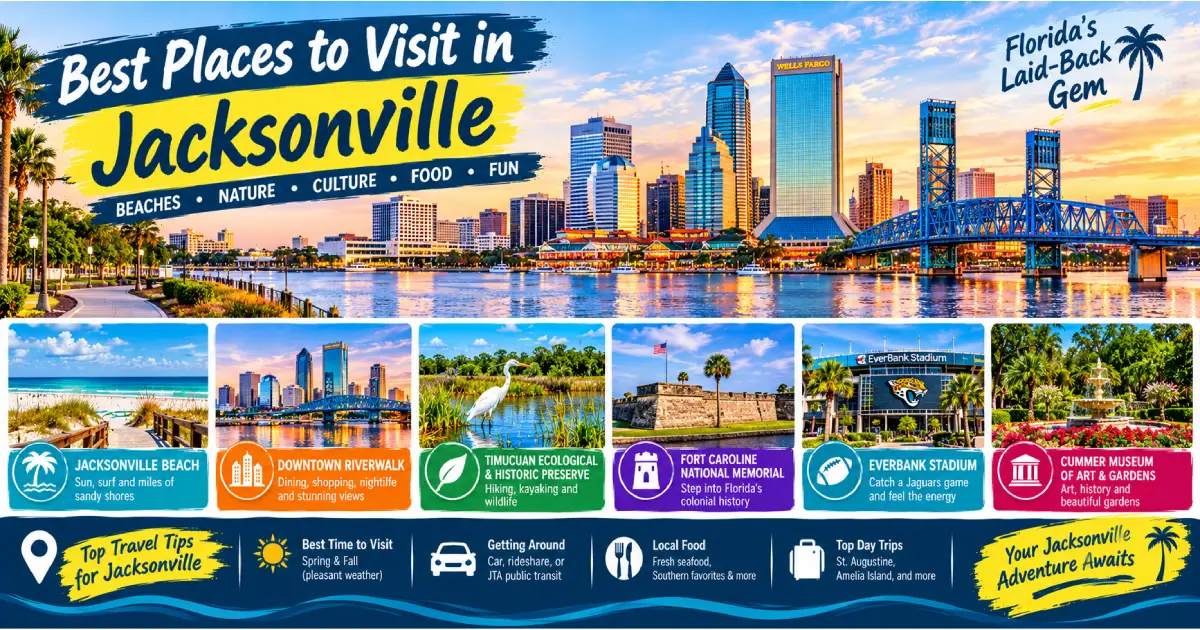
Jacksonville rewards the curious traveler. Florida’s largest city — 874 square miles of Northeast Florida spanning the St. Johns River, the Atlantic coastline, and some of the most ecologically significant undeveloped land remaining in the Eastern United States — contains more places worth visiting than most people who haven’t been there would guess. The national narrative about Florida tends to skip directly from Orlando’s theme parks to Miami’s beaches, leaving Jacksonville as a flyover on the map. That’s a mistake. Within city limits you have a world-class zoo, 22 miles of Atlantic beach communities with genuine neighborhood character, a 46,000-acre national preserve with 12,000 years of human history, a Civil War-era plantation that is the oldest in Florida, and a series of neighborhoods — Riverside, San Marco, Avondale, Springfield — that carry architectural and cultural richness built across 150 years.
The St. Johns River is the organizing feature of Jacksonville’s geography. One of the few rivers in the United States that flows north (from the interior of Florida to the Atlantic near Mayport), the St. Johns bisects the city and creates the downtown waterfront that the city has been steadily transforming over the past decade. The Northbank and Southbank Riverwalk promenades frame the river; the water taxi between them costs a dollar and is one of the small pleasures that make Jacksonville feel like a city that understands itself. Beyond downtown, the river winds through Riverside and Avondale to the west, and out through the Timucuan Preserve to the east before meeting the ocean at Fort George Inlet.
What follows is the definitive guide to the 20 best places to visit in Jacksonville — covering the well-known highlights, the underrated gems, and the day-trip destinations that make the city’s geographic position in Northeast Florida so valuable. Whether you’re arriving for a long weekend or building a week-long Florida itinerary, these are the places that justify the trip.
| Factor | Details |
|---|---|
| Top Attraction | Jacksonville Zoo and Gardens |
| Best Free Experience | Treaty Oak Park + Southbank Riverwalk |
| Best Beach | Little Talbot Island State Park (day trip) / Atlantic Beach (in-city) |
| Best Historic Site | Kingsley Plantation (NPS, free) |
| Best Neighborhood | Riverside / Avondale Historic District |
| Best Day Trip | St. Augustine (55 miles south) |
| Best Outdoor Experience | Timucuan Ecological and Historic Preserve |
$24.95 adults, $19.95 children | 370 Zoo Pkwy, North Jacksonville | Open daily 9 AM–5 PM
Jacksonville’s signature attraction, the Zoo and Gardens spans 120 acres along the Trout River and houses over 2,000 animals representing more than 400 species. The Range of the Jaguar — a 4-acre immersive Central American rainforest habitat — is widely regarded as one of the finest jaguar exhibits in North America: visitors walk winding paths through the habitat with jaguars, capybaras, giant river otters, and tropical birds visible at close range. The Emerald Forest Aviary is the largest free-flight aviary in the Southeast, where hundreds of tropical birds fly freely around visitors. The Land of the Tiger houses critically endangered Sumatran tigers. Wild Florida showcases native species — black bears, American alligators, the Florida panther, whooping cranes. The botanical gardens component — with a formal rose garden, a Florida native plant garden, and a butterfly garden — gives the zoo genuine beauty beyond its animal collection. Budget 3–4 hours; arrive at opening on weekends to beat crowds at the most popular exhibits.
Free (NPS) | Multiple entry points across Northeast Jacksonville | Open daily sunrise–sunset
One of the most undervisited national park sites in the Eastern United States, the Timucuan Preserve protects 46,000 acres of tidal salt marshes, coastal dunes, hardwood hammocks, pine flatwoods, and pristine tidal rivers in the northeast corner of Jacksonville. The preserve encompasses several distinct historic sites — Kingsley Plantation, Fort Caroline National Memorial, the Theodore Roosevelt Area — as well as miles of water trails through the Fort George River, Nassau Sound, and Broward River estuaries. The ecological significance is enormous: the salt marshes here are some of the most biologically productive habitats on the planet, supporting commercially important fisheries, nesting sea turtles, wintering shorebirds, and year-round populations of bottlenose dolphins, manatees (summer), and bald eagles. The Theodore Roosevelt Area offers 4 miles of hiking trails through maritime forest and along the St. Johns River bluff. Bring binoculars, wear bug spray, and go at low tide for the best wildlife viewing.
Free (NPS) | 11676 Palmetto Ave, Fort George Island | Open daily 9 AM–5 PM
The oldest surviving plantation house in Florida, Kingsley Plantation was established on Fort George Island in 1814 by Zephaniah Kingsley Jr. and his wife Anna Madgigine Jai — a formerly enslaved Senegalese woman whom Kingsley freed and who became a landowner and plantation manager in her own right, a historically extraordinary circumstance that the NPS interprets with appropriate complexity. The main plantation house (tabby construction, rare and well-preserved), the kitchen house, and the remains of 25 enslaved worker cabins arranged in a semicircle form one of the most complete plantation-era ensembles in the South. The setting — surrounded by tidal marsh and ancient live oaks — is strikingly beautiful and powerfully atmospheric. Park rangers offer interpretive programs that present the full, uncomfortable history of the site without sanitizing it. Free admission. A profound Florida historical experience that goes far beyond what most visitors expect.
$5/vehicle | 12157 Heckscher Dr, Little Talbot Island | Open daily 8 AM–sunset
Twenty-five miles northeast of downtown Jacksonville, Little Talbot Island is 5 miles of pristine Atlantic barrier island beach with no hotels, no condos, no commercial development — just wide, wind-swept sand, sea oats-covered dunes, and the Atlantic Ocean at its most elemental. The island’s interior is maritime scrub forest and tidal marsh, home to armadillos, river otters, bobcats, and over 200 bird species. Loggerhead sea turtles nest here from May through August. The adjacent Big Talbot Island offers “boneyard beach” — a dramatic shoreline of wind-bleached, wave-polished dead oak and cedar trunks, created by the advancing ocean claiming the maritime forest. The combination of Little and Big Talbot Islands (Big Talbot: $3/vehicle) is one of the finest natural day trips in Florida. Camping available at Little Talbot ($24/night, reserve at ReserveAmerica).
$15 adults, $6 children | 829 Riverside Ave, Riverside | Tue–Sat 10 AM–4 PM, Sun noon–4 PM
Jacksonville’s finest cultural institution, the Cummer occupies a gracious 1961 building (expanded twice since) on the west bank of the St. Johns River in Riverside and houses a permanent collection of more than 5,000 works spanning 5,000 years. The strength of the collection lies in its European Old Masters (Rubens, Van Dyck, Cranach), its exceptional Meissen porcelain holdings (one of the finest in the United States), its American paintings from the 18th and 19th centuries, and a thoughtful collection of Japanese decorative arts. The formal riverside gardens — designed in the early 20th century and extensively restored in the 1990s — are among Jacksonville’s most beautiful outdoor spaces: terraced lawns, a wisteria-draped pergola, English and Italian garden sections, and an unobstructed view of the St. Johns River. Free on Tuesday evenings 4–9 PM. The museum’s scale — thoroughly satisfying without being overwhelming — makes it an ideal 2-hour visit.
Free | 1209 Prudential Dr, Southbank | Open daily sunrise–sunset
A single ancient tree that has become one of Jacksonville’s most beloved landmarks: a live oak estimated to be 250 years old, with a canopy spread of 188 feet and a trunk circumference of 25 feet, draped in Spanish moss and standing in a small riverside park on the St. Johns River Southbank. To stand beneath the Treaty Oak is to experience a kind of quiet awe that is difficult to manufacture — the tree was alive during the American Revolution, predates every building in Jacksonville, and has weathered every hurricane, freeze, and flood the region has produced for two and a half centuries. The park around it is small and beautifully maintained, with Riverwalk access and river views. Bring a book. Stay longer than you planned.
Castillo $15; Historic District free | 55 miles south of Jacksonville | Drive: 50 min
The oldest continuously occupied European settlement in the continental United States, established by Spain in 1565 — 42 years before Jamestown, 55 years before Plymouth Rock — St. Augustine is Jacksonville’s indispensable day trip. The Castillo de San Marcos (1672) is the oldest masonry fort in the US and one of the most impressive military structures on the East Coast: a coquina-stone fortress on Matanzas Bay that survived every siege, bombardment, and storm thrown at it for 350 years. The Flagler College campus (Henry Flagler’s 1888 Ponce de León Hotel, now one of Florida’s most beautiful college campuses) anchors the historic district. St. George Street is the pedestrian spine of the old city — brick paving, 18th-century building facades, galleries, restaurants, and ghost-tour operators. The Lightner Museum (in Flagler’s Alcazar Hotel, 1888) houses an extraordinary collection of Gilded Age decorative arts. A full day in St. Augustine — Castillo, Flagler College tour, St. George Street, lunch at one of the old-city restaurants — is one of the finest historical travel days in the Eastern United States.
Free (30 miles north); Ft. Clinch State Park $5/vehicle | Drive: 35–40 min
Amelia Island is the northernmost of Florida’s Atlantic barrier islands, just across the Nassau River from the Georgia border, and it carries a weight of history disproportionate to its modest size: eight flags have flown over the island (French, Spanish, British, Patriots, Green Cross of Florida, Mexican Patriot, United States, and Confederate — the most of any place in the US), and the layered cultural heritage is visible everywhere in Fernandina Beach’s architecture and character. The 50-block Victorian-era historic district on Centre Street is one of the most intact in Florida — 19th-century storefronts, a working shrimp dock (the American commercial shrimping industry began here in the 1880s), and independent restaurants with genuine personality. Fort Clinch State Park on the island’s north end has a beautifully preserved Civil War-era brick fortification with sweeping ocean views and an excellent beach on both the ocean and river sides. The island’s beaches — wide, uncrowded, backed by maritime forest and dunes — are among the finest in Florida.
Free | West side of St. Johns River, 2 miles from Downtown
Jacksonville’s most walkable and architecturally rich neighborhood complex, Riverside and Avondale comprise a swath of late 19th and early 20th century residential architecture — craftsman bungalows, Queen Anne Victorians, Mediterranean Revival apartment buildings, and Tudor Revival cottages on tree-lined streets with enormous live oaks. The commercial heart is the Five Points area in Riverside, where Park Street and Margaret Street intersect in a small but vibrant strip of indie coffee shops (Bold Bean), vintage stores, bars, and restaurants including Black Sheep and Orsay. The Riverside Arts Market operates under the Fuller Warren Bridge every Saturday. Avondale focuses on St. Johns Avenue, with boutiques and Biscottis café. The Cummer Museum anchors the Riverside Ave riverfront. An afternoon of walking these streets — coffee at Bold Bean, browse the farmers market, museum visit, dinner at a neighborhood restaurant — is a quintessentially Jacksonville experience.
Free | San Marco Blvd at Hendricks Ave, 3 miles south of Downtown
Built in the 1920s as an upscale residential development along Mediterranean Revival lines, San Marco has aged into Jacksonville’s most distinguished neighborhood — a place where the original vision has been preserved and enhanced rather than replaced. San Marco Square is the neighborhood’s heart: a small Italian-influenced piazza with three fountain sculptures of lions, surrounded by independent restaurants (bb’s, Town Hall), wine bars (Olio), boutiques, and the San Marco Bookstore (one of Florida’s finest independent bookshops, in operation for decades). The surrounding residential streets are dense with stucco villas and red-tile roofs under massive live oaks. Balis Park at the neighborhood’s western edge provides riverfront access to the St. Johns. San Marco rewards a slow afternoon — bookstore browsing, lunch, a walk through the residential streets, and dinner at one of the square’s restaurants.
Free (parking fees vary) | 20 miles east of Downtown
Jacksonville’s three beach communities are distinct in character despite sharing a continuous strand. Atlantic Beach is the quietest and most residential — locals’ preference when they want fewer tourists. Neptune Beach, centered on 3rd Street, is the most charming: walkable, with excellent independent restaurants (Safe Harbor Seafood, Ocean 60) and a low-key neighborhood feel. Jacksonville Beach is the most developed, with a pier, volleyball courts, a boardwalk, and the highest concentration of bars and restaurants. All three are genuine communities rather than resort strips, with year-round populations and the personality that comes from decades of neighborhood character accumulation. The water is Atlantic — cleaner and more energetic than the Gulf side of Florida, with consistent small surf. The beaches are busiest on summer weekends but manageable year-round.
Free (NPS) | 12713 Fort Caroline Rd, within Timucuan Preserve | Open daily 9 AM–5 PM
In 1564, a group of French Huguenot colonists under René Goulaine de Laudonnière established Fort Caroline on the south bank of the St. Johns River — one of the earliest European settlements in what is now the United States and the first Protestant settlement in North America. The colony was massacred by Spanish forces under Pedro Menéndez de Avilés in 1565, who then established St. Augustine 40 miles south. The National Park Service maintains a reconstructed fort and a visitor center that presents this overlooked chapter of American history — the French attempt to establish a colonial foothold in Florida, the Timucua people who inhabited the region, the Spanish-French religious and imperial rivalry — with clarity and depth. The setting within the Timucuan Preserve, overlooking the St. Johns River from the south bank, is evocative. Free admission; pairs naturally with Kingsley Plantation for a full day in the Preserve.
$15 adults, $11 children | 1025 Museum Circle, Southbank Riverwalk | Mon–Sat 10 AM–5 PM
MOSH sits directly on the Southbank Riverwalk, making it naturally integrated into a Riverwalk day. The museum’s two floors cover Northeast Florida’s natural history and human history from multiple angles: the Currents of Time gallery traces 12,000 years of occupation from the Timucua people through to the 20th century; the Florida Naturalist’s Center showcases the region’s biodiversity with live animals and interactive exhibits; the Alexander Brest Planetarium runs daily shows on astronomy and space exploration. The museum is family-oriented without being exclusively for children — the historical content is substantive for adult visitors. A 2-hour visit covers the highlights without fatigue.
$8/vehicle, $1/pedestrian | Heckscher Dr at Mayport | Runs daily, 6:20 AM–10 PM
One of Florida’s last remaining car ferries, the Mayport Ferry crosses the St. Johns River at its mouth — connecting Heckscher Drive on the south bank to Mayport Village on the north bank, a distance of about half a mile. The crossing takes 10 minutes and costs $8 per vehicle (or $1 for walk-ons). The view from the ferry — the wide river mouth, the Atlantic Ocean visible beyond, shrimp boats at dock in Mayport — is worth the price regardless of where you’re going. Mayport Village itself is a working fishing community at the mouth of the St. Johns River and home to several excellent seafood restaurants serving the day’s catch. The ferry is also the main access point for Little Talbot Island when approaching from the south. A short, cheap, and genuinely charming piece of old Florida infrastructure.
Varies by event | 128 E Forsyth St, Downtown
Built in 1927 as a movie palace with a Spanish Baroque atmospheric interior — vaulted ceiling painted to simulate an open night sky, elaborately carved archways, and a 1,700-seat auditorium — the Florida Theatre is one of the Southeast’s best-preserved examples of the grand movie palace tradition. Elvis Presley performed here in 1956; the Ed Sullivan Show taped a segment here the same year. Meticulously restored, the Florida Theatre now hosts concerts, comedy, Broadway touring productions, and classic film screenings year-round. Even outside of an event, the exterior on Forsyth Street is worth seeing as part of a downtown walk. Check floridatheatre.com for current programming.
Beach: free | TPC Sawgrass: $250–$600+ | 20 miles south via A1A
An upscale barrier island community south of Jacksonville Beach, Ponte Vedra is most famous as the home of TPC Sawgrass — site of THE PLAYERS Championship, the PGA Tour’s unofficial “fifth major.” The Stadium Course’s 17th hole (an island green par-3 surrounded entirely by water) is one of the most photographed holes in golf. Public tee times are available but expensive and book quickly; check tpcsawgrass.com. Non-golfers come for the beach (wide, less crowded than Jacksonville Beach, excellent for long walks) and the upscale dining and shopping along A1A. THE PLAYERS Championship runs in March — attending is a bucket-list golf experience even for casual fans.
Free (NPS) | 13165 Mt. Pleasant Rd, North Jacksonville | Open daily sunrise–sunset
The hiking component of the Timucuan Preserve, the Theodore Roosevelt Area offers 4 miles of well-maintained trails through some of the finest maritime forest and coastal hammock in Northeast Florida. The Willie Browne Trail (0.7 miles) loops through ancient live oaks and slash pines to the bluff overlooking the St. Johns River — a quiet, beautiful stretch of old-growth coastal forest. The Myrtle Lake Trail (2.5 miles round-trip) passes through a variety of habitats and reaches a freshwater lake in the preserve’s interior. Bird life is exceptional year-round; the area is a designated Important Bird Area with nesting bald eagles, red-shouldered hawks, painted buntings (winter), and a remarkable diversity of warbler species during spring migration. Free, uncrowded, and genuinely excellent hiking within city limits.
Free | Under the Fuller Warren Bridge, Riverside | Every Saturday, 10 AM–3 PM
Jacksonville’s finest outdoor market, the Riverside Arts Market has operated every Saturday under the Fuller Warren Bridge along the St. Johns River since 2005. Over 100 vendors sell original art, handmade jewelry, ceramics, photography, and craft goods; food vendors range from Cuban food trucks to locally sourced farm-to-table breakfast plates; live music fills the Saturday morning air. The setting — under the bridge, with the river on one side and the Riverside neighborhood on the other — is uniquely Jacksonville. Free admission, free parking on surrounding streets. A Riverside Arts Market Saturday morning, followed by lunch at Black Sheep or Orsay and a walk through the Avondale streets, is as good as a Jacksonville day gets.
$65–$350+ (game tickets) | 1 EverBank Stadium Dr, Downtown | NFL season Sept–Jan
EverBank Stadium completed a $1.4 billion renovation in 2024, the most significant renovation in NFL stadium history, adding a canopy roof that covers all seating areas — the first fully shaded NFL stadium in the country. The stadium sits on the St. Johns River directly north of downtown, and the combination of the riverfront setting, the covered design, and the vocal Duval County fanbase makes a Jaguars home game one of the better NFL game-day experiences in the league. The EverBank Gridiron fan zone opens 4 hours before kickoff. Even non-football fans will find the stadium’s architecture and the energy of the tailgate scene worth experiencing. Check nfl.com/jaguars for the 2026 home schedule.
$8/vehicle to Honeymoon Island + $17/adult ferry | 90 miles south via Dunedin | Drive: ~90 min
Technically closer to Tampa than Jacksonville, Caladesi Island is included here because it represents the pinnacle of Gulf Coast beach day-trip experience for visitors spending multiple days in Northeast Florida. Accessible only by ferry from Honeymoon Island State Park in Dunedin, Caladesi Island has 3 miles of undeveloped Gulf beach consistently rated among the finest in the United States — the white quartz sand, the clear Gulf water, and the complete absence of commercial development combine for an experience that is genuinely exceptional. The ferry runs multiple times daily; the round trip including the state park entry fee runs about $25 per adult. Bring food and water (limited concessions on the island), sunscreen, and a full day. Worth the drive from Jacksonville for anyone who hasn’t experienced a pristine Gulf beach.
Posted By : Vinay
Latest Article
2nd Floor, 39, Above Kirti Club, DLF Industrial Area, Kirti Nagar, New Delhi, Delhi 110015



Travel Tourister is a leading Travel portal where we introduce travellers to trusted travel agents to make their journey hasselfree, memorable And happy. Travel Tourister is a platform where travellers get Tour packages ,Hotel packages deals through trusted travel companies And hoteliers who are working with us across the world. We always try to find new and more travel agents and hoteliers from every nook and corners across the world so that you could compare the deals with different travel agents and hoteliers and book your tour or hotel with the one you have chosen according to your taste and budget.
Copyright © Travel Tourister, India. All Rights Reserved

 Call
 Enquiry