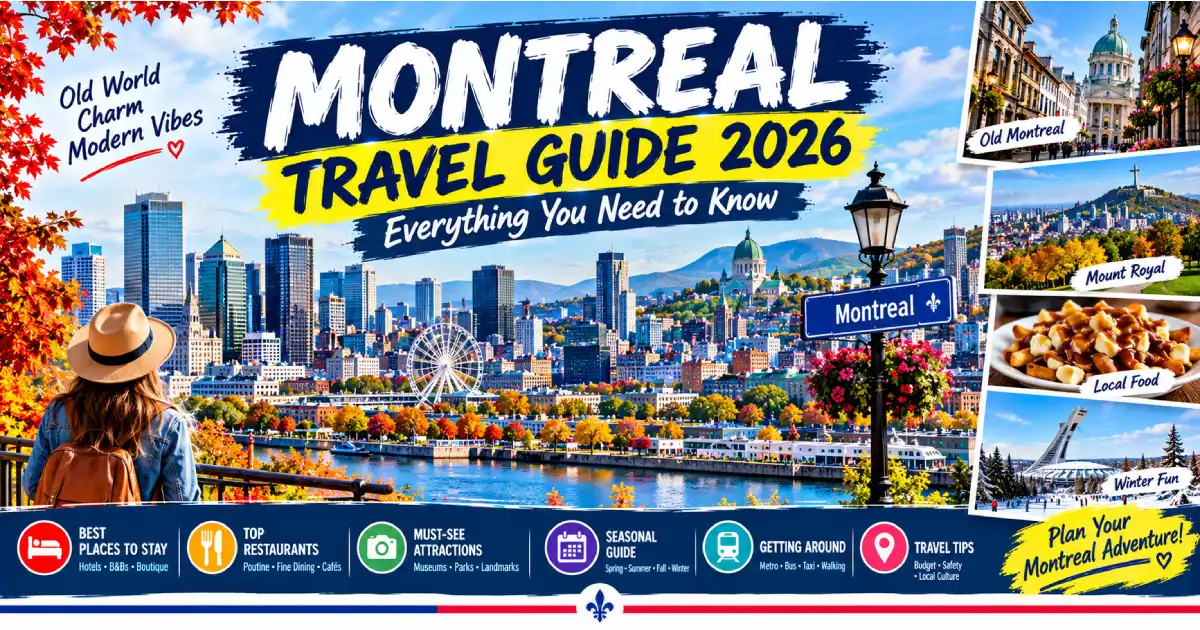
Montreal Travel Guide 2026: Everything You Need to Know
Published on : 20 Oct 2026
Montreal Travel Guide 2026 — Best Time to Visit, Top Attractions, Neighborhoods, Transit, Where to Stay, Costs in CAD, Food, Day Trips, and Insider Tips for First-Time Visitors
By Travel Tourister | Updated October 2026
This Montreal travel guide is built for visitors planning a first (or fifth) trip to Canada’s French-speaking cultural capital — an island city of about 1.8 million people (roughly 4.3 million across the metro area) where cobblestoned Old Montreal and a basilica with a star-spangled blue ceiling sit a short walk from a glass-and-steel downtown, where a forested mountain park in the middle of the city doubles as the local gym, picnic lawn, and sunset viewpoint, and where food culture — bagels, smoked meat, poutine, farm-market produce, and a nationally dominant restaurant scene — is reason enough to book the trip. Montreal feels European in its architecture and street life, North American in its scale and energy, and entirely its own in its bilingual rhythm, summer festival calendar, and winter traditions.
What makes Montreal easy for visitors is how compact and walkable its core is and how much you can do without a car. The 747 airport bus reaches downtown in about 30 to 45 minutes, the Metro connects most major attractions, Old Montreal and the Old Port are easy to explore on foot, the Plateau and Mile End reward slow wandering, and the Underground City links downtown buildings and Metro stations for winter days. English works almost everywhere in the tourist core, but a friendly “bonjour” — or the local “bonjour-hi” — opens doors, and French is the everyday language of the city. Montreal is also the natural midpoint of an Eastern Canada trip, with Toronto about five hours away by train, Quebec City about three hours, and Ottawa about two.
This Montreal travel guide covers everything needed to plan a 2026 trip — quick facts, the best time to visit, how to get from the airport and around the city (with current STM fares), the 15 best attractions, a neighborhood guide, where to stay, food, day trips, realistic costs in Canadian dollars, itineraries, safety and practical tips, and answers to the most common questions from first-time visitors. Prices, schedules, and opening hours change, so verify current information before you book.
For complete guides, see our Canada Travel Guide 2026, Best Restaurants in Canada, Canada 7 Day Itinerary, and Canada Trip Cost guides.
Quick Overview: Montreal Travel Guide at a Glance
Topic
Quick Facts
Province
Quebec, on an island in the St. Lawrence River
Population
About 1.8 million (city); roughly 4.3 million (metro area)
Language
French is the official and everyday language; English is widely spoken in tourist areas
Currency
Canadian dollar (CAD); GST (5%) and Quebec sales tax (9.975%) are added at checkout
Time Zone
Eastern Time
Airport
Montréal–Trudeau International Airport (YUL)
Airport to Downtown
747 bus, CAD 11.25 per person, which includes 24 hours of unlimited transit (verify)
Mount Royal, the Old Port, the Lachine Canal, Parc Jean-Drapeau
Art and museums
Montreal Museum of Fine Arts, Space for Life (Biodôme, Botanical Garden)
Neighborhood wandering
Plateau, Mile End, Little Italy, Old Montreal, the Village
Festivals and nightlife
Jazz Festival, Osheaga, Igloofest, Gay Village, Saint-Laurent Boulevard
Families
Old Port, Biodôme, La Ronde, Space for Life
Day trips
Quebec City, Mont-Tremblant, Eastern Townships, Ottawa
🗓️ Best Time to Visit Montreal
The best time to visit Montreal is June to September for warm weather, terraces, and the festival calendar, with late September and early October offering fall color and softer prices, and January and February offering winter festivals, skating, and cozy restaurants for visitors who can handle the cold.
Season
Typical Weather
Highlights
Drawbacks
Spring (Apr–May)
Highs about 10–19°C (50–66°F)
Fewer crowds, blossoms, terraces reopen in May
Cool, wet, and slushy early on
Summer (Jun–Aug)
Highs about 24–27°C (75–81°F)
Jazz Festival, Osheaga, terraces, Mount Royal, outdoor events
Hot and humid spells; peak prices and crowds
Fall (Sep–Oct)
Highs about 14–21°C (57–70°F)
Fall color on Mount Royal, harvest food, fewer crowds
Shorter days and cooler evenings by late October
Winter (Dec–Mar)
Highs about −5 to 3°C (23–37°F), with strong wind chill
Christmas markets, Igloofest, Montréal en Lumière, skating, Underground City
Very cold, snow and ice, short days
Insider tips: Book hotels well ahead for the Jazz Festival and other summer festivals, dress in layers year-round, and in winter use the Underground City and Metro to stay warm. For a national view, see our Best Time to Visit Canada guide.
✈️ How to Get to Montreal and Around the City
Getting there: Most international visitors fly into Montréal–Trudeau (YUL), with direct flights from North America, Europe, and beyond. VIA Rail connects Montreal’s Central Station with Toronto (about 5 hours), Ottawa (about 2 hours), and Quebec City (about 3.5 hours), and buses and rental cars cover the same routes. Amtrak and bus services connect Montreal with the northeastern United States (verify current service).
From YUL to downtown: The 747 bus runs 24 hours a day between the airport and downtown, stopping at Lionel-Groulx Metro station and downtown. The fare is CAD 11.25 per person and includes a 24-hour pass for unlimited bus and Metro travel in Zone A. A single-ride ticket does not work on the 747, and you may pay on board only with exact coins (verify), so buy a digital fare in advance or load an OPUS card. The REM light rail extension to the airport is not expected to open until at least 2027, so the 747 is still the main option.
Getting around: The STM runs the Metro and buses on a shared fare system. A single trip costs CAD 3.75 and is valid for 120 minutes across bus and Metro, a 24-hour pass costs CAD 11.25, a 3-day pass costs CAD 21.75, and an unlimited evening pass is about CAD 6.75 (July 2026 fares; verify). You pay when you enter the Metro or board a bus and do not tap out on the STM. Children 11 and under ride free with an adult. A reloadable OPUS card costs a few dollars, and the Chrono app can load fares onto an OPUS card from a phone; check whether contactless bank-card payment is available at your station, because coverage has been expanding, and always carry an OPUS card, paper ticket, or exact change as a backup. BIXI bike share, taxis, and rideshare are also available.
Insider tips: The Metro closes around 1 AM (about 1:30 AM on weekends), while buses run all night, the downtown core is very walkable, and you should avoid driving in the city center because of construction and parking costs. Fares change each July, so confirm current prices on the STM website.
🏙️ Top 15 Things to See and Do in Montreal
1. Old Montreal — Cobblestones and Place Jacques-Cartier
Cost: Free to wander | Best Time: Daytime and evenings; summer for terraces | Time Needed: 2–4 hours
Old Montreal, the city’s historic district beside the Old Port, is a maze of cobblestone streets, 17th- to 19th-century stone buildings, boutique hotels, galleries, and restaurants. Place Jacques-Cartier is its lively main square, with street performers and terraces in summer, and Bonsecours Market and the surrounding lanes reward slow exploring.
Insider tips: Visit in the early morning for photos without crowds, stay overnight for evening atmosphere, and wear comfortable shoes for the cobblestones.
2. Notre-Dame Basilica — A Star-Studded Interior
Cost: Admission roughly CAD 15–20 (verify) | Best Time: Morning or evening | Time Needed: 1–2 hours
Notre-Dame Basilica, on Place d’Armes in Old Montreal, is one of the most striking churches in North America, with a deep-blue vaulted ceiling studded with gold stars, intricate carved wood, and stained glass depicting Montreal’s history. In the evening, a light show may be offered (verify current schedule).
Insider tips: Book timed tickets online in summer, and check opening hours since church services can limit visits.
3. Mount Royal — The City’s Mountain Park
Cost: Free | Best Time: Sunset; fall for color | Time Needed: 2–4 hours
Mount Royal, the 233-meter hill that gives the city its name, is a large park designed by Frederick Law Olmsted, the landscape architect of New York’s Central Park. The Kondiaronk Belvedere offers panoramic views over downtown, and trails lead through forest to Beaver Lake and lookouts. In winter, the park is used for skiing and snowshoeing.
Insider tips: Walk up from Parc Avenue or take a bus to the belvedere, go at sunset, and bring layers since it can be breezy.
4. Jean-Talon Market — Quebec Produce and Cheese
Cost: Free to enter; food extra | Best Time: Weekday mornings; summer and fall | Time Needed: 1–2 hours
Jean-Talon Market, in Little Italy, is one of the largest open-air markets in North America, with stalls of Quebec produce, cheeses, maple products, flowers, and prepared foods. It is the best single place to taste the province’s ingredients in one visit.
Insider tips: Visit in the morning, sample cheeses and maple products, and bring a reusable bag.
5. Plateau Mont-Royal and Mile End — Bagels and Boutiques
Cost: Free to wander | Best Time: Afternoons and weekends | Time Needed: 2–4 hours
The Plateau is a colorful neighborhood of walk-up apartments with outdoor staircases, cafes, murals, and independent shops, and neighboring Mile End is home to bagel bakeries, design studios, and creative energy. Fairmount Bagel (open since 1919) and St-Viateur Bagel (open since 1957) are the two great rivals, both in Mile End.
Insider tips: Try a warm bagel from each shop, walk Saint-Laurent Boulevard and Duluth Street, and visit on a weekend afternoon for the liveliest atmosphere.
6. The Old Port and Clock Tower
Cost: Free to walk; Ferris wheel and attractions extra (verify) | Best Time: Summer evenings | Time Needed: 1–3 hours
The Old Port is a waterfront promenade along the St. Lawrence River with a clock tower, a Ferris wheel, bike paths, summer events, and in winter, skating. It sits beside Old Montreal and is an easy place to relax after sightseeing.
Insider tips: Visit at sunset, check the events calendar, and combine it with Old Montreal.
7. Montreal Museum of Fine Arts
Cost: Admission roughly CAD 25–35 (verify) | Best Time: Rainy days; weekday mornings | Time Needed: 2–4 hours
The Montreal Museum of Fine Arts, on Sherbrooke Street, is Canada’s oldest museum and one of its largest, with collections of Canadian, European, Indigenous, and contemporary art across several pavilions.
Insider tips: Check for free admission programs for young visitors and special exhibitions, and pair the visit with a walk through the nearby Golden Square Mile.
8. The Underground City — Winter’s Secret Network
Cost: Free | Best Time: Winter and rainy days | Time Needed: 1–2 hours
The Underground City (RESO) is a network of pedestrian tunnels linking shopping centers, office towers, Metro stations, hotels, and attractions beneath downtown, and it lets winter visitors move around in comfort.
Insider tips: Use a map or app since signage can be confusing, and treat it as a convenient connector rather than a destination.
9. Pointe-à-Callière — Archaeology and History Museum
Cost: Admission roughly CAD 25–35 (verify) | Best Time: Any day | Time Needed: 2–3 hours
Pointe-à-Callière Museum, in Old Montreal, is built on the site where the city was founded and lets visitors walk through archaeological remains and exhibits that tell Montreal’s story from its Indigenous roots to the present.
Insider tips: Book tickets online and allow time for the underground exhibits.
10. Saint Joseph’s Oratory
Cost: Free to enter; donations welcome; some areas have fees | Best Time: Daytime | Time Needed: 1–2 hours
Saint Joseph’s Oratory is a huge basilica on the slopes of Mount Royal, with one of the largest church domes in the world and sweeping views over the city. It is a major pilgrimage site and an architectural landmark.
Insider tips: Take a bus or Metro to Côte-des-Neiges and respect the religious setting, and expect many stairs.
11. Space for Life — Biodôme, Botanical Garden, and Olympic Park
Cost: Admission roughly CAD 25–35 per site; combination passes available (verify) | Best Time: Any day; rainy days | Time Needed: Half day
Space for Life groups several attractions around Olympic Park in the east of the city: the Biodôme, which recreates ecosystems of the Americas, the Botanical Garden and Insectarium, and the Planetarium. The Olympic Stadium’s inclined tower, the tallest of its kind in the world, offers views of the city.
Insider tips: Choose one or two sites rather than trying to see everything, take the Metro to Viau or Pie-IX, and check combo ticket options.
12. Parc Jean-Drapeau — Expo 67 Islands
Cost: Park free; Biosèphere and La Ronde extra (verify) | Best Time: Summer | Time Needed: Half day
Parc Jean-Drapeau covers Île Sainte-Hélène and Île Notre-Dame, built for Expo 67, and includes the Biosèphere, an environment museum in a geodesic dome, the La Ronde amusement park, a beach, picnic lawns, and the Circuit Gilles Villeneuve, which hosts the Canadian Grand Prix. It also hosts the Osheaga music festival in early August.
Insider tips: Take the Metro to Jean-Drapeau station, check event dates since closures and crowds change, and bring sun protection in summer.
13. Cycle the Lachine Canal
Cost: BIXI day pass roughly CAD 5–10 (verify) | Best Time: May–October | Time Needed: 2–4 hours
The Lachine Canal is a historic waterway with a paved bike and walking path that runs from the Old Port toward the southwest of the island, past Atwater Market, converted factories, and green space. BIXI bike share stations make it easy to ride a section without owning a bike.
Insider tips: Ride in the morning to avoid crowds, stop at Atwater Market for food, and carry water and sun protection.
14. The Village — Montreal’s Gay Village
Cost: Free to wander | Best Time: Summer evenings; Montreal Pride in August | Time Needed: 2–3 hours
The Village, along Sainte-Catherine Street East, is one of the largest LGBTQ+ neighborhoods in North America, with bars, restaurants, shops, and in summer, a pedestrianized street lined with colorful pink balls overhead. Montreal Pride in August is its biggest event.
Insider tips: Visit in the evening for the liveliest atmosphere, check Pride dates, and explore the nearby cafes and restaurants.
15. Catch a Game or a Festival
Cost: Tickets vary widely | Best Time: Seasonal | Time Needed: Evening or several days
Montreal’s calendar is packed: the Canadiens play hockey at the Bell Centre from October to April, CF Montréal plays soccer and the Alouettes play football in summer and fall, and festivals include the Montreal International Jazz Festival (late June to early July), Osheaga (early August), Igloofest (an outdoor electronic music festival in January and February), and Montréal en Lumière (late winter). Dates shift each year.
Insider tips: Book hotels early for festival weekends, buy tickets through official channels, and check schedules before booking flights.
🗺️ Montreal Neighborhood Guide
Neighborhood
Vibe
Best For
Good Base?
Old Montreal
Cobblestones, historic buildings, boutique hotels
First-timers, atmosphere
Yes, best for first-timers
Downtown
Skyscrapers, museums, shopping, Underground City
Convenience, business, museums
Yes, central
Plateau Mont-Royal
Colorful streets, cafes, boutiques
Local feel, dining
Yes, great for a local base
Mile End
Bagels, design, creative energy
Food and wandering
Day visit or stay
Little Italy and Jean-Talon
Market, cafes, Italian heritage
Food and markets
Day visit
The Village
LGBTQ+ nightlife, restaurants
Nightlife, festivals
Yes for nightlife
Griffintown and Saint-Henri
Converted warehouses, new dining
Dining and Lachine Canal
Yes for trendy stays
Westmount and Outremont
Quiet, residential, upscale
Peaceful strolls
Less central
Olympic Park area
Museums and parks
Space for Life
Day visit
🏨 Where to Stay in Montreal
For first-time visitors, the best base is Old Montreal or Downtown, close to the Metro, the Old Port, and major sights. The Plateau suits travelers who want a local, neighborhood feel, and the Village and Griffintown suit nightlife and trendy stays.
Level
Typical Nightly Rate (Per Room)
Notes
Hostel dorm bed
CAD 35–70
Downtown and Plateau
Budget
CAD 100–170
Budget hotels and small guesthouses
Mid-Range
CAD 180–300
Three- and four-star hotels
Luxury
CAD 400+
Five-star and boutique hotels in Old Montreal and downtown
Rates rise during the Jazz Festival, Osheaga, the Canadian Grand Prix, and other major events, and are lowest in January and February. Hotel stays carry 5 percent GST, 9.975 percent Quebec sales tax, and a lodging tax of about 3.5 percent, which comes to roughly 18 to 19 percent on top of the quoted rate (verify with your hotel).
Insider tips: Book early for summer festivals, stay near a Metro station, and consider an Old Montreal stay for atmosphere or the Plateau for value.
🍽️ Where to Eat in Montreal
Montreal is one of the best food cities in Canada. Canada’s 100 Best 2026 ranked Mon Lapin second, Beba sixth, and Le Violon eighth nationally, with Montreal alone placing a large share of the full list, and Mastard in Montreal holds a Michelin star in the 2026 Quebec guide.
Must-try bites: Montreal bagels (Fairmount, open since 1919, and St-Viateur, open since 1957), smoked meat at Schwartz’s (open since 1928), poutine, and market treats at Jean-Talon.
Food neighborhoods: Mile End and the Plateau for bagels and brunch, Little Italy and Jean-Talon for markets, Old Montreal for fine dining, and Saint-Laurent Boulevard for nightlife.
Splurge: Book Mon Lapin or Mastard weeks ahead, and consider Au Pied de Cochon for Quebec indulgence.
About 255 km, 3 hours by car, about 3.5 hours by train
Old Quebec, Château Frontenac, Montmorency Falls
Ottawa
About 200 km, 2 hours
Parliament Hill, Rideau Canal, museums
Mont-Tremblant
About 130 km, 1.5 hours
Skiing, village, hiking
Eastern Townships
About 1–1.5 hours
Wineries, Magog, Sutton, hiking
Laurentians (Saint-Sauveur)
About 1 hour
Outdoor activities, spas
Mont-Saint-Hilaire
About 35 minutes
Apple orchards, hiking
Insider tips: Quebec City works best as an overnight, and winter driving requires winter tires (required by law in Quebec from December 1 to March 15). See our Canada 7 Day Itinerary guide for how Montreal fits into a longer trip.
💰 How Much Does a Trip to Montreal Cost?
The table below shows estimated costs per person per day in Canadian dollars, assuming two travelers sharing a room and excluding international flights and hotel taxes.
Cost Category
Budget
Mid-Range
Luxury
Accommodation (per room per night)
CAD 100–170
CAD 180–300
CAD 400+
Food (per person per day)
CAD 45–75
CAD 85–140
CAD 200+
Local transit (per day)
CAD 9–12
CAD 11–35
CAD 60+
Attractions (per day)
CAD 20–40
CAD 50–110
CAD 180+
Estimated Daily Total (Per Person)
CAD 125–215
CAD 250–430
CAD 620+
A three-day trip therefore costs roughly CAD 375 to 645 per person on a budget, CAD 750 to 1,290 mid-range, and CAD 1,860 or more for luxury, before flights and hotel taxes. Montreal is generally cheaper than Toronto for hotels and transit.
Insider tips: Menu and shelf prices exclude taxes, restaurant tips of 15 to 20 percent are standard, a 24-hour or 3-day transit pass keeps transit costs low, and many top experiences (Mount Royal, Old Montreal, the Old Port, and Jean-Talon Market) are free. For a national view, see our Canada Trip Cost guide.
🧳 Sample Montreal Itinerary
Day
Morning
Afternoon
Evening
Day 1: Old Montreal
Notre-Dame Basilica and Place Jacques-Cartier
Pointe-à-Callière and the Old Port
Dinner in Old Montreal (Au Pied de Cochon or a bistro)
Day 2: Mount Royal and Markets
Bagels in Mile End, then Mount Royal
Jean-Talon Market and Schwartz’s smoked meat
Plateau dinner or Mon Lapin or Mastard (book ahead)
Montreal is generally safe for visitors; use normal city precautions, watch for pickpockets in crowded areas and on the Metro, and never leave valuables in a parked car
Language
French is the everyday language; start with “bonjour” and most staff will switch to English if needed
Weather
Hot and humid summers, very cold winters with strong wind chill; pack layers and a waterproof jacket
Metro Hours
The Metro closes around 1 AM (1:30 AM on weekends); buses run all night
Underground City
Useful for winter and rainy days; use a map or app
Tipping and Taxes
5% GST and 9.975% Quebec sales tax at checkout; tip 15–20% in restaurants, bars, and taxis
Alcohol and Cannabis
The legal age is 18 for alcohol and 21 for cannabis in Quebec
Driving
Avoid driving downtown; winter tires are required by law from December 1 to March 15
Moving Day
July 1 is Quebec’s traditional moving day, when many leases end; expect busy streets and trucks in some neighborhoods
Insurance
Medical insurance is essential because provincial health plans do not cover visitors
Emergency
Call 911 for police, fire, or ambulance
Frequently Asked Questions: Montreal Travel Guide
How many days do I need in Montreal?
Three to four days is ideal for Old Montreal, Mount Royal, the Plateau, markets, a museum, and food, and an extra day or two lets you add Quebec City, Mont-Tremblant, or Ottawa.
Is Montreal worth visiting?
Yes. Montreal combines European-style architecture, outstanding food, a vibrant festival calendar, and a distinctive bilingual culture, making it one of Canada’s best destinations and a natural stop between Toronto and Quebec City.
What is the best time to visit Montreal?
June to September offers the warmest weather and the biggest festivals, late September to early October offers fall color and fewer crowds, and winter offers festivals, skating, and cozy restaurants for visitors who can handle the cold.
Is Montreal expensive?
Montreal is moderately priced, generally cheaper than Toronto for hotels and transit. Taxes and tips add to costs, but free attractions and affordable transit help keep a trip manageable.
Do I need to speak French in Montreal?
No. English is widely spoken in tourist areas, but greeting people in French with a friendly “bonjour” is appreciated and often leads to a switch to English.
Is Montreal safe for tourists?
Montreal is generally safe, but visitors should take normal city precautions, watch for pickpockets in crowded areas, and keep valuables out of parked cars.
How do I get from Montreal airport to downtown?
The 747 bus runs 24 hours a day to downtown and costs CAD 11.25, including a 24-hour transit pass. The REM airport extension is not expected until at least 2027. Verify current fares and how to buy your ticket.
Is Montreal cheaper than Toronto?
Generally yes for hotels and public transit, though flights, taxes, and restaurant tips are similar. A single STM trip costs CAD 3.75 compared with CAD 3.30 for a TTC fare in Toronto, but Montreal’s day and monthly passes are cheaper.
Final Verdict: Montreal Travel Guide
Montreal is one of the most rewarding and walkable big cities in Canada for first-time visitors: compact enough to see the highlights in three or four days, rich enough in food, festivals, and neighborhoods to reward repeat visits, and perfectly placed between Toronto, Quebec City, and Ottawa for a longer Eastern Canada trip.
For most travelers, the best plan is to stay in Old Montreal or Downtown, spend one day on Old Montreal and the Old Port, one on Mount Royal, the Plateau, Mile End, and Jean-Talon Market, and one on a museum, Parc Jean-Drapeau, or a day trip, and book one or two destination dinners well ahead. Travel in June to September or early October for the best weather and festivals, use the STM transit passes to keep costs low, greet everyone with a friendly “bonjour,” and plan Montreal as part of a longer Canadian adventure.
About Travel TouristerTravel Tourister’s destination specialists have explored Montreal from Old Montreal and Notre-Dame Basilica to Mount Royal, the Plateau, Mile End, Jean-Talon Market, and its Michelin-recognized restaurants — to deliver the most practical and honest Montreal travel guide for every type of 2026 traveler.Want help planning your Montreal trip? Our specialists can help you choose the right season and hotel area, book top restaurants and festivals early, add Quebec City and other day trips, and build a realistic budget before you commit to non-refundable bookings.
Posted By : Vinay
As a lead contributor for Travel Tourister, Vinay is dedicated to serving our Tier 1 audience (US, UK, Canada, Australia). His mission is to deliver precise, fact-checked news and actionable, data-driven articles that empower readers to make informed decisions, minimize travel risks, and maximize their adventure without compromising safety or budget.
Travel Tourister is a leading Travel portal where we introduce travellers to trusted travel agents to make their journey hasselfree, memorable And happy. Travel Tourister is a platform where travellers get Tour packages ,Hotel packages deals through trusted travel companies And hoteliers who are working with us across the world. We always try to find new and more travel agents and hoteliers from every nook and corners across the world so that you could compare the deals with different travel agents and hoteliers and book your tour or hotel with the one you have chosen according to your taste and budget.



 Call
 Enquiry