Published on : 20 Oct 2026
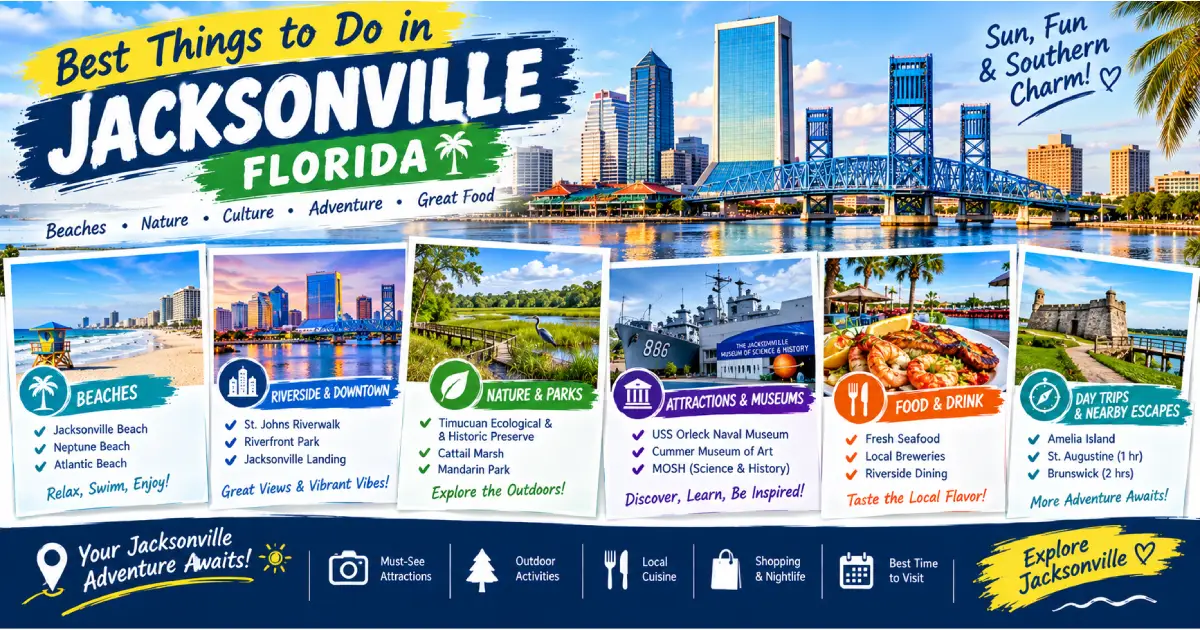
Jacksonville doesn’t get nearly enough credit. Florida’s largest city by area — bigger than Los Angeles, bigger than New York City proper, sprawling across 874 square miles of Northeast Florida — has spent the past decade quietly assembling one of the most diverse activity rosters on the East Coast. You have a world-class zoo, 22 miles of Atlantic beaches within city limits, a nationally recognized museum complex in the San Marco neighborhood, an NFL franchise with one of the league’s most passionate fanbases, and a Southside culinary scene that has drawn James Beard attention in recent years. The St. Johns River bisects the city and creates a dramatic downtown waterfront — the Northbank and Southbank promenades face each other across the water, connected by a water taxi that costs a dollar and feels like a little gift every time you ride it.
What Jacksonville offers that most Florida cities don’t is authentic Southern character. This is North Florida, geographically and culturally closer to Savannah and Charleston than to Miami, and the city carries that heritage in its architecture, its food, and the easy, unhurried pace of its best neighborhoods. The Riverside and Avondale Historic District is filled with bungalows and craftsman homes, independent restaurants, and neighborhood bars that have been operating for decades. San Marco’s Mediterranean Revival architecture and its village square make it feel like a town unto itself. Fernandina Beach and Amelia Island — 30 minutes north — is one of the most charming coastal towns on the East Coast. And the beaches — Jacksonville Beach, Neptune Beach, Atlantic Beach — are real, year-round communities with personality far beyond the typical Florida resort strip.
First-time visitors are often surprised by how spread out Jacksonville is and how much it rewards a few days of exploration. The city doesn’t reveal itself in a single afternoon. Give it three days and you’ll come away with a genuine affection for a Florida city that has been doing things its own way for a very long time.
| Factor | Details |
|---|---|
| Location | Northeast Florida, Duval County |
| Known For | 22 miles of beaches, St. Johns River, Jaguars NFL, Jacksonville Zoo |
| Best Neighborhoods | Riverside/Avondale, San Marco, Jacksonville Beach, Downtown |
| Top Free Activities | Southbank Riverwalk, Riverside Arts Market, Treaty Oak Park, beaches |
| Best for | Beach lovers, nature, history, sports fans, food explorers |
| Nearest Airport | Jacksonville International Airport (JAX) — 14 miles north of downtown |
Entry: $24.95 adults, $19.95 children | Hours: 9 AM–5 PM daily
One of the Southeast’s finest zoological institutions, Jacksonville Zoo and Gardens spans 120 acres along the Trout River and houses over 2,000 animals representing 400+ species. The Range of the Jaguar — a 4-acre immersive Central American habitat — is consistently cited as one of the best jaguar exhibits in North America. The Emerald Forest Aviary is the largest free-flight aviary in the Southeast, where visitors walk among hundreds of tropical birds. The Great Apes exhibit features lowland gorillas and chimpanzees in naturalistic habitats. Land of the Tiger houses Sumatran tigers. The Wild Florida exhibit showcases native Florida wildlife including black bears, American alligators, and the endangered Florida panther. The botanical gardens component — with formal gardens, a butterfly garden, and a native plant section — makes the zoo genuinely beautiful as well as educational. Budget 3–4 hours for a thorough visit; arrive early on weekends.
Entry: Free (parking fees apply) | Best: Atlantic Beach, Neptune Beach, Jacksonville Beach
Jacksonville is one of the few major American cities with Atlantic Ocean beaches within city limits, and the three main beach communities — Jacksonville Beach, Neptune Beach, and Atlantic Beach — each have distinct personalities. Atlantic Beach is the quietest and most residential, favored by locals who want fewer tourists and genuine neighborhood character. Neptune Beach is the middle ground — charming, walkable, with excellent restaurants on the main drag (3rd Street). Jacksonville Beach is the most developed, with a fishing pier (free to walk, $3 to fish), beachside volleyball courts, a boardwalk, and the highest concentration of bars and restaurants. All three beaches are connected by a continuous strand; parking is free in many areas with meters or pay lots near the busier sections. The water is the Atlantic — cooler than the Gulf side of Florida but perfectly swimmable May through October.
Entry: Free | Hours: Saturday 10 AM–3 PM (year-round, under the Fuller Warren Bridge)
One of Florida’s best outdoor markets, the Riverside Arts Market has operated under the Fuller Warren Bridge along the St. Johns River every Saturday since 2005. Over 100 vendors sell original art, handmade jewelry, ceramics, photography, woodwork, and food. Live music plays throughout the morning. Food vendors range from excellent Cuban food trucks to locally sourced farm-to-table breakfast options. The setting — under the bridge, with the St. Johns River on one side and the Riverside neighborhood on the other — is uniquely Jacksonville. Free admission, free parking in surrounding streets and nearby lots. A genuine community institution that rewards a leisurely Saturday morning.
Entry: $15 adults, $6 children | Hours: Tue–Sat 10 AM–4 PM, Sun noon–4 PM
Jacksonville’s finest art museum, the Cummer occupies a 1961 building (with subsequent expansions) on the west bank of the St. Johns River in Riverside. The permanent collection spans 5,000 years of art history — ancient Egyptian artifacts, European Old Masters (including works by Rubens, Van Dyck, and Cranach), American paintings from the 18th and 19th centuries, Japanese woodblock prints, and an outstanding collection of Meissen porcelain (one of the finest in the United States). The museum’s formal gardens, designed in the early 20th century and restored in the 1990s, extend to the St. Johns River waterfront and are among Jacksonville’s most beautiful outdoor spaces. Free on Tuesday evenings 4–9 PM. The museum’s scale is manageable — 2 hours is sufficient for a thorough visit without fatigue.
Entry: Free | Location: 1209 Prudential Dr, Southbank
One of Jacksonville’s most beloved living landmarks, the Treaty Oak is a 250-year-old live oak tree with a canopy spread of 188 feet, making it one of the largest and oldest live oak trees in Florida. The tree predates the United States itself, and local legend holds that it marked a boundary between Native American territories (hence “treaty”). Positioned in a small waterfront park on the Southbank of the St. Johns River, Treaty Oak is surrounded by the green expanse of Treaty Oak Park. Bring a blanket and a book. The Spanish moss-draped canopy, the river views, and the scale of the tree — you have to stand beneath it to appreciate the full spread — make this a genuinely moving experience. Free, open daily sunrise to sunset.
Entry: Free | Length: 1.2 miles Northbank + 1.5 miles Southbank
The St. Johns River Riverwalk is Jacksonville’s outdoor living room. The Southbank Riverwalk (1.5 miles) runs from the Main Street Bridge past Treaty Oak Park and the Museum of Science & History to the Friendship Fountain (one of the largest fountains in the United States when built in 1965; recently restored to full operation). The Northbank Riverwalk runs along Downtown’s riverfront past Riverfront Plaza and Friendship Park. The two promenades are connected by the St. Johns River Taxi (water taxi, $1 each way) that shuttles passengers between the Northbank and Southbank landings every 30–45 minutes. The views of the city across the river, the drawbridges, and the working waterway make a Riverwalk walk a distinctly Jacksonville experience.
Entry: Free (National Park Service) | Location: Fort George Island, 25 miles north of downtown
The oldest surviving plantation house in Florida, Kingsley Plantation was established in 1814 by Zephaniah Kingsley Jr. and his wife Anna Madgigine Jai (a formerly enslaved Senegalese woman who was freed by Kingsley and became a plantation manager and landowner in her own right — a complex and historically significant story). The site is now managed by the National Park Service as part of Timucuan Ecological and Historic Preserve. The main plantation house, the kitchen house, and the remains of 25 tabby-construction enslaved worker cabins are preserved. Rangers offer interpretive talks that engage honestly with the plantation’s history. The setting on Fort George Island — surrounded by tidal marshes, maritime forest, and the Fort George River — is strikingly beautiful. Free. Open daily 9 AM–5 PM. A profound and important Florida historical site that is genuinely undervisited.
Entry: $5/vehicle | Location: 25 miles northeast of downtown
One of the finest undeveloped barrier island beaches on the entire East Coast, Little Talbot Island has 5 miles of pristine Atlantic beach with almost no development — no hotels, no condos, no boardwalk. The island’s interior is maritime scrub forest and tidal marshes, home to armadillos, river otters, bobcats, and over 200 bird species. The beach itself is wide, clean, and frequently wind-scoured, with loggerhead sea turtles nesting from May through August. Campsites available (reserve at ReserveAmerica). The adjacent Big Talbot Island offers dramatic “boneyard beach” — wind-bleached tree trunks on a dark-sand beach created by erosion, one of the most photogenic coastal landscapes in Florida. The combination of Little and Big Talbot makes for an extraordinary nature day trip.
Entry: $15 adults, $11 children | Hours: Mon–Thu 10 AM–5 PM, Fri–Sat 10 AM–8 PM, Sun noon–5 PM
MOSH sits on the Southbank Riverwalk and offers a genuinely engaging mix of natural history, Florida ecology, and hands-on science exhibits spread across two floors. The Currents of Time permanent exhibit traces 12,000 years of Northeast Florida history from the Timucua people through Spanish colonial rule, British occupation, and American statehood. The Florida Naturalist’s Center showcases the region’s remarkable biodiversity — from sea turtles and manatees to black bears and rare orchids. The Alexander Brest Planetarium within MOSH offers daily shows with a 65-seat domed theater. Family-friendly without being condescending to adults; a solid 2-hour visit.
Entry: Free | Size: 46,000 acres
One of the least-visited national parks in the Eastern United States, the Timucuan Preserve protects 46,000 acres of tidal marshes, coastal dunes, hardwood hammocks, and the pristine waters of the Nassau Sound and Fort George River estuary in Northeast Jacksonville. The preserve encompasses Kingsley Plantation, Fort Caroline National Memorial (site of a 1564 French Huguenot settlement — one of the oldest European settlements in what is now the US), Theodore Roosevelt Area (excellent hiking through maritime forest), and several boat launches for kayaking and canoeing through the salt marshes. Bird life is extraordinary, particularly during spring and fall migration. This is old-growth Florida — the real, complicated, biologically rich landscape that existed before development — and it exists within the city limits of the largest city in the contiguous United States.
Entry: Free
San Marco is arguably Jacksonville’s most beautiful neighborhood, built in the 1920s in a Mediterranean Revival style around San Marco Square — a small village square anchored by three Italian-inspired fountain sculptures of lions. The Square is ringed with independent restaurants, wine bars, boutiques, and the historic San Marco Theatre (1938). The surrounding residential streets are lined with stucco villas, red tile roofs, and enormous live oak trees draped in Spanish moss. San Marco Bookstore is one of Florida’s great independent bookshops. The neighborhood borders the St. Johns River to the west, where Balis Park provides riverfront access. San Marco rewards an afternoon of wandering — have lunch at one of the Square’s restaurants, browse the bookstore, then walk toward the river.
Entry: Free
Adjacent neighborhoods on the west side of the St. Johns River, Riverside and Avondale make up Jacksonville’s most walkable, eclectic district. The Five Points area at the heart of Riverside is a small commercial district with indie coffee shops (Bold Bean Coffee, Black Sheep Restaurant), vintage shops, bars, and restaurants packed into a few blocks. The surrounding streets are lined with craftsman bungalows, Queen Anne Victorians, and 1920s apartment buildings. Avondale proper centers on the shops and restaurants of St. Johns Avenue. The Riverside Arts Market operates here every Saturday. This is also the neighborhood that houses the Cummer Museum. Best explored on foot on a Saturday morning — market, coffee, museum, lunch.
Entry: Varies by event | Location: 128 E Forsyth St, Downtown
Built in 1927 as a movie palace, the Florida Theatre is one of the Southeast’s best-preserved atmospheric theatres, with its ornate Spanish Baroque interior — vaulted ceilings painted to simulate a starlit sky, elaborately carved archways, and a 1,700-seat auditorium — meticulously restored. Elvis Presley performed here in 1956 on one of his earliest concert tours. Today the Florida Theatre hosts a year-round calendar of concerts, comedy shows, Broadway touring productions, classic film screenings, and community events. Check the calendar at floridatheatre.com. Even if you don’t attend a show, the building’s exterior is worth seeing on a downtown walk.
Entry: Free (30 miles north of Jacksonville) | Drive: 35–40 minutes
Just north of Jacksonville across the Nassau River, Amelia Island is one of the most charming barrier islands on the East Coast — an island that has flown eight flags (French, Spanish, British, Patriots, Green Cross of Florida, Mexican Patriot, US, and Confederate) over its history and retains an architectural and cultural richness that reflects that layered past. Fernandina Beach, the island’s main town, has a 50-block Victorian-era historic district centered on Centre Street, with independent restaurants, galleries, and a working shrimp dock (the American shrimping industry traces its origins here). Fort Clinch State Park on the island’s north tip is a beautifully preserved Civil War-era fortification with ocean views and excellent beach access. Amelia Island’s beaches — wide, uncrowded, and fringed with dunes — are among the finest in Florida.
Entry: $65–$350+ | Season: September–January
The Jacksonville Jaguars play their home games at EverBank Stadium (capacity 62,000), which completed a $1.4 billion renovation in 2024 that included a new canopy roof covering all seating areas — the first fully shaded NFL stadium in the country, a genuine gift in Florida’s heat. The stadium sits in downtown Jacksonville directly on the St. Johns River, and the combination of the riverfront setting, the covered stadium, and the passionate Duval County fanbase makes a Jaguars home game one of the better NFL stadium experiences in the country. The EverBank Stadium Gridiron (a massive fan zone outside the stadium) opens 4 hours before kickoff for tailgating. Check nfl.com/jaguars for the 2026 home schedule.
Entry: Rentals $30–55/half day
The tidal salt marshes, rivers, and backwater creeks of the Timucuan Preserve and the Nassau Sound estuary offer some of the finest flatwater kayaking in Florida. Several outfitters operate guided tours and kayak rentals from locations near the beaches and the preserve: Adventure Landing (Jacksonville Beach), Kayak Amelia (Fernandina Beach), and REI Adventures Jacksonville (guided trips). The salt marshes at high tide — with dolphin sightings frequent, osprey overhead, and the occasional manatee in summer — are extraordinary. A sunrise kayak paddle through the Fort George River marsh is one of the most memorable experiences Northeast Florida offers.
Entry: Free (coffee prices) | Multiple locations
Jacksonville’s premier specialty coffee roaster, Bold Bean has been operating in Riverside since 2011 and has grown to multiple locations across the city while maintaining the quality that made it a regional standout. The Riverside flagship on Stockton Street occupies a beautifully converted space with excellent espresso drinks and single-origin pour-overs. The Jax Beach location is the best morning stop before a day at the Atlantic Beach. Bold Bean sources directly from farms in Ethiopia, Colombia, Guatemala, and other origins, and their house espresso blend is one of the best in Florida. A visit to Bold Bean is woven into the fabric of a proper Jacksonville trip.
Entry: Free | Location: 12713 Fort Caroline Rd (within Timucuan Preserve)
In 1564, French Huguenot colonists established Fort Caroline on the south bank of the St. Johns River — one of the earliest European settlements in what is now the United States. The colony ended in a Spanish massacre in 1565, but the site represents a crucial chapter in the history of European contact with North America. The National Park Service maintains a reconstructed fort and a visitor center that tells the story of the French colony, the Timucua people who inhabited the region, and the Spanish military response. The setting within the Timucuan Preserve is beautiful — the St. Johns River is visible from the fort walls, and the surrounding hammock forest looks much as it did when the French colonists arrived. Free admission.
Entry: Public access to Ponte Vedra Beach free; TPC Sawgrass golf $250–$600+
Twenty miles south of downtown Jacksonville, Ponte Vedra Beach is an upscale barrier island community best known as the home of THE PLAYERS Championship — the PGA Tour’s unofficial “fifth major,” played at TPC Sawgrass every March. Non-golfers come for the beach (wide, clean, low-key) and the dining scene along A1A. Golfers come for TPC Sawgrass, where the Stadium Course’s famous island-green 17th hole is one of the most recognizable par-3s in golf. Public tee times are available but expensive; book months in advance. THE PLAYERS Championship typically runs the second week of March; tickets are available at pgatour.com.
Entry: Museum free, grounds by event | Location: 1830 Epping Forest Dr, Riverside
The former estate of Alfred I. du Pont and his wife Jessie Ball du Pont, Epping Forest was built in 1927 and features a stunning 22,000 square foot Spanish Colonial Revival mansion on the west bank of the St. Johns River. The property operates today as a private yacht club, but the du Pont connection is significant: Alfred’s brother-in-law Ed Ball controlled the Florida East Coast Railway and much of Northern Florida’s economy for decades, and the du Pont family’s Nemours Estate in Wilmington, Delaware, is one of America’s great historic houses. The small museum within the complex tells this story. The grounds are occasionally open for public events — check the Epping Forest website. The view of the St. Johns River from the estate’s lawn is among the finest in Jacksonville.
Entry: Free
Neptune Beach — the middle of Jacksonville’s three beach communities — is where locals go when they want to avoid the Jacksonville Beach crowds. The main strip, 3rd Street, runs parallel to the ocean and is lined with genuinely excellent independent restaurants and bars. Safe Harbor Seafood (smoked fish spread, fresh shrimp), Sliders Oyster Bar (raw bar, fish sandwiches), and The Blind Rabbit (cocktail bar in a converted space) make Neptune Beach a worthy dining destination in its own right. Atlantic Beach’s Ocean 60 (market-fresh seafood) and The Seahorse are equally excellent. This stretch of beach communities — Atlantic, Neptune, Jacksonville — rewards an evening of beach bar hopping after a sunset swim.
Entry: $20–$95 | Season: September–May
The Jacksonville Symphony, founded in 1949, is one of Florida’s major professional orchestras and has seen its profile rise significantly with international tours and acclaimed recordings in recent years. Jacoby Symphony Hall in downtown Jacksonville underwent a $20 million renovation in the late 2010s and now offers exceptional acoustics and comfortable viewing from all sections. The season runs September through May with an expanded Pops series. For summer music, the Riverside Arts Market and outdoor amphitheater events fill the gap. Check jaxsymphony.org for the 2025–26 season schedule.
Entry: Varies by event
Jacksonville’s independent music scene is anchored by two excellent mid-size venues. Ponte Vedra Concert Hall (300 capacity, St. Johns County) is one of the Southeast’s best small-to-medium live music rooms — near-perfect sight lines, excellent sound, and an intimate atmosphere for national touring acts. 1904 Music Hall in downtown Jacksonville (capacity ~600) hosts local and regional acts in a converted historic space. Both venues book consistently interesting programming. Check local listings at folioweekly.com (Jacksonville’s alternative weekly) for current schedules.
Entry: Go-karts/mini golf $8–$16; waterpark (summer) $25–$35 | Location: Jacksonville Beach
A beloved Jacksonville Beach institution since 1991, Adventure Landing is a family entertainment complex directly on the oceanfront at Jacksonville Beach. The complex includes multiple mini golf courses, go-kart tracks, laser tag, arcade games, and — in summer — Shipwreck Island Water Park, a modest but fun waterpark with slides and a wave pool. It’s unapologetically fun in a retro way and a genuine Jacksonville experience. The location directly facing the Atlantic makes it a perfect complement to a beach day. Go-kart racing with an ocean breeze is a specifically Jacksonville pleasure.
Entry: Castillo de San Marcos $15 | Location: 55 miles south of Jacksonville | Drive: 50 min
Florida’s oldest city — and the oldest continuously occupied European settlement in the continental United States, established by Spain in 1565 — St. Augustine is an indispensable complement to any Jacksonville visit. The historic district centers on the Castillo de San Marcos (a 1672 Spanish stone fort, the oldest masonry fort in the US, now a National Monument), St. George Street (a pedestrian shopping and dining promenade), the Cathedral Basilica (oldest Catholic parish in the US), and the Flagler College campus (Henry Flagler’s 1888 Ponce de León Hotel, a stunning example of Spanish Renaissance architecture). The Colonial Quarter living history museum, the Lightner Museum of Gilded Age decorative arts, and the St. Augustine Lighthouse all reward several hours each. St. Augustine is realistically a full day trip from Jacksonville — leave early, take the historic trolley for orientation, walk St. George Street, tour the Castillo, and have dinner before returning. A day in St. Augustine is one of the finest historical travel experiences in the Eastern United States.
Posted By : Vinay
Latest Article
2nd Floor, 39, Above Kirti Club, DLF Industrial Area, Kirti Nagar, New Delhi, Delhi 110015



Travel Tourister is a leading Travel portal where we introduce travellers to trusted travel agents to make their journey hasselfree, memorable And happy. Travel Tourister is a platform where travellers get Tour packages ,Hotel packages deals through trusted travel companies And hoteliers who are working with us across the world. We always try to find new and more travel agents and hoteliers from every nook and corners across the world so that you could compare the deals with different travel agents and hoteliers and book your tour or hotel with the one you have chosen according to your taste and budget.
Copyright © Travel Tourister, India. All Rights Reserved

 Call
 Enquiry