Published on : 20 Oct 2026
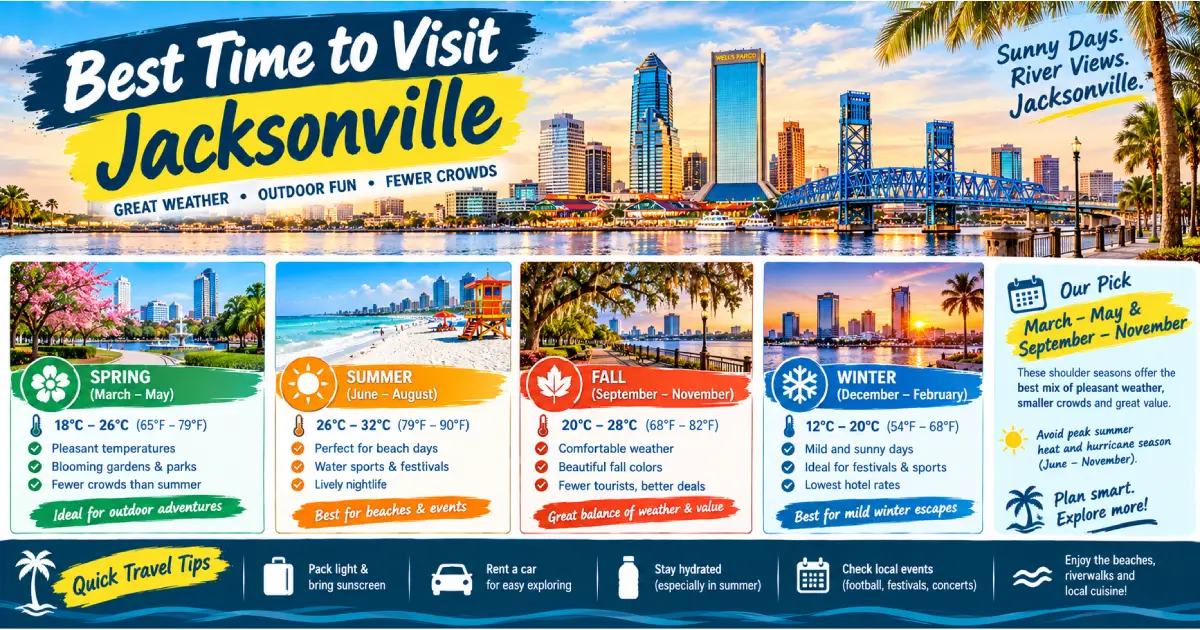
Jacksonville occupies a genuinely unique climate position among Florida’s major cities. Sitting at 30 degrees north latitude — the same as Cairo, Egypt and Shanghai, China — Northeast Florida is far enough north to experience real seasons in a way that Miami and Tampa simply don’t. Winters bring genuine cool fronts with overnight lows occasionally dipping into the 30s°F. Fall and spring are long, pleasant, and temperate. Summer is hot and humid with afternoon thunderstorms, but the heat is less relentless than South Florida and the city’s 22 miles of Atlantic beach provide a sea breeze that takes the edge off even the most oppressive July afternoons. Jacksonville averages about 233 sunny days per year, which is significantly more than New York, Chicago, or Seattle, and roughly comparable to Los Angeles.
The result is a destination with a genuinely long “good season” compared to most Florida cities. While Tampa and Miami see their best weather concentrated into a narrow November–April window before the summer heat becomes oppressive, Jacksonville’s milder latitude means that October through May is all excellent travel territory, with peak conditions occurring in October–November and March–April. The city’s location in the Atlantic time zone — same as Miami, one hour ahead of Central Florida’s theme parks — is a detail worth noting if you’re combining Jacksonville with a broader Florida itinerary.
The single best months to visit Jacksonville are October and March. October delivers the year’s best combination of warm beach water (still 73–75°F from summer), comfortable air temperatures (highs in the low-to-mid 80s°F), dramatically reduced humidity, and excellent events including the Jacksonville Jazz Festival and the opening of the outdoor concert season. March brings THE PLAYERS Championship at TPC Sawgrass, the beginning of outdoor season across the beach communities, St. Patrick’s Day celebrations in Riverside, and weather that is reliably beautiful without the summer heat. If October and March are unavailable, November and April are nearly as good.
| Factor | Details |
|---|---|
| Best Months | October, March |
| Runner-Up Months | November, April |
| Peak Season | March – April, October – November |
| Shoulder Season | February, May |
| Budget Season | June – August |
| Wettest Months | July, August |
| Driest Months | November, December, April |
| Hottest Month | July (avg high 92°F) |
| Coolest Month | January (avg high 65°F) |
| Hurricane Season | June 1 – November 30 |
| Annual Sunny Days | ~233 days per year |
| Month | Avg High °F | Avg Low °F | Sunny Days | Rainfall (in) | Humidity | Crowds |
|---|---|---|---|---|---|---|
| January | 65 | 44 | 20 | 3.3 | Low | Low-Med |
| February | 68 | 46 | 21 | 3.5 | Low | Low-Med |
| March | 74 | 51 | 23 | 3.7 | Low-Med | Medium |
| April | 80 | 57 | 25 | 2.9 | Medium | Medium |
| May | 86 | 64 | 24 | 3.4 | Med-High | Medium |
| June | 90 | 71 | 19 | 5.6 | High | Low-Med |
| July | 92 | 74 | 17 | 6.3 | High | Medium |
| August | 91 | 74 | 17 | 7.7 | High | Medium |
| September | 87 | 70 | 18 | 7.1 | High | Low |
| October | 80 | 60 | 23 | 3.4 | Medium | Medium |
| November | 73 | 51 | 22 | 2.2 | Low | Low-Med |
| December | 66 | 44 | 20 | 2.8 | Low | Low-Med |
Best for: Beach visitors, golf fans, outdoor activities, city exploration
Spring is Jacksonville’s most photogenic season. March brings the city’s most famous annual event — THE PLAYERS Championship at TPC Sawgrass in Ponte Vedra Beach, typically the second week of the month — along with warming temperatures (mid-70s°F daily highs), low humidity, and the best conditions of the year for hiking through the Timucuan Preserve. The Atlantic beach communities come alive in March and April with outdoor bars reopening their patios, beach volleyball leagues starting up, and the annual influx of visitors who time their Florida trips to the pleasant spring weather.
April is arguably the sweetest month in Jacksonville. Average highs of 80°F with low humidity, virtually no rain, and the full benefit of the year’s longest daylight hours make it ideal for everything the city offers: beach days, kayaking the salt marshes, cycling Riverside, exploring San Marco on foot. The water is still cool (around 68–70°F in April) for those who want to swim, but it warms quickly through the month.
May starts strong and gradually adds humidity as the summer pattern approaches. Early May (through roughly the 10th) retains spring character; late May begins to feel like summer. If traveling in May, the first two weeks are significantly more comfortable than the last two.
Packing: Light layers for mornings and evenings in March; t-shirts and shorts by April. Sunscreen essential year-round.
Best for: Budget travelers, families with school-age children, beach swimmers, summer events
Jacksonville summers are genuinely hot — July highs reach 92°F with humidity that makes the feel-like temperature approach 100°F on many afternoons. The Atlantic sea breeze moderates conditions on the beach, where it can feel 5–8°F cooler than inland, and the ocean water reaches 80–82°F in July and August — perfect for swimming. But the afternoon thunderstorm pattern is real: storms typically develop between 2–5 PM and can bring intense lightning and heavy rain for 30–90 minutes before clearing. Jacksonville shares the “lightning capital” distinction with Tampa (the broader Florida peninsula generates more lightning per square mile than anywhere in North America), so when thunderstorms are present, outdoor activities halt.
The summer strategy that works: start beach days before 10 AM, plan an indoor lunch or attraction for early afternoon, and return outside by 5 PM when the storms have typically cleared and the evening light on the Atlantic is extraordinary. Busch Gardens in Tampa and other Florida theme parks use this same model — morning rides, afternoon break, evening return.
The financial case for summer is strong. Hotel rates in Jacksonville drop 25–40% from spring and fall peak prices. The beach communities have fewer tourist crowds on weekdays. Summer events — the outdoor concert series at Metropolitan Park, the Springing the Blues festival in June, craft brewery festivals — fill the calendar. And the Jacksonville Zoo operates extended summer hours, making the early-morning visit worthwhile before the heat builds.
Hurricane season runs June 1 through November 30, with peak activity in August and September. Jacksonville sits in a historically lower-risk zone than South Florida — major direct landfalls are infrequent — but the risk exists, particularly from September systems. Monitor the National Hurricane Center (nhc.noaa.gov) if traveling in late summer or fall.
Packing: Lightweight fabrics, moisture-wicking shirts, a compact rain layer for afternoon storms, and SPF 50+.
Best for: All travelers; the ideal time to visit Jacksonville
October is Jacksonville’s finest month. The summer heat has broken — daily highs drop from the low-90s to a comfortable 80°F by mid-October and the mid-70s by Halloween. Humidity falls sharply, creating the crisp, clear air that makes outdoor activities genuinely pleasant rather than merely tolerable. The Atlantic water is still warm from summer (73–75°F in October), making it the ideal combination of comfortable air and swimmable ocean. Crowds are at their shoulder-season moderate level — past the peak summer beach traffic, not yet into the full-winter visitor surge. The Timucuan Preserve reaches its most beautiful state in October, with clear skies and the low golden light that makes the salt marshes and maritime forest look extraordinary.
November doubles down on the fall excellence. Highs in the low-70s°F, overnight lows in the low-50s (bring a light jacket), virtually no rain (Jacksonville’s driest month), and no humidity to speak of. The beach water cools to around 68°F — cool for swimming but excellent for long walks and photography. Kingsley Plantation and the Theodore Roosevelt hiking trails are superb in November. Downtown’s Riverwalk is a pleasure in the mild evening air. Hotel prices remain reasonable — below the January–March peak and below the October spike — making November one of the year’s best values.
Packing: T-shirts and shorts for days in October; light jacket for November evenings. One medium layer for any November cold front that pushes overnight lows toward 45°F.
Best for: Snowbird visitors, budget travelers, museum-focused trips, THE PLAYERS Championship lead-up
Jacksonville winters are mild by most national standards but genuinely cool by Florida standards — January average lows of 44°F occasionally produce overnight temperatures in the mid-30s°F during cold front passages. Snow is extraordinarily rare (it has fallen measurably in Jacksonville only a handful of times in recorded history). But the mild weather — January highs of 65°F on clear days, frequent sunshine — makes it entirely comfortable for outdoor activities with appropriate layering.
December brings the holiday lighting of downtown Jacksonville, the opening of the winter concert season at Jacoby Symphony Hall, and a genuine festive atmosphere in San Marco and Riverside. January and February are peak season for the snowbird crowd from New England and the Midwest — hotel occupancy rises and rates climb accordingly, but remain well below Miami or Tampa winter peaks because Jacksonville is less established on the snowbird circuit.
February is a particular sweet spot: the last full month before the March crowds arrive for THE PLAYERS, the weather is reliably in the mid-60s to low-70s°F on clear days, and the city’s cultural calendar (Jacksonville Symphony, Florida Theatre programming, gallery exhibitions) is at its most active. The Atlantic beach is cool but gorgeous for walks, with the winter light producing exceptional photographic conditions.
Packing: Jeans, light sweater, and a medium jacket for evenings and cold front days. T-shirts still work on warm afternoons.
Best: October, May, June–August (with early-morning strategy) The Atlantic water is warmest July–September (80–82°F) but the air-and-water combination is best in October (water still 73–75°F, air comfortable). May offers the last of the spring pleasantness before summer humidity. Avoid January–February if swimming is the goal — the Atlantic drops to 58–62°F.
Best: October, November, March, April The Timucuan Preserve, Little Talbot Island, and the Theodore Roosevelt hiking trails are all at their finest in October and November (wildlife active, no humidity, excellent light) and March–April (migrating birds, blooming coastal wildflowers, comfortable temperatures). Summer hiking is possible early in the morning but becomes unpleasant quickly after 9 AM.
Best: March (THE PLAYERS Championship second week) THE PLAYERS Championship at TPC Sawgrass is the reason to visit Ponte Vedra Beach in March. Practice rounds (Monday–Wednesday) offer excellent player access at lower ticket prices; Thursday–Sunday rounds require advance purchase. The weather in March is typically ideal for golf spectating.
Best: October–April Jacksonville’s restaurant scene — Black Sheep, Orsay, bb’s, San Marco — is year-round, but the most enjoyable time to explore it is when the evening air is comfortable enough for outdoor dining and unhurried neighborhood walks. The Jacksonville Jazz Festival (April) and Springing the Blues (May) are the cultural calendar highlights.
Best: June–August (weekdays) and January Summer weekday hotel rates are the year’s lowest, and the beach and free attractions (Timucuan Preserve, Treaty Oak, Riverside Arts Market, Riverwalk) are unaffected by the heat for morning visitors. January — post-holiday, pre-spring peak — also offers good hotel values with surprisingly pleasant weather on clear days.
Best: June–August, March (Spring Break) Summer aligns with the school calendar. The Jacksonville Zoo’s extended summer hours and Busch Gardens (Tampa, 3 hours south) make the June–August window practical despite the heat. Spring Break (typically late March) offers excellent weather but advance booking is essential and prices spike.
Best: October–November, February–March The low-angle golden light of fall and late winter — combined with Jacksonville’s Spanish moss-draped live oaks, the salt marsh landscapes of the Timucuan Preserve, and the Atlantic beach’s morning light — produces the year’s most extraordinary photographic conditions. The boneyard beach on Big Talbot Island in November morning light is one of the most remarkable natural photography subjects in Florida.
Cold fronts in winter: Jacksonville receives genuine cold fronts from November through February, with overnight lows occasionally dropping to the upper 30s°F. These fronts pass in 1–3 days, followed by clear, mild weather. Pack a medium jacket if visiting in December–February; a light jacket is sufficient for October–November evenings.
Atlantic vs. Gulf water: Jacksonville’s beaches face the Atlantic, which is cooler and more energetic than the Gulf Coast beaches of Tampa and Naples. Water temperatures range from 58°F in February to 82°F in August. The Atlantic provides better surfing conditions (consistent small waves) but cooler swimming temperatures than the Gulf side of Florida.
Sea turtle nesting: Loggerhead sea turtles nest on Jacksonville’s beaches and Little Talbot Island from May through August, with hatchlings emerging July through October. Turtle watches are organized by several conservation groups; check First Coast Outdoors. Night beach walks to observe nesting turtles (from a safe distance with a guide) are one of summer’s genuinely special experiences.
Spring Break timing: Jacksonville Beach and the Atlantic Beach communities see significant Spring Break crowds from mid-March through early April. If visiting during this period, book 2–3 months in advance and budget for elevated hotel rates.
Posted By : Vinay
Latest Article
2nd Floor, 39, Above Kirti Club, DLF Industrial Area, Kirti Nagar, New Delhi, Delhi 110015



Travel Tourister is a leading Travel portal where we introduce travellers to trusted travel agents to make their journey hasselfree, memorable And happy. Travel Tourister is a platform where travellers get Tour packages ,Hotel packages deals through trusted travel companies And hoteliers who are working with us across the world. We always try to find new and more travel agents and hoteliers from every nook and corners across the world so that you could compare the deals with different travel agents and hoteliers and book your tour or hotel with the one you have chosen according to your taste and budget.
Copyright © Travel Tourister, India. All Rights Reserved

 Call
 Enquiry