Published on : 26 Oct 2026
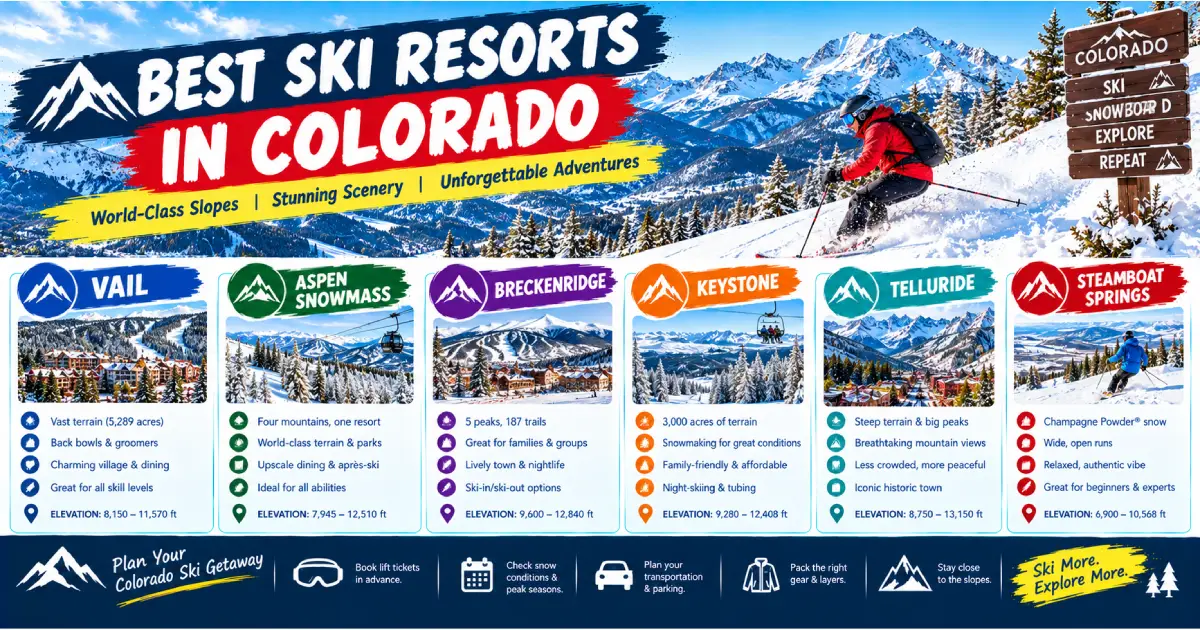
Colorado is the undisputed capital of American skiing — a state with more ski resorts than any other in the country, more skiable terrain than any other except Utah, and a snow quality (the legendary Colorado powder, low-moisture snowflakes that fall at altitude and compress into a light, fast surface unlike the wet, heavy snow of the Rockies’ western slope) that has made the state the destination of choice for skiers from around the world. The combination of high base elevations (most Colorado resorts sit above 9,000 feet, giving them a longer season and a higher percentage of above-freezing days that produce fresh snowfall rather than rain), access from Denver International Airport (the fifth-busiest in the United States), and the concentration of world-class mountain infrastructure in a 150-mile corridor along I-70 and its connecting roads makes Colorado the most complete ski destination in North America.
The 2025–26 ski season brought important developments to several Colorado resorts: Vail Resorts’ Epic Pass continues to offer the most comprehensive multi-resort access in Colorado, covering Vail, Breckenridge, Keystone, Park City, and Beaver Creek among others; Alterra Mountain Company’s Ikon Pass covers Aspen Snowmass, Steamboat, Winter Park, Copper Mountain, and Eldora; and several independent resorts (Telluride, Arapahoe Basin, Loveland) offer their own season passes at significantly lower price points. Choosing a Colorado ski resort in 2026 means choosing between scale (Vail’s 5,317 acres, Aspen Snowmass’ four-mountain complex), character (Telluride’s box-canyon isolation, Crested Butte’s cult following), access (Breckenridge and Keystone within 90 minutes of Denver), and snow reliability (Wolf Creek receives more natural snowfall than any resort in the state at 430 inches annually).
This guide covers the 12 best ski resorts in Colorado for 2026, ranked for the reader who wants to choose the right mountain for their specific priorities: beginner-friendly terrain, expert challenges, on-mountain dining, après-ski culture, family programming, and value.
| Resort | Skiable Acres | Vertical Drop | Best For | Season Pass | Base Elevation |
|---|---|---|---|---|---|
| Vail | 5,317 | 3,450 ft | All-mountain, luxury | Epic | 8,120 ft |
| Aspen Snowmass | 5,527 (4 mtns) | 4,406 ft (Snowmass) | Expert terrain, culture | Ikon | 7,945 ft |
| Telluride | 2,000 | 4,425 ft | Experts, isolation, beauty | Telluride/Ikon add-on | 8,750 ft |
| Steamboat | 2,965 | 3,668 ft | Champagne Powder, families | Ikon | 6,900 ft |
| Breckenridge | 2,908 | 3,398 ft | Access, variety, apres | Epic | 9,600 ft |
| Beaver Creek | 1,815 | 4,040 ft | Service, intermediates | Epic | 8,100 ft |
| Winter Park | 3,081 | 3,060 ft | Experts (Mary Jane), value | Ikon | 9,000 ft |
| Copper Mountain | 2,465 | 2,601 ft | Natural terrain separation | Ikon | 9,712 ft |
| Arapahoe Basin | 1,428 | 2,530 ft | Expert, late season | Ikon/own | 10,780 ft |
| Crested Butte | 1,547 | 3,062 ft | Extreme terrain, culture | Ikon | 9,375 ft |
| Wolf Creek | 1,600 | 1,604 ft | Snowfall, value, uncrowded | Own | 10,300 ft |
| Loveland | 1,800 | 2,210 ft | Value, Front Range locals | Own | 10,800 ft |
Skiable Acres: 5,317 | Vertical Drop: 3,450 ft | Base Elevation: 8,120 ft | Summit: 11,570 ft Pass: Epic Pass ($729–$989/season) | Day Ticket: $229–$299 (book in advance for lower rates) Getting There: 97 miles west of Denver on I-70 (1.5–2 hours); Eagle County Airport (EGE) 35 miles west with direct flights from major US cities
Vail is the largest single-mountain ski resort in the United States by skiable acreage and the standard by which all other Colorado ski resorts are measured — a 5,317-acre mountain with 195 trails, three terrain parks, and the famous Back Bowls (Blue Sky Basin and the seven bowls of Vail Back Bowls totaling 2,734 acres of open bowl skiing) that define the resort’s reputation for expert above-treeline terrain. The Back Bowls alone are larger than most complete Colorado ski resorts.
Terrain Breakdown:
What makes Vail exceptional:
On-Mountain Dining:
Lodging: The Lodge at Vail (Vail’s first hotel, ski-in/ski-out, $600–1,500+/night), the Four Seasons Vail ($700–2,000/night), the Sonnenalp ($500–1,200/night). Budget options in nearby Avon (Westin Riverfront, $250–500/night) with free Vail Valley bus service.
Best for: Skiers who want the largest mountain, the most terrain variety, a genuine European-style village, and are willing to pay premium prices. The Back Bowls on a powder day are among the finest big-mountain experiences in the United States.
Four Mountains: Aspen Mountain (Ajax), Aspen Highlands, Buttermilk, Snowmass Combined Skiable Acres: 5,527 | Best Vertical: 4,406 ft (Snowmass) | Trails: 336 combined Pass: Ikon Pass ($1,049–$1,349/season) | Day Ticket: $189–$279 Getting There: 200 miles west of Denver (3.5–4 hours); Aspen/Pitkin County Airport (ASE) with direct flights from LA, Dallas, Chicago, New York
Aspen is the most famous ski destination in the United States — a town as well-known for its social scene, film festival, and billionaire homeowners as for its skiing, but whose four mountains contain some of the finest expert terrain in the country. The four-mountain complex (collectively operated by Aspen Skiing Company) offers four completely distinct ski experiences within 12 miles of each other, connected by free shuttle buses.
The Four Mountains:
Aspen Mountain (Ajax) — Expert mountain, no beginner terrain
Aspen Highlands — Expert mountain, locals’ favorite
Buttermilk — Beginner and intermediate mountain; X Games venue
Snowmass — The big mountain, all levels
Après-ski and culture:
Best for: Expert skiers (Ajax, Highlands Bowl), families wanting a full resort (Snowmass), and travelers who want the best non-skiing cultural scene in Colorado ski country.
Skiable Acres: 2,000 | Vertical Drop: 4,425 ft | Trails: 148 Pass: Telluride Season Pass ($1,199–$2,299) or Ikon Pass add-on (5 restricted days) Day Ticket: $179–$249 Getting There: 335 miles southwest of Denver (6+ hours by road); Telluride Regional Airport (TEX) with direct service, or Montrose Regional (MTJ, 65 miles, better flight options)
Telluride is the most beautiful ski resort in Colorado — a town set in a box canyon at 8,750 feet surrounded on three sides by 14,000-foot peaks, with the ski mountain rising 4,425 vertical feet from the valley floor to the 13,150-foot summit. The combination of the box-canyon setting (it genuinely looks like a painting), the Victorian mining town (a National Historic Landmark district, one of the finest anywhere), the relative difficulty of access (it requires more travel than Front Range resorts), and the expert-heavy terrain has kept Telluride smaller and more authentic than Vail or Aspen while offering terrain quality that matches either.
Terrain:
Key terrain:
The Town:
Best for: Expert and advanced skiers willing to make the travel effort; travelers who want the most beautiful mountain town in Colorado; festival-goers who combine a ski trip with the Bluegrass or Film Festival.
Skiable Acres: 2,965 | Vertical Drop: 3,668 ft | Trails: 169 Pass: Ikon Pass | Day Ticket: $159–$239 Getting There: 160 miles northwest of Denver (2.5–3 hours via US-40); Yampa Valley Regional Airport (HDN, 22 miles, with direct flights from Denver, Dallas, Houston, Chicago, LA)
Steamboat Springs is the most family-friendly major ski resort in Colorado and the resort most associated with the “Champagne Powder” trademark — the term Steamboat trademarked in 1946 for its light, dry powder, which results from the resort’s position in the northern Rockies (a colder, drier snow climate than the central Colorado mountains). Steamboat has produced more Winter Olympians than any other ski town in the United States — over 100 athletes — a fact the resort promotes with genuine pride and that reflects the quality of its competitive programs.
Terrain:
What makes Steamboat distinctive:
Steamboat Springs Town: The finest authentic Western ski town in Colorado — Old Town Hot Springs ($20/adult; natural mineral hot springs pool complex adjacent to the Yampa River), the Strawberry Park Natural Hot Springs (7 miles from town, $20/adult, outdoor mineral springs in a canyon, adults-only after dark, no reservations accepted), the Steamboat Farmers’ Market (Lincoln Avenue, June–September), the Strings Music Pavilion, and a craft brewery count (seven) that rivals any mountain town in Colorado.
Best for: Families (excellent ski school, the best beginner terrain separation in the state), powder addicts, travelers who want a genuine Western small-city experience rather than a resort village.
Skiable Acres: 2,908 | Vertical Drop: 3,398 ft | Trails: 187 | Summit: 12,998 ft Pass: Epic Pass | Day Ticket: $189–$249 Getting There: 80 miles west of Denver (1.5–2 hours via I-70 and CO-9); free Summit Stage bus from Frisco, Dillon, and Silverthorne
Breckenridge is the most popular ski resort in Colorado by skier visits and one of the most accessible — 80 miles from Denver, served by direct shuttle from Denver International Airport ($60–75 one-way), and connected by the free Summit Stage bus system to the other Summit County resorts (Keystone, Arapahoe Basin, Copper Mountain). The town of Breckenridge (the highest incorporated town in the United States at 9,600 feet) is also the finest Victorian mining town on the Front Range — a 10-block historic district with over 250 Victorian buildings housing excellent restaurants, breweries, and galleries.
Terrain:
The Five Peaks: Breckenridge’s skiing is divided across five connected peaks (Peaks 6, 7, 8, 9, and 10), each with its own character:
The Imperial Bowl: The top of the Imperial Express SuperChair at 12,840 feet opens to a series of above-treeline chutes and bowls accessible by a 10–15 minute hike. The Imperial Bowl is the highest lift-served skiing in North America.
Town: Breckenridge’s Main Street (Historic District) is the finest skiing-accessible Victorian town in Colorado — Modis (best dinner), Kenosha Steakhouse, the Breckenridge Brewery (founded 1990, now Colorado’s highest-production craft brewery), and the Blue River Trail connecting the town to the ski mountain on foot.
Best for: Intermediate and advanced skiers with easy Denver access; families who want the best combination of mountain variety and Victorian town character; Epic Pass holders maximizing the I-70 corridor options.
Skiable Acres: 1,815 | Vertical Drop: 4,040 ft | Trails: 150 Pass: Epic Pass | Day Ticket: $219–$279 Getting There: 110 miles west of Denver (1.75–2.25 hours); 10 miles from Vail via I-70 Exit 167
Beaver Creek is Vail’s quieter, more refined neighbor — a gated ski resort (the only one in Colorado) that opened in 1980 and has consistently ranked as one of the top three ski resorts in North America for ski school quality, on-mountain service, and grooming. The resort is smaller than Vail but offers 4,040 feet of vertical descent (more than Vail), and the combination of narrower crowds, Vail-level service, and the famous “Beaver Creek experience” (warm cookies served slope-side at 3 PM every afternoon since 1981) has built a loyal following among skiers who find Vail’s crowds and commerce excessive.
Terrain:
Key terrain:
The Village: The Beaver Creek pedestrian village is smaller than Vail’s but more refined — the Park Hyatt Beaver Creek ($450–1,200/night, the finest ski-in/ski-out hotel in the resort), the Beaver Creek Lodge, and restaurants including Toscanini (best dinner in Beaver Creek, Northern Italian), Craftail Lounge (cocktails), and Beaver Creek Chophouse.
Best for: Skiers who want Vail-quality terrain without the crowds; families with young skiers (the ski school is outstanding); skiers who value on-mountain service over raw acreage.
Skiable Acres: 3,081 | Vertical Drop: 3,060 ft | Trails: 166 Pass: Ikon Pass | Day Ticket: $139–$189 Getting There: 67 miles west of Denver (1.5 hours via US-40 through the Moffat Tunnel); the Ski Train (operated winter weekends from Denver Union Station, $39–$59 each way — the finest ski train in the United States, a genuine resort highlight)
Winter Park is Denver’s “home mountain” — closest major resort to the city, accessible by the legendary Ski Train, and one of the two best expert mountains in Colorado. The combination of the challenging Mary Jane terrain (the expert half of the mountain, with mogul runs of sustained 40-degree pitch) and the gentler Winter Park side makes the resort genuinely good for mixed-ability groups.
Two Distinct Mountains:
National Sports Center for the Disabled (NSCD): Winter Park’s disabled ski program — founded in 1970, the largest adaptive skiing program in the United States — is one of the resort’s defining characteristics and has shaped its entire mountain design philosophy.
Best for: Denver-day-trip skiers (closest major resort by road or rail); expert mogul skiers (Mary Jane); families with mixed ability levels; budget-conscious skiers (lower day ticket prices than the Vail/Aspen corridor resorts).
Skiable Acres: 2,465 | Vertical Drop: 2,601 ft | Trails: 148 Pass: Ikon Pass | Day Ticket: $149–$209 Getting There: 75 miles west of Denver (1.25–1.5 hours via I-70)
Copper Mountain is the most naturally terrain-separated resort in Colorado — the mountain’s topography organically divides beginner terrain (east side), intermediate terrain (center), and expert terrain (west side and Union Bowl) without the artificial routing found at purpose-designed resorts. Beginners ski the east side without encountering expert terrain; experts ski the west side and Union Bowl without passing through beginner zones.
Natural Terrain Separation:
Best for: Intermediates looking for uncrowded cruisers; families with beginners who don’t want to navigate expert terrain; Summit County pass holders (Ikon) who want variety.
Skiable Acres: 1,428 | Vertical Drop: 2,530 ft | Summit: 13,050 ft | Base Elevation: 10,780 ft Pass: Ikon Pass (restricted days) or A-Basin season pass ($699) Day Ticket: $129–$169 Getting There: 68 miles west of Denver (1.5 hours); 6 miles east of Keystone on US-6
Arapahoe Basin has the highest base elevation of any Colorado ski resort (10,780 feet) and the latest closing date of any resort in the state — in good snow years, A-Basin stays open through late June or even early July (it has been known to close on July 4th weekend in exceptional years). The resort is beloved by Colorado locals as an antidote to the Vail Resorts experience: genuinely challenging terrain, a parking-lot tailgate culture (the A-Basin Beach — the legendary lot directly at the base where locals grill in ski boots), modest prices, and no on-mountain sushi bars.
Key Terrain:
Late Season: A-Basin’s combination of high base elevation, north-facing terrain, and conservative snowmaking strategy means it holds its snowpack longer than any other Colorado resort. April skiing at A-Basin in a good year is as good as December skiing at lower resorts.
Best for: Expert and advanced skiers who find the mainstream resorts too commercial; locals who want the best price-to-terrain ratio in Summit County; late-season skiing (April–June).
Skiable Acres: 1,547 | Vertical Drop: 3,062 ft | Trails: 121 Pass: Ikon Pass | Day Ticket: $149–$199 Getting There: 230 miles southwest of Denver (4 hours via US-285); Gunnison-Crested Butte Regional Airport (GUC, 30 miles, with direct flights from Denver, Dallas, Houston, LA)
Crested Butte is the most cult-followed ski resort in Colorado — a mountain with the finest extreme terrain in the state (steeper in-bounds designated extreme skiing than any other Colorado resort), a genuine small-town character (the original Victorian town of Crested Butte, 3 miles from the mountain, is one of the most authentic ski communities in Colorado), and a passionate local community that regards the resort with the intensity usually reserved for religious feeling.
The Extreme Terrain: Crested Butte is officially designated as having more extreme terrain than any other resort in Colorado — specific runs with pitches above 40 degrees, with cliff bands and exposure that few resorts would leave unroped. The North Face (accessed from the High Lift Chair) and the adjacent terrain (Headwall, Phoenix Bowl, Spellbound Bowl) represent the finest in-bounds extreme skiing in the state.
The Town: The original town of Crested Butte (3 miles from the ski mountain via free shuttle) is the finest completely preserved Victorian mining town in Colorado — Elk Avenue (the main street) contains original 1880s commercial buildings housing the best collection of independent restaurants and bars in any Colorado ski town per capita: the Secret Stash (pizza in an original Victorian building, the finest pizza in ski country), Elk Avenue Kitchen, the Princess Wine Bar, Raffles (Colorado’s only ski-specific rock climbing gym, open winter), and the Brick Oven.
Best for: Expert skiers seeking extreme terrain; travelers who want the most authentic Colorado ski town experience; Ikon Pass holders looking for an alternative to the Front Range crowds.
Skiable Acres: 1,600 | Vertical Drop: 1,604 ft | Trails: 77 Pass: Wolf Creek Pass only (no major pass accepted) | Day Ticket: $99–$129 Getting There: 280 miles southwest of Denver (5 hours via US-160 over Wolf Creek Pass); nearest city Alamosa (51 miles)
Wolf Creek is Colorado’s snowiest ski resort — 430 inches of average annual snowfall, more than any other resort in the state, the result of the mountain’s position at the top of Wolf Creek Pass (10,857 feet) on the Continental Divide in the southern San Juan Mountains, where Pacific moisture hits the Divide and drops extraordinary quantities of snow. The mountain itself is modest in scale and vertical, and there is no base village (accommodation is in the town of South Fork, 23 miles away), but for the powder skier willing to make the long drive from Denver, Wolf Creek represents the best powder value in Colorado: day tickets under $130, no lift lines, and snow so deep in January and February that mid-thigh powder is routine.
What Wolf Creek offers:
Best for: Powder enthusiasts willing to drive from Denver or Albuquerque; skiers on a budget who want the best natural snowfall in Colorado; southern Colorado travelers combining a ski day with the Great Sand Dunes.
Skiable Acres: 1,800 | Vertical Drop: 2,210 ft | Trails: 94 Pass: Loveland Season Pass ($419–$549) or Ikon Pass | Day Ticket: $129–$159 Getting There: 53 miles west of Denver (1 hour via I-70); accessible even in moderate snowstorms
Loveland is the closest major ski resort to Denver and the most consistent value on the Front Range — day tickets significantly below Vail and Breckenridge pricing, a 1-hour drive from Denver, and a base elevation of 10,800 feet (higher than any Vail Resorts property) that produces excellent snow quality and a long season. The resort lacks the glamour and village infrastructure of Vail and Breckenridge but delivers the essential ski product at a significantly lower price.
Key features:
Best for: Denver day-trippers on a budget; beginners (Loveland Valley); early-season and late-season skiing; Front Range locals who want consistency without the I-70 traffic of the Vail/Breckenridge corridor on weekends.
| Resort | Distance from Denver | Drive Time (off-peak) | Nearest Airport |
|---|---|---|---|
| Loveland | 53 mi | 1 hr | DEN |
| A-Basin | 68 mi | 1.5 hrs | DEN |
| Keystone | 71 mi | 1.5 hrs | DEN |
| Breckenridge | 80 mi | 1.5–2 hrs | DEN |
| Copper Mountain | 75 mi | 1.5 hrs | DEN |
| Winter Park | 67 mi | 1.5 hrs | DEN |
| Vail | 97 mi | 1.75–2.5 hrs | EGE (35 mi west) |
| Beaver Creek | 110 mi | 2 hrs | EGE (10 mi west) |
| Steamboat | 160 mi | 2.5–3 hrs | HDN (22 mi west) |
| Aspen | 200 mi | 3.5–4 hrs | ASE (3 mi) |
| Telluride | 335 mi | 6 hrs | TEX or MTJ |
| Crested Butte | 230 mi | 4 hrs | GUC (30 mi) |
| Wolf Creek | 280 mi | 5 hrs | Alamosa (51 mi) |
I-70 Traffic: The worst ski traffic bottleneck in the United States — westbound Friday evenings (4–8 PM) and eastbound Sunday afternoons (1–6 PM) on I-70 between Denver and the Eisenhower Tunnel can add 1–3 hours to normal drive times. Departing Thursday evening or Saturday morning avoids the worst of it; the Colorado Department of Transportation’s COtrip app (cotrip.org) provides real-time traffic and chain-law information.
Airport Shuttles: Colorado Mountain Express ($65–85 one-way) serves Vail, Beaver Creek, Aspen, Breckenridge, Keystone, and Steamboat from DEN. Resort transfers should be booked in advance for peak holiday weeks.
Epic Pass ($729–$989): Unlimited skiing at Vail, Breckenridge, Keystone, Beaver Creek, Park City (UT), and 40+ resorts worldwide. The most valuable pass for skiers who primarily ski the Vail Resorts Colorado properties. Epic Day Passes ($79–$149/day depending on days purchased and advance booking) are the best value for occasional skiers.
Ikon Pass ($1,049–$1,349): Unlimited or restricted days at Aspen Snowmass, Steamboat, Winter Park, Copper Mountain, A-Basin, Crested Butte, Eldora, plus 50+ destinations worldwide including Alta, Snowbird, Jackson Hole, and international resorts. The Ikon Base Pass ($749–$849) offers 7 days per resort rather than unlimited.
Colorado Gem Pass ($399): A newer regional pass covering Crested Butte, Steamboat, Winter Park, Copper, and Eldora — the best value pass for skiers focused on the non-Epic resorts.
Individual Resort Passes: Wolf Creek ($499), Loveland ($419–$549), Telluride ($1,199–$2,299), and A-Basin standalone ($699) offer the best value at their specific mountains.
All major Colorado ski resorts operate at base elevations between 6,900 and 11,000 feet — significantly higher than ski resorts in Europe (most Alpine bases below 5,000 feet) and all eastern US ski areas. Altitude sickness affects a significant percentage of visitors from sea level and low-elevation cities:
Posted By : Vinay
Latest Article
2nd Floor, 39, Above Kirti Club, DLF Industrial Area, Kirti Nagar, New Delhi, Delhi 110015



Travel Tourister is a leading Travel portal where we introduce travellers to trusted travel agents to make their journey hasselfree, memorable And happy. Travel Tourister is a platform where travellers get Tour packages ,Hotel packages deals through trusted travel companies And hoteliers who are working with us across the world. We always try to find new and more travel agents and hoteliers from every nook and corners across the world so that you could compare the deals with different travel agents and hoteliers and book your tour or hotel with the one you have chosen according to your taste and budget.
Copyright © Travel Tourister, India. All Rights Reserved

 Call
 Enquiry