Published on : 26 Oct 2026
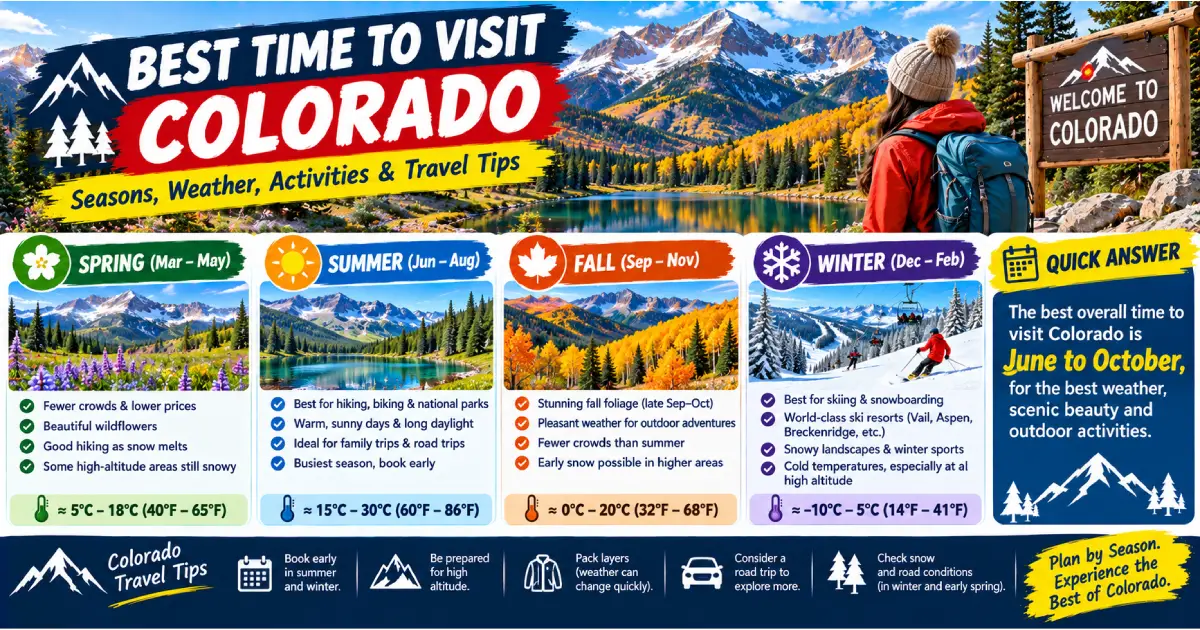
Colorado is one of the few destinations in the United States that offers genuinely world-class experiences in all four seasons — a state where the question of when to visit depends entirely on what you want to do rather than on avoiding an “off season” that is simply less good than the rest. The ski season (November through April) draws more total visitors than any other period and includes some of the finest powder skiing in North America; the summer hiking season (June through August) opens access to the Rocky Mountain high country, the wildflower meadows, and the 14,000-foot summits that are buried under snow the rest of the year; the fall aspen season (late September and early October) produces a foliage display that rivals anything in New England; and the spring shoulder (April and May) offers a combination of late-season skiing, early wildflowers at lower elevations, and dramatically reduced crowds throughout the state.
Colorado’s climate is also more varied than most visitors expect. The eastern plains around Denver are semi-arid and temperate — warm dry summers, mild winters with frequent Chinook-thaw days, and an average of 300 sunny days per year. The Western Slope (Grand Junction, Montrose, Durango) is drier still and significantly warmer in summer. The mountain resorts (Aspen, Vail, Breckenridge, Telluride) experience a true alpine climate with cold winters, brief cool summers, afternoon thunderstorms from July through September, and dramatic weather shifts that can change conditions from shorts weather to snowfall in a single afternoon. Knowing these climate distinctions — and matching them to your planned activities — is the key to choosing the right Colorado travel dates.
This guide breaks down each season in detail, including specific weather data, crowd levels, pricing patterns, and the activities that each season makes uniquely possible. Whether you are planning a ski trip to Vail, a hiking trip to Rocky Mountain National Park, a fall color drive on the San Juan Skyway, or a summer visit to the mountain towns, the guide below will identify the optimal window for your specific goals.
| Month | Season | Weather (Denver) | Mountains | Crowds | Prices |
|---|---|---|---|---|---|
| January | Peak ski | 14–44°F | Deep powder, cold | High (ski) | High |
| February | Peak ski | 19–47°F | Best snow, cold | High (ski) | High |
| March | Late ski / spring | 26–54°F | Spring skiing, warmer | Moderate | Moderate |
| April | Late ski / shoulder | 35–61°F | Closing weeks, mud | Low | Low |
| May | Shoulder / spring | 44–70°F | Snow melting, passes opening | Low | Low |
| June | Early summer | 54–80°F | Trail ridge roads open, wildflowers begin | Moderate | Moderate |
| July | Peak summer | 59–88°F | Full summer, afternoon storms | Very High | High |
| August | Late summer | 57–85°F | Wildflower peak, storms, fall preview | Very High | High |
| September | Fall / shoulder | 47–75°F | Aspen gold, elk rut, fewer crowds | High (fall) | Moderate |
| October | Fall color peak / early ski | 34–62°F | Peak low-elevation foliage, first snow | Moderate | Moderate |
| November | Early ski season | 23–51°F | Resorts opening, unstable snow | Low–Moderate | Low–Moderate |
| December | Ski season | 16–44°F | Holiday peak, early season snow | Very High (holiday) | Very High |
Best overall: January and February Holiday periods to avoid: December 22–January 2, Presidents’ Day weekend (mid-February)
Colorado’s ski season officially begins in November (A-Basin and Loveland typically open in mid-October), reaches its peak snowpack in January and February, and closes at most resorts between mid-April and early May (Wolf Creek sometimes skis into June). The sweet spot for powder-seeking skiers is the window between January 5 and February 15 — after the holiday crowds have left, before the Presidents’ Day rush, and in the months when Colorado’s storm cycle typically produces the most total snowfall.
January: The finest month for powder skiing in Colorado. January averages are the highest monthly snowfall totals at most resorts (Vail averages 52 inches in January; Telluride averages 58 inches). The holiday crowds from Christmas and New Year have departed by January 3–5, leaving a 5–6 week window of deep snow and manageable lift lines. Temperatures are the coldest of the season — summit temperatures can reach -20°F on exposed days — but the cold keeps the snow light and fast. Book early for January; the window is well-known and popular with experienced powder skiers.
February: Essentially equal to January for snow quality and total snowfall. The Presidents’ Day weekend (third Monday of February) is the single busiest ski weekend of the year at most Colorado resorts — lift lines can reach 45–60 minutes at Vail and Breckenridge on the Saturday and Sunday of that weekend. The weeks on either side of Presidents’ Day are among the finest in the season.
March: Spring skiing — warmer temperatures (summit highs often reach the mid-20s to low 30s°F), corn snow in the afternoons, and the first appearances of the mountain sun culture (outdoor deck lunches, t-shirt skiing on warm days). March is also when the back bowls and south-facing terrain at Vail begin to open up as the sun angle increases. Slightly lower prices than January and February at most resorts.
December: Peak holiday pricing (December 22–January 2 is the most expensive two-week period of the year at Colorado ski resorts) and the most variable snow conditions of the season. Early December can be excellent (in years with good early snowfall) or thin (in years when the December storm cycle is late). Booking the December 22–January 2 period requires the most advance planning of any ski window — popular resort lodging can sell out by August or September.
Early season (November – December 15):
Peak season (December 22 – March 15):
Late season (March 15 – closing):
Best overall: Late June through mid-August (avoiding peak afternoon storm season in late July – August) Crowded periods: July 4 weekend, any summer weekend in Rocky Mountain NP
Summer in the Colorado mountains is brief, brilliant, and punctuated by the afternoon thunderstorm cycle that defines Rocky Mountain weather from July through early September. The high country (above 10,000 feet) remains under snow through late May and into early June, and most high trails are not fully accessible until late June. The summer season proper runs from late June through Labor Day, with the highest wildflower concentrations in mid-July and the finest weather for above-treeline hiking in the early mornings.
June: The finest month for hiking in the mountain parks without the peak summer crowds. Rocky Mountain National Park’s Trail Ridge Road (the highest paved continuous road in the United States) typically opens in late May or early June; the tundra wildflowers begin in late June. Snow lingers on north-facing slopes and in couloirs through June; expect wet, slushy conditions on high trails early in the month. Afternoon storms less frequent than July–August. Shoulder pricing (20–30% below July/August) and lighter crowds at most attractions.
July: Peak summer — full wildflower bloom at subalpine elevations (9,000–11,000 ft), all trails open, all mountain attractions operating. Also the beginning of the serious afternoon thunderstorm season: storms typically build over the peaks from 11 AM and can produce lightning, hail, and heavy rain by 1–2 PM. The cardinal rule for above-treeline hiking in Colorado is to be below 12,000 feet by noon — a rule that requires early starts (before 6 AM for long above-treeline routes). July is also the busiest month at Rocky Mountain National Park, Great Sand Dunes, Black Canyon of the Gunnison, and Mesa Verde; expect significant crowds and the requirement for timed-entry permits at Rocky Mountain NP.
August: Very similar to July in weather and crowds; the afternoon storm season reaches its most frequent in late August. The early signs of fall appear in the very highest elevations (above 11,500 feet) in late August — the first turning aspens in the subalpine zone. School summer holidays end around Labor Day, which produces a significant crowd drop immediately after the first Monday of September.
Denver and Front Range:
Rocky Mountain National Park:
Western Slope and Mesa Country:
Mountain Resorts (Aspen, Telluride, Vail):
Best overall: Third and fourth weeks of September (high elevations) and first two weeks of October (valleys and lower slopes) Peak at specific locations:
Colorado’s aspen fall color season is one of the finest annual natural events in the American West — not the red-and-orange palette of New England, but a golden-yellow display produced by the quaking aspen (Populus tremuloides), the most widely distributed tree species in North America, which covers enormous swaths of the Colorado Rockies in a single-species canopy that turns from green to brilliant gold in a 2–3 week window each fall. The Elk Mountains above Aspen, the San Juan Mountains around Telluride and Ouray, the Sawatch Range above Leadville, and the Medicine Bow and Front Range mountains above Rocky Mountain NP all produce aspen displays of extraordinary quality.
2026 Fall Color Forecast: Based on historical patterns (Colorado’s aspen color is driven primarily by temperature — the first nights below freezing trigger the color change, which then progresses from high elevations down), the 2026 peak at high elevations (above 10,000 feet) is projected for September 18–28 in normal years. Low-elevation and valley peaks follow 1–2 weeks later. La Niña/El Niño conditions can shift the peak by up to 10 days in either direction.
1. Maroon Bells / Aspen (September 20–30 peak): The Maroon Bells — two 14,000-foot peaks above Maroon Lake, 12 miles from Aspen — are the most photographed mountains in Colorado, and the aspen surrounding the lake at peak color is arguably the finest single autumn landscape in the American West. The mandatory shuttle runs from Aspen Highlands (June 1 – October 1, $16/adult); after October 1 you can drive in.
2. San Juan Skyway (September 20 – October 5 peak): The 236-mile loop through Durango, Silverton, Ouray, Ridgway, Telluride, and Cortez passes through some of the most dramatic aspen groves in Colorado on the mountain passes. The Ophir Pass and Red Mountain Pass sections peak around September 22–28.
3. Kebler Pass Road (Crested Butte, September 20–30 peak): Kebler Pass Road (County Road 12) west of Crested Butte passes through one of the largest aspen groves in North America — a single clone of Populus tremuloides covering thousands of acres (the “Pando” of Colorado, though separate from Utah’s famous Pando). Peak color here is extraordinary; the road is unpaved but suitable for passenger cars in dry conditions.
4. Independence Pass (Aspen, September 15–25 peak): CO-82 over Independence Pass (12,095 ft) between Aspen and Twin Lakes provides the finest high-elevation aspen drive on the Front Range. The Lincoln Creek Road turnoff at the summit adds a 9-mile dirt-road extension through the aspen.
5. Rocky Mountain National Park (September 20 – October 5 peak): The aspen in Horseshoe Park and along Bear Lake Road peak in late September, coinciding with the elk rut (mid-September through mid-October) — bull elk bugling at dawn in the aspen groves near Moraine Park is one of the finest wildlife experiences in Colorado.
6. Ohio Pass Road (Crested Butte to Gunnison, September 22 – October 2 peak): County Road 730 over Ohio Pass (10,033 ft) between Crested Butte and Gunnison is one of the least-known excellent fall drives in Colorado — a quiet dirt road through aspen and spruce with a genuine sense of isolation.
September (mountain focus):
October (valley and gateway focus):
April and May are Colorado’s quietest travel months and offer the best value for visitors who can be flexible about conditions. Ski resorts are winding down (most close April 15–May 1), the mountain trails are muddy or snow-covered, and the weather is transitional — warm days punctuated by late-season snowstorms that can drop 12–18 inches at mountain elevations even in May.
What spring offers:
What spring lacks:
Denver’s climate is more mild and more sunny than most visitors expect for a Rocky Mountain city. The official elevation (5,280 feet, the “Mile High City”) places it well below the mountain resorts but gives it a climate drier and sunnier than eastern US cities at similar latitudes.
The Western Slope is Colorado’s warmest and driest region — a high desert climate influenced by proximity to the Colorado Plateau.
| Date | Event | Location |
|---|---|---|
| Mid-October | Opening weekend (A-Basin, Loveland) | Summit County |
| Late November | Most major resorts open | Statewide |
| Dec 22 – Jan 2 | Holiday ski peak | All ski resorts |
| Mid-January | X Games | Aspen Buttermilk |
| 3rd Mon February | Presidents’ Day ski peak | All ski resorts |
| Late April | Spring Wildflower Pilgrimage | Great Smoky area |
| Late May | Mountainfilm Festival | Telluride |
| June (3rd week) | Telluride Bluegrass Festival | Telluride |
| June–August | Aspen Music Festival | Aspen |
| July 4 weekend | Peak summer crowds | All mountain towns |
| Mid-July | Wildflower peak (subalpine) | Statewide high country |
| Late July | Vail Dance Festival | Vail |
| Labor Day weekend | Telluride Film Festival | Telluride |
| September (3rd week) | Aspen color peak (high elevations) | Elk and San Juan Mtns |
| September (mid-late) | Elk rut peak | Rocky Mountain NP |
| Early October | Aspen color peak (lower elevations) | Statewide valleys |
| 1st week October | Colorado Balloon Classic | Colorado Springs |
| Mid-October | Ski resort opening season | Front Range resorts |
Skiing and snowboarding: January–February (powder), March (spring skiing value) Hiking above 11,000 ft: Late June–mid-September (before first autumn snowfall) Wildflower viewing: Mid-July (subalpine), early June (lower foothills) Fall aspen color: September 20–October 10 (elevation-dependent) Elk rut wildlife viewing: Mid-September–mid-October (Horseshoe Park, Moraine Park, Cataloochee) Road trips (San Juan Skyway, Trail Ridge Road): June–October (mountain passes open) Mesa Verde cliff dwelling tours: May–October (full tour schedule) Great Sand Dunes: May–June (Medano Creek flowing), September–October (cooler temperatures) White-water rafting (Arkansas River, Gunnison): May–July (peak snowmelt flow) Music festivals: June–September (Telluride, Aspen, Denver) Budget travel: April–May, November
Posted By : Vinay
Latest Article
2nd Floor, 39, Above Kirti Club, DLF Industrial Area, Kirti Nagar, New Delhi, Delhi 110015



Travel Tourister is a leading Travel portal where we introduce travellers to trusted travel agents to make their journey hasselfree, memorable And happy. Travel Tourister is a platform where travellers get Tour packages ,Hotel packages deals through trusted travel companies And hoteliers who are working with us across the world. We always try to find new and more travel agents and hoteliers from every nook and corners across the world so that you could compare the deals with different travel agents and hoteliers and book your tour or hotel with the one you have chosen according to your taste and budget.
Copyright © Travel Tourister, India. All Rights Reserved

 Call
 Enquiry