Published on : 26 Oct 2026
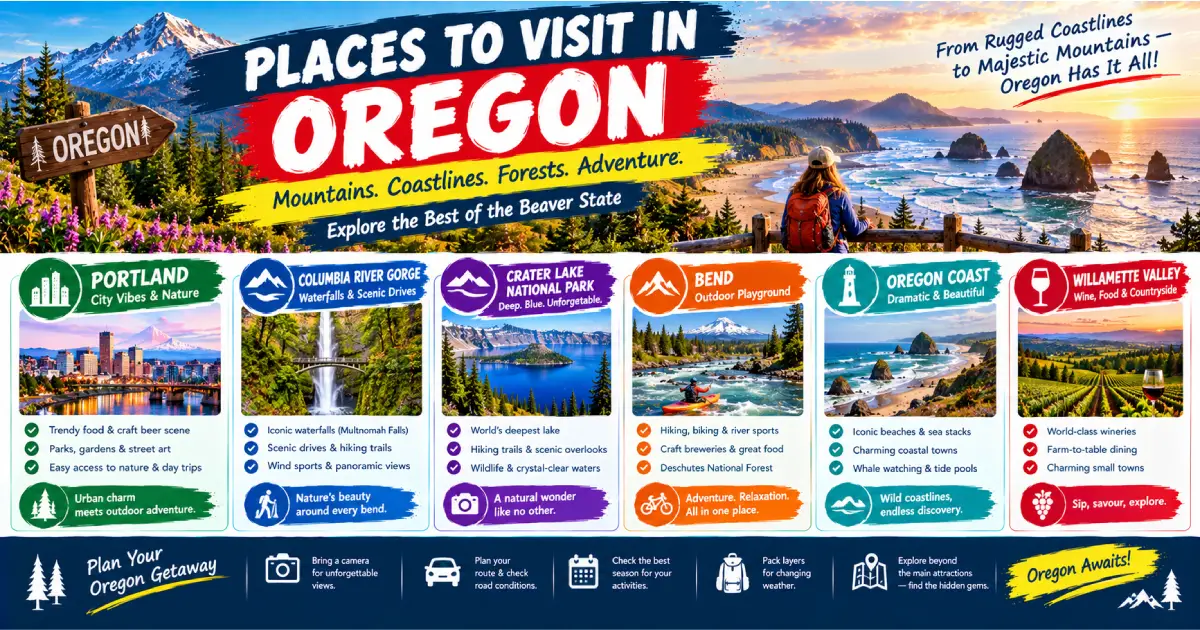
Oregon is one of the most geographically diverse states in the continental United States — a state that contains an active volcanic arc (the Cascade Range, with five major stratovolcanoes including Mount Hood, Mount Jefferson, and the Three Sisters), a temperate rainforest coast (the Oregon Coast, 363 miles of publicly owned shoreline with no private beach ownership), a high desert plateau (the Oregon High Desert east of the Cascades, larger in area than the Willamette Valley by a factor of three), a wine region producing Pinot Noir of international standing (the Willamette Valley), and a city with one of the most distinctive urban cultures in the United States (Portland). Visiting Oregon means choosing between landscapes that have almost nothing in common with each other — and the reward for exploring beyond any single region is discovering how much the state contains.
The Oregon Coast alone would be worth a dedicated trip: 363 miles of publicly accessible shoreline under Oregon’s 1967 Beach Bill (which declared the entire wet-sand zone public property regardless of adjacent ownership), with sea stacks, tide pools, ancient Sitka spruce forest growing to the cliffedge, whale migration viewpoints, and a series of small fishing towns that feel more genuinely coastal than the developed resort towns of California and Florida. Crater Lake — the deepest lake in the United States, formed in the caldera of the collapsed volcano Mount Mazama — offers a shade of blue that visitors consistently describe as unreal and that the photographs consistently fail to capture. The Columbia River Gorge, cut by the Columbia River through the Cascade Range at the Oregon–Washington border, is the finest waterfall-per-mile drive in the United States, with 77 waterfalls within a 25-mile stretch of US-30 on the Oregon side.
This guide covers the 15 best places to visit in Oregon in 2026 — from the coast to the high desert, from Portland’s food and art scene to Crater Lake’s volcanic geology — with specific highlights, distances, and the best season for each destination.
| Destination | Region | Best For | Best Season |
|---|---|---|---|
| Portland | Willamette Valley | Food, culture, urban exploration | Year-round |
| Crater Lake NP | Southern Oregon Cascades | Volcanic scenery, deepest US lake | July–September |
| Oregon Coast (North) | Coast | Sea stacks, Cannon Beach, Haystack Rock | May–September |
| Columbia River Gorge | North Central Oregon | Waterfalls, hiking, windsurfing | April–October |
| Oregon Coast (South) | Coast | Samuel H. Boardman, gold beaches | Year-round |
| Bend and Central Oregon | High Desert | Volcanic landscapes, outdoor sports | June–October |
| Mount Hood | Northern Cascades | Skiing, hiking, Timberline Lodge | Year-round |
| Willamette Valley Wine Country | Valley | Pinot Noir, farm-to-table dining | July–October |
| John Day Fossil Beds | Eastern Oregon | Paleontology, painted hills | March–June, Sept–Oct |
| Ashland and Southern Oregon | Rogue Valley | Shakespeare Festival, Rogue River | May–October |
| Oregon Dunes | South-Central Coast | Largest coastal dunes in North America | Year-round |
| Steens Mountain / Alvord Desert | Southeast Oregon | Remote high desert, wild horses | June–October |
| Smith Rock State Park | Central Oregon | World-class rock climbing | March–June, Sept–Nov |
| Silver Falls State Park | Willamette Valley | Trail of Ten Falls | Year-round |
| Wallowa Mountains | Northeast Oregon | Alpine lakes, Eagle Cap Wilderness | July–September |
Region: Willamette Valley | Distance from Eugene: 110 miles north on I-5 Best Season: Year-round (summer and early fall ideal for outdoor dining culture) Airport: Portland International Airport (PDX) — one of the finest urban airports in the United States, with local food vendors and a Powell’s Books outlet in the terminal
Portland is one of the most distinctive cities in the United States — a mid-sized city (population 650,000 in the metropolitan area) with an outsized national influence on food culture, outdoor recreation, urban design, and independent music. The city’s reputation for weirdness (“Keep Portland Weird” predates Austin’s version by several years) is grounded in a genuine commitment to independent business culture: Powell’s Books (the largest independent bookstore in the world, 68,000 square feet, one city block, open since 1971), a food cart culture with over 600 pods in the metro area, and a craft brewery count (100+) that gives Portland one of the highest breweries-per-capita ratios of any large US city.
What to see and do:
Powell’s City of Books (1005 W Burnside St): A genuine pilgrimage destination — 3,500 sections, 1 million new and used books, a separate rare books room, and a staff-recommendation system that rivals any editorial publication. Allow at least 2 hours. Open daily 9 AM–10 PM.
Portland Japanese Garden (611 SW Kingston Ave): One of the finest Japanese gardens outside Japan — 12 acres on the slopes of Washington Park, designed by Professor Takuma Tono and opened in 1967. The Garden Room building designed by Kengo Kuma (2017, $33.5 million) contains the finest Japanese architecture in the Pacific Northwest. $19/adult; reserve online for summer visits.
Oregon Museum of Science and Industry (OMSI, 1945 SE Water Ave): The finest science museum in the Pacific Northwest — submarine tours ($6.50 extra), planetarium, and a genuine natural history collection. $22/adult.
Mississippi Avenue and Alberta Arts District: The two finest neighborhood commercial corridors in Portland — Mississippi Avenue (SE) and Alberta Street (NE) have the best concentration of independent restaurants, galleries, and vintage shops in the city. Mississippi Studios (live music venue on Mississippi) is one of the finest small-capacity music venues in the Pacific Northwest.
Food and Dining:
Day Trips from Portland:
Region: Southern Oregon Cascades | Distance from Portland: 280 miles south (5 hours via I-5 and OR-62) Distance from Medford: 80 miles north (1.5 hours) Best Season: July–September (Rim Drive fully open; snow closes most roads October–June) Entry Fee: $35/vehicle; America the Beautiful Pass accepted
Crater Lake is one of the most visually extraordinary places in the United States — a lake of such deep, saturated blue that first-time visitors consistently question whether the color is real. The blue is real and has a physical explanation: Crater Lake is the deepest lake in the United States (1,943 feet), its water comes entirely from rain and snowfall (no inflow streams, therefore no sediment), and the extraordinary depth allows sunlight to penetrate to extreme depths and scatter back as pure blue wavelength. The lake sits in the 6-mile-wide caldera of Mount Mazama, a 12,000-foot Cascade volcano that collapsed in a catastrophic eruption approximately 7,700 years ago — an event that covered much of the Pacific Northwest in ash and was witnessed and recorded in the oral traditions of the Klamath and Modoc peoples.
Key experiences:
Lodging: Crater Lake Lodge ($225–$450/night, on the rim, one of the finest NPS lodge locations in the United States — book 6+ months in advance for July and August); Mazama Village Campground ($25/night, 5 miles from the rim).
Region: North Oregon Coast | Distance from Portland: 80 miles (1.5 hours via US-26) Best Season: May–September (summer fog burns off by midday; July–August warmest)
The Oregon Coast is the most distinctive and most protected coastal landscape in the continental United States — 363 miles of shoreline entirely open to the public under the 1967 Oregon Beach Bill. The north coast, between Astoria and Lincoln City, combines the most dramatic sea stack scenery in Oregon (Cannon Beach, Haystack Rock), the finest coastal state parks in the Pacific Northwest (Ecola, Oswald West), and the historic town of Astoria (the oldest US settlement west of the Rockies, founded 1811) at its northern end.
Key stops south to north:
Astoria (95 miles from Portland via US-30):
Cannon Beach (80 miles from Portland via US-26):
Oswald West State Park (10 miles south of Cannon Beach): Short Sand Beach — the finest protected cove beach on the Oregon Coast, accessible via a 0.5-mile trail through old-growth Sitka spruce. No vehicle access to the beach; wheelbarrows available at the trailhead to carry gear. One of the finest surfing beaches in Oregon.
Lincoln City (100 miles south of Portland): The largest tourist city on the north coast; glass floats (250 glass floats placed on beaches between D River and Siletz Bay October–May, part of the Finders Keepers program); the Chinook Winds Casino for those interested.
Region: North Central Oregon / Washington border | Distance from Portland: 30 miles east via I-84 Best Season: April–June (waterfalls at peak flow), September–October (fall color)
The Columbia River Gorge National Scenic Area is the finest concentration of roadside waterfalls in the United States — 77 waterfalls within 25 miles of each other on the Oregon side of the Columbia, accessible from the Historic Columbia River Highway (US-30, built 1913–1922, the first planned scenic highway in the United States). The gorge itself — 80 miles long, up to 4,000 feet deep, carved by the Columbia River through the Cascade Range — separates the wet western climate of the Willamette Valley from the dry eastern Oregon high desert, creating a unique microclimate where western red cedar and Douglas fir forest grows beside bunchgrass steppe within a few miles.
Key stops west to east on US-30:
Vista House (Crown Point, Milepost 16): The most iconic overlook in the gorge — a 1918 rotunda on a 733-foot basalt promontory with views 30 miles in both directions. Free admission; reopened after seismic renovation in 2019.
Latourell Falls (Milepost 28): The finest roadside waterfall in the gorge — a 249-foot plunge fall directly onto columnar basalt, visible from the parking area. 2.4-mile loop trail to the upper falls (free).
Bridal Veil Falls (Milepost 28.5): 0.5-mile trail to a two-tiered 120-foot falls through old-growth forest. Free.
Multnomah Falls (Milepost 31): Oregon’s most visited natural attraction — a 620-foot two-tiered waterfall (the fourth-highest year-round waterfall in the United States) with a 1914 bridge at the midpoint. Free to view from the base; timed entry permit required to hike to the top (recreation.gov, $2 reservation fee, required May–September). The Multnomah Falls Lodge (1925, at the base) serves lunch and dinner.
Wahkeena Falls (Milepost 32): A 242-foot horsetail fall 0.4 miles from the trailhead; connects to Multnomah via a 4-mile loop trail.
Horsetail Falls (Milepost 36): 176-foot falls visible from US-30; the trail (2.7 miles loop) passes behind Ponytail Falls — one of the few trails in the gorge that passes behind a waterfall.
Bonneville Dam (Milepost 40): The first federal hydroelectric dam on the Columbia (1938); the fish ladder viewing windows (free, open daily) allow close-up observation of migrating salmon and steelhead in season (August–October for fall Chinook).
Hood River (58 miles from Portland): The windsurfing and kiteboarding capital of the United States (the Columbia Gorge produces consistent 15–25 knot winds funneled through the range). Excellent fruit stands (Hood River Valley produces the finest pears in Oregon); Full Sail Brewing (one of the originators of the Pacific Northwest craft beer movement, 1987). The best base for Mount Hood day trips.
Region: South Oregon Coast | Distance from Portland: 360 miles (6+ hours) Distance from San Francisco: 350 miles north (5.5 hours via US-101) Best Season: Year-round; drier and sunnier than the north coast
The southern Oregon Coast is the least-visited and most geographically dramatic section of Oregon’s coastline — a stretch from Gold Beach to Brookings that contains Samuel H. Boardman State Scenic Corridor (the finest scenic drive on the Oregon Coast, 12 miles of sea stacks, natural bridges, and offshore islands), the Rogue River estuary at Gold Beach (Rogue River jet boat tours, 64–104 miles upriver), and Brookings (the “Banana Belt” of Oregon, the warmest and sunniest town on the coast, with blooming Lily Festival in April).
Samuel H. Boardman State Scenic Corridor (12 miles, US-101 between Brookings and Gold Beach): The finest stretch of the Oregon Coast — a series of viewpoints, short trails, and sea stack panoramas that many Oregon locals consider the state’s single most beautiful landscape. Key stops:
Bandon (240 miles from Portland via US-101):
Region: High Desert | Distance from Portland: 160 miles southeast (3 hours via US-26) Best Season: June–October (dry, warm summers); February–March (Mt. Bachelor ski season) Airport: Redmond Municipal Airport (RDM) with direct flights from Seattle, LA, San Francisco, Denver
Bend is the fastest-growing city in Oregon and the finest outdoor recreation hub in the state — a city of 100,000 surrounded by volcanic landscapes, 300+ miles of mountain biking trail, the finest whitewater kayaking in the state (the Deschutes River through downtown), and the Newberry National Volcanic Monument (the largest volcanic complex in the continental United States by area). The combination of the Central Oregon high desert climate (300+ sunny days per year, elevations around 3,600 feet, significantly drier than the Willamette Valley) and access to the Cascade volcanic peaks (Mount Bachelor, the Three Sisters, Broken Top) makes Bend the most versatile outdoor sports base in Oregon.
Key attractions:
Newberry National Volcanic Monument (20 miles south of Bend):
Smith Rock State Park (25 miles north of Bend): See the dedicated section below (Entry 13).
Lava Lands Visitor Center and Lava Butte (10 miles south of Bend):
Mount Bachelor (22 miles west of Bend):
Deschutes River Trail: 10 miles of trail along the Deschutes through Bend — the finest urban river trail in Oregon.
Craft Beer: Bend has the highest breweries-per-capita ratio of any city in Oregon (25+ for a population of 100,000). Deschutes Brewery (1044 NW Bond St, founded 1988 — one of the originators of Pacific Northwest craft brewing) and 10 Barrel Brewing (62970 18th St, the largest Bend-headquartered brewery) are the anchors.
Region: Northern Cascades | Distance from Portland: 60 miles east (1 hour via US-26) Best Season: Year-round (skiing November–May, hiking July–September) Summit Elevation: 11,249 ft (highest peak in Oregon)
Mount Hood is Oregon’s defining natural landmark — the 11,249-foot glaciated stratovolcano visible from Portland on clear days, skiable year-round on the Palmer Snowfield (one of only two locations in the continental US offering summer ski racing, the other being Mammoth Mountain), and the anchor of the Mount Hood National Forest. The Timberline Lodge — a 1937 WPA project built entirely by hand with hand-forged metalwork, hand-carved wood beams, and hand-woven textiles — is the finest example of New Deal public architecture in the Pacific Northwest and the inspiration for the exterior shots of the Overlook Hotel in Stanley Kubrick’s The Shining (1980).
Timberline Lodge:
Hiking:
Skiing:
Region: Valley | Distance from Portland: 30–90 miles south via OR-99W Best Season: July–October (harvest September–October); May–June (bloom season)
The Willamette Valley is one of the finest Pinot Noir wine regions in the world — regularly compared to Burgundy for the elegance of its Pinot Noir and the quality of its Chardonnay, and consistently producing bottles that compete at the highest level in international tastings. The valley’s cool climate (similar in latitude to Burgundy, with the Coast Range providing a rain shadow from the west and the Cascades blocking cold continental air from the east) creates growing conditions for Burgundian varieties that exist almost nowhere else in the New World. The 2025 harvest was described by producers as one of the finest in a decade — a long, cool growing season with concentrated flavor development.
Key wine regions:
Best wineries for visitors:
Region: Eastern Oregon | Distance from Portland: 270 miles (4.5 hours via US-26) Best Season: March–June, September–October (spring and fall for wildflowers and mild temps) Entry Fee: Free
The John Day Fossil Beds contain one of the most complete records of plant and animal evolution in the world — a 40-million-year fossil record (the most continuous Cenozoic fossil record on earth) preserved in the layered volcanic ash and lake sediments of three separate units spread across John Day country in eastern Oregon. The monument is one of the least-visited in the US park system given its remote location, which means uncrowded access to landscapes of extraordinary geological and paleontological interest.
Three Units:
Painted Hills Unit (8 miles northwest of Mitchell): The most visited and most photogenic — a series of low hills composed of layered volcanic ash in red, gold, black, and tan bands that shift color with light and moisture. The Carroll Rim Trail (1.6 miles RT, 400 ft gain) provides the finest elevated view; the Painted Hills Overlook (0.5 miles RT) is the primary postcard viewpoint. Best photographed in morning and late afternoon light. Free; no entry fee.
Clarno Unit (20 miles west of Fossil): The oldest unit (Eocene, 44 million years old) — a tropical forest ecosystem preserved in mudflow deposits. The Fossil Trail (0.25 miles, flat, paved) passes through a 40-million-year-old mudflow with embedded fossil logs, fruits, nuts, and plant impressions.
Sheep Rock Unit (40 miles north of Burns): The Thomas Condon Paleontology Center (the visitor center and museum) contains the finest fossil collection in the monument — Eohippus (dawn horse), Merycoidodon (sheep-like ungulates), and Paraceratherium (the largest land mammal in evolutionary history). The Blue Basin Trail (3.3 miles RT) descends into a badlands landscape of blue-green volcanic ash carved into hoodoos and spires.
Region: Rogue Valley | Distance from Portland: 285 miles south (4.5 hours via I-5) Distance from San Francisco: 360 miles north (5.5 hours via I-5) Best Season: May–October (Oregon Shakespeare Festival season)
Ashland is the finest small arts town in Oregon — home of the Oregon Shakespeare Festival (OSF, one of the largest regional theater companies in the United States, founded 1935, operating three theaters and an outdoor Elizabethan stage from February through November), a Main Street of independent restaurants and galleries of exceptional quality, and immediate access to the Rogue River and the Cascade-Siskiyou region.
Oregon Shakespeare Festival: 11+ plays per season including Shakespeare, classic theater, and new American works. The Allen Elizabethan Theatre (outdoor, 1,190 seats) operates June–October; tickets $35–$125. Book at osfashland.org; popular shows in July and August sell out 2–3 months in advance.
Rogue River Jet Boats (Gold Beach, 90 miles west): 64-mile and 104-mile upriver jet boat tours ($40–$85/adult) into the Rogue River Wild and Scenic corridor — the finest way to see the lower Rogue canyon.
Oregon Caves National Monument (50 miles west of Ashland): A marble cave system in the Siskiyou Mountains — 90-minute guided tours through the cave’s marble formations. $12/adult; reservations required.
Wine: The Rogue Valley and Applegate Valley are Oregon’s second wine region — warmer than the Willamette Valley, producing Syrah, Tempranillo, and Bordeaux varieties alongside Pinot Noir.
Region: South-Central Coast | Distance from Portland: 175 miles (3 hours via I-5 and OR-38) Best Season: Year-round
The Oregon Dunes are the largest expanse of coastal sand dunes in North America — 40 miles of active dunes reaching up to 500 feet in height between Florence and Coos Bay, formed by the erosion of the Coast Range and carried north and inland by wind and ocean currents. The dunes are both a natural landscape of genuine scientific interest (a rare example of active coastal sand movement at large scale in the continental US) and an OHV recreation area (Oregon Dunes NRA allows off-highway vehicle use on designated sections, unusual for a federally managed recreation area).
Highlights:
Region: Southeast Oregon | Distance from Portland: 380 miles (6 hours via US-97 and OR-205) Best Season: June–October (road typically snow-free)
Steens Mountain is the finest remote landscape in Oregon — a 30-mile-long fault-block mountain rising from the Alvord Desert on its east face to 9,733 feet, with four U-shaped glacial gorges cut into its west slope (the Kiger, Blitzen, Little Blitzen, and Big Indian gorges) that provide some of the most dramatic alpine scenery in the American West. The summit road (the highest road in Oregon at 9,733 feet) is open July–October and provides access to an above-treeline landscape of unusual clarity — the Alvord Desert (a dry lakebed playa, 12 miles wide and 20 miles long) visible 5,000 feet directly below the east escarpment.
What makes Steens exceptional:
Region: Central Oregon | Distance from Bend: 25 miles north | Distance from Portland: 155 miles (2.5 hours) Best Season: March–June, September–November (avoid midsummer heat) Entry Fee: $5/vehicle day-use
Smith Rock is one of the most important sport climbing areas in the United States — the birthplace of American sport climbing in the 1980s, where Alan Watts established the first 5.14 in the country (To Bolt or Not to Be, 1986) and the community of tactics and standards that would define American sport climbing for decades developed. Today Smith Rock has 1,000+ established routes on its rhyolite and basalt columns above the Crooked River, ranging from beginner trad routes to the most difficult sport climbs in Oregon.
For non-climbers:
Climbing access: Several sport climbing guide services operate from Terrebonne (the nearest town, 3 miles north); Red Point Climbing (redpointclimbing.com) provides the finest instruction and guide service at the park.
Region: Willamette Valley foothills | Distance from Portland: 60 miles south (1 hour via OR-213) Distance from Salem: 26 miles east Best Season: Year-round (winter for dramatic flow, spring for lush green, fall for color) Entry Fee: $5/vehicle
Silver Falls is Oregon’s largest state park and home of the Trail of Ten Falls — a 7.2-mile loop trail that passes behind, beneath, and beside ten separate waterfalls in a single hike, with a total of over 1,000 feet of falls height encountered on the circuit. The park’s basalt canyon contains some of the most distinctive waterfall architecture in the Pacific Northwest: the signature “behind-the-falls” passages where the trail routes through the alcove space between the basalt wall and the falling water.
The Trail of Ten Falls:
Accommodation: The Silver Falls Lodge (within the park, $70–$120/night for cabins, Civilian Conservation Corps construction, 1930s) is the finest state park accommodation in Oregon.
Region: Northeast Oregon | Distance from Portland: 355 miles (6 hours via I-84 and OR-82) Best Season: July–September (high country snow-free)
The Wallowa Mountains — often called the “Oregon Alps” or the “Alps of Oregon” — are the most dramatic and least-visited mountain range in Oregon, a compact granite range rising to 9,839 feet (Sacajawea Peak) in the extreme northeast corner of the state. The range’s alpine character (glacially carved lakes, above-treeline ridges, high granite walls) is more reminiscent of the Sierra Nevada than the volcanic Cascades, and the Eagle Cap Wilderness (the largest wilderness area in Oregon at 360,000 acres) provides one of the finest roadless wilderness experiences in the American West.
Key experiences:
By Car: Oregon’s geography requires a car for most destinations outside Portland. US-101 is the Coast Highway (slow and scenic); US-26 connects Portland to the coast (80 miles to Cannon Beach) and to Bend; I-84 connects Portland to the Columbia Gorge and to eastern Oregon; I-5 runs north–south through the Willamette Valley.
By Air: Portland International (PDX) is the primary entry point; Redmond Municipal (RDM) serves central Oregon (Bend); Medford-Jackson County (MFR) serves southern Oregon; Eastern Oregon Regional (OTH) serves Pendleton.
Distances from Portland:
Posted By : Vinay
Latest Article
2nd Floor, 39, Above Kirti Club, DLF Industrial Area, Kirti Nagar, New Delhi, Delhi 110015



Travel Tourister is a leading Travel portal where we introduce travellers to trusted travel agents to make their journey hasselfree, memorable And happy. Travel Tourister is a platform where travellers get Tour packages ,Hotel packages deals through trusted travel companies And hoteliers who are working with us across the world. We always try to find new and more travel agents and hoteliers from every nook and corners across the world so that you could compare the deals with different travel agents and hoteliers and book your tour or hotel with the one you have chosen according to your taste and budget.
Copyright © Travel Tourister, India. All Rights Reserved

 Call
 Enquiry