Published on : 27 Oct 2026
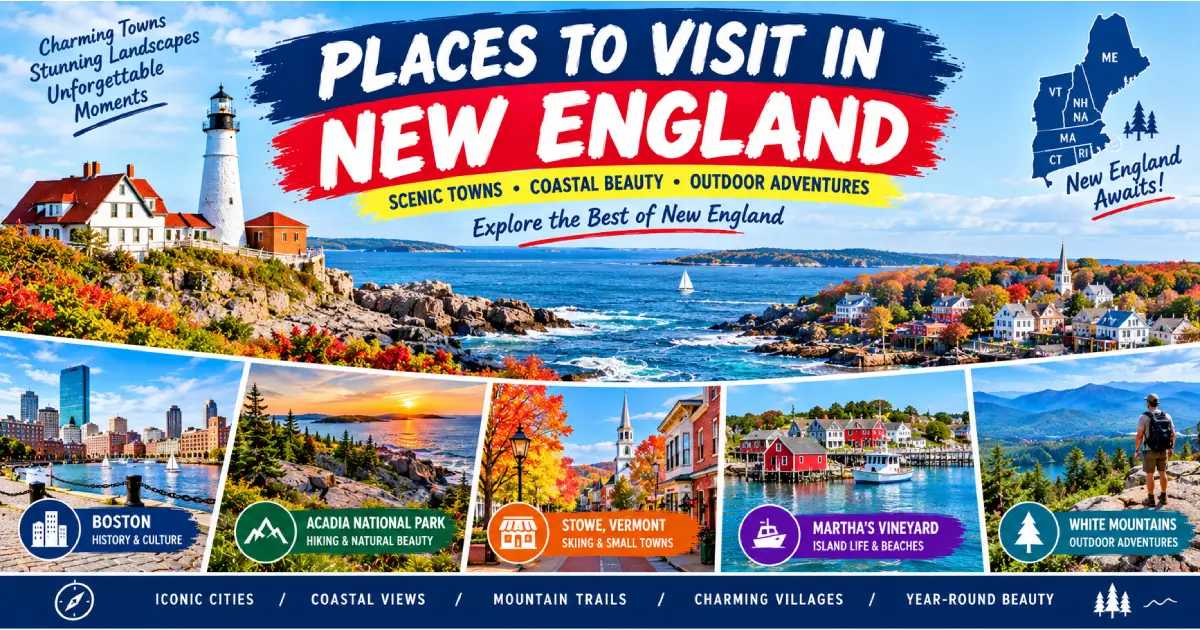
New England is the most historically layered travel region in the United States — six states (Maine, New Hampshire, Vermont, Massachusetts, Rhode Island, and Connecticut) compressed into a geography the size of England itself, spanning rocky Atlantic coastline, hardwood-covered mountains, white-steepled village greens, and the finest concentration of Colonial and Revolutionary-era history anywhere in the Americas. The region gave the United States its oldest university (Harvard, 1636), its first public park (Boston Common, 1634), its earliest European settlement north of Florida (Plymouth, 1620), and the landscapes that produced the first distinctly American school of landscape painting (the Hudson River School’s New England counterpart, the White Mountain School of the 1850s). No region in the country packs as much variety — coastline, mountains, history, cities, and farm country — into as compact an area.
New England in fall is the most iconic seasonal travel experience in the United States. The combination of the region’s sugar maple, red maple, and American beech forest (the finest hardwood coloration of any temperate forest outside central Japan and the Korean peninsula) with its white Congregational churches, covered bridges, and mountain backdrops produces the visual archetype of American autumn. Peak foliage typically runs from the last week of September through the second week of October across most of New England, moving from north to south: Vermont’s Northeast Kingdom and New Hampshire’s White Mountains peak in early October, the Berkshires and Connecticut River valley in mid-October. Lodging across the region books solid 3–4 months in advance for peak foliage weekends; advance planning is not optional.
The New England travel season effectively runs May through October for outdoor destinations and year-round for the cities and coastal towns. New England winters (November through March) are cold, snowy, and relatively uncrowded outside of ski resorts — a genuinely excellent time to visit Boston, Portland (Maine), Newport, and Salem, which are transformed by Christmas decorations and uncrowded museums. The region’s ski resorts (Stowe, Killington, Sunday River, Sugarloaf) are world-class; Vermont alone has more ski resorts per square mile than any state in the country outside Colorado.
| Destination | State | Best For | Best Season |
|---|---|---|---|
| Boston | MA | History, culture, food | Year-round |
| Cape Cod & the Islands | MA | Beaches, seafood | June–September |
| Acadia National Park | ME | Coastal hiking, sunrise | June–October |
| Vermont Fall Foliage | VT | Covered bridges, color | Late September–mid-October |
| White Mountains | NH | Hiking, Mount Washington | July–October; winter skiing |
| Newport, RI | RI | Gilded Age mansions, sailing | June–October |
| Portland, Maine | ME | Food scene, lighthouses | Year-round |
| The Berkshires | MA | Arts, Tanglewood | July–August; October |
| Salem | MA | History, Halloween | Year-round; October peak |
| Mystic, CT | CT | Maritime history | May–October |
| Stowe, VT | VT | Skiing, village, cycling | Year-round |
| Block Island, RI | RI | Remote beaches, cycling | June–September |
| Kennebunkport, ME | ME | Lobster, coastal charm | June–September |
| Litchfield Hills, CT | CT | Historic villages, wineries | September–October |
| Burlington, VT | VT | Lake Champlain, college town | May–October |
Getting there: Logan International Airport (BOS); South Station for Amtrak from New York (4.5 hours) and Washington DC (7 hours); MBTA commuter rail from Providence (1 hour)
Boston is the most historically concentrated city in the United States — a 4.5-square-mile peninsula (before land reclamation expanded it) where the foundational events of American independence occurred within walking distance of each other. The Freedom Trail (2.5 miles, free self-guided, red brick line through the city) connects 16 sites in chronological order of their role in the American Revolution: from Boston Common (1634, the oldest public park in the United States) through Paul Revere’s House (1680, the oldest remaining structure in downtown Boston), the Old North Church (1723, where the “one if by land, two if by sea” signal lanterns were hung on the night of April 18, 1775), and Bunker Hill Monument (1843 obelisk marking the June 17, 1775 battle). The trail ends at the USS Constitution (“Old Ironsides,” the oldest commissioned warship afloat in the world, launched 1797) in the Charlestown Navy Yard.
Fenway Park (America’s Most Beloved Ballpark): The oldest Major League Baseball park in use (opened April 20, 1912) and the finest sports venue experience in the United States — a 37,731-capacity park with the Green Monster (the 37-foot left field wall, a defining feature of the American cultural landscape), sight lines from every seat, and a rooftop club that provides the finest view of the playing field from the upper level of any stadium in the country. Red Sox tickets: $35–$185 (StubHub; face value from redsox.com). The Fenway neighborhood (Kenmore Square, Lansdowne Street) has the finest concentration of sports bars in New England; Game On! sports bar inside the park is open for non-game days.
Museum of Fine Arts: The finest art museum in New England and one of the finest in the United States — a collection of 500,000 works spanning ancient Egypt (the finest Egyptian collection outside Cairo), American decorative arts (the finest colonial furniture and silver collection in the country), Impressionism (the finest Monet series outside Paris), and a Japanese collection built by Ernest Fenollosa (the most significant Japanese art collection assembled by an American). General admission $27/adult; free Wednesdays 4–9:45 PM.
The Isabella Stewart Gardner Museum: The finest single-collector museum in the United States and one of the most distinctive museum experiences in the world — a Venetian-style palazzo built by Fenway Park neighbor Isabella Stewart Gardner between 1899 and 1901 around an interior courtyard garden (the finest museum garden in North America), with her personal collection of Titians, Rembrandts, Vermeer, Sargent, and Raphael displayed exactly as she arranged them in 1903 (her will specifies the collection cannot be rearranged). The March 18, 1990 theft of 13 works ($500 million at current valuation; Vermeer, Rembrandt, and Degas among them) left the empty frames hanging where the paintings were — the frames remain empty today as required by Gardner’s bequest, creating the most haunting gallery in any museum in the United States. Admission $20/adult.
Eating in Boston: The finest seafood city in the United States east of San Francisco: Union Oyster House (1826, the oldest continuously operating restaurant in the United States, oysters $3.50–$5 each), Neptune Oyster (North End, the finest raw bar in Boston, arrive before 11:30 AM to avoid the queue), Eventide Oyster Co. (the finest brown butter lobster roll in New England), Toro (Ken Oringer’s South End tapas bar, one of the finest restaurants in the country). The North End (Boston’s Italian neighborhood since 1880) has the finest Italian pastry on the East Coast: Modern Pastry and Mike’s Pastry (the great cannoli rivalry; try both — $4–$5 each).
Getting there: US-6 from Boston (90 minutes to the bridge); Bourne and Sagamore bridges onto the Cape; Steamship Authority ferries to Martha’s Vineyard (Vineyard Haven from Woods Hole, 45 min, $20/person + $90–$115 vehicle advance reservation essential July–August) and Nantucket (Hyannis, 2 hours slow ferry $39/person + $385 vehicle, or $250/person high-speed 1 hour)
Cape Cod is the defining beach destination of the American Northeast — a 70-mile-long sandy peninsula curled into the Atlantic from the Massachusetts mainland, with the finest ocean-side beaches on the East Coast (the National Seashore’s 40 miles of protected barrier beach), the quintessential New England fishing village (Provincetown), and the most historically significant Pilgrim landing site in the Americas.
Cape Cod National Seashore: Established by John F. Kennedy in 1961 — his personal intervention preserved the last undeveloped sections of the Outer Cape from private development. The National Seashore protects 40 miles of Atlantic-facing barrier beach, the finest swimming beach on the East Coast outside the Florida Keys: Coast Guard Beach (the finest accessible beach on the Cape, strong surf, lifeguards, shuttle required from Doane Road lot in summer), Race Point Beach (the most remote and dramatic, Provincetown end of the Cape, the finest whale-watching vantage from shore), and Nauset Beach (the longest continuous sand beach in Massachusetts). Day-use fee $25/vehicle (summer).
Martha’s Vineyard: The finest island in New England for a multi-day stay — 100 square miles of beaches, farmland, and gingerbread cottages with 6 distinct towns: Edgartown (the finest historic architecture, whaling-era captains’ homes, the Old Whaling Church 1843, the finest dining on the island at Détente and Among the Flowers Café), Vineyard Haven (the ferry port, Bunch of Grapes Bookstore), Oak Bluffs (the Campground’s 300 Victorian gingerbread cottages, the Flying Horses Carousel 1876 — the oldest operating platform carousel in the United States, $4/ride), and West Tisbury / Chilmark / Aquinnah (the agricultural up-island, the Red Barn Emporium, Menemsha fishing village for the finest lobster roll on the island, the Aquinnah Cliffs — Gay Head Cliffs — the most dramatic geological feature in New England, 150-foot multicolored clay cliffs designated a National Natural Landmark). Advance ferry vehicle reservations are essential for July–August (Steamship Authority, steamshipauthority.com, releases 6 months in advance; foot passengers can generally get walk-on space).
Nantucket: The finest single-town destination in New England — a 14-mile island 30 miles offshore with one of the finest intact historic districts in the United States: the Nantucket Historic District contains more pre-Civil War structures than any other location in New England, reflecting the island’s peak as the whaling capital of the world (1810–1845). The cobblestone Main Street, the Whaling Museum ($25, finest whaling artifact collection in the world, 46-foot sperm whale skeleton), the Hadwen House, and the Old Mill (1746 — the oldest working windmill in the United States) form the finest 18th–19th century commercial streetscape in New England. Nantucket is the most expensive destination in New England ($350–$700/night for mid-range lodging in summer); the $250/person fast ferry round trip makes it most practical as a day trip from Hyannis.
Provincetown: The finest town on Cape Cod and the original Pilgrim landing site (the Mayflower first anchored in Provincetown Harbor on November 11, 1620 — 41 days before the Pilgrims moved to Plymouth) — a Portuguese fishing village turned arts colony turned LGBTQ+ cultural destination, with the finest art galleries on the Cape (over 30 galleries on Commercial Street), the Pilgrim Monument (252 feet, the tallest all-granite structure in the United States, panoramic view of the Lower Cape and the National Seashore), and the finest whale-watching in the Atlantic (Dolphin Fleet, $56/adult, Stellwagen Bank National Marine Sanctuary, guaranteed humpback sightings July–October).
Location: Mount Desert Island, 5 hours from Boston via I-95 to Bar Harbor Entry Fee: $35/vehicle (7-day); timed entry for the Park Loop Road required mid-June through Columbus Day (recreation.gov, $2/reservation, 90 days advance) Best base: Bar Harbor (lodging from $150–$450/night in summer)
Acadia National Park is the finest national park east of the Mississippi River — 49,076 acres on Mount Desert Island and adjacent parcels protecting the only fjord-carved mountain coastline in the contiguous United States. The park was largely created through private land donation (John D. Rockefeller Jr. donated 11,000 acres, built 45 miles of broken-stone carriage roads, and funded the construction of Cadillac Mountain Road) and was the first national park established entirely east of the Mississippi.
Cadillac Mountain (1,528 ft, the highest point on the Atlantic coast north of Brazil): The finest sunrise viewpoint on the East Coast — from October 7 through March 6 each year, Cadillac Mountain is the first place in the United States to receive direct sunlight (due to its height and eastern position on the US coast). The Cadillac Mountain Summit Trail (0.5-mile paved loop) and the North Ridge Trail (4.4 miles RT, the finest hiking approach) both reach the open granite summit with 360-degree views of Frenchman Bay, the Porcupine Islands, and the Maine coast. The summit road (timed entry required; recreation.gov, $2, 90-day advance) is driveable May–November. Summit parking fills by 5 AM on peak foliage and sunrise days.
Precipice Trail (3.2 miles RT, 1,000 ft gain, very strenuous): The most dramatic trail in Acadia — a near-vertical ascent of the Champlain Mountain east face using iron rung ladders and hand-holds placed in the granite, with the finest view of Frenchman Bay from any trail-accessible point in the park. The trail is closed from April through mid-August for peregrine falcon nesting (the falcons returned to Acadia in 1991 after regional extirpation due to DDT; the nesting closure has maintained a successful breeding pair each year since). This is a rock scramble requiring fitness, comfort with heights, and dry conditions — not suitable for children under 10 or in wet weather.
Jordan Pond and the Carriage Roads: The 45 miles of broken-stone carriage roads built by John D. Rockefeller Jr. (1913–1940) — designed for horse-drawn carriages (automobiles were banned on the roads at Rockefeller’s insistence; they remain car-free today) — are the finest cycling and walking network in any national park in the eastern United States. Jordan Pond (the finest lake in the park, fed entirely by underground springs and perfectly clear) has the Jordan Pond House restaurant (1847 tradition of popovers and tea on the lawn overlooking the Bubbles, two rounded glacial mountains at the pond’s north end; $14 for the popover and tea service, lunch $18–$28).
Ocean Path and Thunder Hole: Ocean Path (4.4 miles RT, flat, paved) is the finest accessible coastal walk in Acadia — a path along the rocky Atlantic shoreline from Sand Beach to Otter Point, passing Thunder Hole (a narrow sea cave that produces a thunderclap when waves push air from the cavity; best at 3/4 tide on days with moderate Atlantic swell, roughly 6–8 feet).
Sand Beach: The only sand beach in Acadia National Park (the rest of the coastline is granite) — a 290-yard crescent of pink sand formed from crushed shells and granite in a protected cove. Water temperature: 55°F in August (the warmest it gets); the finest cold-water swimming experience in New England. Arrive before 9 AM in summer; parking fills by 9:30 AM.
Peak season: Late September (Northeast Kingdom, northern VT) through mid-October (southern VT, Berkshires) Best routes: VT-100 (the spine of Vermont, 200+ miles from Massachusetts border to Canada); VT-12 (Woodstock to Montpelier); US-4 (Quechee Gorge to Killington)
Vermont is the finest fall foliage destination in the United States — a state that is 78% forested with the highest percentage of sugar maple in the canopy of any state in the country. Sugar maple (Acer saccharum) produces the most intense orange-red coloration of any North American tree species; Vermont’s combination of cold nights (below 40°F triggers the color chemistry), warm sunny days, and the patchwork of farms, covered bridges, and church steeples produces the visual archetype of American autumn.
Stowe and the Green Mountains: The finest fall foliage village in Vermont — a classic ski town of white church spires, maple-lined streets, and the finest inn in New England (the Trapp Family Lodge, $250–$450/night, 2,500 acres on a south-facing Austrian-style hillside above the village, built by the family from The Sound of Music after they settled in Vermont in 1942). The Stowe Recreation Path (5.3 miles, paved, along the West Branch River) is the finest flat walk in Vermont. Stowe Pinnacle hike (5.8 miles RT, 1,500 ft gain) provides the finest summit view of the foliage-covered Green Mountains.
Woodstock: The most handsome village in New England and perhaps in the United States — a Federal-era village green surrounded by the finest concentration of early 19th-century architecture in Vermont, with four churches, the Norman Williams Public Library (1883, the finest library building in Vermont), and the Woodstock Inn & Resort ($275–$550/night, the finest main-street inn in Vermont). Billings Farm & Museum (the finest working farm museum in New England, $18/adult) and Marsh-Billings-Rockefeller National Historical Park (the first national park in Vermont, the only NHP focusing on conservation history, free ranger tours) are the primary cultural attractions.
Quechee Gorge: The “Grand Canyon of Vermont” — a 165-foot-deep glacially carved gorge of the Ottauquechee River, visible from the US-4 highway bridge (a 2-minute walk from the roadside pullout) and from the 1.5-mile Quechee Gorge Trail below. In fall foliage season the combination of the gorge and the maple canopy is the finest viewpoint from a highway bridge in New England.
Covered Bridges: Vermont has the most covered bridges per square mile of any state in the United States — 104 remaining historic covered bridges, mostly in Washington, Windsor, and Orange counties. The finest concentration is in the Middlebury and Waitsfield area of the Mad River Valley: the Waitsfield Covered Bridge (1833), the Emily Covered Bridge (1851), and the Great Eddy Covered Bridge (1833) are within 3 miles of each other. The finest single covered bridge in New England is the Cornish-Windsor Bridge on the Connecticut River between Vermont and New Hampshire — the longest covered bridge in the United States at 460 feet (1866).
Burlington and Lake Champlain: Vermont’s largest city (population 45,000 — the smallest “largest city” of any state in the continental United States) on the eastern shore of Lake Champlain, with the finest urban waterfront in New England outside Boston: the Burlington Waterfront Park, the ECHO Leahy Center for Lake Champlain ($15/adult), the Church Street Marketplace (the finest pedestrian shopping street in Vermont), and ferry crossings to New York State (Cumberland Head ferry, $8/person). The University of Vermont’s campus (1791, the 5th oldest university in New England) anchors the Church Street arts and dining scene; Hen of the Wood Burlington is the finest farm-to-table restaurant in Vermont.
Location: North-central New Hampshire; Franconia Notch and North Conway are the primary gateways (2 hours from Boston) Best base: North Conway (full lodging range $85–$300/night), Lincoln/Woodstock (west side, near Franconia Notch)
The White Mountains are the finest mountain hiking destination in the eastern United States — a 750,000-acre national forest with 48 peaks above 4,000 feet (the AMC 4,000-Footer list, the most popular peak-bagging challenge in the eastern US), the highest peak east of the Mississippi (Mount Washington, 6,288 ft), and the most extreme weather of any mountain in the world that is accessible to non-technical climbers.
Mount Washington (6,288 ft): The highest peak in the northeastern United States and the site of the highest surface wind speed ever recorded on earth: 231 mph on April 12, 1934 (a record that stood until 1996). The summit is accessible three ways: the Mount Washington Auto Road (8 miles, $40/car + $15/driver, open mid-May to late October, the finest mountain driving experience in the eastern US), the Mount Washington Cog Railway (the world’s first mountain-climbing cog railway, 1869, $52–$82/adult round trip, 3 hours total), and hiking via the Tuckerman Ravine Trail (8.4 miles RT, 4,200 ft gain, strenuous — the standard summer hiking route). The summit weather station, museum, and the historic Tip Top House (1853) are open in summer. The summit is in cloud (and often in storm) approximately 60% of the time; checking the Mount Washington Observatory forecast (mountwashington.org) before any summit approach is essential.
Franconia Notch State Park: The finest state park in New England — a dramatic glacial notch (a U-shaped valley carved by the Laurentide Ice Sheet) with several world-class attractions in 6,000 acres:
Kancamagus Highway (34 miles, NH-112, Lincoln to Conway): The finest scenic drive in New England — a highway through the heart of the White Mountain National Forest with the finest fall foliage corridor in New Hampshire (peak typically first week of October), Rocky Gorge (finest swimming hole on the road, easy 0.4-mile walk), Lower Falls (finest picnic area), and the Sabbaday Falls (0.4-mile trail to a three-stage waterfall — the finest accessible waterfall in the White Mountains).
AMC Huts System: The Appalachian Mountain Club operates 8 backcountry huts spaced 7–8 miles apart along the Appalachian Trail through the White Mountains — the finest backcountry lodging network in the eastern United States. Huts offer bunk-style lodging, communal meals (breakfast and dinner), and naturalist programs ($130–$175/person/night in summer, all-inclusive; hiker workstays available). The AMC’s Lonesome Lake Hut (3.2-mile round trip from Franconia Notch, 1,000 ft gain) is the most accessible hut in the system; Zealand Falls Hut (5.4 miles, flat, the easiest hut approach) is the finest winter hut destination.
Getting there: 1 hour from Boston via I-93/I-95 and RI-24; 3 hours from New York via I-95 and RI-138 Best season: June–October (mansions open year-round; Newport Folk and Jazz Festivals late July)
Newport is the finest Gilded Age destination in the United States — a small city (population 24,000) that was the summer resort of the Vanderbilts, Astors, and Belmonts at the peak of American industrialist wealth (1880–1920), producing the greatest concentration of historic estate architecture in the country. The Newport Mansions — 11 estates managed by the Preservation Society of Newport County — represent the apex of American residential architecture of the period: designs by McKim, Mead & White, Richard Morris Hunt, and Horace Trumbauer for the wealthiest families in the country.
The Breakers (1895, Vanderbilt): The finest mansion in Newport and the finest example of Gilded Age architecture in the United States — a 70-room Italian Renaissance palazzo designed by Richard Morris Hunt for Cornelius Vanderbilt II, modeled on 16th-century Genoese palaces, with a central Great Hall rising 45 feet and ceilings decorated with French decorative painters. Admission $35/adult (Preservation Society ticket; combo tickets available for multiple mansions). The Breakers is the most visited historic house in New England; arrive at opening (9 AM) to avoid peak crowds.
The Cliff Walk (3.5 miles, free): The finest urban coastal walk in the United States — a public right-of-way path along the Newport cliff edge (established by a 19th-century easement battle between fishermen and the mansion owners; the fishermen won) with the Gilded Age mansions on the inland side and the Atlantic Ocean on the seaward side. The southern section of the path becomes a rocky scramble (the “Rough Section”); the northern 2 miles (from Memorial Boulevard to Ruggles Avenue) are paved and stroller-accessible. The finest free attraction in Rhode Island.
Marble House (1892, Vanderbilt) and Rosecliff (1902, Oelrichs): The two finest mansions after The Breakers: Marble House (designed by Richard Morris Hunt for William K. Vanderbilt, the architectural inspiration for The Breakers, with the finest Gold Room — a room sheathed entirely in gilded bronze and Siena marble) and Rosecliff (designed by Stanford White for Tessie Oelrichs, modeled on the Grand Trianon at Versailles, with the largest ballroom in Newport — the setting for several scenes in The Great Gatsby).
Newport Folk Festival and Newport Jazz Festival: The two finest outdoor music festivals in New England — both held at Fort Adams State Park on Newport Harbor in late July (Jazz Festival, $165–$225/day) and early August (Folk Festival, $165–$225/day). The Newport Folk Festival (est. 1959) is where Bob Dylan went electric in 1965 — the single most consequential moment in American popular music history. Both festivals sell out months in advance.
Getting there: 2 hours from Boston via I-95; Portland International Jetport (PWM) with direct flights from major northeastern cities Best season: Year-round; peak June–September; December for Christmas season
Portland is the finest food city in New England outside Boston — a compact peninsula city (population 68,000) with the highest concentration of restaurants per capita of any city in the United States (consistently rated in the top 5 nationally) built on a foundation of Maine’s extraordinary seafood, dairy, and agricultural production. The Old Port district (a 20-block waterfront neighborhood of 19th-century brick commercial buildings) contains the finest block-for-block concentration of independent restaurants, bars, and shops in northern New England.
Portland food scene (essential stops):
Portland Head Light (Fort Williams Park, Cape Elizabeth): The finest lighthouse in New England and the most photographed single structure in Maine — an active lighthouse (1791, the oldest lighthouse in Maine, commissioned by George Washington) on the rocky headland of Cape Elizabeth with the open Atlantic on three sides. The keeper’s quarters museum ($3/adult) and the walking path around the lighthouse headland are the finest 30-minute stops near Portland. 12 miles from downtown Portland via US-1 south.
Casco Bay Islands: The 365 Calendar Islands of Casco Bay (there are actually closer to 100) are accessible from the Casco Bay Lines ferry terminal in downtown Portland. Peaks Island (20 minutes, $7.90 RT) has the finest accessible island day trip from Portland — a small year-round community with art galleries, the Umbrella Cover Museum (the world’s largest collection of umbrella covers, free), and a 4-mile perimeter bicycle/walking route. Great Chebeague Island (45 minutes) is the finest cycling island day trip. Kayak Portland (kayakportland.com) offers guided island tours from $75/person.
Getting there: 2.5 hours from Boston via I-90 west; 2.5 hours from New York City via the Taconic State Parkway; Pittsfield is the principal city Best season: July–August (Tanglewood); October (foliage); year-round for cultural institutions
The Berkshires are the finest arts destination in rural New England — a region of rolling hills, small historic towns, and cultural institutions of national importance in the western Massachusetts hills, anchored by the summer homes of Boston’s and New York’s cultural establishment since the late 19th century. The Berkshires produce more cultural programming per square mile in summer than any rural destination in the United States.
Tanglewood: The summer home of the Boston Symphony Orchestra (the finest orchestra in the United States) on a 524-acre estate in Lenox — 8 weeks of concerts from late June through August, including the finest outdoor classical music experience in North America. The main shed (Koussevitzky Music Shed, 5,000 seats) is supplemented by the Ozawa Hall (1,200 seats) and the open lawn (bring a picnic). The Saturday evening BSO concerts on the main lawn — a bottle of wine, cheese from Guido’s in Pittsfield, and the orchestra playing through the open sides of the shed — are the finest summer evening experience in New England. Tickets: $22–$145 (lawn $22, shed $55–$145); bso.org. Lodging in Lenox and Stockbridge books 3–4 months ahead for peak BSO weekends.
Massachusetts Museum of Contemporary Art (MASS MoCA, North Adams): The finest contemporary art museum in New England and one of the finest in the United States — a 350,000-square-foot former industrial complex (the Arnold Print Works, est. 1860) converted in 1999 into 25 galleries for large-scale contemporary art installations. The scale of the former mill buildings allows commissions impossible in conventional museum spaces; James Turrell’s “Into the Light” light installation and Gunnar Schonbichler’s “Exploded Views” structural installations are permanent highlights. Admission $22/adult; open year-round; the finest single museum experience in rural New England.
Stockbridge and Norman Rockwell: The Norman Rockwell Museum ($25/adult) in Stockbridge is the finest single-artist museum in New England — the largest collection of original Norman Rockwell art in the world (321 original paintings, including the Four Freedoms series, 1943), with the artist’s original Stockbridge studio relocated to the museum grounds. Stockbridge itself is the most perfectly preserved New England village main street — the “Main Street at Christmas” that Rockwell painted in 1967 is visible from the same angle on Stockbridge’s Main Street today.
Clark Art Institute (Williamstown): The finest art museum in rural New England — a collection of extraordinary quality assembled by industrialist Sterling Clark (Renoir, Monet, Degas, Sargent, Homer, and the finest collection of French academic painting in the United States) in a Williamstown campus combining a 1955 neo-classical building and a 2014 Tadao Ando addition. Admission $20/adult (free November–May). The Williamstown Theatre Festival (WTF, June–August) at the adjacent Williams College is the finest summer theater festival in New England.
Getting there: 25 miles north of Boston via US-1A or MBTA Commuter Rail (Salem station, 30 minutes, $8.25) Best season: Year-round; October is peak season (Haunted Happenings festival, 500,000 visitors)
Salem is the most historically layered small city in New England — a former Puritan settlement turned Atlantic trading port turned witch-trial site turned maritime museum city of extraordinary architectural quality. The Salem Witch Trials of 1692 (during which 19 people were executed by hanging, one pressed to death, and 5 died in prison on charges of witchcraft) have made Salem the most visited historic city in New England in October; the Peabody Essex Museum has made it one of the finest art museum destinations in New England year-round.
Peabody Essex Museum: The finest museum in Salem and one of the finest art museums in New England — a collection built from the East India Marine Society’s maritime collection (1799) into a world-class repository of maritime art, Asian export art, Native American art, and international architecture. The centerpiece is the Yin Yu Tang — a completely preserved 200-year-old Qing dynasty merchant’s house from Anhui province, China, dismantled beam by beam and reconstructed inside the museum (the only example of historic Chinese domestic architecture installed permanently in a museum outside China). Admission $22/adult; free first Saturdays of the month.
The Witch Trials Memorial and Charter Street Cemetery: The most sober and powerful memorial in Salem — a small park of 20 stone benches (one for each victim of the 1692 trials) with the victims’ names and death dates carved on the bench seats. The adjacent Charter Street Cemetery (1637, the oldest cemetery in Salem) contains the graves of multiple judges from the trials, including John Hathorne — the only judge who never apologized for his role, and the great-great-grandfather of Nathaniel Hawthorne (who added the “w” to his name to distance himself from the family connection). Free, open year-round.
Derby Wharf and the Salem Maritime National Historic Site: The finest preserved 18th-century commercial waterfront in New England — the three surviving wharves (Derby Wharf, Central Wharf, and Pickering Wharf) from Salem’s peak as the 6th-largest city in the United States (1790s), when its merchants controlled more trade with the Far East than any other American port. The Elias Hasket Derby House (1762) and the Custom House (1819, where Nathaniel Hawthorne worked 1846–1849 and wrote the introduction to The Scarlet Letter) are the finest buildings in the complex. Free ranger-led tours daily.
Getting there: 2.5 hours from Boston via I-95; 2.5 hours from New York City via I-95; New London/Mystic Amtrak station (Acela and Northeast Regional) Best season: May–October
Mystic is the finest maritime destination in New England south of Portland — a small Connecticut River town that was the center of American whaling and shipbuilding from 1784 through the Civil War, preserved in the finest living maritime museum in the United States.
Mystic Seaport Museum: The finest maritime museum in the Western Hemisphere — a 19-acre reconstructed 19th-century seaport village with the last surviving American wooden whaleship (the Charles W. Morgan, 1841, the oldest commercial vessel in the United States), a working shipyard, and costumed interpreters demonstrating 19th-century maritime trades. The Charles W. Morgan, moored at the main wharf, is the finest historic ship experience in the United States — visitors walk the original decks, enter the crew quarters, and climb the rigging (seasonal). Admission $34/adult; mysticseaport.org.
Mystic Aquarium: One of the finest aquariums in the northeastern United States — the largest collection of beluga whales in the United States, Steller sea lions, and the finest collection of deep-sea bioluminescent organisms on the East Coast. Admission $35/adult; combination tickets available with the Seaport Museum.
Stonington Borough: The finest historic village in Connecticut — a small peninsula 4 miles east of Mystic with the most compact and intact 18th-century New England village streetscape in Connecticut, the only town in Connecticut to repel a British naval attack during the War of 1812 (August 10, 1814), and the Old Lighthouse Museum (1823, $5). The Mystic area oyster aquaculture (Mystic Oyster and Thimble Island Oyster) produces some of the finest brined oysters in the Atlantic; the Oyster Club restaurant (Mystic) is the finest dining in southeastern Connecticut.
5 Days (First-time New England): Day 1–2: Boston (Freedom Trail, MFA, North End) → Day 3: Salem + Cape Ann (Rockport) → Day 4: White Mountains (Kancamagus Highway + Franconia Notch) → Day 5: Stowe, VT (foliage drive, VT-100)
7 Days (Classic New England): Day 1–2: Boston → Day 3: Newport → Day 4: Cape Cod (National Seashore + Provincetown) → Day 5: Portland, ME → Day 6: Acadia National Park → Day 7: White Mountains + return to Boston
10 Days (Full New England): Day 1–2: Boston → Day 3: Salem/Gloucester → Day 4: Portland, ME → Day 5–6: Acadia NP → Day 7: Vermont (VT-100 drive, Stowe) → Day 8: White Mountains → Day 9: Newport, RI → Day 10: Mystic, CT + New Haven (Yale campus) → New York or Boston departure
Posted By : Vinay
Latest Article
2nd Floor, 39, Above Kirti Club, DLF Industrial Area, Kirti Nagar, New Delhi, Delhi 110015



Travel Tourister is a leading Travel portal where we introduce travellers to trusted travel agents to make their journey hasselfree, memorable And happy. Travel Tourister is a platform where travellers get Tour packages ,Hotel packages deals through trusted travel companies And hoteliers who are working with us across the world. We always try to find new and more travel agents and hoteliers from every nook and corners across the world so that you could compare the deals with different travel agents and hoteliers and book your tour or hotel with the one you have chosen according to your taste and budget.
Copyright © Travel Tourister, India. All Rights Reserved

 Call
 Enquiry