Published on : 28 Oct 2026
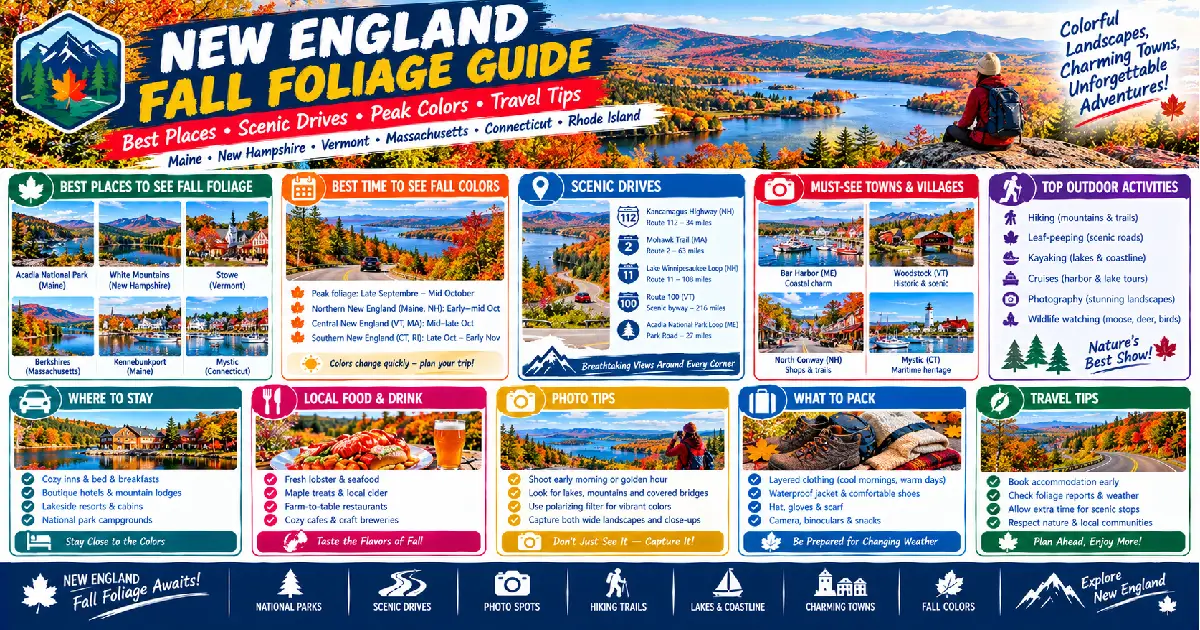
New England fall foliage is the most spectacular seasonal natural phenomenon in the United States that can be experienced from a car window — a 6-week progression of color that sweeps south and downhill from the Canadian border in late September, peaks across the region’s interior in the first two weeks of October, and reaches the southern coast by late October, turning 62,000 square miles of mixed hardwood forest into the finest color show on Earth. The science is straightforward: the shorter days of late summer trigger the cessation of chlorophyll production in deciduous trees, revealing the underlying pigments (yellow and orange xanthophylls in birch, poplar, and ash; red and purple anthocyanins produced specifically in response to bright autumn days and cool nights in sugar maple and red maple; the tannin-based browns of oaks) that were masked all summer by green. What makes New England’s display exceptional is the species mix — sugar maple (the king of fall color, producing the most saturated scarlet and orange of any tree species in the world), red maple, yellow birch, American beech, and white ash in a composition assembled by glaciation and temperate maritime climate that exists nowhere else in quite this combination.
The color peaks differently in each state, at different elevations, and in different microclimates — and predicting it precisely is more art than science. The general rule: northern Vermont, northern New Hampshire (above 2,500 feet), and the Maine North Woods peak in the last week of September; the Connecticut River Valley, the Berkshires, and mid-elevation New England peak in the first two weeks of October; the Massachusetts coast, southern Connecticut, and Rhode Island typically hold their best color through the third week of October. A warm, wet summer followed by a stretch of sunny days and cool nights (above 45°F but below 50°F) in September produces the most saturated color; a drought year mutes the reds, a frost before peak kills the leaves before they color fully.
Planning a New England foliage trip in 2026 requires three things: flexibility in dates (peak can shift by 1–2 weeks from year to year depending on weather), advance reservations (the finest foliage inns — the Woodstock Inn, the Trapp Family Lodge, the Pitcher Inn — book out a year in advance for peak-week weekends), and an understanding that the finest foliage experience is not at the roadside overlooks shown in every travel photo, but rather on a canoe on the Androscoggin River at 7 AM, or on a trail above the Connecticut River Valley when the morning fog fills the valley below you and the hillside is lit in orange and red.
| Region | Typical Peak | Best Roads & Trails |
|---|---|---|
| Northern VT / Northeast Kingdom | Sept 22–Oct 4 | VT-100, VT-105, Lake Willoughby |
| White Mountains, NH (above 2,500 ft) | Sept 25–Oct 5 | Kancamagus Highway, Mt. Washington Auto Road |
| Northern Maine (Rangeley, Moosehead) | Sept 22–Oct 2 | ME-17, ME-6/15, Grafton Notch |
| Green Mountains, VT (mid-elevation) | Oct 1–Oct 12 | VT-100 Granville Gulf, VT-12, Lincoln Gap |
| White Mountains, NH (valleys) | Oct 3–Oct 15 | Franconia Notch, Kancamagus, NH-16 |
| Berkshires, MA / Connecticut River Valley | Oct 5–Oct 18 | MA-2 Mohawk Trail, MA-112, VT/MA-7 |
| Maine coast / Acadia | Oct 1–Oct 15 | Park Loop Road, ME-1, Schoodic Peninsula |
| Southern VT / Litchfield Hills, CT | Oct 8–Oct 20 | VT-9, CT-44, Housatonic River Valley |
| Pioneer Valley, MA / Cape Ann | Oct 10–Oct 22 | MA-116, MA-2A, MA-127 |
| Rhode Island / Southern CT coast | Oct 15–Oct 25 | RI-1, CT-169, Narragansett Coastal Route |
Vermont is the finest foliage state in New England — the state has the highest percentage of forest cover (76%) and the largest unbroken tracts of sugar maple in the region. Vermont’s sugar maple dominance (the state tree; Vermont produces 40% of US maple syrup) means the fall color skews orange-red more than any other state, with the deep scarlets of sugar maple hillsides visible from 10 miles across a valley.
VT-100: The Great River Road (215 miles, Readsboro to Newport) The finest foliage road in New England — Vermont Route 100 runs the length of the state along the Mad River and White River valleys, passing through the finest small towns in Vermont (Weston, Ludlow, Rochester, Waitsfield, Stowe) with unbroken views of color-covered hillsides and no commercial strip development. The finest sections: the Granville Gulf Reservation (5 miles of state-owned roadside land between Granville and Warren, no development, the road cuts through a gorge of sugar maple and yellow birch that is the finest single roadside foliage mile in Vermont), the Rochester Corridor (Rochester to Hancock, 12 miles of open valley with the White River below and Green Mountain peaks above), and the Stowe approach (the VT-100 north from Morrisville to the Stowe ski area, with Mount Mansfield above and the Little River below).
Northeast Kingdom: Vermont’s Best Kept Secret The Northeast Kingdom (Essex, Orleans, and Caledonia counties in Vermont’s northeast corner) is the finest foliage destination in New England for visitors who want color without crowds — a landscape of boreal forest, farm country, and remote ponds and lakes with no resort towns and the most authentic rural Vermont experience available.
Stowe: The finest foliage resort town in Vermont — a Victorian village at the foot of Mount Mansfield (4,393 ft, Vermont’s highest peak) with the finest concentration of foliage-season accommodations in New England. The Trapp Family Lodge (trappfamily.com, $250–$450/night, 2,500 acres on a south-facing hillside above the village, the finest foliage-season property in Vermont) has 100 km of groomed cross-country trails repurposed as hiking and biking trails in fall, with panoramic views of the foliage-covered hillsides. The Stowe Recreation Path (5.3 miles, paved, along the West Branch River from the village to the ski area) is the finest flat foliage walk in Vermont.
Lincoln Gap Road: The finest mountain pass road in Vermont — a single-lane paved road (closed in winter) over the Green Mountain crest between Lincoln and Warren, passing through a summit notch at 2,424 feet with the finest 10-mile-view in Vermont in either direction. The road is accessible by car from mid-May to mid-November; drive Lincoln to Warren (east to west) in the afternoon for the finest light on the western foliage. The Long Trail crosses the Lincoln Gap Road at the summit; the South Lincoln Gap approach on the Long Trail (1 mile to Battell Shelter, moderate) is the finest short hike from a mountain pass road in Vermont.
Woodstock: The finest village in Vermont by common consensus — a Federal and Greek Revival main street around an elliptical village green, the finest collection of intact 19th-century commercial architecture in New England outside of Nantucket, and the Woodstock Inn & Resort (woodstockinn.com, $350–$650/night, built 1969 on the site of the original 1793 Woodstock Inn, the finest foliage-season resort in southern Vermont — book 8–12 months ahead for peak-week rooms). The Marsh-Billings-Rockefeller National Historical Park (the only national park in Vermont, free entry to the Carriage Barn visitor center; $18/adult for the mansion tour) preserves the farm and forest management practices that influenced the American conservation movement; the managed forest above the farm is the finest old-growth-adjacent maple forest accessible by trail in southern Vermont.
Kancamagus Highway (NH-112, 34.5 miles, Lincoln to Conway): The finest foliage highway in New England — a National Scenic Byway through the heart of the White Mountain National Forest with no commercial development for its entire length, following the Swift River through the finest valley foliage in New Hampshire. The highway crests at Kancamagus Pass (2,855 ft) and descends through Passaconaway and Sabbaday Falls (a 0.3-mile walk from the roadside to a 45-foot flume falls, the finest 5-minute roadside waterfall walk in the White Mountains). Peak color typically first week of October at valley elevation, last days of September above 2,500 feet. Drive east to west (Conway to Lincoln) in morning for the best light on the north-facing slopes. Stop at Lower Falls, Rocky Gorge, and the Covered Bridge at Albany for the finest roadside pullouts on the highway.
Mount Washington Auto Road (Pinkham Notch, NH-16): The finest high-elevation foliage drive in New England — a privately operated toll road (mountwashington.com, $42/car and driver + $10/additional adult, open early May through late October, closed on foggy days and in bad weather) ascending 4,618 feet in 7.6 miles to the summit of Mount Washington (6,288 ft, highest peak in the northeastern US). The above-treeline foliage (tundra-zone dwarf birch and blueberry heath, brilliant red-orange in late September) is the finest above-treeline fall color in the eastern US; the view from the summit on a clear day extends to the Atlantic Ocean (80 miles), the St. Lawrence River (100 miles), and five states. Peak above-treeline color: September 20–30. Check road conditions at mountwashington.com before driving; the road closes for wind speeds above 45 mph. The AMC Pinkham Notch Visitor Center (open year-round, $0 entry) is the finest trailhead for Tuckerman Ravine Trail and the finest White Mountain hiking information resource.
Franconia Notch State Park: The finest state park in New Hampshire for fall foliage — a glacially carved notch between Franconia Range (Liberty, Flume, and Lafayette summits, the finest traverse ridge in the White Mountains: the Franconia Ridge Loop, 8.9 miles, 3,500 ft gain, the most dramatic above-treeline ridge hike in the eastern US) and Cannon Mountain (4,100 ft, the Cannon Mountain Aerial Tramway, $32/adult, provides the finest above-treeline foliage view without hiking in New Hampshire). The Flume Gorge ($20/adult, open May–October) — a 800-foot natural gorge with sheer 70-foot granite walls — is the finest accessible gorge walk in New England, with fall color framing the gorge walls above. Profile Lake (the “Old Man of the Mountain’s” lake — the famous profile collapsed in 2003; a steel silhouette on Cannon Mountain marks the spot) is the finest mirror-reflection foliage photography lake in the White Mountains.
Franconia Ridge Loop (8.9 miles, strenuous, 3,500 ft gain): The finest foliage season hike in New England — an above-treeline ridge traverse connecting Mount Lafayette (5,249 ft), Mount Lincoln (5,089 ft), and Little Haystack Mountain via 1.7 miles of exposed, above-treeline ridge with 360° views of the White Mountains in full color below. The ridge foliage view — looking down onto a valley-floor carpet of orange and red with the summits bare granite above — is the finest hiking foliage experience in the eastern US. Trailhead at Lafayette Campground, Franconia Notch State Park; allow 5–6 hours. Peak ridge color: September 22–October 2.
Mount Monadnock (southern NH, 3,165 ft): The most-climbed mountain in the eastern United States (and one of the most-climbed in the world, after Fuji and Snowdon) — a solitary granite summit 60 miles north of Boston with the finest 360° foliage view accessible in a day trip from southern New England. White Dot Trail (3.8 miles RT, 1,800 ft gain, the most direct route) is the finest foliage hike from the Boston day-trip orbit. Trailhead at Monadnock State Park ($5/person), Jeffrey, NH. Peak color: October 5–15.
Grafton Notch State Park (ME-26, Newry): The finest foliage state park in Maine — a glacial notch on the western Maine border with New Hampshire, featuring Screw Auger Falls (a 23-foot waterfall through a pothole gorge carved by glacial meltwater), Mother Walker Falls, Moose Cave Gorge, and the trailhead for Old Speck Mountain (4,170 ft, 7.6 miles RT, the fourth-highest peak in Maine, with a fire lookout tower and the finest Maine interior foliage view accessible by trail). The notch itself on ME-26 provides the finest roadside foliage drive in western Maine. Peak: late September.
ME-17: Height of Land (Oquossoc to Mexico): The finest roadside foliage pullout in Maine — the Height of Land overlook on ME-17 between Oquossoc and Rumford provides a 270° panoramic view of Mooselookmeguntic Lake (the finest lake name in New England) and Rangeley Lake from a 2,100-foot roadside pullout with no climbing required. The view encompasses 100+ square miles of unbroken northern hardwood forest at peak color — the finest “you have to pull over” foliage moment in Maine. Peak: late September.
Acadia National Park (MDI): The finest coastal foliage destination in New England — Acadia’s combination of pink granite shoreline and inland hardwood forest creates the finest foliage-over-water color composition in New England. The carriage roads (particularly the Eagle Lake Loop and the Hadlock Brook Loop in the Acadia Mountain area) provide the finest cycling-in-foliage experience in any US national park. The Park Loop Road drive (27 miles) in the first two weeks of October is the finest single scenic driving loop in New England during foliage season. Peak: October 1–15 on MDI.
Rangeley Lakes Region: The finest moose-watching foliage destination in Maine — 110 miles north of Portland on ME-4/ME-16, the Rangeley Lakes area (Rangeley, Mooselookmeguntic, Richardson, and Umbagog lakes — a chain of boreal-zone wilderness lakes) combines the finest moose-watching in the eastern US (dawn and dusk drives on ME-16 between Rangeley and Stratton, the highest moose density per square mile in the eastern US) with the finest lakeside fall color in Maine. Saddleback Mountain (4,120 ft, currently without chairlift access; hike the 6 miles RT to the summit for the finest above-treeline foliage view in western Maine). Peak: late September.
Mohawk Trail (MA-2, 63 miles, Athol to Williamstown): The first designated scenic road in the United States (1914) — Massachusetts Route 2 follows the Deerfield River gorge and climbs through the Berkshire Hills to Williamstown, passing through the finest foliage corridor in Massachusetts. Key stops: the Hairpin Turn (a 90-degree right-angle turn on the western descent to North Adams, the finest single roadside foliage view in the Berkshires, with the Hoosac Valley 1,000 feet below carpeted in color), the Mohawk Trail State Forest (the largest grove of ancient white pine in Massachusetts, 150-foot trees towering above the Deerfield River, the finest forest floor walk in the Berkshires), and the Bridge of Flowers in Shelburne Falls (a decommissioned trolley bridge over the Deerfield River converted into a 400-foot flower garden in 1929, the finest horticultural foliage-season combination in western Massachusetts). Peak color: October 5–18.
Berkshires (Lenox, Stockbridge, Great Barrington): The finest foliage resort region in Massachusetts — the southern Berkshires offer a combination of cultural destinations (Tanglewood’s fall open rehearsals, Norman Rockwell Museum in Stockbridge, MASS MoCA’s massive contemporary art complex in North Adams, Clark Art Institute in Williamstown with the finest French Impressionist collection in New England) with the finest inn accommodations in Massachusetts foliage country. Route 7 from Great Barrington to Williamstown is the finest north-south foliage drive in the Berkshires, and the Mount Washington area (southeast of Great Barrington) holds Bash Bish Falls (the finest waterfall in Massachusetts, 80-foot twin cascade in a narrow gorge — 0.4 miles from the lower parking lot) surrounded by the finest mixed hardwood foliage in the state. Peak: October 8–20.
Connecticut River Valley (I-91/MA-47 corridor): The Connecticut River — the longest river in New England (407 miles) — cuts through the finest agricultural valley in Massachusetts, with tobacco barns, oxbow meanders, and the finest river-valley foliage drive in southern New England on MA-47 between Hadley and Deerfield. Mount Sugarloaf State Reservation (South Sugarloaf Mountain, $5/car, 3 miles north of Sunderland on MA-116) has the finest accessible panoramic Connecticut River valley view in Massachusetts from a 791-foot summit accessible by car (paved summit road) or a 1-mile hiking trail. Peak: October 10–20.
Litchfield Hills (CT-44, CT-202, CT-118): The finest foliage region in Connecticut — the Litchfield Hills northwest of Hartford are the most elevated terrain in Connecticut (Canaan Mountain, 2,380 ft) with the finest sugar maple and yellow birch display in the state. CT-44 through the falls area of Canaan and Norfolk is the finest Connecticut foliage road; the Norfolk village green (surrounded by the finest collection of Gothic Revival architecture in New England outside of college campuses) is the finest single-village foliage composition in Connecticut. The Housatonic River Valley on CT-7 through Kent and Cornwall Bridge provides the finest river-corridor foliage drive in Connecticut; Kent Falls State Park (free, Kent Falls, the finest cascade waterfall in Connecticut at 250 feet over a series of ledges) and the West Cornwall covered bridge (the finest covered bridge in Connecticut, Palladian-window design, 1864) are the finest two roadside stops on CT-7. Peak: October 10–22.
Quabbin Reservoir (MA-9/MA-122, central Massachusetts): The finest hidden foliage destination in Massachusetts — a 39-square-mile reservoir created in 1939 by the flooding of four Swift River valley towns (Dana, Enfield, Greenwich, and Prescott — the “lost towns of the Quabbin”), surrounded by 81,000 acres of watershed forest with no development. The Quabbin is the finest undeveloped foliage landscape accessible by car in central Massachusetts; the Enfield Lookout (MA-9, Belchertown, free roadside pullout) provides a sweeping view of the reservoir and surrounding forest at peak color. Peak: October 8–18.
Block Island, Rhode Island: The finest coastal foliage experience in Rhode Island — Block Island (ferry from Point Judith, $28/RT foot passenger, 55 minutes) has no natural-color hardwood forest, but the combination of the clay bluffs of Mohegan Bluffs (the finest coastal cliff walk in southern New England, 200-foot clay bluffs above the Atlantic, 2-mile Greenway path) with the autumn heath colors (bayberry, beach plum, blueberry — brilliant red-orange ground cover) and the clear September-October light over the Atlantic creates the finest coastal late-season color in New England. Peak: October 10–25.
| Hike | State | Distance | Peak Color | Why It’s the Best |
|---|---|---|---|---|
| Franconia Ridge Loop | NH | 8.9 mi loop | Sept 25–Oct 5 | Above-treeline ridge; valley-floor color below |
| Mount Pisgah above Lake Willoughby | VT | 3.2 mi RT | Sept 22–Oct 2 | Cliff-edge view of fjord-like lake in color |
| Cadillac Mountain North Ridge | ME | 4.4 mi RT | Oct 1–12 | Above-treeline granite; color over Frenchman Bay |
| Mount Monadnock White Dot | NH | 3.8 mi RT | Oct 5–15 | Finest 360° foliage from day-trip distance of Boston |
| Old Speck Mountain | ME | 7.6 mi RT | Sept 25–Oct 5 | Fire tower; finest Maine interior view |
| Acadia Mountain | ME | 2.5 mi RT | Oct 1–12 | Somes Sound + color |
| Mount Greylock | MA | 2 mi RT (road) | Oct 8–18 | Highest MA peak; Berkshires panorama |
| Stratton Mountain | VT | 3.6 mi RT | Oct 1–12 | Appalachian Trail; Long Trail; 360° southern VT |
| Welch-Dickey Loop | NH | 4.4 mi loop | Oct 1–12 | Best open-ledge loop for effort in the White Mountains |
| Mount Tom, VT (Lincoln) | VT | 2.8 mi RT | Oct 3–15 | Finest view from a VT Green Mountain summit for effort |
The Ultimate New England Foliage Road Trip (7 days, 900 miles):
Day 1 — The Kancamagus Highway (NH): Drive Conway to Lincoln on NH-112 (34.5 miles), stopping at Sabbaday Falls, Rocky Gorge, and Lower Falls. Overnight in Lincoln or Woodstock, NH.
Day 2 — Franconia Notch and Northeast Vermont: North on I-93 through Franconia Notch (Flume Gorge, Cannon Mountain tram, Profile Lake). Northeast on US-3/US-302 to St. Johnsbury, VT. Overnight in St. Johnsbury or Lyndonville.
Day 3 — Northeast Kingdom: Northeast Kingdom circuit — Lake Willoughby (VT-5A), Craftsbury Common, Island Pond, and Burke Mountain. Overnight in the Kingdom (Lyndonville or Burke area).
Day 4 — VT-100 South: The Great River Road south — Stowe (Trapp Family Lodge, Stowe Recreation Path), Waitsfield and Warren (Lincoln Gap Road detour), Granville Gulf, Rochester. Overnight in Woodstock or Quechee.
Day 5 — Southern Vermont and the Berkshires: Woodstock, Quechee Gorge (165-ft gorge, free), Brattleboro (CT River headwaters area) and south on I-91/MA-2 (Mohawk Trail, Shelburne Falls Bridge of Flowers, Hairpin Turn). Overnight in Lenox or Stockbridge.
Day 6 — Berkshires: Bash Bish Falls, Norman Rockwell Museum (Stockbridge), MASS MoCA or Clark Art Institute (Williamstown), CT-44 through Litchfield Hills (Kent Falls, West Cornwall Covered Bridge). Overnight in Litchfield or Kent, CT.
Day 7 — Connecticut River Valley and the Coast: CT-169 (the finest Colonial road in Connecticut, from Lisbon to Woodstock — a National Scenic Byway through the finest concentration of 18th-century village greens in New England), northeast to Cape Ann (MA-127 around Gloucester, the finest coastal foliage drive in Massachusetts), or directly to Boston.
The single most important rule for New England foliage planning: go mid-week. The finest foliage inns and the most scenic roads are overwhelmed on peak-color weekends; arriving Tuesday–Thursday gives you the same color with a fraction of the traffic and the same hotel room at 20–30% lower rate (some inns charge weekend premiums of $50–$100/night above midweek rates). The color doesn’t care what day of the week it is.
Foliage forecast resources:
Peak color duration: Most locations hold peak color for 5–10 days. A warm, cloudy, windless week extends peak by several days; a heavy rainstorm at peak strips leaves within 24 hours. Check the forecast 3–4 days before your intended visit and adjust travel dates if possible.
Reservations are essential for any foliage-season weekend visit; the finest properties book out in January for peak-October weekends. Book early or plan a midweek visit.
Vermont:
New Hampshire:
Massachusetts (Berkshires):
Friday evening: Arrive Woodstock or Stowe; dinner at Woodstock Inn or Trapp Family Lodge Saturday: Drive VT-100 (Granville Gulf section), hike from Lincoln Gap (Long Trail 1 mile to Battell Shelter), afternoon carriage at Trapp Family Lodge Sunday: Drive Northeast Kingdom — Lake Willoughby (VT-5A), Craftsbury Common; return via I-89
Day 1: Drive Kancamagus Highway (Conway to Lincoln), stop at Sabbaday Falls and Lower Falls; overnight in Lincoln Day 2: Franconia Ridge Loop hike (8.9 mi, 5–6 hours), afternoon Flume Gorge; overnight in Franconia or Bethlehem Day 3: Mount Washington Auto Road drive (check conditions), PMC Pinkham Notch; overnight in North Conway Day 4: Drive NH-16 south through Mount Washington Valley to Portsmouth; coastal return via US-1
See “Best Foliage Drives: The Ultimate Road Trip” section above.
Posted By : Vinay
Latest Article
2nd Floor, 39, Above Kirti Club, DLF Industrial Area, Kirti Nagar, New Delhi, Delhi 110015



Travel Tourister is a leading Travel portal where we introduce travellers to trusted travel agents to make their journey hasselfree, memorable And happy. Travel Tourister is a platform where travellers get Tour packages ,Hotel packages deals through trusted travel companies And hoteliers who are working with us across the world. We always try to find new and more travel agents and hoteliers from every nook and corners across the world so that you could compare the deals with different travel agents and hoteliers and book your tour or hotel with the one you have chosen according to your taste and budget.
Copyright © Travel Tourister, India. All Rights Reserved

 Call
 Enquiry