Published on : 29 Oct 2026
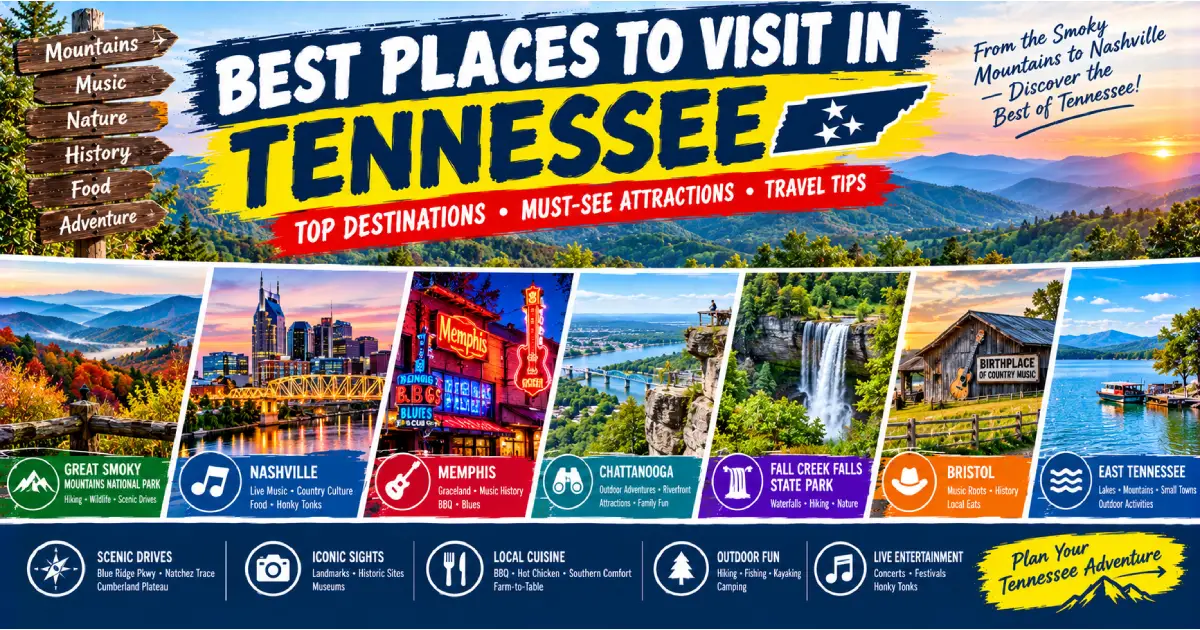
Tennessee is one of the most geographically and culturally diverse states in the American South — a 432-mile-wide state that stretches from the Appalachian Mountains on its eastern border with North Carolina to the Mississippi River on its western boundary with Arkansas, encompassing three distinct Grand Divisions (East, Middle, and West Tennessee) that differ in geology, culture, accent, and history as much as three separate states might. The eastern third is mountain country: the Great Smoky Mountains, the Cherokee National Forest, and the Tennessee Valley, anchored by Knoxville. The middle third is the heartland of American country music, bluegrass, and the southern agricultural tradition, dominated by Nashville and its satellite towns. The western third is Mississippi Delta country — flat, alluvial, deeply Blues-influenced — anchored by Memphis, the birthplace of rock and roll and the soul food capital of the South.
Tennessee’s claim on American music is unmatched by any other state. Nashville is the global capital of country music (Music Row, the Ryman Auditorium, the Grand Ole Opry), Memphis is the birthplace of the Blues (Beale Street), rock and roll (Sun Studio, where Elvis Presley, Jerry Lee Lewis, Johnny Cash, and Roy Orbison all first recorded), and soul music (Stax Records). The state also produced Bessie Smith, Dolly Parton, Chet Atkins, and the Tennessee Waltz. No 432-mile corridor in America has contributed more to popular music than the stretch of US-70 and I-40 between Memphis and Johnson City.
Beyond music, Tennessee offers the most-visited national park in the United States. The Great Smoky Mountains National Park receives more annual visitors than Yellowstone and Yosemite combined — over 13 million per year — and is the only national park with no admission fee, making it the most accessible and democratic national park in the system. The park’s biodiversity (over 19,000 documented species in the Smokies, more than in any other national park in the continental US) and the extraordinary Blue Ridge Parkway approach from the east make the Smokies the finest mountain destination east of the Rockies.
| Destination | Region | Best For | Entry |
|---|---|---|---|
| Great Smoky Mountains NP | East TN | Hiking, wildlife, scenic drives | Free |
| Nashville | Middle TN | Music, food, nightlife | Varies |
| Memphis | West TN | Blues, BBQ, Elvis, Civil Rights | Varies |
| Gatlinburg | East TN | Smokies gateway, craft distilleries | Free |
| Chattanooga | Southeast TN | Lookout Mountain, outdoor recreation | Varies |
| Knoxville | East TN | Old City, Market Square, UT | Free |
| Dolly Parton’s Pigeon Forge | East TN | Dollywood, outlet shopping | Varies |
| The Natchez Trace Parkway | Middle TN | Scenic drive, cycling | Free |
| Cades Cove | East TN (Smokies) | Wildlife, pioneer homesteads | Free |
| Bristol | Northeast TN | Birthplace of Country Music | Varies |
| Lynchburg | Middle TN | Jack Daniel’s Distillery | $20/tour |
| Franklin | Middle TN | Civil War history, boutique shops | Varies |
| Rugby | Northeast TN | Utopian Victorian colony | $10/adult |
| Reelfoot Lake | West TN | Eagles, cypress swamps | $5/vehicle |
| Fall Creek Falls SP | Middle TN | Highest waterfall in eastern US | $5/vehicle |
Entry Fee: Free (no admission fee — the only major national park in the US without one, a condition of the park’s 1934 charter requiring Tennessee and North Carolina highway access to remain toll-free) Annual Visitors: 13+ million (most-visited national park in the US) Size: 522,427 acres across Tennessee and North Carolina
The Great Smoky Mountains National Park is the finest mountain national park in the eastern United States and the most biologically diverse temperate forest in the world outside of the Appalachian-Cumberland plateau itself — over 19,000 documented species, including 100 species of native trees (more than in all of northern Europe), 1,500 flowering plant species, 200 bird species, and more salamander species (30+) than any other park in the world. The famous blue haze that gives the mountains their name is not pollution but biogenic isoprene vapor released by the dense vegetation — the finest naturally occurring atmospheric phenomenon visible from a mountain road in North America.
Clingmans Dome (6,643 ft, highest point in the park and in Tennessee): The finest high-elevation destination in the Smokies — a 7-mile spur road from Newfound Gap Road (closed in winter) leads to a parking area, followed by a 0.5-mile steep paved trail to the Clingmans Dome Observation Tower (a 1950s-era concrete spiral ramp structure, the finest 360° panoramic view in the Appalachians on a clear day, with sightlines to 100 miles). The tower is above the Fraser fir and red spruce zone — the boreal zone of the southern Appalachians, the finest high-elevation forest environment east of the Rockies. Allow 30–45 minutes from the parking area.
Cades Cove (11-mile one-way loop road): The finest wildlife-viewing destination in the eastern national park system — an 11-mile one-way loop road through an open valley in the western Smokies, with white-tailed deer, black bear (the park has 1,500 black bears, the finest black bear density of any protected area in the eastern US, approximately 2–3 bears per square mile), wild turkey, and groundhog visible year-round from the car window. The loop road is one-way (counterclockwise) on weekends and in summer; on Wednesday and Saturday mornings from May through September, the loop road opens for foot and bicycle traffic only (7 AM–10 AM, the finest wildlife viewing window of the week). Historic structures include the Cable Mill (an 1868 working grist mill), three 19th-century churches, and several pioneer homesteads that represent the finest preserved collection of Appalachian pioneer architecture in the national park system.
Alum Cave Trail (4.4 miles RT to Alum Cave Bluffs; 11 miles RT to LeConte summit): The finest trail in the Great Smoky Mountains — an approach trail to Mount LeConte (6,594 ft, the third-highest peak in the park and the finest lodge-accessible summit in the eastern US) via Alum Cave Bluffs (a massive concave rock overhang at 4,400 ft, the finest natural shelter structure in the park, 2.2 miles from the trailhead). The full hike to the LeConte summit (5.5 miles one-way) is the finest day hike in the Smokies.
LeConte Lodge: The finest backcountry lodge in the eastern national park system — a collection of rough-hewn log cabins on the summit of Mount LeConte (6,594 ft), accessible only by foot (minimum 5-mile hike; no road access) or by llama supply train (the only summit lodge in any national park supplied by llama pack train). The lodge has operated since 1926; sleeping lug capacity is 60 guests; meals (breakfast and dinner, included in the rate) are cooked on a propane range at 6,594 feet. $175–$200/person including meals; reservations open in October for the following year and sell out within hours. lecontelodge.com.
Roaring Fork Motor Nature Trail: The finest short auto tour in the Smokies — a 5.5-mile one-way paved road through old-growth forest and past Place of a Thousand Drips (a seasonal waterfall), Rainbow Falls (2.7-mile RT from the trailhead on the motor nature trail — the finest waterfall hike in the park, 80-foot single drop, accessible year-round), and Grotto Falls (2.6 miles RT, 25-foot falls behind which the trail passes — the only trail in the park where the route goes behind a waterfall). Closed in winter.
Appalachian Trail through the Smokies: The Appalachian Trail traverses the park’s ridge crest for 71.1 miles — the finest section of the entire AT in terms of above-treeline views and biodiversity. Day hiking the AT from Newfound Gap (US-441, the main road crossing) is the finest accessible AT section in the park: Charlies Bunion (8 miles RT from Newfound Gap, an exposed rocky outcrop with the finest 360° view of the Tennessee/NC border ridge) is the finest day hike on the AT in the park.
Getting there: Nashville International Airport (BNA), 9 miles southeast; well-served by all major carriers; I-40 (east-west) and I-65 (north-south) converge at Nashville Best season: April–June and September–November (spring and fall; summer is very hot and humid, with peak tourist crowds; winter is the finest time to hear live music without crowds) Neighborhoods: Downtown (Broadway, Honky Tonk Row); 12South; East Nashville (Inglewood, Five Points); The Gulch; Germantown; Music Row; Hillsboro Village
Nashville is the capital of country music, the fastest-growing major city in the southeastern United States (the Nashville metro added 100+ people per day for a decade before the 2020s), and the finest food city in the mid-South. The city’s identity has two layers: the authentic music culture that produced the Grand Ole Opry, the Ryman Auditorium, and the Music Row recording studios (a culture that dates to the WSM radio broadcasts of the 1920s and is still alive in the city’s 200+ live music venues), and the bachelorette-party-and-country-superstar-bar culture of Lower Broadway that has dominated the city’s tourist image since approximately 2010.
The Ryman Auditorium: The finest concert venue in Nashville and one of the finest in the United States — the 1892 Union Gospel Tabernacle (renamed the Ryman after businessman Tom Ryman, who built it for evangelist Sam Jones, died in 1904, and was posthumously honored) that served as the home of the Grand Ole Opry from 1943 to 1974. The Ryman’s extraordinary acoustics (the building was designed for the human voice without amplification; the brick walls, wood pews, and arched ceiling create a natural reverb that is the finest acoustic environment in Nashville) and its mahogany church-pew seating (capacity 2,362, every seat within 90 feet of the stage) make it the finest intimate concert hall in the American South. Tours ($30/adult) run daily; concerts most nights year-round. ryman.com.
Country Music Hall of Fame and Museum: The finest music museum in the United States — a purpose-built museum on 5th Avenue South covering the full history of American country music from its Appalachian and Western swing roots to the present, with the finest collection of music artifacts in the world: Elvis’s “Gold Car” (a gold-leaf-plated 1960 Cadillac, the finest single artifact in the collection), Patsy Cline’s costumes, Hank Williams’s guitar, and 2.5 million items in the archive. $30/adult; allow 3–4 hours. countrymusichalloffame.org.
Grand Ole Opry: The longest-running live radio program in American history — the WSM Barn Dance (renamed the Grand Ole Opry in 1927) has broadcast live from Nashville every Friday and Saturday night without interruption since November 28, 1925, making it the longest-running radio program in the world. The current venue (the Grand Ole Opry House, 9 miles east of downtown) seats 4,400; tours run daily ($30/adult); tickets for the Friday/Saturday night shows ($40–$100) sell out months in advance. opry.com.
Lower Broadway (Honky Tonk Row): The 500-block of Lower Broadway — a 3-block stretch of neon-lit honky-tonks operating since the 1940s — is the finest free live-music block in the United States. Robert’s Western World (416 Broadway, the finest authentic honky-tonk on the strip, operating since 1999 in the former Sho-Bud Guitar store where Stonewall Jackson, Little Jimmy Dickens, and Webb Pierce shopped for guitars), Tootsie’s Orchid Lounge (422 Broadway, the finest historical honky-tonk, operating since 1960 — Kris Kristofferson, Roger Miller, Willie Nelson, and Waylon Jennings all played Tootsie’s before they were famous), and Station Inn (402 12th Ave S, the finest bluegrass venue in Nashville, operating since 1974) are the finest three music destinations in Nashville.
12South and Germantown: The finest Nashville neighborhoods for dining: 12South (Imogene + Willie denim, Josephine, the Catbird Seat — 32 seats, chef’s counter, one of the finest dining rooms in the South, $155/person, reservations via Tock 60 days in advance) and Germantown (City House — Tandy Wilson’s finest pizza and housemade charcuterie, the finest restaurant in Nashville by critical consensus 2015–2020; The 404 Kitchen; Henrietta Red — the finest oyster bar in Nashville).
Nashville Hot Chicken: The finest single dish in Nashville and one of the most significant American regional foods of the 20th century — a cayenne-laced fried chicken served on white bread with pickle chips, invented at Prince’s Hot Chicken Shack (123 Ewing Dr, operating since 1945, the finest and most historically important hot chicken restaurant in Nashville; tenders only; cash only; expect a 30–60-minute wait on weekends) by Thornton Prince’s girlfriend as a punishment for his late-night carousing that he liked so much he put it on the menu.
Getting there: Memphis International Airport (MEM), 12 miles southeast of downtown; I-40 (east-west) and I-55 (north-south) converge at Memphis Best season: April–May (spring, pre-summer heat) and September–October (finest weather, Memphis in May barbecue festival ends May 31) Neighborhoods: Downtown (Beale Street, Main Street Mall); South Main Arts District; Midtown (Cooper-Young, Overton Square); East Memphis
Memphis is the birthplace of the Blues, the first home of rock and roll, and the finest BBQ city in the United States — a Mississippi River city of extraordinary cultural depth and considerable grit, where more essential American music history was made in a 50-year span (1900–1950) than in any other city on Earth. The confluence of the Mississippi Delta Blues tradition (brought up the river from the Delta by musicians including W.C. Handy, who wrote “Memphis Blues” in 1912 on Beale Street) with the church-based gospel tradition of the Black South, the hillbilly music of the Arkansas and Tennessee mountains, and the commercial ambitions of Sam Phillips at Sun Studio produced, in the mid-1950s, the single most consequential musical event of the 20th century: rock and roll.
Sun Studio (706 Union Ave): The finest music historical site in the United States — the recording studio opened by Sam Phillips in 1950 where Elvis Presley (July 5, 1954: “That’s All Right”), Jerry Lee Lewis, Johnny Cash, Roy Orbison, Carl Perkins, B.B. King, Howlin’ Wolf, and Ike Turner all first recorded. The studio (capacity 20 musicians, the size of a large living room) is still operating as a functional recording studio (U2, Rattle and Hum, 1988; Bonnie Raitt; John Mellencamp) and operates tours every hour from 10 AM ($16/adult). The original RCA microphone, the acoustic tile ceiling, the reverb echo chamber beneath the studio floor, and the painted-brick exterior on Union Avenue are the finest single intact rock-and-roll historical site on Earth. sunstudio.com.
National Civil Rights Museum at the Lorraine Motel: The finest civil rights museum in the United States and one of the most important historical sites in America — the Lorraine Motel at 450 Mulberry Street, where the Reverend Dr. Martin Luther King Jr. was assassinated on April 4, 1968, has been preserved and expanded into a comprehensive museum covering the full history of the American civil rights movement from the African slave trade through the present. Room 306, where Dr. King was staying, is preserved exactly as it was on April 4, 1968; the exterior balcony where he was shot is viewable from the courtyard. $18/adult; allow 3–4 hours. civilrightsmuseum.org.
Beale Street: The finest Blues street in the world — a 3-block pedestrian entertainment district in downtown Memphis where W.C. Handy wrote “Memphis Blues” (1912), Louis Armstrong played, and B.B. King busked before his first recording contract. The Blue’s Hall of Fame Museum ($10/adult), B.B. King’s Blues Club (B.B. King’s home venue until his death in 2015; finest Memphis Blues bands nightly), and Rum Boogie Café (the finest Beale Street bar for live blues without a tourist-trap atmosphere) are the best stops. The street’s neon and tourist-trap veneer is significant, but the music underneath is still real.
Stax Museum of American Soul Music: The finest soul music museum in the world — the rebuilt Stax Records studio at 926 E. McLemore Ave (the original burned in 1989; the current museum was built in 2003 on the original footprint) covers the history of Stax Records (1957–1975) and the Memphis soul sound that produced Otis Redding, Isaac Hayes, Sam & Dave, the Staple Singers, Wilson Pickett, and Booker T. & the MGs. Isaac Hayes’s gold-plated 1972 Cadillac Eldorado (the finest single artifact in the Memphis music collection outside Sun Studio) and the original organ from the studio are the finest pieces. $13/adult. staxmuseum.com.
Graceland: The finest Elvis Presley site in the world and one of the most-visited private homes in the United States (650,000 visitors/year) — the 13.8-acre estate at 3764 Elvis Presley Blvd where Elvis lived from 1957 until his death on August 16, 1977. The mansion tour (Elvis’s living room, dining room, kitchen, jungle room recording studio, and the Meditation Garden where Elvis is buried alongside his parents and grandmother) is the finest single-property tour in Tennessee. The Elvis Experience Campus (across Elvis Presley Blvd) includes the Graceland Archives (Elvis’s cars, the Lisa Marie airplane, his stage costumes), a fine restaurant, and a hotel. Basic Graceland mansion tour $43/adult; full Campus experience $85/adult. graceland.com.
Memphis BBQ: The finest BBQ city in the United States (with apologies to Kansas City, Austin, and Lexington, NC) — Memphis dry-rub and wet-mopped pork ribs represent the finest tradition in American barbecue. The finest BBQ restaurants: Rendezvous (52 S. Second St, since 1948, the most famous dry-rub ribs in Memphis, eaten in a basement under the alley — order the dry-rub ribs, half-slab $22); Cozy Corner (745 N. Parkway, since 1977, the finest whole cornish hen BBQ and the finest BBQ atmosphere in Memphis — a two-room cinderblock building, cash only, $14 for a BBQ cornish hen); Interstate Bar-B-Que (2265 S. Third St, since 1979, the finest BBQ nachos and the most authentic south Memphis BBQ experience, $16–$24).
Chattanooga is the finest mid-sized outdoor-recreation city in the South — a city of 180,000 on the Tennessee River at the foot of Lookout Mountain, reinvented since the 1990s from one of the most polluted cities in America (a 1969 federal study found Chattanooga’s air quality worse than Los Angeles) into a model of urban environmental recovery and outdoor recreation, with the finest riverfront in Tennessee and the finest single-city concentration of outdoor climbing in the Southeast.
Lookout Mountain: The finest attraction cluster in Chattanooga — a 2,392-foot mountain above the city with three major attractions: Rock City (a fantasy garden of rock formations, gnome statuary, and a glass-floored Swing-A-Long Bridge above a 1,000-foot drop — “See 7 States” from Lover’s Leap, the finest Tennessee tourist spectacle, $25/adult); Ruby Falls (the finest accessible underground waterfall in the eastern US, a 145-foot waterfall 1,120 feet underground inside Lookout Mountain’s limestone, $25/adult); and the Incline Railway (the steepest passenger railway in the world at 72.7% grade at its steepest section, operating since 1895, $16/adult RT — the finest single mechanical feat visible from a passenger car in Tennessee). All three can be combined in a one-day pass.
Tennessee Aquarium: The finest freshwater aquarium in the world — the Tennessee Aquarium on the Chattanooga riverfront houses exhibits on the Tennessee River watershed (the most biologically diverse river system in the temperate world outside the Yangtze, with 300+ fish species, more than in all of Europe) and Gulf of Mexico marine life. $35/adult; allow 2–3 hours. tnaqua.org.
Rock Climbing: Chattanooga is the finest single-city rock climbing destination in the eastern United States — the sandstone bluffs of the Sunset Rock area (above St. Elmo neighborhood) and the bouldering at Denny Cove and LRC (Little Rock City, a boulder field with 450+ documented problems, the finest bouldering area in the Southeast) draw climbers from across the country. High Point Climbing (highpointclimbing.com, the finest climbing gym in the Southeast, with 45,000 sq ft of indoor climbing) is the finest gym for visitors to orient before heading outdoors.
Gatlinburg: The finest Smoky Mountains gateway town — a small resort community at the main entrance to Great Smoky Mountains NP on US-441, with the finest craft distillery concentration in Tennessee (Ole Smoky Moonshine, Ole Smoky Distillery, Sugarlands Distilling Company — all operating tasting rooms on the Gatlinburg Parkway), the finest mountain-resort dining on the Tennessee side (The Peddler Steakhouse, 1967, riverside dining, the finest steak in the Smokies), and the SkyBridge (the longest pedestrian suspension bridge in North America, 680 feet long, connecting two Anakeesta mountaintop adventure park peaks above the city, $30/adult including gondola).
Dollywood (Pigeon Forge): The finest theme park in the southeastern United States and one of the finest in the country — Dolly Parton’s Pigeon Forge theme park, operating since 1986 on the site of the former Silver Dollar City attraction, is the finest combination of thrill rides (the Lightning Rod launched roller coaster, once the fastest launch coaster in the world; the Wild Eagle steel wing coaster, the finest views of the Smokies from any roller coaster) and authentic Appalachian cultural programming (the Dollywood Crafts Festival, the finest Appalachian craft exhibition in the Southeast; the Dollywood Harvest Celebration in October; authentic dulcimer, banjo, and fiddle performances) of any theme park in the US. $99–$125/adult; dollywood.com. The finest single-day theme park experience in the South.
Knoxville is the finest college city in Tennessee and the most underrated destination in the state — a mid-sized city of 190,000 anchored by the University of Tennessee (the state’s flagship, home of the Volunteers, Tennessee orange the most distinctive color scheme in college football) with the finest food scene in East Tennessee, a thriving Market Square, and the best live music scene in the state outside of Nashville.
Market Square: The finest urban public space in Tennessee — a Victorian-era market square surrounded by 19th-century commercial buildings converted to restaurants, bars, and shops, with a year-round farmers market (Saturday mornings, the finest in East Tennessee) and outdoor concerts. The finest restaurants: Stock & Barrel (35 Market Square, the finest craft burger in Knoxville, $14–$18); OliBea (using locally sourced eggs and house-made jams, the finest breakfast in Knoxville, 10 Market Square); Peter Kern Library (secret craft cocktail bar in the basement of the Oliver Hotel, the finest cocktail bar in Knoxville — ring the doorbell, tell them “I have a reservation”).
Old City: The finest historic district in Knoxville — a warehouse district of 1890s–1920s commercial brick buildings converted to the finest bars, restaurants, and music venues in East Tennessee. The Casual Pint (the finest craft beer bar in Knoxville), the International (the finest independent concert venue in East Tennessee), and Tupelo Honey Café (the finest Southern brunch destination in Knoxville) are the best stops.
Length: 444 miles total (Nashville to Natchez, MS) | Tennessee section: Approximately 50 miles | Entry: Free | Speed limit: 50 mph | No trucks or commercial vehicles
The Natchez Trace Parkway is the finest road in Tennessee for uninterrupted scenic driving — a National Parkway (administered by the NPS) following the route of the historic Natchez Trace trail used by Native Americans, European explorers, and early American settlers between Nashville and Natchez, Mississippi. The Tennessee section (Mile Markers 385–444, from the Tennessee River to Nashville) passes through the finest pastoral Middle Tennessee landscape, with the Double Arch Bridge (the only double-arch bridge on the American interstate/parkway system, the finest architectural roadway structure in Tennessee, carrying the parkway 155 feet above the valley floor on two concrete arches, visible from a pullout at Mile Marker 438) and the Gordon House and Ferry Site (the only remaining structure on the original Trace dating to the Natchez Trace era, 1817, free) as the finest stops.
The Natchez Trace is the finest cycling road in the South — no trucks, no commercial traffic, 50 mph speed limit, and 4-foot paved shoulders for the full 444 miles. The Adventure Cycling Association rates the Natchez Trace as one of the top 5 long-distance cycling routes in the United States.
Location: Spencer, TN (60 miles east of Nashville) | Entry: $5/vehicle | Season: Year-round (roads may close in winter)
Fall Creek Falls (256 feet, the highest waterfall east of the Rocky Mountains) is the finest waterfall in the eastern United States — a free-falling plunge over a sandstone escarpment into a plunge pool that in wet conditions carries 5,000+ gallons per second, with a spray zone that extends 150 feet from the base. The falls are accessible by a 1-mile trail from the gorge overlook parking area or by a longer (4-mile RT) approach via the Gorge Overlook Trail along the rim. The surrounding state park (20,000 acres, the largest state park in Tennessee) has 34 miles of hiking trails, a swimming lake, a campground (270 sites, $17–$27/night), and a golf course.
Piney Falls (80 ft) and Cane Creek Falls (85 ft) within the same park create a waterfall-dense hiking corridor that is the finest state park for waterfall hiking in Tennessee.
Location: 182 Lynchburg Hwy, Lynchburg, TN | Tours: $20–$75/adult depending on tour type | Dry county: Moore County, TN is a dry county — whiskey can be purchased at the distillery gift shop only | Best season: Year-round; spring and fall for the finest surroundings
The Jack Daniel’s Distillery in Lynchburg is the finest single-site American whiskey tourism destination in the country — the oldest registered distillery in the United States (registered 1866, one year after Jasper Newton “Jack” Daniel established the distillery in the hollow above the Iron County Cave Spring, whose constant 56°F cave-spring water is the key to the Lincoln County Process charcoal mellowing that distinguishes Tennessee whiskey from bourbon). The hollowed-out-sugar-maple charcoal mellowing vats (10 feet deep, the whiskey drips through 10 feet of charcoal over 3–5 days before entering the barrel), the Rickhouse warehouses (70+ barns aging 1.5–3 million barrels), and the original 1866 cave spring are accessible on the $20 standard tour. The Dry County Tasting experience ($75/person) is the finest whiskey tasting experience in Tennessee.
Location: Bristol, TN/VA (on the Tennessee-Virginia border, 130 miles northeast of Knoxville)
Bristol is the most historically significant small city in American country music — the site of the Bristol Sessions of August 1–2, 1927, when Victor Records talent scout Ralph Peer recorded the Carter Family and Jimmie Rodgers in a building on State Street (the state line runs down the center of State Street, the only main street in America straddling two states). The Carter Family recordings (“Bury Me Under the Weeping Willow,” “Wildwood Flower”) and Rodgers’s recordings (“The Soldier’s Sweeping”) from the Bristol Sessions are the founding documents of country music; the Library of Congress has designated the Bristol Sessions “the big bang of country music.” The Birthplace of Country Music Museum (101 Country Music Way, $12/adult, opened 2014, the finest museum devoted to the origins of American country music) and the Bristol Rhythm & Roots Reunion festival (September, 25+ stages throughout downtown, the finest roots music festival in the southeastern US) are the finest Bristol cultural destinations.
Tennessee is a 432-mile state; a car is essential. I-40 runs east-west through Knoxville, Nashville, and Memphis. I-75 connects Chattanooga and Knoxville. I-65 connects Nashville north to Louisville and south to Birmingham. The Great Smoky Mountains have no interstate access; US-441 (Newfound Gap Road) and US-321 are the main approaches.
Posted By : Vinay
Latest Article
2nd Floor, 39, Above Kirti Club, DLF Industrial Area, Kirti Nagar, New Delhi, Delhi 110015



Travel Tourister is a leading Travel portal where we introduce travellers to trusted travel agents to make their journey hasselfree, memorable And happy. Travel Tourister is a platform where travellers get Tour packages ,Hotel packages deals through trusted travel companies And hoteliers who are working with us across the world. We always try to find new and more travel agents and hoteliers from every nook and corners across the world so that you could compare the deals with different travel agents and hoteliers and book your tour or hotel with the one you have chosen according to your taste and budget.
Copyright © Travel Tourister, India. All Rights Reserved

 Call
 Enquiry