Published on : 28 Oct 2026
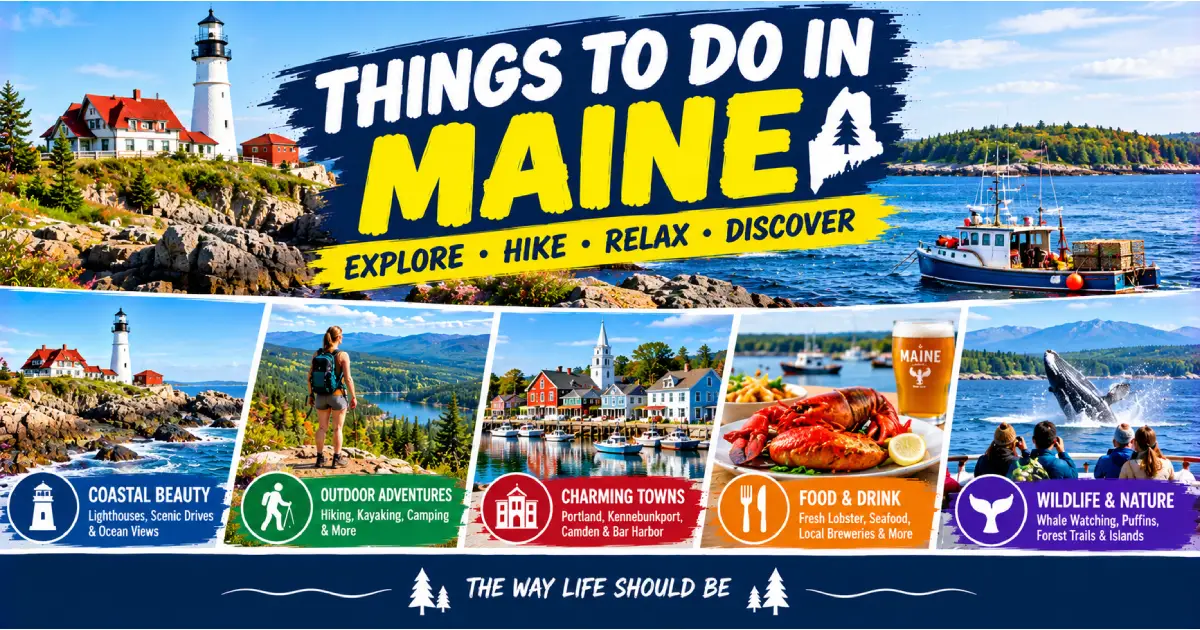
Maine is the most elemental of the New England states — a vast, thinly populated expanse of boreal forest, granite coastline, and cold clear lakes that occupies 35,380 square miles (larger than the other five New England states combined) and is home to fewer than 1.4 million people, making it one of the most sparsely populated states east of the Mississippi. Its coastline, measured in all its tidal inlets and peninsulas, is 3,478 miles long — the longest coastline of any state on the Atlantic seaboard and among the most rugged and beautiful in the world. The Maine coast runs from Kittery (90 miles north of Boston) to the Canadian border at Lubec (the easternmost point in the contiguous United States), passing through a succession of harbor towns, fishing villages, and wild headlands that constitute the defining image of New England’s maritime character.
Maine’s identity is built on three things: lobster, lighthouses, and wilderness. The state produces 90% of the nation’s lobster supply — approximately 100 million pounds annually from a fishery that has been sustainably managed by Maine lobstermen through a system of informal territorial rules and formal DMR regulations for over 150 years. Its 60+ historic lighthouses include the most photographed lighthouse in New England (Portland Head Light, 1791) and the most remote (Machias Seal Island, accessible only by boat). Its wilderness — Baxter State Park with Katahdin (the northern terminus of the Appalachian Trail), the Allagash Wilderness Waterway, and the Downeast lakes region — is the finest wild country east of the Rockies.
The Maine travel calendar is compressed but intense: summer (July–August) is peak season, when the lobster boats are running, the sailboats are out, and the coastal towns are at their most alive; fall (September–October) brings foliage on the inland lakes and rivers, the crowds thin sharply after Labor Day, and prices drop 30–40%; winter (December–March) is quiet on the coast but excellent for snowmobiling, cross-country skiing, and the extraordinary experience of an empty Portland or Bar Harbor; and spring (May–June) is mud season inland but beautiful on the coast, with flowering lupines along the roadsides (peak blooms in June) a distinctly Maine seasonal experience.
| Activity | Location | Best Season | Cost |
|---|---|---|---|
| Acadia National Park hiking | Bar Harbor / MDI | June–October | $35/vehicle |
| Lobster dinner | Statewide | Year-round | $18–$45/person |
| Portland food scene | Portland | Year-round | $15–$65/meal |
| Portland Head Light | Cape Elizabeth | Year-round | Free |
| Katahdin summit | Baxter State Park | June–October | $15/vehicle |
| Sailing in Penobscot Bay | Rockland / Camden | June–September | $125–$175/person |
| Whale watching | Bar Harbor / Kennebunkport | June–October | $55–$75/adult |
| Sea kayaking, MDI | Bar Harbor | May–October | $55–$85/half-day |
| Freeport / L.L.Bean flagship | Freeport | Year-round | Free |
| Allagash canoe trip | Northern Maine | June–September | Permit required |
| Lupine viewing | Statewide | Late May–June | Free |
| Camden Hills State Park | Camden | Year-round | $6/adult |
| Marginal Way, Ogunquit | Ogunquit | Year-round | Free |
| Kennebunkport | Kennebunkport | May–October | Free |
| Schoodic Peninsula (Acadia) | Winter Harbor | Year-round | Free (no entry fee) |
| Sunday River skiing | Bethel | Dec–April | $99–$149/day |
| Sugarloaf skiing | Carrabassett Valley | Dec–April | $99–$149/day |
| Moose watching, Rangeley | Rangeley Lakes | May–July | Free |
| Pemaquid Point Lighthouse | New Harbor | May–October | $5/adult |
| Boothbay Harbor | Boothbay | May–October | Free |
Location: Mount Desert Island, 5 hours from Boston via I-95; Bar Harbor is the primary gateway Entry Fee: $35/vehicle (7-day); timed-entry required mid-June through Columbus Day for the Park Loop Road (recreation.gov, $2/reservation, 90 days in advance) Best base: Bar Harbor (lodging from $150–$500/night in July–August)
Acadia is the finest national park east of the Mississippi — a 49,076-acre preserve of pink granite mountains, fjords, carriage roads, and Atlantic coastline on Mount Desert Island (MDI) and adjacent parcels. The park protects the only fjord-carved mountains on the Atlantic coast of the United States, the highest point on the Atlantic seaboard north of Brazil (Cadillac Mountain, 1,528 ft), and the most distinctive coastal hiking in the eastern United States.
Cadillac Mountain (1,528 ft): The highest point on the US Atlantic coast and, from October 7 through March 6, the first place in the contiguous United States to receive direct sunlight each morning. The summit is accessible by road (timed entry, $2, recreation.gov) and by the Cadillac North Ridge Trail (4.4 miles RT, 1,530 ft gain) — the finest hiking approach to the summit, climbing open granite slabs with continuous ocean views. The summit view — Frenchman Bay, the Porcupine Islands, the Schoodic Peninsula across the bay, Acadia’s mountains to the west, and the open Atlantic to the south — is the finest panoramic view from any roadside or trail-accessible summit on the East Coast. Arrive at least 45 minutes before sunrise for the first-light experience; the summit parking area fills by 4:30 AM in peak season.
Precipice Trail (1.6 miles RT, 1,000 ft gain, strenuous): The most dramatic short trail in the eastern United States — a nearly vertical ascent of Champlain Mountain’s east face using iron rung ladders and hand-holds, with the finest views of the Porcupine Islands and the open Atlantic from the upper ledges. The trail is closed April through mid-August for peregrine falcon nesting (the only peregrine nesting site in Maine accessible to day hikers). Open mid-August through October. Not suitable in wet conditions.
Jordan Pond and the Carriage Roads: John D. Rockefeller Jr. built 45 miles of broken-stone carriage roads (1913–1940) designed exclusively for horse-drawn carriages (automobiles were banned at Rockefeller’s insistence and remain so today) — the finest cycling and walking network in any eastern national park. Jordan Pond House (the finest lunch stop in Acadia — the 1847 tradition of popovers and tea on the lawn overlooking the Bubbles, the rounded glacial mountains at the pond’s north end; $14 for popovers and tea, $18–$28 for lunch). Bicycle rentals at Acadia Bike (acadiabike.com, $35/half-day) in Bar Harbor.
Ocean Path and Thunder Hole: Ocean Path (4.4 miles RT, flat and paved) follows the rocky Atlantic shoreline from Sand Beach to Otter Point — the finest accessible coastal walk in Maine. Thunder Hole, at the path’s midpoint, is a narrow sea cave that produces a thunderclap when Atlantic swells push air from the cavity; best at 3/4 incoming tide with moderate swell.
Sea Kayaking in Frenchman Bay: The finest sea kayaking base in Maine — guided tours departing from Bar Harbor into Frenchman Bay with the pink granite mountains of Acadia as backdrop. Coastal Kayaking Tours (acadiakayak.com, $55/half-day guided, $85/full day); the National Park Sea Kayak Tours (nps.gov, ranger-led, $65/person) are the most educational option. The early morning kayak tour (depart 7 AM, Frenchman Bay at dawn with Cadillac Mountain’s reflection in calm water) is the finest guided experience in Bar Harbor.
Bar Harbor town: The finest tourist town in Maine — a compact village of Victorian hotels, excellent seafood restaurants, and independent outfitters on a natural harbor with views of the Porcupine Islands. The Bluenose Inn ($285–$575/night) provides the finest view of Bar Harbor and Frenchman Bay from any hotel in Maine. Café This Way (the finest breakfast in Bar Harbor), Peking Chinese Restaurant (a 1970s constant that locals love and tourists overlook), Side Street Cafe (the finest lobster roll in Bar Harbor, $28–$32).
Schoodic Peninsula (free section of Acadia): The only mainland section of Acadia National Park — a 2,266-acre peninsula 45 minutes east of Bar Harbor with the finest viewpoint of Acadia’s mountains from outside the park (Schoodic Head, 440 ft, 1.6 miles RT), a 6-mile one-way scenic road with 6 named overlooks, and none of the summer crowds of MDI. No entry fee for the Schoodic section. The finest alternative base is Winter Harbor village (the Acadia’s Oceanside Meadows Inn, $175–$285/night).
Getting there: 2 hours from Boston via I-95; Portland International Jetport (PWM) with direct flights from major Northeast and mid-Atlantic cities Best season: Year-round; peak June–September; December for the holiday season
Portland is the finest food city in New England outside of Boston, and by many measures — restaurant density per capita, James Beard Award nominations per capita, quality-to-price ratio — it rivals any city in the country. The Old Port (a 20-block neighborhood of 19th-century brick commercial buildings on the working waterfront) is the epicenter of one of the most remarkable food cultures to emerge in any American city in the past 20 years.
Essential Portland restaurants:
Portland Public Market (Deering Oaks Park, Saturday year-round): The finest farmers market in Maine — a year-round Saturday market with the finest concentration of Maine food producers under one roof: Aurora Mills & Farm (Maine heritage grain flour), Broadturn Farm (the most beautiful farm stand in Maine), Dandelion Spring Farm (the finest organic vegetables), and a rotating selection of Maine cheesemakers, maple syrup producers, and artisan bakers.
The Eastern Promenade: The finest urban waterfront in Maine — a 2.1-mile paved path along the bluff above Casco Bay, with views of the harbor islands and (on clear days) the White Mountains 60 miles inland. The East End Beach at the base of the promenade is the finest urban swimming beach in Maine (water temperature 60–65°F in August; minimal current). East End Beach is also the departure point for Casco Bay Lines ferry tours to the Calendar Islands.
Portland Head Light (Fort Williams Park, Cape Elizabeth): The most photographed lighthouse in New England and the oldest lighthouse in Maine (1791, commissioned by George Washington, the first lighthouse authorized by the federal government) — an active automated lighthouse on a dramatic rocky headland with the open Atlantic on three sides. The lighthouse keeper’s dwelling is now the Museum at Portland Head Light ($3/adult), open May–November. Fort Williams Park (free, open year-round) surrounding the lighthouse has 94 acres of walking paths, the ruins of a Spanish-American War–era coastal defense battery, and the finest picnic grounds on the Maine coast. 12 miles south of downtown Portland via US-1 south and Shore Road.
Pemaquid Point Lighthouse (Bristol): The finest lighthouse setting in Maine — a 1827 lighthouse on an extraordinary geological formation of folded and tilted metamorphic rock (the most dramatic coastal geology in New England outside Acadia), with the rock formations creating natural slide-ways, pools, and ramps that make the headland below the lighthouse the finest place to sit on the Maine coast. The Fishermen’s Museum inside the keeper’s house ($5/adult) is the finest small museum on the midcoast. Located 50 miles northeast of Portland at the tip of the Pemaquid Peninsula; the 15-mile drive from US-1 through the fishing villages of Damariscotta and New Harbor is one of the finest Maine coastal drives.
Maine Lighthouse Trail: Maine has 65 historic lighthouses — more than any state except Michigan. The Maine Lighthouse Trail (lighthousetrail.org) is a self-guided tour format connecting the finest accessible lighthouses from Kittery to Lubec. Key lighthouses beyond Portland Head and Pemaquid:
Maine lobster (Homarus americanus) is the finest crustacean in the world by broad consensus — a cold-water lobster from the Gulf of Maine whose flavor complexity exceeds that of any other Homarus species due to the cold, clean water and the exceptional phytoplankton productivity of the Gulf of Maine (the fastest-warming ocean body in the world, which has paradoxically increased lobster populations in recent decades by warming the bottom water temperature from below the lobster’s preferred range to near its optimal range). Maine harvests approximately 100 million pounds annually — 90% of the US total and approximately 40% of global Homarus americanus production.
The definitive Maine lobster meal: A shore dinner at a lobster pound — a whole steamed or boiled lobster ($18–$32/pound for a 1.5-lb hard-shell in season), steamers (soft-shell clams steamed in seawater, with drawn butter and broth for dipping), corn on the cob, and a can of Moxie (the only non-alcohol option at a proper Maine lobster pound). The finest lobster pounds in Maine:
Lobster season timing: Maine lobster is available year-round, but the finest quality is in July–October when the lobsters are in hard shell (full of meat). The late summer “shedder” season (July–August) produces soft-shell lobsters (recently molted) that are easier to crack and sweeter in flavor but lower meat yield. Hard-shell lobster (September–October) has the finest flavor and highest meat density.
Getting there: 2 hours from Portland via US-1; the finest coastal drive in southern Maine Best season: June–October
Camden is the finest sailing town in the United States — a compact harbor town at the base of Camden Hills (1,380 ft, the highest coastal mountain in the eastern US) where an extraordinary concentration of historic windjammer schooners operates multi-day sailing voyages through Penobscot Bay. The combination of the harbor (the finest natural harbor in Maine, with the mountains rising directly behind the docks), the windjammer fleet, and the Camden Hills hiking makes Camden the single finest destination on the Maine coast for visitors who want the full complement of Maine experiences.
Windjammer sailing (multi-day, Penobscot Bay): The Maine Windjammer Association (sailmainecoast.com) operates 13 historic schooners offering 3-, 4-, and 6-day sailing voyages through Penobscot Bay, the Deer Isle archipelago, and the Acadia approaches — the finest sailing experience in the United States east of Newport. The schooners range from 1870s originals (the Lewis R. French, 1871, the oldest American commercial sailing vessel still in operation) to mid-20th-century vessels; all are wooden hull, sail-powered, and operate without cell signal in the bay islands. Rates: $850–$1,400/person for 3 days (all meals included, most BYOB). The most distinctive vacation experience in New England.
Camden Hills State Park: The finest coastal hiking in Maine outside Acadia — a 5,700-acre state park with the highest coastal mountain in the eastern United States (Mount Battie, 1,380 ft) accessible by trail (4 miles RT, 1,000 ft gain, the finest views of Penobscot Bay from any accessible summit in midcoast Maine) or by car (Mount Battie Auto Road, $3/vehicle, open May–October). The view of Penobscot Bay from Mount Battie summit — the Camden Harbor 1,380 feet below, the islands of North Haven and Vinalhaven and beyond them the open Atlantic — was what inspired Edna St. Vincent Millay to write “Renascence” at age 19 in 1912 from a hilltop in Camden. Day use: $6/adult.
Day trips to the islands: Penobscot Bay’s islands are the finest island-hopping destination in Maine:
Location: 80 miles north of Bangor via I-95 and ME-11; the park entrance at Togue Pond is 18 miles from Millinocket Entry Fee: $15/vehicle (Maine residents free); vehicle reservation required in peak season (baxterstatepark.org) Season: Katahdin summit trails open June 1; Chimney Pond and summit zone can have snow into July
Katahdin (5,269 ft) is the highest peak in Maine, the northern terminus of the Appalachian Trail, and the finest mountain hiking experience in the eastern United States — a massif of dramatic glacially carved cirques, knife-edge ridges, and open granite summit terrain with 360-degree views of the Maine wilderness extending to the horizon in every direction (on clear days, no roads or buildings are visible from the summit). Baxter State Park, surrounding Katahdin, was donated to the State of Maine by former Governor Percival Baxter in a series of land purchases between 1931 and 1962, with the deed requirement that the park “shall forever be left in its natural wild state.”
Knife Edge Trail (the standard summit loop, 10.4 miles, 4,200 ft gain, strenuous-expert): The finest ridge walk in the eastern United States — a loop that climbs via the Hunt Trail (the Appalachian Trail approach, 5.2 miles one-way) to Baxter Peak (5,269 ft, the true summit and the AT’s northern terminus, marked by a wooden sign that has been painted and repainted since 1937), traverses the Knife Edge (1.1 miles of exposed ridge between Baxter Peak and Pamola Peak, 3–5 feet wide in places with 1,500-foot drops on both sides — the most adrenaline-intense trail experience in New England), descends Pamola Peak to Chimney Pond via the Helon Taylor Trail. Requires a full day (8–10 hours), the finest weather conditions, confidence with heights, and — critically — a Chimney Pond Day Use reservation from baxterstatepark.org. No dogs allowed anywhere in Baxter State Park.
Chimney Pond: The finest backcountry camp in the eastern United States — a glacially carved tarn at 2,914 ft directly below the Katahdin massif, surrounded by the three great cirque headwalls (the Northwest Basin, the South Basin, and the Great Basin). The Chimney Pond Campground (bunkhouse and tent sites, $11–$30/night, reservations essential) is the finest base for a two-day Katahdin ascent; the trail from Chimney Pond to Baxter Peak (the Cathedral Trail, 2.2 miles one-way, 2,355 ft gain) is the finest technical non-roped hiking in New England.
Katahdin from the south — AT thru-hikers: Baxter Peak is the northern terminus of the Appalachian Trail; approximately 3,000 AT thru-hikers arrive at Katahdin each year (August–October), having walked 2,193 miles from Springer Mountain, Georgia. The moment of summiting Katahdin after a thru-hike is one of the most emotionally significant experiences available in American outdoor culture; the summit sign photo is the defining image of the AT. The Abol Campground at the park’s southern entrance is the traditional staging point for AT finishers’ celebration meals at the Appalachian Trail Café in Millinocket.
Getting there: 90 miles from Boston via I-95 (exit 25) and ME-9; 1.5 hours Best season: May–October; beach season July–August
Kennebunkport is the finest resort town on the southern Maine coast — a well-preserved Federal-era port town of captains’ houses and white picket fences, with the finest lobster roll in southern Maine (The Clam Shack), the finest boutique lodging in the region, and a Bush family presidential connection (the Walker’s Point compound is visible from Ocean Avenue). The Dock Square area has the finest independent shopping on the southern coast; the Colony Hotel (1914, $295–$595/night in summer) on the oceanfront is the finest historic hotel in southern Maine.
Ogunquit Marginal Way: The finest accessible coastal walk in southern Maine — a 1.4-mile paved clifftop path from Perkins Cove (a working lobster harbor with the finest lobster shacks in Ogunquit) to the main Ogunquit Beach, with the Atlantic on one side and gardens and shorefront properties on the other. Free, open year-round; best in early morning before crowds. Ogunquit Beach (3.5 miles, the finest sand beach in Maine) is accessible by trolley from Perkins Cove parking ($2).
Old Orchard Beach: The finest beach resort town in Maine — a 7-mile sand beach with a classic American amusement pier (Palace Playland, the only amusement park in Maine), French-Canadian beach culture (OOB has been the preferred summer destination for Québécois since the 1880s — approximately 40% of summer visitors speak French as a first language, making it the most bilingual community in Maine), and the finest fried dough and taffy on the Maine coast. Parking $5–$15/day.
Location: 95 Main St, Freeport, ME (18 miles north of Portland via I-295) Hours: Open 24 hours a day, 365 days a year (a policy in continuous effect since 1951) Admission: Free
The L.L.Bean flagship store is the most distinctive retail experience in Maine and one of the most distinctive in the United States — a 220,000-square-foot flagship complex that has been open 24 hours a day without locks on its doors since 1951, on the principle that hunters and fishermen arrive and depart at all hours. The flagship includes a trout pond, an indoor climbing wall, a boat department, and the world’s largest L.L.Bean duck boot (a 16-foot-tall sculpture outside the entrance). The surrounding Freeport village has 170 outlet stores in former colonial houses and converted historical buildings (the finest outlet shopping village in New England), but the L.L.Bean flagship remains the reason 3.5 million people visit Freeport annually.
The L.L.Bean Outdoor Discovery School (llbean.com/ODS) offers fly-fishing lessons on the Kennebec, guided kayak tours of Casco Bay, and stand-up paddleboard clinics from the Freeport campus — the finest introductory outdoor education program in Maine, operated by the company that invented outdoor education retail.
Sunday River (Bethel, 2.5 hours from Portland via US-2): The finest ski resort in Maine and one of the finest in the eastern United States — 8 interconnected mountain peaks, 135 trails, 870 skiable acres, and the finest snowmaking system in New England (Sunday River invented modern snowmaking technology in the 1980s and can cover 95% of its terrain in 72 hours). The resort’s combination of consistent conditions, varied terrain, and well-designed base village make it the most reliable ski experience in Maine. Lift tickets $99–$149/day; Ikon Pass and Ikon Base Pass include unlimited days.
Sugarloaf (Carrabassett Valley, 3 hours from Portland via ME-27): The finest vertical skiing in Maine and the second-highest vertical in the eastern United States (2,820 ft) — a remote resort in the Carrabassett Valley with a ski-in/ski-out village, the only lift-served above-treeline skiing in Maine (the Snowfields, above 4,000 ft on the summit), and a cult following among expert skiers who consider it the finest mountain in the east. The remoteness (no quick day trip from any major city) keeps the mountain less crowded than Sunday River; the slopeside village is the finest ski-village atmosphere in Maine. Lift tickets $99–$149/day; Ikon Pass included.
Allagash Wilderness Waterway: The finest wilderness canoe route in the eastern United States — a 92-mile canoe and kayak route through a chain of interconnected lakes and rivers in northern Maine, from Telos Lake to the St. John River at Allagash Village. The route was designated a National Wild and Scenic River in 1970 and is managed by the Maine Bureau of Parks and Lands; the waterway is entirely within the working forests of northern Maine, with no paved roads crossing the route and the finest bird wildlife (common loon, black bear, moose, bald eagle, osprey) of any canoe route in the east. A typical through-paddle takes 7–10 days; the finest outfitter is Allagash Canoe Trips (allagashcanoetours.com, fully guided 7-day trips $1,500–$1,800/person).
Moose watching (Rangeley Lakes and Moosehead Lake): Maine has the largest moose population in the contiguous United States (approximately 60,000–75,000 animals) and the finest accessible moose watching of any state in the east. The finest viewing locations:
Rangeley Lakes: The finest lake recreation destination in inland Maine — a chain of 5 interconnected lakes (Rangeley, Mooselookmeguntic, Upper Richardson, Lower Richardson, and Umbagog — the most distinctive lake name cluster in the eastern US) with the finest fly-fishing for brook trout in New England (the Rangeley region produced the world-record brook trout, 14.5 lbs, in 1915), and the finest accessible moose watching in Maine. The Wilhelm Reich Museum (outside Rangeley, the former home and laboratory of the controversial psychoanalyst, the finest eccentricity of the Maine wilderness, $10/adult) and the Rangeley Lake State Park (boat launch, swimming, camping) are the principal visitor facilities.
Maine is a driving state — the distances between destinations are vast (Portland to Bar Harbor is 3 hours; Portland to Katahdin is 4 hours) and public transportation beyond the Portland METRO bus system and the Downeaster is essentially nonexistent. US-1 (the coastal highway from Kittery to Fort Kent) is the scenic alternative to I-95; it passes through every coastal town but adds 30–90 minutes to most segments due to the traffic through Kennebunk, Wiscasset, and Camden. Download the Maine DOT map before departing — cell service in northern and western Maine is unreliable.
| Season | Coast | Mountains | Wildlife | Crowds | Prices |
|---|---|---|---|---|---|
| July–Aug | Perfect | Excellent | Good | Very High | Peak |
| Sept–Oct | Excellent, foliage | Hiking peak | Moose peak | Medium | -20–30% |
| November | Quiet, some storms | Hunting season | Low | Very Low | -40% |
| Dec–March | Cold, uncrowded | Skiing | Minimal | Resort-high | Varies |
| April–May | Lupines starting | Mud season | Moose calving | Very Low | -40% |
| June | Excellent | Trails opening | Good | Low-Medium | -15% |
Best overall: July–August for the full Maine experience; September after Labor Day for finest conditions with 20–30% fewer people; June for lupines and no crowds.
Posted By : Vinay
Latest Article
2nd Floor, 39, Above Kirti Club, DLF Industrial Area, Kirti Nagar, New Delhi, Delhi 110015



Travel Tourister is a leading Travel portal where we introduce travellers to trusted travel agents to make their journey hasselfree, memorable And happy. Travel Tourister is a platform where travellers get Tour packages ,Hotel packages deals through trusted travel companies And hoteliers who are working with us across the world. We always try to find new and more travel agents and hoteliers from every nook and corners across the world so that you could compare the deals with different travel agents and hoteliers and book your tour or hotel with the one you have chosen according to your taste and budget.
Copyright © Travel Tourister, India. All Rights Reserved

 Call
 Enquiry