Published on : 28 Oct 2026
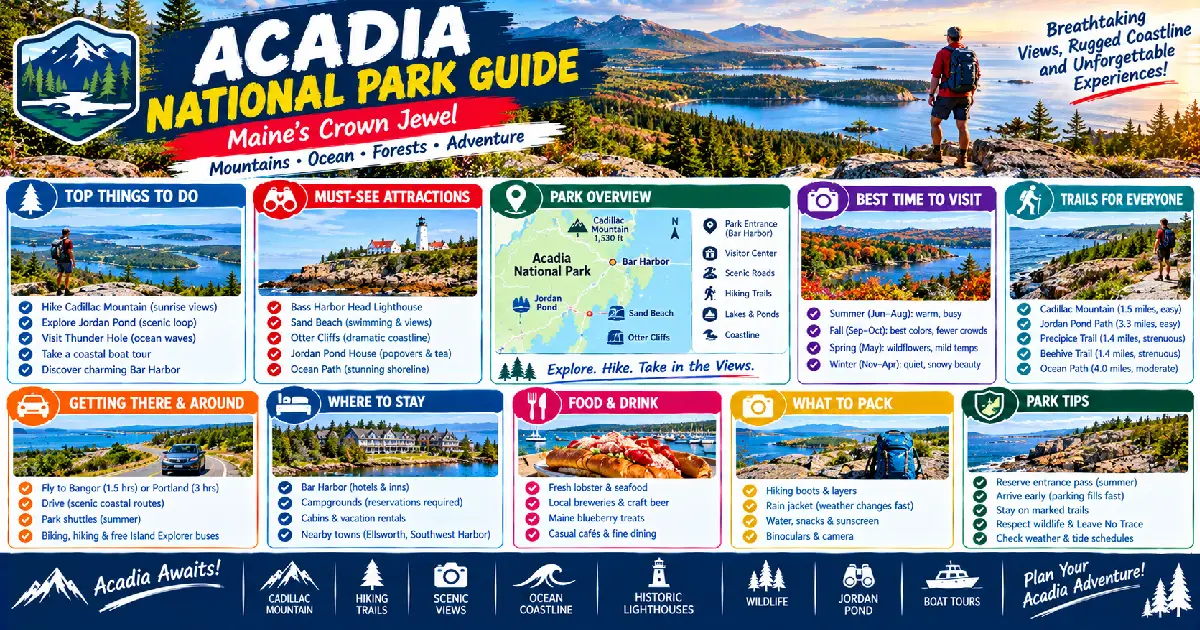
Acadia National Park is the crown jewel of the Maine coast and the most-visited national park in the northeastern United States — a 49,000-acre mosaic of pink granite summits, boreal forest, cobblestone beaches, and fjord-like sounds on and around Mount Desert Island (MDI), 50 miles south of Bangor on the coast of Maine. The park sees 4 million visitors annually, yet its geography — the island itself, the Schoodic Peninsula on the mainland 7 miles across Frenchman Bay, and the remote Isle au Haut accessible only by mail boat — means that 90 percent of visitors concentrate in a narrow strip around Bar Harbor and the eastern side of MDI, leaving the western side (the Quiet Side) and Schoodic remarkably uncrowded even in peak July.
The park’s founding story is one of the most extraordinary in the history of American conservation. Mount Desert Island had been the summer retreat of the American Gilded Age elite since the 1880s — John D. Rockefeller Jr., J.P. Morgan, Edsel Ford, and Andrew Carnegie all had estates here — and when development threatened the island’s wild character in the early 1900s, Boston landscape architect Charles Eliot and Harvard president Charles W. Eliot convinced the summer residents to donate their land to the federal government. The park that resulted, established in 1916 (as Sieur de Monts National Monument) and expanded through the 1940s, contains the donated lands of 30 families. John D. Rockefeller Jr.’s contribution was not only 11,000 acres of land but also the 45 miles of carriage roads — broken-stone bridle paths with 17 hand-built stone bridges — that remain the finest non-motorized trail network in any national park in the eastern United States.
Acadia’s Cadillac Mountain (1,530 feet) holds a distinction that draws visitors year-round: from early October through early March, it is the first place in the United States where the sunrise is visible — the easternmost and highest coastal summit in the eastern US catches the sun 20–40 minutes before any other point in the continental United States. The summit parking lot fills by 4:00–4:30 AM on popular sunrise mornings (timed-entry reservations required April 15–October, $6/vehicle reservation fee); those who miss the reservation can hike the South Ridge Trail (7 miles RT from Blackwoods) or the Cadillac North Ridge Trail (4.4 miles RT from the Entrance Road) to reach the summit.
| Feature | Detail |
|---|---|
| Established | 1919 (redesignated from Lafayette National Park) |
| Annual Visitors | ~4 million |
| Size | 49,000 acres |
| Highest Point | Cadillac Mountain, 1,530 ft |
| Entry Fee | $35/vehicle (7-day); America the Beautiful Pass accepted |
| Main Entrance | Mount Desert Island via ME-3 from Ellsworth |
| Gateway Town | Bar Harbor (primary); Southwest Harbor (Quiet Side) |
| Nearest Airports | Bangor International (BGR, 50 miles); Portland International (PWM, 160 miles) |
| Park Website | nps.gov/acad |
| Timed Entry (2026) | Cadillac Summit Road: April 15–October 31, $6/reservation, recreation.gov |
| Campgrounds | Blackwoods (year-round), Seawall (May–October), Schoodic Woods (May–October) |
| Cell Service | Good in Bar Harbor and on Park Loop Road; limited on western MDI and Isle au Haut |
Elevation: 1,530 ft | Road access: Cadillac Summit Road (timed-entry April 15–October, $6/reservation) | Hiking options: North Ridge Trail (4.4 mi RT) or South Ridge Trail (7 mi RT)
Cadillac Mountain is the reason Acadia fills its parking reservations in January — the highest point on the US Atlantic coast north of Rio de Janeiro, and from early October through early March, the first place in the United States where sunrise is visible. The pink Cadillac granite (a Devonian-age alkali feldspar granite unique to the Acadia region, its distinctive pink color from potassium feldspar crystals) forms the smooth, open summit dome — an above-treeline landscape of bare rock, blueberry heathland, and dwarf spruce at an elevation lower than any comparable alpine experience in the White Mountains or Adirondacks, making it the most accessible above-treeline summit in the eastern US.
Sunrise by car: Reserve the Cadillac Summit Road entry on recreation.gov ($6/reservation; reservation windows open 90 days in advance and sell out within minutes for October sunrise dates, within hours for July–September). The summit road is 3.5 miles one-way; the summit parking area accommodates 125 vehicles. Arrive at the parking area before civil twilight (approximately 45–60 minutes before sunrise); the eastern sky lightens dramatically in the last 30 minutes before the sun clears the horizon. October sunrises (typically 6:20–7:10 AM) are the finest — air temperatures 38–48°F, foliage color in the valley below, and the shortest reservation wait (October reservations typically available 2–4 weeks in advance vs. July–August booking out 60–90 days in advance).
Hiking to the summit: The North Ridge Trail (4.4 miles RT, 1,000 ft elevation gain, trailhead on the Cadillac North Ridge parking area off the Entrance Road) is the finest hiking route to the Cadillac summit — a trail mostly above treeline on open pink granite slabs with continuous views of Frenchman Bay, the Porcupine Islands, and Bar Harbor below. The South Ridge Trail (7 miles RT, 1,530 ft gain from Blackwoods Campground) is the longest and most scenic approach, passing through Eagle Lake junction and climbing the open south ridge to the summit; allow 4–5 hours RT. Neither trail requires a timed-entry reservation (only vehicle access to the Summit Road).
Cadillac summit in summer: The summit visitor shelter (rebuilt 2022), the fine gift shop, and the 0.5-mile Summit Loop Trail (accessible, paved in most sections) make the summit a destination at any hour — the 360° panoramic view of Frenchman Bay (east), Jordan Pond and the Cranberry Islands (south), the Quiet Side of MDI (west), and the mainland (north) is the finest panoramic view in New England from an accessible paved overlook.
Total length: 45 miles | Surface: Broken stone (crushed granite), compacted; accessible to bicycles, horses, and pedestrians only (no motor vehicles) | Access: Multiple carriage road entrances throughout MDI | Bicycle rental: Acadia Bike (acediabike.com, Bar Harbor, $32–$48/half-day)
The 45 miles of carriage roads built by John D. Rockefeller Jr. between 1913 and 1940 are the finest non-motorized recreation network in any national park in the eastern United States — a system of broken-stone bridle paths, 17 hand-built stone-arch bridges (each architecturally unique, none repeated; the Jordan Pond Bridge, Cobblestone Bridge, and Waterfall Bridge are the finest), 3 gatehouses (the Jordan Pond Gate Lodge, the Rockefeller-designed Eagle Lake Gate Lodge, and the Brown Mountain Gate Lodge are the finest examples of Olmsted-era park architecture on the East Coast), and a seamless integration with the park’s ponds, summits, and shoreline.
Best carriage road routes:
Eagle Lake Loop (6 miles, easy-moderate, bicycle): The finest introductory carriage road loop — a circuit of Eagle Lake (the largest body of fresh water in the park, 436 acres) through birch and maple forest with views of Cadillac Mountain reflected in the lake. Begin at the Eagle Lake parking area (off ME-233 west of Bar Harbor); the full loop takes 1.5–2 hours by bicycle, 2.5–3 hours on foot.
Jordan Pond–Bubble Pond–Eagle Lake–Amphitheater Loop (16 miles, moderate, bicycle): The finest full-day carriage road route — a 16-mile loop connecting the three main ponds and the finest stone bridges, with the Amphitheater (a natural granite amphitheater with Rockefeller’s finest carriage road construction, the double-arch Amphitheater Bridge) as the architectural centerpiece. Begin at the Jordan Pond parking area; 3.5–4 hours by bicycle.
Day Mountain (4.4 miles RT, easy, bicycle or foot): The only carriage road that ascends to a summit (583 ft, open ledges with views of the Cranberry Islands and Great Cranberry Island to the south) — the finest carriage road viewpoint on MDI, accessible by bicycle from the Jordan Pond area via carriage road (no hiking required).
Jordan Pond House: The finest dining experience in Acadia — a National Historic Landmark restaurant on the shore of Jordan Pond, operating since 1870 (the current building dates from 1979; the original 1847 farmhouse burned). The Jordan Pond House is the only restaurant inside Acadia National Park and one of the finest park lodges in the eastern national park system. The signature experience: afternoon tea on the lawn — popovers ($14 for two, served with butter and strawberry jam, the finest popovers in New England, baked to order in 45 minutes) with views of the Jordan Pond and the Bubbles (the twin rounded granite mountains above the pond’s north shore, the finest natural landscape composition in Acadia). Reservations essential July–August (jordanpondhouse.com, reservations open 60 days in advance; same-day walk-in possible before 11 AM or after 3 PM on weekdays). Dinner entrées $28–$52.
Jordan Pond Loop (3.3 miles, easy): The finest accessible loop trail in Acadia — a flat, crushed-granite path along the shore of Jordan Pond (the clearest body of water on Mount Desert Island, the bottom visible at 40+ feet in ideal conditions, through water so clear it was used as the island’s drinking water source before the park’s establishment) with continuous views of the Bubbles (North Bubble, 872 ft; South Bubble, 766 ft — both rounded by glacial ice, the most photographed peaks in Acadia). The paved section (south shore) is fully accessible; the north shore is a boardwalk over the marshy inlet. Allow 1.5 hours. Trailhead at Jordan Pond parking area (timed-entry not required for the parking area; arrive before 9 AM or after 4 PM in summer to secure a space).
The Bubbles Hike (0.8 miles RT to South Bubble, easy-moderate): The finest short hike in Acadia with views proportionally extraordinary for the effort — a 0.8-mile RT climb (335 ft gain) from the Bubble Rock parking area (on the Park Loop Road, 0.5 miles north of Jordan Pond House) to South Bubble summit, where Bubble Rock (a glacial erratic — a 14-ton boulder of Lucerne granite deposited atop the Cadillac granite summit by the retreating Laurentide Ice Sheet 12,000 years ago, balanced on the edge of the cliff and photographically irresistible) and the finest bird’s-eye view of Jordan Pond in the park await. Round trip 30–45 minutes.
Park Loop Road (Ocean Drive section): The finest coastal drive in New England — a 4-mile one-way section of the Park Loop Road from Sand Beach to Otter Cliffs, following the pink granite shoreline of the Atlantic with no equivalent coastal scenery in the eastern national park system.
Sand Beach: The finest ocean beach in Acadia and the only significant sand beach in the park — a 290-yard crescent of coarse sand (40% shell fragment, 60% quartz; the shell fragment gives the beach its warm tan color and its coarse texture) at the head of Newport Cove, surrounded by the pink granite headlands of Great Head (the largest headland on the US Atlantic coast north of Cape Cod) and Newport Mountain. The water temperature at Sand Beach is the coldest ocean swimming temperature of any developed beach in the continental United States — 52–58°F in peak July, occasionally reaching 62°F in late August after sustained southerly winds. Lifeguards on duty mid-June through Labor Day; $35/vehicle park entry fee required (timed-entry for the Sand Beach parking lot, recreation.gov, strongly recommended mid-June through September). Arrive before 8:30 AM or after 3:30 PM.
Great Head Trail (1.7 miles loop, moderate): The finest coastal loop trail in Acadia — a circuit from Sand Beach east to the 145-foot granite headland of Great Head (the finest elevated coastal view on MDI, with the Cranberry Islands to the south, the Porcupine Islands to the north, and the open Atlantic to the east) and back along the cliff edge. Allow 1.5 hours. Trailhead at the east end of Sand Beach.
Ocean Path (4.4 miles RT, easy): The finest accessible coastal walk in the park — a flat, partially paved path along the Atlantic shore between Sand Beach and Otter Cliffs, passing Thunder Hole (a sea cave where breaking waves compress air to create a cannon-like report; finest conditions at mid-incoming tide with 4–6-foot swells, typically October–November after autumn storms) and Otter Cliffs (60-foot vertical granite sea cliffs, the finest rock climbing site in New England, with the finest beginner sea-cliff climbing on the East Coast — Acadia Mountain Guides, acadiamountainguides.com, from $125/person). No elevation gain.
Length: 1.6 miles RT | Elevation Gain: 1,000 ft | Difficulty: Strenuous (iron rungs and ladders) | Seasonal Closure: Early April through mid-August (peregrine falcon nesting) | Trailhead: Precipice Trailhead parking, Park Loop Road (free lot, no timed entry)
The Precipice Trail is the finest adventure hike in Acadia — a technically demanding route up the sheer east face of Champlain Mountain (1,058 ft) via iron rungs, hand-hewn wooden ladders, and narrow ledge traverses installed by the Civilian Conservation Corps in the 1930s. The route gains 1,000 feet in 0.8 miles on near-vertical terrain; the ladder sections are exposed (1,000-foot drops to the talus field below) but well-maintained, and the route is safe for hikers who are comfortable with heights and strong enough to climb vertical iron rungs. Not appropriate for young children, those afraid of heights, or during wet or icy conditions.
The Precipice Trail is closed from approximately early April through mid-August each year to protect the nesting peregrine falcons (Falco peregrinus) that have nested on the cliff face since the park’s recovery program began in 1984; Acadia’s peregrine program is the most successful urban peregrine recovery program in the northeastern United States, with 2–3 nesting pairs now resident on MDI. Check nps.gov/acad for current closure status before visiting.
When open: The Precipice Trail is the finest 2-hour hike in New England for the dramatic-to-effort ratio. Allow 2.5–3 hours RT (1.5–2 hours up, 45 minutes down). The summit of Champlain Mountain is above treeline, with 360° views of Frenchman Bay, Bar Harbor, and the Porcupine Islands. The hike down via the Orange and Black Path (2.4 miles, moderate) provides a scenic loop.
Alternative when closed: The Beachcroft Path (1.6 miles RT) climbs Huguenot Head via hand-laid stone steps — the finest crafted staircase trail in the park — to a viewpoint above the Precipice, with views of the peregrine nesting cliff across the valley.
Getting there: From Bar Harbor, take ME-233 west to ME-198 south, or ME-102 south; 20–35 minutes to Southwest Harbor Character: Uncrowded, fishing-village atmosphere; the least-visited section of the park on MDI
The western side of Mount Desert Island (called the Quiet Side by locals) contains some of Acadia’s finest hiking and scenery with a fraction of the eastern side’s crowds — 90% of park visitors stay east of Somes Sound, leaving the western MDI trails remarkably uncrowded even in peak July.
Somes Sound: The only natural fjord on the US Atlantic coast (technically a fjard — a shallower glacially carved inlet, though the distinction is disputed; the 5-mile-long sound was carved by a lobe of the Laurentide Ice Sheet to a depth of 175 feet) — a dramatic narrow water passage between the eastern and western halves of MDI, with granite cliffs rising directly from the water at Flying Mountain and Valley Cove. The sound is visible from ME-198 along its eastern shore; the finest view of the sound’s full extent is from the summit of Acadia Mountain (681 ft, 2.5 miles RT).
Acadia Mountain (2.5 miles RT, moderate): The finest short hike on the Quiet Side and the finest view of Somes Sound from any trail in the park — a 500-ft climb through mixed forest to an open granite summit with the sound directly below, the Cranberry Islands and open ocean to the south, and Cadillac Mountain across the sound to the east. Allow 1.5–2 hours RT. Trailhead on ME-102 in Somesville (free parking, no timed entry).
Flying Mountain (1.5 miles loop, easy-moderate): The finest short loop on the Quiet Side — a 284-ft summit above the southern entrance to Somes Sound with the finest close-up view of the sound from any summit in the park. The Valley Cove loop section follows the shore of the sound through a boulder field below the sound’s cliffs. Allow 1.5 hours. Trailhead at Fernald Cove Road, off ME-102 in Southwest Harbor.
Beech Mountain (1.5 miles RT, moderate): The finest summit on the western side of MDI — a 839-ft summit with an active fire lookout tower (open to visitors July–August, ranger-staffed, the finest staffed summit in the park) and views of Echo Lake (the finest freshwater swimming beach in the park — Acadia’s freshwater alternative to the frigid Sand Beach, water temperature 68–72°F by late July, with a lifeguarded sandy beach, free, no timed entry) below. Trailhead at the Beech Mountain Lot on Beech Hill Road. Allow 1.5 hours.
Bass Harbor Head Light: The most photographed lighthouse in Maine — the 1858 Bass Harbor Head Light on the southwestern tip of MDI, perched atop a 40-foot granite ledge at the head of Blue Hill Bay. The lighthouse is an active aid to navigation (USCG) and is the finest sunset photography location in Acadia — the light faces southwest, and the late-afternoon sun illuminates the lighthouse from the front while the ledge and sea stack below glow in warm light. Free; accessible via ME-102A at Bass Harbor, 10 minutes south of Southwest Harbor. The observation area below the lighthouse (accessible by stairs) provides the closest approach and the finest composition; arrive 45 minutes before sunset in summer.
Getting there: Mail boat ferry from Stonington, ME (30 miles west of Bar Harbor; Isle au Haut Boat Services, isleauhaut.com, $40 RT/adult, May–October, 45 minutes); no vehicle ferry Character: Remote, roadless (within the park), extremely limited visitor access (max 48 visitors/day in the park section) Reservations: Required May–October, nps.gov/acad; reservations open April 1 and sell out within 24 hours
Isle au Haut is the most remote and least-visited section of Acadia National Park — a 6-by-3-mile island 15 miles south of Stonington in Penobscot Bay, with 4,000 acres of park land and 18 miles of hiking trails accessible only by the mail boat. The island is the finest backcountry experience in the eastern national park system — trails through boreal forest to cobblestone beaches (Duck Harbor Beach, the finest cobblestone beach in Maine), rocky headlands with open Atlantic views (Western Head Trail, the finest coastal trail in the park), and a sense of complete wildness that is impossible to find on MDI in summer.
Duck Harbor Campground: The finest backcountry campground in Acadia — 5 lean-to shelters on the shore of Duck Harbor (the most dramatic campsite in any eastern national park, with direct Atlantic views from the lean-to platforms). $25/night per shelter (up to 6 people); reservations open April 1 on recreation.gov and sell out within hours. The campground is accessible only by boat and on foot.
Western Head and Cliff Trail Loop (4.5 miles, moderate): The finest trail on Isle au Haut — a loop along the island’s western coastline through boreal forest and over open granite headlands with the finest Atlantic coastal scenery in the park. Allow 3–4 hours.
Getting there: US-1 north from Ellsworth to Winter Harbor (9 miles from the MDI bridge causeway); alternatively, the Bar Harbor Ferry (BH Ferry, barharborferry.com, $32 RT, late June–Labor Day, 1.5 hours by scenic ferry from Bar Harbor to Winter Harbor) Character: Mainland section of the park; no entry fee (no vehicle fee collected at Schoodic); Schoodic Woods Campground
The Schoodic Peninsula is the only mainland section of Acadia National Park — 2,366 acres of rocky headland and boreal forest on the far side of Frenchman Bay from Mount Desert Island, with the finest undeveloped coastal scenery of any roadside section of the park and, crucially, none of the crowds of MDI. The 6-mile one-way Schoodic Loop Road (one-way, recommended driving direction: counterclockwise from the Winter Harbor entrance) follows the shoreline past the finest examples of the diabase dike geology unique to the Schoodic area (dark basalt intrusions cutting through the pink granite in geometric patterns, the finest exposed igneous intrusion geology in the northeastern US) to Schoodic Point — the finest spot in Acadia for watching Atlantic swells crash against the granite headland, with sea spray reaching 30 feet in northeast storms.
Schoodic Head (1.5 miles RT, moderate): The finest hike on the Schoodic Peninsula — a 440-ft summit with 360° views of Frenchman Bay, Mount Desert Island (the entire MDI shoreline visible from one summit), and the open Atlantic. Allow 1.5 hours RT. Trailhead from the Blueberry Hill parking area on the Schoodic Loop Road.
Schoodic Woods Campground: The finest family campground in Acadia — a 94-site campground (RV and tent sites, $22–$30/night) with a dedicated cycling trail network (Schoodic has 8.7 miles of paved bike paths connecting the campground to Schoodic Point and the village of Winter Harbor) and virtually no crowds compared to Blackwoods on MDI. Reservations open 6 months in advance on recreation.gov; late May and early June sites available with 2–4 weeks advance.
| Trail | Distance | Gain | Difficulty | Highlights |
|---|---|---|---|---|
| Precipice Trail | 1.6 mi RT | 1,000 ft | Strenuous (iron rungs) | Most dramatic climb; seasonal closure April–mid-Aug |
| Cadillac North Ridge | 4.4 mi RT | 1,000 ft | Moderate | Above-treeline ridge; sunrise hike |
| Beachcroft Path | 1.6 mi RT | 700 ft | Moderate | Stone steps; open views; Precipice alternative |
| Jordan Pond Loop | 3.3 mi loop | Minimal | Easy | Flat; clear water; Bubbles views; accessible |
| The Bubbles (South) | 0.8 mi RT | 335 ft | Easy-moderate | Bubble Rock glacial erratic; Jordan Pond view |
| Great Head Loop | 1.7 mi loop | 200 ft | Easy-moderate | Finest headland coastal loop; Sand Beach access |
| Ocean Path | 4.4 mi RT | Minimal | Easy | Thunder Hole; Otter Cliffs; Coastal walk |
| Gorham Mountain | 1.8 mi RT | 525 ft | Moderate | Open ledge above Sand Beach; sea views |
| Acadia Mountain | 2.5 mi RT | 500 ft | Moderate | Finest Somes Sound view; Quiet Side |
| Beech Mountain | 1.5 mi RT | 400 ft | Moderate | Fire lookout tower; Echo Lake views |
| Isle au Haut Western Head | 4.5 mi loop | 400 ft | Moderate | Most remote; finest Atlantic coastal trail |
| Schoodic Head | 1.5 mi RT | 440 ft | Moderate | Full Frenchman Bay panorama; no crowds |
| Cadillac South Ridge | 7 mi RT | 1,530 ft | Moderate-strenuous | Longest Cadillac approach; full ridge experience |
| Flying Mountain | 1.5 mi loop | 284 ft | Easy-moderate | Somes Sound entrance; Valley Cove shoreline |
Bar Harbor is the finest gateway town in the eastern national park system — a Victorian resort village on the northeast shore of MDI that was the most fashionable summer colony in late-19th-century America (the “rusticator” era, 1880–1947; the Porcupine Islands, Northeast Harbor, and Bar Harbor defined the American summer resort aesthetic). A 1947 fire destroyed most of the grand cottage estates (the fire burned 17,000 acres and destroyed 170 estates in 3 days — the worst natural disaster in Maine since the Colonial era), and the town has never returned to its Gilded Age grandeur, but what remains is a charming, walkable village of Victorian commercial architecture with the finest concentration of independent restaurants, outfitters, and whale-watching operations in the park corridor.
Best restaurants in Bar Harbor:
Bar Island Land Bridge: The only land bridge to a private island in the Acadia corridor — a gravel bar connecting Bar Harbor to Bar Island that is exposed for 2 hours on either side of low tide, allowing a walk to the island’s summit viewpoint (0.5 miles each way, the finest view of Bar Harbor from any accessible point). Check tide tables before walking; the bar re-submerges 2 hours after low tide and the crossing requires wading hip-deep water at high tide.
Bar Harbor Whale Watch (Whale Watch Company): The finest whale-watching operation serving Acadia — trips to the Petit Manan grounds and Jeffrey’s Ledge in the Gulf of Maine (finback whales, the second-largest animal on earth, are the most frequently seen species; humpbacks in July–September; minke year-round). $58/adult; 4 hours; May–October.
Cadillac Summit Road: Required April 15–October 31 for all vehicles accessing the Cadillac Summit Road. Reservations ($6/vehicle) open on recreation.gov 90 days in advance at 10 AM EST. Peak demand dates (October 1–20 for foliage sunrise, July 4 weekend) sell out within minutes of release; standard July–September dates sell out within 1–4 hours. No timed-entry required to hike Cadillac via the North Ridge, South Ridge, or Gorge Path trails.
No timed-entry at other areas: Sand Beach parking lot is first-come-first-served (arrive before 8:30 AM or after 3:30 PM); Jordan Pond, carriage roads, and all trailheads are first-come-first-served. The park has no gate entry timed-entry system (unlike Yosemite Valley or Rocky Mountain); the $35/vehicle fee is collected at the entrance kiosks but does not require advance reservation.
Park Pass recommendation: The America the Beautiful Annual Pass ($80/year) covers the Acadia vehicle entry fee; it does not cover the $6 Cadillac Summit Road reservation fee.
6:00 AM — Cadillac Summit sunrise (requires advance timed-entry reservation; alternatively, hike North Ridge Trail 2.2 miles in darkness with headlamp to catch the summit sunrise without a reservation) 8:30 AM — Breakfast at Café This Way, Bar Harbor (arrive before 9 AM to avoid 30-minute queue) 10:00 AM — Drive Park Loop Road: Sand Beach (swim briefly in 55°F water; Great Head Loop, 1.7 miles), Thunder Hole (mid-tide), Otter Cliffs (stop) 12:30 PM — Jordan Pond House: popovers and tea on the lawn ($14), followed by Jordan Pond Loop (3.3 miles, 1.5 hours) 3:30 PM — South Bubble via Bubble Rock parking area (0.8 miles RT, Bubble Rock photo) 5:00 PM — Carriage Road bicycle (Eagle Lake Loop, 6 miles from Eagle Lake parking area; rent at Acadia Bike in Bar Harbor) 8:00 PM — Dinner at Havana, Bar Harbor (reservations essential)
Day 1: As above, excluding the evening bicycle; add the Beachcroft Path or Precipice Trail (when open) in the late afternoon Day 2: Morning on the Quiet Side — Acadia Mountain (2.5 miles, Somes Sound view), Bass Harbor Head Lighthouse (noon), Echo Lake swim (warm freshwater, lifeguard, free), Flying Mountain loop (1.5 miles). Drive ME-102 back north along the western shore, stopping at the Long Pond Hand Pump (the finest free cold water on the island) and the Somesville Museum Village.
Days 1–2: As above Day 3: Schoodic Peninsula day trip — depart Bar Harbor on the ferry ($32 RT, 1.5 hours scenic), cycle the Schoodic Loop and bike path network (12 miles RT from Winter Harbor village), picnic at Schoodic Point, watch the swells at low tide, return on the afternoon ferry. Alternative: Isle au Haut day trip (reservations required, $40 RT boat, May–October — the finest full-day wilderness experience in Acadia).
Days 1–3: As above Day 4: Sea kayaking Frenchman Bay — guided half-day tour from Bar Harbor with National Park Sea Kayak Tours (acadiakayak.com, $58/person, circumnavigate the Porcupine Islands, the finest sea kayaking in the northeast); afternoon at Sand Beach Day 5: Full ridge hike — Cadillac South Ridge from Blackwoods (7 miles RT, 1,530 ft, 4–5 hours), followed by a late afternoon visit to Jordan Pond and the final popover session at Jordan Pond House before closing
Acadia sits at the southern edge of the boreal zone, where the northern hardwood forest (sugar maple, yellow birch, beech) meets the boreal forest (red spruce, balsam fir), creating the most ecologically diverse small park in the northeast:
| Campground | Location | Sites | Season | Price | Notes |
|---|---|---|---|---|---|
| Blackwoods | Eastern MDI, 5 mi south of Bar Harbor | 281 | Year-round | $30/night | Closest to Park Loop Road; books months ahead in summer |
| Seawall | Western MDI, Southwest Harbor area | 214 | Late May–October | $22–$30/night | Quieter; Quiet Side access; walk-in tent sites |
| Schoodic Woods | Schoodic Peninsula | 94 | Late May–October | $22–$30/night | Finest facilities; dedicated cycling trails; no crowding |
| Duck Harbor (Isle au Haut) | Isle au Haut | 5 lean-tos | May–October | $25/night | Most remote; sells out April 1; boat-access only |
All reservations: recreation.gov; Blackwoods and Seawall open 6 months in advance; Duck Harbor opens April 1.
The Island Explorer Shuttle (islandexplorerme.com) operates fare-free, propane-powered buses connecting Bar Harbor, all major trailheads, campgrounds, and the ferry dock from late June through Columbus Day. The Island Explorer is the finest way to avoid parking problems on peak summer days — park in Bar Harbor’s downtown ($2/hour) and take the shuttle to Sand Beach, Jordan Pond, and other trailheads. 8 routes; 7 AM–10 PM daily in peak season.
July–August: Peak season; finest weather (75°F days, 55°F nights); all facilities open; advance reservations essential for campgrounds, Jordan Pond House, Cadillac sunrise September–October: Best overall conditions — foliage (peak color last week of September–first week of October on MDI), empty carriage roads, the finest October sunrise reservations on Cadillac, temperate hiking weather (60°F days), warm enough water for the brave at Sand Beach (58–62°F) May–June: Uncrowded; wildflowers (Rhodora blooms on the heathlands in late May, the finest wild flower display in the park); migrating warblers (25+ species peak mid-May on the carriage roads, the finest warbler migration in New England after Point Pelee); accommodations 30–40% below peak Winter (November–April): 3–4 feet snow annually; cross-country skiing on the carriage roads (the finest groomed XC skiing in a US national park, maintained by Friends of Acadia when snow conditions allow); Blackwoods Campground open year-round (primitive, no hookups; $10/night Nov–April); no Island Explorer service; most Bar Harbor restaurants closed
Posted By : Vinay
Latest Article
2nd Floor, 39, Above Kirti Club, DLF Industrial Area, Kirti Nagar, New Delhi, Delhi 110015



Travel Tourister is a leading Travel portal where we introduce travellers to trusted travel agents to make their journey hasselfree, memorable And happy. Travel Tourister is a platform where travellers get Tour packages ,Hotel packages deals through trusted travel companies And hoteliers who are working with us across the world. We always try to find new and more travel agents and hoteliers from every nook and corners across the world so that you could compare the deals with different travel agents and hoteliers and book your tour or hotel with the one you have chosen according to your taste and budget.
Copyright © Travel Tourister, India. All Rights Reserved

 Call
 Enquiry