Published on : 29 Oct 2026
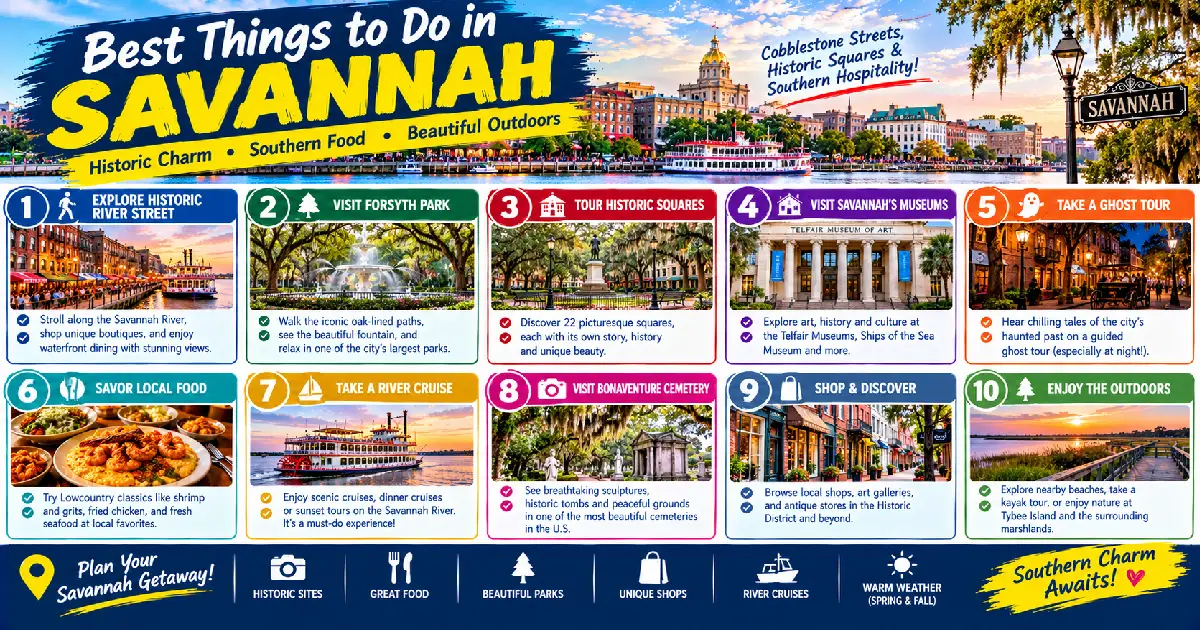
Savannah is the finest city in the American South for walking — a planned colonial city of extraordinary architectural coherence, laid out in 1733 by James Oglethorpe on a bluff above the Savannah River on a grid of 24 wards, each centered on a square of live oaks draped in Spanish moss. Of those original 24 squares, 22 survive intact, making Savannah’s Historic District the largest National Historic Landmark District in the United States and one of the finest intact examples of 18th- and 19th-century urban planning on Earth. No American city has preserved its historic core as completely; walking the squares of Savannah’s Historic District on a cool spring morning, with the light filtering through the Spanish moss and the antebellum townhouses and churches rising above the greenery, is one of the finest urban experiences in the United States without qualification.
Savannah’s history is layered and complicated in the way that all great Southern cities are — founded as a buffer colony between British Carolina and Spanish Florida, built on the labor of enslaved Africans whose Gullah Geechee cultural descendants still live in the Low Country, occupied by William Tecumseh Sherman in December 1864 (Sherman’s famous telegram to President Lincoln offering Savannah “as a Christmas gift” was sent from the Green-Meldrim House on Madison Square, still standing), and reinvented in the late 20th century by the restoration movement led by the Historic Savannah Foundation (founded 1955 when the Isaiah Davenport House was saved from demolition by a group of seven women who raised the purchase price in days) and the arrival of the Savannah College of Art and Design (SCAD) in 1978, which transformed dozens of derelict historic buildings into the finest art school campus in the American South.
The result is a city that wears its contradictions beautifully: a 24-square grid of architectural magnificence where ghost tours and dive bars and Michelin-starred restaurants coexist on the same blocks; a port city and college town and tourist destination all at once; a city of extraordinary beauty that is also completely unpretentious about it. Savannah does not require you to appreciate it quietly.
| Activity | Type | Cost | Best Season |
|---|---|---|---|
| Savannah Historic District squares walk | Sightseeing | Free | Year-round |
| Forsyth Park | Park | Free | Year-round |
| River Street | Dining/shopping | Free | Year-round |
| Bonaventure Cemetery | History/culture | Free | Year-round |
| Old Town Trolley or walking tour | Tour | $30–$40/adult | Year-round |
| Ghost tour | Entertainment | $20–$30/adult | Year-round |
| Savannah History Museum | History | $9/adult | Year-round |
| Mercer Williams House Museum | History | $12.50/adult | Year-round |
| SCAD Museum of Art | Art | $10/adult | Year-round |
| Cathedral of St. John the Baptist | Architecture | Free | Year-round |
| Wormsloe Historic Site | History | $10/adult | Year-round |
| Kayaking/paddling, Tybee Island | Outdoor | $45–$65/half-day | March–November |
| Tybee Island beach | Beach | Free | April–October |
| Savannah food tour | Food | $65–$90/person | Year-round |
| The Pirates’ House | Dining | $18–$38 entrée | Year-round |
| Jazz’d Tapas Bar | Live music | Free cover | Year-round |
| Paula Deen’s The Lady & Sons | Southern dining | $20–$35 | Year-round |
| Kayak through the marsh, Savannah NWR | Outdoor | $45–$65/half-day | Year-round |
| Midnight in the Garden tour | Literary/history | $25–$35/person | Year-round |
| First African Baptist Church | History | $8/adult | Year-round |
Number of squares: 22 surviving (of the original 24) Best squares for first-time visitors: Chippewa, Madison, Monterey, Calhoun, Columbia, Lafayette, Wright, Troup Best time: Early morning (7–9 AM) before tour groups; any season
Savannah’s 22 surviving squares are the finest urban public spaces in the American South and among the finest in the country — each a 100-by-100-foot green space of live oak trees (the finest live oak canopy of any American city), Spanish moss, flowering oleander, and cast-iron benches, surrounded by the finest concentration of intact antebellum architecture in the eastern United States. No two squares are identical: each has its own monument or fountain, its own surrounding architecture (Federal, Greek Revival, Italianate, Gothic Revival), and its own character.
The finest individual squares:
Forsyth Park (the grandest): Not technically a square but the crown jewel of the Savannah park system — a 30-acre park at the south end of the Historic District anchored by the Forsyth Fountain (1858, cast iron, modeled after a fountain in Place de la Concorde, Paris — the finest fountain in the American South), surrounded by the finest Victorian residential architecture in Savannah and ringed by Spanish-moss-draped live oaks that are 150+ years old. The Saturday farmers market (the finest in Savannah, 9 AM–1 PM March–November) and the Fragrant Garden for the Blind (the finest sensory garden in Georgia) are the finest side attractions.
Monterey Square: The finest single square in Savannah — the setting for the Mercer Williams House (the finest antebellum townhouse open for tours in Savannah, built 1860, the setting of John Berendt’s Midnight in the Garden of Good and Evil), the Congregation Mickve Israel (the third-oldest Jewish congregation in the United States, 1733, the only Gothic synagogue in America), and the Pulaski Monument (the finest monument in the squares — a 55-foot column commemorating Polish General Casimir Pulaski, mortally wounded at the Siege of Savannah in 1779, with a bronze eagle at the summit).
Chippewa Square: The finest square for literary and cultural history — the location where Forrest Gump’s bench scene was filmed (the bench was a prop; a replica is in the Savannah History Museum), the site of General Oglethorpe’s statue (the finest equestrian-type monument in Savannah; Oglethorpe faces south toward the Spanish, as he reportedly insisted), and the location of the First Baptist Church of Georgia (1800, the oldest Baptist church in Georgia).
Madison Square: The finest Civil War history square — the site of the Green-Meldrim House (1853, Gothic Revival, the finest Gothic Revival townhouse in Savannah, where William Tecumseh Sherman made his headquarters in December 1864 and from which he sent Lincoln the “Christmas gift” telegram; open for tours Tuesday–Saturday, $10/adult), the Jasper Monument (commemorating Sergeant William Jasper, killed in 1779 planting the American flag under fire at the Siege of Savannah), and Savannah’s finest residential block of antebellum townhouses.
Lafayette Square: The finest square for architectural concentration — surrounded by the Cathedral of St. John the Baptist (the finest Gothic Revival church in Georgia, 1876, rebuilt 1899 after fire, free entry, the finest interior ecclesiastical space in Savannah), the Hamilton-Turner Inn (1873 Second Empire mansion, now the finest B&B in the Historic District), and the Andrew Low House (1849, where General Robert E. Lee stayed while visiting Savannah).
Location: 330 Bonaventure Road, Thunderbolt (3 miles east of Historic District) Entry: Free | Hours: Daily 8 AM–5 PM Best time: Early morning with low mist; late afternoon golden hour
Bonaventure Cemetery is the finest Victorian cemetery in the American South and one of the finest in the United States — a 160-acre cemetery on a bluff above the Wilmington River, established in 1846 on the former plantation of John Mullryne (the name means “good wind” from the French bon aventure), with the finest live oak canopy of any cemetery in America (trees 200–300 years old, draped in Spanish moss, their roots lifting the brick pathways in the finest gothic-vegetation composition in the South). The cemetery gained national literary fame from John Berendt’s 1994 Midnight in the Garden of Good and Evil — the Bird Girl statue (photographed by Jack Leigh for the book’s cover) has been moved to the Telfair Museums; the cemetery retains Leigh’s grave, the Williams graves, and the Johnny Mercer grave (the finest celebrity grave in Bonaventure — Mercer wrote “Moon River,” “Days of Wine and Roses,” “That Old Black Magic,” and 1,500 other songs, the most commercially successful songwriter of the mid-20th century, born in Savannah 1909; his grave is marked by a plain granite stone and usually decorated with fresh flowers and Moon River tabs by pilgrims).
The finest way to experience Bonaventure: arrive at 7:30 AM on a cool morning, park at the main entrance on Bonaventure Road, and walk the main avenue under the live oaks for 30 minutes before the tour groups arrive. The cemetery is active (burials continue) and requires respectful behavior; photography is permitted.
Operators: Savannah Dan (savannahdan.com, $25/person, walking tours); numerous operators offer “Midnight” themed tours What it covers: The key locations from John Berendt’s 1994 nonfiction novel — Mercer Williams House, Bonaventure Cemetery, the Pirate’s House, the Armstrong Mansion, Jim Williams’s world
John Berendt’s Midnight in the Garden of Good and Evil (1994) is the finest work of narrative nonfiction set in any American city — a true-crime account of the 1981 shooting of Danny Hansford by antiques dealer Jim Williams at the Mercer Williams House, embedded in a portrait of Savannah’s eccentric aristocracy that became the first nonfiction book to spend four years on the New York Times bestseller list and introduced the city to a generation of American travelers. The book is still the finest single piece of writing about Savannah; reading it before or during a visit transforms the city’s squares, buildings, and social dynamics from backdrop to foreground. The Midnight walking tours (1.5–2 hours, $25–$35/person) are the finest literary tours in the South.
Mercer Williams House Museum ($12.50/adult): The finest single house tour in Savannah — the 1860 Italianate townhouse on Monterey Square where Jim Williams lived and died (he died in the house of a heart attack in 1990 before the trials concluded), filled with the finest collection of 18th-century American antiques assembled by a private individual in the 20th century. The drawing room where the shooting occurred, the garden, and the carriage house are on the tour. Williams’s sister still lives in the house and oversees the museum. mercerwilliamshouse.com.
Location: Along the Savannah River, below the Factors Walk ramps Character: Cobblestone tourist street; the finest waterfront in Georgia Best time: Late afternoon and evening for dining; Sunday morning for the farmers market
River Street is the finest riverfront in Georgia — a cobblestone promenade on the Savannah River below the Factor’s Walk (the iron-bridged walkways connecting the antebellum cotton warehouses on the riverfront bluff to the city above, the finest example of commercial adaptive reuse architecture in Savannah), with a continuous line of restaurants, bars, candy shops, and galleries in the converted 1820s–1860s cotton warehouses. The setting — the river above, the bluff-top city visible above the Factor’s Walk, and the container ships passing 30 feet from the promenade — is the finest industrial-riverfront urban experience in the South.
The riverfront is best at dusk on a weekday when the day-trippers have left — the container ships navigating the Savannah River channel (one of the busiest container ports on the East Coast, 3rd largest in the US by volume) pass close enough to the promenade to read the ship names. The Savannah Riverboat Company (savannahriverboat.com, sightseeing cruises from $28/adult, dinner cruises from $68/adult) operates the finest river narrated tours in the city.
Location: 23 Montgomery Street, Franklin Square Tours: $8/adult; Tuesday–Saturday 11 AM, 1 PM, and 3 PM Founded: 1773 (the oldest African American church in North America)
The First African Baptist Church on Franklin Square is the most historically significant church in Savannah and one of the most historically significant in the United States — the oldest continuously operating African American congregation in North America (organized 1773 by George Liele, a formerly enslaved man who later became the first American Baptist missionary abroad, moving to Jamaica in 1782), with its current building dating to 1859 and constructed largely by enslaved people who hid freedom-seeker-assistance symbols in the quilted pattern of holes drilled beneath the pew benches. The sanctuary — with its original slave-built pew benches, the floor holes used to pass food and water to freedom-seekers hiding in the crawl space below, and the extraordinary story of the congregation’s founding — is the finest single historical interior in Savannah.
Location: 7601 Skidaway Road, Isle of Hope (10 miles southeast of Historic District) Entry: $10/adult | Hours: Tuesday–Sunday 9 AM–5 PM Best known for: The finest live-oak avenue in the United States
Wormsloe is the most photographed location in Georgia — a 1.5-mile oak-canopied avenue of 400 live oak trees planted in the late 19th century (the trees are approximately 150 years old) on the approach road to the colonial estate of Noble Jones (one of the original settlers of the Georgia colony in 1733). The avenue is the finest natural photographic composition in Georgia and among the finest in the South: two rows of massive live oaks forming a cathedral-like tunnel above the brick-and-crushed-oyster-shell road, the Spanish moss hanging in curtains, converging to a point in the distance. The ruins of Jones’s 1740s tabby (oyster shell and lime) fortified house (the finest tabby ruins accessible in Georgia) and the colonial life interpretive exhibits (living history demonstrations of 18th-century colonial Georgia life on weekends) complete the experience.
The best time to photograph the avenue is 30–60 minutes after sunrise on a misty morning, when the low light and morning fog create the finest atmospheric condition for the live oak tunnel.
Location: 601 Turner Blvd (in the restored 1856 Savannah Volunteer Guards Armory) Entry: $10/adult, students free Hours: Tuesday–Saturday 10 AM–5 PM, Sunday noon–5 PM
The Savannah College of Art and Design Museum of Art is the finest contemporary art museum in Georgia — housed in a restored 1856 Italianate armory building in the SCAD Historic District, with the finest collection of contemporary fashion design (the Lacoste Gallery’s fashion collection is the finest in the Southeast), rotating exhibitions of work by internationally recognized artists, and the SCADstory permanent collection that traces the college’s influence on American contemporary art since 1978. SCAD’s presence in Savannah (22,000 students, 70+ buildings in the Historic District) has transformed the city’s cultural landscape since 1978, restoring and repurposing more historic buildings than any single entity in Savannah’s history.
Location: 222 East Harris Street, Lafayette Square Entry: Free (donations appreciated) Hours: Daily 9 AM–5 PM; Sunday Mass schedules at savannahcathedral.org
The Cathedral of St. John the Baptist is the finest Gothic Revival church interior in Georgia and the finest single ecclesiastical interior in Savannah — the Cathedral of the Diocese of Savannah, originally built in 1876 and rebuilt after a catastrophic fire in 1898, with the finest stained glass windows in Savannah (German-made, 1896, depicting the life of Christ across 18 lancet windows, the finest single collection of ecclesiastical stained glass in Georgia), the finest painted interior of any church in Savannah (the nave and ceiling are painted in a complex polychrome scheme of blues, golds, and reds, executed by a Munich firm in 1912, restored 2000), and the finest rose window in the South. Free entry; respectful dress required; photography permitted.
Operators: Savannah’s Haunted History Tours (savannahhauntedhistory.com, $23/adult); Hearse Ghost Tours (the finest theatrical ghost tour, $28/adult, departs in a vintage black hearse); Blue Orb Tours (the finest historically accurate ghost tour in the city) Best time: After 8 PM year-round; most atmospheric in October and in fog
Savannah is consistently ranked the most haunted city in the United States — a designation that the tourism industry has enthusiastically embraced, with 20+ competing ghost tour operators running nightly from the Historic District. The designation is at least partially deserved: the squares and cemeteries of the Historic District sit above 18th- and 19th-century burial grounds (several squares were established over existing cemeteries; Colonial Park Cemetery on Abercorn Street, the finest historic cemetery in the Historic District, dates to 1750 and contains the graves of Button Gwinnett, signer of the Declaration of Independence, and 700 yellow fever victims buried in a mass grave). The ghost tour industry is the finest entry point into Savannah’s history for visitors who find standard tours too dry — the stories, even embellished, cover the yellow fever epidemics, the slave history, the Civil War occupation, and the colonial settlement in ways that stick. The finest ghost tour is the one that takes you to Colonial Park Cemetery at night.
Colonial Park Cemetery (free, open daily dawn–dusk): The finest historic cemetery in the Historic District — the original municipal cemetery of Savannah, established 1750, containing the graves of colonial-era settlers, Revolutionary War figures (Button Gwinnett, one of three Georgia signers of the Declaration), and the famous “doctored epitaphs” (Union soldiers who occupied the cemetery in 1864 moved headstones and added false birth and death dates as pranks; the misinformation has never been fully corrected). Free entry; finesthistorically significant site accessible without admission in the Historic District.
Savannah Riverboat Cruises: The finest way to see the Savannah River — the Savannah Riverboat Company (savannahriverboat.com) operates narrated sightseeing cruises (1.5 hours, $28/adult), Sunday gospel brunch cruises ($68/adult), and Saturday evening dinner-dance cruises ($78/adult) on the Georgia Queen and Savannah Belle paddlewheel riverboats, the finest riverboats in Georgia. The narrated sightseeing cruise covers the history of the Savannah port, the cotton trade, and the Factor’s Walk from the water.
Container ship watching (free): The Savannah port (the third-busiest container port in the United States, handling 5.6 million TEUs annually) sends massive Panamax and post-Panamax container ships past the River Street promenade day and night, close enough to the walkway to read the ship names. The finest free entertainment on River Street is watching the ships pass at dusk from the eastern end of the promenade, with the Talmadge Memorial Bridge lit against the evening sky behind them.
Distance from Savannah: 18 miles east on US-80 (30–40 minutes) Entry: Parking $2/hour at North Beach, South Beach | Best season: April–October
Tybee Island is the finest beach destination accessible from Savannah — a barrier island at the mouth of the Savannah River, 3 miles long and 0.75 miles wide, with 5 miles of Atlantic beach, the finest sea turtle nesting program in Georgia (loggerhead sea turtle nests monitored by the Tybee Island Marine Science Center from May–August), and the Tybee Island Light Station (1867, the oldest and tallest lighthouse in Georgia, 154 feet, $10/adult, the finest lighthouse experience on the Georgia coast).
Back River kayaking: The finest outdoor experience accessible from Savannah — a kayak tour through the Back River salt marshes on the western side of Tybee Island (Sea Kayak Georgia, seakayakgeorgia.com, $55–$75/half-day), passing through the finest intact Lowcountry salt marsh accessible from Savannah, with bottlenose dolphin encounters (the finest dolphin-watching kayaking on the Georgia coast) and bird watching (great blue heron, brown pelican, oystercatcher, and painted bunting in the marsh).
Tybee Island Light Station ($10/adult): The finest lighthouse in Georgia — the 1867 Tybee Island Light, rebuilt following Civil War damage, is the oldest (original foundation from 1736, the second lighthouse built in Georgia) and tallest (154 feet) lighthouse in Georgia and the finest lighthouse tower climb on the Georgia coast. The 178-step climb to the lantern room provides the finest panoramic view of the Savannah River entrance, the Atlantic, and the Georgia coast from any accessible point in the region.
Savannah has one of the finest restaurant scenes in the American South — a city where the Low Country cooking tradition (she-crab soup, shrimp and grits, fried green tomatoes, oyster roasts), the African American culinary heritage of the Gullah Geechee people, and the arrival of talented chefs drawn by SCAD and Savannah’s tourism boom have combined to produce the finest dining scene in Georgia outside of Atlanta.
The Grey (108 Martin Luther King Jr. Blvd): The finest restaurant in Savannah and one of the finest in the South — a converted 1938 Greyhound bus terminal (the finest restaurant interior in Georgia, the original Art Deco terrazzo floors and bus-station lunch counter preserved and incorporated into an extraordinary dining room) serving chef Mashama Bailey’s Coastal Georgia cuisine. Bailey won the James Beard Award for Best Chef Southeast in 2019; her cooking (the finest smoked catfish dip in the South, the finest pork chop in Savannah, the finest rice grits interpretation of a Gullah staple) is the finest expression of Savannah’s culinary identity. Dinner entrées $32–$68; reservations on Resy 60 days in advance; one of the hardest reservations in Georgia.
The Grey Market (next door to The Grey): The finest casual dining option in the Grey restaurant group — a daytime counter-service deli-café serving the finest breakfast sandwiches (the smoked fish plate, $14) and lunch ($16–$22) in the Historic District, in the original Art Deco bus-station lunch counter. No reservations; opens 8 AM.
Clary’s Café (404 Abercorn Street): The finest diner in Savannah — a Historic District institution since 1903 (the current ownership since the 1940s), with the finest traditional Southern breakfast in Savannah (grits, eggs, biscuits, sausage gravy, $8–$14) and the distinction of being a prominent location in Midnight in the Garden of Good and Evil (Luther Driggers and his flea-circus fleas had breakfast here). Closes at 3 PM daily; cash preferred.
The Olde Pink House (23 Abercorn Street): The finest historic-setting fine-dining restaurant in Savannah — a 1771 Georgian mansion (built for planter James Habersham Jr., one of the finest Colonial-era residential buildings in the city, its brick stuccoed exterior has stained pink from the original brick showing through over 250 years) converted to a restaurant in 1970, with Low Country cuisine ($26–$52, the finest fried green tomatoes in Savannah) and the finest basement tavern (Planters’ Tavern, the finest candlelit bar in Savannah, live piano nightly) in the city. One of Savannah’s most celebrated restaurants; reservations essential.
She-Crab Soup: The defining dish of the Savannah food culture — a rich cream soup of blue crab meat, crab roe, sherry, and cream, the finest version of which is at the Pirates’ House (20 East Broad Street, $12/bowl, in a building dating to 1734 — the oldest building in Georgia, originally a tavern for sailors arriving in the port and a reputed press-gang recruitment point for the British Navy, later an inn mentioned in Robert Louis Stevenson’s Treasure Island) and at 45 Bistro (45 Bistro, 123 E. Broad St).
Location: US-17 north of Savannah, 8 miles; the refuge straddles the SC/GA border Operators: Savannah Canoe and Kayak (savannahcanoeandkayak.com, $45–$65/half-day guided) Best season: Year-round; finest September–May (before summer heat and insects)
The Savannah National Wildlife Refuge is the finest inland paddling destination accessible from Savannah — a 30,000-acre refuge of freshwater impoundments, tidal rivers, and cypress-tupelo swamp along the Savannah River, with the finest winter waterfowl concentration in Georgia (15,000+ ducks and geese in January–February) and year-round alligator, river otter, and wading bird sightings. The 4-mile Laurel Hill Wildlife Drive (a crushed-shell auto route through the impoundments, free) is the finest free wildlife auto tour in the South; the kayak tours through the cypress swamp sections are the finest paddling experience in the Savannah area. Guided tours (2.5–3 hours) depart from the refuge or from the Savannah Canoe and Kayak outfitter on Waters Avenue.
Savannah History Museum (303 Martin Luther King Jr. Blvd): The finest overview of Savannah’s history in a single building — housed in the restored 1860 train shed of the former Central of Georgia Railway Station, with exhibits covering Savannah’s founding in 1733, the cotton trade, the Civil War occupation, and the Forrest Gump bench replica (the actual prop bench from the 1994 film, the finest single movie prop on public display in Georgia). $9/adult.
Roundhouse Railroad Museum (601 West Harris Street, adjacent): The finest railroad history museum in the South — the best-preserved antebellum railroad repair facility in the United States, with the original 1851 roundhouse (a circular turntable building housing 13 locomotive stalls, the finest intact example of its type in the country), the original steam-powered shop machinery, and a collection of 19th-century steam locomotives. $10/adult. The two museums share a site and can be combined for $15/adult.
Operators: The Savannah Culinary Institute (savannahculinary.com, $95–$125/person); Cook-Off Savannah; multiple SCAD-affiliated cooking experiences Best for: Foodies, groups, hands-on travelers
The finest hands-on food experience in Savannah — the Low Country cooking class covers the defining dishes of the Georgia-Carolina coastal cuisine tradition: shrimp and grits (with stone-ground grits from a local mill, the finest version of the defining Savannah dish), she-crab soup, fried chicken, red rice (the Gullah Geechee one-pot dish that is the ancestor of Louisiana red beans and rice), and benne (sesame) seed wafers (a traditional Gullah confection brought from West Africa). Classes run 2–3 hours; $95–$125/person including ingredients and the meal. Book in advance; classes fill quickly.
Savannah St. Patrick’s Day Festival (March 17): The finest St. Patrick’s Day celebration in the United States outside of New York City — Savannah’s Irish heritage (the city has one of the largest Irish-descended populations in the South, dating to the Great Famine immigration of the 1840s–1850s) produces the second-largest St. Patrick’s Day parade in the United States (approximately 400 units, 250,000 spectators lining the squares and Bull Street), with the Savannah River dyed green and live Irish music throughout River Street and the squares. Book accommodations 6–8 months in advance.
SCAD Savannah Film Festival (October): The finest film festival in the South — an annual competitive film festival presented by SCAD, drawing major filmmakers and studio premieres, the largest juried film festival in the Southeast. Free screenings available to the public at SCAD venues throughout the Historic District.
Savannah Food & Wine Festival (November): The finest food festival in Georgia — 5 days of chef dinners, tastings, and demonstrations featuring the finest Low Country and Southern chefs, held in venues throughout the Historic District including Forsyth Park.
Operators: Carriage Tours of Savannah (carriagesavannah.com, $30/adult, 1 hour); multiple operators depart from City Market Best time: Evening for the finest atmosphere; spring and fall for comfortable temperatures
The finest way to orient in Savannah on a first visit — a 1-hour horse-drawn carriage tour of the Historic District covering all 22 squares and the finest architectural landmarks, narrated by a guide with detailed historical knowledge. The carriage pace (3–4 mph) is the finest speed at which to absorb the square geometry and the antebellum architecture; the evening tour (departing at dusk) passes the squares and facades in the finest light. Depart from City Market (Jefferson and Bryan Streets, the finest restaurant-and-gallery block in the Historic District).
Savannah has the finest concentration of working artists and galleries in the Southeast outside of Atlanta — SCAD’s 22,000 students and 150 faculty have transformed the city into one of the densest art-school communities in the world. The finest galleries:
Jazz’d Tapas Bar (52 Barnard Street): The finest live jazz venue in Savannah — a below-street-level jazz club and tapas bar with live jazz or soul music nightly (no cover), the finest cocktail menu in the Historic District, and small plates ($10–$18) that represent the finest tapas menu in Savannah. The finest jazz evening in the city.
Congress Street Up (Congress Street): The finest craft cocktail bar in Savannah — a subterranean cocktail lounge beneath the Congress Street level with the finest bartenders in the city and the finest seasonal cocktail menu in Georgia. Reservations recommended on weekends.
Pinkie Masters (318 Drayton Street): The finest dive bar in Savannah — a legendary neighborhood bar operating since the 1950s, where Jimmy Carter reportedly announced his presidential candidacy in 1976 (a distinction shared with several Savannah bars), cash only, the finest $3 beer and $5 well-drink values in the Historic District.
The Historic District is entirely walkable — all 22 squares, Forsyth Park, River Street, City Market, and the major museums are within a 1.5-mile radius. The free DOT Dot Shuttle (a small electric shuttle bus, free, operates 7 AM–midnight daily) connects the Historic District to the Savannah Visitor Center on MLK. Bicycles: Savannah Bike Rentals (210 W. Broughton St, $15/half-day, the finest way to cover the squares quickly). Parking: $1–$2/hour in city garages; the Bryan Street garage (behind City Market) and the Whitaker Street garage are the finest value.
| Season | Temp | Crowds | Notes |
|---|---|---|---|
| Spring (March–May) | 68–80°F | High | Finest weather; azalea bloom (March–April); St. Patrick’s Day (March 17) — book months ahead |
| Summer (June–August) | 90–95°F, very humid | Medium-high | Hot; afternoon thunderstorms daily; fewer crowds than spring |
| Fall (September–November) | 70–82°F | Medium | Finest overall season; comfortable temperatures; SCAD Film Festival (October) |
| Winter (December–February) | 50–62°F | Low | Lowest prices (30–40% below spring peak); mild enough for outdoor walking; fewer crowds |
Best overall: October–November — the finest weather, the finest festival programming (SCAD Film Festival, Food & Wine Festival), comfortable temperatures for walking the squares, and 20–30% lower accommodation rates than the spring peak.
Posted By : Vinay
Latest Article
2nd Floor, 39, Above Kirti Club, DLF Industrial Area, Kirti Nagar, New Delhi, Delhi 110015



Travel Tourister is a leading Travel portal where we introduce travellers to trusted travel agents to make their journey hasselfree, memorable And happy. Travel Tourister is a platform where travellers get Tour packages ,Hotel packages deals through trusted travel companies And hoteliers who are working with us across the world. We always try to find new and more travel agents and hoteliers from every nook and corners across the world so that you could compare the deals with different travel agents and hoteliers and book your tour or hotel with the one you have chosen according to your taste and budget.
Copyright © Travel Tourister, India. All Rights Reserved

 Call
 Enquiry