Published on : 31 Oct 2026
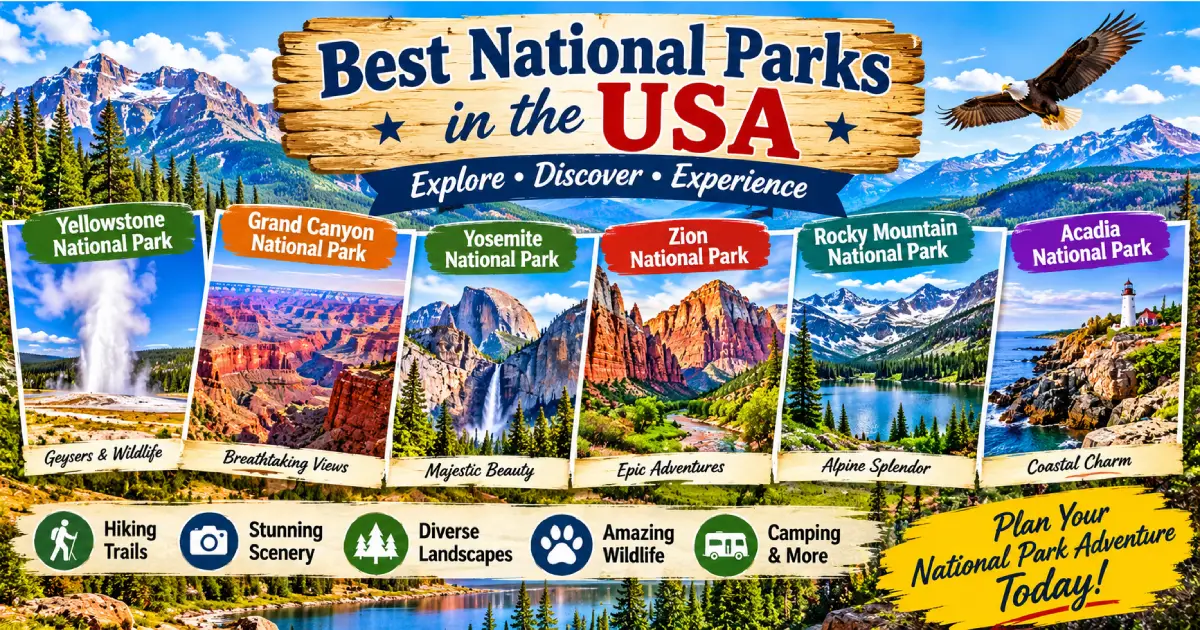
The United States National Park System is one of the greatest conservation achievements in human history — 63 national parks protecting 84 million acres of wild landscape from the Arctic tundra of Denali to the coral reefs of Biscayne Bay, from the geothermal wonders of Yellowstone to the ancient redwood forests of the California coast. When Congress established the National Park Service in 1916, the mandate was explicit and revolutionary: to conserve the scenery, natural and historic objects, and wildlife in the parks “unimpaired for the enjoyment of future generations.” More than a century later, that mandate has held, and the result is a public land system unlike anything else on Earth — a legacy that belongs equally to every American and is open to every visitor.
In 2025, the 63 national parks collectively received over 325 million recreation visits. The most visited park — Great Smoky Mountains — drew 13 million people; the least visited — Gates of the Arctic in Alaska’s Brooks Range — received fewer than 10,000. Between those extremes lies an extraordinary range of landscapes, experiences, and challenges. Some parks, like Yellowstone and Yosemite, require months of advance planning for popular permits and lodging; others, like Congaree and Great Basin, can be visited on a week’s notice with a same-day campsite. Some parks demand serious physical fitness and backcountry experience; others have paved, accessible paths that bring the wilderness to every visitor. What they share is the quality that John Muir called “wildness” — the sense of encountering something larger than human scale, older than human memory, and more enduring than any individual life.
This guide covers the 20 best national parks in the USA for 2026, chosen for the quality and distinctiveness of their landscapes, the range of experiences they offer, and the practical accessibility that makes them worth planning a trip around. Each entry includes the park’s signature experiences, best season, practical logistics, and links to our full guides where available — everything you need to decide where to go and how to go there.
| Park | State | Best For | Best Season | Entry Fee |
|---|---|---|---|---|
| Grand Canyon | Arizona | Canyon grandeur, South Rim hikes | Mar–May, Sep–Nov | $35/vehicle |
| Yellowstone | Wyoming/MT/ID | Geysers, wildlife, thermal features | May–Jun, Sep | $35/vehicle |
| Yosemite | California | Valley, Half Dome, waterfalls | Apr–Jun, Sep–Oct | $35/vehicle |
| Zion | Utah | Angels Landing, The Narrows | Mar–May, Sep–Oct | $35/vehicle |
| Acadia | Maine | Rocky coast, Cadillac summit | Sep–Oct | $35/vehicle |
| Great Smoky Mountains | TN/NC | Waterfalls, wildflowers, wildlife | Apr–Jun, Oct | Free |
| Rocky Mountain | Colorado | Alpine tundra, Trail Ridge Road | Jul–Sep | $35/vehicle |
| Olympic | Washington | Rainforest, coast, glacier | Jul–Sep | $35/vehicle |
| Bryce Canyon | Utah | Hoodoos, stargazing | May–Jun, Sep–Oct | $35/vehicle |
| Arches | Utah | Natural arches, Delicate Arch | Mar–May, Sep–Nov | $35/vehicle |
| Glacier | Montana | Going-to-the-Sun Road, hiking | Jul–Sep | $35/vehicle |
| Shenandoah | Virginia | Skyline Drive, fall foliage, Old Rag | Oct, May–Jun | $35/vehicle |
| Grand Teton | Wyoming | Teton Range reflections, climbing | Jun–Sep | $35/vehicle |
| Congaree | South Carolina | Old-growth floodplain, canoe trail | Nov–Mar | Free |
| Everglades | Florida | Sawgrass prairies, manatees, birds | Dec–Apr | $35/vehicle |
| Canyonlands | Utah | Mesa arches, White Rim Road | Mar–May, Sep–Oct | $35/vehicle |
| Capitol Reef | Utah | Waterpocket Fold, fruit orchards | Apr–May, Sep–Oct | $20/vehicle |
| Great Basin | Nevada | Bristlecone pines, Lehman Caves, dark sky | Jun–Sep | Free |
| Crater Lake | Oregon | Deepest lake in US, blue water | Jul–Sep | $35/vehicle |
| Isle Royale | Michigan | Wolf/moose ecosystem, true wilderness | Jun–Sep | $7/person |
The Grand Canyon is the defining natural landmark of the American West — 277 miles long, up to 18 miles wide, and a mile deep, carved by the Colorado River through two billion years of Earth history. The South Rim (90% of visitors) offers 75 overlooks along a 33-mile corridor, the iconic Bright Angel Trail descending through the full geological sequence to the Colorado River, and the historic El Tovar Hotel (1905) perched at the canyon edge. The North Rim (open mid-May through mid-October) receives only 10% of visitors but has the finest viewpoints in the entire park — Cape Royal and Point Imperial look into the widest and most complex section of the canyon.
Signature experiences: Bright Angel Trail to Indian Garden (Havasupai Gardens) — 9 miles RT, 3,060 ft; South Kaibab Trail to Ooh Aah Point — 1.8 miles RT, the finest short hike; Fort Sumter ferry from the South Rim to the island fortress; Desert View Watchtower designed by Mary Colter; California condor watching (the reintroduced population now exceeds 500 birds). 2026: Timed-entry vehicle permits ($2) required May–October; book 3 months in advance at recreation.gov.
See our full Grand Canyon South Rim Guide 2026 for complete details.
Yellowstone is the world’s first national park (established 1872) and the largest geothermal system on Earth — more than half of the world’s geysers, 10,000 thermal features, and the most intact temperate large-mammal ecosystem outside Africa. The Yellowstone Caldera (the supervolcano underlying the park) drives the thermal activity: Old Faithful Geyser erupts every 60–110 minutes to heights of 100–185 feet; the Grand Prismatic Spring (370 feet wide, the largest hot spring in the US and the third-largest in the world) is the most vivid thermal feature on Earth, its rings of orange, yellow, and green bacteria surrounding a deep indigo pool; the Norris Geyser Basin is the hottest, most dynamic, and most geologically active section of the park.
The Lamar Valley (northeast corner, accessible year-round, the “Serengeti of North America”) is the finest wildlife-watching location in the continental US: wolf packs are seen hunting bison on a regular basis from the roadside, grizzly bears forage in the sagebrush meadows, and bison herds of hundreds block the road. The Hayden Valley (south of the Grand Canyon of the Yellowstone) is equally productive for bison and bears. The Grand Canyon of the Yellowstone — a 24-mile-long canyon of yellow and orange rhyolite where the Yellowstone River drops 308 feet over Lower Falls (twice the height of Niagara Falls) — is the most dramatic non-thermal scenery in the park.
Best season: May–June (wildflowers, newborn bison calves, bears with cubs, fewer crowds than summer) and September (elk rut bugling echoes across the valleys, fewer crowds, cooler temperatures). July–August is peak season — the park’s 500 miles of road are open but the busiest areas (Old Faithful, Grand Prismatic, Lamar Valley) are extremely crowded by 9 AM. Winter (mid-December through February) offers the most surreal experience — the thermal basins steaming in −20°F air, bison crusted with frost, and the park accessible only by snowcoach and snowmobile.
Practical: $35/vehicle entry fee (7-day pass). Lodging (managed by Yellowstone Forever at yellowstonenationalparklodges.com) books up to 13 months in advance — Old Faithful Inn (the largest log structure in the world, 1904, 327 rooms, $175–450/night) and Lake Yellowstone Hotel (1891, the oldest operating hotel in the national parks, $175–350/night) are the finest options. Book campgrounds 6 months in advance at recreation.gov. The park receives 4.5 million visitors annually.
Yosemite Valley — a 7-mile-long, 1-mile-wide glacier-carved valley in the Sierra Nevada of central California — contains the highest concentration of spectacular waterfalls, granite monoliths, and alpine meadow scenery in North America. El Capitan (3,000-foot vertical granite wall, the largest exposed granite face in the world and the proving ground of American rock climbing), Half Dome (the park’s icon, a 8,842-foot granite dome split in half by glaciation), Yosemite Falls (2,425 feet, the tallest waterfall in North America), Bridalveil Fall, and Mirror Lake are all visible from the Valley floor.
Half Dome Cables (16.8 miles RT from Yosemite Valley, 4,800 ft) is the most sought-after day hike permit in the national park system ($10/person, permit required, lottery system at recreation.gov — pre-season lottery in March, daily lottery 2 days in advance). The John Muir Trail begins in Yosemite Valley and runs 211 miles south to Mount Whitney, the highest peak in the contiguous US. The Mist Trail to Vernal Fall and Nevada Fall (5.4 miles RT, 1,900 ft) is the finest waterfall hike in the park, at its most spectacular in May and June when snowmelt swells the falls.
2026: Yosemite requires a day-use reservation ($2/person) for vehicles entering the Valley from late May through early September (7 AM–4 PM). The Valley lodging — The Ahwahnee (formerly the Ahwahnee Hotel, 1927 National Historic Landmark, $350–600/night, the finest historic hotel in the national parks) — books 366 days in advance. Tioga Road (US-120, the only trans-Sierra highway through the park) opens late May to mid-June depending on snowpack and closes in October.
Zion is the most visited national park in Utah and the gateway to the Mighty Five — a canyon of 2,000-foot Navajo Sandstone walls carved by the Virgin River, with the most dramatic slot canyon hiking in the American Southwest. Angels Landing (5.4 miles RT, permit required, the most famous chain-assisted scramble in America), The Narrows (wading the Virgin River through the world’s most celebrated slot canyon, no permit for the bottom-up day hike), and the Zion–Mt. Carmel Tunnel (a 1930 engineering marvel through the canyon walls) are the essential experiences.
See our full Utah National Parks Road Trip Guide for complete Zion details.
Acadia is the only national park in the northeastern United States — a mosaic of granite mountains, rocky coastline, and boreal forest on Mount Desert Island off the coast of Maine, where the Atlantic meets the Appalachian Mountains at the same longitude and the result is a landscape of extraordinary compressed drama. Cadillac Mountain (1,530 feet, the highest point on the US Atlantic coast north of Rio de Janeiro) is the first place in the continental United States to receive sunlight from October through March; the Carriage Roads (45 miles of crushed-stone paths built by John D. Rockefeller Jr. with 17 stone bridges — the finest carriage road system in America) offer the most civilized outdoor recreation in the national parks; and the Precipice Trail (1.6 miles RT, iron rungs and ladders on sheer granite — the finest exposed scramble in the eastern parks) is the most exhilarating non-technical climb on the East Coast.
Best season: September and October — the crowds of August have thinned, fall foliage peaks on the island in the second and third weeks of October, and the light on the granite and the sea is extraordinary. Bar Harbor (the park’s gateway town) is a genuine New England resort village with excellent restaurants, whale-watching tours, and kayak outfitters.
See our full Acadia National Park Guide 2026 for complete details.
Great Smoky Mountains is the most visited national park in the United States — 13 million visitors annually, free admission, and within a day’s drive of one-third of the American population — and it earns every visitor. The park protects the most biodiverse temperate forest in North America: more tree species than in all of northern Europe, 1,500 species of flowering plants, 200 species of birds, and the largest black bear population in the eastern US (1,500 bears, 2–3 per square mile in the best habitat). Clingmans Dome (6,643 feet, the highest point in the park and the highest point on the Appalachian Trail, accessible by a steep 0.5-mile paved walk from the parking area) provides the most panoramic summit view in the southern Appalachians on clear days; Cades Cove (an 11-mile wildlife loop through an 1800s mountain community, the single best wildlife-viewing drive in the eastern US) reliably produces black bears, white-tailed deer, wild turkeys, and red foxes. The synchronous fireflies display at Elkmont Campground for approximately two weeks in late May and early June — the only place in the western hemisphere where multiple firefly species synchronize their flashing — requires an advance shuttle reservation ($1/person) that sells out within minutes of opening.
See our full Things to Do in Gatlinburg 2026 guide (gateway town) for complete park details.
Rocky Mountain National Park — 65 miles northwest of Denver — is the highest national park in the contiguous United States, with 77 named peaks above 12,000 feet and Trail Ridge Road (US-34, the highest continuous paved road in the US, reaching 12,183 feet at its highest point) crossing the Continental Divide above treeline in a 48-mile traverse of genuine alpine tundra. The Alpine Visitor Center (11,796 feet) is the highest visitor center in the national park system; the view from the center across the tundra to the Never Summer Mountains is as close as any road-accessible point in the contiguous US gets to Arctic landscape.
Hiking: Longs Peak (14,255 feet, the only 14er in the park, 15 miles RT, 5,100 ft — strenuous, requires a 3 AM start to clear the summit before afternoon thunderstorms, no permit required) is the finest big-mountain day hike in the Rockies accessible without a permit. Sky Pond (9 miles RT, 1,800 ft) through Glacier Gorge to a high alpine lake below the Cathedral Spires is the finest scenically rewarding non-summit hike in the park. Bear Lake (0.5-mile accessible loop at 9,475 feet, the most visited single location in the park) and the Emerald Lake Trail (3.6 miles RT from Bear Lake) are the finest easy options.
Wildlife: The elk rut in September and early October — when bull elk bugle and battle in Moraine Park and Horseshoe Park meadows at dawn and dusk — is one of the finest wildlife spectacles in the contiguous US. 2026: Timed-entry reservation ($2/vehicle) required for Bear Lake Road corridor from late May through mid-October; book at recreation.gov.
Olympic National Park — on the Olympic Peninsula of western Washington — is one of the most ecologically diverse parks in the system: a single park containing temperate rainforest (the finest in the contiguous US — the Hoh Rain Forest receives 140–167 inches of rain annually, producing Douglas firs 300 feet tall and Sitka spruces 60 feet in circumference), 65 miles of wild Pacific coastline (the longest wilderness beach in the contiguous US, with sea stacks, tide pools, and one of the most intact coastal wildlife ecosystems in the lower 48), and glaciated alpine peaks (Mount Olympus, 7,980 feet, supports the most extensive glacier system in the contiguous US outside Alaska). No other park in the country encompasses this range of ecosystems in a single unit.
Hoh Rain Forest (Hall of Mosses Trail, 0.8 miles, the single most dramatic easy walk in the Pacific Northwest — a cathedral of 300-foot bigleaf maples draped in club moss), Rialto Beach and the Hole-in-the-Wall (1.5-mile beach walk to a sea arch at low tide), and the Hurricane Ridge day area (alpine meadows and views of Mount Olympus) are the essential experiences. Best season: July–September (the only reliably dry months on the West Side; the coast and Hoh are green and spectacular year-round but access is easier in summer).
The Mighty Five’s most otherworldly park — 8,000 hoodoos in a single amphitheater, Gold Tier dark skies, and the finest short canyon hike in the US (Navajo Loop + Queen’s Garden). The park’s elevation (8,000–9,100 feet) keeps temperatures pleasant even in summer, and the hoodoo color at sunrise and sunset is unmatched anywhere on Earth.
See our full Bryce Canyon National Park Guide 2026 for complete details.
Glacier National Park — on the Canadian border in northwestern Montana — protects the finest mountain wilderness in the contiguous United States: 1 million acres of glacier-carved peaks, turquoise alpine lakes, and the most intact grizzly bear habitat in the lower 48. The Going-to-the-Sun Road (50-mile trans-park highway completed in 1932, considered one of the greatest engineering achievements of the 20th century) climbs from the west valley floor to Logan Pass (6,646 feet) on the Continental Divide — the most spectacular paved mountain road in North America. The road typically opens in mid-June and closes by mid-October; vehicle reservations ($2/vehicle, required June 15–September 10 between 6 AM and 3 PM at the western entrance) are required in peak season.
Wildlife: The densest grizzly bear population in the lower 48 (300–400 grizzlies), plus wolf packs, mountain goats on the Logan Pass boardwalk (the most reliable mountain goat viewing in any park), wolverines, and lynx. Hiking: The Highline Trail (11.8 miles one way from Logan Pass, mostly flat traverse across the Continental Divide at 6,500 feet — the finest maintained trail in the American Rockies) and the Grinnell Glacier Trail (10.6 miles RT, 1,600 ft — to one of the park’s 25 remaining named glaciers, down from 150 in 1850) are the essential long hikes. Hidden Lake Overlook (2.8 miles RT from Logan Pass, mountain goats nearly guaranteed) is the finest short hike.
The glaciers are disappearing: At current rates, all named glaciers in the park will be gone by 2030–2050 — a window that is closing. Seeing Grinnell Glacier or Sperry Glacier now, while they still exist as functional ice masses, is an experience that future generations will not have.
Shenandoah is the national park closest to the largest population center on the East Coast — 75 miles from Washington D.C. — and the finest fall foliage drive in the mid-Atlantic: Skyline Drive runs 105 miles along the Blue Ridge crest with 75 overlooks above the Shenandoah Valley and Virginia Piedmont. Old Rag Mountain (the finest rock scramble in the eastern parks, permit required) and Dark Hollow Falls are the essential hikes; the park’s 500+ black bears make Big Meadows one of the best wildlife-watching sites east of Yellowstone.
See our full Shenandoah National Park Guide 2026 for complete details.
Grand Teton — immediately south of Yellowstone, sharing a border and a combined ecosystem — protects the most dramatic mountain front in the contiguous United States: the Teton Range rises 7,000 feet in less than 5 horizontal miles from the flat floor of Jackson Hole, with no foothills to soften the visual impact. The Snake River Oxbow Bend at dawn — with the Teton Range reflected in still water, moose feeding in the shallows, and bald eagles perched in the cottonwoods — is the single most photographed scene in the national park system. Jenny Lake (the finest alpine lake in the Rocky Mountain parks), Hidden Falls and Inspiration Point (3 miles RT from Jenny Lake, accessible by ferry — $20 RT — or on foot), and the Teton Crest Trail (40 miles, 3–5 days, one of the finest backpacking routes in the US) are the essential experiences.
Wildlife: Combined with Yellowstone, the Greater Yellowstone Ecosystem hosts the largest intact temperate large-mammal ecosystem outside Africa — grizzly bears, wolves, bison, elk, pronghorn antelope, moose, and mountain lions all present. The Antelope Flats area along Antelope Flats Road is the finest pronghorn and bison viewing in the park. Best season: June–September for hiking; late September for elk rut and fall color; December–March for world-class skiing at Jackson Hole Mountain Resort (adjacent to the park).
2,000+ natural stone arches including 52-foot Delicate Arch (Utah’s state symbol) and Landscape Arch (306-foot span, the longest in North America), in the most arch-dense landscape on Earth. The 18-mile scenic drive, the Wall Street slot canyon of Fiery Furnace, and Moab as a world-class adventure hub make Arches the most well-rounded single-day park experience on the Mighty Five.
See our full Arches National Park Guide 2026 for complete details.
Congaree — 40 miles southeast of Columbia, SC — protects the largest intact old-growth bottomland hardwood forest in the contiguous United States, a floodplain of extraordinary biological richness that most visitors have never heard of. The park holds more state and national champion trees (the tallest individual of each species) than any other location in the country — loblolly pines 169 feet tall, water tupelos 83 feet, American elms 148 feet — in a forest that survived because the swampy floodplain made logging impractical. The Boardwalk Loop (2.4 miles, free, accessible) traverses the old-growth canopy; the Cedar Creek Canoe Trail (15 miles, full day, rental canoes available) is the most immersive experience. Free admission, no timed-entry permit, and among the least crowded national parks in the East — the best-kept secret in the national park system.
See our full Places to Visit in South Carolina 2026 guide for complete details.
The Everglades — the largest subtropical wilderness in the United States, at the southern tip of Florida — is unlike any other national park: a 1.5-million-acre “river of grass,” a slow-moving sheet of freshwater only inches deep flowing southward from Lake Okeechobee across the limestone plateau of South Florida to Florida Bay. The park protects the only remaining subtropical wilderness in the contiguous US, the largest mangrove ecosystem in the western hemisphere, the largest continuous stand of sawgrass prairie on Earth, and critical habitat for the Florida panther, the West Indian manatee, the American crocodile (the only place in the world where crocodiles and alligators coexist), and more than 360 species of birds.
Anhinga Trail (0.8 miles, the finest wildlife-dense easy walk in any national park — anhingas, herons, alligators, and turtles within feet of the path), Shark Valley Tram Road (15-mile loop, bicycle rental $15/half day, the finest wildlife density per mile in the park — 30–40 alligators visible per mile), Ten Thousand Islands kayaking (the finest paddling wilderness on the East Coast), and Dry Tortugas National Park (70 miles west by ferry or seaplane from Key West, Fort Jefferson — the most isolated national park in the contiguous US, snorkeling above the third-largest coral reef barrier in the world) are the essential experiences. Best season: December through April — the dry season concentrates wildlife at water sources and temperatures are pleasant (75–85°F); summer brings extreme heat, humidity, and mosquitoes.
The largest and most remote of the Utah national parks, where the Colorado and Green Rivers converge 1,000 feet below the mesa tops — Mesa Arch at sunrise (the most photographed sunrise in Utah), Grand View Point (the most sweeping canyon panorama in the American West), and the White Rim Road (100-mile 4WD/mountain bike route circling the Island in the Sky mesa) are the essential experiences. The Needles district (the finest backcountry hiking in the Mighty Five) and the Maze (the most remote and technically demanding terrain in the national park system) reward those who venture beyond Island in the Sky.
See our full Utah National Parks Road Trip Guide for complete details.
The most overlooked of the Mighty Five and the most rewarding for those who seek it out — a 100-mile monocline called the Waterpocket Fold, a working 1880s fruit orchard with free self-harvest in season, and canyon hiking (Cassidy Arch, Grand Wash, Capitol Gorge) that rivals the more famous Utah parks without the crowds. The absence of a timed-entry permit system and the genuine solitude on the trails even in peak season make Capitol Reef the hidden gem of the Utah national parks.
See our full Utah National Parks Road Trip Guide for complete details.
Great Basin — in the Snake Range of eastern Nevada, 5 miles from the Utah border — is one of the least visited and most rewarding national parks in the contiguous United States: an isolated mountain range rising from the Nevada desert to 13,063-foot Wheeler Peak, protecting the finest bristlecone pine forest in the Great Basin (trees up to 5,000 years old — the oldest living organisms on Earth), the Lehman Caves (the most decorated limestone caverns in the Great Basin, guided tours $8–12, 60–90 minutes), and some of the darkest skies of any national park in the lower 48.
Wheeler Peak Scenic Drive (12 miles from the visitor center to the trailhead at 10,000 feet) and the Alpine Lakes Loop (2.7 miles, 600 ft) past Stella and Teresa Lakes are the finest non-cave experiences. The Wheeler Peak Summit Trail (8.6 miles RT, 2,900 ft) reaches the second-highest peak in Nevada; the Bristlecone Pine Trail (2.8 miles RT from the Wheeler Peak Campground) takes visitors to trees that were already 1,000 years old when the Roman Empire fell. Free admission, no timed-entry permit, and fewer than 150,000 annual visitors make Great Basin one of the most genuinely uncrowded wilderness experiences in the national park system.
Crater Lake — in the Cascade Range of southern Oregon — is the deepest lake in the United States (1,943 feet) and one of the most intensely blue bodies of water on Earth: a crater lake formed 7,700 years ago when Mount Mazama (a 12,000-foot Cascade volcano) erupted and collapsed, filling the caldera with precipitation-fed water of extraordinary clarity. The lake has no inlet or outlet streams — its water level is maintained entirely by precipitation and evaporation — and the absence of sediment makes the water so clear that it absorbs all colors except deep blue, which it scatters back at a saturation that makes photographs look artificially enhanced.
Rim Drive (33 miles around the caldera rim, open July–October) with Wizard Island (a 764-foot cinder cone rising from the lake floor, accessible by boat tour $48/adult, book in advance), Cleetwood Cove Trail (1.1 miles RT, 700 ft — the only legal trail to the lake’s edge, steep), the Watchman Peak Trail (1.6 miles RT, 420 ft, the finest short summit hike on the rim with unobstructed lake views), and Crater Lake Lodge (1915, 71 rooms, $175–350/night, the finest lodge dining room view in the national parks) are the essential experiences. Best season: July–September — the road to the rim typically doesn’t fully open until early July.
Isle Royale — a remote archipelago in Lake Superior, accessible only by ferry (3.5–7 hours from Houghton or Copper Harbor, MI, or 20 minutes by floatplane) — is the most isolated national park in the contiguous United States and the only one that closes entirely in winter (November–mid-April). The park is famous for hosting the longest-running predator-prey study in the world: wolves and moose have been continuously monitored on the island since 1958, and the fluctuations in their populations have produced seminal insights into ecosystem dynamics. The current wolf population has rebounded from near-extinction (2 wolves in 2018) following a reintroduction program (23 wolves by 2023) and the moose herd (approximately 1,500 animals) is now in balance.
160 miles of trail, 36 inland lakes, and complete absence of wheeled vehicles (no cars, no bikes) make Isle Royale the finest true wilderness backpacking experience in the Great Lakes. The Greenstone Ridge Trail (40 miles, 4–5 days) traverses the island’s spine through boreal forest with lake views; Rock Harbor Lodge ($305–355/night, meal plan required, the only in-park lodging) books 12 months in advance. The moose sighting rate on Isle Royale (approximately 1 sighting per 2 miles of hiking) is the highest of any national park — virtually every backpacking trip produces multiple moose encounters at close range.
The America the Beautiful Annual Pass ($80/year at any federal park or online at store.usgs.gov) covers entry to all 63 national parks, 400+ other federal lands, and waives day-use fees at most sites. It pays for itself after two national park visits at $35/vehicle. Buy it before your first park entry.
Recreation.gov is the single most important planning tool — campground reservations (open 6 months in advance for most parks, fills in minutes for the most popular), timed-entry permits, and backcountry permits all flow through this system. Set a calendar reminder for 6 months before your target dates.
Shoulder seasons (March–May and September–October) deliver the best balance of weather, crowd levels, and natural spectacle at almost every park in this list. The only exceptions: Everglades (December–April is both peak and best), Olympic (July–September for dry weather), and Great Basin (June–September).
Cell service is limited or absent throughout most of these parks. Download offline maps (Gaia GPS or the NPS app), download your specific park’s offline map, and tell someone your itinerary before entering backcountry.
Posted By : Vinay
Latest Article
2nd Floor, 39, Above Kirti Club, DLF Industrial Area, Kirti Nagar, New Delhi, Delhi 110015



Travel Tourister is a leading Travel portal where we introduce travellers to trusted travel agents to make their journey hasselfree, memorable And happy. Travel Tourister is a platform where travellers get Tour packages ,Hotel packages deals through trusted travel companies And hoteliers who are working with us across the world. We always try to find new and more travel agents and hoteliers from every nook and corners across the world so that you could compare the deals with different travel agents and hoteliers and book your tour or hotel with the one you have chosen according to your taste and budget.
Copyright © Travel Tourister, India. All Rights Reserved

 Call
 Enquiry