Published on : 30 Oct 2026
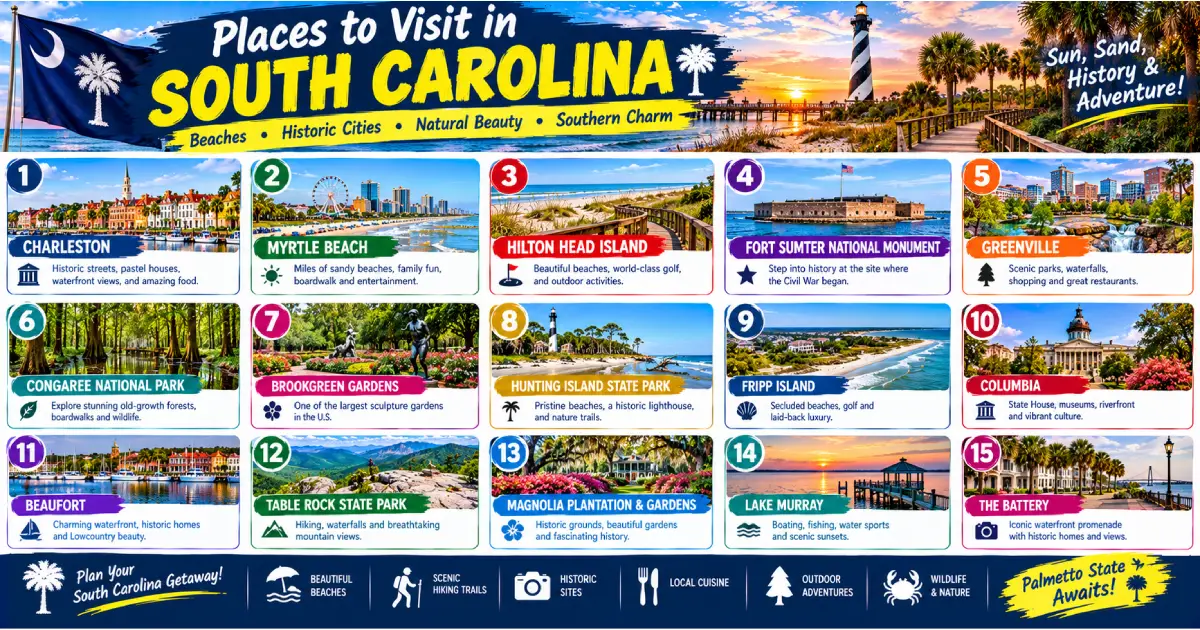
South Carolina is one of the most geographically and historically layered states in the American South — a compact 32,020 square miles that spans from the Blue Ridge Mountains in the northwest corner to 187 miles of Atlantic coastline, with the sprawling Sea Islands, the ancient cypress swamps of the Low Country, and the red-clay rolling Piedmont in between. It was one of the original 13 colonies, the site of more Revolutionary War battles than any other state, and the first state to secede from the Union in December 1860 — a history that makes itself felt in the architecture, the landscape, and the cultural traditions at every turn. And while the state’s complexity is real, so is its beauty: South Carolina has some of the finest beaches on the East Coast, two exceptional national parks, a James Beard Award–saturated food scene centered on Charleston, and a Gullah Geechee cultural heritage that represents one of the most significant and endangered African American traditions in the country.
The diversity of experience within a short drive is remarkable. You can eat James Beard–level seafood in Charleston, surf head-high Atlantic swells on Folly Beach, canoe through a cathedral of old-growth cypress trees in Congaree National Park, hike above 3,500 feet on the Foothills Trail in the Blue Ridge, and paddleboard through a wild dolphin-rich estuary in the ACE Basin — all within a four-hour drive of one another. The state also punches far above its weight in food culture: Charleston is widely considered the finest dining city in the South, but Greenville has emerged as a serious culinary destination in its own right, and the barbecue traditions of the Midlands — South Carolina is the only state with all four recognized BBQ styles (mustard, vinegar-pepper, light tomato, and heavy tomato) — make a road trip through Orangeburg and the Pee Dee region a pilgrimage for smoked meat devotees.
This guide covers the 15 best places to visit in South Carolina, from the iconic to the overlooked, with the practical details — costs, driving distances, best seasons, where to stay — that help you plan an itinerary worthy of everything this state has to offer.
| Destination | Why Go | Distance from Charleston |
|---|---|---|
| Charleston | America’s most beautiful historic city | — |
| Myrtle Beach | 60 miles of Grand Strand beach | 99 miles north |
| Hilton Head Island | World-class golf and resort beaches | 100 miles south |
| Beaufort | Most intact antebellum town in the South | 72 miles south |
| Congaree National Park | Ancient old-growth floodplain forest | 120 miles northwest |
| Greenville | Best small city food scene in the Southeast | 220 miles northwest |
| Table Rock State Park | Blue Ridge foothills hiking | 250 miles northwest |
| Pawleys Island | Oldest resort community on the East Coast | 72 miles north |
| Georgetown | South Carolina’s third-oldest city | 62 miles north |
| Hunting Island SP | Best barrier island state park in the state | 72 miles south |
| ACE Basin | Largest undeveloped estuary on East Coast | 60 miles southwest |
| Edisto Island | Most remote and authentic barrier island | 45 miles southwest |
| Columbia | State capital, rivers, and craft beer | 120 miles northwest |
| Cheraw | America’s oldest inland town park (1768) | 200 miles north |
| Kings Mountain NMP | Revolutionary War’s “turning point” battlefield | 275 miles northwest |
South Carolina’s crown jewel and one of the most beautiful cities in America, Charleston is the essential starting point for any visit to the state. Founded in 1670, it accumulated extraordinary wealth through the labor of enslaved Africans cultivating rice, indigo, and cotton, and that wealth built the antebellum streetscape — the pastel single houses of the French Quarter, the grand mansions of South of Broad, the wrought-iron gardens and church steeples — that survives today in greater completeness than almost any other American city of comparable age.
The Battery and White Point Garden at the southern tip of the peninsula, Rainbow Row on East Bay Street (13 Georgian row houses in candy-colored pastels, the most photographed streetscape in the South), Fort Sumter in the harbor (where the Civil War began April 12, 1861, ferry $28/adult), and the Ashley River Road plantation houses (Drayton Hall $30/adult — finest unrestored Georgian-Palladian house in America; Middleton Place $30/adult — oldest formally landscaped garden in the US; Magnolia Plantation $25/adult) are the cornerstone experiences. The food scene is the finest in the South: FIG and The Ordinary (both James Beard Award winners), Husk, and Rodney Scott’s Whole Hog BBQ are the headline names, but the full list runs to dozens of exceptional restaurants.
Best base: Charleston Peninsula — Wentworth Mansion $350–650/night (finest boutique hotel), Zero George Street $350–500/night (most design-forward), Mills House Wyndham Grand $199–350/night (best location/value). Allow at least 3 full days; 5 is better.
See our full Things to Do in Charleston SC 2026 guide.
The Grand Strand is a 60-mile arc of Atlantic barrier beach running from the North Carolina line south to Georgetown County — the longest stretch of continuous beach development on the East Coast and one of the most visited tourist destinations in the United States, drawing 14 million visitors annually. At its center is Myrtle Beach, a quintessential American beach resort city of boardwalks, amusement parks, mini-golf courses, seafood buffets, and condominium towers that polarizes visitors but delivers exactly what it promises: affordable, high-energy, family-friendly beach vacation infrastructure on an enormous scale.
Broadway at the Beach (200-acre entertainment complex, free entry), the Boardwalk and Promenade (1.2 miles of oceanfront, free), the SkyWheel (187-foot Ferris wheel, $15/adult), and Ripley’s Aquarium ($32/adult) are the main Myrtle Beach attractions. The Myrtle Beach State Park ($8/vehicle, 1 mile of undeveloped beach within the city) is the finest natural escape from the resort strip. North Myrtle Beach’s Cherry Grove Fishing Pier and the undeveloped marshes of Sunset Beach (just across the NC line) provide quieter alternatives.
The more discerning stretch of the Grand Strand runs south through Murrells Inlet — the “Seafood Capital of South Carolina,” with a marsh walk of a dozen waterfront restaurants where the shrimp boats dock within view of your table — to Pawleys Island (one of the oldest resort communities on the East Coast, established 1700s, low-key hammock-and-oyster culture) and Litchfield Beach (quieter, more residential). Brookgreen Gardens (between Murrells Inlet and Pawleys Island, $20/adult) is the largest outdoor sculpture garden in the United States, set on a former rice plantation with 9,000 acres of gardens, wildlife preserve, and Low Country history — one of the most underrated attractions in the state.
Best base: Barefoot Resort area (North Myrtle) or Litchfield Beach for quality; downtown Myrtle Beach for proximity to attractions. April–June and September–October for crowds and pricing.
Hilton Head Island is South Carolina’s most polished resort destination — a 42-square-mile barrier island at the southern end of the state, 45 minutes from Savannah and 100 miles from Charleston, that has been developed since the 1950s into one of the most upscale planned resort communities in the United States. The island is defined by its golf (24 courses, including Harbour Town Golf Links at Sea Pines Resort, host of the PGA Tour’s RBC Heritage since 1969 — the red-and-white striped lighthouse here is the island’s visual signature), its beaches (12 miles of Atlantic shoreline, the widest in the state at low tide), its bicycle infrastructure (60+ miles of dedicated pathways), and its relative lack of billboards and neon (a 1971 land use ordinance established strict aesthetic controls).
The Sea Pines Resort ($6/vehicle entry) is the original and finest planned community, encompassing Harbour Town, the Harbour Town Lighthouse ($5/adult, 90-foot climb for harbor views), and the Sea Pines Forest Preserve (605 acres of ancient Sea Island forest with a 4,000-year-old Native American shell ring — one of the most significant prehistoric sites in the Southeast). Coligny Beach Park (free, most accessible public beach) is the main public beach hub with restaurants and chair rentals.
Kayaking and dolphin watching in the tidal creeks of the Pinckney Island National Wildlife Refuge (adjacent to the island, free) and the surrounding estuaries is some of the finest in the Low Country — Outside Hilton Head ($45–75/guided tour) is the best outfitter. The Mitchelville Freedom Park (free) preserves the site of the first self-governed town of formerly enslaved people in the United States, established in 1861 when Union forces took the island — an essential and undervisited piece of American history.
Best base: Sea Pines Resort villas $250–600/night (finest experience), Coligny area hotels $150–300/night (most convenient). Avoid July–August peak if possible; April–June and September–October are ideal.
Beaufort (pronounced BYOO-fort, not BOH-fort like the NC city) is the second-oldest city in South Carolina (founded 1711) and the most intact antebellum town in the entire South — 300 blocks of historic district containing more pre-Civil War homes per capita than anywhere in the country, most of them still occupied as private residences. Because Union forces occupied Beaufort early in the Civil War (November 1861) and used the town as a military headquarters, the grand mansions were requisitioned rather than destroyed, surviving the war in a condition that Savannah and Charleston, both evacuated under threat, did not uniformly achieve.
The Beaufort Historic District Walking Tour (self-guided map free at the visitor center, 713 Craven Street) covers the finest concentration of antebellum architecture in the South — the Tidalholm (the “Big Chill house,” featured in The Big Chill, The Great Santini, and Forrest Gump), the John Mark Verdier House Museum ($8/adult, circa 1790, the finest Federal-period interior in the state), and the sweeping waterfront Henry C. Chambers Waterfront Park where locals picnic beneath live oaks. Bay Street is the main commercial street — a genuine small-city downtown of independent restaurants, art galleries, and bookshops without a chain store in sight.
Hunting Island State Park (18 miles east, $8/vehicle) is the most practical day trip from Beaufort — 5 miles of wild Atlantic beach, the only publicly accessible lighthouse in the state, cabin rentals that book 11 months in advance, and the most pristine natural environment on the South Carolina coast. The Penn Center on St. Helena Island (10 miles east, free museum) was founded in 1862 as one of the first schools for freed African Americans in the country and remains an active Gullah Geechee cultural institution — one of the most historically significant sites in the state.
Best base: Planter’s Inn ($175–295/night) or The Rhett House Inn ($195–350/night, James Beard chefs have stayed here). 2 nights minimum to do justice to both the town and Hunting Island.
Congaree National Park — 40 miles southeast of Columbia, the only national park in South Carolina — protects the largest intact old-growth bottomland hardwood forest in the contiguous United States, a floodplain forest of extraordinary scale and ecological significance. The trees here are the reason Congaree exists: the park holds the greatest concentration of state and national champion trees in the country, including the tallest loblolly pine (169 feet), the tallest American elm (148 feet), and the tallest water tupelo (83 feet) ever recorded — trees that survived because the swampy floodplain made logging impractical in the 19th century.
The Boardwalk Loop Trail (2.4 miles, free, accessible) is the essential Congaree experience — an elevated wooden walkway through the old-growth canopy of loblolly pines and bald cypress, over the dark tannin-stained floodwaters of Cedar Creek, past trees 150 feet tall and 6 feet in diameter. The Cedar Creek Canoe Trail (15 miles, put-in at the park’s canoe launch, free with park entry) is the most immersive experience — paddling through the cypress-tupelo swamp among alligators, river otters, and wood ducks — and can be done as a full-day self-guided trip (canoe rentals available from outfitters in Columbia, $40–55/half day). The park also has excellent firefly viewing in late May and early June, when synchronous fireflies display in patterns similar to the more famous event in the Great Smoky Mountains.
Entry fee: $0 (Congaree is one of the few national parks with no entry fee). Best season: November through March, when the snakes are less active, the mosquitoes are minimal, and the flooding that fills the floodplain creates the cathedral swamp atmosphere. Summer is beautiful but hot, humid, and buggy.
Greenville has undergone one of the most celebrated downtown revivals of any mid-size American city over the past 25 years — transforming from a post-textile mill town into a nationally recognized food, outdoor recreation, and arts destination that Frommer’s called the finest small city in the United States. The catalyst was the Falls Park on the Reedy (downtown, free) — a 32-acre urban park centered on the 40-foot Reedy River Falls, spanned by the elegant Liberty Bridge (355-foot pedestrian suspension bridge, the longest single-sided suspension pedestrian bridge in the United States) — and a $1 billion downtown investment that followed.
Main Street is the heart of it: a walkable mile of independent restaurants, craft cocktail bars, art galleries, and boutiques that delivers a consistently excellent dining and drinking experience. Soby’s ($32–58, one of the finest restaurants in the Southeast, Southern contemporary cuisine since 1997), Husk Greenville (sister to the Charleston original), The Anchorage (finest seafood in the Upstate, $28–52), and Methodical Coffee (finest specialty coffee in the city) anchor the food and drink scene. Falls Park and the Swamp Rabbit Trail (22-mile paved multi-use trail from Greenville to Travelers Rest, connecting to the mountains) make it one of the most outdoor-recreation-accessible downtowns in the South.
The Greenville County Museum of Art (free, 420 College Street) holds the finest collection of American watercolors in the world — including the largest public collection of Andrew Wyeth watercolors — and is a genuinely world-class institution that most visitors overlook. The BMW Manufacturing Plant (1 Bmw Dr, Spartanburg, 35 minutes away, free tours Mon–Fri by reservation at bmwusfactory.com) is the largest BMW plant in the world, producing the X3, X4, X5, X6, X7, and XM — one of the finest free industrial tours in the country.
Best base: The Westin Poinsett ($189–329/night, 1925 landmark hotel, finest address in Greenville) or AC Hotel Greenville ($149–249/night). 2 nights minimum to cover downtown, Falls Park, and a day trip into the Blue Ridge foothills.
The northwestern corner of South Carolina rises into the Blue Ridge Mountains — less celebrated than the North Carolina or Virginia sections of the range, but offering some of the most rewarding hiking and scenery in the state, with shorter drives from Charlotte and Atlanta than the more famous Northern Blue Ridge destinations.
Table Rock State Park (Pickens County, $8/vehicle) is the centerpiece: a 3,083-acre park dominated by the 3,124-foot granite dome of Table Rock Mountain, accessible via the Table Rock Trail (6.8 miles RT, 2,000 feet of elevation gain, one of the finest summit hikes in the Carolinas) and the shorter Pinnacle Mountain Trail (9.7 miles RT for the full ridge, or 4.4 miles RT to the Bald Rock viewpoint at 3,425 feet — the highest point accessible by trail in the South Carolina state park system). The park’s Lake Oolenoy has canoe and kayak rentals ($8–12/hour) and a swimming beach. The historic Table Rock Lodge (1930s CCC-built stone and timber lodge, $125–195/night, books up months in advance) is the most atmospheric accommodation in the state park system.
Caesars Head State Park (30 minutes south of Table Rock, $8/vehicle) offers the most dramatic single viewpoint in South Carolina — a 3,266-foot rocky promontory with a 270-degree view across the Blue Ridge escarpment — and the Raven Cliff Falls Trail (4 miles RT) to the highest waterfall in the state (420 feet). Devil’s Fork State Park on Lake Jocassee (the finest mountain lake in South Carolina, crystal-clear blue water fed by mountain streams, $10/vehicle, cabin rentals $120–175/night) completes the Upstate trifecta. The Foothills Trail (76 miles total) connects all three parks in a multi-day backpacking route through the finest mountain wilderness in the state.
Pawleys Island — 25 miles south of Myrtle Beach — is one of the oldest resort communities on the East Coast, visited by Low Country planters as a summer escape from the malarial rice plantations since at least the 1700s. The four-mile barrier island is deliberately undeveloped, with no hotels or chain establishments, just a few hundred beach cottages (many available for weekly rental, $1,500–5,000/week) and the Pawleys Island Hammock Shops — the home of the original rope hammock, invented here in 1889 by riverboat captain Joshua Ward and still handmade on the premises ($100–250 for the finest hammock in the world).
Brookgreen Gardens (1931 highway 17, $20/adult), situated between Pawleys Island and Murrells Inlet on the former Brookgreen, Springfield, The Oaks, and Laurel Hill rice plantations, is the largest outdoor sculpture garden in the United States — 9,000 acres featuring works by American sculptors from 1800 to the present (the largest collection in the country), formal gardens in the footprint of the original plantation allée, a wildlife preserve with river otters and bald eagles, and a Low Country history museum that addresses the plantation period honestly and fully. Budget half a day minimum; it is one of the most underrated attractions in the American South.
Murrells Inlet (adjacent to Pawleys, 25 miles south of Myrtle Beach) is the Seafood Capital of South Carolina — a working fishing village turned seafood restaurant hub where shrimp trawlers unload at the town dock and a half-dozen restaurants on the marsh walk ($18–38/entrée) serve the freshest fried shrimp, crab cakes, and flounder in the state. Creek Ratz and Dead Dog Saloon are the most atmospheric waterfront options.
Georgetown — South Carolina’s third-oldest city (1729), 62 miles north of Charleston — was once the wealthiest district in all of British North America, the center of an immense rice-plantation economy that stretched across the tidal river systems of the Waccamaw Neck and produced more rice than any comparable region in the world from the 1720s through the Civil War. The Rice Museum (633 Front Street, $7/adult) tells this story with the most comprehensive exhibit on Low Country rice cultivation in the country, including tools, maps, and the records of the enslaved Africans who built and maintained the irrigation systems.
The Georgetown Historic District along Front Street is one of the best-preserved small-city commercial streetscapes from the 18th and 19th centuries in the South — a nine-block stretch of brick storefronts, independent restaurants, and the Prince George Winyah Episcopal Church (1747, one of the oldest churches in the South, free tours). The Harold Kaminski House (1769, $10/adult) is the finest house museum in the city. The Winyah Bay waterfront and the confluence of five rivers — Black, Pee Dee, Waccamaw, Sampit, and Little Pee Dee — create extraordinary fishing, kayaking, and wildlife habitat accessible from the town docks.
Hobcaw Barony (adjacent to Georgetown, free tours by reservation, hobcawbarony.org) is the 17,500-acre former plantation and hunting estate of financier Bernard Baruch (advisor to six U.S. presidents), preserved intact as a research reserve and offering some of the finest birding and natural history tours in the Low Country.
Edisto Island — 45 miles southwest of Charleston — is the most remote and authentically unhurried of the accessible South Carolina Sea Islands: a 10-mile barrier island with no resort development, no chain establishments, and a genuinely local character rooted in its history as one of the most productive Sea Island cotton plantations in the antebellum South and subsequently as a stronghold of Gullah Geechee culture that persists today.
Edisto Beach State Park ($8/vehicle, 1.5 miles of Atlantic beach, campground $25–40/night) is the most popular destination on the island, with the finest shell collecting on the South Carolina coast (the wide beach at low tide exposes shark teeth, fossilized bones, and Pleistocene-era shells) and the Spanish Mount Trail (1.7 miles through ancient maritime forest to a 4,000-year-old Muscogee Indian shell mound). The Edisto Beach town itself — a small residential beach community of raised cottages and a few casual seafood restaurants — has the Old Post Office Restaurant ($28–52, one of the finest and most personal dining experiences in the Low Country, reservations essential) and the Waterfront Restaurant at the marina. The tidal creeks and salt marshes surrounding the island offer superb kayaking and dolphin watching; rentals available locally.
Edisto gives the best Low Country experience for visitors willing to forego resort amenities — the pace is genuinely slow, the natural beauty is extraordinary, and the fishing from the beaches and creeks rivals anything in the state.
The ACE Basin — named for the Ashepoo, Combahee, and Edisto Rivers that flow through it — is the largest protected estuarine system on the East Coast: 350,000 acres of tidal marshes, bottomland hardwood forests, barrier islands, and river floodplains between Charleston and Beaufort that support one of the most biodiverse ecosystems in North America. It is protected through a unique combination of public lands (National Wildlife Refuges, State Wildlife Management Areas, state parks) and private conservation easements, and remains almost entirely undeveloped.
The ACE Basin offers the finest wild kayaking and canoeing in South Carolina — day trips through the tidal creeks of the Donnelley Wildlife Management Area (off US-17, free), multi-day canoe camping on the Edisto River (longest free-flowing blackwater river in the world, 250 miles total), and guided naturalist tours through the Bear Island Wildlife Management Area (best waterfowl and alligator viewing in the state, open by permit). ACE Basin Kayak Tours and Edisto River Adventures offer guided half-day and full-day paddles ($55–85/person). The ACE Basin National Wildlife Refuge (free, Grove Plantation historic house visible from the road) has a 3.5-mile auto tour and hiking trails through bottomland forest.
Wildlife highlights include alligators (abundant May–October), bald eagles (resident year-round), wood storks (summer), painted buntings (summer), and an extraordinary diversity of wading birds — great blue herons, egrets, roseate spoonbills (rare but present). The 15,000+ winter waterfowl that concentrate in the basin’s impoundments make November through January the finest birding season.
Columbia — South Carolina’s capital and largest city — sits at the geographic center of the state where the Broad and Saluda Rivers meet to form the Congaree, and while it lacks the architectural charm of Charleston or the mountain backdrop of Greenville, it offers the most diverse and underrated urban experience in the state. The University of South Carolina (founded 1801, 35,000 students) drives a vibrant Five Points and Vista entertainment district; the Congaree Vista (a former warehouse district along Gervais Street) is now the finest concentration of restaurants and bars in the city.
The South Carolina State Museum (301 Gervais Street, $9.95/adult, finest natural history and cultural history museum in the state), the Columbia Museum of Art ($12/adult, excellent European and American collection), and the Robert Mills House (1823, $9/adult, designed by the same architect who designed the Washington Monument — Mills was the first native-born American architect to receive formal training) are the cultural anchors. Riverbanks Zoo and Garden ($20/adult, 70-acre zoo across the Broad River, consistently ranked one of the best mid-size zoos in the country) is the most visited attraction in the state.
The three rivers offer excellent kayaking and paddleboarding (Saluda Shoals Park, $8/day paddleboard rental), and the proximity to Congaree National Park (40 miles southeast) and Lake Murray (25 miles northwest, one of the largest man-made lakes in the eastern US, excellent bass fishing and sailing) makes Columbia an ideal hub for a Midlands road trip.
Kings Mountain National Military Park — on the North Carolina–South Carolina border, 275 miles northwest of Charleston — preserves the site of the Battle of Kings Mountain (October 7, 1780), which Thomas Jefferson called “the turn of the tide of success” in the American Revolution. At a moment when the British had conquered most of the South and the Continental Army was in disarray, approximately 900 frontier “Overmountain Men” — backwoods riflemen from Virginia, North Carolina, and what is now Tennessee — surrounded and destroyed the only Loyalist force in the Southern theater, killing or capturing all 1,100 men and dealing the British a blow from which their Southern strategy never recovered.
The 1.5-mile Battlefield Trail (free, open year-round) follows the perimeter of the battlefield through second-growth forest, with interpretive markers explaining the tactics of the riflemen who fought from the surrounding ridges. The visitor center (free) has an excellent museum with original weapons, uniforms, and a 26-minute film. The adjacent Kings Mountain State Park (South Carolina side, $8/vehicle) offers camping ($20–25/night) and 16 miles of hiking trails through piedmont forest. Combined with the nearby Cowpens National Battlefield (free, 35 minutes west in South Carolina — site of another pivotal 1781 American victory) and Historic Brattonsville ($10/adult, one of the best-preserved Revolutionary War–era Catawba River plantation complexes), the area forms the finest Revolutionary War heritage corridor in the American South.
South Carolina occupies a unique position in American barbecue geography: it is the only state with all four recognized regional BBQ sauce styles — mustard-based (the Midlands tradition brought by German immigrants in the 1700s), vinegar-pepper (the Pee Dee region), light tomato (the Upstate), and heavy tomato (the Grand Strand) — and the only state where whole hog BBQ is practiced in every region, not just a local specialty. The result is a barbecue culture of extraordinary diversity and depth that rewards dedicated exploration.
The canonical mustard-belt experience runs through Orangeburg (home of Dukes Bar-B-Que, the gold standard of South Carolina mustard BBQ since 1946, cash only, open Thursday–Saturday, $12–18 by the pound) and Columbia (Sweatman’s BBQ in Holly Hill, 35 miles southeast, whole hog pit BBQ since 1959, Fridays and Saturdays only, worth a dedicated trip). In Charleston, Rodney Scott’s Whole Hog BBQ (James Beard Award 2018) has brought global attention to the South Carolina tradition. The South Carolina Barbecue Trail (scbbqtrail.com, free map) identifies 200+ BBQ restaurants across the state organized by region — an essential resource for planning a smoke-focused road trip.
Getting there: Charleston International Airport (CHS) is the most convenient entry point for Low Country and coastal travel. Greenville-Spartanburg International Airport (GSP) serves the Upstate and Blue Ridge. Myrtle Beach International Airport (MYR) serves the Grand Strand. Columbia Metropolitan Airport (CAE) serves the Midlands. I-26 (Columbia to Charleston), I-85 (Charlotte to Greenville), and US-17 (the full coastal route from NC to Savannah) are the primary driving corridors.
When to visit: April and May are peak season for the Low Country and coast — wildflower bloom, azalea season, mild temperatures, and the Charleston Food + Wine Festival (March) and Spoleto Festival USA (late May–early June). October and November offer the best conditions statewide — comfortable temperatures everywhere, fall color in the Upstate, minimal humidity, and lighter crowds at the coast. Summer (June–August) brings heat (90°F+), high humidity, afternoon thunderstorms, and peak beach crowds; prices are highest at coastal destinations. Winter is mild along the coast (55–65°F) and the finest season for Congaree.
Signature experiences by region:
Posted By : Vinay
Latest Article
2nd Floor, 39, Above Kirti Club, DLF Industrial Area, Kirti Nagar, New Delhi, Delhi 110015



Travel Tourister is a leading Travel portal where we introduce travellers to trusted travel agents to make their journey hasselfree, memorable And happy. Travel Tourister is a platform where travellers get Tour packages ,Hotel packages deals through trusted travel companies And hoteliers who are working with us across the world. We always try to find new and more travel agents and hoteliers from every nook and corners across the world so that you could compare the deals with different travel agents and hoteliers and book your tour or hotel with the one you have chosen according to your taste and budget.
Copyright © Travel Tourister, India. All Rights Reserved

 Call
 Enquiry