Published on : 01 Jan 2026
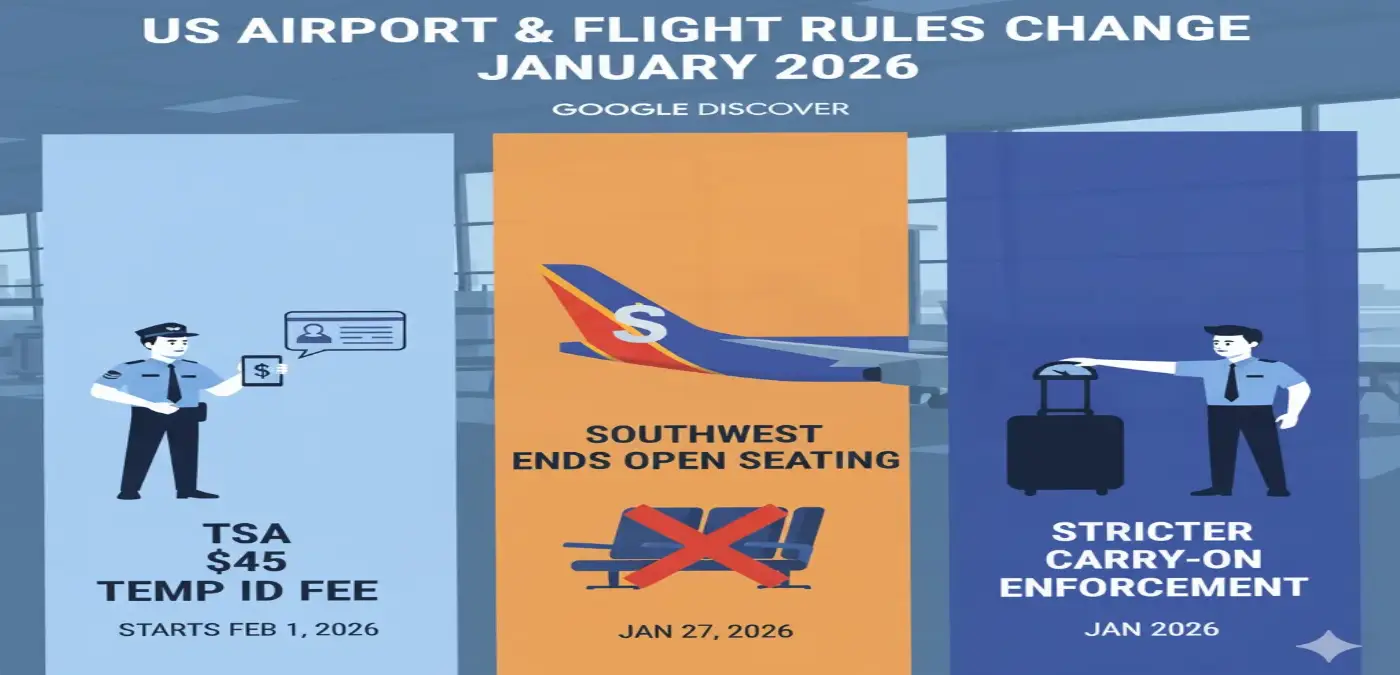
TRENDING: TSA introduces $45 ConfirmID fee February 1, 2026 for travelers without REAL ID (affecting 6% of passengers, ~140 million Americans annually), while Southwest Airlines ends 53-year open seating tradition January 27—replacing iconic A/B/C boarding with assigned seats, eight boarding groups, and premium “Extra Legroom” tier marking biggest US air travel transformation in decades
Published: January 1, 2026 Source: TSA, Southwest Airlines, Federal Aviation Administration, Multiple Industry Sources Key Finding: $45 TSA ConfirmID fee effective February 1, 2026 (non-refundable, valid 10 days) Historic Change: Southwest ends open seating January 27, 2026 after 53 years Affected Travelers: 94% have REAL ID, but 6% (140M annually) face new fee ANZ Impact: All Australian/New Zealand travelers to USA must carry passports (REAL ID doesn’t apply)
American air travel undergoes its most significant transformation in decades as multiple new rules take effect throughout January and February 2026—with TSA introducing a controversial $45 “ConfirmID” fee starting February 1 for passengers arriving at security checkpoints without REAL ID-compliant identification, while Southwest Airlines officially ends its signature 53-year open seating policy January 27, replacing the beloved first-come-first-served system with assigned seats, premium tiers, and an eight-group boarding process that aligns the Dallas-based carrier with industry standards after holding out longer than any other major US airline.
The TSA’s ConfirmID program charges travelers without acceptable identification a non-refundable $45 fee to verify identity through biometric screening—a process taking 10-30 minutes that covers a 10-day travel period but offers no guarantee of approval, as passengers whose identity cannot be confirmed will still be denied boarding despite paying the fee. With approximately 6 percent of US travelers (roughly 140 million passengers annually based on TSA’s 2.3 billion annual screening volume) still lacking REAL ID-compliant licenses despite the May 7, 2025 enforcement deadline, industry experts warn of unprecedented chaos at security checkpoints if travelers don’t prepare immediately.
“The steady implementation of these new rules shows that 2026 marks a watershed moment for American aviation, fundamentally changing how passengers book flights, navigate airports, and interact with TSA checkpoints,” confirms travel security analysis. “For travelers accustomed to showing up with expired driver’s licenses or Southwest’s democratic seat selection, these changes require immediate adaptation—the grace period is over.”
For Australian and New Zealand travelers planning USA trips in 2026, the practical impact is straightforward: carry your passport always, as REAL ID applies only to US state-issued identification and foreign visitors must present passports regardless of TSA’s new fee structure. However, Southwest’s seating changes affect all travelers equally—Aussies and Kiwis who’ve enjoyed Southwest’s egalitarian boarding (no assigned seats, everyone equal) will now encounter tiered pricing, premium seat fees, and boarding groups identical to American, Delta, and United.
Starting February 1, 2026, passengers arriving at TSA security checkpoints without acceptable identification—including REAL ID-compliant state driver’s licenses, passports, military IDs, permanent resident cards, or other federally accepted IDs—will be referred to TSA’s “ConfirmID” alternative identity verification system, which charges a non-refundable $45 fee to establish identity through modernized biometric screening methods distinct from traditional document verification.
ConfirmID key details:
“Travelers will be able to pay $45 to use TSA ConfirmID for a 10-day travel period,” confirms official TSA announcement, emphasizing that the fee represents a last-resort option for passengers who arrive without proper identification rather than a convenient alternative to obtaining REAL ID—with TSA strongly urging all travelers to schedule DMV appointments and update licenses to REAL ID-compliant versions as soon as possible to avoid checkpoint delays and unexpected costs.
The ConfirmID system uses biographic and biometric information to verify passenger identity through questions, database cross-checks, and potentially fingerprint or facial recognition scans—creating a temporary identity profile that allows boarding without physical government-issued ID but requires significantly more time and scrutiny than standard document checks that take seconds for passengers with proper identification.
Step-by-step ConfirmID process:
“Identity verification is essential to traveler safety, because it keeps terrorists, criminals and illegal aliens out of the skies and other domestic transportation systems such as rail,” TSA senior official Adam Stahl emphasizes, noting that the $45 fee ensures travelers—not taxpayers—fund the advanced verification technology and operational costs required to process passengers without standard identification.
The confusion surrounding TSA’s new fee stems from REAL ID requirements that began enforcement May 7, 2025 but maintained grace periods for passengers without compliant identification—a lenience ending February 1, 2026 when the $45 fee kicks in for anyone lacking acceptable ID regardless of previous accommodations.
Acceptable forms of ID (no $45 fee required):
NOT acceptable (triggers $45 ConfirmID fee):
International travelers (Australian/New Zealand):
“If you’re 18 or older and flying within the U.S., you’ll need to show a Real ID-compliant driver’s license or another TSA-approved form of ID at the checkpoint,” confirms Expedia travel expert Melanie Fish. “You can apply for a REAL ID online or by visiting your local DMV. Please note that it can take a few weeks to receive a physical copy. If you plan to travel this holiday season and still do not have a REAL ID, you can also use your passport.”
TSA initially proposed an $18 ConfirmID fee in November 2025 Federal Register notice, but final implementation settled on $45—a 150% increase driven by higher-than-expected costs for advanced identity verification technology, biometric equipment installation across hundreds of airports, operational staffing requirements, and database access fees that significantly exceeded original projections during pilot program testing.
“After careful review, it was determined that the expenses for the new technology and operational costs were higher than originally projected, leading to an increase in the final fee,” senior TSA officials explained to Fox News Digital, noting that the fee structure aims to make the program self-sustaining through user fees rather than taxpayer subsidies, aligning with federal policy preferences for fee-based optional services.
The $45 price point sparked immediate controversy, with family travel advocates arguing that a family of four without REAL IDs faces $180 in fees for a single round-trip—effectively a tax on lower-income travelers who may lack time, resources, or documentation to obtain REAL ID, while wealthier travelers with passports or Global Entry simply flash documents and proceed through PreCheck lanes without delays or unexpected costs.
TSA strongly emphasizes that ConfirmID represents a last-resort option for unprepared travelers rather than a convenient alternative to proper identification, urging all passengers to obtain REAL ID-compliant licenses immediately through state DMV appointments to avoid checkpoint delays, unexpected fees, and potential boarding denials if identity verification fails.
Getting REAL ID (US residents only):
Alternative for immediate travel:
“NOW is the time to apply for a REAL ID,” Melanie Fish emphasizes. “If you’re planning to travel in 2026, you should plan to arrive at the airport earlier. Be prepared for longer wait times and further verification.”
Southwest Airlines officially ends its signature open seating policy on January 27, 2026—a date marking the conclusion of 53 years of first-come-first-served boarding that defined the Dallas-based carrier’s unique identity since the 1970s, making Southwest the last major US airline to abandon democratic seat selection in favor of assigned seating, premium tiers, and revenue-generating seat fees that executives project will add $1.5 billion in annual ancillary revenue.
“After holding out longer than any other major U.S. airline, Southwest will discontinue its open seating system on all flights departing January 27, 2026, and beyond,” confirms Newsweek reporting. The change concludes an era when Southwest passengers checked in exactly 24 hours before departure, scrambled for coveted A1-A15 boarding positions, and strategically positioned themselves at gate poles to secure aisle or window seats—rituals that became cultural touchstones for Southwest loyalists who valued the airline’s egalitarian approach over competitors’ tiered systems.
What changes January 27, 2026:
What remains unchanged:
Southwest’s assigned seating introduces three distinct seat categories mirroring competitors’ tiered systems while maintaining slightly larger dimensions than ultra-low-cost carriers that squeeze 28-29 inch pitch into economy cabins.
Extra Legroom Seats:
Preferred Seats:
Standard Seats:
“Southwest’s reducing pitch from 32 to 31 inches on these seats—still reasonable but slightly tighter than before,” notes The Points Party analysis, confirming that the airline sacrifices one inch of legroom across most seats to accommodate additional rows generating more revenue through seat fees and increased passenger capacity per flight.
Gone are Southwest’s iconic A/B/C boarding groups (A1-A60, B1-B60, C1-C60) and the strategic dance of checking in exactly 24 hours early to secure low numbers—replaced by eight numbered boarding groups determined by seat type, fare class, loyalty status, and credit card membership rather than check-in timing.
New boarding order (Groups 1-8):
Gate experience changes:
“Gone are the days of checking in exactly 24 hours early to snag A1-15,” confirms The Points Party. “Southwest’s new boarding mirrors what you’ll find on American Airlines or United Airlines”—eliminating the quasi-gamification element that made Southwest boarding unique but also stressful for passengers who forgot check-in times or lacked smartphone access exactly 24 hours before departure.
Southwest’s Rapid Rewards program undergoes significant enhancements alongside assigned seating, with tier benefits expanding beyond current perks to include seat selection privileges, boarding priority, and other benefits that make elite status more valuable while preserving core program strengths like no blackout dates and points that don’t expire.
A-List Preferred (75,000 tier-qualifying points or 50 one-way flights annually):
A-List (35,000 tier-qualifying points or 25 one-way flights annually):
No status:
“Rapid Rewards Members can still enjoy our industry-leading loyalty program. We will continue to offer no blackout dates, uncapped reward seat availability, and points that don’t expire,” Southwest emphasizes, noting that while seat assignment changes how benefits manifest, core program philosophy remains intact—though cynics note that “industry-leading” status diminishes when Southwest matches competitors’ assigned seating, baggage fees, and tiered service rather than maintaining unique positioning.
For Australian and New Zealand travelers visiting the United States, TSA’s new $45 ConfirmID fee and REAL ID enforcement have straightforward implications: always carry your passport for domestic US flights, as foreign nationals cannot obtain REAL ID (US state-issued identification only) and must present passports regardless of whether flying domestically within USA or internationally.
Key points for ANZ travelers:
“More than 94% of passengers already use their REAL ID or other acceptable forms of identification,” TSA confirms, meaning lines shouldn’t significantly slow for prepared travelers—but Australians and New Zealanders visiting US should budget extra time February-March 2026 as American travelers adapt to new system and ConfirmID processing creates bottlenecks at checkpoints where confused passengers discover their expired licenses now trigger $45 fees.
Southwest’s transition to assigned seating actually makes the airline more familiar for Australian and New Zealand travelers accustomed to Qantas, Virgin Australia, and Air New Zealand’s seat selection systems—eliminating Southwest’s confusing A/B/C boarding that baffled international visitors unfamiliar with 24-hour check-in rituals and strategic gate positioning.
What Aussies/Kiwis should know:
Booking strategy for ANZ travelers:
Apple Wallet, Google Wallet, and Samsung Wallet digital ID acceptance continues expanding across US airports, with 250+ TSA checkpoints now accepting state-issued driver’s licenses stored on smartphones as valid identification—though only 15 participating states currently support the feature (Arizona, California, Colorado, Florida, Georgia, Hawaii, Iowa, Kentucky, Maryland, Mississippi, Ohio, Oklahoma, Texas, Utah, Vermont).
Digital ID details:
For Australian and New Zealand travelers, digital IDs remain irrelevant as foreign passports cannot be stored in US digital ID formats—physical passport remains only option.
Trump administration canceled Biden-era proposed rule that would have mandated automatic compensation ($200-755) for significant controllable flight delays, meaning airlines maintain individual policies determining whether passengers receive meal vouchers, hotel accommodations, or nothing when flights delay for maintenance, crew issues, or operational problems.
Current reality:
Australian and New Zealand travelers accustomed to consumer-friendly regulations should purchase comprehensive travel insurance covering delays, as US passengers enjoy far fewer protections than international standards.
Airlines increasing carry-on size and weight enforcement, with gate agents checking bags immediately before boarding and assessing excess fees ($65-100 typical) for oversized items that previously slipped through—tightening focus reflecting airlines’ revenue dependence on baggage fees and reducing overhead bin crowding that delays boarding/deplaning.
Stricter enforcement:
Southwest’s standard carry-on allowance (24″H x 16″W x 10″D) remains consistent, but enforcement tightens post-assigned-seating as overhead bin access becomes boarding group privilege rather than first-come-first-served scramble.
The convergence of TSA’s $45 ConfirmID fee effective February 1, 2026 and Southwest’s historic transition to assigned seating January 27, 2026 represents the most significant transformation of American air travel in decades—fundamentally altering how passengers prepare for flights (REAL ID now essential vs. lenient expired license policies), navigate security checkpoints (biometric screening for unprepared travelers adding 10-30 minute delays), and experience the nation’s fourth-largest airline (Southwest’s egalitarian boarding replaced by premium tiers, seat fees, and boarding groups identical to competitors).
For the approximately 6 percent of American travelers—roughly 140 million passengers annually based on TSA’s 2.3 billion annual screening volume—still lacking REAL ID-compliant identification despite the May 7, 2025 enforcement deadline, February 2026 marks the end of grace periods and beginning of unexpected $45 fees, extended checkpoint delays, and potential boarding denials if identity verification fails. The non-refundable fee structure particularly burdens families, lower-income travelers, and those with documentation barriers, creating a de facto tax on unpreparedness that critics argue disproportionately affects vulnerable populations while wealthier travelers with passports or Global Entry breeze through PreCheck lanes.
Southwest’s seating revolution concludes 53 years of democratic boarding where every passenger—regardless of wealth, status, or ticket price—enjoyed equal opportunity to select preferred seats through strategic 24-hour check-in timing and gate positioning skills. The new assigned seating system generates projected $1.5 billion annual revenue through Extra Legroom fees ($15-50 per segment), Preferred seat charges ($10-30), and premium fare sales, while simultaneously disappointing loyalists who valued Southwest’s egalitarian philosophy over competitors’ tiered service models that segregate passengers into visible classes based on willingness to pay.
Key takeaways for all travelers in 2026:
✓ Get REAL ID immediately if US resident (2-4 weeks DMV processing, bring birth certificate, Social Security card, residency proofs) ✓ Carry passport always if international traveler (Australian/NZ passports exempt from REAL ID but must be valid) ✓ Budget extra time February-March 2026 (TSA checkpoint delays expected as ConfirmID system launches, confused passengers create bottlenecks) ✓ Southwest bookings after Jan 27 require seat selection strategy (purchase Choice fare minimum for selection vs. Basic assigned at check-in) ✓ Consider TSA PreCheck/Global Entry if frequent traveler ($78/100 for 5 years, bypass general security lines, keep shoes on, laptops in bags) ✓ Purchase travel insurance (no automatic delay compensation means coverage essential for unexpected costs) ✓ Download airline apps (mobile boarding passes, digital bag tags, gate change notifications) ✓ Check carry-on rules (stricter enforcement means size/weight limits matter, $65-100 gate-check fees) ✓ Book early for preferred seats (Southwest’s Extra Legroom limited inventory sells quickly popular routes) ✓ Join Rapid Rewards if frequent Southwest flyer (A-List status now includes free Premium/Extra Legroom selection, priority boarding)
“After a year of surprises and upheaval, the U.S. airline industry is hoping 2026 brings a sense of calm, predictability, and growth,” notes The Travel analysis. “However, 2026 also promises many policy changes, some by airlines and others by federal security norms implemented by the TSA”—changes forcing travelers to adapt quickly or face unexpected fees, delays, and frustrations that mar trips beginning the moment they arrive at security checkpoints unprepared for new reality of American aviation.
For More Resources:
Related Travel Guides:
Final Advice: Whether you’re American traveler scrambling to obtain REAL ID before February 1 deadline or Australian/New Zealand visitor planning USA trip in 2026, these changes demand immediate attention and preparation. The days of showing expired driver’s licenses at TSA checkpoints or arriving at Southwest gates minutes before departure expecting optimal seat selection are over—replaced by $45 fees, 30-minute identity verification delays, assigned middle seats, and premium charges that reflect broader aviation industry shift toward revenue maximization through fees, tiers, and segregated service levels. Adapt quickly, prepare thoroughly, and budget extra time and money for 2026’s new normal in American air travel.
Posted By : Vinay
This article is provided for general informational purposes only and is based on information available at the time of publication. Travel advisories, airline schedules, airport operations, visa requirements, government regulations, and other travel-related information are subject to change without prior notice. While Travel Tourister makes reasonable efforts to verify information using official announcements, government publications, airline and airport communications, and other reliable sources, we cannot guarantee that all information remains complete, accurate, or up to date at all times. Readers should independently verify any information that may affect their travel plans with the relevant airline, airport authority, government agency, embassy, or other official source before making travel, financial, or other decisions. Travel Tourister shall not be liable for any direct or indirect loss, inconvenience, or damages arising from the use of or reliance on the information contained in this article. Nothing in this publication constitutes legal, immigration, financial, or professional travel advice. If you believe any information in this article is inaccurate or outdated, please contact our editorial team. We review all credible correction requests promptly and update our content whenever appropriate.
Lastest News
2nd Floor, 39, Above Kirti Club, DLF Industrial Area, Kirti Nagar, New Delhi, Delhi 110015



Travel Tourister is a leading Travel portal where we introduce travellers to trusted travel agents to make their journey hasselfree, memorable And happy. Travel Tourister is a platform where travellers get Tour packages ,Hotel packages deals through trusted travel companies And hoteliers who are working with us across the world. We always try to find new and more travel agents and hoteliers from every nook and corners across the world so that you could compare the deals with different travel agents and hoteliers and book your tour or hotel with the one you have chosen according to your taste and budget.
Copyright © Travel Tourister, India. All Rights Reserved

 Call
Call Enquiry