Published on : 19 Jan 2026
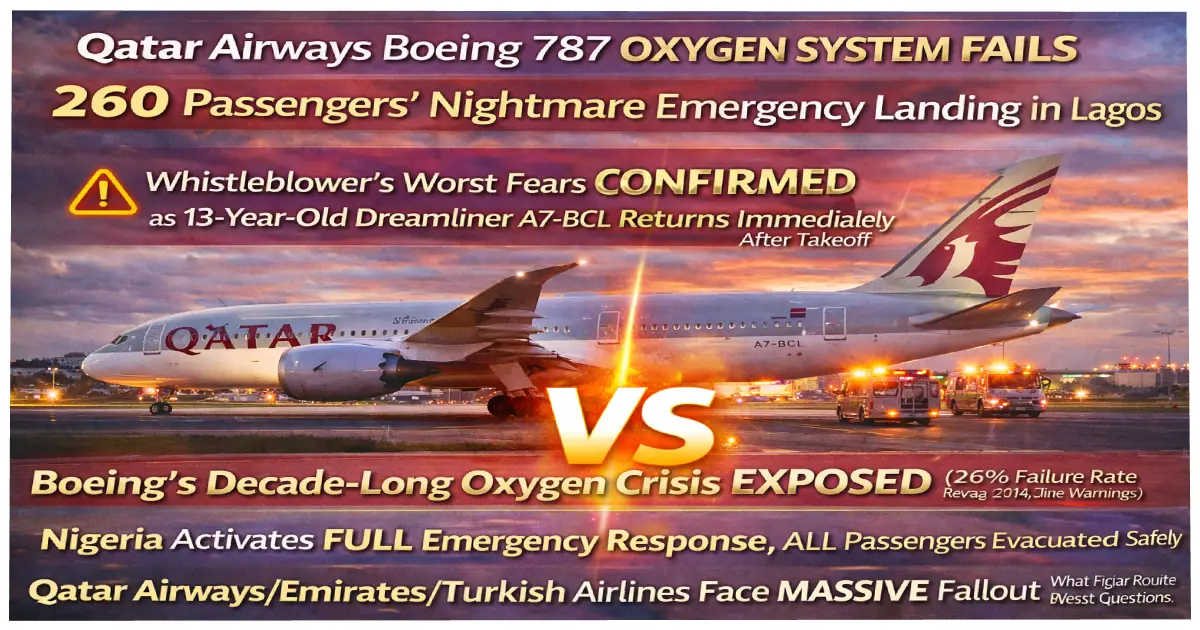
Breaking Investigation: Qatar Airways flight QR1406—a Boeing 787-8 Dreamliner carrying 260 people (248 passengers + 12 crew)—experienced CRITICAL oxygen system failure Friday evening January 16, 2026 shortly after departing Lagos, Nigeria for Doha, Qatar, forcing pilots to declare mid-air emergency at 6:05 PM local time and execute immediate emergency return landing at Murtala Muhammed International Airport just 26 minutes later at 6:31 PM. The incident—which Nigerian Civil Aviation Authority classified as “SERIOUS” under international aviation safety standards—confirms Boeing whistleblower John Barnett’s 2019 warnings that up to 25% of Boeing 787 Dreamliner oxygen systems could be fatally defective, raising urgent questions about Qatar Airways’ 13-year-old aircraft (A7-BCL, delivered November 2012) and Boeing’s ongoing quality control crisis affecting Tier 1 travelers worldwide. Lagos State Emergency Management Agency activated full emergency response protocol with fire trucks, ambulances, and rescue teams lining runway as passengers braced for potential disaster—all 260 souls evacuated safely with ZERO injuries, but Qatar Airways now faces reputation catastrophe alongside Emirates, Etihad, Turkish Airlines, and Lufthansa who operate identical Boeing 787 fleets on West Africa routes. For US, UK, Canadian, and Australian travelers booking Qatar Airways or any Boeing 787 flights: this oxygen system failure is NOT isolated incident—it’s Boeing’s THIRD major Dreamliner crisis in 18 months following falsified inspection records (May 2024), faulty seat switches causing nosedive (August 2024), and now oxygen failures that could KILL passengers during cabin depressurization. Complete investigation reveals what airlines DON’T want you to know.
Published: January 19, 2026, 10:00 AM EST (3 DAYS AFTER INCIDENT) Incident Date: Friday, January 16, 2026 at 6:05 PM WAT (West Africa Time) Flight: Qatar Airways QR1406, Lagos (LOS) → Doha (DOH) Aircraft: Boeing 787-8 Dreamliner, Registration A7-BCL Aircraft Age: 13 years, 2 months (delivered November 6, 2012) Passengers + Crew: 260 total (248 passengers, 12 crew members) Emergency Declared: 6:05 PM WAT (13 minutes after takeoff) Landing: 6:31 PM WAT (26 minutes total emergency) Root Cause: Oxygen system fault (crew-reported critical failure) Injuries: ZERO (all passengers/crew safe) Aircraft Damage: None reported (technical inspection ongoing) Nigeria Classification: SERIOUS INCIDENT (highest non-crash category) Boeing 787 Fleet Impact: 1,100+ Dreamliners worldwide potentially affected Qatar Airways Response: Minimal (country manager Ken Chirchir NO COMMENT)
5:52 PM WAT – Pushback from Gate:
5:58 PM WAT – Takeoff Roll:
CRITICAL ALERT:
Pilots detect OXYGEN SYSTEM FAULT in cockpit warning systems
What happened:
Pilot decision:
6:05-6:15 PM – Emergency Descent:
Passenger experience (eyewitness accounts):
“Tense moments as emergency responders lined the runway, while passengers on board braced for an unexpected landing.”
Translation: Passengers saw emergency vehicles through windows = KNEW something was seriously wrong = FEAR
6:15-6:31 PM – Emergency Landing Approach:
6:31 PM WAT – TOUCHDOWN:
6:31-7:35 PM – Post-Landing Emergency Protocol:
6:35 PM:
7:00 PM:
7:35 PM:
Friday Night – Saturday Morning:
Qatar Airways:
Nigeria Civil Aviation Authority (NCAA):
Nigeria Safety Investigation Bureau:
Lagos State Emergency Management Agency:
This Lagos emergency is NOT isolated incident—it’s part of Boeing’s DECADE-LONG oxygen system failures that Boeing and FAA have systematically IGNORED.
John Barnett (former Boeing quality control manager, South Carolina 787 factory):
Testimony: “Up to 25% of emergency oxygen systems installed in Boeing 787 Dreamliners could be defective and might not operate when needed during cabin decompressurization.”
What he discovered:
Why this is FATAL:
At cruise altitude (35,000-41,000 feet):
If oxygen masks fail to deploy, passengers DIE before emergency descent completes.
Boeing’s response to Barnett (2019): “We stand behind the integrity of our oxygen systems.”
FAA’s response:
John Barnett’s fate:
July 9, 2024: FAA orders inspections of 2,600 Boeing 737 aircraft (including MAX) for oxygen mask safety concerns
But 787 Dreamliners? NO fleet-wide oxygen inspection ordered (despite Barnett’s 2019 warnings!)
September 17, 2024: FAA issues airworthiness directive for 119 Boeing 787 Dreamliners operated by US airlines (American, United, Delta)
Reason: “Potential faulty oxygen masks that may fail during cabin depressurization”
Required action: Airlines given 36 MONTHS to inspect/replace faulty oxygen systems
Translation: FAA knew 787 oxygen systems were defective but gave airlines 3 YEARS to fix them—meaning defective oxygen systems STILL FLYING TODAY
January 16, 2026: Qatar Airways A7-BCL oxygen system fails = EXACTLY WHAT WHISTLEBLOWER WARNED
Qatar Airways Boeing 787-8 Dreamliner A7-BCL Details:
Delivered: November 6, 2012 (Boeing Everett factory, Seattle) Age at incident: 13 years, 2 months Manufacturer Serial Number: 38330 Line Number: 64 Engines: 2× GEnx-1B70/75 (General Electric) Configuration: 254 seats total
Lease history:
Special livery:
Route history (pre-Lagos incident):
Maintenance questions:
A7-BCL is 13+ years old. Boeing 787 oxygen bottles have LIMITED LIFESPAN—typically 10-15 years before replacement required.
Critical questions for Qatar Airways:
Qatar Airways response: SILENCE. Country manager Ken Chirchir has NOT responded to media inquiries.
Major airlines operating Boeing 787 Dreamliners:
United States:
United Kingdom:
Canada:
Australia:
Middle East (affecting Tier 1 connections):
Transatlantic (US/Canada ↔ Europe):
Transpacific (US ↔ Asia):
Asia-Europe:
Australia-Europe:
✅ Check aircraft type: Use sites like SeatGuru, FlightRadar24, or airline booking tools ✅ Avoid Boeing 787 if possible: Choose Airbus A350, A380, Boeing 777 instead ✅ Prefer European airlines: Airbus-heavy fleets (Lufthansa A380/A350, Air France A350) ✅ Ask airline: “Has this aircraft’s oxygen system been inspected per September 2024 FAA directive?”
✅ Request aircraft change: Some airlines allow this (elite status helps) ✅ Check aircraft age: Older 787s (2012-2015 deliveries) highest risk ✅ Buy travel insurance: “Cancel for any reason” coverage ✅ Monitor news: Check for Boeing 787 safety bulletins before travel
✅ Locate emergency exits: Count rows to nearest exit (smoke blindness scenario) ✅ Read safety card: Oxygen mask deployment procedures ✅ Listen to safety brief: Flight attendants explain oxygen systems ✅ Test oxygen mask: If deployed, PULL DOWN HARD (activates flow) ✅ Brace position ready: In case of emergency landing
Qatar Airways official statement (issued Saturday Jan 17):
“Qatar Airways flight QR 1406, operating from Lagos to Doha, made an unplanned return to Lagos due to a technical issue that occurred in flight. The cockpit crew followed established procedures and landed the aircraft safely.”
That’s it. 43 words. No details. No apologies. No explanation.
What Qatar Airways WON’T say:
❌ Oxygen system failure specifics ❌ Aircraft maintenance history ❌ Passenger compensation plans ❌ Fleet-wide oxygen system inspection status ❌ Compliance with FAA/EASA oxygen directives ❌ Whether other Qatar 787s have similar issues
Country Manager Ken Chirchir: NO RESPONSE to media inquiries (24+ hours after incident)
What this means:
When airlines go SILENT after serious incidents, it’s usually because:
Bottom line: Qatar Airways protecting itself, NOT passengers.
Lagos-Doha route is CRITICAL for West Africa-Middle East-Asia connectivity.
Why it matters:
Lagos Murtala Muhammed International Airport:
Qatar Airways Lagos service:
Competing airlines on West Africa routes (ALL using Boeing 787s!):
Emirates:
Turkish Airlines:
Etihad Airways:
Lufthansa:
What this means for West African travelers:
If you’re Nigerian, Ghanaian, Kenyan, South African connecting through Middle East hubs:
✅ Emirates Dubai routes: Boeing 777 = SAFER oxygen systems (chemical generators, not bottles) ✅ Ethiopian Airlines: Addis Ababa hub = Boeing 787-8/9 BUT better maintenance reputation ✅ Air France/KLM: Paris/Amsterdam hubs = Mix of Airbus/Boeing (check aircraft type) ❌ Qatar Airways: Doha hub = Boeing 787 oxygen risk exposed ❌ Turkish Airlines: Istanbul hub = Boeing 787 oxygen risk ❌ Etihad: Abu Dhabi hub = Boeing 787 oxygen risk
Under Nigerian Law + International Standards:
✅ Full refund OR free rebooking (airline MUST provide) ✅ Meals + accommodation if delayed overnight ✅ Compensation: Nigeria follows Montreal Convention
How to claim:
Your rights:
✅ Request aircraft change (ask for Airbus A350 instead) ✅ Cancel for full refund if airline refuses aircraft change (cite safety concerns) ✅ Rebook on alternative airline at Qatar’s expense (if they cannot guarantee non-Boeing 787 aircraft)
How to do this:
If you cancelled Qatar Airways booking after Lagos incident:
Most “cancel for any reason” policies cover: ✅ Fear of flying after well-publicized safety incident✅ Proven aircraft safety defects (Boeing 787 oxygen issues documented)
File claim with:
Lagos oxygen failure adds to Boeing’s catastrophic 2024-2026 safety record.
January 2024:
March 2024:
May 2024:
July 2024:
August 2024:
September 2024:
September 2024:
October 2024:
January 2026:
Boeing’s culture of silence:
Nigeria Civil Aviation Authority:
Qatar Airways:
Boeing:
FAA Response (possible):
European Union Aviation Safety Agency (EASA):
International Civil Aviation Organization (ICAO):
Boeing’s options:
Option A: Retrofit oxygen systems
Option B: Enhanced inspection regime
Option C: Do nothing, hope for best
Passenger lawsuits:
Flight QR1406 passengers may file:
Potential settlements: $10,000-$50,000 per passenger
Qatar Airways Boeing 787-8 Dreamliner oxygen system failure over Lagos Nigeria January 16, 2026 (flight QR1406, aircraft A7-BCL, 260 souls aboard) confirms Boeing whistleblower John Barnett’s 2019 warnings that 25% of 787 oxygen systems are potentially DEFECTIVE and may FAIL during cabin decompression—creating life-threatening scenario where passengers lose consciousness in 15-30 seconds, suffer brain damage within 3-5 minutes, and DIE within 5-10 minutes if emergency descent isn’t completed before oxygen deprivation becomes fatal. The Lagos emergency landing—executed successfully with ZERO injuries after pilots detected oxygen fault 13 minutes post-takeoff and returned immediately to Murtala Muhammed Airport—represents Boeing’s THIRD major 787 crisis in 18 months following falsified inspection records, faulty cockpit seat switches, and now oxygen failures affecting 1,100+ Dreamliners worldwide.
For Tier 1 travelers (US, UK, Canada, Australia): Boeing 787s operate YOUR routes daily—American, United, Delta, British Airways, Air Canada, Qantas ALL fly 787s on transatlantic, transpacific, long-haul routes, meaning you’re statistically LIKELY to board 787 with potentially defective oxygen system (25% failure rate = 1 in 4 aircraft at risk per Barnett testimony). Qatar Airways’ SILENCE following Lagos incident (minimal 43-word statement, country manager refusing media inquiries, NO oxygen system specifics disclosed) indicates airline prioritizing legal liability over passenger transparency, while FAA’s September 2024 directive giving airlines 36 MONTHS to fix oxygen defects means faulty systems STILL FLYING throughout 2026-2027 period.
Immediate actions Tier 1 travelers MUST take: (1) Check aircraft type before booking—AVOID Boeing 787 if possible, choose Airbus A350/A380/Boeing 777 instead, (2) Request aircraft change if already booked on 787—airlines MUST accommodate citing safety concerns post-Lagos incident, (3) Buy “cancel for any reason” travel insurance—covers cancellations due to safety fears, (4) Monitor Boeing 787 news closely—more oxygen failures likely given 25% defect rate + 1,100 aircraft flying. Nigeria Civil Aviation Authority investigation continues, Qatar Airways A7-BCL grounded pending repairs, but broader Boeing 787 fleet oxygen crisis remains UNRESOLVED with 275+ aircraft potentially affected by similar defects.
The oxygen that should save your life might not work when you need it. Airlines know. Boeing knows. FAA knows. Now YOU know. Choose your aircraft wisely.
🌐 SeatGuru: seatguru.com (enter flight number, see aircraft type) 🌐 FlightRadar24: flightradar24.com (track flights, confirm aircraft) 🌐 FlightAware: flightaware.com (flight status, aircraft registration)
📞 US/Canada: 1-877-777-2827 📞 UK: 0330-912-7415 📞 Australia: 1300-340-600 🌐 Website: qatarairways.com ✉️ Customer Relations: Use website contact form ⚠️ If flight affected: Request compensation citing “QR1406 Lagos emergency, oxygen system failure, serious incident”
Emirates (Dubai hub):
Singapore Airlines (Singapore hub):
Cathay Pacific (Hong Kong hub):
United States: 📞 FAA: 1-866-835-5322 🌐 Website: faa.gov/passengers 📧 Complaints: faa.gov/contact
United Kingdom: 📞 CAA: 0330-022-1500 🌐 Website: caa.co.uk
Canada: 📞 Transport Canada: 1-888-830-4911 🌐 Website: tc.gc.ca/aviation
Australia: 📞 CASA: 131-757 🌐 Website: casa.gov.au
FAA Airworthiness Directives: 🌐 Search: rgl.faa.gov (search “787 oxygen”)
Boeing Service Bulletins: 🌐 Boeing: boeing.com/commercial (requires account)
Whistleblower Reports: 🌐 John Barnett BBC Investigation: bbc.com/news/business-50293927
Allianz Global Assistance: 📞 1-866-884-3556 🌐 allianztravelinsurance.com 💡 Covers safety-related cancellations
Travel Guard: 📞 1-800-826-4919 🌐 travelguard.com
World Nomads: 📞 +1-720-496-1217 🌐 worldnomads.com 💡 Backpacker/adventure travel focus
FlyersRights (US): 📞 1-877-FLY-RIGHTS 🌐 flyersrights.org 💡 Advocates for airline passengers
AirHelp: 🌐 airhelp.com 💡 Flight delay/cancellation compensation claims
Aviation Consumer Protection: 🌐 airconsumer.dot.gov (US DOT)
Want to know which airlines fly Boeing 787s?
🌐 Planespotters: planespotters.net/airline-fleets 💡 Complete airline fleet databases
🌐 ch-aviation: ch-aviation.com 💡 Professional aviation intelligence
IF YOU’RE ON BOEING 787 AND OXYGEN MASKS DROP:
✅ PULL mask down HARD (activates oxygen flow—many people don’t pull hard enough!) ✅ Place mask over nose AND mouth ✅ Breathe normally (oxygen flowing, you’re safe) ✅ Tighten elastic straps (mask must seal)
✅ Children first (secure your mask, then theirs) ✅ Elderly/disabled passengers ✅ DO NOT help others BEFORE securing your own mask (you’ll lose consciousness!)
⚠️ Stay calm (panic increases oxygen consumption) ⚠️ Signal flight attendant (hand signals, don’t shout—wastes oxygen) ⚠️ Try neighboring mask (if 3-seat group shares oxygen bottle, try all 3 masks) ⚠️ Bend down to floor (oxygen sinks—breathe floor-level air) ⚠️ Portable oxygen bottles (flight attendants have backup bottles)
✅ Report defective oxygen mask to crew (critical safety data) ✅ Document everything (photos, video if possible) ✅ File incident report with airline + FAA ✅ Consult lawyer (oxygen system failure = airline negligence)
Posted By : Vinay
This article is provided for general informational purposes only and is based on information available at the time of publication. Travel advisories, airline schedules, airport operations, visa requirements, government regulations, and other travel-related information are subject to change without prior notice. While Travel Tourister makes reasonable efforts to verify information using official announcements, government publications, airline and airport communications, and other reliable sources, we cannot guarantee that all information remains complete, accurate, or up to date at all times. Readers should independently verify any information that may affect their travel plans with the relevant airline, airport authority, government agency, embassy, or other official source before making travel, financial, or other decisions. Travel Tourister shall not be liable for any direct or indirect loss, inconvenience, or damages arising from the use of or reliance on the information contained in this article. Nothing in this publication constitutes legal, immigration, financial, or professional travel advice. If you believe any information in this article is inaccurate or outdated, please contact our editorial team. We review all credible correction requests promptly and update our content whenever appropriate.
Lastest News
2nd Floor, 39, Above Kirti Club, DLF Industrial Area, Kirti Nagar, New Delhi, Delhi 110015



Travel Tourister is a leading Travel portal where we introduce travellers to trusted travel agents to make their journey hasselfree, memorable And happy. Travel Tourister is a platform where travellers get Tour packages ,Hotel packages deals through trusted travel companies And hoteliers who are working with us across the world. We always try to find new and more travel agents and hoteliers from every nook and corners across the world so that you could compare the deals with different travel agents and hoteliers and book your tour or hotel with the one you have chosen according to your taste and budget.
Copyright © Travel Tourister, India. All Rights Reserved

 Call
Call Enquiry