Published on : 22 Jan 2026
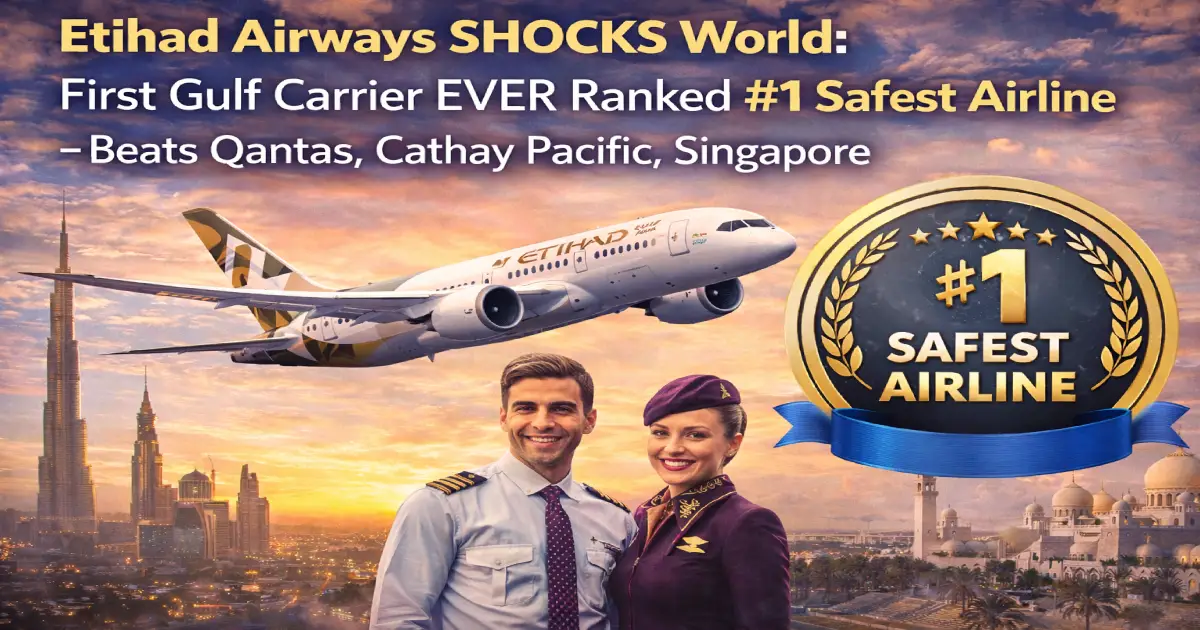
Breaking: In a historic upset that stunned the aviation industry, Etihad Airways has been crowned the world’s SAFEST AIRLINE for 2026—the FIRST time in history a Gulf carrier has topped AirlineRatings.com’s prestigious safety rankings. Etihad crushed traditional safety champions Cathay Pacific (#2), Qantas (#3), and Singapore Airlines (#7) through a combination of the youngest fleet, zero crashes EVER, lowest incident rate per flight, and revolutionary turbulence management technology. Qatar Airways (#4) and Emirates (#5) also cracked the top 5, giving the UAE THREE airlines in the elite group. Air New Zealand—the 2025 champion—CRASHED to #6. Here’s how a Middle Eastern carrier dethroned aviation’s safety royalty.
Published: January 22, 2026 Rankings Released: January 13, 2026 (9 days ago) Source: AirlineRatings.com (320 airlines evaluated) Historic Achievement: FIRST Gulf carrier EVER to rank #1 Margin of Victory: Just 1.3 points separated top 6 airlines Previous #1: Air New Zealand (held top spot for multiple years) Etihad Fleet Age: Youngest among top 25 airlines Incident Rate: 0.002 per flight (LOWEST on entire list) Crash History: ZERO fatal crashes in airline’s 20-year history Turbulence Management: Participated in independent onboard safety audit
🥇 1. Etihad Airways (UAE) – FIRST GULF CARRIER EVER AT #1 🥈 2. Cathay Pacific (Hong Kong) – Up from #3 (tied) in 2025 🥉 3. Qantas (Australia) – Down from top 3 historically 4. Qatar Airways (Qatar) – Up from #3 (tied) in 2025 5. Emirates (UAE) – Up from #3 (tied) in 2025 6. Air New Zealand (New Zealand) – CRASHED from #1 in 2025 7. Singapore Airlines (Singapore) – REINSTATED after 2025 exclusion 8. EVA Air (Taiwan) 9. Virgin Australia (Australia) 10. Korean Air (South Korea)
11. STARLUX Airlines (Taiwan) – DEBUT (new to list) 12. Turkish Airlines (Turkey) 13. Virgin Atlantic (UK) 14. ANA – All Nippon Airways (Japan) 15. Alaska Airlines (USA) – Highest US carrier 16. TAP Air Portugal (Portugal) 17. SAS – Scandinavian Airlines (Scandinavia) 18. British Airways (UK) 19. Vietnam Airlines (Vietnam) 20. Iberia (Spain)
21. Lufthansa (Germany) 22. Air Canada (Canada) 23. Delta Air Lines (USA) 24. American Airlines (USA) 25. Fiji Airways (Fiji) – DEBUT (new to list)
Sharon Petersen, CEO of AirlineRatings.com:
“This is the FIRST YEAR a Gulf carrier has taken the number one spot. Etihad achieved this through a combination of factors: a young fleet, advancements in cockpit safety—particularly around turbulence—a crash-free history, and the lowest incident rate per flight of any airline on the list.”
Let that sink in.
Etihad beat:
This is like a rookie boxer knocking out Muhammad Ali, Mike Tyson, and Floyd Mayweather in the same night.
1. Gulf Carriers Were NEVER Considered Safety Leaders
Historically, aviation safety elites came from:
Gulf carriers (Etihad, Emirates, Qatar) were known for:
But NOT safety leadership. Until now.
2. Etihad is Only 20 Years Old
Etihad Airways founded: 2003 (just 23 years ago as of 2026)
For comparison:
Etihad is a BABY compared to these century-old titans.
Yet it beat them ALL.
3. The Margin Was RAZOR-THIN
Sharon Petersen explained:
“What stands out this year is how little separates the leaders. Less than four points covered positions 1 through 14, and at the very top the margins were even tighter, with just 1.3 points separating positions 1 through 6 in the full-service category.”
Translation: The difference between #1 Etihad and #6 Air New Zealand = 1.3 points out of 100.
This wasn’t a landslide victory. This was winning by a WHISKER.
But a win is a win.
According to AirlineRatings.com, Etihad dominated across five critical criteria:
Etihad’s fleet:
Why young fleets matter:
Comparison to competitors:
Etihad’s strategy: Retire aircraft BEFORE they age. Most airlines fly planes for 20-25 years. Etihad retires them at 10-15 years.
Result: Fleet is perpetually “new,” reducing mechanical failure risks.
Etihad’s fatal crash record: ZERO.
Not one. Not ever. In 23 years of operations.
For context:
Etihad joins an elite club:
Airlines with ZERO fatal crashes include:
But Etihad is the FIRST from this group to rank #1 safest.
Etihad’s incident rate: 0.002 incidents per flight
What this means:
Comparison:
Sharon Petersen:
“It is important to note that every airline featured in the 2026 list has recorded incidents over the past two years, from tail strikes to on-board fires and engine shutdowns, yet the actual incident rate per flight sits between 0.002 and 0.09 across the airlines, which is a true credit to the industry as a whole.”
Translation: Even the “worst” airline on the Top 25 (incident rate 0.09) is still extraordinarily safe. But Etihad is the SAFEST of the safe.
2026’s NEW EMPHASIS: Turbulence prevention
AirlineRatings.com changed methodology this year:
“We are placing greater emphasis on turbulence prevention, as it remains the leading cause of in-flight injuries.”
Why turbulence matters:
Etihad’s turbulence strategy:
✅ Participates in IATA Turbulence Aware programme
✅ Advanced cockpit technology
✅ Cabin safety protocols
✅ Independent onboard safety audit
Result: Etihad’s turbulence-related injury rate is among the LOWEST globally.
Etihad invests HEAVILY in pilot training:
Antonoaldo Neves, CEO of Etihad Airways:
“As the first Gulf carrier to achieve this position, it reflects the strength of our safety culture, the dedication of our people, and the aviation excellence of our region.”
UAE’s regulatory environment:
Comparison to US/Europe:
While FAA (US) and EASA (Europe) are gold standards, UAE’s GCAA MATCHES or EXCEEDS these standards for Gulf carriers.
2025 ranking: #1 (champion) 2026 ranking: #6
What happened?
Air New Zealand held the top spot for MULTIPLE YEARS (exact streak not disclosed, but reports suggest 3-5 years).
Then Etihad, Cathay Pacific, Qantas, Qatar, and Emirates ALL leapfrogged it.
Possible reasons:
Air New Zealand’s response: Not publicly commented (likely embarrassed).
2024: Singapore Airlines Flight SQ321 encountered severe turbulence over Myanmar (May 21, 2024)
2025 ranking: EXCLUDED from Top 25 (disqualified due to SQ321 incident)
2026 ranking: #7 (REINSTATED)
Sharon Petersen:
“Singapore Airlines was reinstated after extensive reviews of its safety and training operations.”
What Singapore did to get back on the list:
The comeback: From disqualified to #7 in ONE YEAR = impressive recovery.
Highest US carrier: Alaska Airlines (#15)
Other US carriers:
US Big 3 (Delta, United, American) are NOT in Top 25’s top half.
Why US carriers lag:
Counterargument:
US airlines still have excellent safety records. Being #23 out of 320 airlines WORLDWIDE = still top 10%.
But compared to Etihad, Cathay, Qantas? They’re lagging.
Critics argue: The rankings are misleading.
Sharon Petersen herself admits:
“We may be reaching a point where traditional rankings risk being misleading, and where grouping airlines into performance tiers provides a more accurate reflection of reality. All airlines in the top 25 are world leaders in aviation safety, and claims that one is significantly safer or less safe than another are both sensationalist and false.”
Translation: The difference between #1 Etihad and #25 Fiji Airways is TINY. All 25 are extraordinarily safe.
The numbers support this:
Statistician’s perspective:
In a sample of millions of flights, the difference between 0.002 and 0.09 incidents per flight is statistically insignificant.
Analogy:
Both are effectively 100% safe for practical purposes.
So why rank them?
Marketing. Airlines LOVE being #1.
Etihad will plaster “WORLD’S SAFEST AIRLINE 2026” across every advertisement, airport billboard, and social media post for the next year.
Is it misleading? Slightly.
Is it effective marketing? Absolutely.
TOP 25 SAFEST LOW-COST AIRLINES 2026:
🥇 1. HK Express (Hong Kong) – 2ND CONSECUTIVE YEAR at #1 🥈 2. Jetstar Airways (Australia – Qantas subsidiary) 🥉 3. Scoot (Singapore – Singapore Airlines subsidiary) 4. flydubai (UAE) – Will be reclassified as full-service in 2027 5. EasyJet Group (UK/Europe) 6. Wizz Air Group (Hungary/Europe) 7. Vueling (Spain) 8. Norwegian (Norway) 9. Ryanair (Ireland/UK) 10. Transavia Group (Netherlands/France)
Notable mentions:
HK Express dominance:
Sharon Petersen:
“HK Express claimed the top accolade for a second time, driven by a modern fleet, an exceptionally low incident rate, and an almost flawless onboard safety audit.”
HK Express strategy:
Lesson: Budget airlines CAN be safe. HK Express proves it.
Short answer: No.
Long answer: It’s complicated.
Reasons to TRUST the rankings:
✅ Rigorous methodology: AirlineRatings.com evaluates 320 airlines using objective data ✅ Independent: Not funded by airlines (no bias) ✅ Transparent criteria: Fleet age, incident rates, pilot training, audits
Reasons to be SKEPTICAL:
❌ Margins are tiny: 1.3 points separate #1 and #6 ❌ All Top 25 are extraordinarily safe: Choosing #1 vs #15 = negligible real-world safety difference ❌ Marketing tool: Airlines use rankings for advertising, not because they materially impact safety
Aviation expert consensus:
“Flying on ANY Top 25 airline is statistically as safe as it gets. Whether you fly Etihad (#1) or American (#24), your odds of a fatal crash are virtually zero.”
What DOES matter:
✅ Aircraft type: Newer aircraft (787, A350, A321neo) > Older aircraft (737-800, 777-200) ✅ Route: Short-haul domestic flights are statistically safer than long-haul international ✅ Weather: Avoid flying during severe weather if possible ✅ Your behavior: Wear your seatbelt, follow crew instructions, don’t drink excessively
Bottom line: Etihad being #1 is impressive, but flying American (#24) isn’t dangerous. Both are extraordinarily safe.
If you currently fly:
Other factors that matter MORE:
Verdict: Don’t switch airlines SOLELY because of safety rankings. But if you were considering Etihad anyway, this is a nice validation.
Antonoaldo Neves, CEO of Etihad Airways:
“We are incredibly proud to receive one of the most respected airline safety awards in the world from an independent, globally recognised organisation. As the first Gulf carrier to achieve this position, it reflects the strength of our safety culture, the dedication of our people, and the aviation excellence of our region.”
“This recognition is a reminder that safety is never achieved in isolation. Across aviation, airlines continuously share best practices and learn from experience, supported by a strong regulatory environment that sets demanding standards and pushes the bar higher.”
“In the UAE, this regulatory framework challenges us to meet the highest levels of safety and operational excellence every day.”
Translation: Etihad is proud but not arrogant. They acknowledge:
Marketing impact:
Expect Etihad’s 2026 advertising campaigns to feature:
UAE has THREE airlines in Top 5:
🥇 Etihad (#1) – Abu Dhabi 🏅 Emirates (#5) – Dubai 🏅 Qatar Airways (#4) – Qatar (neighboring Gulf state)
This is UNPRECEDENTED.
No other country/region has ever had THREE carriers in the Top 5 simultaneously.
Why the Gulf dominance?
Gulf airlines are state-owned or state-backed:
Advantage: Unlimited funding for:
Contrast to US/Europe:
Gulf carriers: “Profit is secondary. National prestige is primary.”
Gulf carriers are YOUNG:
Advantage: No old aircraft inherited from mergers/acquisitions. Entire fleet is modern.
Contrast to US/Europe:
UAE’s geographic advantage:
Less flying time = Less wear on aircraft = Fewer mechanical issues
UAE’s national strategy: Position itself as global leader in aviation, tourism, business.
Aviation is CORE to national identity.
Failure is NOT an option.
Result: Government pushes airlines to be THE BEST—not just “good enough.”
Challenges Etihad faces in 2027:
Qantas, Cathay Pacific, Singapore, Air New Zealand won’t accept defeat.
Expect:
2027 rankings: Could be ANYONE’s game.
The pressure is ON.
Etihad’s challenge: Stay hungry, keep improving.
AirlineRatings.com tweaks criteria annually.
Example: If 2027 emphasizes “experience over 50+ years,” Qantas/Cathay win.
Etihad must adapt to whatever 2027 brings.
Etihad Airways’ #1 ranking is a HISTORIC ACHIEVEMENT for:
The facts:
✈️ Etihad beat Qantas, Cathay Pacific, Singapore, Air New Zealand ✈️ Zero crashes in 23-year history ✈️ Youngest fleet among Top 25 ✈️ Lowest incident rate (0.002 per flight) ✈️ Revolutionary turbulence management ✈️ 1.3-point margin over #6 Air New Zealand
What it proves:
✅ Gulf carriers are NO LONGER just “luxury brands”—they’re SAFETY leaders ✅ Young airlines CAN beat century-old titans ✅ Government investment in aviation WORKS ✅ Turbulence prevention is the FUTURE of airline safety
What it DOESN’T prove:
❌ Etihad is “significantly safer” than Qantas or Cathay (margins too small) ❌ You should avoid US carriers (Delta/American are still very safe) ❌ Rankings are definitive (methodology changes, results fluctuate)
For travelers:
For Etihad:
For the aviation industry:
Etihad’s #1 ranking won’t last forever. But for 2026, they OWN the crown.
Congratulations, Etihad. You shocked the world.
External Resources & Official Sources:
For More Resources:
Posted By : Vinay
This article is provided for general informational purposes only and is based on information available at the time of publication. Travel advisories, airline schedules, airport operations, visa requirements, government regulations, and other travel-related information are subject to change without prior notice. While Travel Tourister makes reasonable efforts to verify information using official announcements, government publications, airline and airport communications, and other reliable sources, we cannot guarantee that all information remains complete, accurate, or up to date at all times. Readers should independently verify any information that may affect their travel plans with the relevant airline, airport authority, government agency, embassy, or other official source before making travel, financial, or other decisions. Travel Tourister shall not be liable for any direct or indirect loss, inconvenience, or damages arising from the use of or reliance on the information contained in this article. Nothing in this publication constitutes legal, immigration, financial, or professional travel advice. If you believe any information in this article is inaccurate or outdated, please contact our editorial team. We review all credible correction requests promptly and update our content whenever appropriate.
Lastest News
2nd Floor, 39, Above Kirti Club, DLF Industrial Area, Kirti Nagar, New Delhi, Delhi 110015



Travel Tourister is a leading Travel portal where we introduce travellers to trusted travel agents to make their journey hasselfree, memorable And happy. Travel Tourister is a platform where travellers get Tour packages ,Hotel packages deals through trusted travel companies And hoteliers who are working with us across the world. We always try to find new and more travel agents and hoteliers from every nook and corners across the world so that you could compare the deals with different travel agents and hoteliers and book your tour or hotel with the one you have chosen according to your taste and budget.
Copyright © Travel Tourister, India. All Rights Reserved

 Call
Call Enquiry