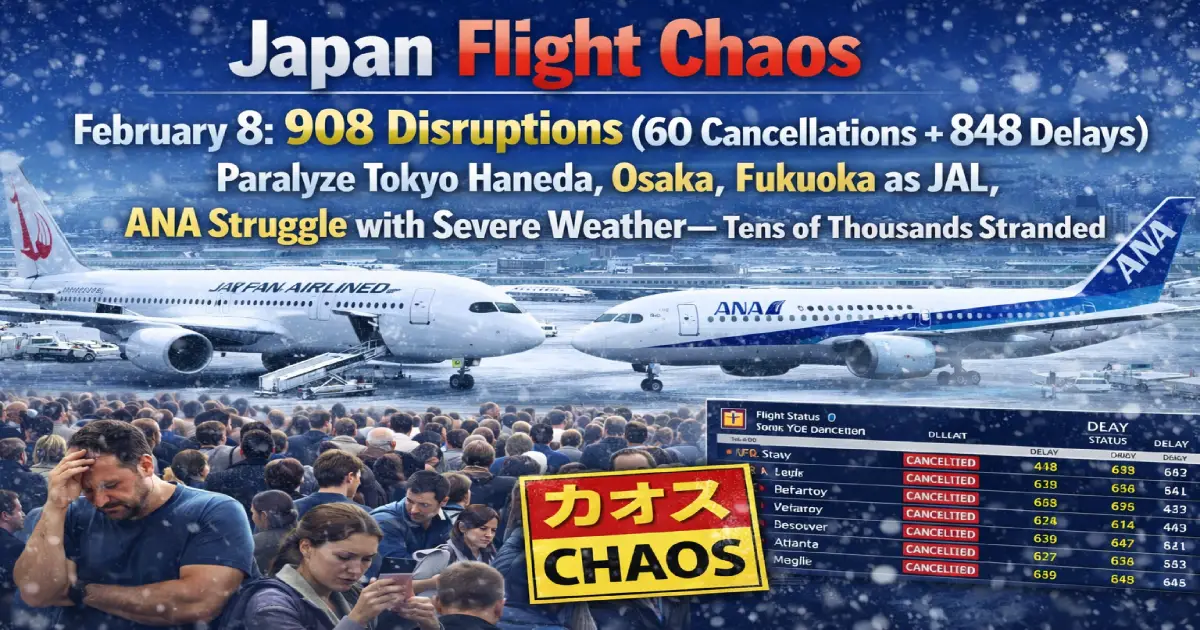
BREAKING: On February 8, 2026, Japanese aviation experienced one of its worst operational days of the year as severe weather triggered 908 total flight disruptions across the country—60 outright cancellations and approximately 848 delays affecting Japan Airlines (JAL), All Nippon Airways (ANA), and regional carrier ANA Wings. Tokyo’s Haneda Airport, Japan’s busiest domestic hub and one of Asia’s largest airports, became the epicenter of chaos as heavy storms, poor visibility, and operational strain caused schedules to unravel throughout the day. Major routes connecting Tokyo to Osaka, Fukuoka, Sapporo, and regional cities ground to a halt, leaving tens of thousands of passengers—including international travelers from the US, UK, and Australia connecting through Japan—stranded in terminals, scrambling for rebookings, and facing hours-long delays. This represents a rare operational meltdown for Japan’s famously punctual airlines, exposing vulnerabilities in the system when weather conditions overwhelm infrastructure. Here’s the complete breakdown of what happened and what it means for travelers.
Published: February 10, 2026
Crisis Date: Saturday, February 8, 2026
Total Disruptions: 908 flights (60 cancellations + 848 delays)
Airlines Affected: Japan Airlines (JAL), All Nippon Airways (ANA), ANA Wings
Airports Hit Hardest: Tokyo Haneda (HND), Osaka Itami (ITM), Fukuoka (FUK), Sapporo (CTS)
Weather Cause: Heavy storms, poor visibility, severe wind conditions
Passengers Impacted: Tens of thousands (estimated 80,000-100,000)
International Impact: Significant (US, Europe, Asia-Pacific connecting passengers stranded)
The Numbers: 908 Disruptions on a Single Day
Saturday, February 8, 2026, stands as one of the most severe operational days for Japanese aviation in recent years:
Total Disruptions Breakdown:
- ✈️ 60 CANCELLATIONS (affecting ~6,000-8,000 passengers directly)
- ✈️ 848 DELAYS (many exceeding 1-2+ hours, affecting ~75,000-85,000 passengers)
- ✈️ 908 TOTAL DISRUPTIONS (nearly 1,000 flights impacted)
- ✈️ Cascading effects: Delays compounded throughout the day as aircraft/crew out of position
- ✈️ Ripple impact: Monday-Tuesday (Feb 10-11) saw residual delays as operations normalized
Context:
- Japan’s major carriers typically operate 1,500-2,000 domestic flights daily
- 908 disruptions = 45-60% of daily operations affected
- This represents an extraordinary breakdown for airlines known for >90% on-time performance
Airline-by-Airline Impact
Japan Airlines (JAL) – National Flag Carrier
Estimated Impact (Feb 8):
- Cancellations: 25-30 flights
- Delays: 350-400 flights
- Total disruptions: 375-430
- Routes hit hardest: Tokyo Haneda ↔ Fukuoka, Osaka, Sapporo, regional cities
Specific Cancelled Routes (Confirmed):
- Tokyo Haneda → Izumo (HND-IZO): Multiple daily flights cancelled
- Tokyo Haneda → Fukuoka (HND-FUK): Several departures cancelled
- Tokyo Haneda → Komatsu (HND-KMQ): Cancelled due to weather
- Tokyo Haneda → Regional airports (Tottori, Miho Airfield, etc.): Cancelled
Why JAL was hit hard:
- Hub concentration: JAL’s domestic network is heavily centered on Tokyo Haneda
- High-frequency routes: Tokyo-Fukuoka, Tokyo-Osaka operate every 30-60 minutes; when one cancels, domino effect begins
- Regional operations: JAL serves many smaller regional airports (Izumo, Komatsu, Tottori) where weather conditions were severe
JAL’s Response:
- Travel waivers issued for affected passengers
- Rebooking offered at no charge
- Some passengers offered refunds for cancelled flights
- Website/app overwhelmed with rebooking requests
All Nippon Airways (ANA) – Major Carrier
Estimated Impact (Feb 8):
- Cancellations: 20-25 flights
- Delays: 350-400 flights
- Total disruptions: 370-425
- Routes hit hardest: Tokyo Haneda ↔ Osaka, Fukuoka, Miho Airfield
Specific Cancelled Routes (Confirmed):
- Tokyo Haneda → Osaka Itami (HND-ITM): Multiple cancellations on busiest domestic route
- Tokyo Haneda → Fukuoka (HND-FUK): Several departures cancelled
- Tokyo Haneda → Miho Airfield (HND-MIB): Small regional airport, weather-sensitive
- Regional connections: Various routes to/from smaller airports
Why ANA was hit hard:
- Similar hub dependency: Like JAL, ANA’s domestic network revolves around Haneda
- International connections: ANA operates many international flights through Haneda; delays cascade into international network
- Fleet size: Despite being Japan’s largest carrier, operational slack minimal during peak travel periods
ANA’s Response:
- Similar to JAL: travel waivers, free rebooking, refunds for cancellations
- Mobile app notifications (though many passengers reported delays in receiving alerts)
- Ground staff overwhelmed at airports
ANA Wings – Regional Subsidiary
Estimated Impact (Feb 8):
- Cancellations: 10-15 flights
- Delays: 100-150 flights
- Total disruptions: 110-165
- Routes hit hardest: Regional connections (Naha, Fukue, Komatsu ↔ Tokyo/Osaka)
Specific Cancelled Routes (Confirmed):
- Tokyo Haneda → Naha (HND-OKA): Some Okinawa flights cancelled
- Tokyo Haneda → Fukue (HND-FUJ): Island airport, weather-dependent
- Tokyo Haneda → Komatsu (HND-KMQ): Multiple cancellations
- Osaka connections: Various regional routes
Why ANA Wings was disproportionately affected:
- Smaller aircraft: Turboprops and regional jets more vulnerable to weather
- Regional airports: Many destinations have limited infrastructure, less capable in severe weather
- Lower priority: Regional carriers often deprioritized for de-icing, gate assignments during congestion
Airport-by-Airport Breakdown
Tokyo Haneda Airport (HND) – The Epicenter
Why Haneda was the epicenter:
- Busiest domestic hub in Japan: Handles ~450-500 domestic flights daily
- Central role: Nearly ALL major Japanese cities have high-frequency Haneda connections
- JAL + ANA base: Both major carriers operate extensive Haneda networks
- Slot constraints: Haneda operates near capacity; any disruption cascades immediately
February 8 Impact:
- Estimated disruptions: 500-600 flights (55-60% of Saturday’s Haneda operations)
- Cancellations: 35-40 flights
- Delays: 460-560 flights (some exceeding 2-3 hours)
- Passenger chaos: Terminals packed with stranded travelers, long rebooking lines, confusion
Specific Issues:
- Weather: Heavy storms reduced visibility, strong crosswinds made landings difficult
- Runway limitations: Haneda has 4 runways, but severe wind conditions reduced usable capacity
- Gate congestion: Delayed inbound flights occupied gates, preventing outbound departures
- Cascading delays: Morning delays compounded into afternoon/evening chaos
Passenger Experience:
- Hours-long lines at airline counters for rebooking
- Limited hotel availability in Tokyo (Saturday night, many hotels full)
- Confusion over rebooking policies (website vs in-person)
- International connecting passengers particularly affected (missed connections to US, Europe, Australia)
Osaka Itami Airport (ITM) – Secondary Hub
Why Osaka Itami matters:
- Domestic-only airport: Serves Osaka metropolitan area (20M+ people)
- Tokyo connection critical: Osaka-Tokyo is world’s busiest air route (~100 daily flights pre-pandemic)
- Business hub: Many business travelers rely on Tokyo-Osaka shuttle
February 8 Impact:
- Estimated disruptions: 150-200 flights
- Cancellations: 10-15 flights
- Delays: 140-185 flights
- Routes affected: Primarily Tokyo connections, but also Sapporo, Fukuoka, regional cities
Specific Issues:
- Weather at both ends: Osaka had its own weather issues + Tokyo problems = double impact
- Tight turnarounds: Osaka-Tokyo flights operate every 30-60 minutes; delays compound quickly
- Limited alternatives: Kansai International (KIX) is option for some, but many prefer Itami for city access
Fukuoka Airport (FUK) – Kyushu Hub
Why Fukuoka is critical:
- Kyushu region hub: Serves southwestern Japan
- Business + tourism: Major city for domestic business travel and tourism gateway
- Regional connections: Many flights to smaller Kyushu islands (Nagasaki, Kumamoto, Oita, etc.)
February 8 Impact:
- Estimated disruptions: 100-120 flights
- Cancellations: 8-10 flights
- Delays: 92-110 flights
- Routes affected: Tokyo, Osaka, regional Kyushu routes
Specific Issues:
- Heavy storms: Fukuoka experienced severe weather directly
- Regional ripple effect: Cancelled Fukuoka-Tokyo flights stranded travelers trying to reach smaller Kyushu destinations
Sapporo New Chitose Airport (CTS) – Hokkaido Hub
Why Sapporo matters:
- Hokkaido gateway: Primary airport for Japan’s northernmost island
- Winter tourism: February is peak ski season; many tourists affected
- Tokyo connection: Sapporo-Tokyo is one of busiest domestic routes
February 8 Impact:
- Estimated disruptions: 80-100 flights
- Cancellations: 5-7 flights
- Delays: 75-93 flights
- Routes affected: Primarily Tokyo, Osaka, Fukuoka connections
Specific Issues:
- Winter weather: Hokkaido often has snow in February, compounding visibility/wind issues
- Tourist impact: Many international tourists (especially Australians for ski season) stranded
Regional Airports Hit
Other airports with significant disruptions:
- Narita International (NRT): Some international flights delayed (UAL flights to Guam, Palau affected)
- Naha (OKA), Okinawa: Island connections cancelled due to weather
- Izumo (IZO): Small regional airport, multiple cancellations
- Komatsu (KMQ): Regional airport serving Ishikawa Prefecture, cancellations
- Fukue (FUJ): Island airport, weather-dependent operations cancelled
- Miho Airfield (MIB): Small regional field, cancellations
- Tottori (TTJ): Regional cancellations
- Yakushima (KUM): Island airport, disruptions
What Caused the Chaos: Severe Weather Breakdown
The Weather Events
Heavy Storms:
- Low-pressure system: Intense low-pressure front moved across Japan on February 8
- Heavy precipitation: Rain, sleet, and snow depending on region
- Wind conditions: Gusts exceeding 40-50 km/h (25-30 mph) at some airports
- Temperature variations: Cold front brought rapid temperature drops
Poor Visibility:
- Fog and mist: Low cloud ceilings reduced visibility below instrument flight minimums at some airports
- Rain intensity: Heavy rain further reduced visibility
- Night operations: Evening flights particularly affected as visibility worsened after sunset
Operational Impacts:
- Landing restrictions: Crosswinds exceeded safe limits for some aircraft types
- De-icing requirements: Precipitation required de-icing, slowing turnarounds
- Ground operations: Rain and wind made ground crew operations hazardous/slow
- ATC restrictions: Air traffic control reduced landing rates for safety
Why Japanese Airlines Struggle with Weather
Cultural/Operational Factors:
1. Punctuality Obsession
- Japan’s on-time performance: Historically >90% (among world’s best)
- Cultural expectation: Passengers expect trains/planes on time
- Operational philosophy: Airlines reluctant to cancel preemptively; try to operate until weather makes it impossible
- Result: When weather hits, schedules already committed, causing chaos rather than proactive cancellations
2. Tight Scheduling
- Aircraft utilization: Japanese carriers run tight schedules with minimal slack
- Quick turnarounds: 30-45 minute turnarounds common on high-frequency routes
- No buffer: When delays start, they cascade quickly through network
- Limited spare aircraft: Few reserve planes to substitute for delayed aircraft
3. Hub Concentration
- Haneda-centric: Both JAL and ANA concentrate operations at Tokyo Haneda
- Single point of failure: When Haneda has weather issues, entire national network suffers
- Alternative airports: Narita is option for international, but domestic heavily Haneda-dependent
4. Geography
- Mountainous terrain: Japan’s mountains create challenging weather conditions
- Island nation: Surrounded by ocean, subject to rapid weather changes
- Typhoon season: While February isn’t typhoon season, Japan’s climate is inherently weather-volatile
International Traveler Impact
While 908 disruptions primarily affected domestic Japanese flights, thousands of international travelers were collateral damage:
Common Affected Scenarios
US Travelers:
- Route: San Francisco/Los Angeles → Tokyo Haneda → domestic connection (Osaka, Fukuoka, Sapporo)
- Problem: International flight arrives on time, but domestic connection cancelled/delayed
- Example: United Airlines passenger arrives HND from SFO at 4 PM, connecting JAL flight to Osaka cancelled, stranded overnight in Tokyo
European Travelers:
- Route: London/Frankfurt → Tokyo Haneda → domestic connection
- Problem: Same as above—international flight OK, domestic disrupted
- Example: British Airways passenger from Heathrow to Haneda, connecting ANA flight to Fukuoka delayed 3 hours
Australian Travelers:
- Route: Sydney/Melbourne → Tokyo Haneda → Sapporo (ski destination)
- Problem: Sapporo is peak ski season destination for Australians in February; delays ruin trip timing
- Example: Qantas passenger Sydney-Haneda, connecting to Sapporo, flight delayed 4 hours, misses resort check-in
Regional Asian Travelers:
- Route: Singapore/Bangkok/Hong Kong → Tokyo → domestic connection
- Problem: Many Asian travelers use Tokyo as hub to reach other Japanese cities
- Example: Singapore Airlines passenger to Haneda, connecting to Hiroshima, flight cancelled
Why International Travelers Suffer More
1. Language Barriers:
- Japanese announcements: Many airport announcements only in Japanese
- Staff language skills: Outside major airlines, limited English support
- Rebooking complexity: Harder for non-Japanese speakers to navigate rebooking systems
2. Hotel Scrambles:
- Tokyo hotel prices: Can be expensive, especially Saturday nights
- Availability: Many hotels fully booked, especially during peak travel seasons
- Location confusion: International travelers unfamiliar with Tokyo geography, hotel locations
3. Itinerary Disruptions:
- Prepaid hotels/activities: Many travelers have non-refundable hotel bookings in final destinations
- Tour packages: Group tours with fixed schedules disrupted
- JR Pass optimization: Japan Rail Pass holders often plan tight itineraries; delays waste valuable days
4. Limited Airline Rights:
- Weather = no compensation: Japanese airlines (like most) don’t compensate for weather delays
- Hotel vouchers rare: Unlike US/EU, Japanese carriers less likely to provide hotel vouchers for weather
- International vs domestic tickets: Separate tickets complicate rebooking (not airline’s responsibility if separate bookings)
Passenger Stories: The Human Impact
Business Traveler Stranded
Scenario: Kenji, a Tokyo-based consultant, had a Monday morning meeting in Fukuoka. His Saturday evening JAL flight (HND-FUK) was cancelled.
Impact:
- Tried to rebook for Sunday—all flights full
- Finally got Monday 6 AM flight (arrives 8 AM, meeting at 9 AM)
- Rushed presentation, no time to prepare
- Lost a day of weekend with family
Cost: Stress, rushed meeting, family time lost
Tourist Family Chaos
Scenario: Smith family (US tourists) flew Los Angeles → Tokyo Haneda, connecting to Sapporo for ski vacation. Connecting ANA flight delayed 5 hours.
Impact:
- Arrived Sapporo 11 PM instead of 6 PM
- Missed first night at resort (non-refundable)
- Lost half-day of skiing (Sunday morning)
- Children exhausted, cranky
Cost: ~$400 lost hotel + half-day ski passes + stress
International Student Nightmare
Scenario: Emma, Australian student studying in Tokyo, flying home to Brisbane via Sydney. Tokyo-Sydney ANA flight delayed 4 hours due to connecting aircraft delayed from domestic route.
Impact:
- Missed Sydney-Brisbane connection (separate ticket)
- Had to buy new domestic ticket in Australia ($350 AUD)
- Arrived home 8 hours late
- No compensation (weather delay)
Cost: $350 AUD + stress
What Travelers Should Have Done (And Can Do Next Time)
Before Booking
1. Avoid Tight Connections in Japan During Winter
- Minimum buffer: 3+ hours for domestic connections, 4+ hours for international-to-domestic
- Peak weather season: December-March highest risk for disruptions
- Alternative: Build extra days into itinerary; don’t schedule critical events day-after arrival
2. Book on Single Tickets When Possible
- Protected connections: If booked on one ticket (e.g., SFO-HND-OSA on United+ANA codeshare), airline must rebook if missed connection
- Separate tickets: If separate bookings, you’re on your own if first flight delays and you miss second
- Cost vs risk: Single tickets cost more, but protection valuable
3. Travel Insurance
- Trip delay coverage: Covers hotels, meals if delayed 6-12+ hours (policy-dependent)
- Cancel for any reason: More expensive, but covers weather disruptions
- Not all policies equal: Read fine print—some exclude weather delays
During Disruptions
1. Rebook Online IMMEDIATELY
- Don’t wait in line: Airport counter lines can be 2-3 hours during mass disruptions
- Use airline app: JAL, ANA apps allow self-service rebooking (when system works)
- Call if app fails: Phone wait times long, but often shorter than airport lines
2. Know Your Rights (Limited in Japan)
- Weather delays: Airlines NOT required to provide hotels, meals, compensation
- Rebooking: Airlines MUST offer free rebooking or refund
- International connections: If on single ticket, airline must rebook (even if weather-related)
3. Hotel Strategies
- Book immediately: Don’t wait for airline to offer voucher (they probably won’t)
- Capsule hotels: Cheaper option if stranded in Tokyo (~$30-50/night)
- Airport hotels: Haneda has airport hotel, but fills fast during disruptions
4. Alternative Transportation
- Shinkansen (bullet train): Tokyo-Osaka 2.5 hours, Tokyo-Fukuoka 5 hours—sometimes faster than waiting for next flight
- Night buses: Cheap option for some routes (e.g., Tokyo-Osaka ~$40, 8 hours overnight)
- JR Pass: If you have Japan Rail Pass, trains are “free” alternative
Japan’s Aviation Punctuality Myth
The Reality Check
Japan’s reputation:
- World’s most punctual airlines: JAL, ANA regularly rank top 3 globally for on-time performance
- Cultural pride: Punctuality (時間厳守, “jikan genshu”) is cultural value
- Shinkansen comparison: Trains famously depart within seconds of schedule
The 908-disruption reality:
- Infrastructure limits: Even Japan’s excellent infrastructure can’t prevent weather delays
- Operational rigidity: Tight schedules optimized for good weather break down when conditions deteriorate
- Rare but severe: Disruptions are less frequent than many countries, but when they happen, impact is massive
Comparisons:
- US airlines: More frequent small delays, proactive cancellations, more operational slack
- European airlines: Similar punctuality struggles during weather, better passenger rights (EU261)
- Japanese airlines: Fewer delays normally, but less resilient when weather hits, weaker passenger protections
What Happens Next: Recovery Timeline
Short-Term (February 9-11, 2026)
Sunday, February 9:
- Residual delays: 100-200 flights delayed as aircraft/crew return to position
- Full flights: Many flights oversold as Saturday’s stranded passengers rebook
- Standby lists: Passengers from Saturday waiting for standby seats
Monday, February 10:
- Business rush: Monday is heavy business travel day; combined with Saturday backlog = stress
- Continued delays: 50-100 flights delayed as operations normalize
- Hotel shortages: Many stranded passengers still in Tokyo trying to get home
Tuesday, February 11:
- Operations normalize: Most aircraft/crew back in position
- Residual standby: Last of Saturday’s passengers finally accommodated
- System reset: Airlines return to normal schedule
Long-Term Implications
For Airlines:
- Financial costs: Lost revenue, crew overtime, rebooking costs (estimated ¥500M-1B+ combined for JAL+ANA)
- Operational review: Airlines likely reviewing schedule buffers, weather contingencies
- Reputation: Rare but severe disruption damages “punctuality” image
For Airports:
- Infrastructure questions: Can Haneda handle severe weather better? More de-icing capacity?
- Alternative routing: Should Japan develop secondary hubs to reduce Haneda dependency?
For Passengers:
- Increased caution: Travelers may build bigger buffers into winter Japan itineraries
- Insurance uptake: More travelers may buy trip delay insurance for Japan winter travel
How Japan Compares to Global Winter Disruptions
Japan vs. North America (Winter 2026)
Canada:
- Disruptions: 4,500+ flights disrupted January-February (multiple events)
- Frequency: Major event every 5-7 days
- Severity: Often worse than Japan (e.g., -40°C cold snaps, 40cm+ snowstorms)
Japan:
- Disruptions: 908 flights on February 8 (single major event)
- Frequency: Infrequent (major disruptions 2-3 times per winter)
- Severity: Moderate compared to Canada’s extreme cold/snow
Conclusion: Japan’s winter aviation is MORE reliable than North America, but when disruptions occur, impact is concentrated and severe due to hub-centric network.
Japan vs. Europe (Winter 2026)
Europe:
- Disruptions: Varies by country; UK often struggles with snow, Northern Europe handles cold better
- Passenger rights: EU261 requires compensation for delays over 3 hours (unless “extraordinary circumstances”)
- Infrastructure: Aging infrastructure in some countries, newer in others
Japan:
- Disruptions: Less frequent than Europe
- Passenger rights: Weaker than EU261 (no compensation for weather delays)
- Infrastructure: Generally excellent, but limited capacity to handle severe weather surges
FAQs
Q: Is 908 disruptions normal for Japan? A: No. This is exceptional. JAL and ANA typically maintain >90% on-time performance. 908 disruptions in a single day represents a rare operational breakdown.
Q: Will I get compensation if my JAL/ANA flight was delayed/cancelled due to weather? A: No. Japanese airlines (like most globally) do not compensate for weather-related delays. You are entitled to free rebooking or refund, but not hotel/meal vouchers or monetary compensation.
Q: What if I missed my connecting flight due to the delays? A: If booked on a single ticket, the airline must rebook you at no charge. If separate tickets, you’re responsible for your own rebooking.
Q: Should I avoid flying in Japan during winter? A: Not necessarily. Japan’s winter aviation is generally reliable. However, build buffer time (3+ hours for connections), avoid critical events scheduled immediately after arrival, and consider travel insurance.
Q: Can I take the train instead if my flight is cancelled? A: Yes! Japan’s Shinkansen (bullet train) is an excellent alternative for many routes:
- Tokyo-Osaka: 2.5 hours
- Tokyo-Fukuoka: 5 hours
- Tokyo-Sendai: 1.5 hours If you have a JR Pass, trains are essentially “free.” Otherwise, fares are expensive but comparable to last-minute flights.
Q: How do I check if my upcoming Japan flight is affected? A: Check airline websites/apps:
- JAL: jal.co.jp/en (domestic), jal.co.jp/en (international)
- ANA: ana.co.jp (domestic), ana.co.jp (international)
- Haneda Airport: tokyo-haneda.com Also use flight tracking: FlightAware, FlightRadar24
Q: Is Japanese aviation safer than other countries? A: Yes. Japan has an excellent safety record. Weather delays don’t indicate safety issues—airlines delay/cancel specifically BECAUSE of safety prioritization.
The Bottom Line
February 8, 2026’s 908 flight disruptions (60 cancellations + 848 delays) exposed a rare vulnerability in Japan’s famously punctual aviation system. While JAL and ANA typically operate at world-leading on-time performance levels, severe weather overwhelmed the tightly-scheduled, hub-centric network—particularly at Tokyo Haneda, which serves as the linchpin for virtually all domestic Japanese air travel.
For travelers, the lessons are clear:
- ✅ Build buffer time (3+ hours for connections during winter)
- ✅ Book on single tickets when connecting (airline must rebook if you miss connection)
- ✅ Buy travel insurance (trip delay coverage for hotels/meals)
- ✅ Know the Shinkansen alternative (trains often faster/more reliable than waiting for next flight)
- ✅ Monitor weather forecasts (February is still winter weather season in Japan)
Despite this disruption, Japanese aviation remains among the world’s most reliable. The 908-flight chaos was a rare exception, not the rule. For context, Canadian airlines faced 4,500+ disruptions in just 38 days this winter—Japan’s one-day crisis is Canada’s weekly reality.
For travelers planning Japan trips: Don’t let one day of chaos deter you. Japan’s aviation infrastructure is excellent. Just build smart buffers during winter months (December-March), and you’ll likely experience the punctuality Japan is famous for.
For More Information:
Related Articles:
Posted By : Vinay
As a lead contributor for Travel Tourister, Vinay is dedicated to serving our Tier 1 audience (US, UK, Canada, Australia). His mission is to deliver precise, fact-checked news and actionable, data-driven articles that empower readers to make informed decisions, minimize travel risks, and maximize their adventure without compromising safety or budget.




 Call
Call Enquiry